salvaging some mid mod style.

Unlike some lucky furniture painters, I don’t have a pole barn full of furniture waiting to be painted.  Although on occasion I’ve been known to have as many as 10 or so pieces out in the carriage house waiting for their moment in the sun, for the most part I don’t have room to store a lot of inventory.

I try to stock up a bit in the fall because typically by now there are slim pickings on Craigslist.  In February people in Minnesota are hibernating, they aren’t cleaning out the attic or getting ready to move.  Plus in the winter I’m obviously not finding pieces at garage sales either.

But I’ve pretty much worked through most of what I had stocked up and now I’m scouring Craigslist on a regular basis looking for candidates for a makeover and not finding a whole lot.  The occasional piece that attracts my eye ends up either too far away, too expensive, or else it has already sold to someone else but the ad wasn’t deleted yet.

When I initially came across the ad for this pair of mid-century dressers I gave them a pass.  I didn’t hate them, but I didn’t love them either.  I do enjoy working on the occasional mid-century piece, but I usually prefer older stuff.
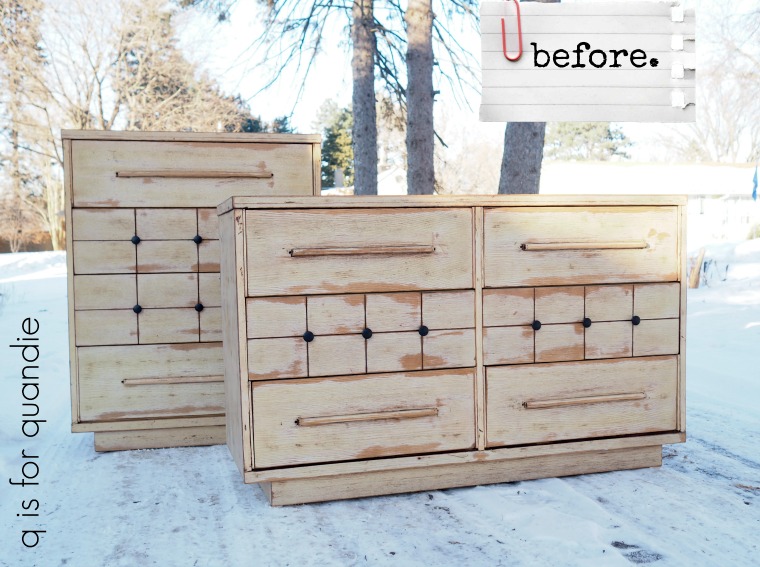
But week after week I kept seeing this ad.  I suspect they weren’t selling because the seller wasn’t ‘working his ad’ very aggressively.  By that I mean that he wasn’t renewing the ad periodically to keep it towards the top of the list.  Over a month had gone by since the ad was originally posted and he’d never renewed it once.

Or perhaps the problem was that no one could see the potential in these pieces.

The price was certainly right, and after seeing the ad pass by a couple of times I stopped to take a closer look.  You know what I saw?  I saw two pieces where someone else had already done half of the work for me.  They’d already been sanded and were pretty much ready to paint (and when Mr. Q and I picked them up the seller told me that he’d also already replaced all of the runners inside).  So I realized that these two pieces could be a pretty quick turnaround.

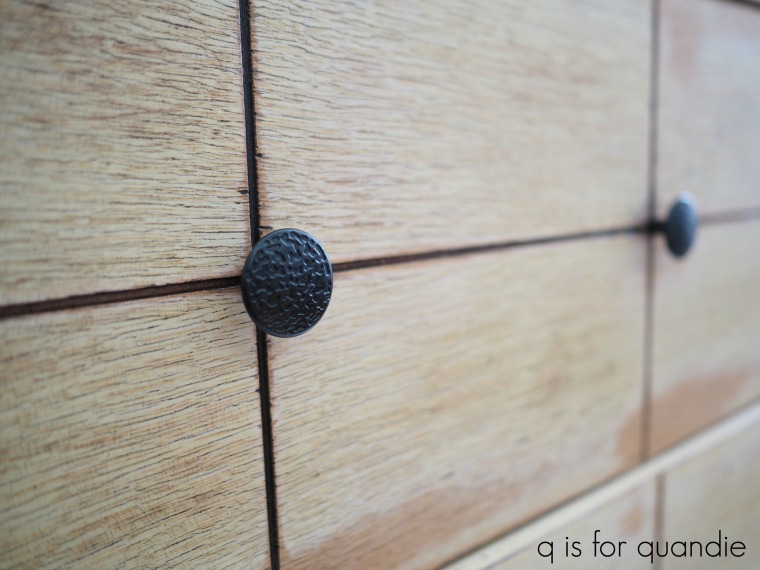
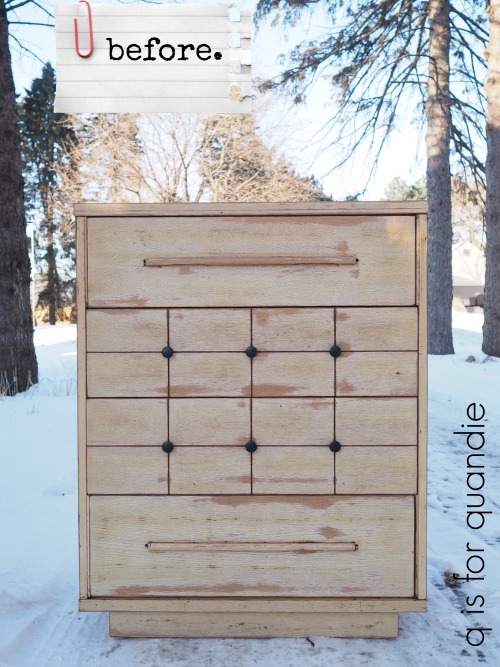
Unfortunately, in addition to the sanding and repairing, the seller had also replaced the original knobs with these awful cheap knobs from the hardware store that are all wrong and have zero mid-century style.
But imagine my glee when I opened one of the drawers and found a Ziploc baggie filled with the original knobs inside.  Jackpot!
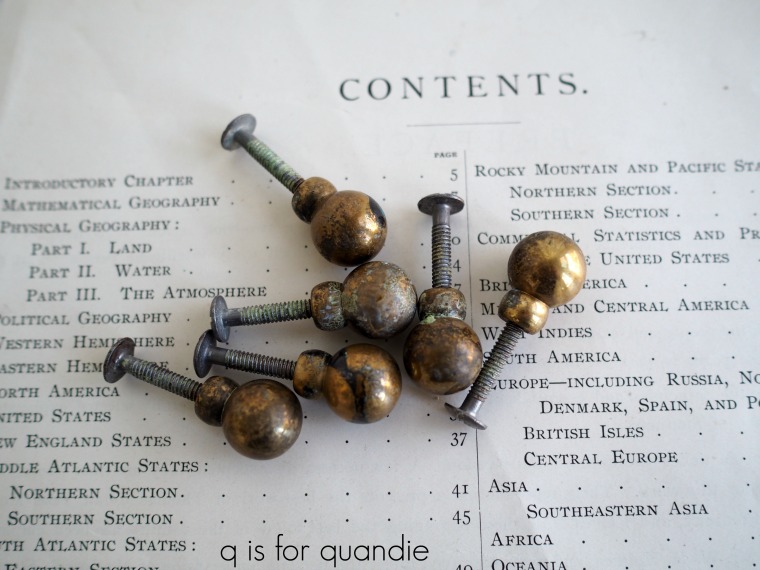
If you are thinking they look a bit grungy in that photo, just sit tight.  You’ll see what I did to spruce them up in a few minutes.

As we got talking with him, the seller happened to mention that he’d also made a couple of … well … let’s call them adjustments to the style of the pieces.  He said that originally the drawers with the long handles has been inset.  He thought that looked weird, so he added stops inside the dresser to keep the drawers from pushing all the way back.  Plus he moved the shims on either side of those drawers forward to bring all of the drawers flush with the front.

Now that you are aware of this, go back and look at the ‘before’ picture again.  Yep, now your eye immediately goes to those shims and you realize they look kind of odd, right?

I realized that I had to un-do those changes before I could start painting.  So much for the quick turn around.  But that being said, thank goodness the seller mentioned this.  I’m honestly not sure that I would have figured this out on my own.  I know I would have been puzzled about those shims, but would I have realized that two of the four drawers were meant to be inset?  Probably not.

I tried to remove the shims intact so that I could just simply move them back to their original location, but I ended up breaking two of them.  That’s when I called my handyman Ken for a consultation.  He came over and helped me get the rest of the shims off without breaking them (they were glued and stapled with heavy duty staples), and he took the broken ones home and cut replacements for me.  What would I do without Ken?

While Ken was working on that I had to take care of one last problem before I could start painting.

It wasn’t until I was wiping the drawers down to paint them that I noticed there was a hole on either side of the long wooden drawer pulls.  I’m guessing that there used to be a metal cap of sorts on either end of that pull.  I wish I’d found those inside a drawer in a Ziploc baggie, but no such luck.  So I needed to fill those holes.  I used my usual trick of placing a piece of tape on the back side of the hole, but then this time I filled them using Dixie Belle’s brown Mud.  It cracks me up that the label says ‘straight from the swamps of Dixie’.

Fortunately it does not smell like it’s straight from the swamps of Dixie 😉

I used a putty knife to press the mud into the holes and then I let it dry.  Once the first pass was dry I went over the holes a second time with the mud to make sure they were level with the drawer front.  Once dry again, I sanded them smooth and cleaned the drawer fronts with a damp rag.

Now came the fun part, the paint!  I always struggle with deciding between choosing a more neutral color that I think will sell more easily and choosing a more vibrant color that will be fun to paint with but may not appeal to as many buyers.  So I made a deal with myself to paint one piece in a neutral and one in a brighter color.  Today I’m starting with the taller piece, and it’s going more neutral.
Dixie Belle’s Gravel Road, to be precise, which is a warm, dark grey.  Once again I used Dixie Belle’s recommended method of painting.  I dipped my brush in water periodically to thin down the paint.  The paint goes on so smoothly using this technique.  It does also thin it down a fair bit, so two coats were required.  Also, in case you are wondering I used about half of the 16 oz jar for this dresser, so less than $10 worth of paint.
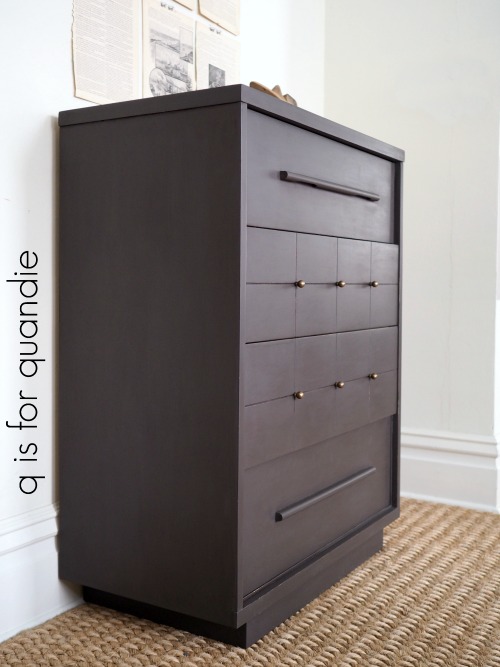
I use Dixie Belle’s Best Dang Wax! in brown as a top coat.  I like how the brown wax warms up and deepens the color a bit.
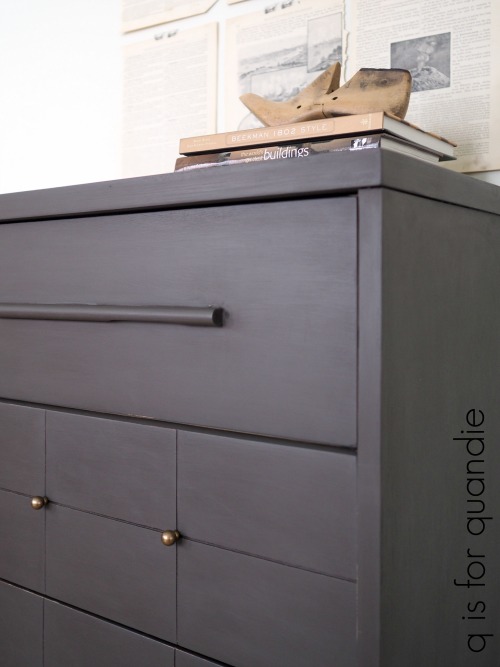
Before putting those original brass knobs back on, I washed them with soap and warm water and then once dry I added some Prima Marketing Metallique wax.  I debated using the Old Silver and although I think that would have looked gorgeous, I went with the warmer tone of the Bronze Age instead.
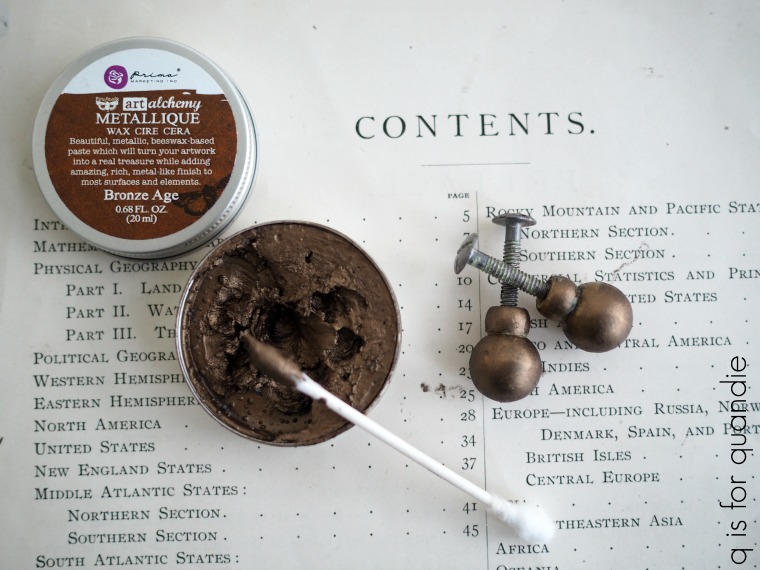
I like to apply it with a q-tip (although some people just use a fingertip).  The trick is to apply even coverage and then leave the knobs alone to ‘dry’ for a couple of hours.  Once dry you can buff lightly to add some shine.

They look amazing on the dresser.  It was so lucky that I was able to put the original knobs back on this piece.

I have to admit that I did not have high expectations for this dresser.  I really expected to improve it somewhat with a paint job and call it good.

But in the end, after salvaging a bit of the original mid-century modern style, I am amazed by the transformation.

How about you?

 

out of the blue.

By now I’m sure most of you have seen the 2018 Pantone color of the year.

Purple.

A choice that seems to have come completely from out of the blue.

As a Minnesotan, I should probably be embracing the purple.  Purple pride, Purple Rain, purple is everywhere here (just for fun, check out this flash mob video taken at this year’s ice castle and you’ll see what I mean!)

But no, I’m just not a fan of purple.  You aren’t likely to see me painting purple furniture anytime soon.  Although as I like to say, never say never.  I did use purple on a dresser I painted for my niece a while back and I did once paint a desk using Miss Mustard Seed’s Dried Lavender, so you never know.

However, when I want a little more color, for the most part I’ll stick with the blues.

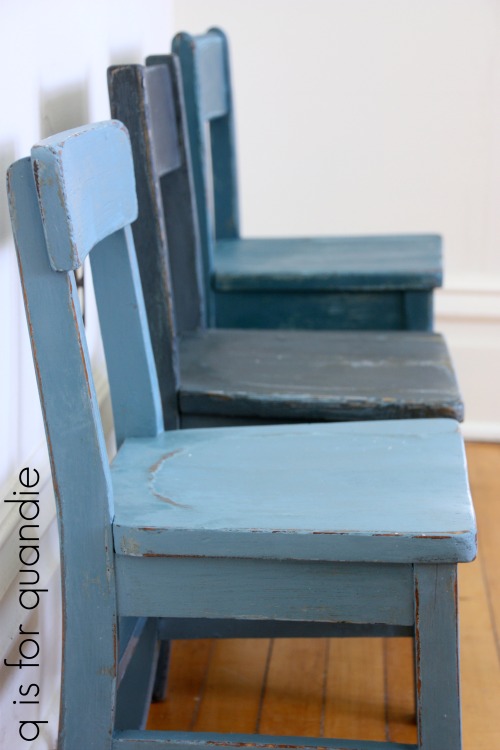
I have yet to meet a shade of blue that I didn’t like.  The trio of chairs below are painted, from front to back, in Miss Mustard Seed milk paint in French Enamel, Artissimo and Flow Blue (I’ve included a link to the original post for all of the following pieces, just click on the green underlined wording to go back and see the full details on each one).

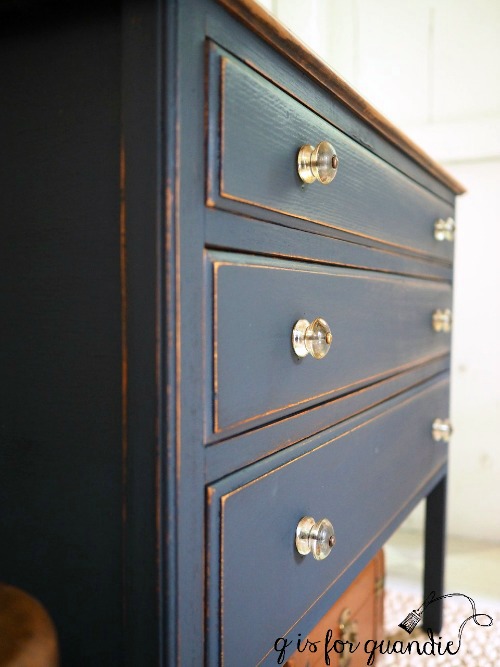
Fusion’s Midnight Blue is a gorgeous navy blue.

Homestead House makes a matching milk paint also called Midnight Blue.

Homestead House’s Maritime milk paint is a sweet blue that reminds me of the color of blue hydrangeas.

Little Billy Goat makes a beautiful shade of dark blue called Prize Winner.

I also used Prize Winner on the pirate desk (click on that link to find out why I called it the pirate desk, but here’s a hint, it has a peg leg).

 I haven’t used it in a while, but I always liked Annie Sloan’s Aubusson.

Sometimes I just create my own shade of blue.  This next dresser was painted in a mix of Miss Mustard Seed’s French Enamel, Luckett’s Green and Eulalie’s Sky with a touch of Ironstone thrown in to lighten it all up.

Miss Mustard Seed’s Eulalie’s Sky, Shutter Grey and Grainsack combined to make the gorgeous pale grey blue shade on the dresser below.

This washstand is also painted in a mix of Miss Mustard Seed colors.

Mixing Fusion paints to come up with a unique shade of blue is fun too.  My sister created a color we decided to call Lake Superior Blue, which is a mix of Fusion’s Homestead Blue and Liberty Blue.

 And now I’m looking forward to painting something in Dixie Belle’s Yankee Blue.

I have just the piece in mind, a lovely buffet that I brought home a few weeks ago.  It needs a little work first though, and my handyman Ken doesn’t work in the cold.  So it could be a while before I get to it.

But how about you?  Do you have a favorite shade of blue?  Please share in a comment.

heartless.

Happy Valentine’s Day everyone!

I don’t have a pretty, frilly pink or red filled post for you today.  Valentine’s Day just isn’t a holiday that I decorate for.  I’m pretty much heartless, at least when it comes to decor.

A while back my thrifting friend Meggan and I were at our local favorite thrift store (Arc Value Village on White Bear Ave, for those of you locals who might be curious) and I was laughing over the plethora of items with hearts on them.  I pointed them out to Meggan, and we both agreed that hearts are pretty much out these days from a home decor point of view (thus they end up in thrift stores by the dozens).  I mentioned to Meggan that I have a couple of tricks for dealing with them though and she suggested that would be a great idea for a blog post.  So I filled my cart with some hearts …

The easiest way to get rid of a heart is to just simply cover it up.  That’s what I did with the heart cut out on this little wall shelf.

But first I transformed the shelf with Dixie Belle’s Patina Collection.  You may remember that they sent me some of their Iron paint and Patina Spray to play around with a couple of weeks ago.  At the time I mentioned that I wanted to try this stuff on wood to see how it looked, so this shelf was the perfect candidate for a little experimentation.

Since the shelf is made of wood, you don’t need to use the special Prime Start primer (you just need that if you are painting over metal).  Instead you can just start with a layer of any color paint.  I used Dixie Belle’s Gravel Road since I happened to have it close by, but the color really doesn’t matter since you’ll be covering it up entirely.  Once that dried I added a coat of the Iron paint and allowed that to dry.  Then I added a second coat of the Iron paint and while it was still wet, I sprayed it with the Patina spray.

Next I just dug through my stash of random bits and pieces and found this back plate to a drawer pull.  It was already rusting on its own, plus it was just the right size, so I thought it was the perfect cover up.

Both Meggan and I simply couldn’t resist this next item.

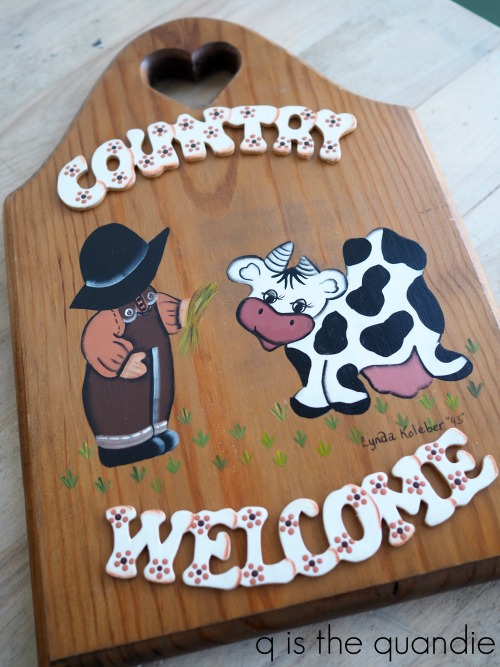
It’s got both a heart and a cow … a classic.

And actually, in the end I didn’t get rid of the heart cut out, just the cow with her heart shaped face and the country welcome.

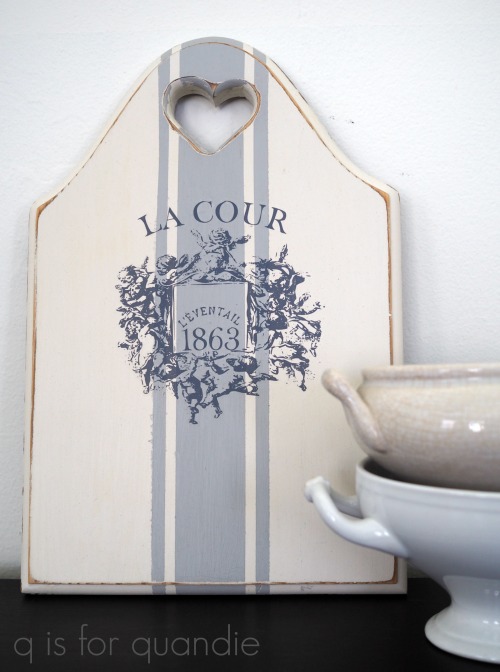
I removed the glued on words, sanded the entire thing down and then painted it in Dixie Belle’s Drop Cloth.  I added the grain sack stripe in Dixie Belle’s Driftwood.

Then I added an Iron Orchid Designs rub-on from one of the French Pots collections.

A vast improvement, even if it isn’t totally heartless.

Unfortunately I ran out of steam (and straight into that cold that I’m still getting over) before I could get to the rest of those heartfelt pieces from the thrift store.  I may have to hang onto them until next year.

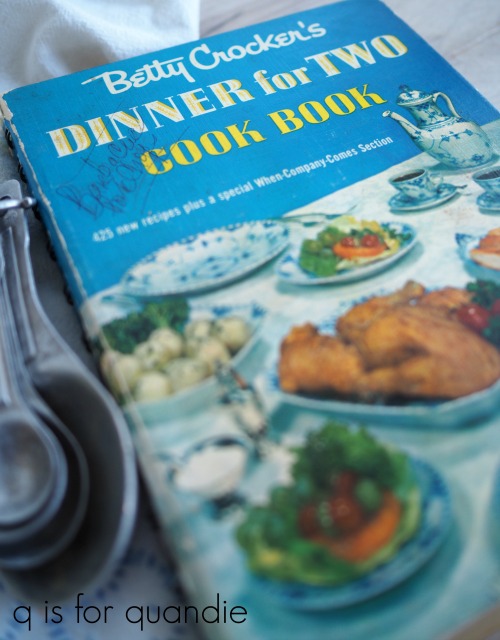
But to prove that perhaps I’m not entirely heartless after all, I couldn’t leave the thrift store without this sweet Dinner for Two cookbook.

It has some great illustrations …

A candlelit dinner for two served on a gondola in Venice would be my idea of the perfect Valentine’s celebration.

So sweet.  This is much closer to my idea of a little Valentine decor.

How about you?  Valentine’s Day decorating, yeah or nay?



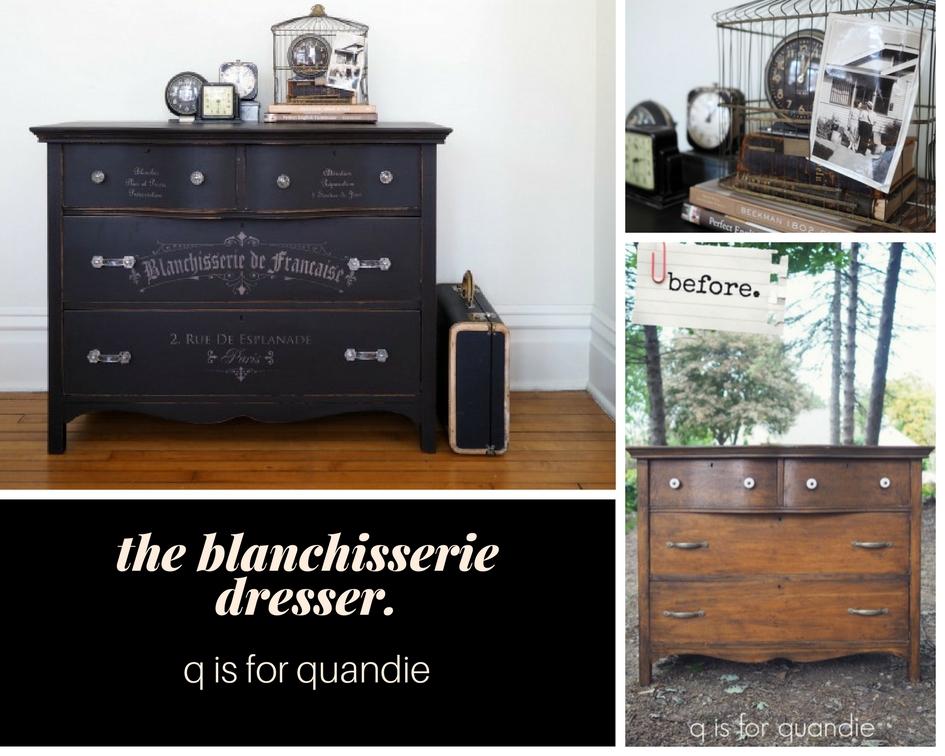
the blanchisserie dresser.

As you can probably tell by the ‘before’ photo below, I purchased this dresser back at the end of summer when I was trying to stock up some projects for the winter.

I think we can all agree that the previous owner had made some rather unfortunate hardware decisions, but otherwise this piece didn’t look all that bad at first.

I wanted to strip the top and then wax it with a dark wax, but after stripping the top of the dresser it looked like this.

I’ve run into these black streaks before.  I’m not 100% sure, but after doing some quick google research I think they might be iron oxide stains (if any of you have any insight, please share in a comment).  Iron oxide stains can occur when the tannins in the wood interact with moisture and turn black over time.  There are methods for removing these stains, but I didn’t think it was worth it to spend that much time and effort on this dresser.  The wood just wasn’t that pretty.  So, in the end I opted to just paint the whole thing.

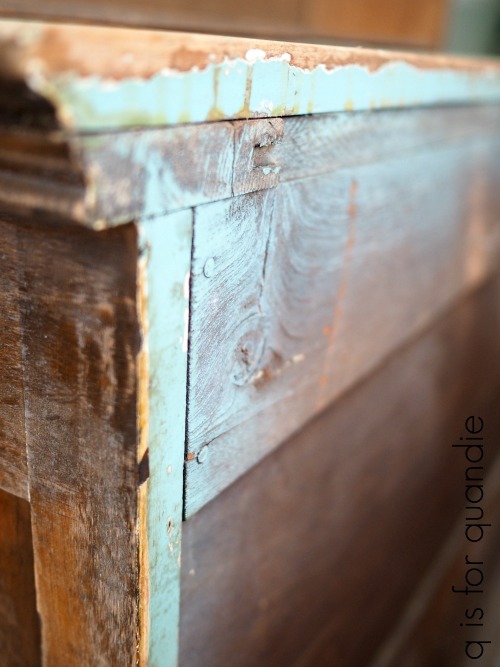
I also found some clues to tell me this dresser was probably originally intended to be painted.  In fact, it had been painted at least twice and possibly three times.  Clue no. 1 is on the back side.

Isn’t that a gorgeous aqua?  I know I would have loved that color!
Clue no. 2 was inside the openings for the drawers …

So it was probably also pink at one time, and maybe even white.

Whoever bought the dresser, then stripped off all of those colors and refinished it, was probably pretty disappointed in the lackluster results.  But I was happy to take it back to its roots.  Except I didn’t choose aqua, pink or white.  At least not on the outside.  Instead I chose black.  More of Dixie Belle’s Caviar to be precise.

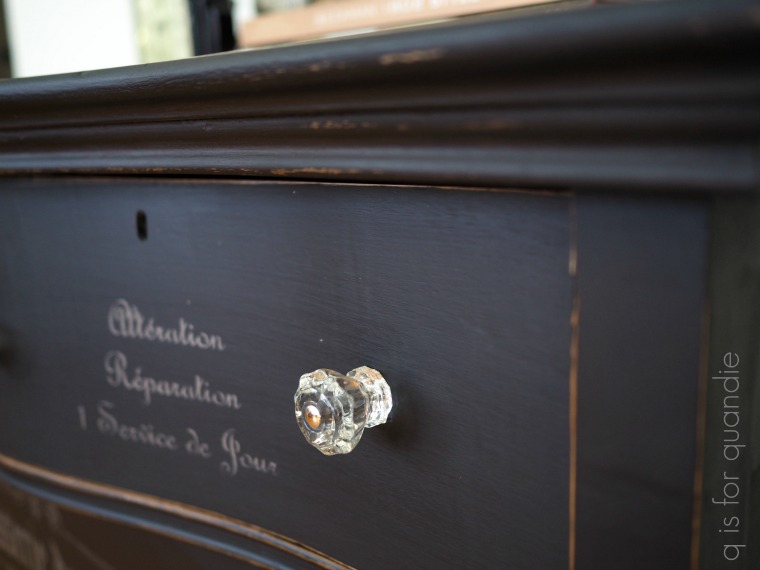
Once the paint was dry I added bits and pieces of my french laundry stencil to the drawer fronts.  Once again, I’d love to share a source for this stencil but the company I purchased it from via Etsy seems to no longer be in business.

To keep the stencil subtle I used a warm, dark grey acrylic craft paint rather than a white.

Once the stencil paint was dry, I sanded lightly by hand over the entire dresser with a fine grit paper and then waxed it using Dixie Belle’s Best Dang Wax! in brown.  I think the amount of sheen I got from this wax is just about perfect.

I ended up using clear glass knobs and drawer pulls on this dresser because I happened to have them on hand.  My friend Sue gave them to me and I had just the right amount for this dresser, plus they were just the right size for the existing holes.  It seemed like it was meant to be.

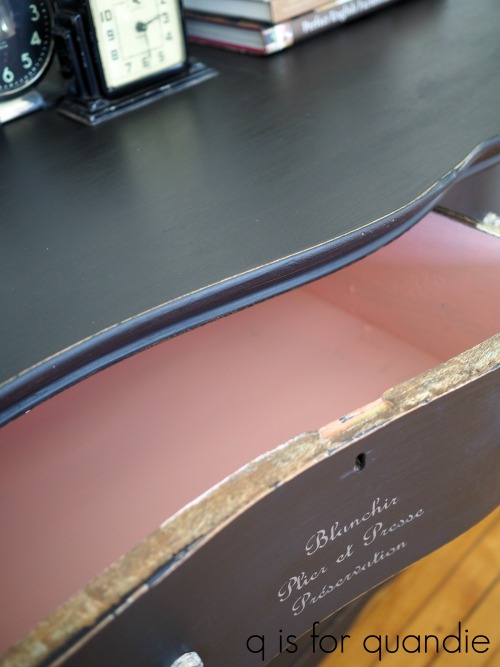
 As a nod to the remnants of pink paint that I found inside the dresser, I painted the interiors of the drawers in Fusion’s English Rose.

I like to use Fusion paint in spots like this because it doesn’t need a topcoat, yet is still fully washable once cured.  A great quality for the insides of drawers.  It only took me about 20 minutes for each coat of paint (I used two) and that fabulous pop of pink when you open the drawer is a lot of bang for your buck, time wise.  I generally only resort to painting the inside of drawers when they are really stained up and scary looking.  These drawers had a few ink stains that needed to be covered up.  In order to prevent the ink stains from bleeding through my paint I tried out the new clear sealer that Dixie Belle provided me with last month, B.O.S.S.

B.O.S.S. stands for Blocks Odors, Stains, Stops bleed-thru.

Had I wanted to block odors, or stop a reddish stain from bleeding thru I would have painted the B.O.S.S. over the entire surface.  However in my case I just had a couple of stain spots that needed blocking, so I just painted two quick coats of B.O.S.S. over the stains themselves.  It worked perfectly.

You might be wondering why I didn’t paint that edge of the drawer.  That is because the drawer fits fairly tightly as it is.  If I added paint, it would not open and close freely.  Always beware of adding too much paint to the edges of your drawers when they are a tight fit.  Nobody wants sticky drawers!

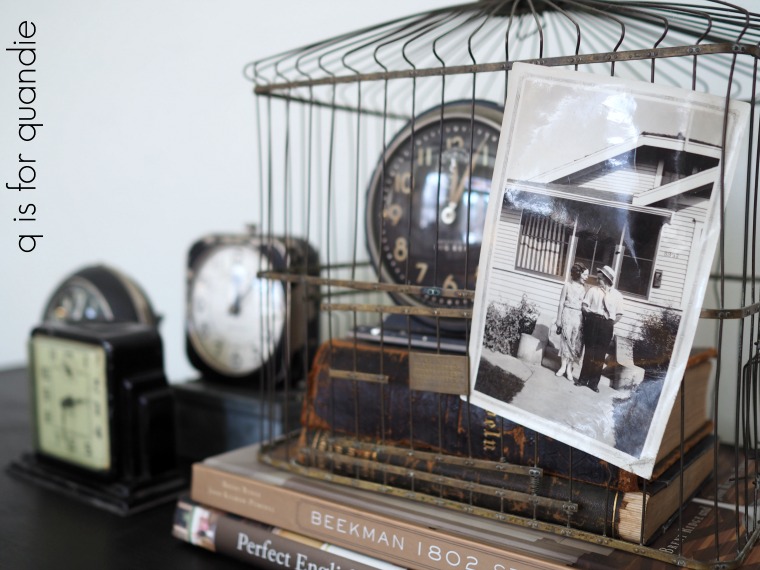
I staged the dresser with some of my favorites from my non-collection of vintage alarm clocks, plus one of my favorite old photos.

That photo was taken on the stoop of my grandparent’s home in South Minneapolis, but no one in the family seems to know who the people are.  They look like such a fun couple though, don’t they?  I imagine that it was a sunny spring day and they were on their way to a picnic at Minnehaha Falls when the photo was taken.

This was back in the day when ladies wore dresses and men wore ties on picnics in the park.

They probably had fabulous painted dressers with glass knobs too, but maybe not with french stencils on them.  Their loss, right?

I gotta tell you guys, I’m kind of in love with this Dixie Belle Caviar.  Lucky they sent me the big jar, because I’m going to be using a lot of this color.

The blanchisserie dresser is available while it lasts, be sure to check my ‘available for local sale’ page for more details!


mirrorless v. DSLR.

The cold that I’m still fighting off has completely zapped my energy, so since I haven’t had the gumption to finish a piece of furniture I thought I would share an update on the Olympus O-M-ED-10 camera I purchased over a year ago.

I realized recently that I tend to grab my Olympus camera (which is a mirrorless camera) more often than my old Canon Rebel (which is a DSLR) these days.  I have to say, it took me almost a year to get to the point where I am more comfortable with the Olympus.  That’s mostly because I’m a slow learner when it comes to the tech-y stuff.  I just don’t have the patience to learn something new, I’d rather jump in at the deep end and sink or swim, which usually tends to involve a bit of sinking.

I purchased my Olympus back in September 2016.  You can read a post about that purchase here if you want more details on why I chose to purchase a mirrorless camera.  And then back in May 2017, just before my cruise to Norway & Scotland, I purchased a 17mm prime lens for it, and I posted another update on the camera here.

I promised to keep you guys updated on how the new camera worked out for me and now that I’ve had it for over a year I feel like I’m in a good position to report back on it.

I generally use my camera for two things, travel photos and blog photos, so I thought I’d address both of those needs separately.

Travel Photos.

I took both of my cameras on that cruise last May, but I definitely used the Olympus far more than the Canon.

Flam, Norway

The main reason for that was size.  The Canon is much bigger and heavier than the Olympus.  I just didn’t want to carry the Canon around with me all day.  The only time I took the Canon off the ship was the day we hired a private guide with a car, so we weren’t on foot all day plus I could leave the camera in the car if I wanted to.

Dunrobin Castle, Scotland

I also used the Canon while taking photos from our balcony.  I have a decent zoom lens for it, so it was fun to play around with that from the comfort of our room.  I definitely got some shots with that zoom lens that I couldn’t have gotten with the Olympus (unless I purchase a zoom lens for it).

sailing away from Bergen, Norway

However, when were off the ship touring around on foot, I only carried the Olympus with me.

It worked beautifully in low light situations.

The Beamish

And I got some beautiful landscape shots with it.

Isle of Skye, Scotland

Before our next trip I plan to find a good zoom lens for the Olympus and not even bother with packing the Canon.

Blog Photos.

As I mentioned at the start of this post, I find myself grabbing the Olympus for blog photos most of the time these days too.  I can’t blame that on size and weight, since I don’t have to lug the camera far to take my furniture photos.

One of the main reasons is the 17mm prime lens that I use with it.  For those of you who aren’t into tech-y details you can skip this next bit, but for those of you who are interested, a 17mm prime lens on a mirrorless camera (like my Olympus) is approximately equivalent to using a 35mm prime lens on a DSLR camera (like my Canon).  There is some sort of mathematical reason for that, but let’s not kid ourselves, who really understands that stuff?  And who really cares?

The important bit is what that means.  With a prime lens you can’t zoom in and out.  It has a fixed focal length.  That means to ‘zoom in’ you have to literally walk closer to your subject, and to ‘zoom out’ you have to walk away from your subject.  You may be wondering why anyone would want a prime lens at this point.  Well, it’s because you can get a good, fast prime lens for less money than a good, fast zoom lens … and speed translates to crisper photos, especially in less than optimal lighting conditions.  So when I’m taking furniture photos in winter, I get better results with a prime lens.

Currently I have a 50mm prime lens for my Canon.  It works great for furniture photos out in my driveway when I can get a good 20’ away from my subject.

But it doesn’t work so great inside my house where I just can’t get far enough away from a piece of furniture to fit it into the frame using that 50 mm.  I can only use it to take close up photos indoors.

The 17 mm prime lens on the Olympus, on the other hand, is just right for indoor photo shoots.  I only need to get about 6’ away from the piece of furniture to get a full shot of it.

I should point out here that if I had a 35mm prime lens for my Canon DSLR I could easily use that for indoor furniture photo shoots too, I just don’t happen to have one.

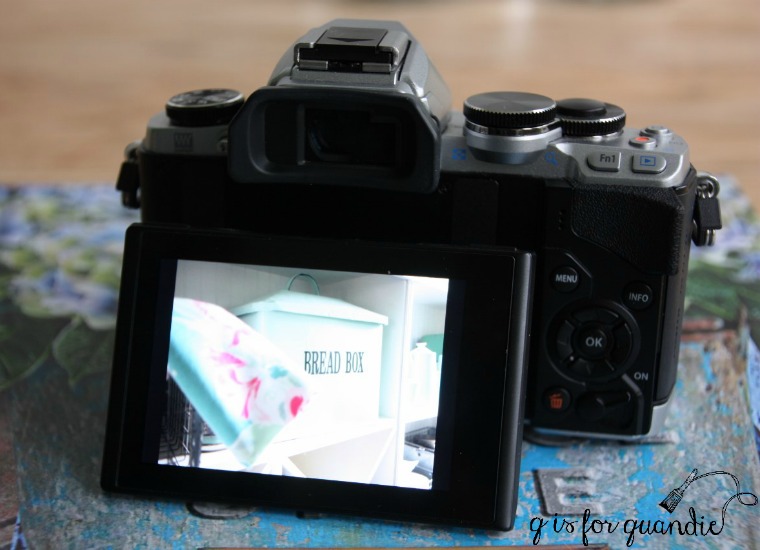
The 2nd reason I tend to grab the Olympus these days is that feature I mentioned the last time I posted about this camera.  The touch screen focus.  Here’s how that works, the LCD screen displays the image you’re about to take and to choose the spot where you want the camera to focus you just touch the screen there.  The camera focuses and takes the shot with just one touch, no need to depress the shutter release button.

I use this feature ALL. THE. TIME.  I can’t emphasize that enough.  It’s how I get awesome crisp photos of the hardware on my furniture even when the hardware isn’t centered in the frame, like this …

I can accomplish that with my Canon also, but it take a few more steps and it’s not as precise.

Lastly, I have found that the automatic white balance setting on my Olympus works better than the same setting on the Canon.  White balance is something I have an ongoing struggle with.  Since a big part of my blog involves showing specific paint colors and how they look on furniture with different top coats, I want the colors in my photos to look as real as possible.  Honestly, sometimes I still don’t manage to pull that off, but I do work at it.  Seriously, just how many different shades of white are there in this next photo?  And which one is ‘true’ white?

Of course, you can adjust your white balance with photo editing software after the fact, but it’s so much easier if you are starting out with a photo that was captured with good white balance.  If you are a fellow furniture painter or blogger, I hope that you are also paying attention to white balance in your photos.  Even if you’re taking photos with a smart phone you should have some options for setting your white balance so be sure to check that out.

One instance where I do still prefer my Canon Rebel is when I want to get a photo like this next one.

For some reason I still find it easier to use the zoom lens on my Canon to create photos with a shallow depth of field (where the background is blurred out like the example above).  If you want to learn more about how to take photos with a shallow depth of field, check out this article I found on the subject.  I’m sure that I can accomplish this with the Olympus, but that is something I need to work on.  That sounds like a good goal for 2018, doesn’t it?

If you’ve stuck with me to the end of this post I hope you learned something new about cameras, lenses, white balance or depth of field.  I plan to be back next week with a gorgeous dresser makeover (photographed indoors with my Olympus mirrorless camera and 17mm prime lens), so be sure to stay tuned.


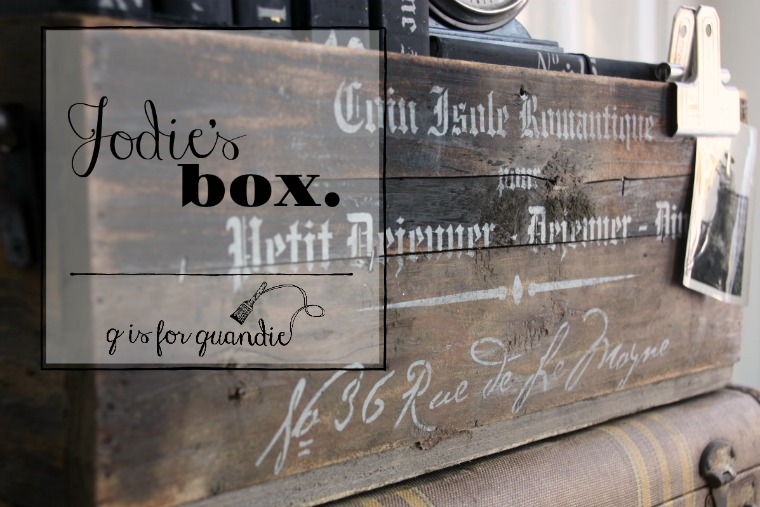
jodie’s box.

Hello!  I’ve been down for the count with a cold since last Friday, so I don’t have anything earth shattering to share on the blog today.  Instead I pulled together a post on this quick project I worked on a while back.

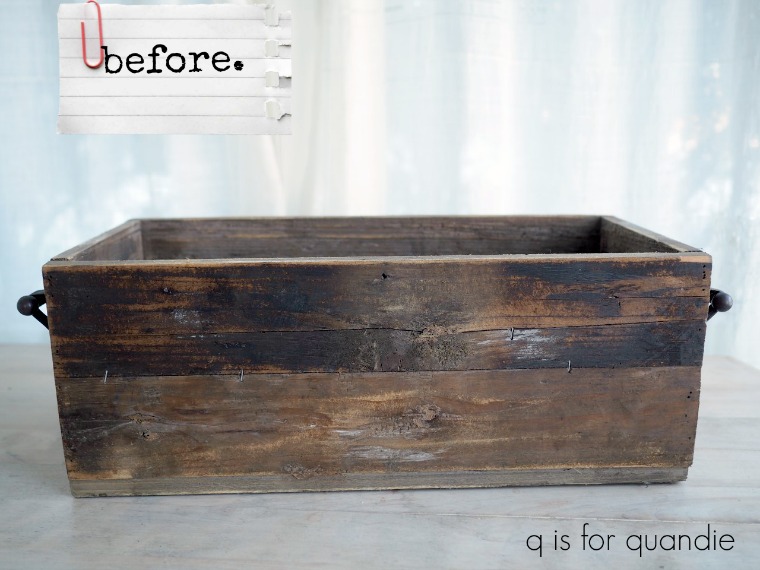
You probably don’t recognize this box, but it has been shared here on q is for quandie once before.

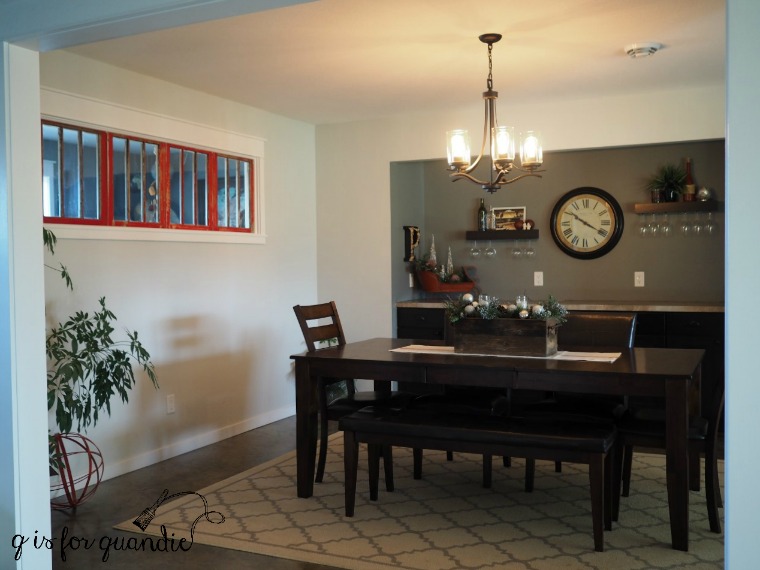
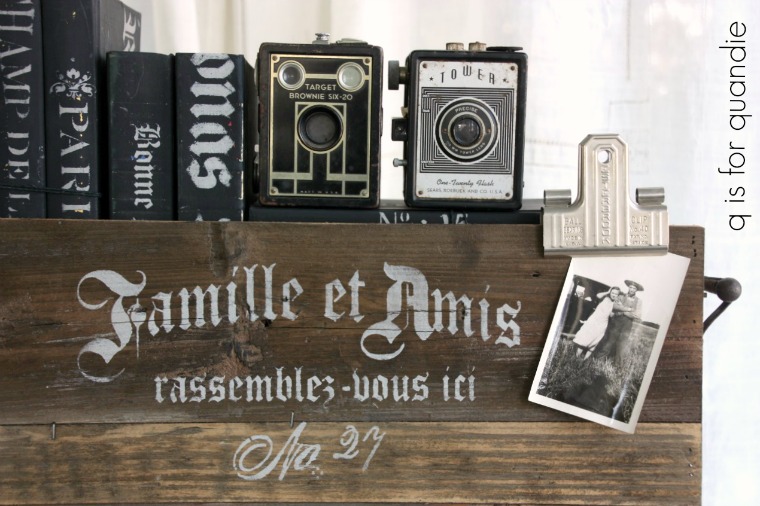
It belongs to my friend Jodie, and the box made it into the photo of Jodie’s dining room back in December when I shared a tour of her home.  There it is on her dining room table …

Recently Jodie decided the box needed just a little more oomph, so she asked me if I would stencil it for her.

Of course I agreed.  Stenciling is just so quick and easy, and really cost effective once you already have the stencils (and I have quite a few).

Jodie was pretty flexible and said I could use whatever stencils I thought would look good, so I went with some french stencils that seemed appropriate for a dining room.  I used a different one on each side.

By the way, both of these are just portions of a larger stencils.  I just used sections that would fit and looked good on the box.  I purchased both of these stencils via Etsy which is a great place to find them.  You might recognize the first one I showed, it’s the same stencil I used on the Windsor chairs last Friday.

Jodie asked me to use white paint for the stencils, but I suggesting going with a pale grey instead.  I think a crisp white would have been too stark and would not have worked with the rustic, aged look of the wood.  The pale grey (this is Martha Stewart Multi-Surface acrylic craft paint in a color called Wet Cement) reads as white next to the wood.

How’s that for a quick and easy update?

Hopefully I’ll get my energy levels back up to normal soon and be able to share something a little more exciting with you.  Until then, be sure to stay tuned!

the windsors.

You might think I’m about to talk about England’s royal family, but no.  I’m talking about the chair kind of Windsors, not the royal kind of Windsors.

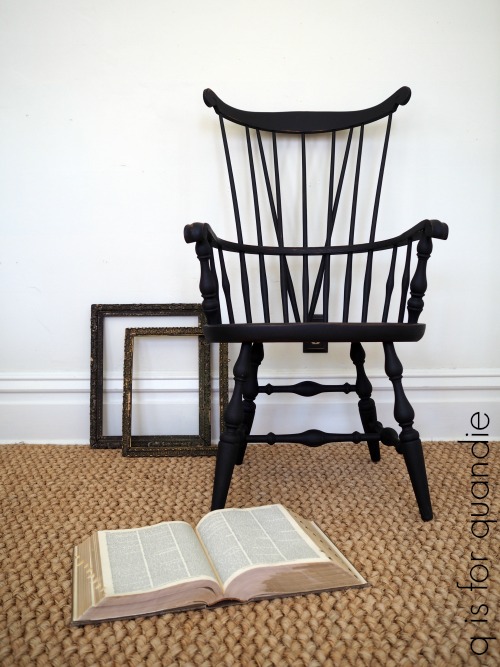
I picked up these Windsor chairs at one of the neighborhood garage sales last summer .

Structurally they are in great shape, they just have a bit of an outdated finish on them.  As soon as I saw them, I pictured them painted black.  Black is a classic color for a Windsor.  So when Dixie Belle sent me some of their chalk style paint in a color called Caviar I dug these chairs out of the carriage house to give them a makeover.

I did not sand the chairs before painting them, I just gave them a good cleaning with some TSP Substitute and started painting.  I used the same damp brush technique that I mentioned in my post on Monday, simply dipping my brush in a cup of water occasionally while painting.  It took two coats to fully cover mainly because the paint thins out using this technique, but it also goes on ultra smooth.  So for those of you who prefer to see a brush-stroke free finish, this is definitely the way to go.

Once dry I wet distressed the edges of the chairs using a damp rag and then used a 320 grit sandpaper on the seats, flat arms and flat top at the back.

I did not sand any of the spindles because that would likely have pushed me over the edge.  Painting them was putzy enough, just look at all of those spindles!

Can we just stop here a minute though and talk about this color?

The Caviar is a gorgeous deep, rich, saturated black.  It looked deep and dark even before I waxed it.

In fact, here’s a secret.  I didn’t wax the legs yet.  Obviously I have to get to that before I sell the chairs, but I was trying to take advantage of a sunny day to get my photos done so I saved the legs for later.

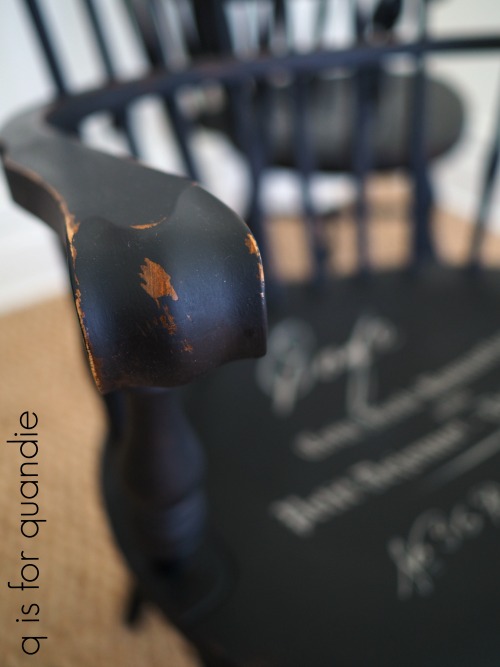
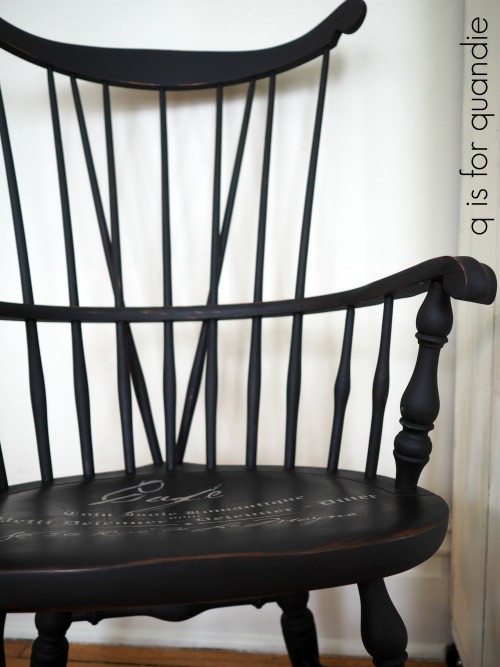
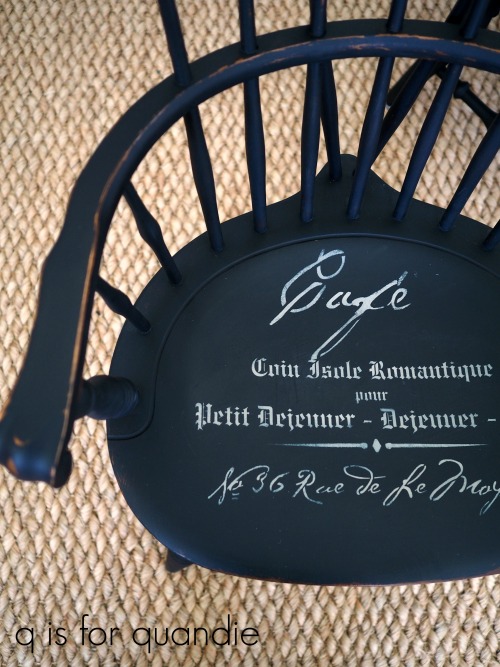
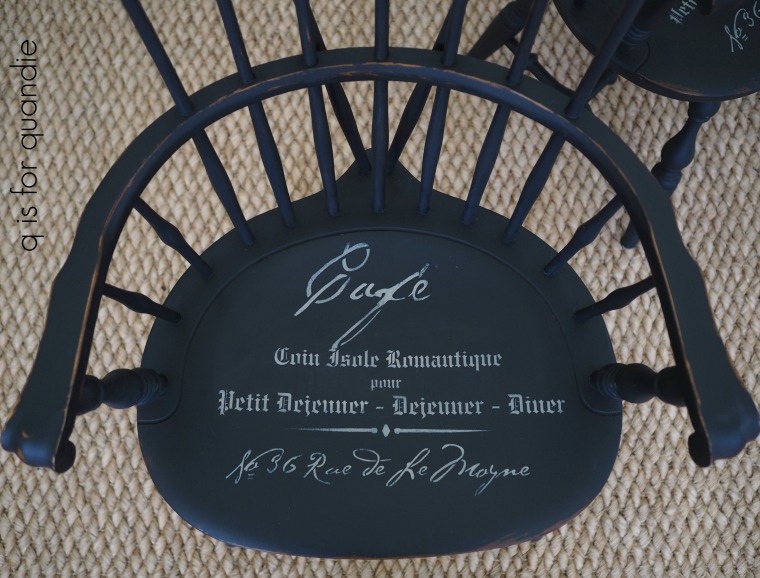
Before waxing I stenciled the seats with a fab french design.  I’m fairly sure I ordered this stencil via Etsy, but once again the shop I ordered from is no longer there.  I seem to have bad luck in this way with stencils.  So I’m sorry that I can’t give you a source for this one.

The stencil was just the pop of something special that took these chairs from ho-hum to fab.

Once I had the stencils done, I sanded lightly over them with 320 grit sandpaper and then waxed the chairs (and I will get to those legs!) with Dixie Belle’s Best Dang Wax in clear.

If you’re used to using Miss Mustard Seed, Homestead House or Fusion wax (like I am), don’t be freaked out when you open up the Dixie Belle clear wax and it looks really white.  I thought for sure I had gotten a white wax by mistake.  But no, ultimately it dries clear.

Also, you really won’t need a dark wax (like brown or black) to deepen the black color of this paint.  It looks gorgeous even with the clear wax.

I love how the chairs turned out.  If I had a spot for them I’d definitely keep them.  But there is no room at the inn, so they have to go.  If you are local and need a pair of Windsors, be sure to check my ‘available for local sale’ page for more details.


shaken, not stirred.

When Dixie Belle asked if I’d like to try some of their products, their Patina Paint was at the top of my list.  I am super excited that they sent me a couple of different looks to try.

I love a good authentic aged patina.  Nothing can beat the real McCoy like the gorgeous verdigrised copper roof on this building in Vienna.

But finding the real thing isn’t always possible, or affordable.  And I’ve never been a fan of the faux paint jobs that use several paint colors to create something that ‘looks’ like verdigris or rust.

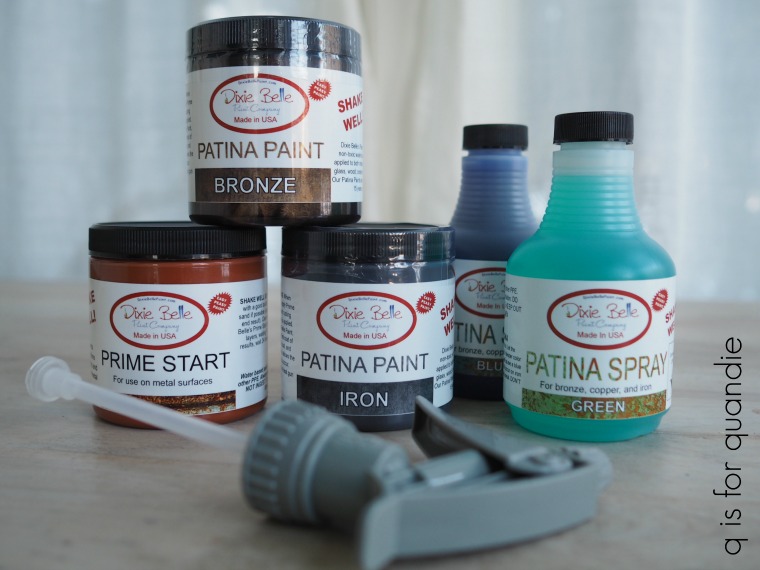
That is not how the Patina Collection from Dixie Belle works.  Instead it uses actual flakes of metal in the patina paint combined with a spray on acidic solution to create actual rust or verdigris.

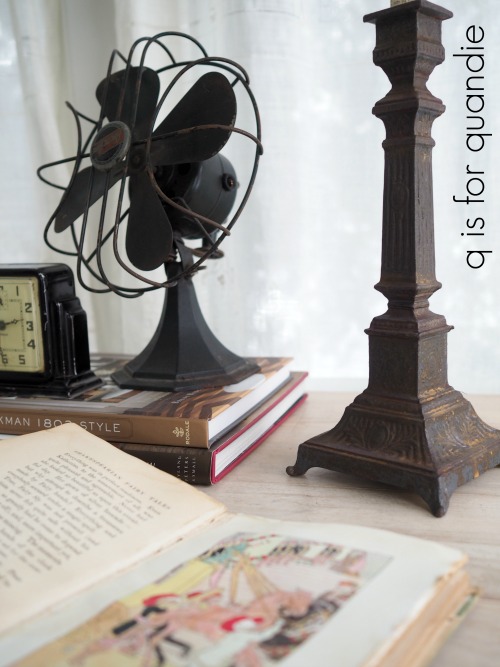
I’m intrigued by the idea of trying this effect on a piece of furniture at some point, but for today I decided to start small with this lamp that I recently picked up at the thrift store.

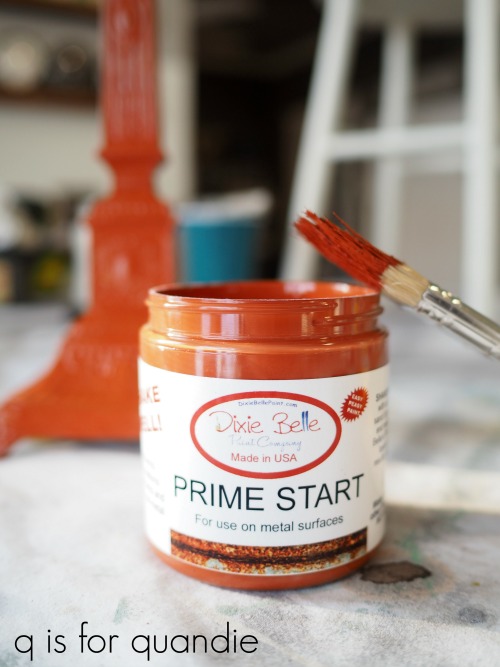
The base on this lamp is metal, but you can also use the patina paints on any other paint-able surface.  However, when using them on metal you must start with a coat of the Prime Start (on all other surfaces you can prime your piece with a coat of regular paint).

The reason for this is simple.  The Prime Start contains an acid blocker that prevents the activator that you apply later from eating through the paint and degrading your metal item.  So be sure not to skip this step if you’re working with a metal item.

It’s not very pretty (unless you like orange), but don’t worry, you’ll be covering that up entirely.

Next you add two coats of your Patina Paint of choice.  I’m using the Iron Paint because I want a rusty patina on my lamp.  There is one very important instruction to take note of before you start using the Patina Paint, can you guess what it is?

Shake well!

I really want to say that the paint should be shaken, not stirred (you know I love my Bond) but I think you could also stir it if you prefer.  But the important thing is that you mix it well in order to distribute the metal flakes throughout.  These are what will give you the patina that you want.  If you don’t get them well mixed you will be disappointed with your end result.

The first coat of the Iron paint goes on fairly thin.

Now here’s the next important bit of info, after painting on a second coat of the Patina Paint you should immediately shake the Patina Spray well and apply it while the paint is still wet.

Now you can sit back and watch metal rust.  It’s sort of like watching grass grow.  It can take 2-6 hours to reach the full effect so I recommend going and getting yourself a vodka martini, shaken not stirred, while you wait.

Then spend some time watching your favorite Bond movie.  Mine is Skyfall which is 2 hours and 23 minutes long, perfect for killing time while waiting for your patina to develop.

In reality, I just went to bed after this step and when I got up in the morning my lamp looked like this.

That patina is so delicious I could just eat it up.

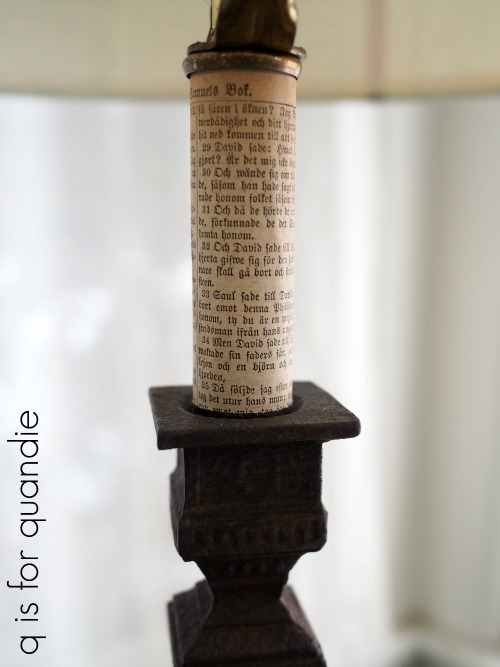
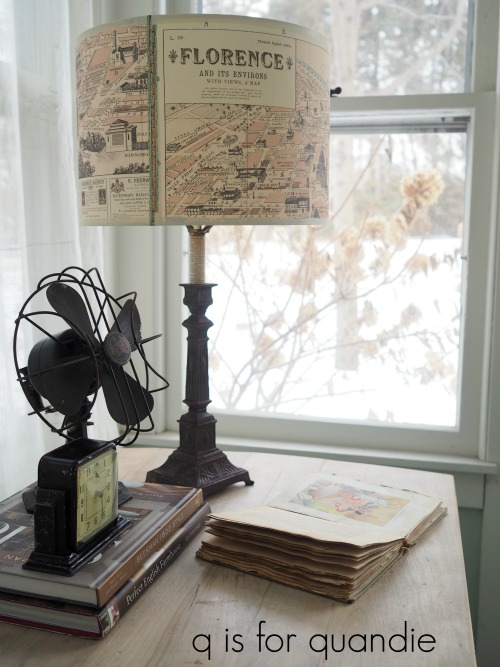
When looking at the ‘before’ photo of the lamp you may have noticed that it had a tacky yellowed plastic faux ‘candle’ at the top of the metal base.  I covered that up with a page from my old Swedish bible.  I simply cut the piece to fit, sprayed it with 3M Super 77 spray adhesive and wrapped it around.

I added a lamp shade that I purchased at Junk Bonanza several years ago.

The shade was made by Light Reading and if you follow my link to their Facebook page you can see that they are going to be at an event in Edina coming up soon.  So any of you locals who need an amazing lamp shade, you can check them out there.  I think I might swing by and try to score another lampshade myself.

In the meantime, I’m going to go look for some more stuff around my house that needs a rusty patina!


stool samples.

Back in the beginning of January I was pondering my blog content and thinking about potential ways to grow in the new year.   I felt like it was time to try some new products.  Don’t get me wrong, I absolutely love Fusion, Homestead House and Miss Mustard Seed products and I’ll definitely continue to use them on a regular basis.  I’m also still officially addicted to the IOD Décor Transfers.  But I felt like I needed to add a good chalk style paint to my line up and also just take a look around at what other sorts of products are out there and what they can do.

After all, variety is the spice of life, right?

My painting philosophy is that there is no one perfect paint that is best no matter what the project.  Some projects are better suited for milk paint, some are better suited for an acrylic paint and some are better suited for a chalk style paint.

I decided to do a little research by looking at what other furniture painters that I admire are doing these days.  One of those painters is Denise at Salvaged Inspirations (be sure to check out her blog post today about painting with black).  She recently painted this gorgeous dresser in Dixie Belle chalk paint in a color called Caviar

and this stunning blue buffet painted in Dixie Belle’s Bunker Hill Blue

So I went to the Dixie Belle website and just browsed around a bit.

And guess what?  They had some really cool stuff, like their Patina Collection for creating an aged metal look and a stain-blocking, smell-blocking clear primer called BOSS.  I was also intrigued by their Easy Peasy Spray Wax and Dixie Belle Mud.

That was when fate intervened in an amazing way.  I received an email from Teri at Dixie Belle out of the blue.  She had seen my blog and wondered if I’d be interested in trying any of their products.

Seriously!  What a wild coincidence right?  The timing could not have been any more perfect.

Of course I said yes!  I’d definitely be interested in trying a whole bunch of their products.  Like all the ones I listed above, and certainly some paint too!

So last week I received a big heavy box in the mail from Dixie Belle!  I’d asked them to ship it to my day job.  The Dixie Belle paint should not be allowed to freeze.  Since it’s January in Minnesota, having the box shipped to my office meant it wouldn’t be left sitting outside on my porch for any length of time.

Now I was fully stocked with some gorgeous paint colors and some fun, unique products that I couldn’t wait to experiment with.

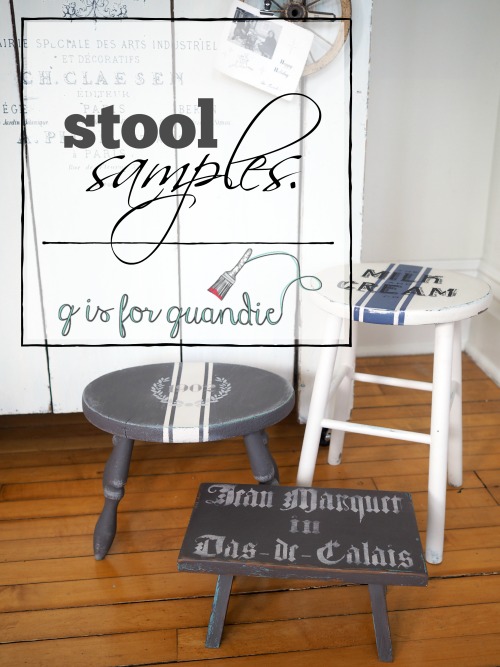
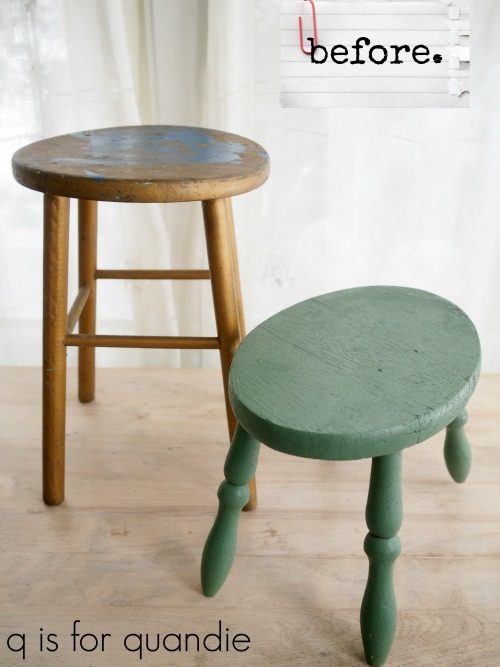
Having made my share of mistakes with new products over the years, I’m learning to start out slowly; test them out on something small to get a feel for how they work before jumping right in to the deep end and painting a big piece of furniture.  So this time I pulled out a pair of stools that my friend Sue recently passed on to me to sample some of the paint colors and top coats.

And hence, the title of this blog post was born.  Stool samples.  Seriously, how could I resist?

The ‘how-to’ guide for Dixie Belle chalk paint says that you don’t have to sand your piece, just clean it and then start painting.  I would have followed that advice to the letter except the seat of the taller stool had a big glob of spilled blue paint on it.  Although I could have painted right over that and the paint would have adhered, you still would have been able to see the texture from it.  In other words, it would have looked like I painted over a glob of something.

Q-tip of the day: if you don’t want to see texture (including drip marks and brush strokes) from a previous paint job (or spill), you will need to sand it down before painting with any kind of paint.

So I sanded the top of the taller stool pretty vigorously, but left the rest alone.  It really was a relief to not have to sand all of those legs!

I didn’t want to see either of the existing colors on each stool when I distressed them after the final coat of paint, so I gave them an undercoat of a color that I wouldn’t mind seeing, Savannah Mist.  Dixie Belle recommends using a damp paint brush and painting in thin coats.  I’d never tried the damp paint brush technique before so I thought I would give it a try.  You simply dip your brush into a bit of water, just a quick dip, not a big, swooshy, saturate your brush sort of dip, then dip your brush into the paint.  You don’t have to re-dip your brush into the water with every fresh dip of paint, maybe just with every 4 or 5.  I just kept a plastic cup of water handy.

Turns out I really like this technique which basically just waters down your paint as you use it.  It makes the paint easier to apply and it definitely goes further.  It also helps prevent brush strokes.  Despite the watering down, I still got great coverage with just one coat of the fairly light base color.

I used the same technique to paint each stool with a top layer of a different color.  The smaller stool got one coat of Gravel Road and the taller stool got two coats of Drop Cloth (white tends to require more coats for good coverage no matter what kind of paint you are using).  Then, while I had the paint out anyway I also painted a third even smaller stool in the Gravel Road.

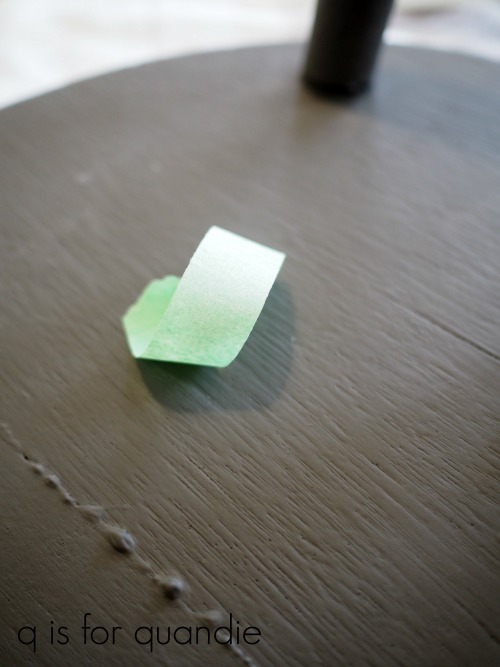
Since I was going to add some grain sack style stripes using tape next, I flipped over to the underside of one of the stools (which I had also painted) to test whether or not the tape would pull off any paint.

Nope.  I was good to go.  By the way, this is the color called Gravel Road.

I taped off some stripes on the two larger stools.  One got striped with Drop Cloth, the other got Yankee Blue.

Next I decided to try wet distressing them.  I think a chalk style paint is easier to wet distress than other types of paint.  The trick is to do it right away as soon as the paint is dry, but before it hardens too much.  In case you’ve never heard of it, to wet distress a piece you just use a damp cloth and wipe the paint off wherever you would normally distress the piece.  I like to use a nubby terrycloth fabric for this and I have a bunch of old towels that I’ve cut down into rag sized pieces for jobs like these.

Here’s how the wet distressed edge looks up close …

 There are a couple of benefits to wet distressing.  First of all, you don’t create any dust.  This is a big plus when you are working indoors in the middle of winter.  Second, you can more easily control how far down you distress.  I didn’t want to see much of that original green color of this stool.  As soon as I could see the coat of Savannah Mist coming through I stopped rubbing.

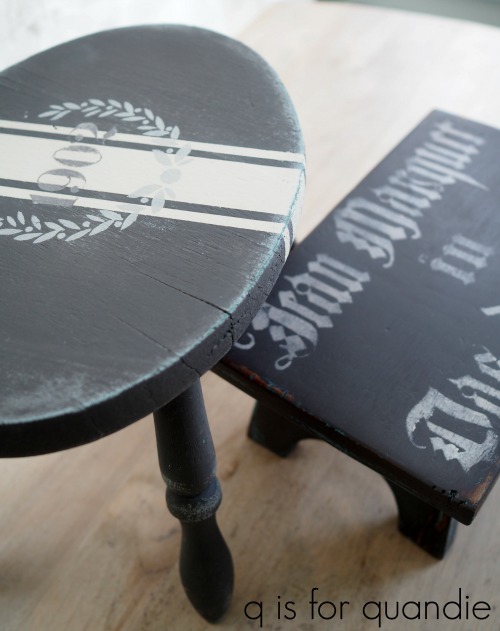
To add a little something extra, I stenciled the two smaller stools.  After the painted stencil designs dried, I sanded the top of each stool with a fine 320 grit sand paper to smooth them out.

Next I sampled two of the Dixie Belle top coat options, the Easy Peasy spray wax and their Best Dang Wax! in Brown.  The ‘1902’ stool was finished with the spray, the smaller stool with the brown wax.

The Easy Peasy spray definitely lives up to its name.  You simple spray it on in a fine mist, wait 5 seconds and then wipe.  Done.

The Best Dang Wax! is very creamy, soft and workable and it has no smell (which translates to no petroleum distillates and you know I like that).  I also like the rich, dark color of the brown.  I’m planning to test it out on some bare wood soon.

After sealing the tall stool with the Real Milk Paint Co’s Dead Flat, I used Fusion Transfer Gel to add a graphic (click here to read more about that technique).

Remember, if perfection is your goal then graphics added with transfer gel might not be right for you.  If you want to compare various methods for adding a graphic to something check out my post on that {here}.  Using transfer gel is definitely one of the most cost effective ways.

I had fun playing around with the various Dixie Belle paint colors and top coats while creating my three stool samples.

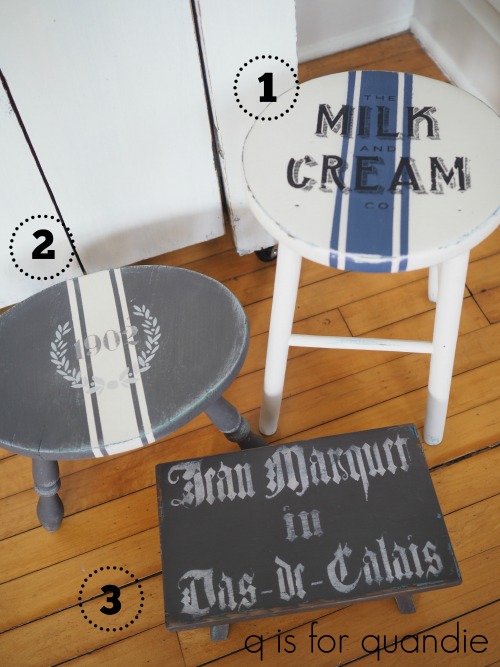
To recap …

stool sample no. 1 – painted with a base coat of Dixie Belle’s Savannah Mist, then painted with Dixie Belle’s Drop Cloth, striped with Dixie Belle’s Yankee Blue, sealed with Real Milk Paint Co’s Dead Flat, graphic added using Fusion’s Transfer Gel.

stool sample no. 2 – painted with a base coat of Dixie Belle’s Savannah Mist, then painted with Dixie Belle’s Gravel Road, striped with Dixie Belle’s Drop Cloth, stenciled with Martha Stewart acrylic craft paint, sealed with Dixie Belle’s Easy Peasy Spray On Wax.

stool sample no. 3 – painted with Dixie Belle’s Gravel Road, stenciled with Martha Stewart acrylic craft paint, waxed with Dixie Belle’s Best Dang Wax! in brown.  You’ll notice that the Gravel Road looks darker on this stool as a result of adding the dark brown wax v. the Spray On wax.

I’ve already started my next project using the Dixie Belle products, so be sure to stay tuned!


more fun with rub-on’s.

I’ve always loved a good rub-on.  Wait.  That doesn’t sound quite right, does it?

But seriously, I’ve been in love with these things since the 70’s.  I think they went out of vogue for a couple of decades, but they came back when the scrapbook craze started to take off.

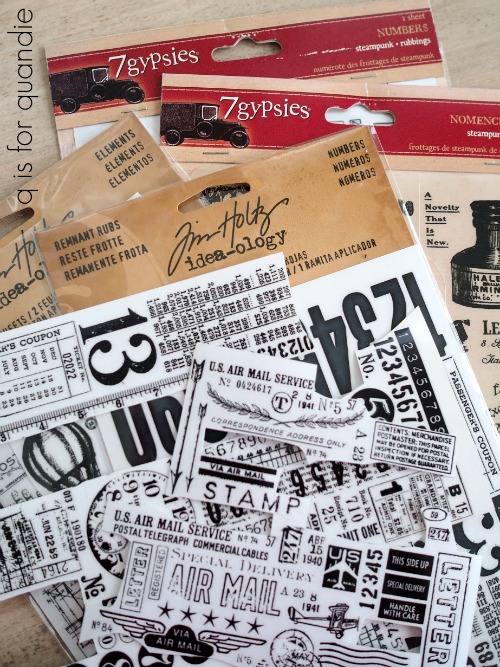
Two of my favorite brands are Tim Holtz and 7 Gypsies.

I have had hit or miss luck finding these in craft stores.  Hobby Lobby used to have a good selection of the Tim Holtz brand, but they don’t seem to any longer.  Meanwhile, Michael’s currently seems to have a large section devoted to the Tim Holtz line, but a small selection of his rub-on’s themselves.  Ever since my favorite scrapbook store went out of business, I haven’t been able to find the 7 Gypsies brand anywhere except online.

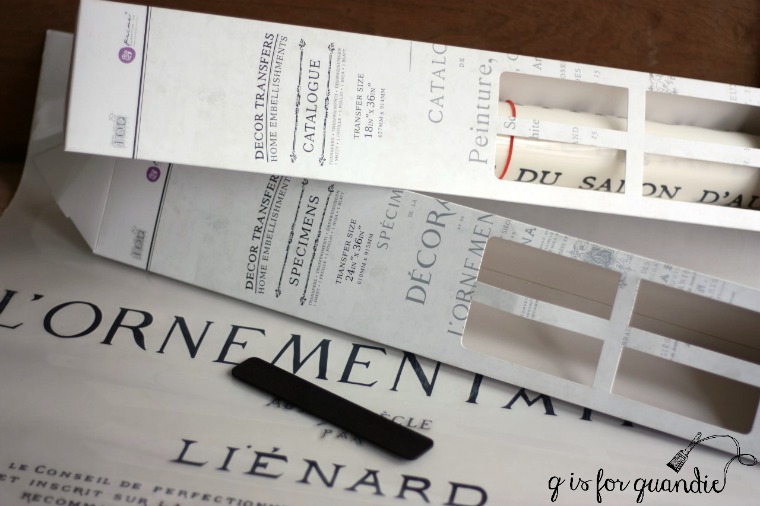
I’ve always been a little bummed that these designs are so small, obviously meant for small paper crafts.  That’s why I was so thrilled when I discovered the Iron Orchid Designs Decor Transfers, which are basically rub-on’s that are sized for furniture.

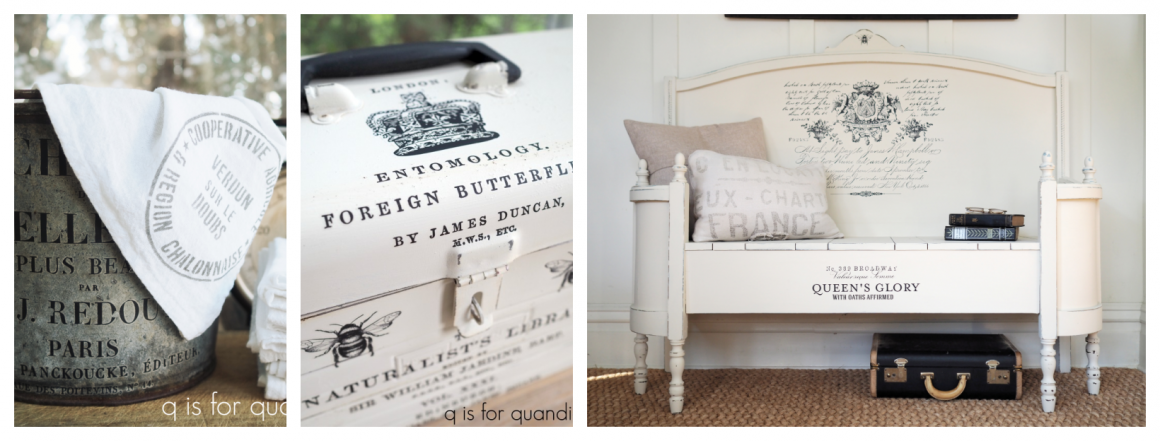
Adding rub-on’s to vintage pieces, big or small, is a quick and easy way to give them a little extra pizzazz.

You saw me do this a little while back with the vintage graters that I turned into photo holders.

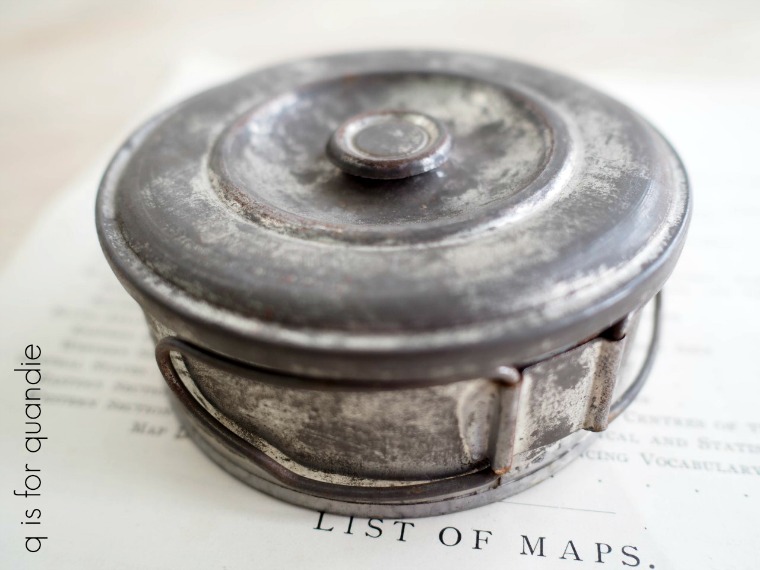
 Today I’ve decided to add some rub-on’s to this …

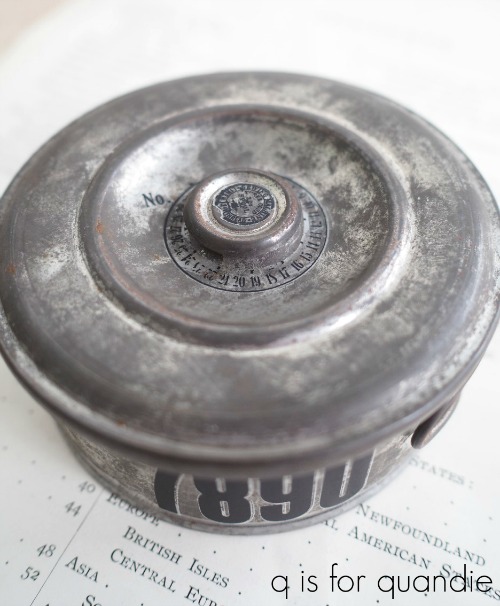
But first, what is it?  I don’t actually know.  Perhaps one of you does?  Those pieces on the side flip out to become a sort of handle.

Now, before you guess some kind of campfire cooking pot, I know it’s hard to judge size from these photos.  This thing is only about 1.5″ deep and 4.5″ across.  It’s way too small to cook in, it’s even way too shallow to be some sort of campfire coffee cup.

I’m baffled.

But whatever its original purpose, I think it would make a great little container for any number of things.  Hairpins?  Jewelry?  Nuts and bolts?  Spare change?

Or perhaps stamps.

I’ve suggested that with my choice of rub-on’s for one side, but on the other side I went more generic with just some numbers.

I added a little something to the top too.

It’s just a fun way to add some interest to an otherwise plain container.

 So if you’re looking for something fun to do this weekend, get yourself some rub-on’s and see what you have lying around that needs a little pizzazz.