some ‘q tips’ on stenciling.

Have you ever checked out my ‘how to.’ page?  If you’re on a computer or tablet, you can find it up above, just under my header photo collage right after ‘available for local sale’.  If you’re on your phone, click on MENU in that same spot.  Or you can click here.

The ‘how to.’ page is where I keep all of my posts that go into specific detail on certain techniques or products such paint inlays, milk paint or how to remove paint from old drawer pulls.

I like having these ‘how to’ posts handy so that I can refer to them in future posts and I don’t have to outline all of the steps for particular techniques each time I use them.  That would get so boring for those of you who either already know how to use them, or really don’t care.

I hadn’t added to my ‘how to’ page in a while, but I recently added the post on how to use the Dixie Shine.  I’d also been thinking that I should add a post on stenciling techniques, so here it is.

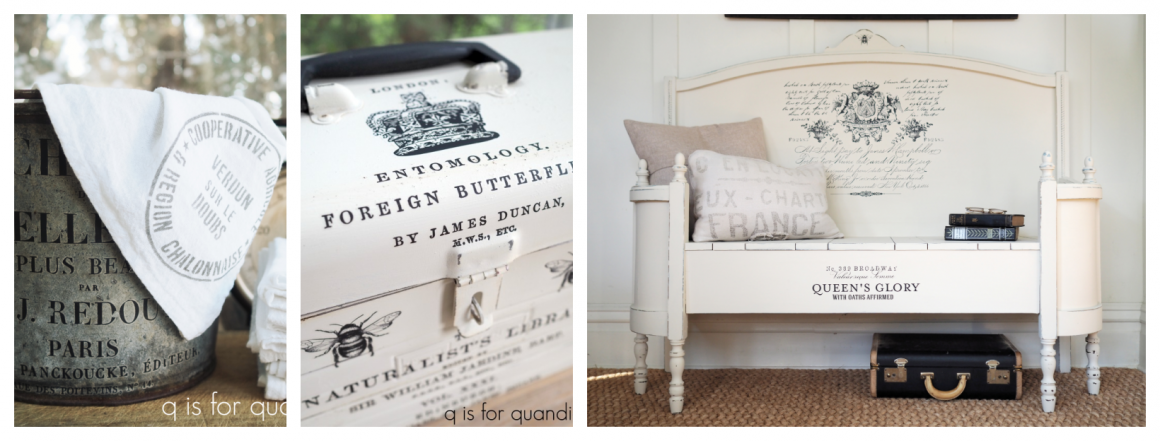
I know that some people struggle to get a good result while stenciling.  This vintage suitcase that I picked up at the thrift store a few years ago is a rather dramatic example of a bad result.

I’m sure none of you have quite that much trouble, but you still may be able to use a few q tips on how to stencil.

Tip no. 1 – First and foremost, my number one tip is to use chalk paint for stenciling projects if possible.  This is one instance where a chalk style paint is going to be superior to an acrylic paint (such as Fusion or Dixie Belle’s Silk paint, or those little bottles of paint from the craft store).  The chalk paint has a rougher surface that doesn’t allow your paint to slide around as much as it can on the slicker acrylic paint.  In addition, chalk paint is thicker (less runny) than acrylic paints, so that also helps you avoid allowing your paint to bleed under the edges of your stencil.

Tip no. 2 – The second most important tip I can give you is to use a dry brush.  I can’t stress this enough, and this may be the biggest mistake most people make.  Just tap your brush very lightly into your paint, and then wipe most of that paint off on a paper towel.  Even if you aren’t getting perfect coverage with the first pass, you’re better off going over that with a very dry brush for a second coat rather than having too much paint on your brush.

Tip no. 3 – Use the right brush.  Your stenciling brush should have densely packed bristles and a flat end.  The Best Dang Brush from Dixie Belle is my current go-to brush for stenciling.

It’s a big one though, which works great for larger stencil projects but will require taping the edges on smaller projects like the one above.

I’ve seen a few people use sponge tipped applicators for stenciling, but I found that the application tends to look a bit sloppy when I’ve tried using one of those.

Tip no. 4 – Use an up and down, stippling motion with your brush.  This helps you avoid pushing paint under the stencil, thus creating a smudgy looking result.  I’ve seen so many YouTube tutorials where the person uses a swirling, circular sort of motion to apply the paint and I always cringe a little.  You may be able to get away with that technique if you’re using an adhesive stencil of some kind, like a silk screen stencil or a stencil that you cut out of adhesive vinyl on a Cricut machine.

But I say always stick with that up and down stippling motion to be on the safe side.

Tip no. 5 – So far I’ve only mentioned using a brush to stencil, and 99.9% of the time that is what I do.  However, you can use a roller, which can make things go faster with a larger stencil.

I like to use a small foam roller for stenciling larger, all over patterns such as the one on the Venetian velvet inspired gift wrap I made a few years back.

Do be sure to follow the same principle of off-loading some of your paint first when using a roller, and don’t press too hard.

Tip no. 6 – My next tip is to know your surface.  Part of the reason the stencil job on that vintage suitcase is so bad is because the surface of the case is very bumpy.  Even the most practiced stenciler is going to have a tough time with that.  The flatter the surface, the easier it is to get a crisp result.  That doesn’t mean you absolutely can’t stencil over an uneven surface, but it will be trickier.

My advice for stenciling over a bumped up area like on the piece above is to stencil lightly and cautiously over that area, then when you take the stencil away, go back and fill in by hand around those curves using a small brush.

Tip no. 7 – Fill in the bridges for a more hand-painted look.

Bridges are those spaces in the lettering in a stencil that hold the inner pieces of the stencil in place.  I like to go back in with a small artist’s brush and fill those in.

Of course, you don’t have to do that.  Sometimes you may want a more industrial looking result, in which case you should just leave the bridges unpainted.

Tip no. 8 – Add a shadow to wording to give your piece more dimension.  This is one of my favorite tips!  It’s so easy to do and adds so much.

Just start by placing your stencil slightly (about 1/8″) down and over to the left of center (or wherever you want your final stencil to go).  Stencil the darker shadow color.  Once that’s dry, just move your stencil up and to the right by that same 1/8″ and stencil again with your final color.  It’s a super simple technique that adds so much, but keep in mind that it works best with chunkier lettering.

Tip no. 9 – If you are new to stenciling and nervous about giving it a shot, practice on fabric first.

These inexpensive flour sack dish towels were a quick and easy stencil job.

As were these pillow covers.

When stenciling fabric, be sure to have a hard, flat surface beneath your fabric.  I placed a piece of thin hardboard inside the empty pillow cover to give me a nice firm surface to stencil on and also to prevent my paint from bleeding through to the back of the pillow case.

Brown craft paper is also a good choice for getting in some practice as a beginner.

Both of these surfaces have a lot of ‘tooth’ making it easier to get a crisp result.

I hope some of you will find these tips useful.  Stenciling is a great way to add some detail to a piece without breaking the budget.

Be sure to leave a comment if you have any questions about stenciling that I haven’t answered in this post.

a little junkin’ and a little drinkin’.

Last week I spent some time helping my neighbor, nnK, paint her parent’s kitchen cabinets.  They live out in Amery, Wisconsin on Lake Wapogasset … or as I like to call it, Lake Pop-a-gasket.

We headed out there last Friday afternoon to add a few finishing touches, and we were done so quickly that we had a little extra time to kill before dinner so nnK and I checked out a few of the shops in town including Acme Junk Co.

I’d only been to this shop once before in their previous location, so I’d been wanting to check out this spot for a while now.

We headed down to the basement level first.  They had a very clever license plate treatment on the stairs.

How long do you suppose it takes to accumulate that many vanity license plates?

The lower level seemed to be mainly small booth spaces that I assume were rented by various different vendors.

Each little space had its own personality.  We had to laugh in one of the spaces that was devoted to paintings of naked women and vintage Playboys.  I didn’t take photos of that one to share with you guys, for obvious reasons.

There were some spaces that harkened back to my shabby chic days.

And some spaces that had a little bit more of a vintage industrial sort of style.

Overall the basement felt more like your typical antique mall, not what I would necessarily call a junk shop.

The main level of the store was much ‘junkier’, and I mean that in the most complimentary way.

They definitely had some cool stuff, including several really amazing antique dress forms.

At $475, this was way out of my price range as were the others in the shop unfortunately.

There were also lots of old typewriters, and clearly someone has gotten tired of bored children banging away on the keys while they wait for their parents to be done shopping.

This next one was particularly cool.

They certainly had some unique finds, hammerhead shark anyone?

I really liked this set of three cobalt blue apothecary bottles.

I thought $43 for all three was a decent price, but I don’t really have this color anywhere in my own décor so I couldn’t think where I would put them.

I was also extremely tempted by this large wooden toolbox.

It was a little pricey at $95, but I would have been willing to pay that for it if I’d had just the right spot for it.  Ultimately though, I realized that I’d want to add some wording to it and I wasn’t sure that I should mess with the original patina.  So I left it behind.

At this point you might be wondering, what did I buy?

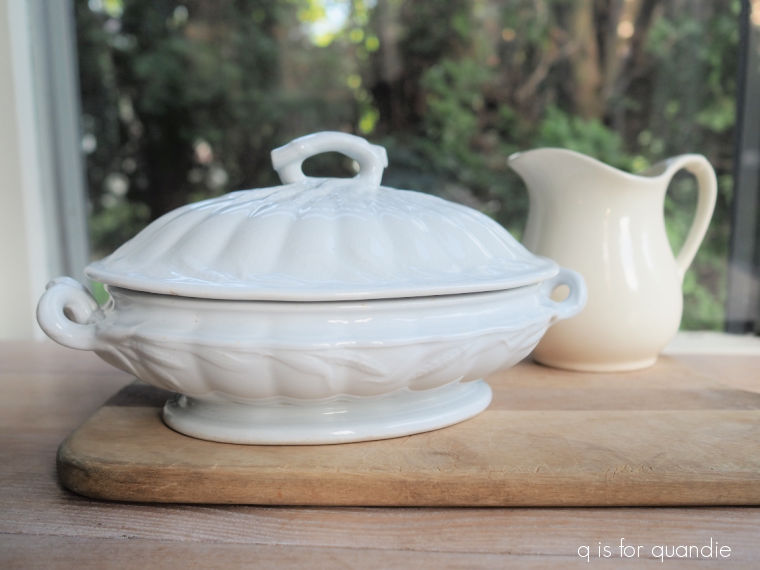
First up, I purchased this little ironstone covered soap dish.

It’s rare to find ironstone at reasonable prices in our area (at least in my experience), and this one was $18.

I love the mark on the bottom.

I’m really trying to pare down my ironstone non-collection these days, but then I come across an item like this and I decide why not?

I’ve saved find of the day status for this guy though …

You may remember that I once had a planets and stars themed ornament just like this, only it was a pretty shade of blue.

And I broke it!

One of my generous readers had sent me a replacement that is red with glittery gold stars and planets (thanks again for that Melissa!).

But still, when I saw the silver one I had to have it.  As a bonus, it was only $2.  Definitely a bargain.

I’m still keeping an eye out for one in that pretty shade of blue, maybe one day I’ll find it.

That was it for my purchases at Acme Junk Co.  We did stop at a couple of other shops in Amery including Ruby Mae’s Treasures and Bittersweet Homestead Boutique.  Ruby Mae’s had some great vintage furniture pieces and is definitely worth a visit.  Bittersweet Homestead has more of a gift shop vibe with lots of seasonal items, candles, soaps, dip mixes and that sort of thing.  So if any of you locals are looking for a fun afternoon shopping trip, I can recommend heading to Amery.

We capped off our day with the Friday night fish fry at a quintessential Wisconsin supper club.

If you aren’t familiar with the Wisconsin supper club culture, there are a few things that make a genuine supper club.  Here is how Kevin Pang from the Chicago Tribune describes them  …

“A Wisconsin supper club is an independently owned, fine-dining destination restaurant, typically in a picturesque locale on the edge of town. The menu comes from yesteryear, void of pretense and decidedly non-froufrou — prime rib, broiled white fish, shrimp cocktail — with enough complimentary sides and trimmings to satisfy a second meal. A relish tray should begin the meal, and three hours later, is bookended with house-made bread pudding or cheesecake. On Fridays they should serve an all-you-can-eat fish fry. A band might be performing. Mixed cocktails such as Manhattans and brandy old-fashioneds are preferred over wine or beer. If you leave hungry, you have not dined in a supper club.”

This one definitely had the location down.  A picturesque locale on the edge of town.

I’ve only been to a handful of supper clubs, but they have all been lakeside.  By the way, as a sidebar, there were people out ice fishing on that lake while we were there.  In April.  I definitely wouldn’t have chanced it.

Most supper clubs feel like a blast from the past when you walk in.

OK, yes, we were the first people to arrive for dinner.  It was early, but we were hungry from a day of painting and shopping.  Most of those tables were occupied by the time we left.

Naturally, I had to order the iconic supper club drink, a brandy old-fashioned.

Since we were there on a Friday, everyone else at our table had the fish fry.  I’m not a big fish eater though, so I opted for the prime rib.  However, the conversation around the table was entertaining, and that drink was mighty tasty, so I completely forgot to get a photo of my dinner.  Suffice to say, it was delicious and we definitely did not leave hungry.

Speaking of leaving, I’m heading off to spend some time with my mom later this week.  I’d been hoping to get out there 3 or 4 times this winter, but other life stuff has been making it difficult to schedule.  But I finally found a semi-open time frame, and was able to use my Delta Skymiles for a free ticket, so off I go.

I’ve scheduled just a couple of posts in advance, so I’m not abandoning you all together.  So I hope you’ll stay tuned!

on the flip side.

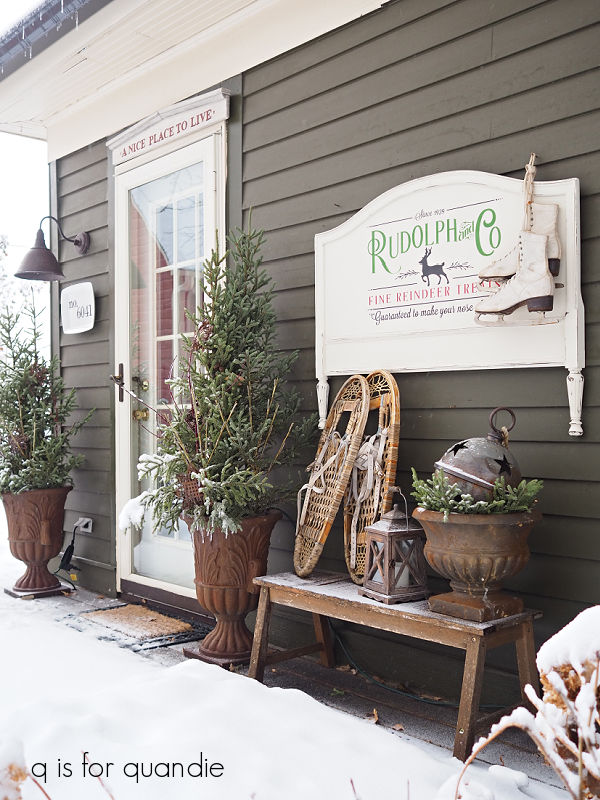
I’m embarrassed to admit that my Rudolph and Co. sign, and all of our other outdoor Christmas decorations, were still up until last week when we’d finally had enough snow melt to be able to reach some of it.

You have to cut us some slack here in Minnesota, especially when we’ve had a winter with a lot of snow.  We can’t always get through the snowbanks to take things down.  In addition, decorations often get frozen into place and we have to wait for them to thaw.  The spruce tips in my rusty urns only just thawed out enough to remove them, and I still can’t get to the potting shed or my front window box at all.

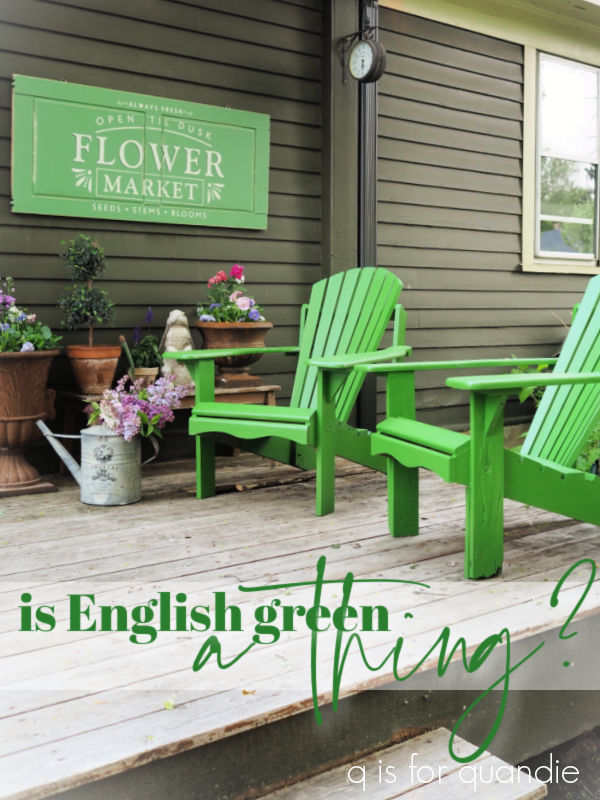
But now I’ve gotten at least some of my Christmas things tucked back away for next year, and I wanted to put something else in that spot on our deck for spring.

Last fall I painted a Farmers Market sign to hang there.

Somehow ‘Farmers Market’ says autumn to me though, so I didn’t want to just put that back up again.

You may also remember that I had a fresh flower market stencil on the flip side of that sign though.

But I was rather tired of that black and white look.  It definitely pales in comparison to the Farmers Market side, doesn’t it?

So I decided to give the flip side some new life with the Flower Market – Open Til Dusk stencil from Wallcutz.  I started by sanding over the previous stenciling.  You always want to do this to prevent seeing a shadow of that old stencil under your new paint.

Next I painted the sign in Dixie Belle’s Kudzu, a spring-ier green than the Dixie Belle Juniper I used on the other side.

I followed that up with the stencil, painting a shadow of the word “FLOWER” in DB’s Midnight Sky, followed by the full stencil in their Drop Cloth.

That tiny black shadow adds so much!

You may remember that the first time I used this stencil on a dresser, I separated the first two lines of wording.

But no worries, I was still able to use the entire thing on this piece.  In fact, it made it even easier for me to once again re-arrange the layout somewhat to fit my sign.  I moved the “always fresh” to the top where it fit nicely on that raised trim, and then put the curved “open ’til dusk” wording below that instead of above it.

Once all of the paint was dry, I sanded to distress.

It’s always fun to distress down to a pre-existing color that works well with your new look.

To finish the sign, I added a topcoat of clear wax.  I’m often asked if clear wax is suitable protection for an item that will be outside, and if I wanted to be on the safe side I would say no.  Certainly not if the item will have standing water on it, and maybe not if you want the piece to look good for years and years.  This sign hangs vertically and although it will get wet, it won’t sit in water at all.  The Rudolph sign that I took down is also finished in clear wax and it has held up just fine in our snowy climate.

So, for me, wax is good enough for things like this sign.  Plus, I don’t mind a little accelerated aging … at least when it comes to painted décor items.

Once the sign was finished, I hung it back up outside.  Just in time for April Fool’s Day!

Yep, Mother Nature played a cruel joke on us and we got a foot of fresh snow on April 1.  I had been planning to get some pansies to replace those spruce tops and fill the urn on the bench before taking some pictures of the sign for this post, but luckily I hadn’t done that quite yet.

But I think it’s going to warm up enough for pansies next week, fingers crossed!

In the meantime, I’m still enjoying my Flower Market sign and telling myself that garden season is going to be here before I know it.  Right?

is this bucket worthy?

Sometimes my stuff just doesn’t sell.  It doesn’t sell here on the blog, and it doesn’t sell at the shop.

When that happens, I might just decide to keep it.  Or I may even take the item back to the Goodwill and donate it.  But usually I try to give it another chance with a new look.

Such is the case with this bucket.

I added that segment of the I.O.D. Label Ephemera transfer to it back in December 2021.

This bucket is on the larger side with a diameter of 13.5″, so I thought it would be the perfect container for a table top Christmas tree.

Apparently no one agreed with me, because it didn’t sell over the holidays.  But I left it at the shop thinking it would also be perfect for potting up some flowering annuals, or maybe a table top herb garden.

But it was still a no go.

So I took a good hard look at the bucket.  Maybe the problem was that it didn’t really look vintage.  The galvanized metal was just a bit too shiny.  Maybe a paint job would help it sell?

I gave it a good cleaning, and then painted it with two coats of Dixie Belle’s Drop Cloth.  Then I went through my transfers looking for just the right one to add to the bucket.  This time I chose one of the Middy transfers from redesign with prima.

I have to laugh at myself a bit here.  You see, I almost didn’t use this transfer because I wasn’t sure the bucket was ‘good enough’ to deserve this portion of the transfer.  I wanted to save it for something that was more special.

How silly is that?  Do you do that too?  And then end up never using the best ones because nothing feels worthy of it?  Or is it just me?

Luckily I came to my senses, realizing that I could always purchase another one if I find something else I really want to use this transfer on.

And in the meantime, I think it looks fabulous on this bucket.  By the way, I gave this bucket a coat of clear wax after applying the transfer.

Now we’ll just have to wait and see whether or not it sells with its new look.  What do you think?  Was it worthy of that transfer?


viv’s furniture, part 2.

On Friday I shared the makeover of my friend Viv’s nightstand.

I mentioned in that post that I was also working on the larger dresser that went with it.  Unfortunately, I didn’t get a ‘before’ picture of the dresser.  To be honest, it was just so big and heavy that I didn’t want to spend the energy to get it set up for a ‘before’.  So you’ll just have to use your imagination knowing that this large dresser was the same wood tone as the nightstand, and initially had the same round wooden knobs.

And now it looks like this …

I followed the same process that I used on the nightstand on this dresser.  I filled the holes for the original knobs with Dixie Belle’s Mud.  Then I scuff sanded and cleaned it.  I added a base coat of Dixie Belle’s B.O.S.S. just on the top, because much like with the nightstand, it had some water rings and other damage to the original finish that might have popped through otherwise.

Finally I painted it with two coats of Dixie Belle’s Gravel Road.

Once dry, I sanded lightly with 220 grit paper and then finished it all with some of Dixie Belle’s Easy Peasy spray wax.

You might think that all of that took a fair amount of work and was rather time consuming, but that was actually the easy part.  For me, anyway.

The hard part for me was adding all of those drawer pulls … and keeping them straight.

I fell back on a trick I’ve learned from my handyman, Ken.  I made a template.

First, I measured all of the drawers.  I initially thought that the top two rows of drawers were all the same size, but lucky I measured, because they weren’t.  The top row drawers are 1″ shorter than the middle and bottom row.  So I have two horizontal lines on my cardboard template.  The top line is for the taller drawers, and the next line is for the shorter drawers.  I simply used the template on all of the taller drawers first, then cut that extra 1/2″ off and used it on the shorter drawers.

Unfortunately, I totally messed up when I got to the two bottom drawers.  Although I had adjusted everything for the different width of those two drawers, I completely forgot that Viv had purchased wider pulls for them.  So I drilled my holes at the same distance apart as the shorter pulls.  Ugh!

So I had to go back to the drawing board and fill those holes back in with the Mud, wait for them to dry, sand, re-paint, then re-measure everything and drill again.  Luckily I’d only done one of the bottom drawers when I realized my mistake.

And fortunately, it wasn’t too difficult to fix.

I added just a few props before photographing this one, my grandpa’s artwork, some books and an old phone.

Once again, it was fun to give this piece an updated, more modern look.

I think it turned out rather fabulous, don’t you?

Thank you to Dixie Belle Paint Co for providing all of their products used in this makeover.

viv’s trippy blocks nightstand.

First up, congrats to Monica.  I drew her name at random to win my Dixie Shine giveaway from last Friday.  Now, on with today’s post …

As you guys know, I don’t typically do custom work.  I’ve learned over the years that I find it too stressful to try to meet someone else’s expectations about how something might (or might not) turn out.

I also don’t like working on something that isn’t really my style.  To explain what I mean by that, I always tell the story of a customer who once asked me to paint a dresser for her because she absolutely loved my work.  She wanted it to be exactly like other pieces I had painted.  Except purple.  And not distressed at all.  And with lots of flowers on it.

In other words, nothing like my normal stuff.

But every once in a while there is an exception to my ‘no custom work’ rule.  The furniture owner has to be willing to pretty much allow me to do my own thing without much input.

In this case, the furniture owner is my friend Viv.  Now that she and her husband’s four kids have all flown the nest, she’s turning what was formerly the boy’s room into a guest room.

She’s added a pair of queen size beds (it’s a large room!) with fabulous upholstered headboards, new linens and a new paint color on the wall.  She had asked me over to give her some ideas on what else she could do with the space, and when I saw the nightstand and bureau combo with their dated finish I immediately suggested she paint them.  Duh.  Obviously.

Well … OK, in the end, I offered to paint them for her, starting with the nightstand.

This piece of furniture was in really good condition.  Certainly better condition than 99% of the pieces I normally work on, and probably about 50 years newer.  The only problem was a few water rings on the top, and well … that orange-y sort of stain color (please just ignore how much that matches my floors, ugh!).

So aside from my usual prep process of scuff sanding and cleaning, I also opted to apply a base coat of Dixie Belle’s B.O.S.S. on the top before proceeding with the paint.

That brings me to today’s q tip:  when you have water rings or other damage that has compromised the existing finish, that change in texture may be hard to disguise with just a coat of regular paint.  You could end up seeing a ghost of those rings after your paint job.  To prevent that, create a uniform base by adding a coat of stain blocking primer, like the B.O.S.S., before painting.

That did the trick on this piece.

I painted Viv’s nightstand in two coats Dixie Belle’s Gravel Road.  Then I decided that the flat shelf at the bottom of the table needed a little something extra.  So I pulled out two stencils from Dixie Belle, Basket Weave and Trippy Blocks, and applied them to a tester board to figure out which one I wanted to use.

I used Dixie Belle’s Silk paint in Black Sands for the stenciling.  The color is a bit darker than the Gravel Road, and the sheen of the Silk paint is just a bit less matte than the chalk paint.  Whenever I mention the Black Sands color, I like to point out that it is not black.  It is a really dark grey, don’t be thrown off by that name.  I’d tried this technique once before (on this piece) using their Midnight Sky and Anchor (which is the black from the Silk line) and loved the subtle results.

I decided that Trippy Blocks would do the best job of modernizing the look of the nightstand, which was mainly what Viv wanted me to accomplish.

Once I had everything painted, I gave Viv the option of whether or not to distress the edges and in the end she decided against it.  So after a very light sanding with 220 grit on the flat surfaces, I sealed this piece with Dixie Belle’s Easy Peasy spray wax.

Next we decided to switch out the original wood knobs for something sleeker and more modern looking.  I had filled the center holes for the original knobs with some of Dixie Belle’s Mud before I painted, so we could do anything she wanted with the hardware.  Viv did a little shopping and came up with these drawer pulls from Menards.

They definitely go a long way towards making this piece look updated, don’t you think?

The pulls came in a wide range of sizes, so we were able to use one size on the nightstand, and two different sizes on the larger dresser (which you’ll see on Monday).

It’s always so satisfying to me to see the massive difference a little paint and a change of hardware can make to a piece of furniture.

I think we definitely met our goal of giving this nightstand an updated look.  What do you think?  Leave a comment and let me know!

home décor blindness.

Do you suffer from home décor blindness?

I definitely do.

What is it?  Well, that’s what I’m calling it when you’ve had your existing décor around long enough that you’ve grown blind to it.  You just don’t see it anymore.  It doesn’t necessarily have to be bad or outdated, it’s just that you’ve had it for a while and you no longer notice it.  That means it’s time to start changing things up a bit.

Such was the case with the mirror frame chalkboard that I had in my living room.

I painted this up back in October 2017, and eventually got around to adding a chalked design to it and hanging it over our sofa in March 2019.

But lately I’ve become rather blind to it.  I think it’s time for a new look on that wall, one that will incorporate that fabulous gold framed mirror I found at the Goodwill recently.

So I took the chalkboard down and decided to give it a refresh.

First I removed the chalkboard from the frame.  I gave the frame a good cleaning, followed by a fresh coat of clear wax.

Then I lightly sanded the chalkboard with some 220 grit sandpaper, cleaned off the resulting dust and re-painted it.  Last time I used Homestead House milk paint in Bayberry, which turned out to be the perfect chalkboard green.  But I decided to go back to a black chalkboard this time around, and thus I painted it with Dixie Belle’s Midnight Sky.

Today’s q tip;  both milk paint and chalk paint left bare (no top coat) make great chalkboards!

I gave it two coats of watered down Midnight Sky, and I sanded lightly in between coats.  I find that this is the best way to keep your chalkboard surface nice and smooth.  I also sanded lightly after the final coat was dry.

Then I waited a couple of hours to give the paint a little time to cure and harden up, then I seasoned the chalkboard by rubbing chalk all over it and then wiping it away.

Seasoning your chalkboard eliminates that ‘new’ look and makes your chalkboard look legit.  It also makes it easier to wipe away anything you later write on the board without leaving marks behind.  I can vouch for that because the final result that you’ll see in a minute is actually ‘take two’ (or would it actually be ‘take three’?) for this chalkboard.  The first time around I didn’t like the placement of my wording.  So I wiped it all off with a damp rag, re-seasoned the chalkboard and started over.

Now, I don’t know about you, but I really don’t like my own handwriting.  So I like to cheat a little when writing on a chalkboard.

In this case I pulled out my two newest flower market themed stencils from Wallcutz.  Then I used a chalk pencil to lightly outline my chosen wording onto the chalkboard.

Then I went back over those fine lines with a sharpened piece of regular chalk.

The cursive writing from their Fresh Flower Market stencil was perfect for my chalkboard …

as were the flower names …

The “BLOOMS, SEEDS, STEMS” writing at the bottom is from the Flower Market – Open ‘Til Dusk stencil.

And just like that, the chalkboard has a fresh new look for spring.

I’m still debating whether to put it somewhere else in our house, or to take it into the shop.  Or perhaps one of my locals wants to snatch it up (in which case, be sure to check out my ‘available for local sale‘ page for more details).

P.S. in case you are wondering, all of that white outside the window?  Yep, that’s still snow.  Those windows look out on Ken & Arlene’s north-ish facing front yard, and that’s one of the last areas to lose its snow cover in the spring.  Surely it will melt soon though, right?

Anyway, back to the chalkboard.

Even though I love how it turned out, I’m leaning towards selling it because that will force me to be on the hunt for some new things for our house that I’m not quite so blind to.

How about you?  Do you suffer from home décor blindness?  Leave a comment and let me know that I’m not alone.

the summer villa dresser.

When I saw I.O.D.’s spring release, I looked at the two new transfer offerings and thought ‘nope, not for me.’  I’m just not a fan of bugs, fish, mushrooms or monkeys.  I was so disappointed.

I was really hoping for new typography transfers that would work well on my toolbox makeovers.

Unfortunately, the designs that would have been perfect for toolboxes were offered as the Melange paint inlay rather than as a transfer.  I so very much would have preferred those designs as a transfer.  Why?  Because I do a lot of layering on those toolboxes, like you see on this one …

 I can’t think how you would layer the paint inlays in a similar fashion since you have to apply each one into a fresh coat of paint.  I know, I know, I could apply the first inlay into paint, and then layer another over it by applying it into a top clear coat on top of the first inlay, but doesn’t that sound putzy and time consuming?!  I also could apply a paint inlay as the bottom layer of a design and then layer a transfer over it, like I did on this tackle box where I layered wording from the Label Ephemera transfer over the Rose Chintz paint inlay.

But transfers are so much easier to layer!  If any of you know of a better method for layering paint inlays, please leave a comment and clue me in.

Anyway, initially I wasn’t going to purchase anything from the new release.

But then I saw the Summer Villa paint inlay.  And I had to have it.  I really tried to talk myself out of it.  After all, these dang paint inlays are rather pricey (it was $46) and I was fairly sure I’d only get one use out of this one.  As I mentioned last Friday, I’ve had mixed results with trying to use the inlays more than once.

  Still, I couldn’t resist, so I ordered it.

You know, sometimes you just have to splurge.  I have to admit, I spent more on a pedicure last week than on the paint inlay, and in the end I’d rather have the inlay (although my toes do look pretty good).

After ordering the paint inlay, I needed to find a piece of furniture to put it on.  I checked the measurements, and then started hunting on Facebook Marketplace and Craigslist.  I ended up finding this dresser on Craigslist.

It presented the perfect canvas for the Summer Villa paint inlay, the front of this dresser is just slightly smaller than the inlay.

This was an almost perfect Craigslist transaction too.  The seller responded to my inquiries right away, we set up a time for the pickup in the afternoon on the same day, and when we got to his house the dresser was at the curb and ready to be loaded.  Best of all, we didn’t have to navigate another icy Minneapolis alley.

I say ‘almost perfect’ because there was a bit of a bait and switch problem with the damaged legs.

Not only were the curved feet missing, but the curved bits further up the leg were also missing.  Somehow I wasn’t aware of that before I got there, and it seems like a detail I would have noticed.  In fact, I went back later and pulled up the photo from the ad …

As you can see, those curved bits further up the legs were still intact in that photo.

I did ask the seller if he had the pieces that fell off, and he did not.  But you know what?  I bought it anyway.  We were already there, the dresser was ready to go, and the price was right at just $40 (yes, the piece of furniture was less than the inlay … and the pedicure, come to think of it).  I was fairly confident that Ken and I could figure out a way to deal with those legs.

After I got the piece home, I had Ken come over for a consultation.  We ended up deciding to remove the curvy trim board from the bottom of the dresser and replace it with a straight board that was flush with the flat fronts of those legs.  That made it far less obvious that there was a curved bit missing.

Then, in an attempt to make those flat legs looks more intentional, I added some molded medallions.

I made these using I.O.D. paper clay and the Ancient Findings mold from re.design with prima.  I glued them in place with regular wood glue.

After doing some other small repairs like gluing veneer and such, I scuff sanded the piece with 220 grit paper and then cleaned it.  Next I began painting with a coat of Dixie Belle’s clear B.O.S.S.   This dresser absolutely had the look of a bleeder with that dark reddish stain.  Better safe than sorry.  As I was applying the B.O.S.S. to the sides of the dresser, I noticed that my brush was picking up some orange coloration (that happens sometimes with severe bleeders), so for a little extra insurance I gave those sides a 2nd coat of B.O.S.S.

I also then painted that fresh new board and those medallions with a coat of Dixie Belle’s Coffee Bean.  I did that so that there would be a uniformly dark undercoat.

After waiting 24 hours (if you read the fine print, the B.O.S.S. should be allowed to dry for 24 hours to reach full efficacy in blocking stains), the next step was adding two coats of Dixie Belle’s Sawmill Gravy.

I debated between Drop Cloth and Sawmill Gravy, but ultimately decided that the Sawmill, with its slightly gray undertone, would be perfect with the paint inlay’s shades of gray.

The paint went on quickly and beautifully over the B.O.S.S. and only took two coats for full coverage, which isn’t always the case when painting white over a very dark color.  That’s another benefit to using the B.O.S.S.

Now it was time for the inlay.  After trimming the edges off each carrier sheet, I laid out the full design on my baby grand piano (yet another great use for it!).  I then measured the width of the front of the dresser and cut down the sides of the inlay to fit (I took off about 1.5″ from each side).  I then held the inlay sheets up to my dresser to make sure that key areas such as the cow’s head and the people in the boat didn’t fall on a line between the drawers.  I then adjusted up or down accordingly before trimming about 6″ off the top and another 1″ off the bottom.  Fortunately there was a lot of sky at the top of this design, so it still looks OK with that much trimmed off.

This inlay comes on 8 separate sheets.  When applying a big overall design like this, whether it’s a paint inlay or a large transfer, I find it best to start at the middle and then work my way out to either side, and that’s what I did here.  Also, after applying the first row of sheets, I realized that it would be far easier if I trimmed my sheets down to the height of the drawer fronts and then did each drawer separately.  So I did that from there on out.

You can find full instructions on applying an I.O.D. paint inlay in this post.

After letting the applied paint inlay dry, and then removing the carrier sheets and letting the drawers dry thoroughly, I sealed the inlay with some RustOleum clear matte spray sealer.

Next up I sanded the edges of my piece to distress them, then gave everything a final topcoat with clear wax.  I also added just a bit of dark wax to the medallions to give them a little more depth.

Talk about getting a pedicure, don’t those legs and feet look so much better!

I freshened up the insides of the drawers by sanding them lightly, cleaning them well and then adding a coat of Dixie Belle’s Big Mama’s Butta in the Orange Grove scent.

I opted to replace the original wood knobs on this piece with some glass knobs from D. Lawless Hardware that I already had on hand.  I knew they would come in handy some day!

I felt like the glass knobs would be a bit more in keeping with the formality of the transfer design than a painted wooden knob, while also sort of disappearing into the background.

I really wish I had a dark grey wall to photograph this piece against, I think it would be stunning against a darker wall color.  I keep looking around my house trying to find a way to make that happen, but I have absolutely no spare wall space that I could paint dark gray for photo staging (maybe it’s time to reconsider that photo cottage?).

So we’ll just have to make do with photographing it on a white wall.

So, about the Summer Villa paint inlay, I feel like this is a ‘one and done’ sort of item (unlike the I.O.D. Label Ephemera transfer that I’ve purchased at least a dozen times!).  It is stunning, but it’s not terribly versatile.  Although it can be trimmed down a bit, you still need a fairly specifically sized piece to put it on.  You can’t really rearrange the design at all, although I suppose you could split it down the middle and use half on one piece and half on another (that could be pretty fab on a pair of nightstands, for example).

Still, I loved using the Summer Villa inlay to create this particular piece of furniture.  It turned out exactly how I pictured it.

Hopefully someone else out there will fall in love with it too, because this piece is for sale locally (see my ‘available for local sale‘ page for the details).

What do you think of this makeover?  Leave a comment and let me know.

Thank you to Dixie Belle Paint Co for providing the B.O.S.S., Big Mama’s Butta and the Sawmill Gravy paint used in this makeover.

can you really re-use an I.O.D. paint inlay?

Now that I’ve been playing around with the I.O.D. paint inlays a bit more, I thought I’d share some of the results I’ve gotten while attempting a 2nd use.

After all, I know that many of you have shied away from purchasing them because they are really rather pricey compared to both transfers and stencils, particularly if you only get one use of each.  So if you’re splurging on one thinking that you’ll definitely get two (or even three) uses out of it, I want to make sure that your expectations are realistic.

First up, if you plan to save a paint inlay for a 2nd use, you’ll want to remove the wet carrier sheet from your first project gently, taking care not to tear it.  Then lay it out flat somewhere to dry back out.  Once dry, return it to the original packaging with the protective tissues that came with the original packaging in between the sheets.

The used paint inlay will have picked up some of the paint that it was used over, as you can see on the two sheets on the right, below …

For reference, the above photo shows an unused sheet of Rose Chintz, one that was used over Kudzu (the green) and one that was used over Sea Glass on the far right.

Here are the results of that first experiment.

The book on the top is the first use of the inlay, and for comparison, the book on the bottom is the 2nd use of the inlay that was used over the Sea Glass.  These books were both painted in Drop Cloth before adding the inlay.

As you can see, the result after applying the used inlay is noticeably more faded, like well worn chintz fabric that has been washed over and over.  I actually rather liked that result on the book.  I did expect to see a little of the Sea Glass color transferring back off that sheet and onto the book, but it definitely wasn’t noticeable.  Also, I should note that the inlay was a bit more flimsy the 2nd time around and I wasn’t able to remove it from the surface without tearing it, thus making it unusable for a third go around.

Flashing forward a few months after the book experiment, I used the Gregory’s Catalogue paint inlay on this bench

and then later I re-used just a small section of it on this wood tote.

As you can see in the photos, the first use of the inlay produced a black image, while the 2nd use of the inlay is somewhat faded resulting in more of a grey image.

Also, as I mentioned in that post, once again I was unable to save the paint inlay when I removed it from the tote because it tore quite easily after a 2nd use and thus did not come off in one piece.

More recently, I decided to re-use some of the Rose Chintz over a darker color, Dixie Belle’s Kudzu.  This time I re-used the sheet that had been used over Kudzu once before.

Here are the results.

Again, I got a very faded 2nd use.  But since it’s over a dark color this time, the inlay is really rather hard to see.  This is probably not the look any of us are going for.  Therefore, I think it’s safe to say that you can’t count on re-using a paint inlay over a dark color.  You’ll want to stick to lighter colors for any repeat use.

The second problem I’ve run into when it comes to re-using an inlay is that I typically cut them up to fit the piece I’m using it on.

Now I’ve got an oddly shaped, used section of inlay.  I could only re-use this on something the same size or smaller, where I can trim it down again.  What I’m finding is that I have a pile of oddly shaped, used pieces of inlay that I may or may not be able to find a use for.
So that’s also something to keep in mind.

In the end, salvaging that watering can was easy enough.  I painted back over it with a fresh coat of Dixie Belle’s Kudzu and then applied a new section of the Rose Chintz inlay.

I have to admit, I think the Rose Chintz looks gorgeous over dark colors, including black.

I’m still willing to use it that way even if I have to use a brand new sheet each time.

To recap, you can’t always get a successful 2nd use out of a paint inlay, so keep that in mind when deciding whether or not to purchase one.  It may be a one time deal.  That being said, they really are fun to use once you get the hang of it (click here for my post with full step by step instructions on how to apply a paint inlay).

In fact, I’m just finishing up another piece with one of the newest I.O.D. paint inlays, so be sure to check back next week to see how it turned out.

In the meantime, have you tried re-using the paint inlays?  If so, leave a comment and let us know how that worked out for you.

stick with me.

You may remember that back in my library book review post, after seeing all of the gold leafing in Amy Howard’s book Rescue, Restore, Redecorate, I mentioned that there was a new product coming out from Dixie Belle that is similar to gold leafing.

Well, I went ahead and ordered some of the silver and some of the gold so that I could try this out.

To use this product you’ll need the Stick with Me Dixie Shine Glue, and one of the metallic foils that go with it.  Dixie Belle also recommends that you use their Finishing Pad to burnish the foil, but I simply used a microfiber cloth as I’ll explain in a minute.

I thought that those metal ceiling tin art pieces that I found while thrifting would make good guinea pigs for this process.

I had never used this product before, but I had a sneaking suspicion that I might need to have an undercoat color that I wouldn’t mind seeing through the gold here and there.

So my first step was to paint the ceiling tins in Dixie Belle’s Midnight Sky.  Then, I also painted over the stone tiles in the middle with their Drop Cloth.  I should note here that painting your surface first is not required, I did it for aesthetic reasons.

The following day I taped off the ceramic tile (center area), and then applied the Stick with Me glue to the metal ceiling tin (the black area) with a small brush.

I want to warn you guys that this stuff is super duper sticky.  And anything you get it on will also become super sticky.  For that reason I put some paper towels under my project so that I could just throw them away at the end.  I didn’t want this sticky stuff getting on the painting drop cloth that I use all the time.

Now you are supposed to wait about 15 minutes for the glue to dry and become transparent (naturally I jumped the gun a bit, but more on that in a minute).

Next up, cut strips of the foil to size and apply them to your surface shiny side up.

It’s OK if they overlap a bit.

Next you want to burnish (ie. rub with some pressure) the foil onto your surface.  As I mentioned earlier, Dixie Belle recommends using their Finishing Pad, but I simply used a microfiber cloth and that worked perfectly well too.  It does take a little bit of effort to make sure that you’ve rubbed firmly over the entire surface.  But once you think you’ve got it, you pull away the the backing paper and the gold foil is left behind.

Now, as I mentioned, I did not quite wait long enough on my first strip and as a result I didn’t get the greatest adherence.

I did better on the rest of the frame though.

It was easy enough to remedy that first side by applying more Stick with Me, giving it the full 15 minutes to set up and then applying more foil.

Also, as I suspected would be the case, I did not get 100% coverage over my very lumpy tin ceiling tile frame.  I was glad I had that black in the background.  That being said, you can also go back and press some of your remaining bits of gold foil into those spot to fill them in.

Also, as you can see, I got much better coverage on the smooth, straight areas.  Just something to keep in mind when using this product.

I have to say that the resulting  shiny gold was a bit bright for my taste.

You know I don’t like a lot of shine.  So I decided to experiment with ways to tone it down a tad.  I started by ‘glazing’ over it using DIY’s Dark & Decrepit.  I brushed it on, then wiped it back with a rag.  Once that dried, I also went over the frames with some dark wax.

That worked beautifully and gave me the more aged looking patina that I prefer.

I filled the center tiles using bits from a couple of different transfers.

The stuff in shades of grey is from Dixie Belle’s Vintage Post transfer, and the colored florals are from the I.O.D. Floral Anthology transfer.

These tiles look amazing against the dark grey walls in my living room in their new coats of gold.

The Dixie Shine is not quite the same as gold leaf.  The foil is not nearly as fragile as gold leafing and you don’t end up with flakes of gold everywhere after applying it.  The end result is quite shiny, but if (like me) you don’t like quite so much shine, you can easily remedy that with a dark glaze or wax.

I’m adding this post to my ‘how to‘ page, so you can easily find it there if you ever need to come back for a reminder on how to use Dixie Shine.

I’m also going to give one of you the chance to try the Dixie Shine.

I’ll be drawing one name at random to receive the Stick with Me glue, plus the gold and silver Dixie Shine foil.

The rules for today’s giveaway:  Simply leave a comment on this blog post (and please forgive me if I don’t respond to every one, but know that I read and appreciate all of them).

Your comment must be left on this blog post, not on Facebook or Instagram.  You are not required to follow my blog, or follow my Facebook or Instagram accounts, although it would be awesome if you did!

I will randomly draw the name of a winner for today’s prize from all of the comments left on this post by Sunday, March 26, 2023 at the stroke of midnight (U.S. Central time).

The fine print: no purchase necessary, you must be 18 years of age or older to win, void where prohibited by law, the number of eligible entries received determines the odds of winning, approximate retail value of prize is $55, if the prize is not claimed by Friday, March 31, 2023 another name will be drawn at random to win, blah, blah, blah.

Thank you to Dixie Belle Paint Co for providing their products that I’m giving away today.