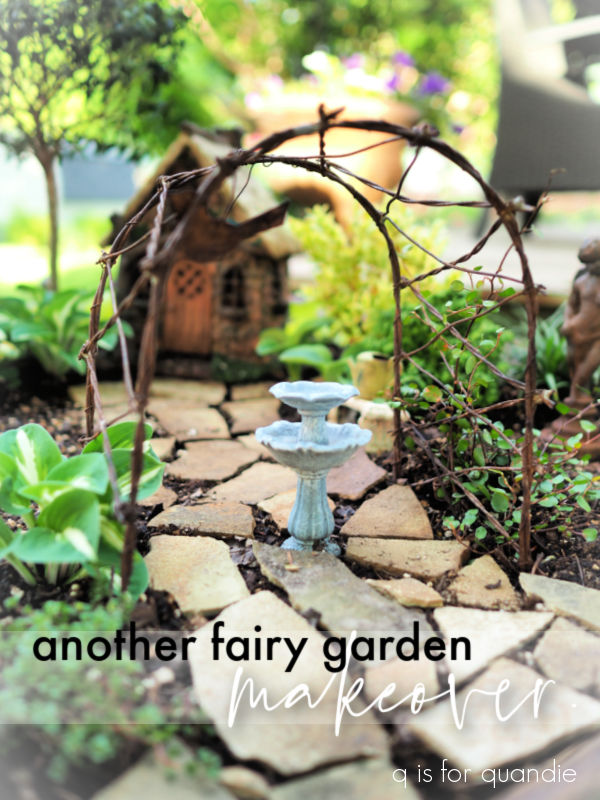
another fairy garden makeover.

Good morning from the garden!

If you’ve followed me for a while, you know all about my fairy garden.  However, just in case some of you are new here, I’ve had a fairy garden of some kind for many years.

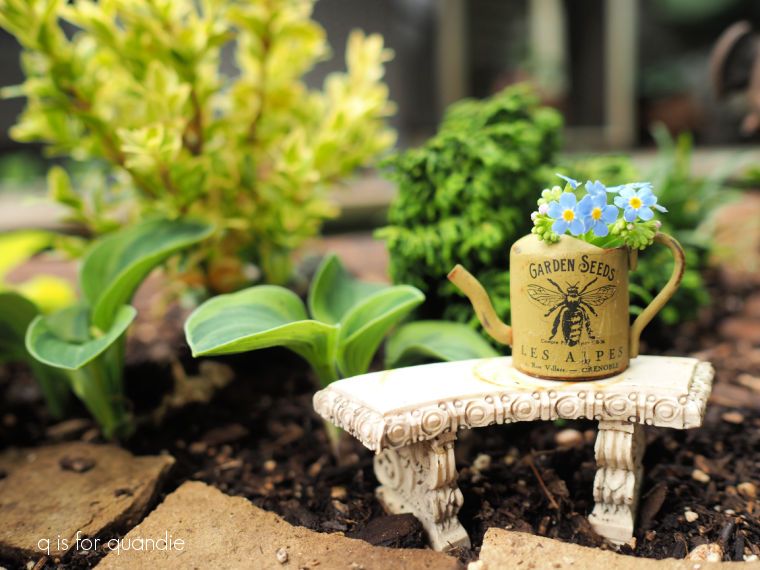
I love gardening in miniature!

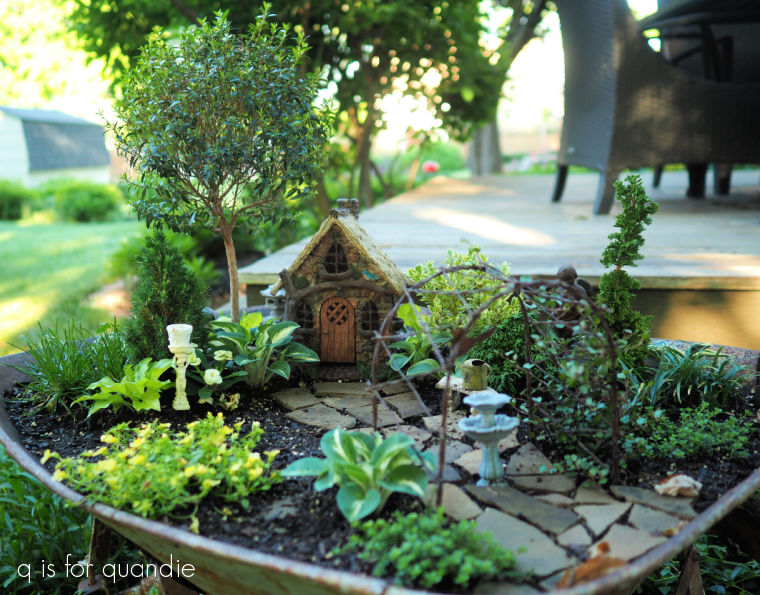
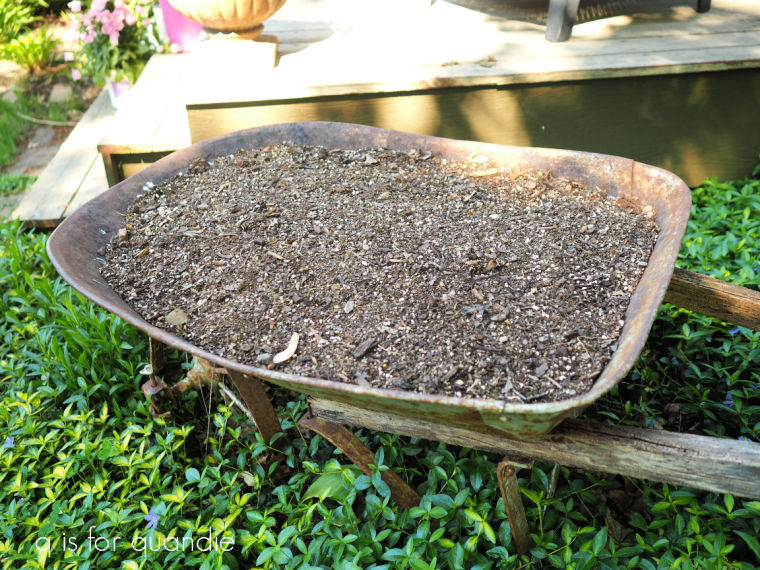
I use a mix of shrubs, perennials and annuals in my fairy garden which is planted in an old wheelbarrow with plenty of rusty holes for drainage.

Typically I add several inches of chopped up leaves and then a burlap cover for winter (we have pretty harsh winters here in Minnesota), but this past winter I never did get around to the cover (although I did add the leaves).  Unfortunately, I ended up losing everything that was planted in there as a result.

On the bright side, last fall I removed the miniature hostas and planted them in a somewhat protected area in the ground to overwinter and that worked out perfectly.  I also potted up the Myrtle topiary and kept it as a houseplant over the winter.

Also on the bright side, losing almost everything meant a chance to start over with a clean slate!

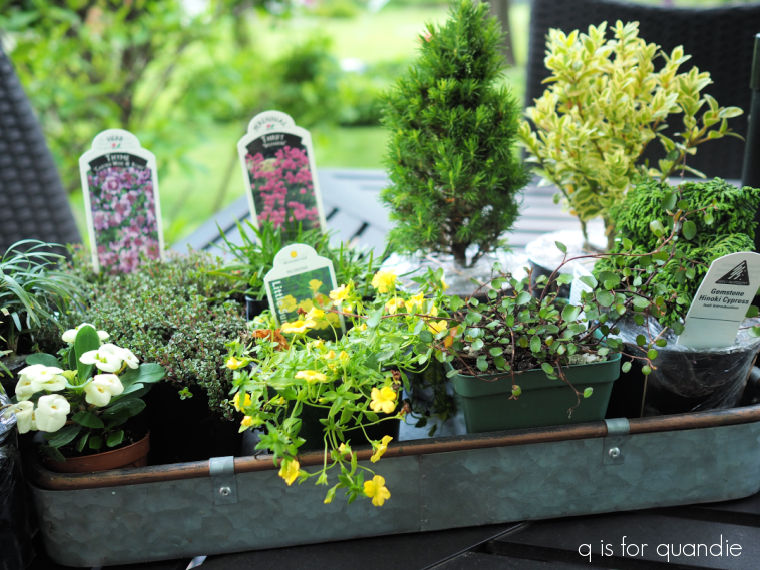
I started with mail ordering a bunch of miniature plants from TwoGreenThumbs.com.  They shipped my plants out quickly, and they were in really good shape when they arrived.  I will say that a few of them were a bit root-bound in their pots, but that’s an easy fix.  Just rough up the roots a bit before planting.

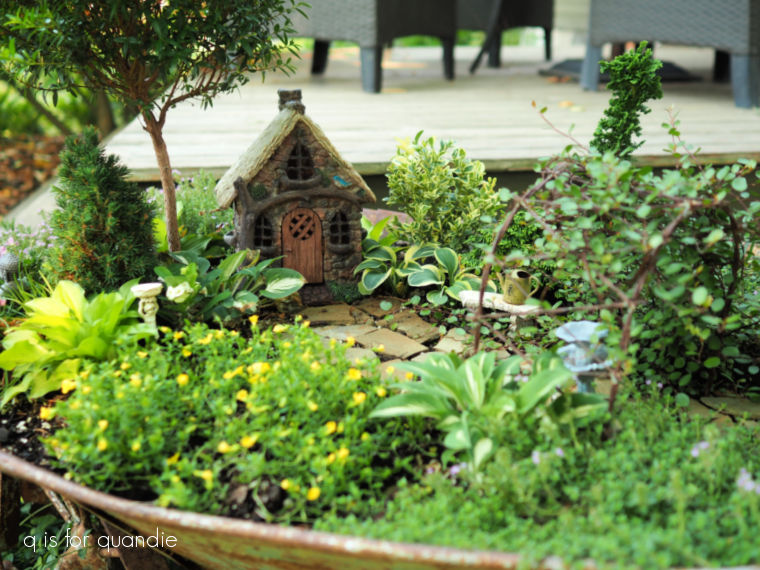
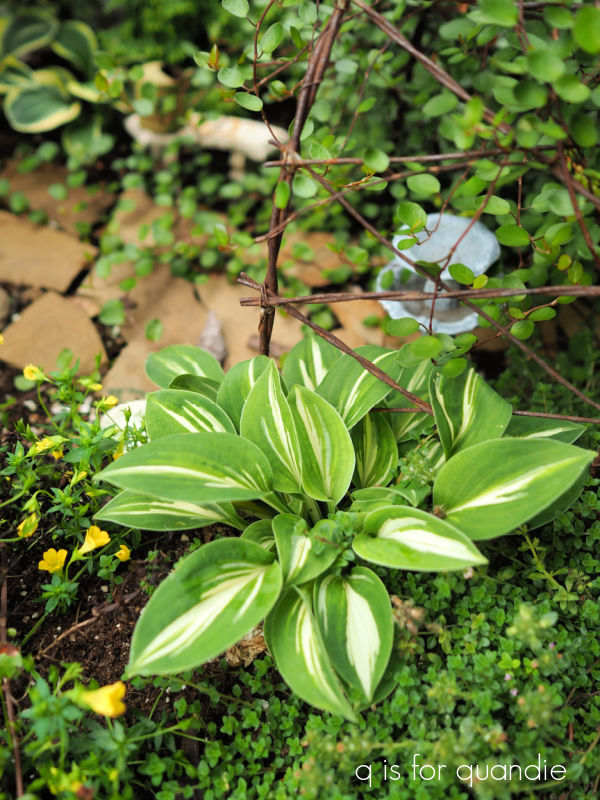
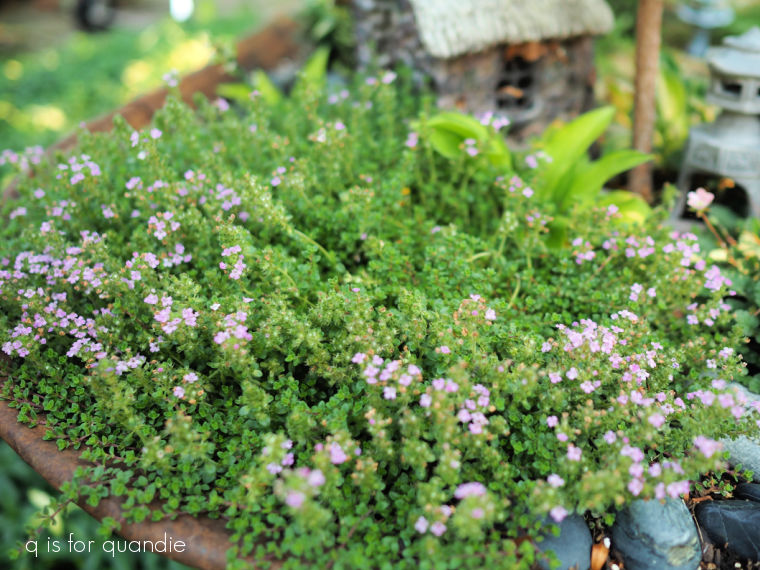
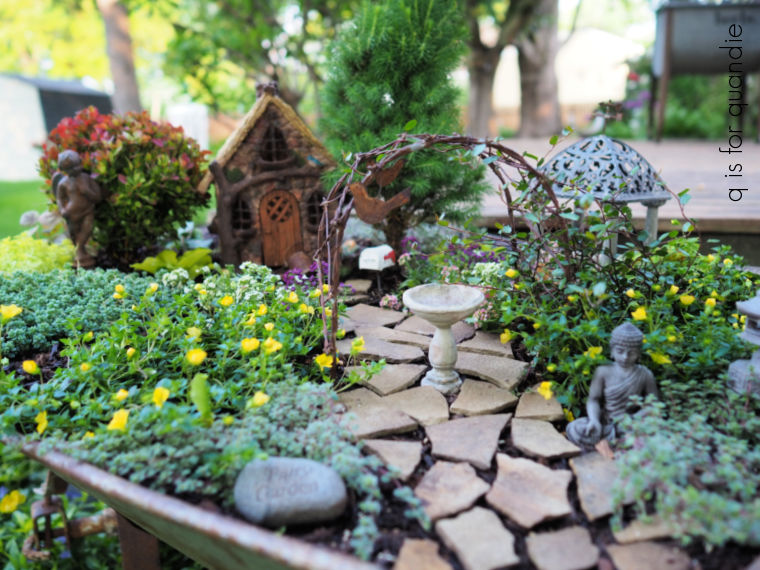
In addition to the plants that are specifically meant for miniature gardens, I also picked up a few ground cover type plants that always work well in miniature;  mecardonia (the plant with the yellow flower above), a creeping thyme, and a small leaf wire vine.  You can usually find those at any nursery or garden center.

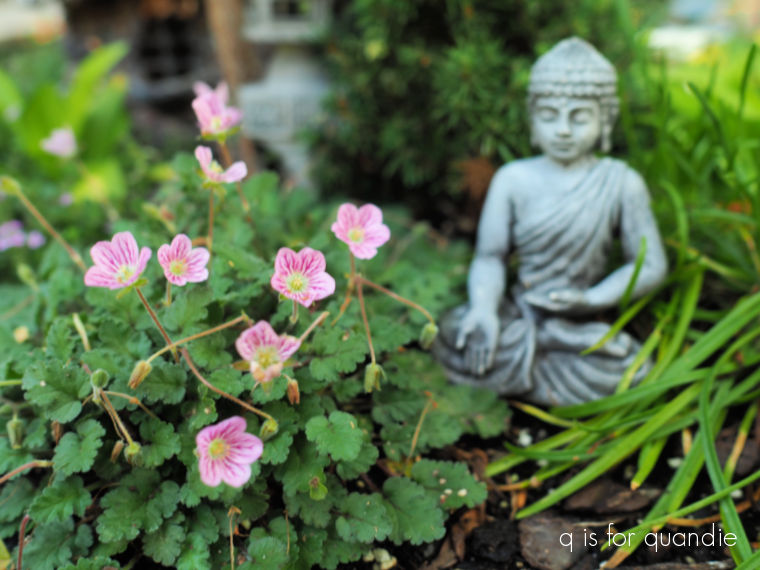
Another good option is alyssum, which is sold everywhere.  I didn’t get any this year, but I’ve used it in the past.  It’s the purple flower shown below.

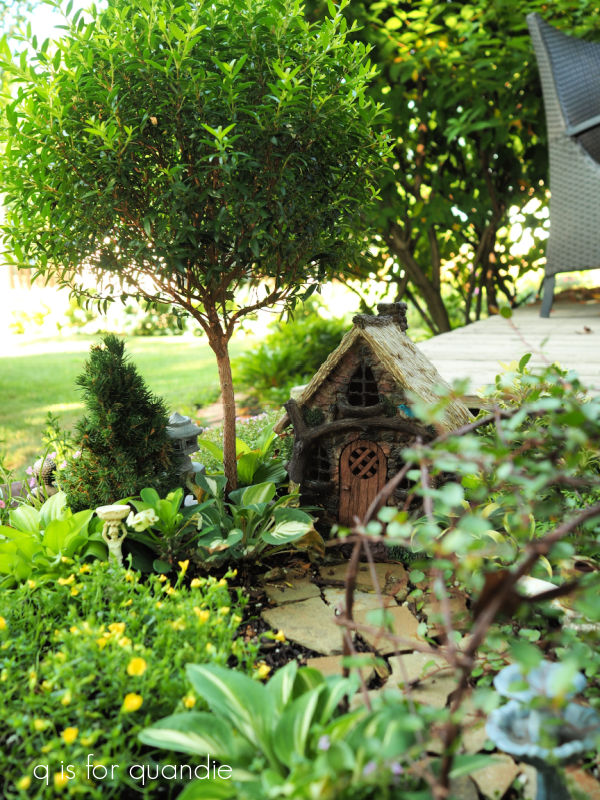
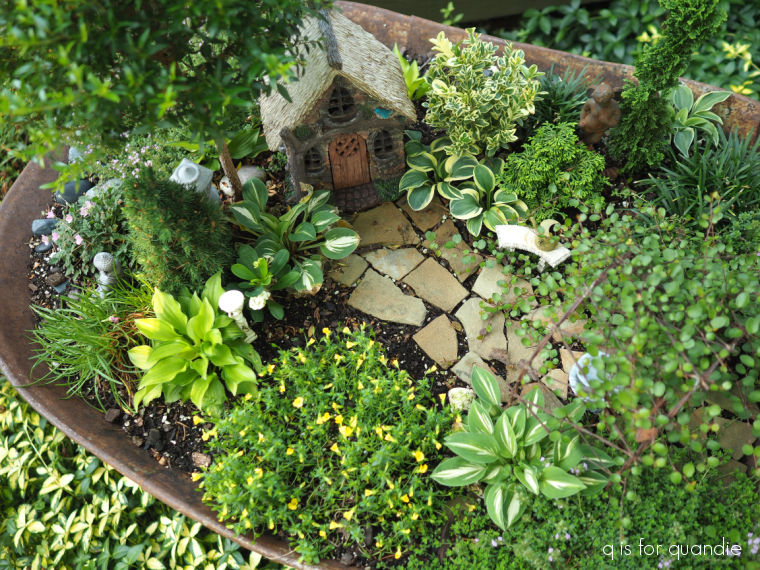
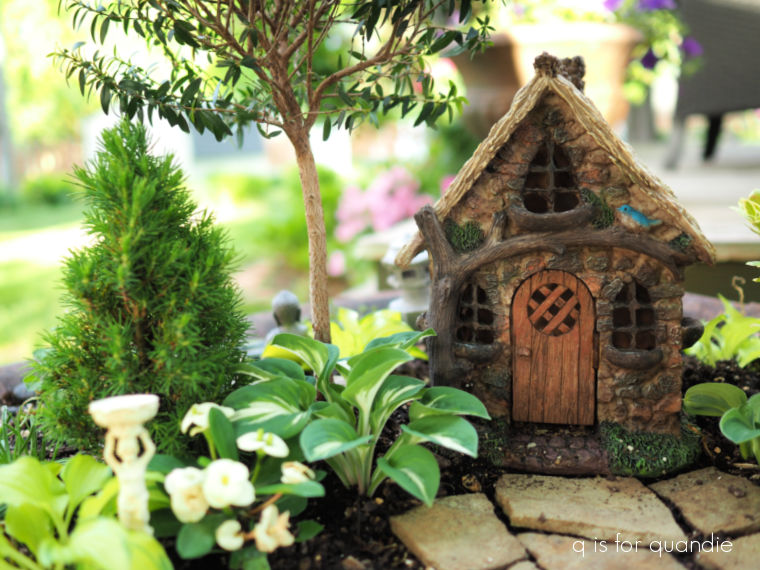
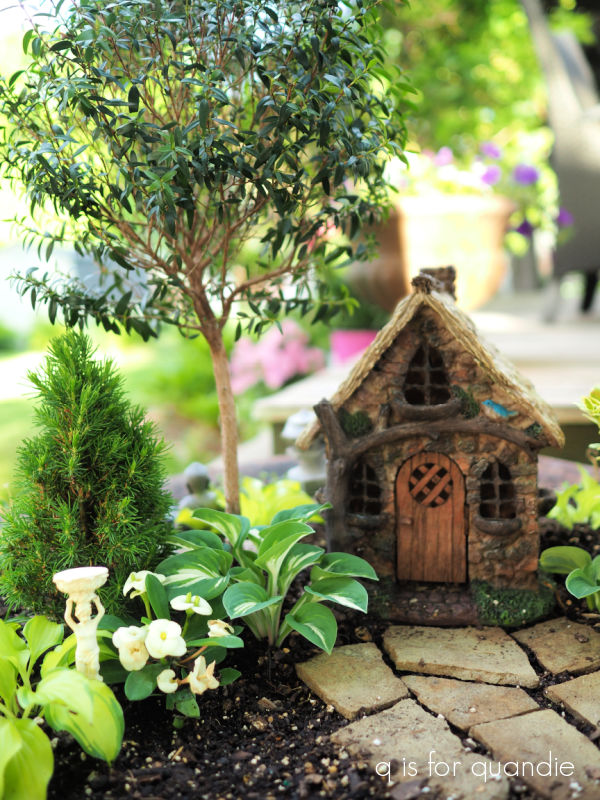
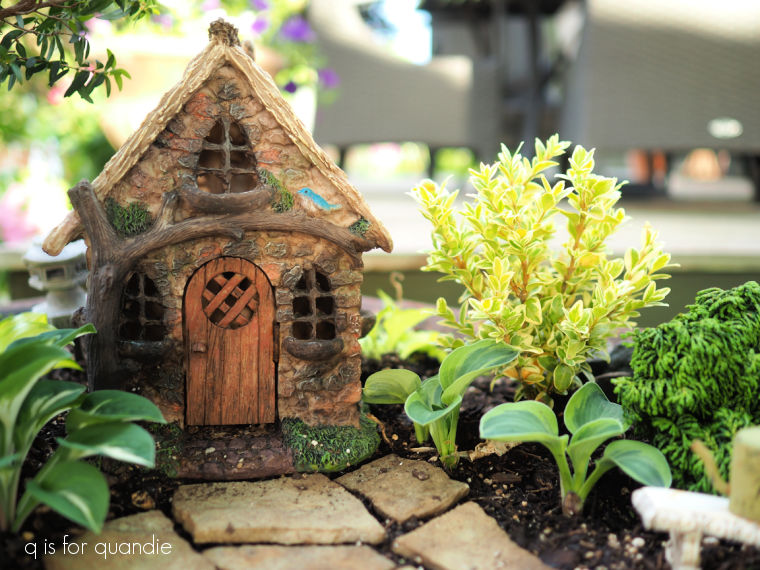
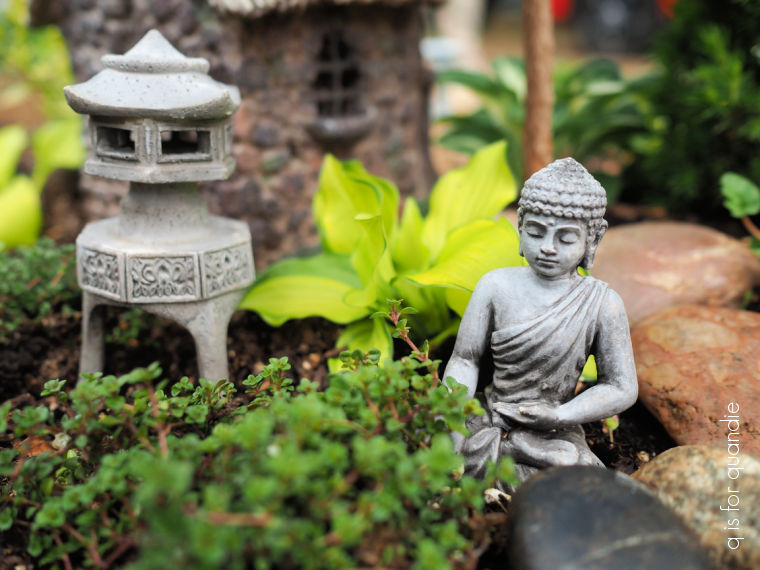
I began with placing the larger items including my fairy house and the myrtle standard that I saved over the winter.  It works perfectly as a ‘tree’.

I’ll probably prune it a little for size after it recovers from any transplant shock.

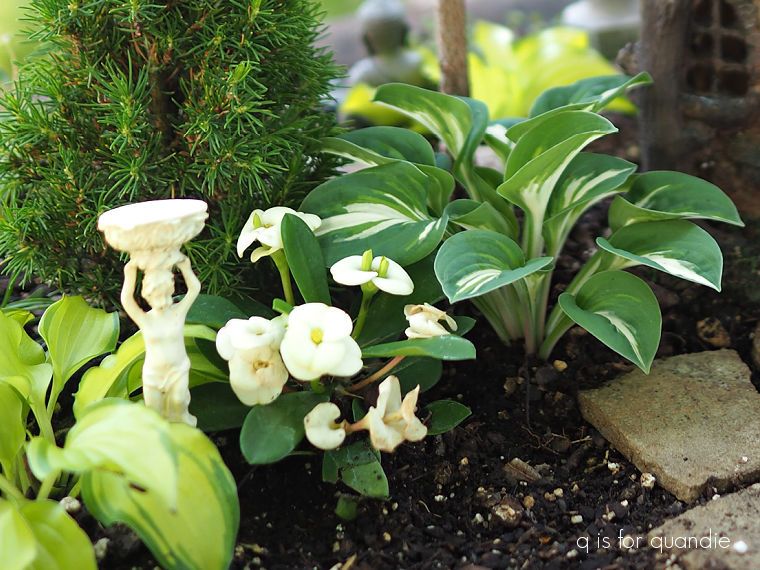
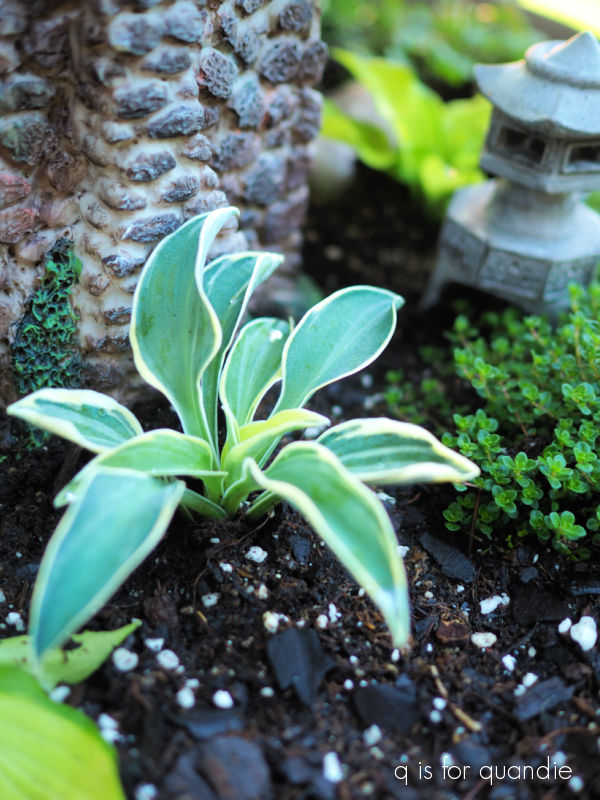
I added a Jean’s Dilly dwarf spruce under the myrtle, as well as one of the Pandora’s Box hostas that I saved from last year.

As for that little plant with the white flowers that is next to the hosta …

well, I have no idea what that is.  I bought it at Bachman’s, but it wasn’t labeled.  It sure is cute though.  Do any of you know what it might be?

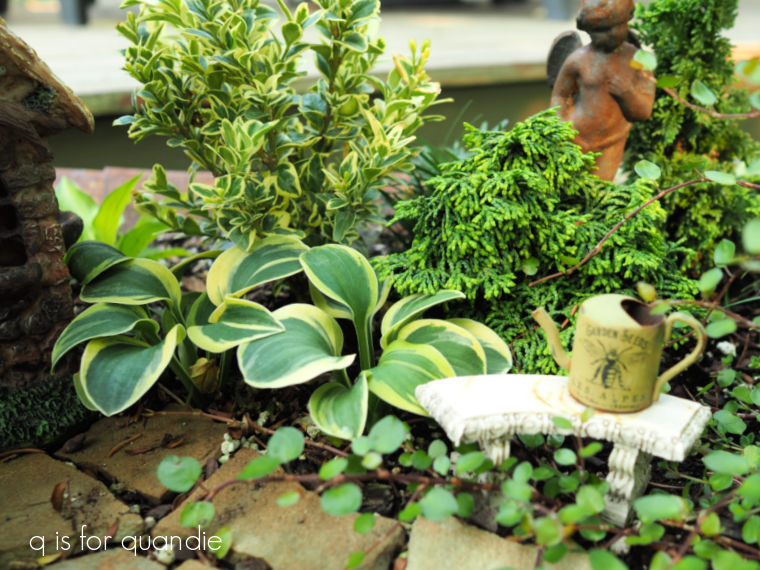
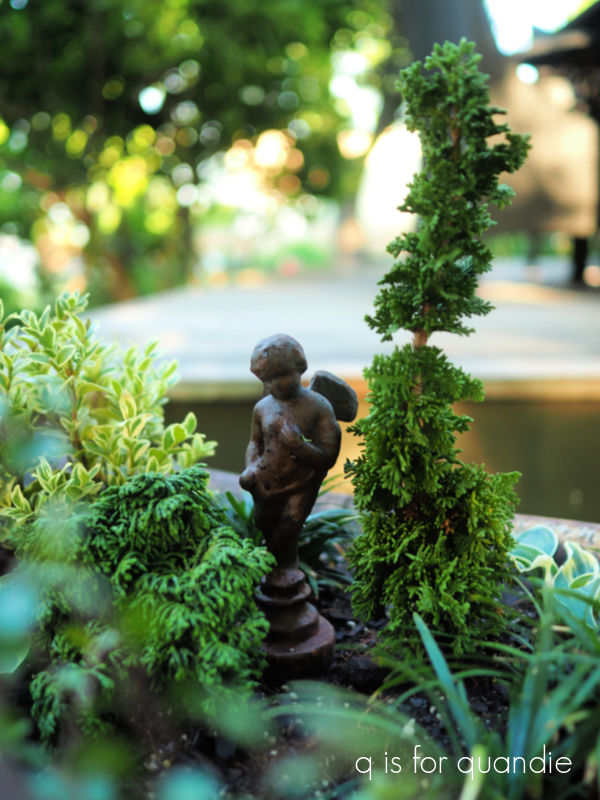
Over on the other side of the house I planted two shrubs, a variegated English boxwood and a Gemstone Hinoki cypress.

I ‘divided’ my Frosted Mouse Ears hostas and put two of them in front of the shrubs.

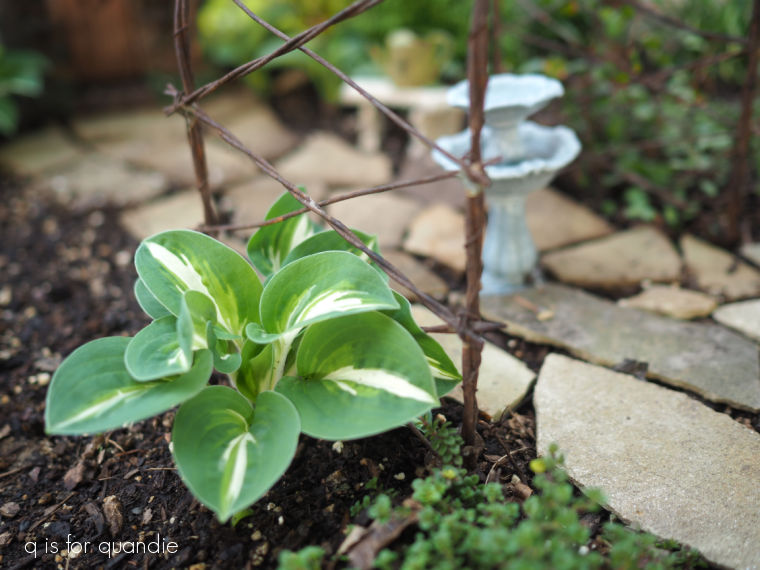
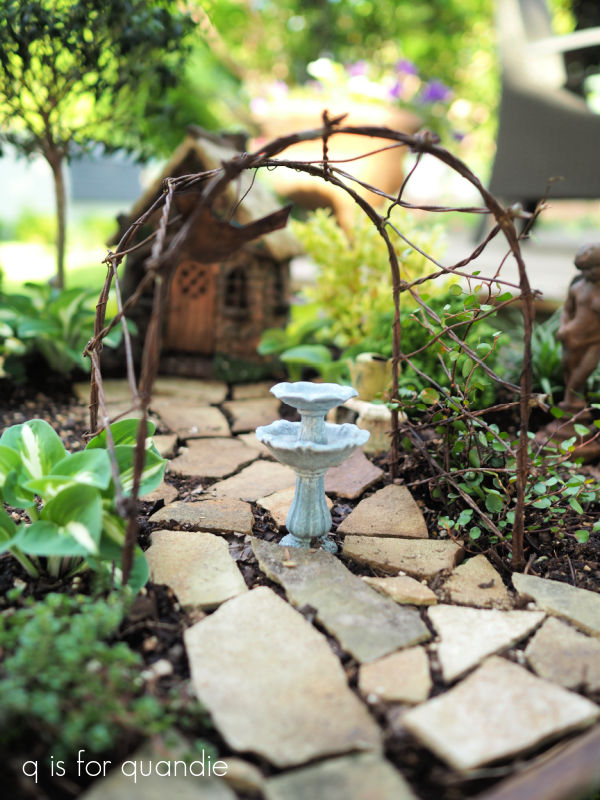
I planted another chunk of the Pandora’s Box next to the arbor.

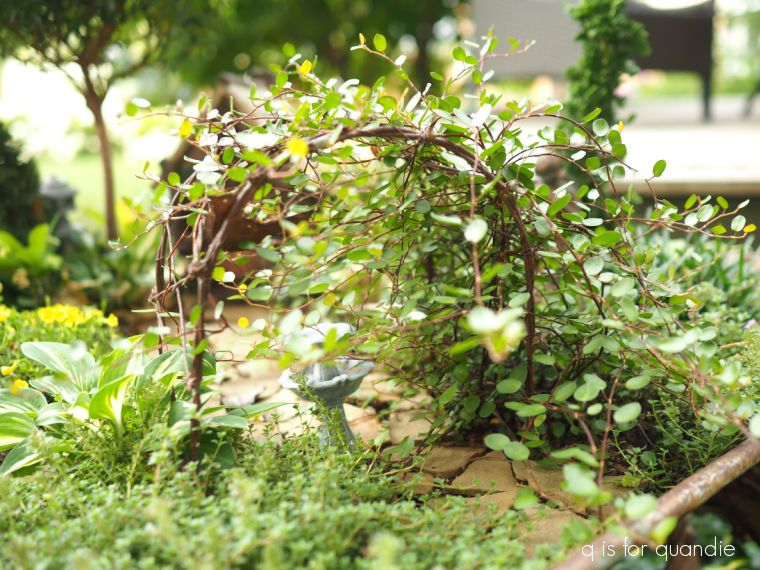
I planted the wire vine on the other side of the arbor and I will train it to grow up and over.

It will eventually try to take over the entire fairy garden, so I’ll have to clip it back quite often later in the summer.

I purchased a couple of Dwarf Mondo Grass plants from Two Green Thumbs, and I was able to divide them right out of the pot before planting.

I’ve never grown these before, so I’m looking forward to seeing how they do.

Around the back of the fairy house I planted a couple of the creeping thyme plants and several of my Feather Boa hostas.

I have a patch of the Feather Boa hostas in the ground near the potting shed, so I just take a chunk out of it for the fairy garden.

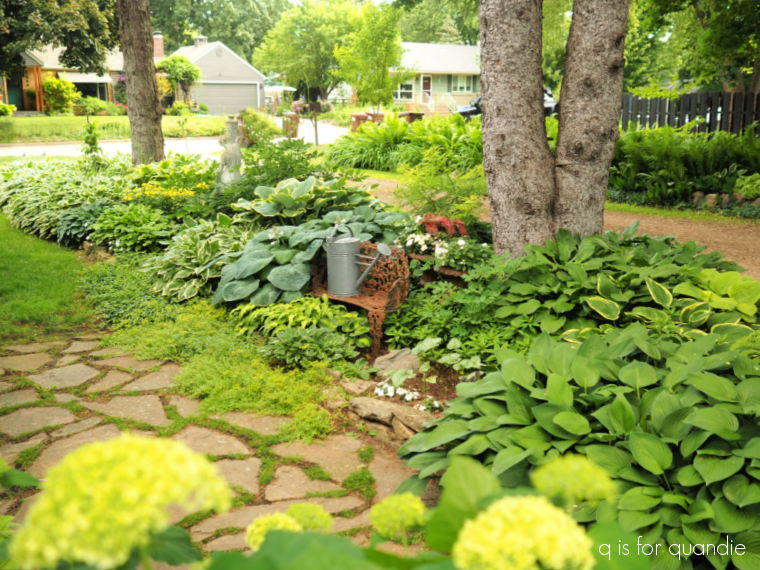
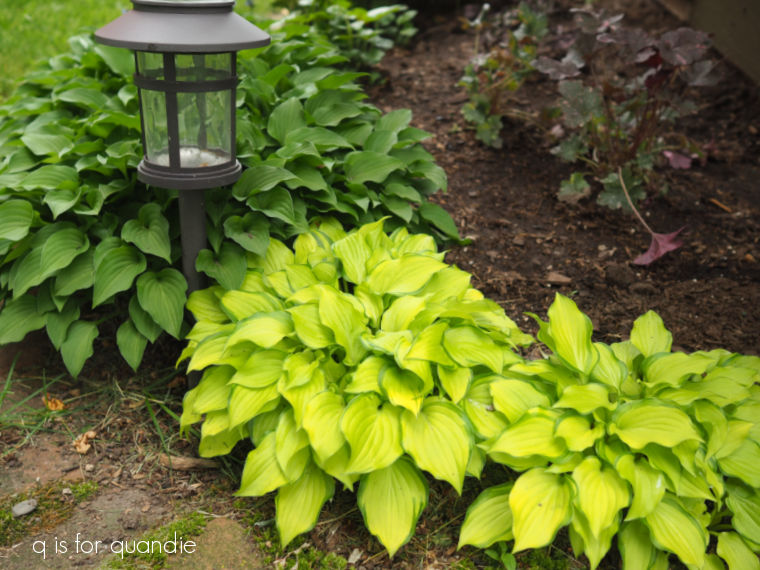
Today’s q tip on growing miniature hostas;  hostas are classified by their mature height into five categories, miniature, small, medium, large and giant.  The hostas in my fairy garden are all in the miniature category.  If you keep the miniature hostas confined in a small planter or pot, they will stay quite small.  If you put them in the ground, they will grow quite a bit larger and spread more.  Here is my patch of Feather Boa hostas in the ground.  Behind them on the left is another miniature hosta that originally came from my fairy garden, but I don’t remember the name of that one.

In addition to being perfect for a fairy garden, these miniature hostas make a fantastic front border for a shady garden.

Unfortunately, I do not have a good mail order source for miniature hostas.  Two Green Thumbs doesn’t carry any.  It looks like there are quite a few options for mail ordering them online, but having never ordered from any of them I can’t make a recommendation.

However, for my local readers, this past Friday I once again stopped in at Dragonfly Gardens in Amery, Wisconsin and they had a couple of miniature hostas available.  I purchased the Funny Mouse.  After I looked their supply over I found a pot that looked full enough that I could divide the hosta before planting it.  I ended up with three plants.  I planted one in my neighbor’s mom’s fairy garden, and two in my own.

I also found that Dragonfly had miniature trees!  I was able to pick up another Primo Arborvitae for $20 (the tall, skinny evergreen on the right in the photo below).

I had added one of these last year as well, but lost it over the winter.  I’ll try harder to save it this year.

I just can’t tell you how much I enjoy gardening in miniature.

If you don’t have space for a full sized garden, or you just don’t want to work that hard, a miniature garden is the way to go.  All you need is a container of some kind and a bit of imagination.

Have you got a miniature garden?  Or have I inspired you to consider adding one?

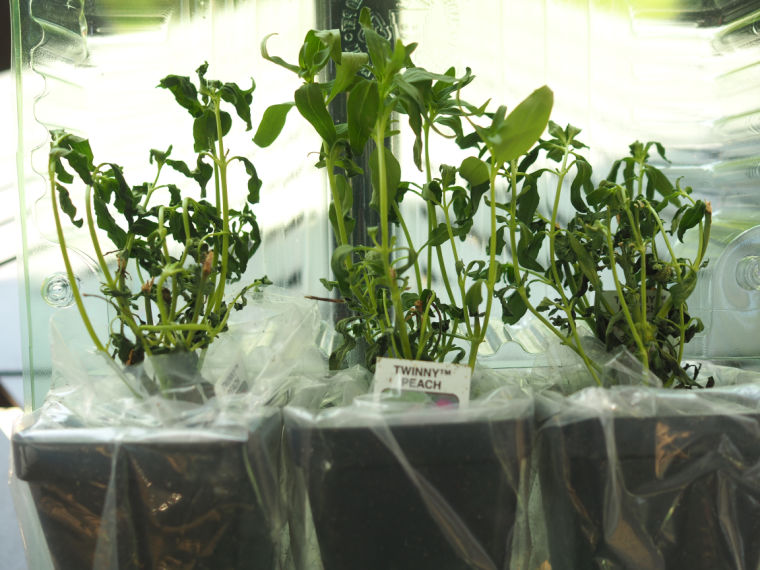
Before I let you go today I wanted to update you on my experiment with ordering ‘plugs’ online.  I ordered three apricot snapdragon plants from Holland Bulb Farms in Milwaukee.  It took them two weeks to get them shipped out, and that was only after I finally inquired about the status of my order.  When they did arrive, they looked like this …

They were bone dry and two were completely shriveled, with the 3rd one well on its way.  I have to wonder how long they were sitting in their packaging before being shipped out.

Shockingly enough, I paid $25 for these three snapdragon plants.  The plants were $15, with an additional $10 in shipping and tax added.  Somehow at that price point I expected a much higher quality plant.

I reached out to Holland Bulb Farms to let them know that the plants arrived in very poor condition and that I doubt they will survive being put in the ground.  Their response was that the plants still look green (I sent the pic shown above) and I should give them two weeks “with proper care” and they should bounce back.

So I’ve put them in the ground and they are starting to look a little bit better, but definitely are not thriving.  I think it will be a miracle if I get any flowers on them by July.

Well, I guess I’ll let this be a lesson to me, and possibly to you too.  Ordering annuals like this is probably not something that’s worth doing for me.  How about you?  Have you ever ordered plants this way, and did you have any luck?  Leave a comment and let me know.

the late spring garden.

Good morning from the garden!

Late May and early June is when my now-sunny border really puts on a show.

If you’ve followed me for long, you’ll remember that my next door neighbor took down a huge tree back in 2024.  As a result, I now have a lot more sun in the backyard.

At the time I was quite bummed out about it, and I do still feel like our backyard is much more exposed.

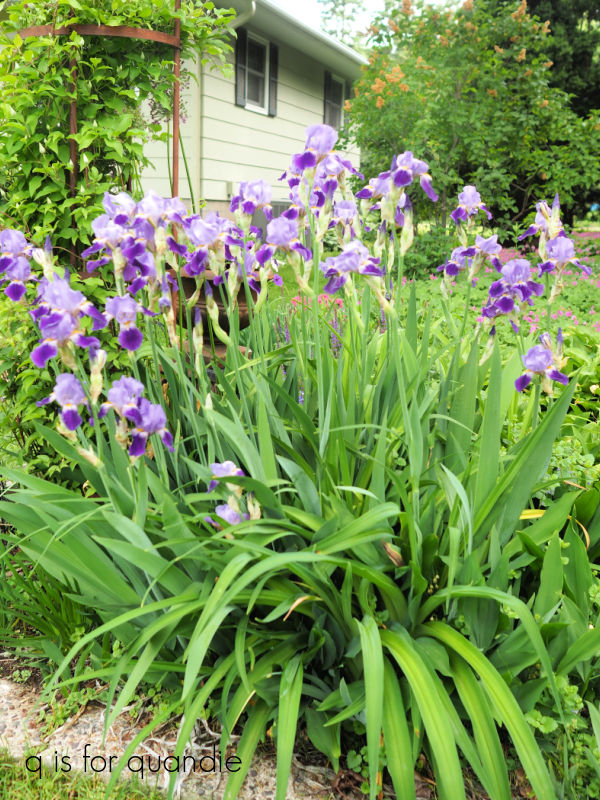
But looking on the bright side (pardon the pun), the irises are really thriving now.

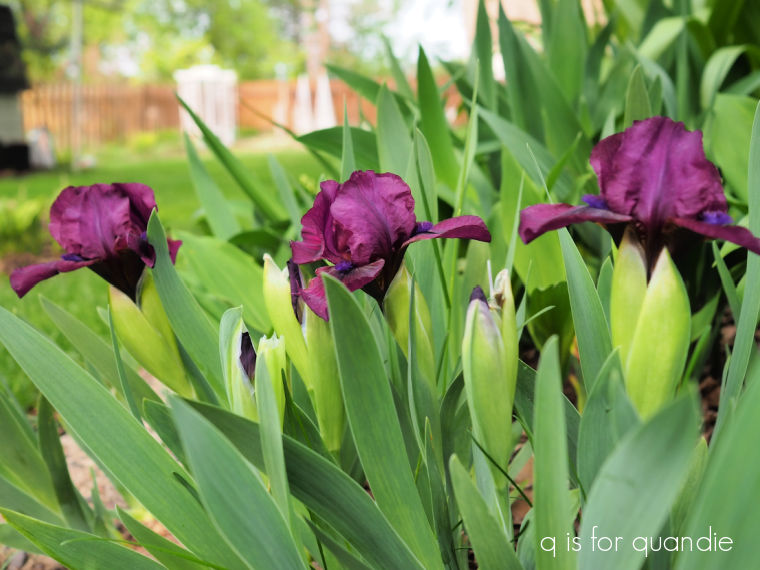
The purple irises above were originally a garage sale purchase.  Last year (or maybe the year before?),  I also purchased another purple and white iris at a garage sale that is just starting to bloom.

I’ve had the yellow irises forever.  In fact, at this point I’m not even sure if I originally planted them or if they were already here when we bought our house back in 1988.  I don’t really remember.

I’ve moved them around a few times over the years and now have them in a couple of different spots.

They work great in the garden next to the carriage house.

I always have to remind myself not to use pink in that particular garden bed, it really clashes with the red siding, but the yellow seems to work.

I planted some Mount Everest allium here two years ago, and they just opened up this week.

If you have a garden and you haven’t discovered alliums yet, you should definitely get some.  I shared a blog post all about them back in 2022, so check that out for more detail.

My Purple Sensation allium are on their way out right now, but you saw them in my garden post last week …

I’ve got some Globemaster allium that aren’t quite open yet too.

If you add a few different varieties of allium you can really stretch out their bloom times.

Some of my peonies are starting to open, mainly just this single version so far …

The peonies behind the carriage house in my cutting garden are still just loaded with buds.  So we still have those to look forward to.

Before I let you go this morning, I want to share another amazing plant that I think is underrated. Geranium macrorrhizum, or Bigroot Geranium.

This is a a rhizomatous semi-evergreen perennial, so in plain English, it’s a plant that spreads by rhizomes that sit just on the surface of the soil, it can stay fairly green all winter under the snow (well, maybe not quite green, but let’s just say alive), and it comes back every year.

It is almost indestructible.

I encouraged it to grow on the west side of our house on a small slope that has black plastic with rock over it (installed by the previous home owner).

Let me elaborate a little on what I meant by “I encouraged it to grow”.  Basically I pulled some chunks of it out of another area, cut a small slit in the black plastic and tucked it in there.

And it has taken off and filled in the entire space.  It looks so much nicer than the rocks ever did.

This is its first, and always best, flush of blooms for the year.  However, it will continue to bloom all summer long, just not as robustly.

If you happen to be battling creeping bellflower, a.k.a. the worst weed ever, Bigroot Geranium will create a dense, weed-suppressing mat that can help keep it in check.  Another plus, it is deer and rabbit resistant.  It will also grow in anything from full sun to dry shade.  Best of all, it is nearly maintenance free.  You do not have to dead head (although you can if you want to encourage another flush of blooms), cut it back, remove dead foliage or really anything.  I literally do nothing for that patch alongside the house, I don’t even water it.

As for cons, I will say that it wilts quite a bit under a hot afternoon sun which looks a little unsightly, however it does bounce back by evening.  It also can really take over an area, even one that is mainly rocks on top of plastic, as you can see above.  That being said, very little effort is required to keep it in check by yanking it out.

If you are local, you have the chance to see my gardens in person by coming to my upcoming occasional sale.

Feel free to wander around and check them out while you are here.

I’ll post my address later this week, so be sure to stay tuned.

In the meantime, have you tried Bigroot Geranium in your garden?  How about alliums?  Or maybe you have irises that are in full bloom right now.  Leave a comment and let me know!

a cottage garden.

Good morning from the garden!

I was watching a YouTube video the other day by Alexandra Campbell from The Middle-Sized Garden about cottage gardens.  I’ve always said that my gardens are cottage style.  They certainly aren’t formal, or modern, or tropical.  I don’t have a Japanese garden or a Mediterranean garden.  Surely I must have a cottage garden, right?

However, Alexandra listed a handful of characteristics that define a cottage garden, and now I’m starting to wonder if my garden qualifies.

One characteristic of a cottage garden that is mentioned in the video is a mix of flowers and vegetables.

Nope.  Not a veggie in sight.  And actually, there aren’t even a lot of flowers in sight in the shadier areas.  I’m more about the colorful foliage.
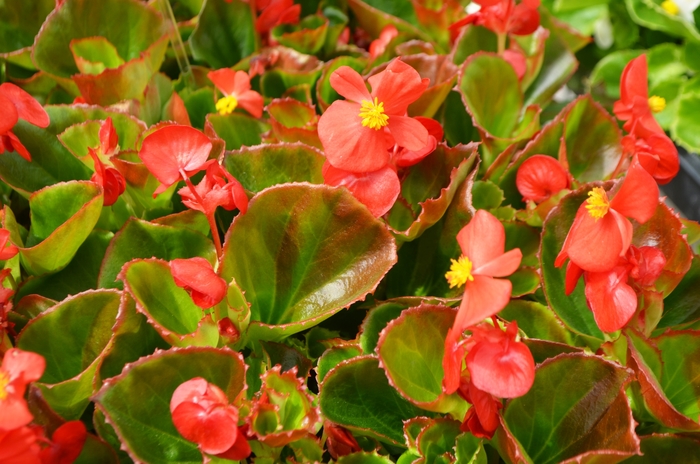
I am starting to add a lot more flowering plants in the back where I have more sun now though.

Next up, having lots of self-seeders.  Um, not really.  I have very few.  My beloved Verbena Bonariensis is a self-seeder.

And so is the Serendipity Allium.

But I tend to be a ruthless weeder in the spring and early summer, so I mostly destroy any seedlings that dare to come up.

She also mentioned that if you have more garden than lawn, you have a cottage garden.

Hmmm.  I’m not quite there (my front yard is almost all lawn, or should I say mostly creeping charlie).  I’m working on it though 😉

She listed some of the must-have plants in a cottage garden and the first one was roses.  Clearly she hasn’t had to deal with Japanese beetles.  I used to have a few more roses, but I’ve pulled all of them out now except for one.  I just can’t deal with those pesky beetles!

But she also mentioned peonies, and I have those in spades.

Lastly, another characteristic of a cottage garden is that plants are absolutely crammed in.

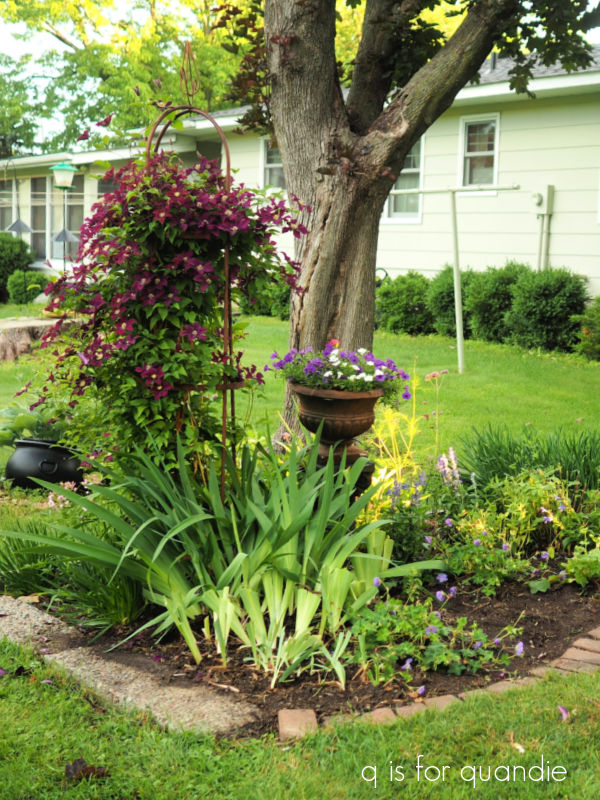
OK, I definitely have that one covered!  And P.S. both my alliums and my irises are looking amazing this year.

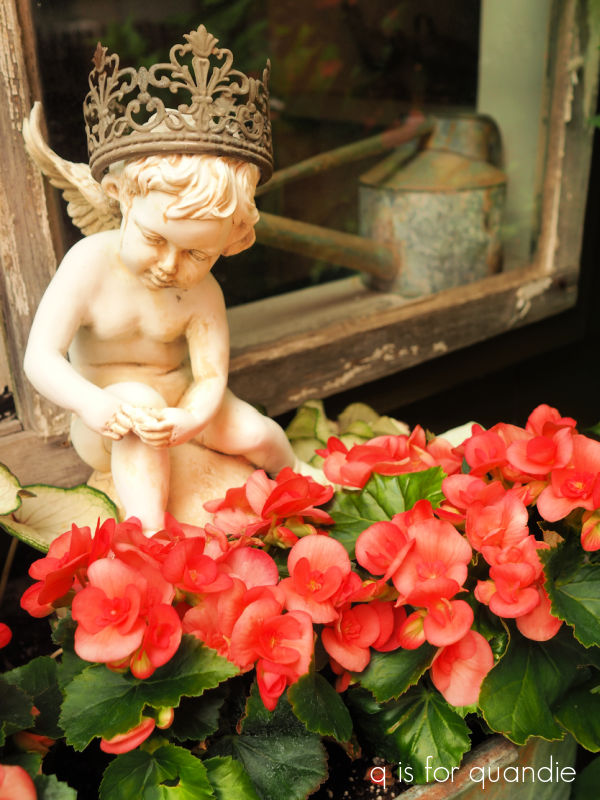
Another characteristic mentioned was having garden ornaments that don’t look brand new.  My latest acquisition, a lovely concrete cherub that I purchased at my friend Lisa’s shed sale is perfect for a cottage garden.

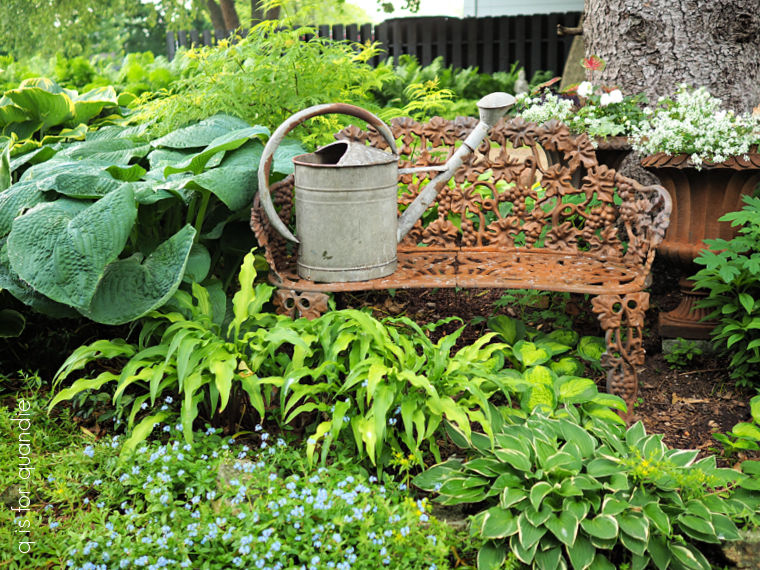
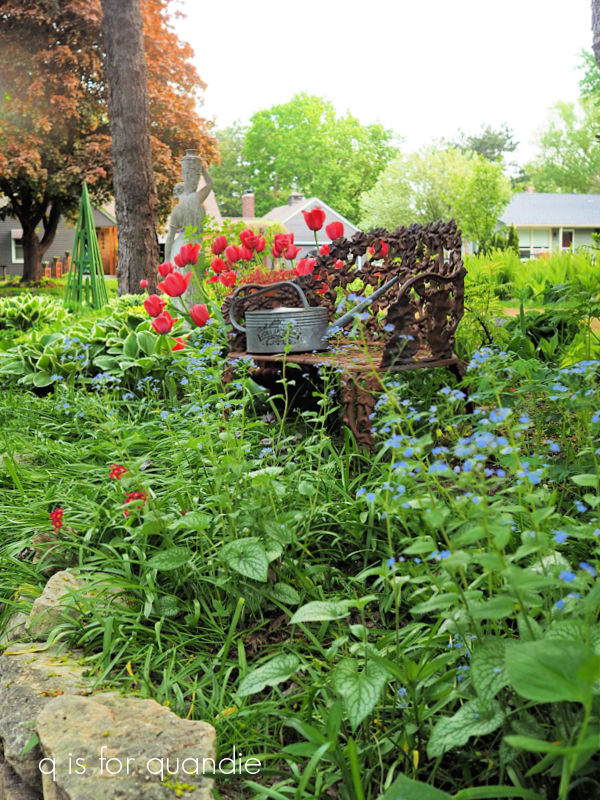
And you know me, I have plenty of things in my garden that don’t look new, almost all of them coming from garage sales or hand-me-downs, like my rusty bench.

Ultimately, Alexandra says you don’t have to have all of the characteristics to qualify as having a cottage garden.  So I definitely think I can continue to call my gardens cottage style.

How about you?  Do you have a cottage garden?  Or perhaps you have another style.  Leave a comment and let me know!

planting plugs.

Good morning from the garden!

It has been awhile since I’ve sent out a Sunday morning in the garden post.  In fact, the last one was on December 14 of last year!

Things are definitely looking a bit different now.

Once again, I am out in the garden.  I’ve been super busy getting things cleaned up, mulched and weeded.  I’ve also been shopping for plants!

I know I’ve said it here before, but just as a reminder to my local readers, Country Sun Farm in Lake Elmo has far and away the best annuals around.

I’ve been to nearly every garden center in my area over the last week or so, and they outshine all of them.

And no, this is not a sponsored post in any way.

As for prices, at $6.99 for a 4.5″ pot they are no more expensive than the same size from Fleet Farm or Bachman’s.

They do only sell annuals, no perennials, and they get picked over fast.  I purchased a couple of gorgeous caladium on my first visit, and then the rest were already gone when I went back a few days later.

I also visited Dragonfly Gardens in Amery, Wisconsin last week.  It’s a garden center that focuses on native plants.  I have to admit, I’m not a big fan of native plants.  I know they are good for wildlife, low maintenance once established and are less prone to pests.  But honestly, not too many of them appeal to me.

However, what I discovered last week is that Dragonfly also sells plugs.

If you aren’t familiar, plugs are young plants cultivated in individual cells, typically in seed trays, that are ready for transplanting into larger containers or directly into the soil.  They are much more cost effective than perennials that are already potted up.  For example, a one gallon perennial at Dragonfly is $14.99 and a plug is only $7.99.  So that’s almost a 50% savings.

If you are planning to plant some perennials en masse … or even just in a grouping of 3 or 5, this is a much more affordable way to do that.

You might be thinking that planting something this tiny must mean that it takes forever for them to turn into a full sized plant, but from everything I’ve read online, theoretically they catch up in just one growing season.

I’ve never planted plugs before, mainly because I’ve never seen them sold in a garden center.  I know you can order them online, but it just never has occurred to me to do that.  So I’ve decided to give it a go.  I purchased three Candytuft plugs and three Brunnera plugs.

At Dragonfly, you simply pop the plug into a small paper sack to take it away.  Just keep in mind that you have to plant them fairly quickly … or otherwise keep them from drying out until you can.  I planted mine right away the next day.

Another big benefit to planting plugs is that it’s easier to get them in the ground.  You just need a small hole.  That works especially well if you’re planting around tree roots, or, as in my case, you don’t want to disturb too many of your scilla bulbs.

Another reason to purchase plugs is if you don’t have the space or the inclination to start things from seed yourself.  You can purchase all kinds of annuals as plugs too, including many vegetable plants.

I plan to update you all near the end of the growing season to let you know how the plugs worked out for me.  So be sure to stay tuned!

In the meantime, have you ever planted plugs?  Leave a comment and let me know.

back home once again.

I’m back from a lovely 10 days spent at my mom’s place just outside Las Vegas.

The weather was nearly perfect with temps in the 70’s to low 80’s, along with brilliant sunshine every. single. day.  Do the locals ever get tired of that unrelenting sun?  You gotta wonder.  Personally I appreciate the occasional rainy day for some contrast.

However, I loved being able to enjoy my coffee on the patio every morning while listening to the birds singing.  Unfortunately here in Minnesota we’re still having morning temps in the 30’s and 40’s, which is just a bit too brisk for coffee on the deck.

I also really enjoyed the walking trail near my mom’s house.  While most of the trail isn’t very green, there are some nice mountains off in the distance (and if you were to turn around and face the other direction you might catch some glimpses of the Vegas strip off in the distance).

But then there is my favorite section of the trail which someone has nicknamed Trail Heaven.

It has some lovely dappled shade.

I did do some painting while at my mom’s, the door into her garage was well overdue for a touch up.  I purchased some Sherwin Williams “door and trim” paint from Lowes, and as I started using it I quickly realized how much nicer it is to work with Dixie Belle paint.  The Sherwin Williams paint was rather thick, and if you brushed back over it at all it would drag back off.  I ended up having to let the first coat dry, then had to sand it down again and start over.  What a mess.

In hindsight, I wish I had brought some Dixie Belle paint with me like I did when I painted her front door.

I painted that in Dixie Belle’s Midnight Green Silk Paint back in March 2022 and it still looks great.

I also did some gardening … of a sort.  I raked the matted pine needles out of the rock bed that runs alongside the sidewalk next to the fence.

I pulled out five grocery bags of pine needles!

But I’m back home now, and first of all I want to thank all of you who left comments on my re-run posts while I was gone.  My mom doesn’t have wi-fi, and I’m practically incapable of typing comment responses on my teeny tiny phone.  But I did read all of your comments, so thank you so much if you left one.

Now, onward.  It’s starting to feel like spring in Minnesota.  The muscari is blooming …

as is the white bleeding heart …

and the brunnera.

But as is always the case, I did suffer some losses over the winter.  It looks like my favorite lungwort is not coming back this year.  Here it was in 2023 …

But it was significantly diminished in size last summer, and now I don’t see any sign of it coming up at all.  Bummer.  Looks like I’m gonna need to do some plant shopping 😉

That being said, I didn’t suffer nearly as much damage this year as I did last year when the the frost line was deeper than any year since 2019.  Thank goodness.

I always find it difficult to imagine that the garden that looks like this right now …

is going to look like this in just a few weeks.

I’m feeling very impatient and ready for it to warm up a bit more, and for things to grow!

I also have some fun makeover projects underway and hope to be sharing some of those with you soon, so be sure to stay tuned!

a winter garden tour.

Good morning from the garden!

Brrrrr!!  It has been cold here!  Sub-zero temps in December are not my favorite.  However, we had some really beautiful snow earlier this week, so I thought some of you might enjoy a tour of the winter garden.

So bundle up, grab a hot beverage, and let’s go!

Cossetta (my statue) has her feet buried in snow, but it’s not quite above her knees yet.

Here she is in January 2023 when she had snow up to her waist!

Will we get that much snow this year?  I don’t know, but we’re off to a good start.

Most of the plants that I left standing in the garden have been buried in snow already, but for now the allium is still standing.  I like how the snow looks like little pointy caps on their heads.

If we get much more snow, they will eventually end up buried as well though.

Speaking of buried, sometimes I’m not sure why I bother with winter window box arrangements when they will just end up covered in snow.

Then again, you never know.  Last year we barely had a dusting of snow by Christmas, so I was able to enjoy my winter window boxes much longer.

Besides, the spruce tips do look pretty covered in snow …

and even in icicles in some cases.

If you remember my post about these winter arrangements, you might be wondering if the ornamental kale and the heuchera that I kept in place are surviving.

I was hoping they would at least last through Christmas, but again, I never expected sub-zero temps this early in the season.  So the answer is no, they didn’t even survive much past Thanksgiving.

We had a bit of wind with this snowfall, so some areas drifted more than others.

I’m glad I didn’t leave my red and white skates on the bench because they would definitely be buried.

They are still looking good hanging from the chippy sled though.

The potting shed is looking festive.

I’ve hung one of my sleds beside the door, and although you can’t see them very well in that photo, I have some star burst lights hanging from the roof on the right.

They do a good job of lighting up the garden after dark.

I had grandiose plans of putting a Christmas tree inside the potting shed this year, but I let it go too long and now it’s far too cold to be out there setting up a tree.  Maybe next year?

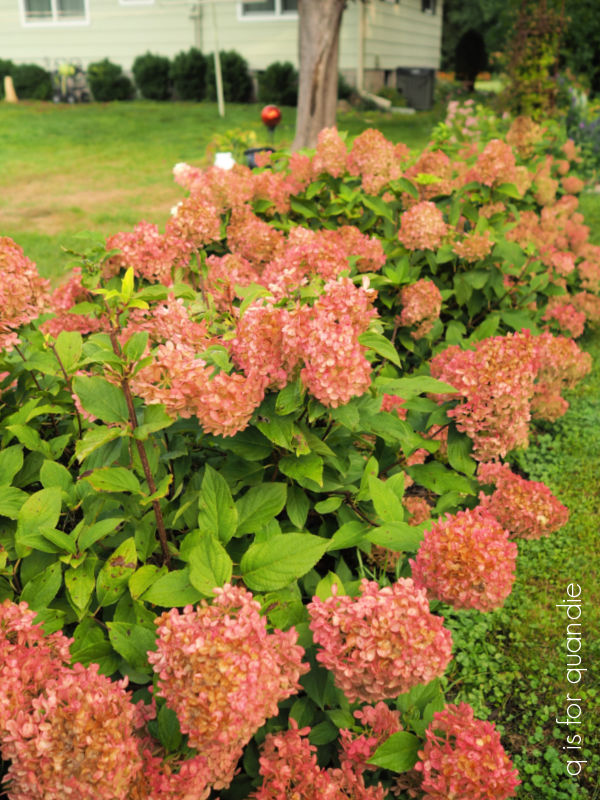
Even though I cut quite a lot of my hydrangea flowers to dry this year, there are still plenty left.  I like to leave them in place for the winter to add some interest to the garden.  They catch the snow quite nicely.

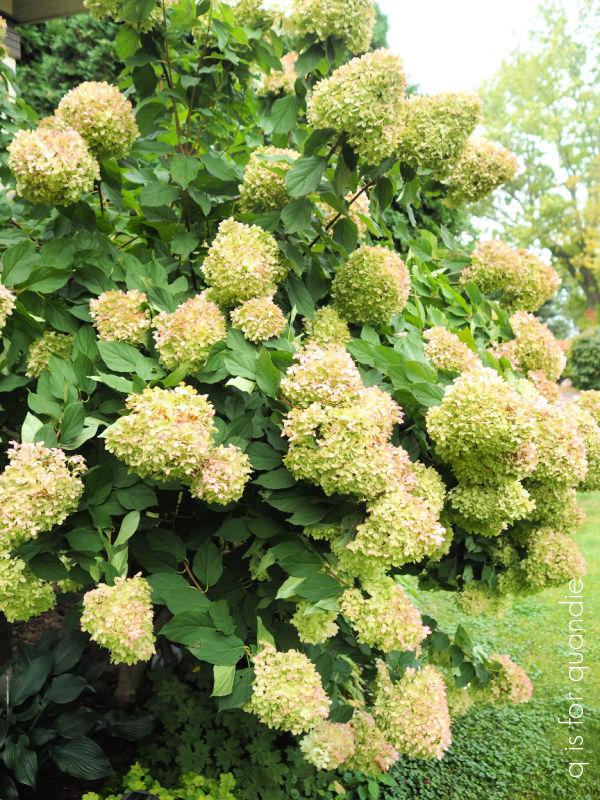
Especially the large Limelight hydrangea to the right of our front door.

It ends up looking like a snowball bush!

As always, the carriage house provide a festive pop of red in a snowy landscape.

It’s definitely looking like we’ll have a white Christmas this year.

Now it’s time to head back inside to warm up with some hot cocoa.  But how about you?  Have you had much snow where you are?  Leave a comment and let me know.

winter window boxes.

Good morning from the garden!

You may remember that a couple of years ago I made the mistake of not cutting and drying any of my hydrangeas before they turned brown.

Well, I definitely did not make the same mistake this year.  I had bushels and bushels of hydrangeas drying in the carriage house and in the potting shed.

  I also dried more allium and astilbe flowers this year.

So a week or so ago when we had an unseasonably gorgeous day, sunny and a high of 70°, I took advantage of the beautiful weather and put together my winter window box arrangements.

Honestly, it’s lucky that I have so much dried material to work with because I have a lot of containers to fill outside.  I usually put arrangements in both of my galvanized boiler ‘window boxes’, my two rusty planters at the back door, one or two rusty planters in the shade garden, and my ginormous window box on the front of the house.  If I had to buy everything to fill all of those each winter it would cost a fortune.

I started with the galvanized boiler window box on the carriage house.  I had done a fall arrangement in that one right before my sale, and although the mum I used had totally bit the dust, the ornamental kale and heuchera still looked pretty good.  So I decided to leave them in place.

The kale can handle temps down to around 5°, so hopefully they will last through Christmas.  In case you are new here, I garden in zone 5a in a suburb of St. Paul, MN.  So yes, we’ll definitely get colder than 5° over the course of the winter.  Eventually they will start to look pretty sad.  As for the heuchera (dark purple foliage at bottom left), so far it seems to handle a bit of freezing weather as well (we have had lows in the 20’s already).

Since I was keeping those deep purple shades, I decided to use the Vanilla Strawberry dried hydrangeas because they dried to nearly that same color this year.

In case you aren’t familiar, the flowers on this variety start out white and then slowly turn  more and more pink as they age.  I waited longer to harvest them this year, so they were pretty dark when I cut them.
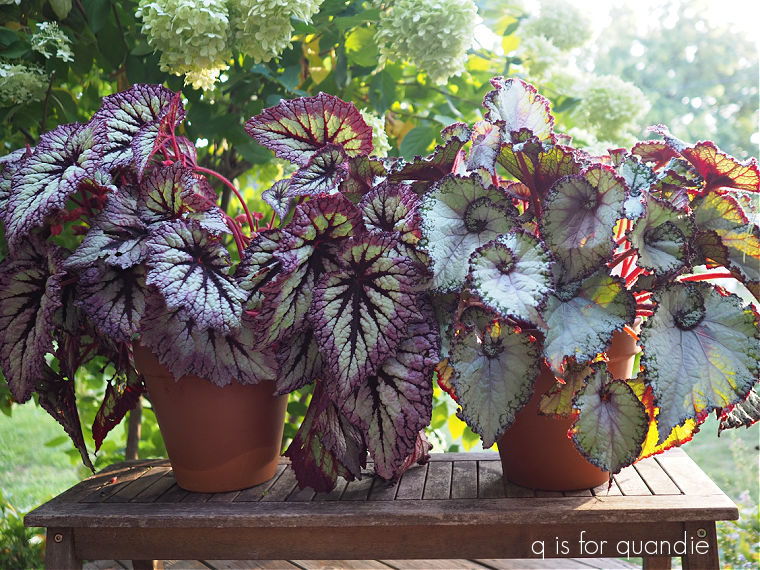
After filling in the back of the planter with the Vanilla Strawberry, I used some of my dried Little Lime  flowers in the front.

I then decided to embellish it all with some touches of gold including that bunch of gold bells that I picked up at last year’s Bachman’s after-Christmas sale.

The sprigs of gold balls that I used were initially way too bright for my arrangement, so I sprayed them with some of the Rust-Oleum metallic paint that I had on hand.

I also sprayed a few of my Quick Fire Fab dried hydrangeas and popped them in here and there.  You can see the gold on the hydrangeas much better in person than you can in photos though.

You may remember that I did that last year for my front window box too.

They didn’t hold up all winter, but they did make it through Christmas.

I kept the front window box super basic this year.  I started with a base layer of faux evergreen garland and my twig lights

Then after adding some spruce tips from Home Depot, I just filled in with dried hydrangeas, astilbe, and allium.

I also found that my verbena bonariensis dried quite nicely on its own, so I cut some and used it too.

This is definitely a more subdued look than some I’ve tried in the past, but I like it.

I did use some more traditional holiday colors on our deck.

Now all we need is a little snow to brighten things up a bit!

How about you?  Do you decorate outside for winter?  Or do you try to hibernate as much as possible?  Leave a comment and let me know!

should I throw in the towel?

Good morning from the garden.

I just realized that the title of today’s post might come across as a little click-bait-y.

No, I’m not throwing in the towel on blogging.  What I am considering is throwing in the towel on my lilac hedge.
Yep, after 14 years of struggling to grow a proper lilac hedge I want to give up.

Let’s start with a little history on the hedge.
When we purchased our house in 1988 there was a hedge that ran all the way across the back of our property.  I have no idea what type of hedge it was.  You can sort of see it in this photo which dates back to 2009.
See it back there behind the potting shed?  It was a tangled hot mess, and it was next to impossible to prune.  However, it did a great job of providing privacy in our backyard.

I was tired of how messy it looked though, so in 2011 we pulled it out and replaced it with a row of lilacs.

I thought lilacs would be easy.  They grow like weeds, don’t they?  I see them everywhere here.  I know people who have literally cut their lilacs down to the ground and they still bounce back.

They require full sun, which I happen to have along the back property line.  So it should be the perfect spot for lilacs.

I also love the flowers, so a lilac hedge seemed like a no brainer.  A big, fairly low maintenance shrub that would provide privacy in the summer (not so much in the winter when they lose their leaves).

But aside from some lovely blooms in the spring …

I have had exceedingly poor results with mine.

I initially planted around 10 lilacs, and after 5 years, the hedge looked like this …

Really sad, right?

But I was determined.  I kept pulling out the scrawny lilacs and replacing them.  I decided that maybe the problem was the hybrid (ie. fancy) lilacs that I was choosing.  Maybe I needed a basic common lilac to get the result I wanted.

So I put in two of those, and they did quite well for a while.  Here they are last summer when I thought maybe this lilac hedge was going to work out after all.

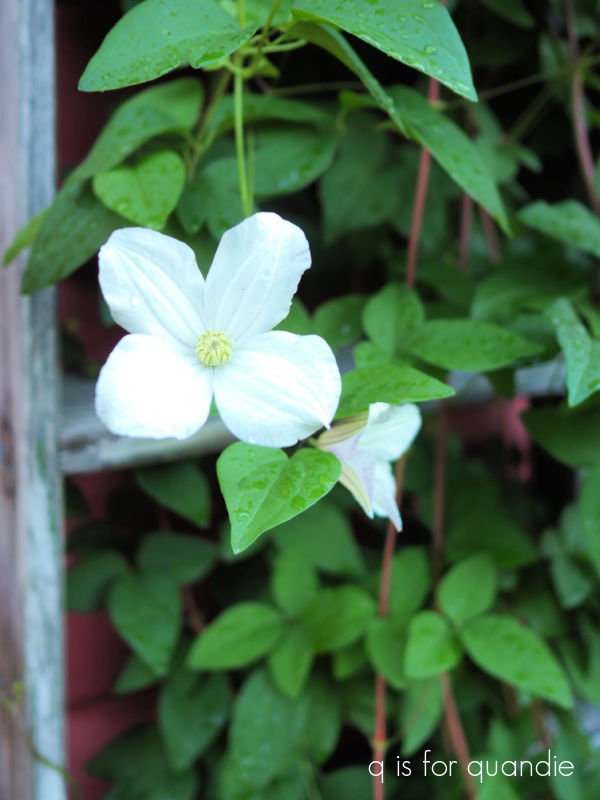
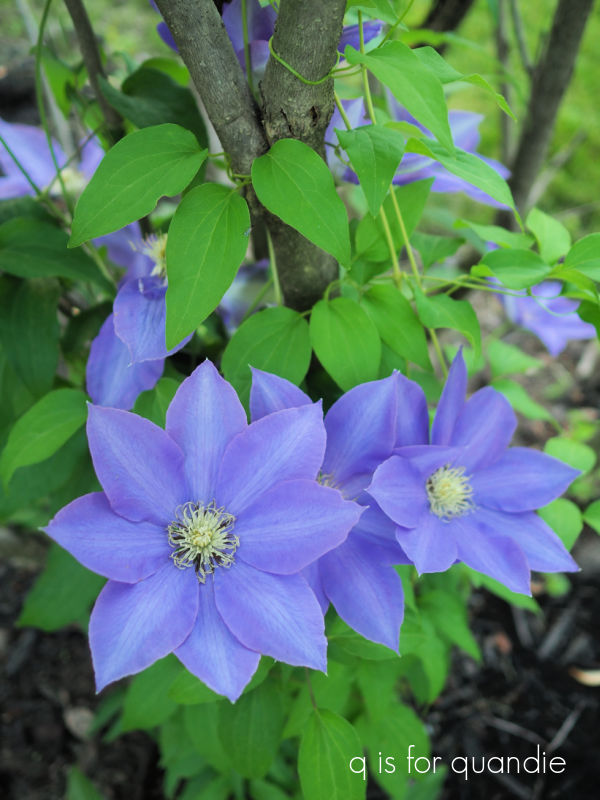
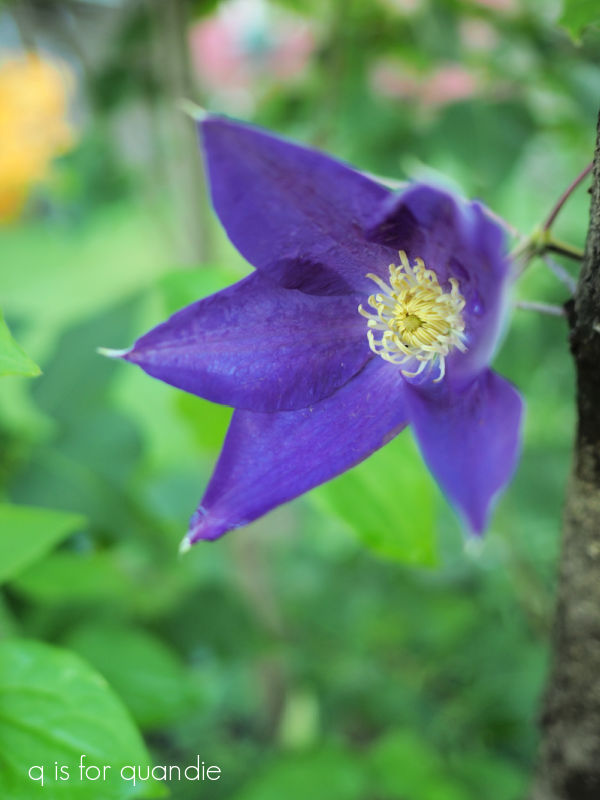
As an experiment, I planted three clematis to grow up amongst the lilacs last summer.  Clematis take a few years to really fill out, but I did get a handful of blooms this summer on the two that made it through last winter.

Unfortunately towards the end of last summer the lilacs ended up with leaf spot fungus and once again looked awful after losing most of their leaves.

They only recovered somewhat this spring.  I had plenty of flowers.

But the leaves never really filled in well.

To try and add some bulk down low, I decided to try to underplant the lilacs with some hostas a month or so ago.

I divided these from a row of hostas that I have in another area.

Hostas always look a bit sad after being divided, and to make matters worse, something is eating them now (I suspect deer, but it could be rabbits).

But they should look much better next year if I can keep them from being eaten.  I think I’m going to have to resort to using a deer/rabbit repellant spray.

However, once again this summer we have had lots of rain and humidity, the conditions that allow leaf spot fungus to proliferate.  So once again my lilacs again look pretty pathetic.

Every year I waste on trying to baby these lilacs is another year that a different shrub could have been growing to maturity.

So now what?  Do I throw in the towel?  Pull everything out and start over?

Or do I give them one more year?  Wait and see how it looks as my clematis and hostas fill in?

What would you do?  Leave a comment and let me know.

all the buzz.

Good morning from the garden.

It seems like planting pollinator friendly plants is getting all the buzz these days (pardon the very bad pun).

I have to admit that I’ve never planted anything just because it’s good for pollinators.  That quality is way down on the list of things I look for in a plant.  I figure any flowering plant is better for the environment than just having a lawn, right?

I do sometimes choose things specifically to attract hummingbirds though, like Salvia guaranitica, or Black & Blue Salvia.

After all, who doesn’t enjoy seeing a pretty hummingbird in the garden?  I can verify that yes, the hummingbirds definitely love this one.

This year I’ve discovered that the Swallowtail butterflies really like my verbena bonariensis.

As do the bees.

So that’s an added bonus to growing it, but I would grow it anyway because I love the look of it.

And that brings me to my Serendipity Allium.

I planted these about three years ago, and this is the first year that they’ve really looked fantastic.  That’s about right, the first year they sleep, the 2nd year they creep, etc.  This is their year to leap!

I also had 4 or 5 seedlings sprout up around the main plant this spring, so although they aren’t especially known to re-seed freely, mine definitely is.

I have to say, these things are bee magnets!

Look closely at the photo.  Do you see how many bees are on there?!

Although the big fat bumble bees aren’t particularly aggressive, they still would prefer that I not mess with them in the garden.  I’ve never been stung by one, but they do chase me away by buzzing around my face and bumping into me which is just as effective.

So I’m pretty much avoiding weeding in this area for the time being and just letting the bees have their fill.

But to be honest, I’m just blaming my lack of weeding on the bees because they are a convenient scapegoat.  I usually get a little tired of gardening about this time of year.  It’s probably lucky that I live in zone 4b/5a because I don’t think I’d enjoy having a longer gardening season.  Even our short growing season is a bit too long for me.

One last thing, while we’re talking about bugs, over the last couple of years I have been approached by at least half a dozen door-to-door sales people trying to get me to sign up for their pest control services.

They always catch me while I’m out in the garden, and they always use the same tactics mentioning that they are only in the neighborhood because my neighbor John Doe (insert actual neighbor’s name here) uses their service.  The latest saleswoman was very charming, mentioning how amazing my gardens were and appreciating how much work they must entail.  And wouldn’t I like to get rid of those pesky spider webs?

I always say that I’m trying to encourage pollinators, not kill them.  The I’m told, ‘oh, but our product is plant based’ … um, yeah, but it still kills insects right?

Anyway, I recently did some research and found a press release from the MN Attorney General’s office warning people about door-to-door pest control scams (you can find that here).  Apparently they are running rampant in the Twin Cities.  So if you are local, or if this is also happening where you are, just be warned.  Send those door-to-door salespeople packing, no matter how charming they might seem.

I’d love to know which plants in your garden are the biggest pollinator attractors.  Leave a comment and let me know.

made in the shade.

Good morning from the garden.

This morning I thought I’d share a quick tour of the mid-August shade garden.

This shade garden runs between the house and the driveway.  It is just a basic rectangle without any fancy curves or anything, but I consider it my favorite of all my garden beds.

It’s also the one that is most visible from inside the house, so on rainy weekends like this one I can still enjoy the garden.

It contains some of the most well-established plants that I have, especially since the Hosta albomarginata was here when we bought our house 37 years ago.

It’s the hosta in the foreground of this photo …

I consider it one of the old standby traditional hostas that every foundation planting had 40 years ago.  It’s a basic green with white margins, and it’s probably … no … definitely my least favorite hosta in the garden.  That being said, it’s also a tremendous workhorse.  I’ve divided mine so many times over the years that I now have dozens of them, and they are huge.  So removing them and replacing them would be quite the project.
Sadly, it’s also the most susceptible to both hail damage and insect damage because the foliage is not as sturdy as some of the newer varieties.  However, so far this summer we haven’t had any hail (knock on wood), and I’ve been using Sluggo Plus to take care of the slugs and earwigs and that’s working really well.

I just discovered Sluggo Plus this year (ordered from Amazon).  I used to use the regular Sluggo which contains iron phosphate, which is effective against slugs and snails.  Sluggo Plus, contains both iron phosphate and spinosad, a natural insecticide which is effective against earwigs and pill bugs.  Last summer was pretty wet and the earwigs did lots of damage to my hostas, so I wanted to stay on top of that problem this year and it’s lucky I did because this summer continues to be fairly wet as well.

It’s nice to have hostas that still look good in mid-August.

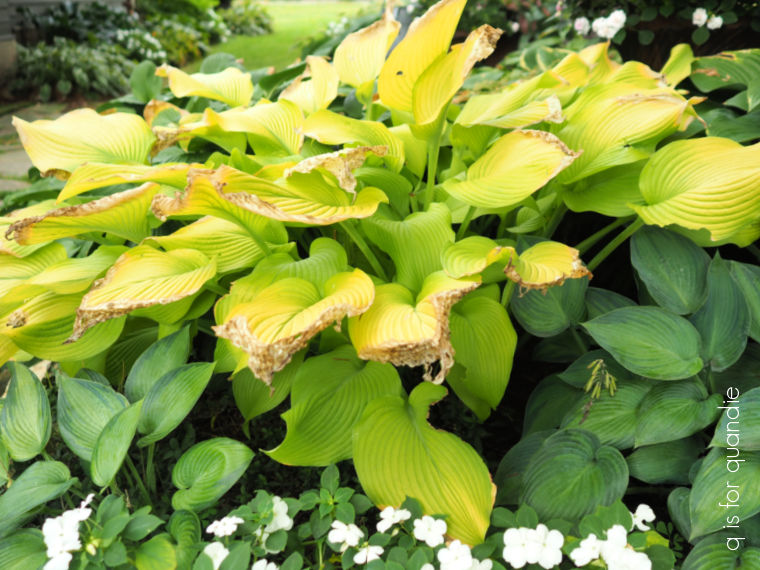
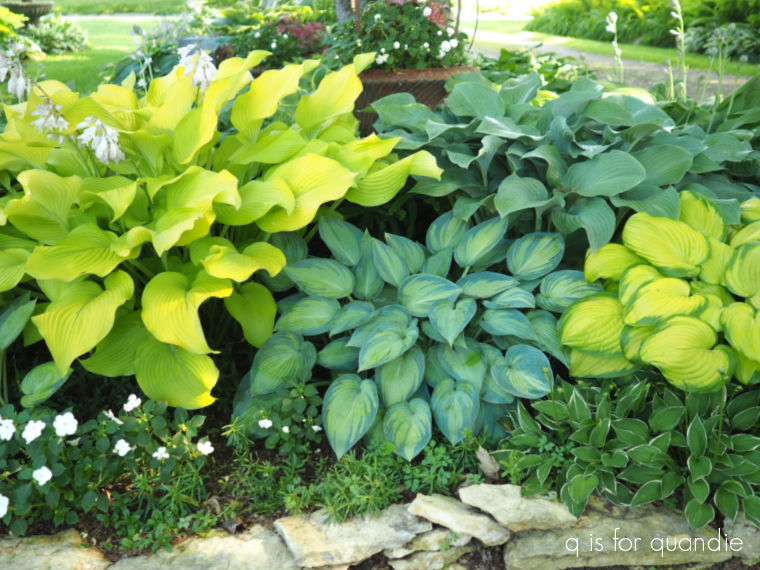
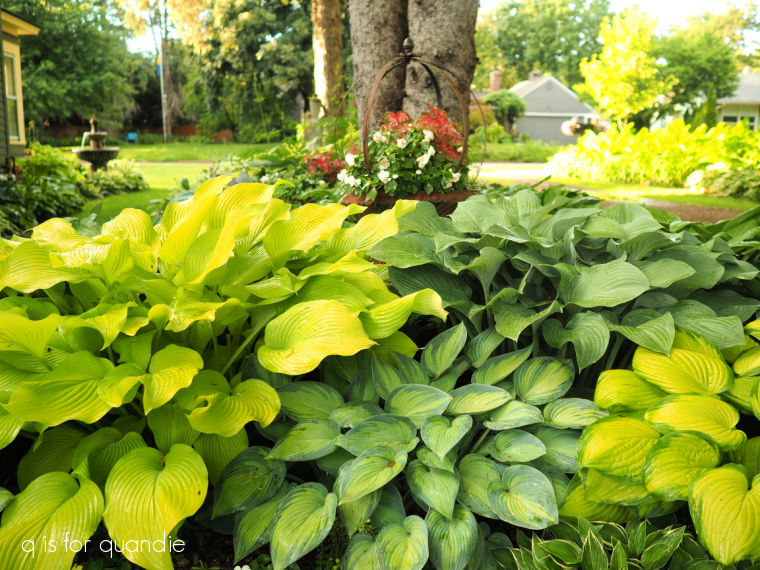
That bright green hosta is Sun Power, and it just glows in the shade.
Another of my favorites is Lakeside Dragonfly (center front below).

It’s perfect for the front of a shady garden bed.

I’m still finding plenty of jumping worms in my garden, and I can tell that they have had an impact on the texture of my soil, especially in the shade garden.  The top couple of inches of soil look very granular, and it dries out quickly.  Fortunately we’ve had plenty of rain this summer, but I’m keeping a close eye on the garden and watering regularly if it gets too dry.  I’m also adding nutrients in the form of both bagged compost and Espoma’s Plant Tone.  There is conflicting info out there on whether or not using an organic fertilizer makes the problem worse by also feeding the worms, but I can’t find any better suggestions for keeping my plants well fed.

I would say that my well established perennials are doing just fine despite the worms, including my Japanese painted fern.

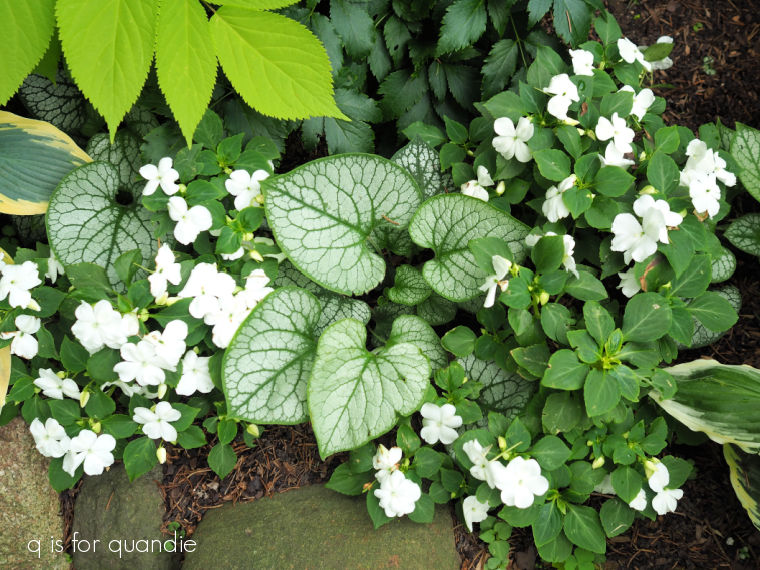
The annuals that I planted this year don’t seem to be struggling either.  Some of you may remember that I filled in some empty spots with Impatiens.

They filled in quite nicely and add a bright pop of color to my otherwise mostly green garden.  The bright pink of the Lipstick impatiens is pretty, but it isn’t really my vibe though.

Perhaps next year I will use the Apple Blossom double impatiens instead.

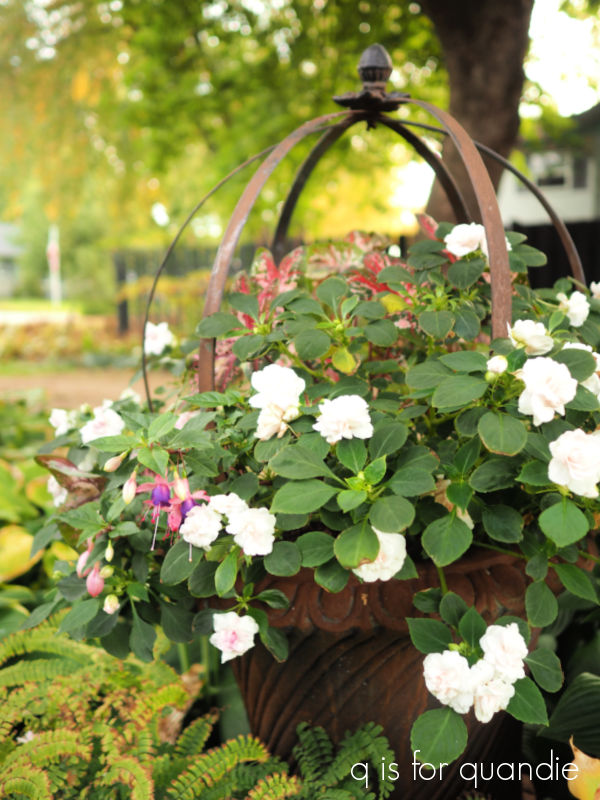
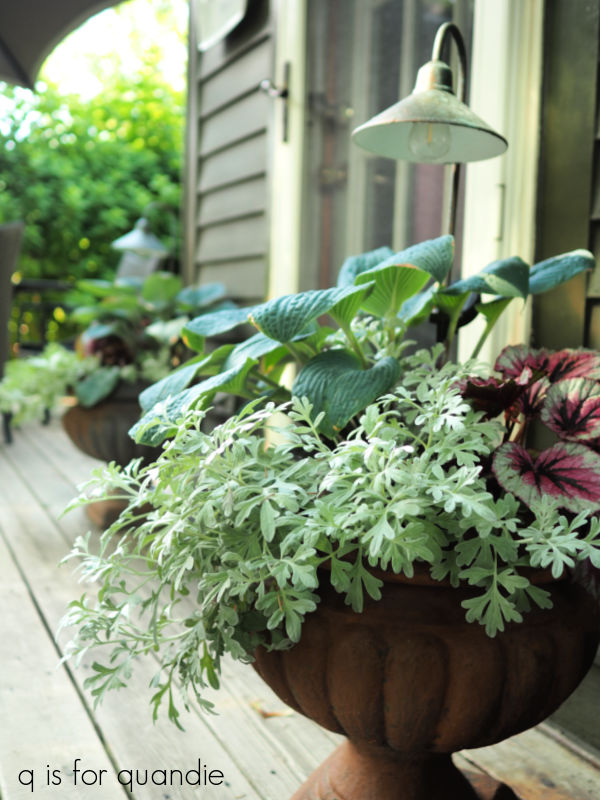
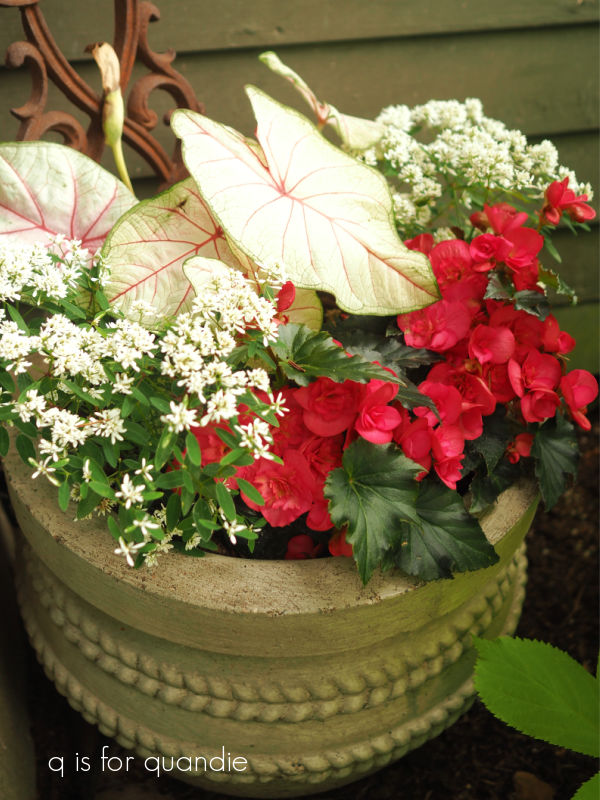
They are looking quite lovely in my planters and are more in line with my personal aesthetic.

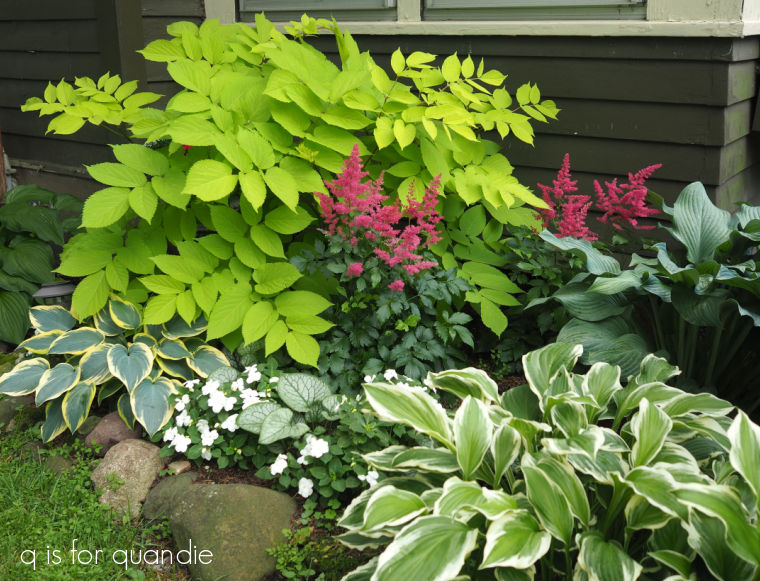
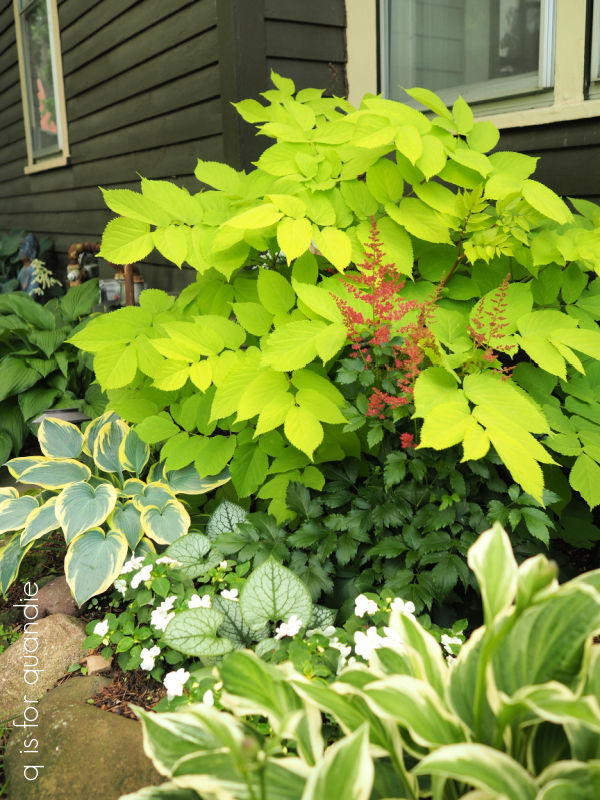
In the spring I mentioned that one section of my shade garden had completely died out over the winter including my Aralia cordata ‘Sun King’.

  I replaced the aralia with one I purchased at Home Depot, and also added in a couple of new hostas, bleeding heart and astilbe.

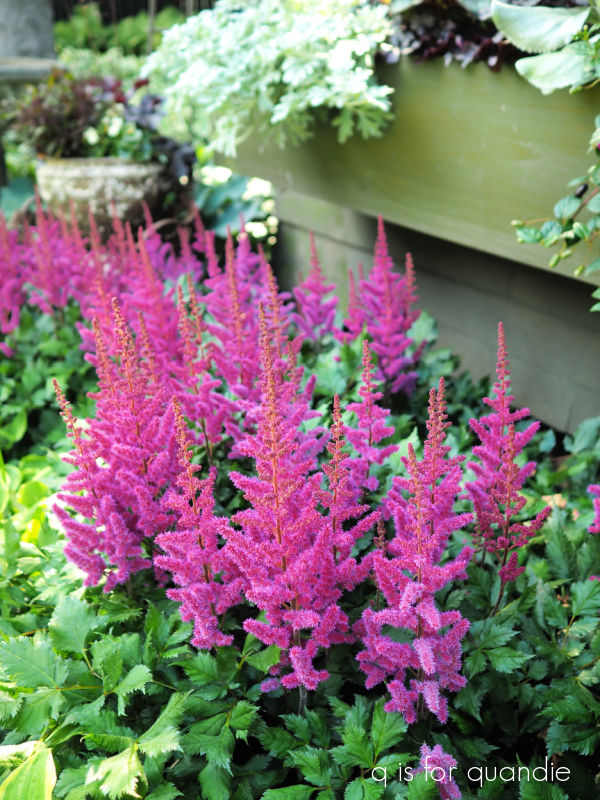
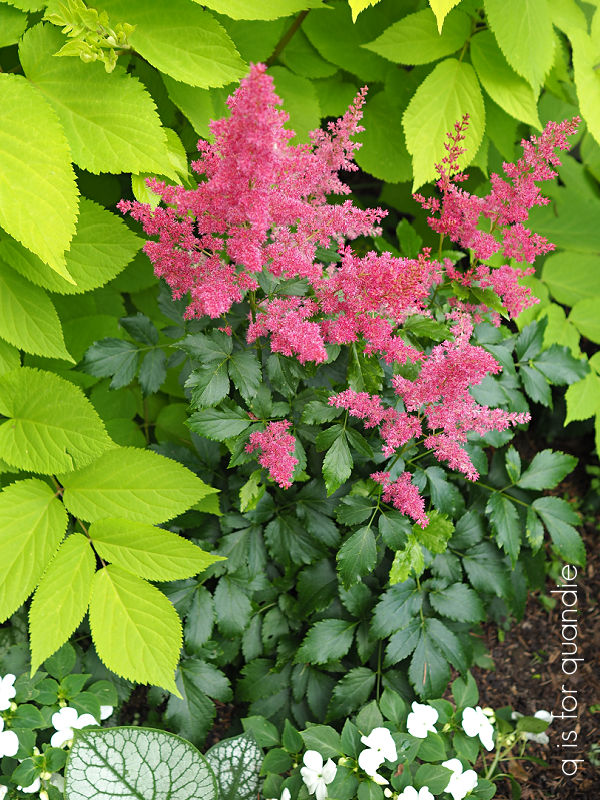
They are all doing well, and the astilbe is blooming for a 2nd time!

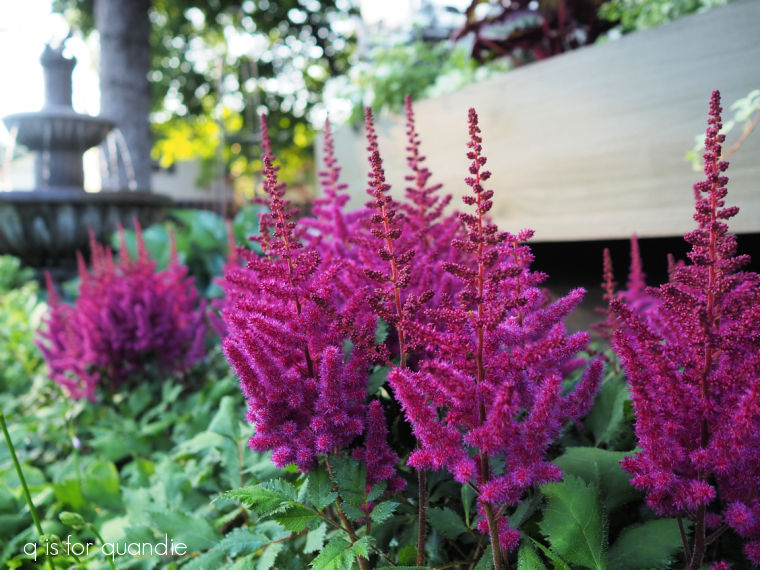
This is Astilbe Younique Ruby Red and everything I’ve found online says this plant does not rebloom so I don’t know what to make of it.

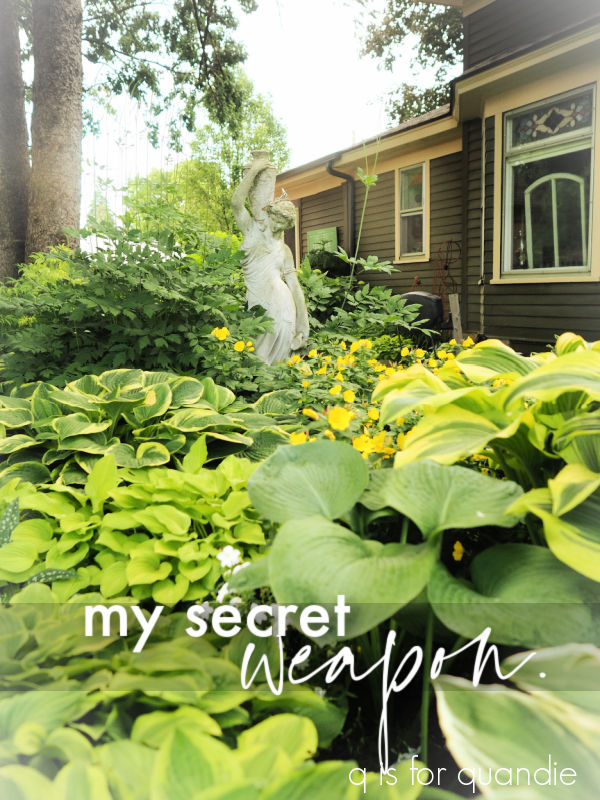
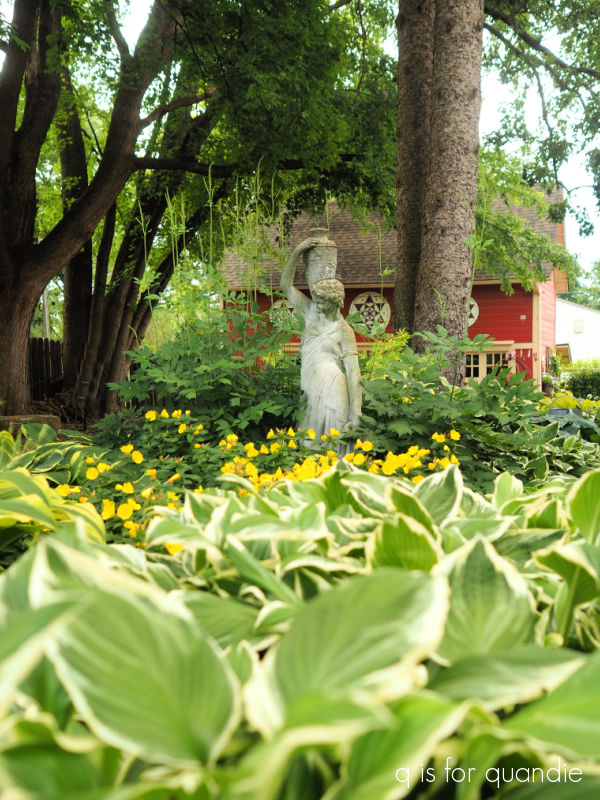
The Fairy Candles (or Black Cohosh, but seriously, isn’t Fairy Candles a way better name?) that I got from my friend Jackie are doing great growing around Cossetta’s feet.

Cossetta is the statue that I purchased at a garage sale that was right behind Cossettas Italian restaurant in St. Paul.  That was such an amazing find.  I never seem to find things like this at garage sales anymore, what a bummer.

But anyway, the Fairy Candles are done blooming now, but here’s how they looked in bloom a few weeks ago.

And with that I’ll bring this tour of the shade garden to a close.

I hope you enjoyed seeing my shade garden and that it inspired you in some way.  Leave a comment and let me know what your favorite element is in this garden!