reinventing the wheel.

Have you ever seen a rusty, crusty old item with amazing patina and decided you simply must have it?

But what to do with it?

Such was the case with this old metal wheel.  I have no idea what it was on originally, by the time it came to me it was just a single chippy wheel.  Maybe it came off a vintage toy baby carriage?

Whatever its original use was, I turned it into a photo holder of sorts.  The photo of my grandmother is just clipped on with little metal clip and the metal label holder is a Tim Holtz product from his Idea-ology line (although they may be hard to find as they have been ‘retired’).

I’ve recently been moving some stuff around in my house and this wheel found a new home resting on the door handle on my Specimens cupboard.

I love the way it looks hanging there, but I have to admit it isn’t very practical.  I have to move it every time I want to get into the cupboard.

The combination of the old photo, the chippy wheel and that delicious furniture transfer is just about perfect though.

So until I get absolutely tired of moving it every time I open the cupboard, I think it will stay in this spot for now.

Do you have any odd little items that you’ve found a use for?  If so, I’d love to hear about it.  Be sure to leave a comment!

rescued from a bad 80’s makeover.

For a little while there I was having a serious furniture dry spell.  I had one piece in the Carriage House that was waiting for warmer weather and for Ken to perform some handy-man miracles (Ken is very susceptible to the cold).  Other than that, the Carriage House was empty.  Yep, you heard that right.  I am not one of those furniture re-vampers who has a storage facility full of pieces waiting for their moment in the sun.  I actually get a little twitchy when I have too much stuff being stored.  I prefer to turn pieces over quickly.

But the downside is that sometimes I run out of furniture to work on and there is nothing available on Craigslist.  And when I say nothing, what I mean is nothing that meets my criteria of not too far away, not too expensive, and with lots of potential.

As usual though, when it rains, it pours.  I went from finding nothing to spending three evenings in a row picking up pieces.  I came home with a three dressers, a bed, a desk and this washstand.

I paid a little more than I normally would for this piece.  Why?  Because it was crying out for a rescue from its 80’s style makeover.  Just check out those grape cluster decals.  Gack!  And those horrible knobs.  Ugh!  I have to tell you guys, one of my pet peeves is when people put two knobs in the holes that were originally meant for a drawer pull with two screws.  I get why they do it, but every time I see it I cringe a little inside.  It’s just not right.

But if you look past the bad knobs, those awful grapes, and that really splotchy orange-y stain, this is a gorgeous little washstand.  Such pretty details, right?

The prep on this piece started with stripping the top.  The wood was so lovely that I wanted to show off some of it.  While the stripper was doing its job, I scraped off those decals.  They came right off with a sharp razor blade.

Next I dealt with those pesky knobs.  I was really hoping that I had 4 matching vintage pulls that I could use, but no such luck.  I did have a pair of absolutely gorgeous pulls that I have been saving for special piece though.  And it just so happened the holes on the upper drawer were spaced exactly right for them.

So I decided to use those on the upper drawer and just simple single knobs on the two lower drawers and the door.  To accomplish that on the drawers, I had to fill in the existing holes and later drill a new single hole in the middle.  Filling holes like this is really very easy.  Put some tape across the hole inside the drawer so that as you add wood filler from the front it doesn’t just escape out the back.  Then, fill the hole with wood filler.  I used Elmer’s Pro Bond Wood Filler in Walnut on these drawers, mainly because that’s all I had on hand.  The walnut was a bit dark, but I was painting over it anyway.  All of the wood fillers claim to ‘resist shrinking’, but I find that they all shrink.  In other words, when your fill dries it will recede back a little.  So go back with another application of fill.  Sometimes you’ll even have to do this a third time (I did with this piece).  But you want that filler to be nice and flush with the surface of the drawer, not sunken in at all, or they will show later.

I let my stripper and my drying wood filler sit overnight.  The next day I scraped the stripper off the top and gave it a good cleaning.  Then I sanded the body of the whole piece lightly and gave it a good cleaning too.  I decided to use my method for perfect chipping again on this piece (more details on that method here), so I added a little beeswax to all of the edges.

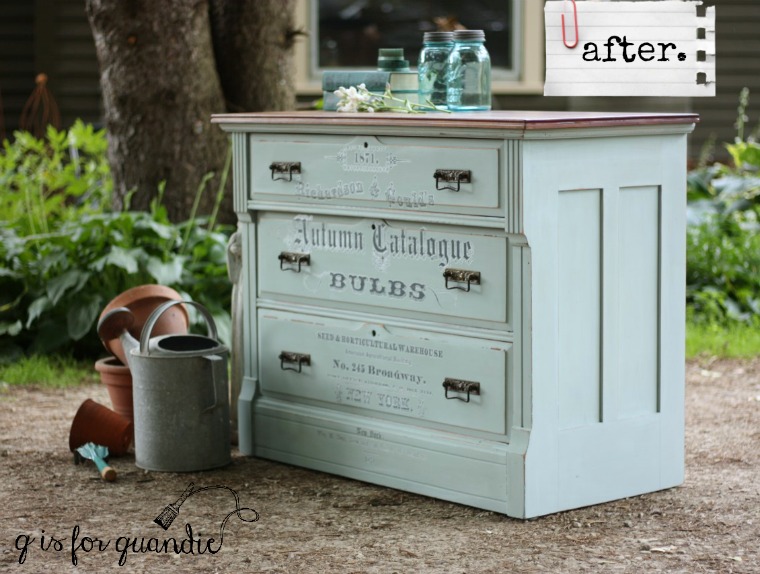
Then I painted three coats of Miss Mustard Seed milk paint in Marzipan.

Once again, perfect chipping, just where I wanted it!

See my little photo bomber?  My cat Lucy is hiding underneath the washstand.  I couldn’t get her to stay out of my photos.

I was initially considering staining the top of this piece, but the wood was so pretty in its bare and natural state so I waxed it with Homestead House furniture wax.  But that brought out a little too much of the golden hue of the wood, so I toned it down by adding some Homestead House white wax over that.

Not so golden, and definitely no longer orange!

What do you think?  Did I successfully rescue this washstand from the 80’s?

This little charmer is for sale while it lasts.  Pieces this size make a perfect bedside nightstand!  Check out my ‘available for local sale’ tab for more details.

a swing and a … miss?

I have a decorating split personality.  I really struggle with it.  You see, the problem is, I like more than one style.  As a result I often find myself going sort of half-way there and ending up missing the mark entirely because I can’t commit fully one way or the other.

For example, I love the French Nordic look with mostly white painted pieces, lots of age showing and maybe a hit of black or grey.  Love, love, love this look.

source

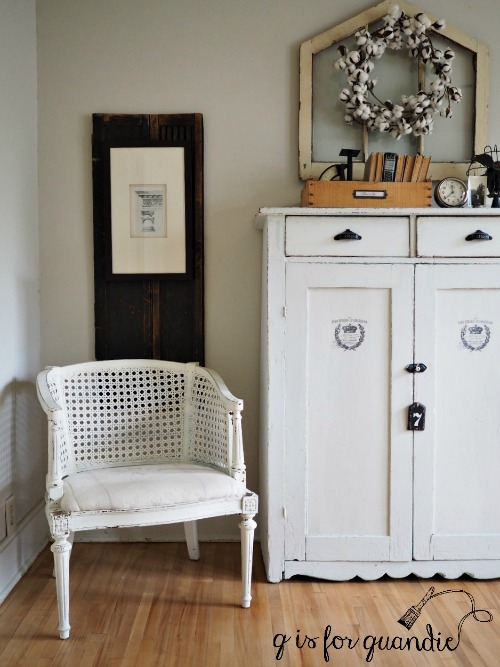
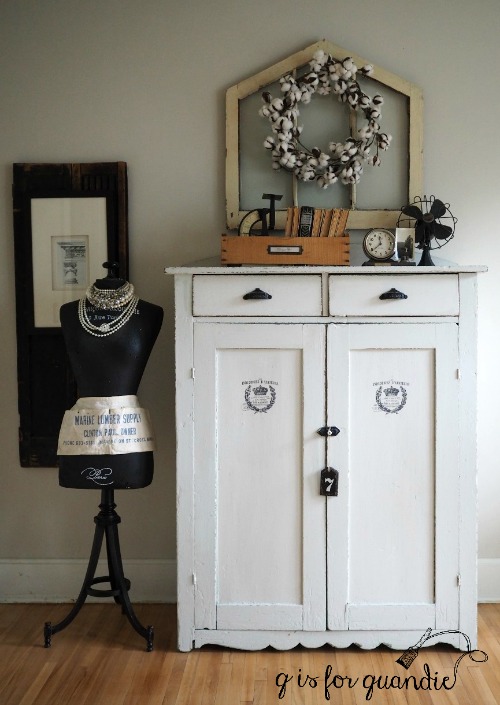
That’s the direction I headed in with my new Specimens cupboard.

But I also love color.  Especially pale aqua, but also blue and greens, and I don’t mind mixing in some pinks or yellows as evidenced by the collection of stuff in my pantry.

You can’t really mix these two styles without diluting them somewhat.  Certainly not in the same room, or rooms that are visible from one another.

So my problem is, I really want to gravitate towards the French Nordic look, but I can’t bare to part with some of my favorite more colorful pieces.  I’ve been making a concentrated effort to head in that direction over the past year or so though.  That is partly behind my switch from the Kitchen Scale buffet (even though I still love that color!) to the Specimens cupboard, although function also played a part in that decision.

As part of that switch, I also recently repainted my grandmother’s chair.  If you’ve been following me since the beginning you may vaguely remember when I painted this chair in Miss Mustard Seed’s Flow Blue.  That was three years ago!  My how time flies.

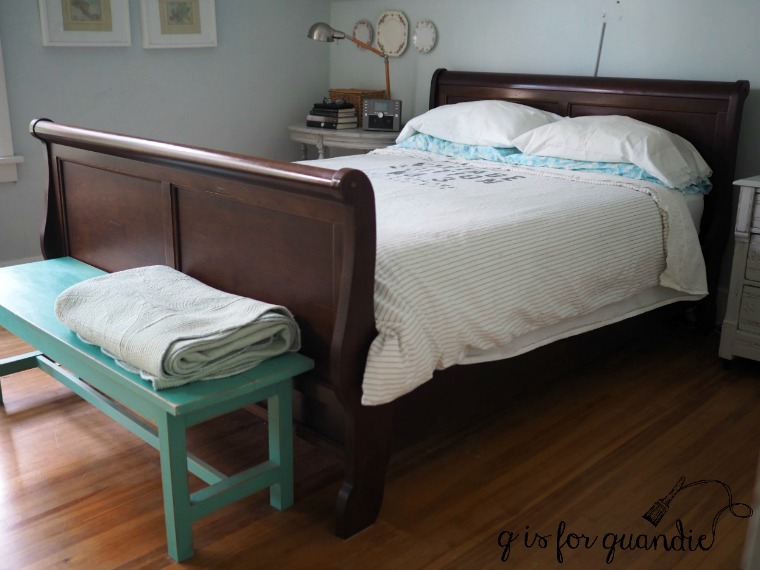
I wasn’t too sure about the Flow Blue on this chair.  It was the first time I’d used that color and I was a little startled by how bold it was.  But it grew on me over time and it worked well with my blue walls.

But in keeping with my switch to a more neutral palette, I decided a muted grey would work well on this chair.  Since I have a ton of milk paint on hand already, and I’m pretty frugal, I also wanted to use a color I already had.  I went to my milk paint supply cupboard and looked for some Miss Mustard Seed Trophy.  Nope, didn’t have it.  How about some MMS Schloss, that’s what I really wanted.  Nope, didn’t have it.  Then I saw my bag of Homestead House milk paint in Bedford.  I love this color, but it is definitely a very warm greige rather than a typical grey.  But I thought it might work.  So I mixed some up and painted the chair.

Hmmm.  A swing and a miss?  When I put the chair back in place, I really didn’t love it.  I don’t think it works that well with the blue walls.

But then I moved it over next to the Specimens cupboard …

And it seems to be much more at home.   So for now I think I’ll leave it in this spot, and I’ll keep on working towards that French Nordic style.  The next thing to go might be those horizontal stripes on my walls in this room.  Be sure to stay tuned!

methods for transferring graphics.

After reading some of the comments on Monday’s post about my ‘specimens de la decoration’ cabinet, I realized that a post comparing rub-on transfers, gel transfers, stencils and hand-painting might be worthwhile.

Are you a fan of adding words or other graphics to furniture?  Or even perhaps to your walls or other items of décor around your home?

I’m sure I’ve already established that I am definitely a fan, and I think I’ve tried just about every method there is to get them on there.  There are pros and cons to each.

Are you familiar with the project management triangle?

The theory behind it is that you can’t have all three things on the triangle at once;  fast, good and cheap.  You can only achieve two out of the three on any one project.  You can have cheap and fast, at the expense of quality.  You can have quick and high quality at the expense of low cost.  Get the concept?  It applies well here.  The cheapest options are also the most time consuming.  The most expensive are the easiest and produce the highest quality result.  But let’s go ahead and evaluate each one, shall we?

Rub-on transfers.

Not to be confused with gel medium transfers, which I’ll discuss in a minute, a rub-on transfer is a ‘dry transfer’ that is on a ‘backing material such as paper or plastic sheeting much like a transparency’ (Wikipedia).  They are applied by placing the sheet with the transfer down over your intended surface and rubbing the sheet with a tool of some kind until the transfer is adhered to your surface.  Rub-on’s will give you a high quality appearance and are fast to apply, but they cost more than other options.

Pros:  I think rub-on’s have the most professional look.  The designs can be much more highly detailed than stencils; in fact they are absolutely gorgeous.  They are easy to apply.  You can use them on painted surfaces, wood, metal, glass, plastic, paper … have I missed anything?  Until now I was only aware of rub-on’s for small craft projects, but I’m thrilled to have found large transfers for furniture!

Cons:  They are expensive and can only be used once each.  There is a little bit of a learning curve if you’ve never used them before because you have to get used to making sure the entire design is properly adhered before you remove the backing.  I wouldn’t use a rub-on transfer on a surface that will get a lot of wear such as on the seat of a chair or a table top.  I don’t think it would hold up well under that kind of use.

Stencils.

Stencils are usually made out of a piece of Mylar with the design cut out of it, although sometimes they are made with heavy paper or even metal.  They are applied by placing the stencil over your intended surface and using a stencil brush and paint with a pouncing motion to fill in the design.  Stencils will also give you high quality and fast, but not cheap.

Pros:  Stencils also have a very professional look when done well.  They are very quick and easy to apply.  You can re-use them over and over and over, thus lowering the cost per use.  You can easily use a painted stencil design on a chair seat or table top as it will wear the same as any other paint treatment.

You can get creative with stencils using just a portion of the design, or pairing up multiple stencils to create a larger design.  Another big plus to stencils is that you can use them on fabric, one of my favorite techniques.

Cons:  Stencils are also rather expensive.  Especially if you are only going to use it once on a specific project.  In addition to the cost of the stencil itself, you’ll also need to purchase a stencil brush and paint.  The price of stencils really only makes sense if you are going to be able to use them multiple times.  In addition, there is a bit of a learning curve with stencils.  Some people I’ve talked to claim they have never been able to develop the knack for getting a clean line with a stencil.  It does take some practice.  A sloppily done stencil is not a good look.  Also, stencil designs aren’t quite as delicate or detailed as a rub-on can be.

Gel transfers.

A gel transfer is made by printing a mirror image of your intended design onto paper with a LaserJet printer, then applying transfer gel to it and placing it face down on your surface being careful to eliminate any bubbles or creases in the paper.  You wait 12 hours, then use water to gently remove the paper leaving the design behind.  This method is cheap and creates a good quality transfer, but it isn’t fast since you have to basically wait overnight before removing the paper.

Pros:  This is a very cost effective way to add transfers.  A container of the transfer gel is under $20 and will last quite some time.  I haven’t even gotten halfway through my jar of Fusion Transfer Gel and I’ve done countless projects with it.  I’ve had the best success using transfer gel on freshly painted surfaces such as wood, cardboard, or metal.  I’ve read that you can use this method to transfer images onto fabric as well, but I’ve never tried it.

Cons:  I’ve also had some failures trying to use transfer gel on metal.  It always works over freshly painted metal, but I’ve had the gel peel right off both unpainted metal and metal with an old paint job taking the design with it.  It would also not work on unpainted cardboard or paper, or anything else that can’t get wet.  I’ve read that people use it on glass, but I’ve never tried it (do any of you have experience with this?), I wonder whether the gel can peel off the glass in the same way it did for me on unpainted metal.  Transferring a design larger than the letter or legal size available on your home printer will require having it printed at a Kinko’s or other print shop, adding a little bit to the cost and a bit of extra time to the process.

Tracing and hand-painting.

There are two ways to trace a design onto your surface and then hand paint it.  The first is to print your design on paper, then use tracing paper (in either white or black depending on the color of your intended surface) to trace the entire design onto your surface.  Then go back with a small artist’s brush with paint and fill in the design.  The second option is to print your design on a letter sized piece of paper, then use an overhead projector to project the image onto your intended surface.  Trace the design using a pencil, then go back and fill in with paint by hand.

Pros:  If you happen to already own a projector and you have excellent painting skills, this is a cost effective way to add a graphic.  Using a projector is also a good way to add a really large graphic to a piece of furniture and be able to size it correctly.  The alternative tracing paper method is very cost effective.  I still use this method for chalkboard designs, to be filled in with chalk, but I almost never use it for painting a design anymore.

Cons:   Back in the day though, this was the way I did all of my graphics.  Can you imagine?  Looking back I am astounded at how time consuming it was, and I was never entirely happy with the end result.  If you don’t have a steady hand and a couple of spare hours, this option is definitely not for you.

Cutting vinyl.

I almost didn’t include this option because it’s not exactly a ‘transfer’, but since I tend to use it fairly frequently I decided I should throw it in.  I use a Cricut machine to cut adhesive backed vinyl, but there are other types of machines out there as well like a Silhouette.

Pros:  Once you’ve made the initial investment in a machine, it’s relatively inexpensive to buy the adhesive vinyl and then the sky is the limit for the quantity of stuff you cut out.  Once you’ve learned how to use your machine, it’s relatively easy and quick to do.  The vinyl will adhere to painted surfaces, glass, metal and plastic.  It is flexible as well, so it works well on surfaces that aren’t flat.  Also, you can print out any word or saying that you can think of.

Cons:  You have to invest in a die-cutting machine like a Cricut or Silhouette, and they aren’t cheap.  You also have to spend some time learning how to use it.  The investment is not worthwhile unless you are going to do a fair amount of cutting.  In my case, with a Cricut that is not attached to my computer, I am limited to designs on font cartridges that I have purchased.  The cartridges themselves can be rather expensive.  If I was starting from scratch I’m not sure I would invest in a Cricut and multiple cartridges, but since I already had them for scrapbooking I’m now finding that I get a lot of use out of them for home décor projects.

That wraps up my synopsis of the various options available to you for adding graphics to your projects.  I don’t have an overall favorite, different projects are better suited to different techniques and aside from tracing and hand-painting I’m sure I’ll continue to use all of them.  How about you?  Do you have a favorite?  Or maybe you have another method that you like to use.  If so, please share with a comment.

the specimens de la decoration cupboard.

I’m not terribly savvy when it comes to Facebook.  I don’t seem to notice when people leave me messages there, so if you have ever left me one and it took me forever to get back to you, please don’t take it personally.  Somehow I just don’t see them.  I also rarely post stuff on Facebook.  I do have my blog linked to my Facebook page so my blog posts appear there automatically, but if you really want to interact with me the best way is to leave a comment here on the blog.

That being said, I recently joined a new Facebook group, How to Paint like a Pro, that was started by the Fusion people.  It has reminded me to never underestimate what you might learn from a group of like-minded individuals on Facebook.

I was randomly perusing the posts and I stumbled across one about some new furniture rub-on’s that are available from Sweet Pickins.

Seriously, are you freakin’ kidding me?  How long have I been wishing I could find large furniture sized rub-ons??  And how did I not know these were available?

I immediately dropped everything I was doing and went online and ordered two.  Each one was $23, plus I paid a flat $6 for shipping.  I think that is a bargain when you consider that one is 24″ x 36″ and the other is 18″ x 36″.  These are large rub-ons (or transfers, if you prefer).

They also arrived lickety split.  I ordered them on Wednesday and they arrived on Friday.

And I simply could not wait to give one a try and luckily I had the perfect ‘canvas’.

A couple of summers ago I purchased a pair of primitive cupboards.  I sold one, but kept the second one.  It was a bit dingy and had some water stains.

I was planning to use it in my bedroom, and I even went so far as to paint it with one coat of Miss Mustard Seed’s Eulalie’s Sky, but that was as far as I got.  It had been sitting out in my carriage house ever since.  I even removed the door and used it to display merchandise at my last Carriage House Sale.

I wanted to go back to white, so I started by painting the cupboard with a couple of coats of Rachel Ashwell’s Clear Primer.  Those water stains that I mentioned earlier had bled through the Eulalie’s Sky, and I didn’t want to see them coming through the white.  Next I added three coats of Miss Mustard Seed’s Linen milk paint.  The primer did its job perfectly, no stains.

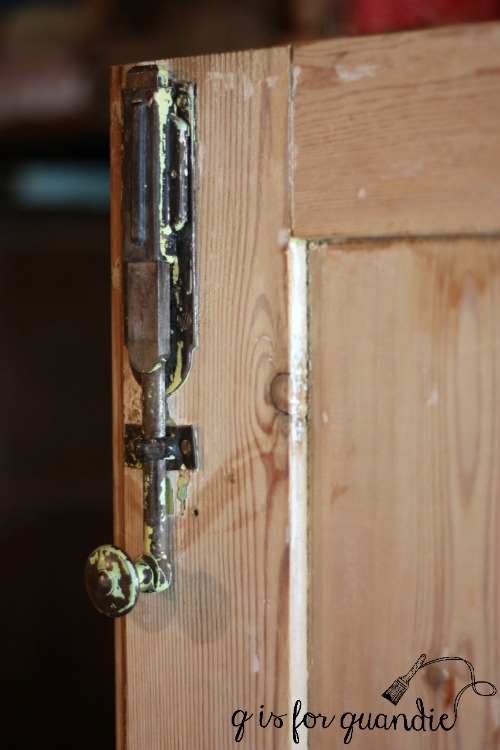
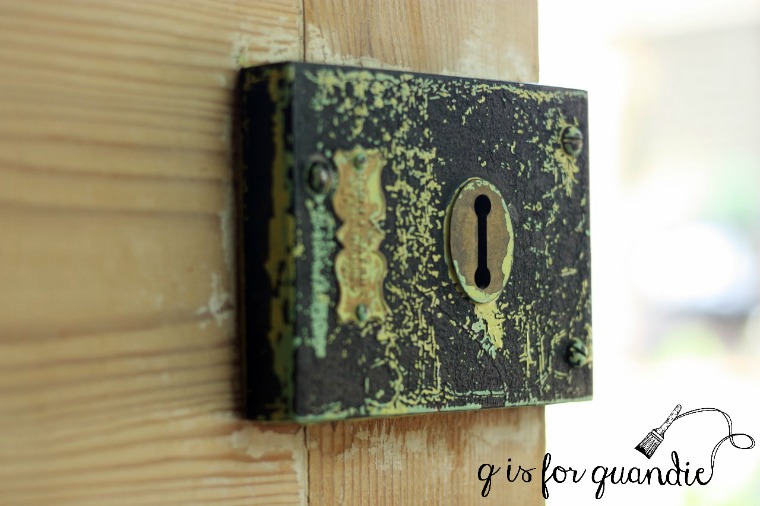
I intentionally left the area around the door’s hardware unpainted and blended my paint around the edges of that area, I love the worn look it gives the cupboard.  I also sanded the edges a bit to distress.  You can’t see that very well in the photos but it did make a difference.

Next I separated the transfer from its backing paper and taped it in place on the door.

I adjusted it a couple of times to get it centered and straight.  Once I was satisfied with the placement, I used the little wooden tool that came with the transfer to carefully rub the entire design onto the door.  This was a little putzy and a bit of an arm workout to be honest.  It took close to 30 minutes to do the entire thing.  But it was so worth it!

Once I was satisfied that I had the design rubbed on sufficiently I very slowly and carefully pulled away the plastic sheet it came on making sure as I went that the entire design was adhered to the cupboard door.

It worked beautifully.

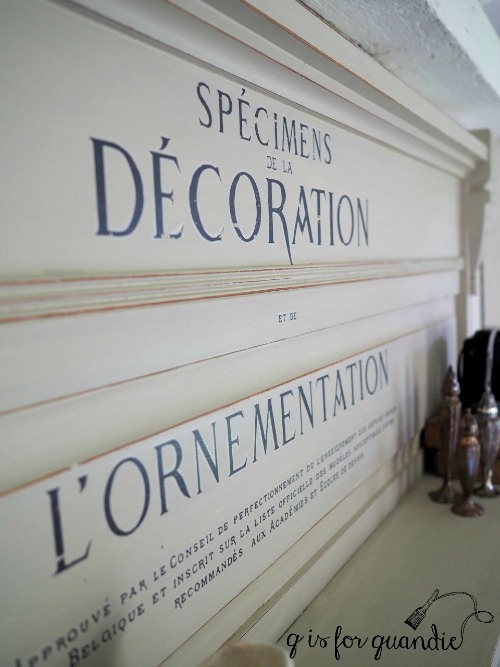
By the way, these transfers are charcoal grey rather than black.  I like that about them too.

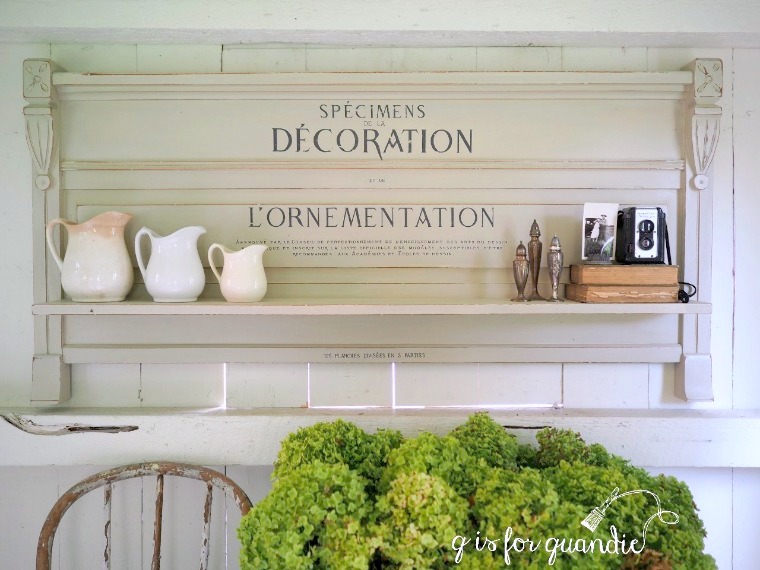
In fact, I could not be any more in love with this product, or this cupboard.  So much so that I am going to keep it right here in this spot.

You may have realized at this point that this is where my Kitchen Scale buffet used to reside.

Yep, it’s being replaced.  I’ve actually been thinking about making this switch for a while.  You see, the thing is, this is the room that I paint in during the winter.  Instead of housing china and silver, my buffet was storing paint supplies.  This cupboard is going to work so much better for that.

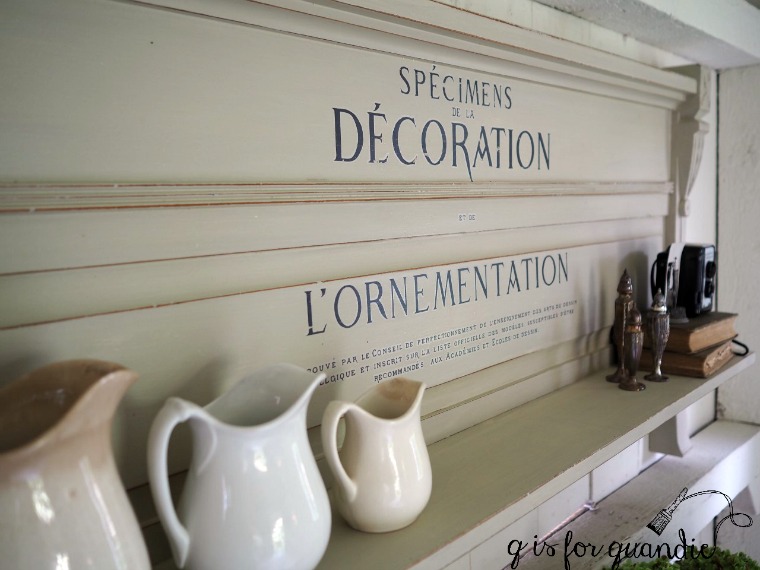
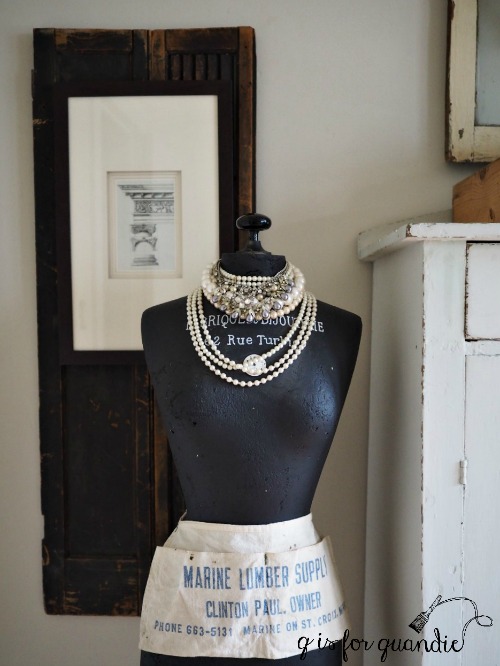
Somehow it now seems entirely appropriate that the door to this cupboard says “specimens de la decoration et de l’ornementation” right?

By the way, I didn’t alter the inside of the cupboard at all.  It came with these painted boards as shelves and I just love their chippy patina.

After all, I’m just storing painting supplies in this cupboard.  If I was going to use it for clothes or linens I would add a coat of two of some kind of sealer to the boards.

What do you think?  Would you have kept the buffet, or made the switch like I have done?  And what do you think of the cupboard’s new look?

If you’re thinking of ordering a couple of transfers yourself, I should warn you that I went back and ordered six more yesterday so you better get on it before they are all sold out.

And P.S. the Kitchen Scale buffet is for sale.  Check out my ‘available for local sale’ page for more details.

Sharing at Silver Pennies Sunday.

a toolbox towel bar.

Last year I bought quite a few old toolboxes and turned them into planters.  My favorite was this ‘hello fall’ planter painted in Fusion’s Mustard.

This kind of toolbox often comes with a lift out handled tray, like this …

There are lots of fun ways to re-purpose one of these.  You could fill it up with succulents or use it to hold all of your craft paint.

But I like the idea of hanging it on the wall and using it as a towel bar.

So while I had my Cricut out last week I went ahead and cut out some vinyl letters for this project and after giving the tray a good cleaning, I added the word ‘dry’.

I also drilled a second hole in the tray so that it could be hung with nails or even with screws for more stability.

It would be perfect in a kitchen …

but it would work equally well for the bathroom.

It would also be a fun addition to a potting bench, if you are lucky enough to have one of those.

What do you think?  Toolbox towel bar, yes or no?

road trip.

One of the best things about having my sister and niece living in Minnesota now is that they like to explore the area and Mr. Q and I go along for the ride.  Last weekend we took a road trip south to visit the National Eagle Center.  Apparently this is prime eagle viewing season.  By the way, if you’re curious, that photo above is of Lake Pepin which is the widest naturally occurring part of the Mississippi River and is taken from the Wisconsin side looking towards Minnesota.

One of the things that my sister really loves about living here is our bald eagle population.  We often see them flying overhead, and occasionally even see one perched in a tree.  She gets excited every time she sees one.

We followed the route suggested in my sister’s Minnesota guide book, Quick Escapes.

We headed south on highway 61 through the charming towns of Hastings and Red Wing about 75 miles to Wabasha.

I love these old main streets with their brick buildings and beautiful ornamentation, don’t you?

We had some lunch in town and then headed over to the National Eagle Center.

There were some interesting displays with facts about eagles and other birds of prey.  One thing I learned is that eagles are actually much lighter than they look.  The average weight is between 6 and 13 lbs.  They look big but are mostly feathers.  The farther north you go, the bigger they get, so our Minnesota bald eagles are on the lighter end while eagles up in Alaska tend to be bigger and heavier.  It’s a total myth that an eagle can scoop up your dog or cat and fly away with it.  They can only lift about 3 lbs.

The best part about the center, in my opinion, was seeing the eagles up close and personal.

Don’t worry, these are not birds that were snatched out of the wild and put on display solely for our amusement.  They are rescued animals that are no longer able to fly or survive on their own in the wild.

I also enjoyed taking a quick photo of my sister and niece in the eagle nest.

After leaving the eagle center, we crossed over to the Wisconsin side of the river to head north again towards home.  We’d heard that this was the more scenic side, and I have to say those rumors are true.  Mr. Q claims it’s only because you’re looking across at Minnesota from that side.

You also get to see fun things over there like this fence made out of old skis.

Since we were feeling adventurous … well, OK, maybe it was just me feeling adventurous … when we passed a sign saying “this way to Laura Ingalls Wilder’s birthplace” I convinced everyone that we needed to make the slight detour to see it.

Of course this is not the actual home she was born in, it’s just a replica of her ‘little house in the big woods’.  You are able to go inside and get a bit of a feel for what living in a log cabin might be like.  It certainly wouldn’t be worth the trip all the way out to Pepin, Wisconsin just to see it, but if you happen to be passing by it’s a good spot to stretch your legs.

Plus, if we hadn’t made this little detour we also wouldn’t have chanced upon the Maiden Rock Winery & Cidery near Stockholm, Wisconsin.  This place was pretty much deserted, I suppose it’s not really winery touring season and by the time we got there it was overcast and drizzling.  However, the proprietor was pouring free samples to help warm us up.  We managed to leave there with some Honeycrisp Hard Cider and some Cyser.

Yum!

When we finally met back up with highway 35 along the river, we had our greatest surprise of the whole trip.  Although we had seen dozens of bald eagles flying overhead, it was a real treat to see them roosting in the trees along the highway.  We saw so many that we lost count!

This was the perfect time of year for seeing them since there were no leaves on the trees to interfere.  Ironically, after a whole day of eagle watching, we had our best view as our trip was coming to an end.

This was a great way to spend the day and I highly recommend this little road trip to any of you locals.  As for the rest of you, do any of you have eagles where you are?

please watch your step.

Hey, any of you guys feel like you’re the only one who doesn’t get projects completed very quickly around your house?  Well, you are definitely not alone.  In fact, I may just be the poster child for unfinished projects.

Three years ago I posted about wanting to spruce up my front hallway and stairs.  I started a pinterest board (because isn’t that the way you start every project?) and Mr. Q starting ripping out the carpet.

Once the carpet was out, it looked like this.

And I’m embarrassed to admit that it stayed this way for well over two years!

I managed to get the risers and the baseboard painted last fall, and that was definitely an improvement.

But the treads still looked like this.

One of the factors that contributed to my procrastination on this project was the inability to make up my mind.  Numbered stairs?  Grain sack striped stairs?  Wallpapered risers?  All fun ideas, but I just wasn’t sure.

In the end I really just wanted old farmhouse stairs, maybe with a fun twist.

And I wanted worn looking stairs.  I love old stairs where the paint is worn away from years and years of use.

So in the end I decided to paint the treads with black milk paint (in this case, Miss Mustard Seed’s Typewriter), and I finally got around to doing exactly that last weekend.

I think it will be interesting to see how the milk paint wears over time.  Also, I was originally planning to put black wax over them, but quickly realized I didn’t have enough black wax on hand.  So instead I used hemp oil.  I know that hemp oil is not going to provide a lot of protection, and I’ll definitely have to re-apply at some point.  But I’m OK with experimenting a little and seeing how it goes.  I may end up ordering some more black wax and adding that over the hemp oil.  Ha, ha, is anyone else rolling their eyes?  Do you really think I’ll get around to doing that when it took me three years to get this far?

Maybe not.

But in the meantime, after I got the treads painted and oiled I decided I needed to add a little bit of quirky fun.  So I got out my Cricut and some black vinyl and added a simple message.

The nice thing about the vinyl is that it’s removable.  So if I get tired of this (or come up with a better idea), I can just take it right off.

But for now I kinda love it.

Isn’t it amazing what you can do with a little paint, some vinyl letters and three years?!

the queenstown gray buffet.

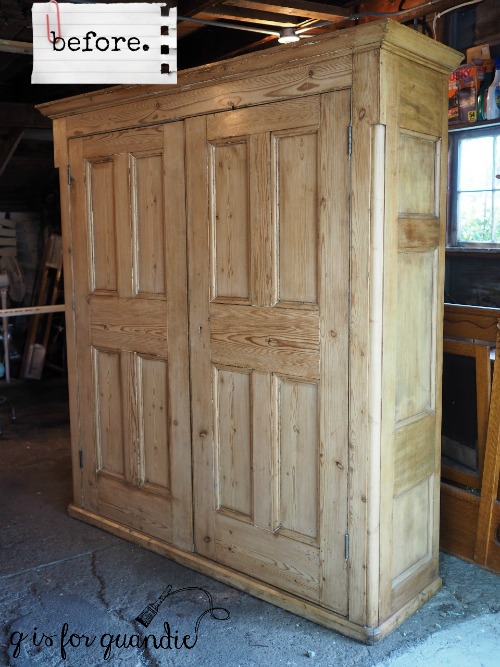
I shared the ‘before’ picture of this buffet with you last week.

My friend Sue purchased this piece via Craigslist for herself.  She got as far as removing the hardware to get it ready for painting, but then she decided she didn’t really want to tackle it after all and she offered to sell it to me.

Since Sue lives only a couple of blocks away, this was one of my easiest ‘Craigslist’ pickups ever!

I waffled between using Fusion’s Midnight Blue or the General Finishes Queenstown Gray on this buffet and I think either one would have been a great choice, but in the end I went with the gray.  Had I realized I would end up posting this on St. Patrick’s Day I would have chosen green!  No, not really.  Green might be a bit much on this one.

Plus, there was a pretty good chance that the red stain on this piece was going to bleed thru my paint, so going with a dark color helps disguise that.

I’ve generally had really good luck with this strategy, but be forewarned that a dark color does not always solve bleed thru problems.  Sometimes you will have to seal a piece to prevent bleed thru from showing and you can use shellac or a clear primer for that.  I like using the Rachel Ashwell clear primer when I need to seal something.

But I did not seal this piece.  I sanded it very lightly, wiped it clean with a damp rag and started painting.  After giving the first coat of paint about 24 hours to dry (because some times bleed thru can take a while to show up), I gave it a close inspection to see if there were any spots of bleeding.  If there had been, I would have then added some clear primer to those spots before adding a second coat of paint.  However, there weren’t, so I added a very light second coat of paint and voila …

I staged it with a lamp wearing my Florence map lamp shade.

I purchased my lamp shade at Junk Bonanza from a vendor called Light Reading (check them out here).  They make gorgeous stuff, and it looks like they will be at the Minnesota Junk Bonanza again this spring.  So if you are in the Twin Cities and could use a cool lamp shade, check them out.

The 2nd drawer down on this buffet is very shallow and has dividers for silverware storage.  It came with some pretty grungy felt lining.  I replaced the felt with some toile patterned fabric instead.

When my sister popped by to pick me for another afternoon of house hunting last weekend, she really loved this buffet.  But she has to wait until she has a house before she’ll know whether or not she needs any new furniture.  And actually that may be soon, but I don’t want to jinx it so I won’t say more.

 In the meantime, this buffet is for sale!  Check out my ‘available for local sale’ page for more details.

open air museums.

I am a huge fan of open air museums.  How about you?

If you aren’t familiar with the concept of an open air museum, it is basically a collection of historic structures that have been gathered from across the country and brought together in one park like area to preserve them.  Frequently they are also ‘living museums’ where ‘costumed interpreters portray period life in an earlier era’ (wikipedia).  The first open air museums were in Scandinavia, so it’s no surprise that they have lots of them there.

My first experience with an open air museum was Den Gamle By in Aarhus, Denmark.  I went on a tour of Scandinavia with my mom about 25 (or more?) years ago and this was one of our stops.

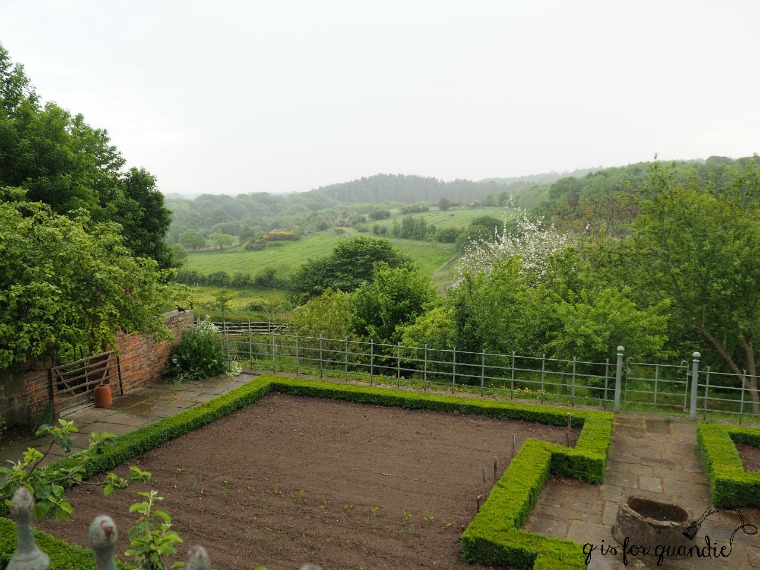
I loved everything about it; the quaint buildings, the history, and especially the gardens.

Fast forward to 2003 when Mr. Q and I were in Stockholm and we visited Skansen.

Skansen was the world’s first open air museum and it was established in 1891.

We spent a lovely day just wandering around.  The occasional building had a costumed interpreter inside and we had plenty of time to chat with them about life in Sweden, and Mr. Q really loved that.  He is a big fan of interacting with people from other places.

I have a photo somewhere of Mr. Q sitting on the patio shown below drinking a cup of coffee.  That was before I went digital though ,so I can’t share that with you here.  Why does the coffee always taste so much better in spots like this?

The cool thing about open air museums is that they encapsulate all of the different styles and time periods of a country in one convenient place.  Some critics of open air museums think they have a fake, Disney-esque quality to them since the buildings have been moved into an artificial setting and in some cases only parts of the buildings are original while other parts have been re-built.  I say bah humbug to those people.  There’s always got to be somebody to spoil the fun, right?

We have a couple of open air museums here in the Twin Cities including the Gammelgården Museum in Scandia, Minnesota that focuses on the lives of the Swedish immigrants who settled in this area in the 1800’s.  It’s a lovely little spot, but not nearly on the same grand scale as Skansen or Den Gamle By.

While researching our upcoming trip, I was super excited to discover that Oslo has an open air museum, the Norsk Folkemuseum, and it is very easy to get to on our own from our ship’s dock.  There is a ferry from there that goes over to Bygdoy and the museum is within walking distance from there.

We probably won’t get a chance to see a Norwegian stave church in situ during our trip, so how nice that we can see one at the museum.

Since this will be my 3rd (but Mr. Q’s 2nd) visit to Oslo, we have already seen many of the other sights in the city so we are planning to spend our entire time in Oslo at the Norsk Folkemuseum and I’m so excited about it!  I’ll be keeping my fingers crossed for a lovely sunny day, but even if it is overcast and rainy I know I’ll still really enjoy it.

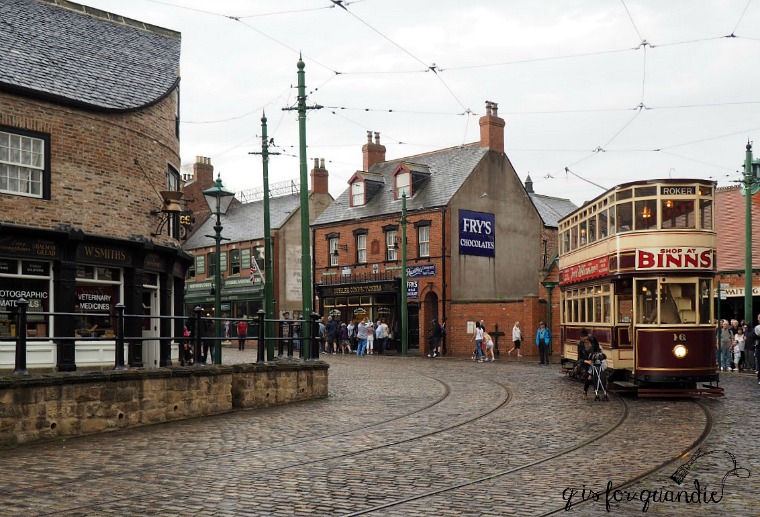
Initially I thought the one open air museum would be sufficient on this trip, but then I discovered the Beamish museum in County Durham, England.

Yeah, that’s not a real town folks, it’s an open air museum.  How cool is that?

And how could I possibly resist this place?

 So it has been added to the itinerary for our one port in England, which is Newcastle Upon Tyne.  I believe it is about an hour away by car and I couldn’t find any public transportation that could get us there in a timely fashion, so this is one case where we will take the ship’s shore excursion.

I can hardly wait!

How about you?  Have you been to any open air museums?  Do you have a favorite?  Have you been to the Beamish or the Norsk Folkemuseum?  If so, I’d love to hear about it so be sure to drop me a comment.