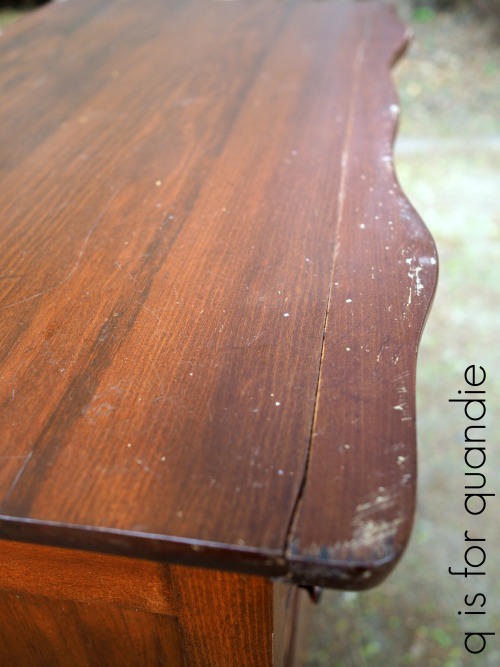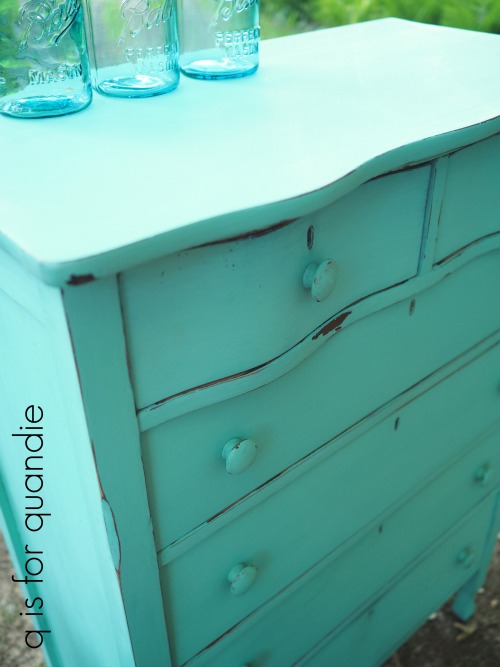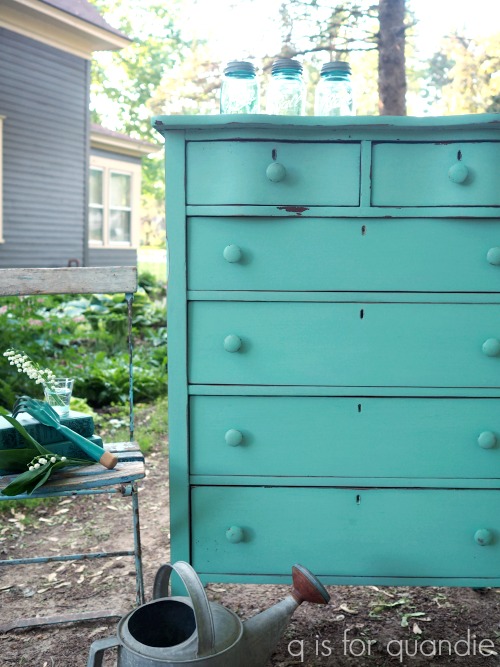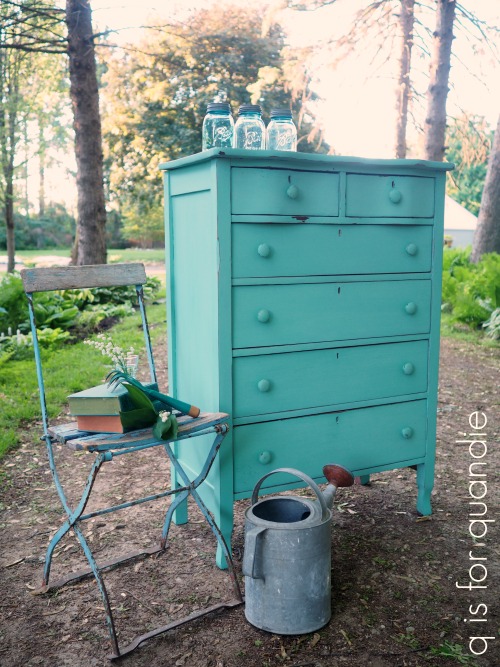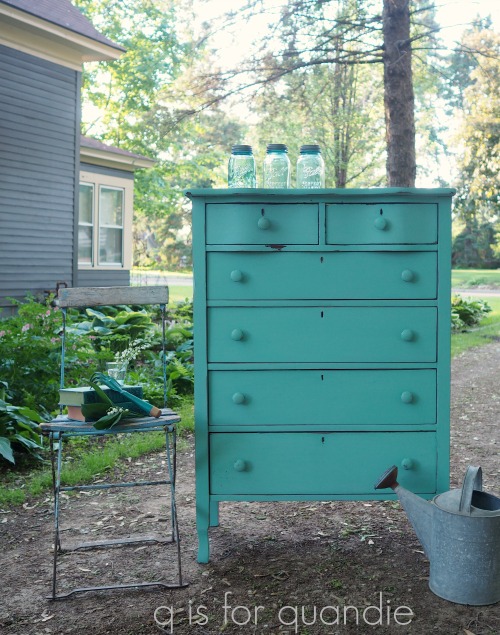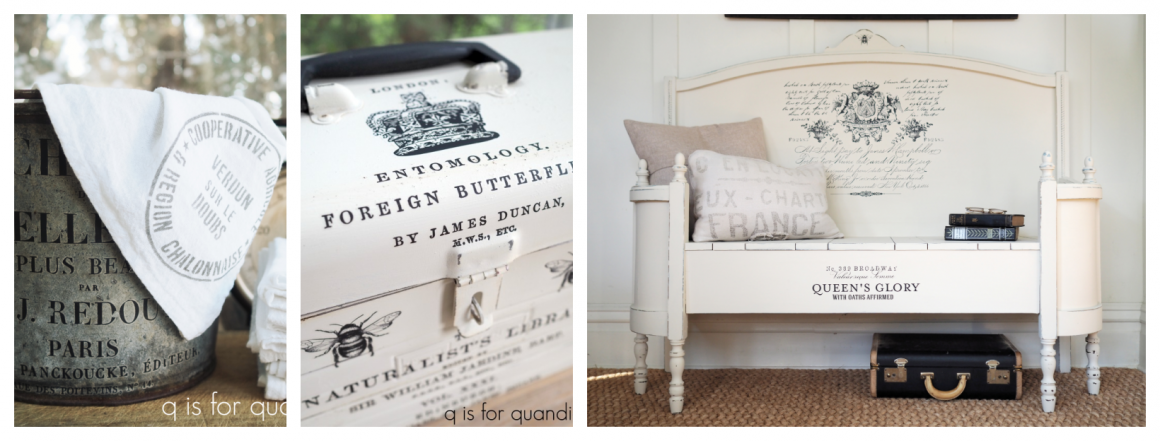
the spring fling dresser.

We’re still recovering from the ridiculous amount of snow we got last weekend, but things are looking up weather-wise here in the Twin Cities, we might even hit 60 by Sunday.  I am suffering from a very serious case of garage sale withdrawal, so I’m chomping at the bit for some spring!

I thought I would nudge it along a little bit with a spring fling in the form of a garden themed dresser.

I shared the beginning of the journey of today’s dresser with you guys on Wednesday.  This dresser just insisted on being something other than what I first imagined.  After several failed attempts to salvage a milk paint finish, I threw in the towel and decided to start over again.

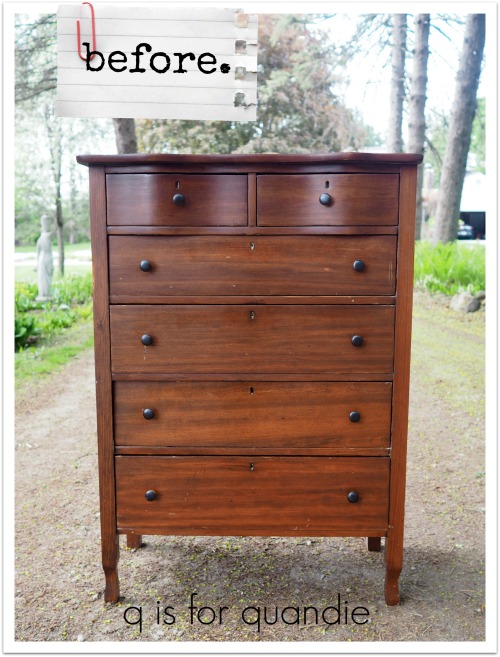
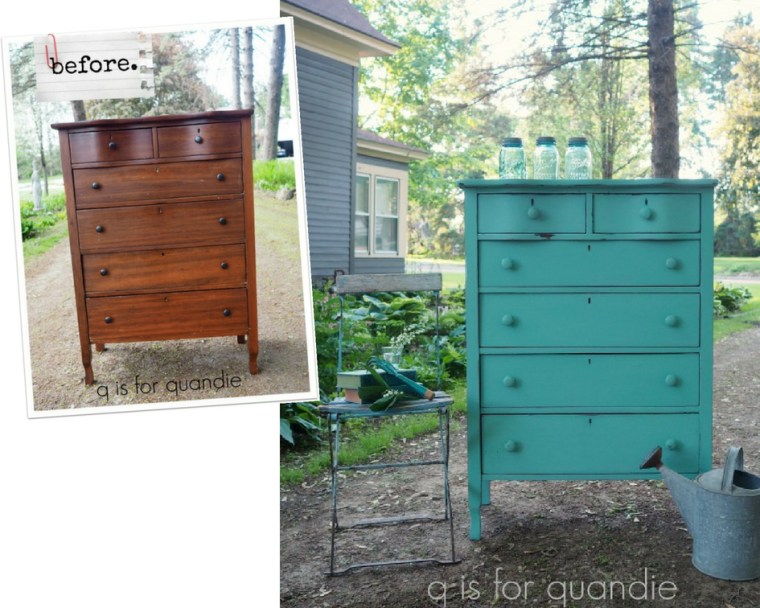
As a reminder, when we last left the dresser it looked like this.

The first thing that you have to understand is that any remaining chippy paint is going to leave a texture on the surface of the dresser if you just paint over it.  In addition, whatever you put over that remaining paint may ultimately chip off as well.  The adherence of your final paint layer is only as good as the adherence of what is under it.   So the first thing I had to do was make a choice between just sanding off the loose chips, or doing a heavier sanding and removing all of the milk paint entirely.

I went with with the former.  I used my orbital sander and a 120 grit paper to remove as much of the chipping paint as I could knowing that the remaining bits of paint would add some texture to my piece.

There were several ways I could have proceeded from there that most likely would have worked well.  I could have stuck with my original milk paint plan and simply added bonding agent to my paint to make it adhere to the surface of this piece better.  Unfortunately, I had already used up almost an entire bag of both the Homestead House Texas Rose and the Miss Mustard Seed Linen.  I did not have enough of either color left to start over with them (and I also don’t happen to have any more bonding agent on hand either).

Another option would have been to paint a base coat of acrylic or chalk paint over the entire piece and then add a layer of milk paint without bonding agent.  The chalk or acrylic paint would have adhered to the dresser, and the milk paint would have adhered to the chalk/acrylic paint.  Again though, I didn’t have enough of the Miss Mustard Seed Linen paint to go that route.

So I decided to just move on to chalk paint, and to switch up my color scheme a bit as well.  I started with an undercoat of two green shades of Dixie Belle paint, Kudzu and Mint Julep.

I wanted the Kudzu (the darker green) to show through some distressing on the edges, but I didn’t have enough Kudzu to paint the entire piece.  Since I hadn’t gotten all of the milk paint off the piece, I knew I would have some texture from what was left and an undercoat would show when I sanded those areas too, so I wanted to have a shade of green there as well.  Luckily I also had a bit of Mint Julep on hand.

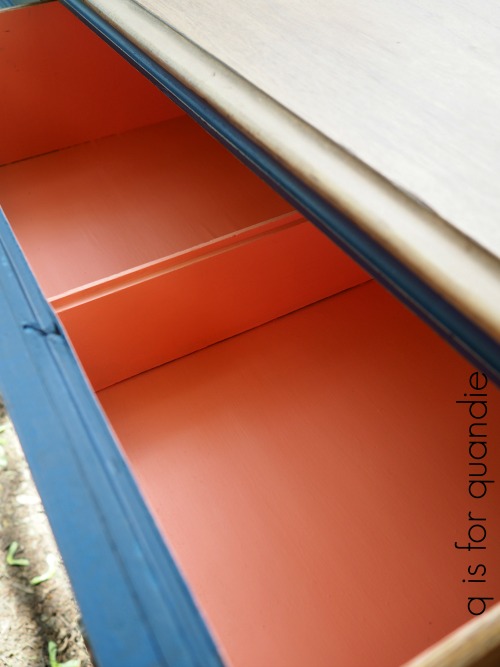
In the end, I decided to paint the inside drawers in the Mint Julep as well.

And I’m so glad I did because it adds the prettiest pop of color when you open the doors.

But before I got to that, I painted two coats of Dixie Belle’s Drop Cloth (paint compliments of Dixie Belle) over the exterior.  Drop Cloth is a warm off-white.  Then I added one of my absolute favorite Iron Orchid Designs transfers (transfer compliments of Prima Marketing) to the front of the piece.

You can sort of see what I mean about the undercoat of green coming through in that photo above, right?  By the way, you can order this transfer online at Scrapbook.com here.  When I looked last night it was on sale for $17.99, which is a great price.

The thing that I really love about these furniture transfers is that they are sized for furniture.  I love the way this one fills up the entire front of the dresser (this is the large version of this transfer, there is also a smaller version available and you can see it on this piece).

And in fact, the large transfer was actually a tad too long so I cut off the “1871.” and put it on the trim at the back of the dresser top.

This is the 4th time I’ve used the larger version of the transfer and each time I have absolutely loved the results.  You can see the other three pieces here, here and here.

Once I had applied the transfer, I waxed this piece with Miss Mustard Seed Furniture Wax over both the Drop Cloth and the Mint Julep Dixie Belle paint, as well as over the transfer.  Yes, you can definitely was over a rub-on transfer.

By the way, I almost forgot to mention.  This dresser came with a key!

It’s really quite rare to have the key, and locks that still function.

Do you ever wonder about these old pieces with locking drawers?  It seems like all of the pieces from this era had them.  What did people lock up in them?  Money?  Their last will and testament?  Their secret diary?  Their hidden stash of chocolate?  Today it seems laughable that you would lock something up in a drawer and feel like it was secure, doesn’t it?

I swapped out the original wooden knobs for some pretty glass knobs.  I buy these knobs in bulk from D Lawless Hardware.  I am exaggerating only slightly when I say ‘in bulk’, but I do order them by the dozen so that I always have them on hand.  I also buy three different sizes.  This is the middle size, or 1 1/4″.

I love using the glass knobs on pieces with the transfers because they disappear a bit and don’t interfere with the detail of the transfer itself.

Here’s one more look at that pretty pop of mint green on the inner drawers.

And there you have it.  It may not be milk paint, but I still think it turned out beautiful in the end.

 If you need a garden themed linen press dresser and you live near the Twin Cities, be sure to check out my ‘available for local sale’ page for more details.

a complete and total fraud.

Remember the pretty sea glass dressing table that I shared a couple of weeks ago?  I mentioned at the time that there were three pieces that I picked up together that night.  Today I’m sharing a story about the 2nd piece, a linen press dresser.

There are four more drawers behind those doors.  Whenever a dresser has drawers behind doors I call it a linen press.  I’m not sure if that is technically accurate, but it works for me.

Since I had so much fun layering milk paint on the desk I painted during milk paint madness week, I decided to try that again on this piece.

So I began with removing the knobs, sanding the piece, cleaning it well and then painting a base coat of Homestead House milk paint in Texas Rose.  I painted the entire outside of the piece, as well as the four inner drawers, both inside and out.  My plan was to use the Texas Rose as a base coat under some Miss Mustard Seed Linen on the outside, but leave the inner drawers in this pretty rosy color.

I’d never used this color before, so before I started I painted a test board in it and tried out a couple of different top coat options.  As you can see, the topcoat can really make a difference in the look of this color.  I wanted to see what my options looked like before I made a decision.

Before moving on to my final color, the Linen, I decided to layer another color under it.  I went through my mostly used bags of milk paint to see what I had and pulled out Homestead House’s Upper Canada Green.  I only had a couple of tablespoons of this paint left, so I mixed it up.  I thought this would be a good opportunity for me to show you what I mean when I tell you to let your milk paint sit for 5 – 10 minutes to be sure all of the pigments are dissolved.

Here is how the paint looked before any mixing at all, just the water and the powder in a cup.

See all of those flecks of blue pigment floating around?  They still need to dissolve.

Here’s is the paint after an initial stir …

You can still see a few darker flecks of color and the overall color is pretty yellowish.

But after waiting five minutes and giving it another stir, you start to see true color of the Upper Canada Green as those blue pigments are finally dissolving.

You can see why you don’t want to start painting before those pigments are all fully dissolved.  You can end up with an entirely different color.

OK.  So you might be wondering at this point why I have mixed up a couple of tablespoons of my next color since this is clearly not going to be enough paint for the entire thing.

This is another little trick I want to show you.  I had someone comment that they hated wasting milk paint for a layer of color that was barely going to show on the finished piece.  I totally get that.  So here’s what you do.  Instead of painting the entire piece in your second color, just paint it over the areas where you want to see it peeking through your distressing/chipping.

So far, so good, or so I thought.

The paint looks pretty well adhered in that photo, doesn’t it?  There were a couple of chippy spots on the legs, but that was about it.

However, fast forward about 18 hours.  The next morning the dresser was chipping pretty much everywhere.  Ugh.  I decided all was not lost, I would just sand it well to get all of the chipping paint off and create a better base for the final color.  So I sanded, vacuumed and then painted on a coat of Miss Mustard Seed’s Linen.

As the Linen started to dry I could see that it was continuing to chip.  In fact, it was chipping even more than before.  And it was chipping all the way down to the wood.  My work applying the layered colors was all just flaking right off.

Ugh.  This was the moment when I felt like a complete and total fraud.  I’d just spent a full week here on my blog proclaiming to be an expert on milk paint and now my own milk paint project was turning into a complete disaster.  Was this the universe’s way of keeping me humble?  Reminding me that I don’t know everything and no matter how much experience I have with milk paint it can still totally backfire on me.

I was mentally beating myself up and wanting to just kick the dresser to the curb.  Suddenly a bonfire seemed like a great idea.

Or maybe I could just hide the dresser under a sheet and never mention it to anyone.  I told Mr. Q I was going to sand it down, paint it with chalk paint and never, ever tell anyone that I’d initially tried to paint it with milk paint and it was a complete failure.

  Instead I did what I usually do in these situations.  I walked away.  I pushed the dresser into a corner and decided to give it a couple of days to think about its behavior.

In the meantime Mr. Q reminded me that I’ve painted well over 100 pieces of furniture with milk paint and this chipping situation has only happened to me a few times (see them here, here and here).  He also suggested that sharing this experience with you guys was the right thing to do.  If it happens to me, it probably happens to other people too.

I really don’t know what was on this piece that caused it to chip like this.  I did prep it properly.  If anything, I sanded and cleaned it more thoroughly than I usually do.  I guess 4 times out of over one hundred or so pieces aren’t terribly bad odds.

A few days later I pulled the dresser out of its corner and I thought to myself ‘you know, that chipping is a little extreme, but some people love a really chippy finish.’  I thought that perhaps if I just added one more coat of the Linen milk paint I could make it work.

Can you guess what happened?  Sigh.  Yep, it chipped even more, if that’s even possible.  Literally to the point that there was very little paint left.  I have run into this phenomenon before, each added layer of paint activating even more chipping.

After knocking off all of the loose paint, this is what was left.

Milk paint just wasn’t meant to be with this piece.

I decided not to throw it on the bonfire, but instead to start over from square one.  After all, under all of that chipping paint is still an adorable linen press dresser that is in great shape.  You’ll have to wait until Friday to see the end result though.  I hope you’ll check back then.  But in the meantime, how about you?  Have you had any colossal paint disasters?  Please tell me I’m not the only one.


the laundry co.

Here it is mid-April in the Twin Cities and winter is still going strong.  I’ve been so patiently waiting for signs of spring.  But lately it seems like just when enough snow melts for us to see the ground, another round comes in.

This past weekend the snow started Friday night, we had blizzard conditions by Saturday afternoon and the snow continued to fall until sometime after midnight last night.  I believe we broke some records and got well over a foot of snow.

But on the bright side, it was a weekend.  So we didn’t have to go anywhere, which left us with plenty of time to just hang out at home and binge watch some Norwegian TV.  Mr. Q and I got through all of season 1 and halfway through season 2 of Okkupert (Occupied).  Somehow it seemed appropriate to be watching this show while the snow came down.  But the weather also gave me a great opportunity to work on some projects.

One of the projects I worked on was updating an old wooden ironing board.  I’d painted it several years ago with black chalkboard paint and tried to sell it at a couple of my occasional sales, and there just weren’t any takers.  So it ended up shoved in the back of the carriage house.  Out of sight, out of mind.

But then Prima Marketing sent me some of their new re.design transfers including the design called ‘Laundry’ (in the middle).

It was the perfect size to add to the old ironing board and turn it into a sign.

I started out by painting over the black chalkboard paint with a coat of Miss Mustard Seed milk paint in Shutter Grey.  Then I used some Homestead House Salad Bowl Finish to create a resist (read more about that technique here) and then added two coats of Homestead House milk paint in Raw Silk which is a white with a grey undertone.

Once the paint was thoroughly dry, I added the transfer following the directions provided in the packaging.

 After the transfer was in place, I sanded it very lightly with 220 grit sandpaper and then added a top coat of Miss Mustard Seed’s Furniture Wax.

The transfer was the perfect size for my ironing board.

I set up a little laundry folding scene against the designated blank wall in my piano room.  Some bloggers might have been able to stage a laundry sign in their fabulous, light filled laundry rooms.  Not me.  My laundry facilities are in my ancient 100+ year old dark basement complete with damp concrete walls and cobwebs we can’t keep up with.

I wish I had a pretty spot like this for folding my laundry down there.

I have so many tablecloths to fold …

Don’t these vintage linens have the most gorgeous colors?

I won’t be hanging on to the laundry co ironing board since I don’t have a spot for it that will do it justice.

If you’re local and you have a nice blank wall in your laundry room that would be perfect for a vintage ironing board turned sign, be sure to check out my available for local sale page for more details.

In the meantime, we’ll be here shoveling out from the storm, watching the rest of Occupied and hoping that spring really is coming this year.  Eventually.

photo finish friday.

Hey, I bet you guys thought I forgot all about Photo Finish Friday!

With all of the hubbub over milk paint madness week, it sort of fell to the bottom of the priority list. But it’s back!

My first photo finish Friday blog post was all about composition, while today’s photo finish subject is white balance.  White balance is a very important part of photography, especially so when you want to correctly represent colors in your photos.  It’s also something that I struggle with all of the time.  I am constantly correcting, and re-correcting, the white balance in my photos!

All light is not created equal.  In fact, lighting has color depending upon its source.  Lighting from an incandescent bulb will be more yellow or orange, while fluorescent lighting will be bluer.

We can also talk about light in terms of temperature.  Incandescent lighting is warm, fluorescent lighting is cool.  Outdoor lighting changes throughout the day depending on the angle of the sun, whether or not it is overcast, or things it reflects off of (like snow, or the side of a big red barn).

However, our eyes (or maybe technically it’s our brains) have the magical ability to automatically adjust the white balance of what we are looking at without us even being aware of it.  That ends up being one of the trickiest aspects of white balance.  Sometimes our brains adjust for it and we don’t even notice that the white balance in our photos is off.  So be sure to take the time to really scrutinize your photos.

There are two easy ways to control white balance; using the white balance settings on your camera and using photo editing software to adjust the white balance of your photo in post processing.

Let’s start with setting the white balance on your camera.  Most cameras will have a white balance setting.  Even my smartphone, which isn’t all that smart because it’s ancient, has a white balance setting.  If you don’t know how to change the white balance on your camera (or whatever you are using as a camera), now is the time to figure that out.  I recommend googling it.  For me that’s the easiest way to get a quick answer on where a setting might be located on my camera.

Typically your camera will have an automatic white balance setting and a few settings for specific lighting conditions both indoors and out.  Those usually include incandescent (or Tungsten), fluorescent, cloudy, sunny, shady and possibly a few more.  Most cameras I’ve seen use the same, or similar, icons for their white balance settings.

The incandescent setting is best for traditional household light bulbs.  The fluorescent setting will prevent the green cast common to photos taken in fluorescent light.  The cloudy setting will add a bit of warmth to the light; the shade setting adds a slight pink tone to eliminate the blue cast that shadows take on in open shade; and sunny option sets the color temperature to something typical of mid-day sun.

For the most part I keep my camera on automatic white balance.  My camera will do its best to determine the current lighting condition and adjust for it.  However, the camera doesn’t always get it right.  When I notice that happening I will try one of the other settings to try and improve the white balance.

But when I fail to get the white balance right in the camera, I still have a chance to correct it in post-processing.

Here’s an example of a photo I took with the automatic white balance.

And here it is after I adjusted the white balance in PicMonkey.

PicMonkey is a photo editing software that used to be free, but unfortunately it isn’t free anymore.  There are lots of options out there for photo editing software ranging from basic to really technical, and from inexpensive to really expensive.  I haven’t tried very many of them, and in fact two that I’ve used regularly in the past have become defunct (Picasa and Window Live Photo Gallery) leaving me currently with just PicMonkey.  Because I’m a renewing customer, I recently paid $48 for another year of PicMonkey.  However, new customers pay a little more.

For the moment I’d rather pay my $48 and not have to learn something new.

Correcting the white balance in PicMonkey is relatively easy most of the time.  Under ‘Basic Edits’ you click on ‘Colors’ and then ‘Auto Adjust’ and PicMonkey takes its best shot at correcting the color for you.

I didn’t necessarily think this next photo needed to be adjusted …

But I tried ‘Auto Adjust’ anyway, and this is the result …

See how it warmed up the colors giving the photo more of a pink cast?  Honestly, I’m not really sure if that is an improvement or not.

The ‘Auto Adjust’ doesn’t always get it right, especially if there are multiple sources of light or multiple shades of white in your photo.  In that case, you may have to choose the spot on your photo that you think represents the best neutral shade.  In PicMonkey you can do that by clicking on ‘Neutral Picker’ instead of ‘Auto Adjust’, then use your mouse to position the little pointer over the spot you want to base the white balance on.

I tried that again with the same photo, positioning the neutral picker over the ironstone tureen.

Hmmmm.  Now it’s really pinkish.

Next I positioned the neutral picker over the folded tablecloth at the bottom of the photo.

That really warmed up the color.

Choosing a sunny spot on the curtain in the background gave this result.

But which one is right?  I’m not sure of the answer to that question.  Beauty is in the eye of the beholder, or perhaps it really depends upon the color settings on your computer screen.

Regardless, I try to choose the white balance that I think best represents the colors on the item I’m featuring in my photo.  Especially if I’m taking photos of a piece of furniture I’ve painted.  I want the paint color to be as accurate as possible.

Is my custom Blue Alligator color more blue …

or is it a tad more green?

That difference might be important to a potential buyer.

It’s well worth your time to take a few extra minutes to get the white balance right in your photographs.  I hope you’ve learned a bit about white balance and how to adjust it today.

Now get your camera out and play around with the white balance this weekend!

oops, I did it again.

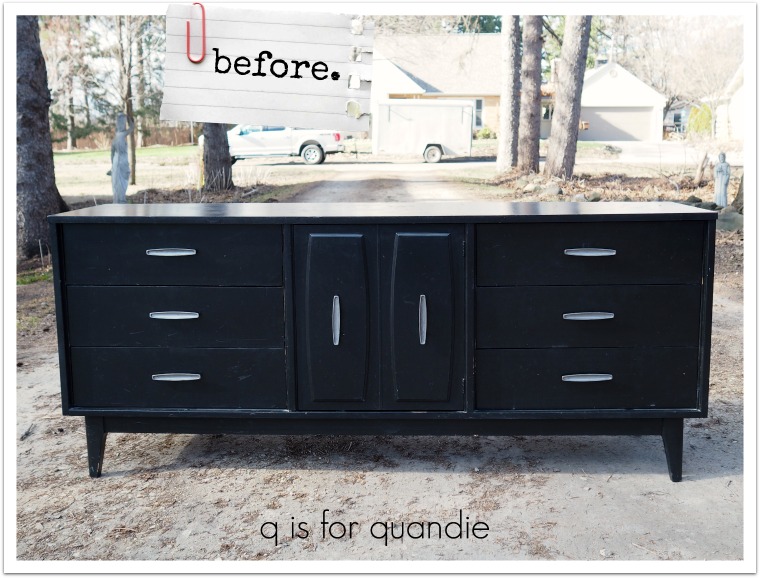
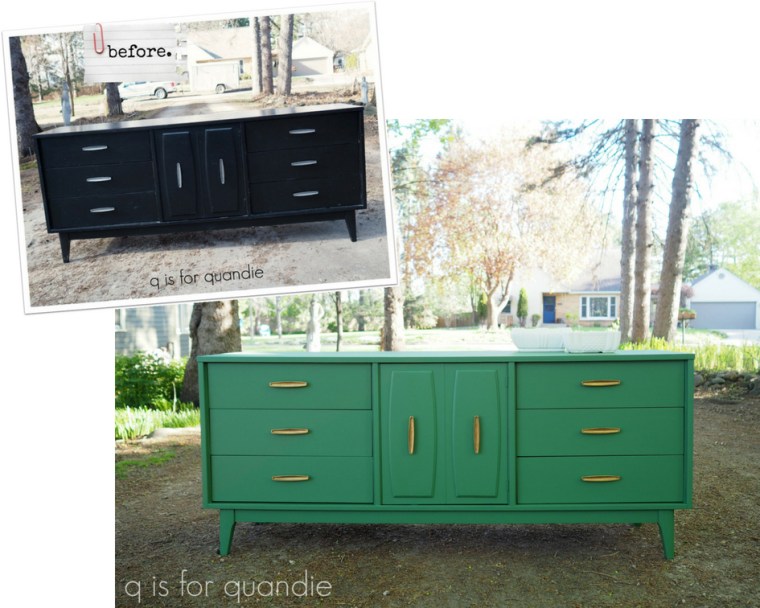
If I come across a mid-century piece while perusing Craigslist these days, and it’s a bargain price, I can’t help but feel like I may as well buy it and paint it green.

This formula has been such a great success for me lately.  Why mess with a good thing?  If it ain’t broke, don’t fix it.  And all of those other proverbs.

So when I saw this piece on Craigslist I decided to go for it.

Luckily it was a bargain, because …

a) it isn’t quite as stylish as the other three pieces I’ve done.

b) two of the knobs are broken so I’ll need a solution for that, and there are 14 knobs total so replacing all of them could be expensive.

c) the top of this piece is plastic laminate, not wood veneer.

d) buying it was a bit of a circus.

Let’s start with that last one.  When I arranged to pick it up, the seller explained that she had already moved out of the house where the dresser was still located and now she lives over an hour away.  She was selling multiple items so she wanted to find a time to meet at the house that would work for everyone so that she only had to make the drive once.  That was two other buyers, myself, plus the seller.  Have you ever tried arranging a time that works for multiple people?  Tricky at best.

But we finally all agreed on Friday evening.  Next, the seller didn’t want to actually give out her address.  I get it.  She’d just told me that the house was empty and she was probably thinking ‘oh wait a minute, should I really be giving out the address now?‘  So instead she asked me to drive to a particular intersection and then call her and she’d give me the address from there.  That ended up working out fine, but I usually like to know where I’m going before I head out.

By the way, for safety reasons I never go pick up a piece of furniture alone.  I always have Mr. Q with me.

So we made it there, we hauled the dresser up out of the basement via a very narrow staircase with low ceilings and got it loaded into our van.  It was a lovely Friday evening, so we then took the scenic route home through St. Paul rather than just take the freeway.

Once I got it home, the first thing I did with this piece was to sand the laminate top with my orbital sander, clean it well with TSP substitute and then added a thin coat of Fusion’s Ultra Grip.  Ultra Grip is intended to improve the adhesion of Fusion paint on tricky surfaces like glass, metal or laminate.  The Ultra Grip needs to dry for at least 12 hours before you add paint over it.

I want to mention here that I hear a lot of people commenting on brush strokes when using Fusion paint, especially with the Ultra Grip.  Although you can’t really see many brush strokes in that photo, when the light hits this piece at just the right angle you can definitely see them.  I’ve read lots of tips on how to minimize the brush strokes and I do my best, but they are still there.  Certainly more so than with chalk or milk paint.  I just don’t worry about them.   All three of my previous Park Bench pieces had brush strokes, and all three of them sold like hotcakes.

Next I decided to try and remove those chunky hour glass trim pieces on the two lower drawers.

I thought this piece would look sleeker and more stylish without them and I was hoping that I would be able to remove them without doing too much damage.  If they had been super glued on I might have had some trouble, but they were nailed on with double ended nails.

I didn’t know that up front though.  I used my mini pry bar to carefully start prying it off.  I gently made my way around the edges of the trim working my pry bar under it and gently lifting to see it if would come loose.

It was held in place with quite a few nails.

I pulled the nails out with pliers and then used Dixie Belle’s Brown Mud to fill the holes and smooth out some of the damage I did prying off the trim.

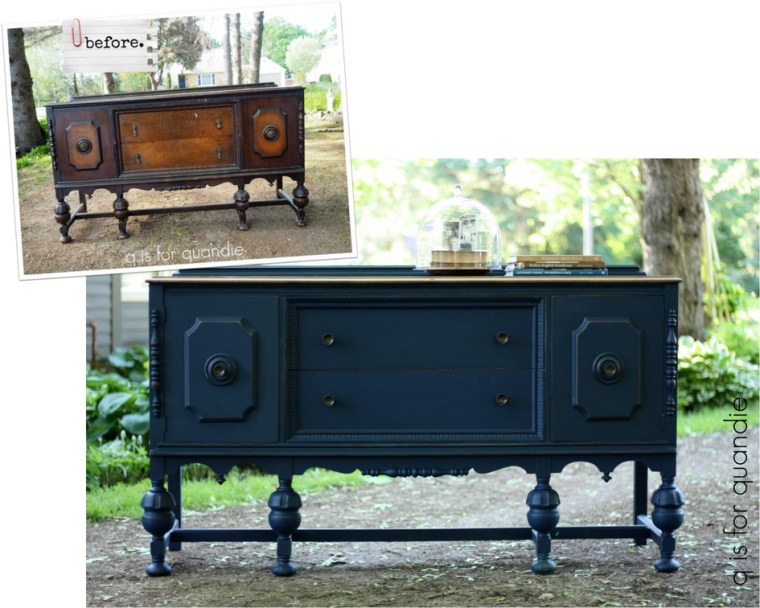
If you are ever considering a piece of furniture but you don’t like the trim on it, keep in mind that removing it can sometimes be an option.  I also removed some medallions that I didn’t like from a buffet I painted a while back (you can read the details here).

The rest was easy.  I painted everything in two coats of Fusion’s Park Bench.  No need for a top coat with Fusion.

I really went round and round with the knobs for this one.  Initially I didn’t want to keep any of the originals so I went to Hobby Lobby to see what they had.  Naturally they didn’t have 14 of anything, so if I’d found the perfect knob I would have had to order more.  Also, even during a 50% off sale, I would have spent at least $35 to $50 just on knobs.

Still, I brought home a few options to try on the dresser.  As it turned out, the drawer fronts on all of the curved upper drawers are really thick.  As a result, the screws on the Hobby Lobby knobs weren’t long enough to reach all the way through.  Argh.  I’m sure Ken could solve this problem by counter sinking the nuts on the back.

But before resorting to that I decided to revisit the original knobs.  First I spruced them up a bit with some of Prima Marketing’s Mettalique wax in Vintage Gold.  Then I moved some knobs around and added new knobs to the just the bottom drawers.  I think it works.

Oh, oops, you can see I didn’t paint the underside of that overhang at the top.  But I promise, you will never even see that in person unless you decide to lie on the floor.

So there you have it, another quick mid-century makeover.

 I’ve decided to hang on to this piece until the paint cures just to be on the safe side.  I don’t always do that, but since this one is plastic laminate on the top I think it will be more susceptible to scratching until it cures.  The Fusion paint takes approximately 21 days to cure.  So I’ll list it for sale in a couple of weeks and then we’ll just have to see if my Park Bench green mid-century modern selling streak continues!
winner, winner, chicken dinner.

First thanks so much for all of the many comments you guys left last week during milk paint madness!  I appreciated every single one and I wish you could all be winners.
But, I only had six prizes to give away.

I say only, but seriously, how incredible were my sponsors in giving me so much fabulous product to give away to you guys?!  I’d like to once again say thank you to Homestead House, Miss Mustard Seed, The Real Milk Paint Co and Sweet Pickins.  They made this all possible.

I used a random number generator to choose a winner from among the comments left on each day’s blog.  Yesterday I notified each winner by email, so if you didn’t get an email, I’m sorry to say that you didn’t win.

But here are the people that did win!

Jeanne R. won the milk paint basics prize.

Constance C. won the milk paint topcoats prize.

Sharon V. won the milk paint chalkboards prize.

Paula G. won the milk paint advanced techniques prize.

Paris B. won the milk paint magic prize.

And Laura W. won the bonus Sweet Pickins prize.

I hope I inspired a few of you to get out the milk paint and start painting something!

milk paint magic.

Hey everybody!  Thanks so much for joining me this week for milk paint madness.  It has been fun sharing lots of info about milk paint with you.  I hope that all of you learned at least one or two new things.  Before I continue I want to take a moment to thank you guys for all of your comments, as well as your continued support of my blog.  I really do appreciate every one of you!

For today’s post I want to take everything we’ve learned over the last week and put it all into practice on piece of furniture.  So let’s get started.

My friend Meggan or, as I now call her, the thrift doctor (I’m trying to convince her to start writing her own column here on my blog called ‘ask the doctor’ with thrifting tips, what do you think?), texted me a few weeks ago letting me know that there was a fabulous desk at the local Goodwill with a bargain price tag.  Luckily Mr. Q was available to dash over there and pick it up for me because I know it would have gone fast.

It doesn’t have a lot of frills, but I like the legs and the drawer pulls are really lovely.  It also was in fairly good shape.

I really didn’t love the orange-y color of this piece though.  I didn’t even want that color to show through in the chippy spots.  So I decided to layer some colors on it using bonding agent in the first color so that it wouldn’t chip down to the wood.

I could also have used a base layer of chalk paint or Fusion acrylic paint, but in this case I had a particular color in mind, Homestead House milk paint in Maritime.  A very pretty blue.  So I mixed my paint first using one part water to one part powder.  Once that was well mixed, I added another one part Miss Mustard Seed bonding agent and stirred it in.

Next I moved on to the prep work.  As I mentioned yesterday, good prep is key to controlling the chipping you might get with milk paint.  But in this case I was using bonding agent in my first layer of paint so I could slack off a little.  Still, I sanded the piece briefly by hand and wiped it down with a damp cloth.

Then I brushed on just one coat of the Maritime milk paint with the bonding agent added.  Now, if I was a really good blogger I would have taken a photo at that point to share with you now.  But no, I didn’t (although that photo of the brush above is taken on top of the desk with its coat of Maritime).  I can tell you that the paint did not chip at all and it had just a little bit more sheen than milk paint normally does.  Similar to the slight sheen of Fusion acrylic paint.

A couple of days went by before I got to the next step in my project, which gave the Maritime plenty of time to dry.  Next, my plan was to use the Homestead House Salad Bowl Finish (or beeswax finish) to encourage a controlled amount of chipping and paint over it with The Real Milk Paint Co’s Soft White milk paint.  So I mixed up the white milk paint, again using equal parts water and powder, and left that to sit while I used my finger to smear some beeswax finish along the edges of the desk.

After painting one coat of the Soft White, you can see the areas where the beeswax is resisting the paint.    The areas without beeswax are not chipping at all.  This also gives you a good feel for the coverage of the Soft White over a darker color.  Pretty good for one coat I think.

I added a second coat of Soft White and left it to dry.

My initial plan was to leave the desk white, but you know what?  I didn’t like it.  I felt there was too great a  contrast between the white and the blue.  It looked splotchy instead of perfectly chippy.  Sorry, again no photo of that step!

One thing that I have learned over the years is to follow my instincts when it comes to these moments.  If my gut is telling me that I don’t like it, I switch gears instead of trying to make it work as is.

So I decided to mix a custom color of milk paint that was about halfway between the lighter Soft White and the darker Maritime.  I pulled out three almost empty bags of milk paint, Miss Mustard Seed’s Shutter Grey and Eulalie’s Sky and Homestead House’s Upper Canada Green and started mixing.

I ended up with this pretty smoky blue with just a tiny hint of green.

I added just one coat of this color over the white.  Once dry I started sanding the edges and discovered the most perfect chipping.

For me, this is the magic of milk paint.

I know you can get a similar look layering chalk paint or even Fusion paint, but I think milk paint always looks the most authentic.

As you can see, I did end up with a little of the wood showing after all, but those are spots where I sanded through the layer of Maritime, not spots where the paint chipped due to the application of the beeswax.

After sanding the entire piece lightly with some 220 grit sandpaper to get it nice and smooth, I added a topcoat of The Real Milk Paint Co’s Dead Flat finishing cream.  Since this is a desk there is the potential it will get a fair amount of use, so I wanted a little more protection than just wax.

By the way, I spruced up the drawer pulls a bit by adding some of Prima Marketing’s Metallique wax in Vintage Gold.

To learn more about that product check out this post.

In the end I love how the desk turned out.  I think I’m going to do more multi-layered pieces using milk paint.  It really adds some authentic age to the piece to see multiple layers of color as though it has been painted several times through the years.

This brings us to today’s giveaway, and guess what?  I have two prizes for today!

The first prize includes:  five colors of milk paint, a Homestead House Espresso wax, a Miss Mustard Seed white wax and a brush.  Thank you to Homestead House, Miss Mustard Seed and The Real Milk Paint Co for providing the items for this giveaway.  Approx. value:  $135.

And I also have a bonus giveaway today!  A while back I had asked Sausha at Sweet Pickins if she wanted to participate in milk paint madness week by providing some merchandise to giveaway.  She said yes, but then life happened and she didn’t get her stuff shipped right away so I just received it in the nick of time in yesterday’s mail.  So I decided to just give that away as a bonus prize today.

Includes:  my absolute favorite Sweet Pickins color, In A Pickle, Oil Wax, Extra Bond, a sanding block, paint brush and paint mixing whisk.  Thank you to Sweet Pickins for providing these items.  Approx. value:  $55.

The basic rules:  to be eligible to win today’s prize leave a comment on this blog post telling me what your favorite milk paint color is.  Your comment must be left on the blog, not on Facebook.  You are not required to follow my blog, although it would be awesome if you did!

I will randomly draw the names of two winners for today’s prizes from all of the comments left on this post by Saturday, April 7, 2018 at the stroke of midnight.  You are eligible to win each day, so if you have left a comment on each day’s post, your name is eligible to be drawn for each prize.

The fine print: no purchase necessary, you must be 18 years of age or older to win, void where prohibited by law, the number of eligible entries received determines the odds of winning, if the prize is not claimed by Friday, April 13, another name will be drawn at random to win, blah, blah, blah.

I’ll be announcing the names of all six winners from milk paint madness week on Monday, so be sure to check back.

In the meantime, remember to pin today’s post for future reference.

And if you are local and in need of a pretty smoky blue desk, be sure to check my ‘available for local sale’ page for more details on the desk.

milk paint advanced techniques.

Welcome to day 4 of milk paint madness week!

Today I’m going to share some of my favorite advanced milk paint techniques including using bonding agent, layering milk paint with other types of paint, resists, how to control the chipping, how to create a crackle effect, and custom mixing.

bonding agent.

All of the milk paint brands sell a bonding agent.  The purpose of bonding agent is to improve the adhesion of milk paint.  I’ve never been a big fan of bonding agent, and here’s why.  If you don’t want any chipping when using milk paint, then why use milk paint?  I feel like bonding agent basically turns milk paint into an acrylic paint.  That may not be scientifically accurate, but you get the idea.  Your paint will become smoother and have a little bit more sheen.  If you want a creamy smooth paint that adheres well and doesn’t chip, use Fusion acrylic paint.  It will be cheaper to buy one jar of Fusion paint than it is to buy milk paint plus bonding agent plus a top coat.

However, bonding agent does have its place.  For example, when there is a milk paint color that you absolutely love and you want that exact color but you don’t want it to chip.  This came up recently for me (and you’ll read more about that tomorrow).  Another time you may want to use it is when you have a surface that you know is going to really resist milk paint far more than you want it to, you can paint a first coat of your color with the bonding agent and then a second coat without.  You’ll still get the look of milk paint with your second coat, but probably not a lot of chipping.

It’s easy enough to use bonding agent.  It’s important to mix your milk paint powder with the water first.  Once that’s well mixed, add the bonding agent directly into your paint and mix well.  You should add one part bonding agent to two parts paint.

layering.

Back when I first started using milk paint I was very confused about what you could paint over with milk paint and what you couldn’t.  Over time I’ve learned a little bit from other painters and a little bit from trial and error.  Here’s what I’ve discovered.

Chalk paint and acrylic paint are perfect for layering with milk paint, especially if you’re worried about milk paint chipping right off the existing finish on your piece.  Much like painting the first coat using bonding agent, you can also paint a first coat of chalk or acrylic paint.  Then use a resist to encourage the milk paint you put over it to chip where you want it to.  But more on resists and chipping in a minute.

When layering milk paint over chalk or acrylic paint you do not need to sand the chalk or acrylic paint.  Just paint right over it with your milk paint.  Please note, this is assuming you have a fresh coat of these paints, not an old paint job with a topcoat of some kind over it.

If you are painting over a piece that was painted previously and then sealed with wax or hemp oil, you need to be sure the topcoat is cured (30 days) before trying to paint over it with milk paint.

If you are painting over a piece that was sealed with The Real Milk Paint Co’s finishing creams or the Tough Coat Sealer you are fine painting over those with milk paint as soon as they are dry.

I treat old latex or oil based paint the same way I would an old varnished finish because all three of those will resist the milk paint to varying degrees.  I’ll go into that a bit more in a minute.

I have also found that milk paint does not adhere well to spray paint.  You’re probably wondering why in the world anyone would want to put milk paint over spray paint, but I have tried that when painting cane or wicker.  I also once tried to paint over a chair that was initially spray painted.  Not much of the milk paint stuck.

the chippy factor.

The most unique thing about milk paint is its tendency to chip when it meets resistance and thus can’t absorb into the surface that you are painting.

Resistance can take many forms.  It can be a pre-existing impervious finish like varnish, it can be layers of furniture wax or polish that have been applied to a piece over the years, it can be oils from handling (or from cooking in the case of kitchen cabinets), or it can be old oil based or latex paint.

With lots of experience painting pieces in milk paint I’ve gotten better at predicting whether or not something is going to chip, but it still sneaks up on me sometimes.

The best way to control unwanted chipping is with good prep!

I can’t stress that enough.  If you don’t want out of control chipping, prep your piece by sanding it well, vacuuming off the dust, then cleaning with a grease cutting cleanser like TSP Substitute.

But if you like to live on the edge and you can roll with the punches, just wipe your piece down with a damp cloth and then take your chances.  Sometimes that’s a fun way to go too.

resists.

Once you’ve prepped your piece you can apply your own resist in a purposeful way to encourage chipping where you want it.  There are lots of choices when it comes to a resist.  You can use hemp oil, furniture wax, petroleum jelly, a wax puck, canning wax or candle wax.  However, my favorite product to use is the Homestead House Salad Bowl Finish.

This is a beeswax finish that is formulated just a little bit differently from furniture wax.  It’s harder and a little bit more oily, and it works perfectly as a resist.  A little bit goes a long way.  I have the small jar and haven’t even used half of it yet, and I’ve probably used it on at least a dozen or more pieces.  As a side note, it works really well as a resist under Fusion paint too.  I’m giving away the larger jar as part of today’s giveaway, so the person who wins will practically have a lifetime supply!

I apply the Salad Bowl Finish much like one would apply lip balm.  Get a little on my finger, then use it to rub the wax onto the furniture in a very thin coat only where I want chipping.  Add it very sparingly if you just want a little chipping, add more if you want a lot.

Miss Mustard Seed and Sweet Pickins also carry a beeswax finish.

the tape method.

What if you painted your piece and totally forgot to add a resist to encourage chipping?  Or maybe you expected the piece to chip naturally and it just didn’t (because sometimes that happens too).

Well, all is not lost.  I’ve had great success with using tape to pull off some of the paint.  Just press some tape onto the area you want to chip and then yank it off again.  It’s sort of like the process of removing lint from your black slacks using tape.  I always start with the yellow Frog tape (for delicate surfaces).  However, if I find the paint still isn’t coming off I’ve been known to try a stronger tape like packing tape.  Just use caution when doing this, you can also pull off a big solid strip of paint which isn’t quite what you want.  Go slowly, start out with a very small area and go from there.

crackling.

Applying heat is a great way to encourage your milk paint to crackle.  You can do this the accidental way (which I totally do not recommend), which is to paint your piece in the hot sun on a summer day.  I’ve done that a few times and have gotten some great crackling, but that’s not very practical or predictable.  A better way to encourage crackling is to use a blow dryer which gives you a little more control.  I recommend mixing your milk paint a little bit thicker than you would normally, then as soon as you’ve painted it on add some heat by ‘drying’ it with the blow dryer on high heat.

If you want to emphasize the look of a crackled finish, try adding a colored top coat such as antiquing wax or white wax which will catch in those cracks and highlight them.

custom colors.

Mixing a custom color is one of my favorite ways to play around with milk paint.  I know you can mix other kinds of paints to create your own colors too, but somehow with milk paint it feels a little more mad scientist-y.  Maybe it’s because you mix various powders, then add water, then you have to wait 5 or 10 minutes to make sure the pigments are all fully dissolved before really getting a good look at the color you’ve created.  Or maybe it’s because I sometimes practice my evil mad scientist laugh while I’m mixing my own paint colors.

Some of my favorite custom mixed colors are Blue Alligator

British Rocker Mint

and French Desk Grey …

Mixing custom colors is a great way to use up those partial bags of milk paint that don’t have quite enough in them to paint a full piece of furniture.

I hope today’s post has given you some ideas for different techniques you can try with milk paint.  Now for the fun part, today’s giveaway:

Includes: Four colors of milk paint, a jar of Homestead House Salad Bowl Finish and a Miss Mustard Seed wax puck.  Thank you to Homestead House, Miss Mustard Seed and The Real Milk Paint Co for providing items for today’s giveaway. 

The basic rules:  to be eligible to win today’s prize leave a comment on this blog post telling me if you’ve tried any of these milk paint techniques, or if not, which one you want to try.  Your comment must be left on the blog, not on Facebook.  You are not required to follow my blog, although it would be awesome if you did!

Normally I make a point of answering every comment left on my blog.  If someone takes the time to leave a comment, I like to acknowledge that.  But I usually only get 10 to 20 comments so it’s easy to fulfill that promise.  But I’m guessing that I’ll get many more comments on these posts so I’m going to warn you up front that I won’t be answering each one.  That helps make it easier for me when it’s time to pick a winner too, so I hope you guys will cut me some slack on that this week.

I will randomly draw the name of a winner for today’s prize from all of the comments left on this post by Saturday, April 7, 2018 at the stroke of midnight.  You are eligible to win each day, so if you leave a comment on each day’s post, your name is eligible to be drawn for each prize.

The fine print: no purchase necessary, you must be 18 years of age or older to win, void where prohibited by law, the number of eligible entries received determines the odds of winning, approximate retail value of prize is $106, if the prize is not claimed by Friday, April 13, another name will be drawn at random to win, blah, blah, blah.

Be sure to check back tomorrow for the final segment of milk paint madness, and in the meantime remember to pin today’s post for future reference.


milk paint chalkboards.

Did you know that you can make a chalkboard using milk paint?

Yep.  No need to buy special chalkboard paint.  Plus the sky is the limit color-wise.

First, the technique.  It’s super simple.  Mix your milk paint as per usual (equal parts water and powder).

Let your paint sit while you prep the surface of your chalkboard by sanding it well, then cleaning it with TSP Substitute.  If I’m using new hardboard for my chalkboard I skip the TSP and just wipe it clean with a damp rag.  Remember, you don’t want a chippy chalkboard so be sure you’ve given your surface plenty of gripping power with good prep.

Give your paint another good stir or two and then brush one coat onto your chalkboard surface.  Once dry, lightly sand with 220 grit sandpaper.  Normally I don’t sand between coats of milk paint, but in this case sanding between coats will help keep your chalkboard super smooth.  Paint a 2nd coat of milk paint.  Once dry, sand again.  The final step is to season your chalkboard by rubbing chalk all over the surface, then wiping it away with a dry cloth.  No other sort of topcoat is needed.

And voila, you have a chalkboard.  Keep in mind that freshly applied paint is always easier to scratch than cured paint.  I’d wait a day or two before drawing on your chalkboard.

Black is a no-brainer and probably everyone’s first instinct for a chalkboard, but I’ve done several green chalkboards too.

I like the look of a green chalkboard with a white painted frame.  This is one of my favorite ways to re-purpose a dresser mirror.

I’ve used a recipe of 3 parts Miss Mustard Seed Boxwood mixed with 2 parts Miss Mustard Seed Artissimo to make a green chalkboard.  But I’ve also discovered that Homestead House milk paint in Bayberry is the perfect chalkboard green.

But you don’t have to stick with just black or green chalkboards.  I’ve also painted a chalkboard using Homestead House milk paint in Laurentien, which is a pretty aqua color.

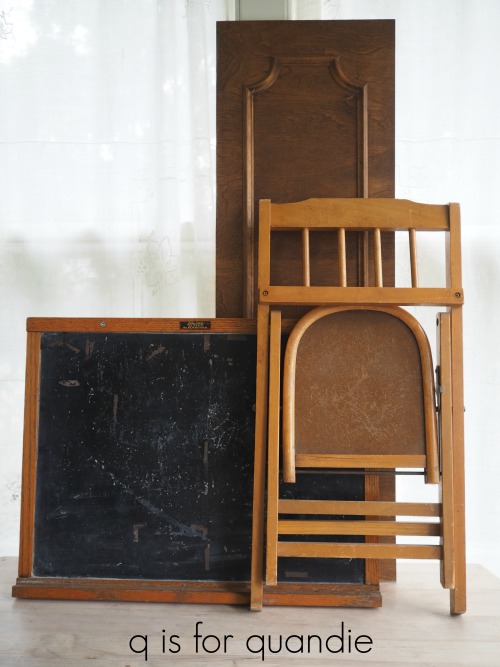
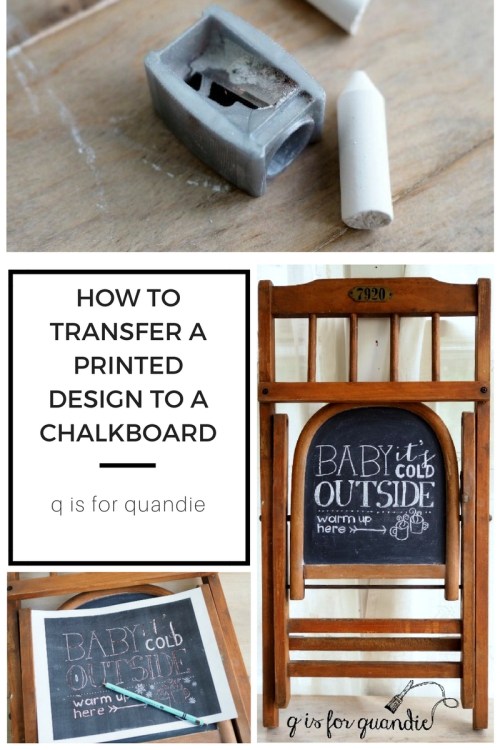
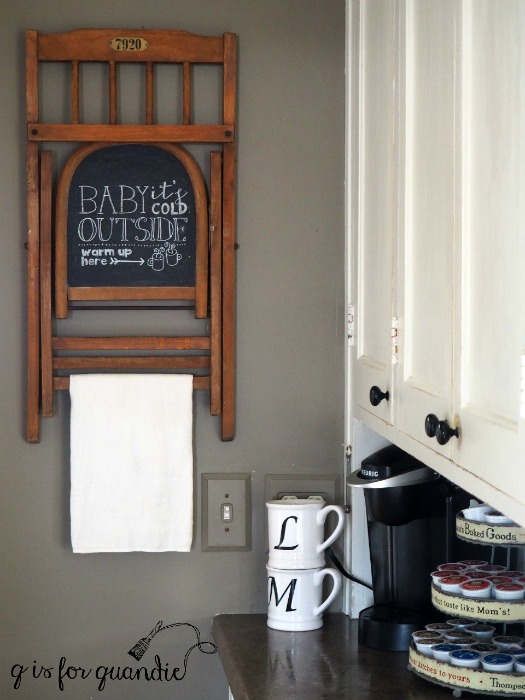
I make a lot of chalkboards.  In addition to re-purposing a dresser’s mirror frame, it’s also a great way to use a picture frame that no longer has its glass.  I even like to turn unconventional items into chalkboards like small folding chairs …

 or washboards …

I always keep a packet of milk paint on hand for whipping up a quick chalkboard.

By the way, not sure what to do with your chalkboard once you have it painted?  I’ve used a few different techniques for drawing on a chalkboard.

You can use chalk to transfer a printed design onto the chalkboard and then fill it in (more details on that here), you can use a stencil (more details on that here), or you can just work on practicing your chalk lettering skills using the book that comes with today’s giveaway.

Speaking of which, it’s time for the fun part!  Today’s prize:

Includes: the Complete Book of Chalk Lettering, 4 colors of milk paint perfect for chalkboards, and a lovely Miss Mustard Seed paint brush for a smooth chalkboard finish.  Thank you to Homestead House, Miss Mustard Seed and The Real Milk Paint Co for providing items for today’s giveaway.

The basic rules:  to be eligible to win today’s prize leave a comment on this blog post telling me whether or not you have at least one chalkboard in your house (I have five!).  Your comment must be left on the blog, not on Facebook.  You are not required to follow my blog, although it would be awesome if you did!

Normally I make a point of answering every comment left on my blog.  If someone takes the time to leave a comment, I like to acknowledge that.  But I usually only get 10 to 20 comments so it’s easy to fulfill that promise.  But I’m guessing that I’ll get many more comments on these posts so I’m going to warn you up front that I won’t be answering each one.  That helps make it easier for me when it’s time to pick a winner too, so I hope you guys will cut me some slack on that this week.

I will randomly draw the name of a winner for today’s prize from all of the comments left on this post by Saturday, April 7, 2018 at the stroke of midnight.  You are eligible to win each day, so if you leave a comment on each day’s post, your name is eligible to be drawn for each prize.

The fine print: no purchase necessary, you must be 18 years of age or older to win, void where prohibited by law, the number of eligible entries received determines the odds of winning, approximate retail value of prize is $122, if the prize is not claimed by Friday, April 13, another name will be drawn at random to win, blah, blah, blah.

Be sure to check back tomorrow for the next segment of milk paint madness, and in the meantime remember to pin today’s post for future reference.


milk paint topcoats.

Welcome back for day 2 of milk paint madness week!

Today I’m going to share a bit of information about the various topcoats you can choose for your milk painted furniture, but I gotta say one could write an entire book about this stuff.  There are so many options out there!  I haven’t tried them all though, so I’m just going to scratch the surface on this topic (pardon the pun).  You may want to go grab a cup of coffee first, this is going to be a long one.  I’m going to list the finish options starting with least amount of protection/added durability and ending with the most durable finish.

going topless.

Before we get into the topcoats, what about not using a topcoat at all?  This is an option with milk paint.  It’s definitely not the most durable option and your milk paint won’t be especially water resistant or scrub-able, but if those factors aren’t important to you, you can go topless!  Without a top coat milk paint has a very matte finish.  I would probably never go without a topcoat on the darker colors, but I do like the look with white or other pale shades.

I didn’t use a topcoat on my Belgian bench.

I painted this piece back in July 2016.  We sit on it to put out shoes on, so it gets a fair amount of use.  The finish has definitely worn a bit more since I first painted it.  But if you’re a fan of the distressed, chippy look that’s a bonus.  The paint itself cures rock hard and won’t rub off on your skin or clothing.

hemp oil.

Hemp oil is one of my favorite topcoats over dark milk paint colors, especially black.  It’s all natural, has zero VOC’s and is solvent free.  Remember what I said yesterday about milk paint having similar qualities?  If you work with these things frequently, it’s important to think about not only the environment, but also your own health.  Homestead House, Miss Mustard Seed and The Real Milk Paint Co all sell an all natural hemp oil in their milk paint lines.

One thing to keep in mind when choosing a topcoat is that all topcoats may change up the color of milk paint to varying degrees.  Hemp oil will deepen the color quite a bit, that’s why it’s perfect for use over dark colors.  It works equally well over mid-tone or lighter colors, but you may want to experiment a bit to see how you like the color with the hemp oil topcoat.  Here you can see how much it changes up Sweet Pickins’ In a Pickle

I like to apply hemp oil with a cheap chip brush that I reserve especially for that purpose.  Once applied, I wipe off the excess with a clean cloth.  There is no buffing required with hemp oil.  Hemp oil dries to a matte finish with no sheen.

Your hemp oiled finish will be somewhat more water resistant and durable than if you went topless, but not as much so as the rest of the topcoat options.  Also, the hemp oil will wear away over time.  If you want to maintain that deep rich color you will have to reapply the hemp oil every year or two.

Here’s a q tip for you that’s just good to know, don’t use hemp oil on your leather goods.  According to The Real Milk Paint Co’s website:  ‘Because Hemp Oil is a drying oil it will soak into leather and dry. This will cause the leather to crack and prematurely destroy your leather goods. Repeated applications of Hemp Oil to leather will just speed of the destruction. Use oil products made to treat leather. These will protect your leather goods for the long term.’

wax.

Wax is another great topcoat for milk paint.  There are so many waxes on the market these days, I could probably write a week’s worth of posts just about wax.  I did write a post about how all waxes are not created equal back in January 2017 (read that here).  Based on the research that I did for that post there are some brands of wax that I won’t use anymore because of their harmful ingredients so be sure to read it for more info on that.

Wax comes in quite a few different colors these days too.  You can get clear, white, brown, grey and black.  Fusion even has some metallic furniture waxes available.

Clear wax will darken the color of your paint somewhat, but not as much as hemp oil.  Brown, grey and black waxes will deepen your paint color and add a tint of their own color to it, while white wax will lighten your color and add a bit of a whitewashed sort of look.

Here’s a great tip;  if you’ve never used colored wax, I highly recommend doing some experimenting with it before you apply it to a piece of furniture.  Paint an old board with your milk paint color, and then try the colored wax over it.  If the look is too dramatic for you, you can try applying clear wax first, then adding a colored wax over it.

I like to apply my wax with a wax brush.  I find it easier to get into the nooks & crannies with the wax.  Since I do a lot of waxing, I keep a separate wax brush for each color I use regularly.  That way I don’t have to clean them after every use.  I only clean them a couple of times a year (I probably shouldn’t admit that out loud).

  Once you’ve applied the wax using a circular motion, wipe away the excess with clean cloth in the direction of the grain.  After the wax dries for about 5 – 10 minutes you can go back and buff it with a clean cloth to get more shine if you want it, but I have to admit I rarely do that.

If you’ve struggled in the past with a waxed finish that ends up feeling tacky, you’ve likely used too much wax.  Keep switching to a section of clean cloth to wipe away excess wax until your surface feels smooth.  Once cured (after about 30 days) a properly waxed surface will feel smooth and silky.

Personally I love the look of a waxed finish.  It has a patina that appeals to me, not super shiny but not completely flat either.  A waxed finish is more durable than hemp oil, but still not really scrub-able.  It will resist liquids though, sort of like a freshly waxed car.  In addition, a waxed surface is pretty easy to ‘fix’ if it does get dinged up.  Just simply sand very lightly and re-wax that spot.  No need to touch up the entire surface.

Much like hemp oil, wax will wear away over time and to maintain water resistance you’ll want to reapply every year or two.  I’m not gonna lie though, I’ve yet to re-wax a single one of my waxed pieces.  But then durability is not something I really worry about in my household.  If you have small children it might be more important to you.

finishing cream.

The Real Milk Paint Co’s Finishing Cream is rapidly becoming one of my favorite topcoats for milk paint, especially for the lighter colors.  I’ve used the low sheen and the dead flat versions and I like them both.  This topcoat won’t change the color of your milk paint by much, if at all.  The low sheen adds just a minimal amount of shine and the dead flat is more matte.

You can apply this product with a rag, brush or damp sponge.  I usually go with a brush.  What I love about the finishing cream is that it’s very thick.  Sort of like the consistency of a body cream rather than a lotion.  Because of that you really don’t have to worry about runs (which seem to be a problem for me).  So far I have found this stuff to be pretty fool proof.  It also takes less effort and time than a hemp oil or waxed finish.  You just brush it on, no need to wipe away excess or buff.

After drying for 24 hours, a piece with this topcoat will be fully washable and more durable than hemp oil or wax.  You shouldn’t have to reapply the product unless your piece gets a lot of wear, in which case you can re-apply if necessary.  I used a finishing cream top coat on the nightstands in our bedroom to protect them from glasses of water left overnight.

One thing to note here, the Dead Flat version is not recommended for use over black or other dark colors.

tough coat.

Tough Coat Sealer is a non-yellowing, clear topcoat that is available under both the Miss Mustard Seed brand and the Fusion brand.  This product also will have a minimal effect on the color of your milk paint, although it may darken it just slightly.  It is considered a matte finish, but it gives a little bit more sheen than hemp oil or wax.  Please note, this topcoat is also not recommended for use over dark colors as it may look cloudy.

You can also apply the Tough Coat with a brush or sponge applicator, or just wipe it on with a lint free cloth.  The Tough Coat Sealer is more of a liquid than the finishing creams.  For that reason you want to be careful to watch for drips, especially on vertical surfaces like the sides of a dresser.  For more info on how to apply this product click here.

Tough Coat is very durable, and even more so if you apply two coats.  It’s a great choice for tabletops or other areas that will get a lot of wear.

stain and finishing oil.

Homestead House Stain & Finishing Oil All is made from safflower oil, tung oil, linseed oil, vegetable wax, safe odourless mineral solvent and cobalt free siccative which means effective drying without toxic cobalt dryers.  Initially I assumed this product was just meant for use over bare wood as a stain and sealer in one.  I never would have thought to use it over milk paint until I saw it done by someone else.

You might have noticed that both of the more durable topcoats I’ve mentioned so far, Finishing Cream and Tough Coat Sealer, are not recommended for use over dark colors.  There is some sort of science-y reason for that and it has to do with the matte finish which can look cloudy or spotty over dark colors.  For that reason I tend to use either hemp oil or one of the dark colored waxes over dark colors.  However, if you are looking for a more durable option that works great over dark colors, the Stain & Finishing oil is perfect for that.

This product comes in a selection of colors (see them here), the natural option will have the least impact on your milk paint color while the Cappucino will darken up your color quite a bit.  Multiple coats of SFO will increase durability, but also increase the color it adds to your piece.

I used one coat of the Cappucino SFO over black milk paint on this desk and got great results.

Refer back to that post for much more detail on how to use SFO over milk paint.

And that brings us to the fun part, today’s prize!

Includes: four colors of milk paint, Homestead House Stain & Finishing Oil in Cappucino, The Real Milk Paint Co’s Dead Flat Finishing Cream, Miss Mustard Seed’s Antiquing Wax, a Miss Mustard Seed waxing brush and a paint brush.  Thank you to Homestead House, Miss Mustard Seed and The Real Milk Paint Co for providing items for today’s giveaway. 

The basic rules:  to be eligible to win today’s prize leave a comment on this blog post telling me what your favorite topcoat is (or maybe you prefer topless!).  Your comment must be left on the blog, not on Facebook.  You are not required to follow my blog, although it would be awesome if you did!

Normally I make a point of answering every comment left on my blog.  If someone takes the time to leave a comment, I like to acknowledge that.  But I usually only get 10 to 20 comments so it’s easy to fulfill that promise.  But I’m guessing that I’ll get many more comments on these posts so I’m going to warn you up front that I won’t be answering each one.  That helps make it easier for me when it’s time to pick a winner too, so I hope you guys will cut me some slack on that this week.

I will randomly draw the name of a winner for today’s prize from all of the comments left on this post by Saturday, April 7, 2018 at the stroke of midnight.  You are eligible to win each day, so if you leave a comment on each day’s post, your name is eligible to be drawn for each prize.

The fine print: no purchase necessary, you must be 18 years of age or older to win, void where prohibited by law, the number of eligible entries received determines the odds of winning, approximate retail value of prize is $150, if the prize is not claimed by Friday, April 13, another name will be drawn at random to win, blah, blah, blah.

Be sure to check back tomorrow for the next segment of milk paint madness, and in the meantime remember to pin today’s post for future reference.