no more whining.

Good morning from the garden!

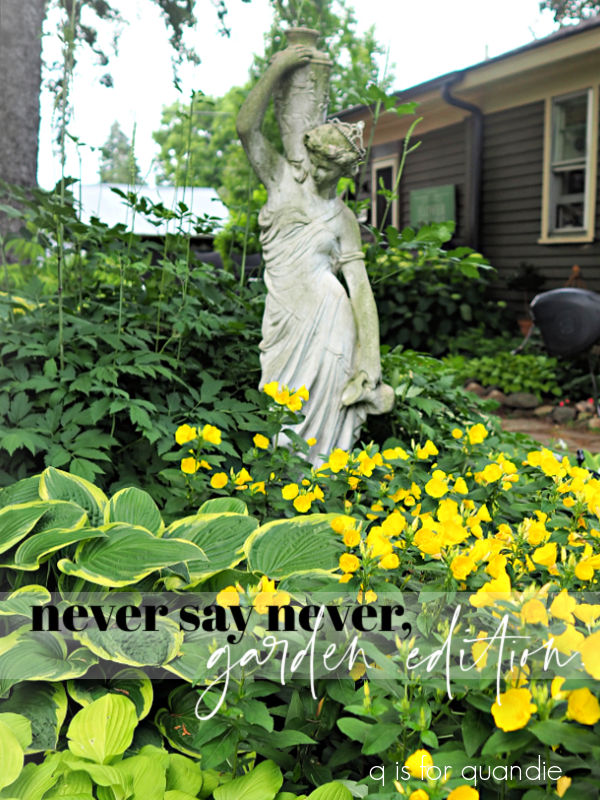
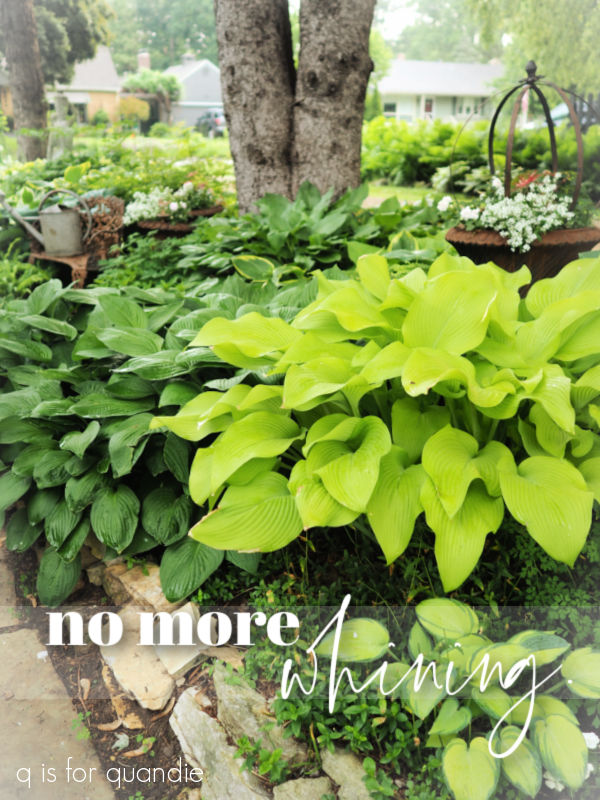
Recently I came to the realization that I need to quit whining about my garden and its jumping worms, pathetic lilac hedge and all the plants that died over the winter.

I’ll admit that I was worried earlier this spring.  Especially when we came back from our trip out east to find the garden bone dry, with plants that were very slow to break dormancy, and weeds everywhere.

But as it turns out, it was the freakish hot and dry weather while we were gone that was the problem, not the jumping worms.

Flash forward a month and add in some much cooler weather, a fair amount of rain, a few plant replacements and a bit of weeding and things are looking really good right now.

If you aren’t familiar with my gardening style, I like to call it ‘jam packed’.

I prefer not to leave any space for the weeds to take hold.

I know not everyone likes this look, and I also know that it can lead to problems with increased insect pressure and plants that get crowded out.  But it’s still my preferred style.

Most everything in my shade garden is doing well, and this is the spot where I found the most worms last year.

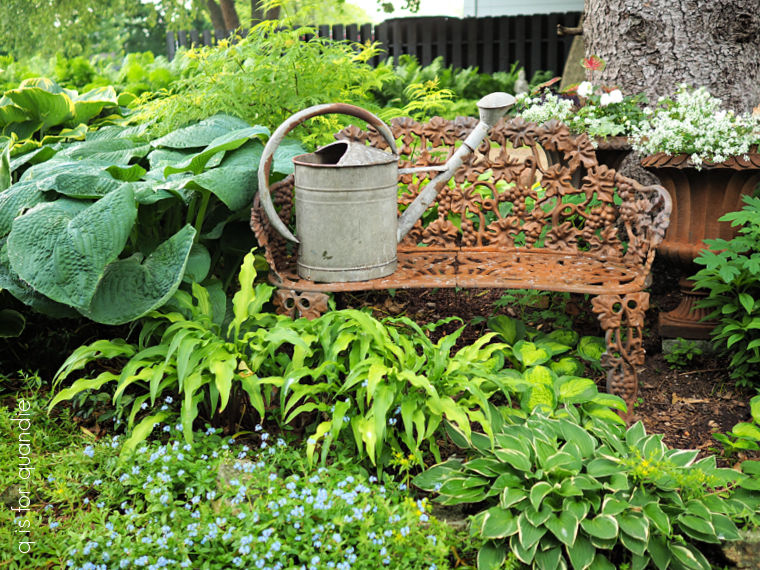
As I mentioned recently, the Forget-Me-Nots (low ground cover with blue flowers in front left) are having their best year ever.  Clearly they aren’t being impacted by those pesky worms.

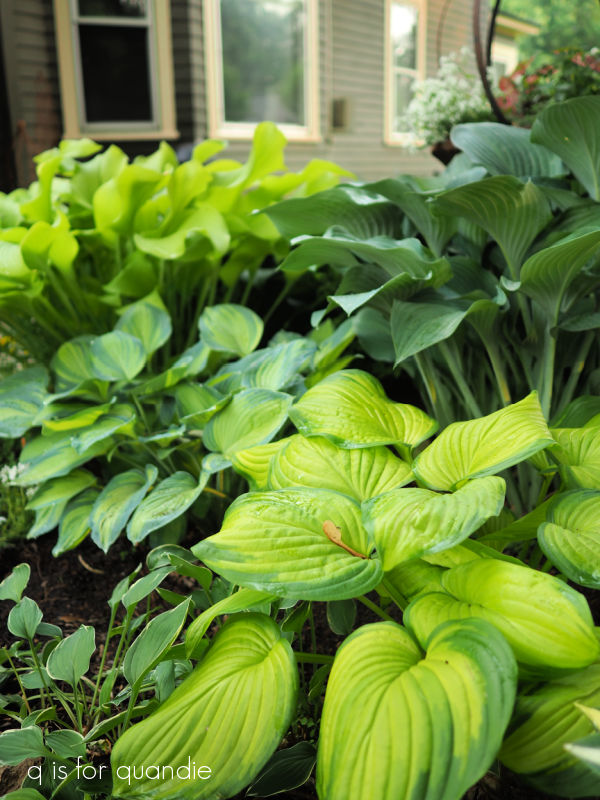
Neither are the hostas.

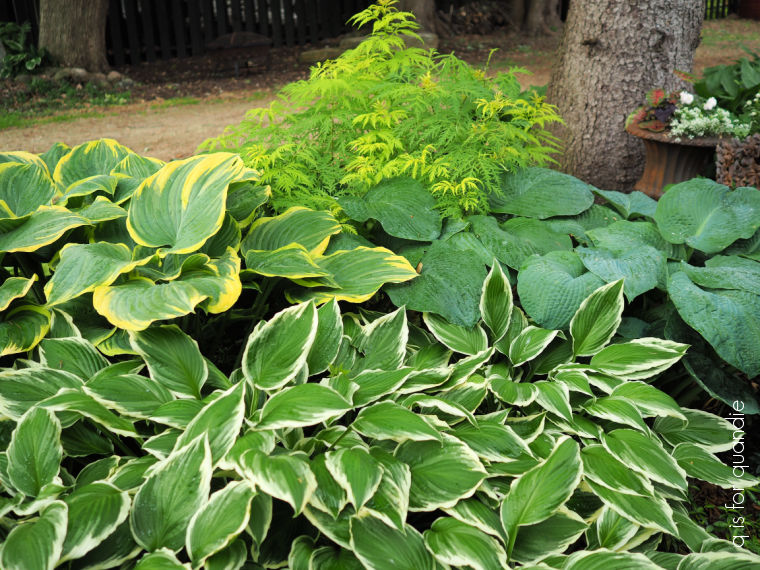
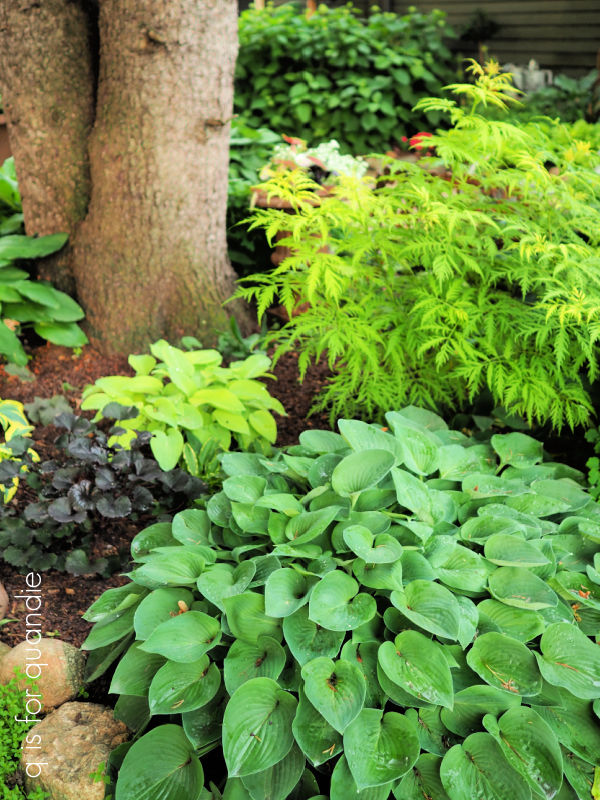
Although I did lose a few hostas over the winter, and there are another several that are coming up very slowly, the rest are looking larger than ever and super healthy.

FYI, that plant in the background that looks sort of like a Japanese maple (seen from both sides in the above two photos) is actually a Morden Golden Glow Elderberry.  Laura of Garden Answer recommended elderberry as a good substitute for Japanese maples when you live in a cold climate.  Visitors to my garden often do think it’s a Japanese maple.  Some elderberries can grow to 10′ tall, but this variety is more compact and only grows to 4′ to 5′ tall and wide.  Also, since I have this in full shade, it will likely remain somewhat smaller.

My Lakeside Dragonfly hosta is looking especially nice right now.

I am trying a few different things to mitigate worm damage in this bed.  First, I fed everything this spring using Espoma’s Plant Tone.  It’s an organic, all purpose plant food and I simply sprinkled it on top of the soil early this spring before the plants were up.  For best results you are supposed to work it in to the top 4″ of soil, but in existing beds like mine you can just sprinkle it onto the soil around the dripline of plants and then water it in.

Second, I’m mulching this area using cocoa bean shells.

There is some anecdotal evidence that jumping worms don’t like cocoa bean mulch.  The pros to cocoa bean mulch; it has a nice dark color and it makes your garden smell like a chocolate factory.  The cons; it’s expensive and it will get mildewy in wet weather (which is definitely what we are having this week).

Finally, I’m hand pulling worms when I find them.  And yes, that’s as gross as it sounds.  The recommended disposal involves sealing them in an airtight container, setting it in the sun for a bit and then tossing it.  So I’ve been stocking up on empty mayo jars, sour cream containers, etc all winter (with the help of nnK and her mom Judy).

Hopefully one or all of these extras will help my garden stay happy this summer.

You may remember that I mentioned in an earlier post that most of my lamium didn’t survive the winter.  That was a bit of a bummer, but it gave me the opportunity to fill in some bare spots with annuals this year.  So I added some bright pops of color with some impatiens.

I know that a lot of the popular gardener influencers consider impatiens to be passé, but then I’ve never been one of the cool kids anyway.

But wait, now there is one small patch of that lamium coming back!

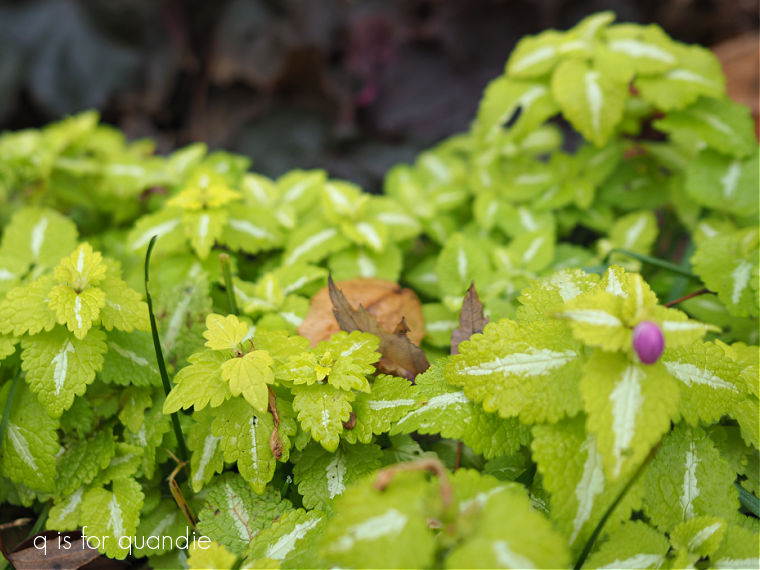
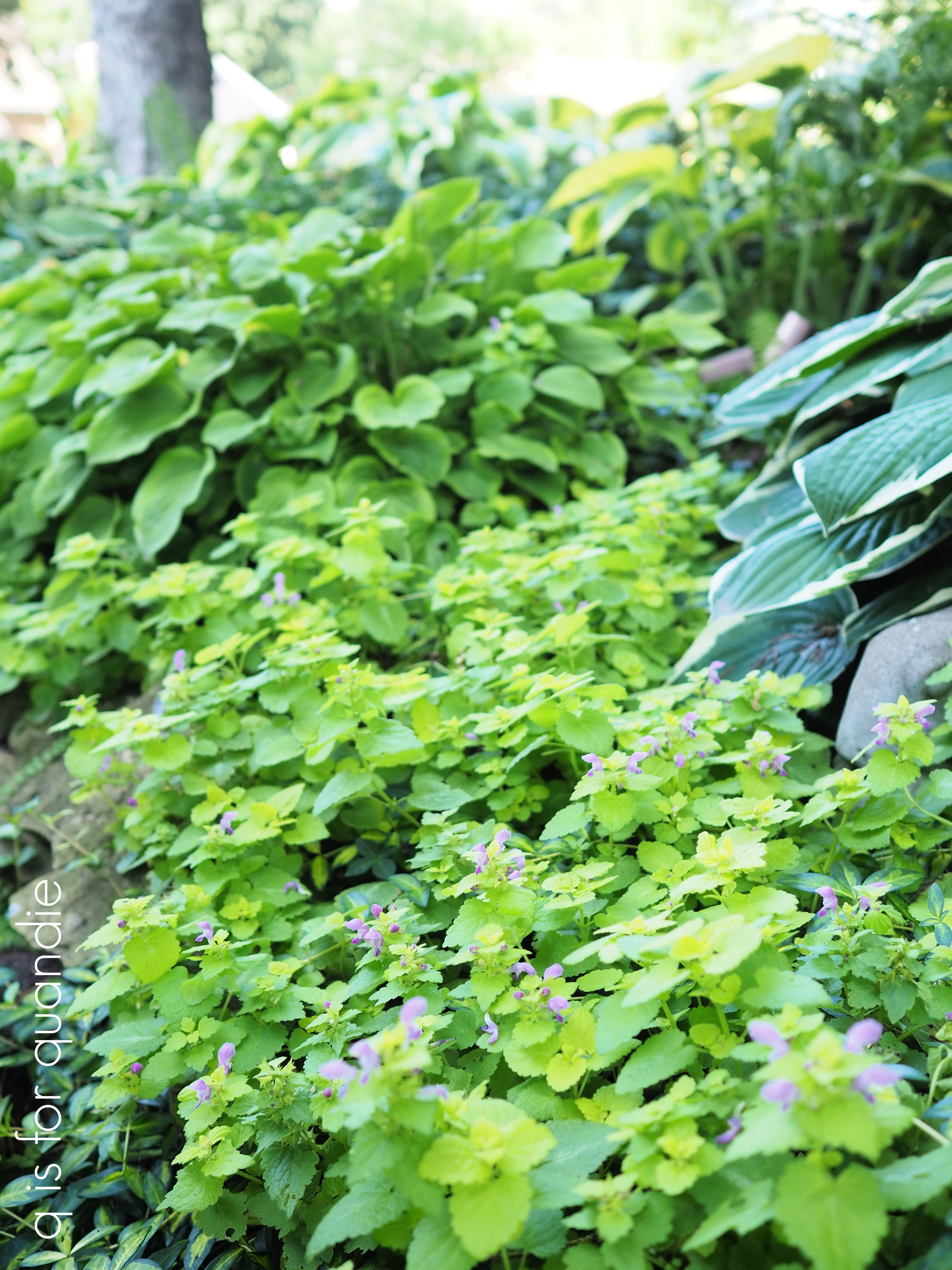
I’m so happy to see it since I’ve been scouring the nurseries trying to find more to put in and haven’t had any luck.  Sure, they have lots of other varieties of lamium, but I can’t find this fabulous chartreuse variety.  I had two different chartreuse lamiums in my garden, the Lamium maculatum ‘Lemon Frost’ which has a more pronounced white center (and so far none of that is coming back).

And I believe my older plants were Lamium maculatum ‘Aureum’.

As you can see in the photo below, I had lots of it last year.

I plan to baby that little patch that is coming back, and hopefully I can start to divide it and spread it around again soon.

With that I’m going to head out into the garden now to pull some weeds.  But hey, if you have any tips on controlling jumping worms, please be sure to leave a comment!  And even if you don’t have any tips, let me know how your garden is looking so far this season.

the versailles of brandywine.

Continuing on with my posts about our trip to the Brandywine Valley back in May, today I’m sharing our visit to the Nemours Estate.

This is yet another property that was once owned by a duPont.  The main house was built in 1910 and has 77 rooms.  There are 200 acres of gardens and those near the house were modeled after Versailles.

The Long Walk runs between the house and the reflecting pool and it features the symmetry associated with formal French style gardens.

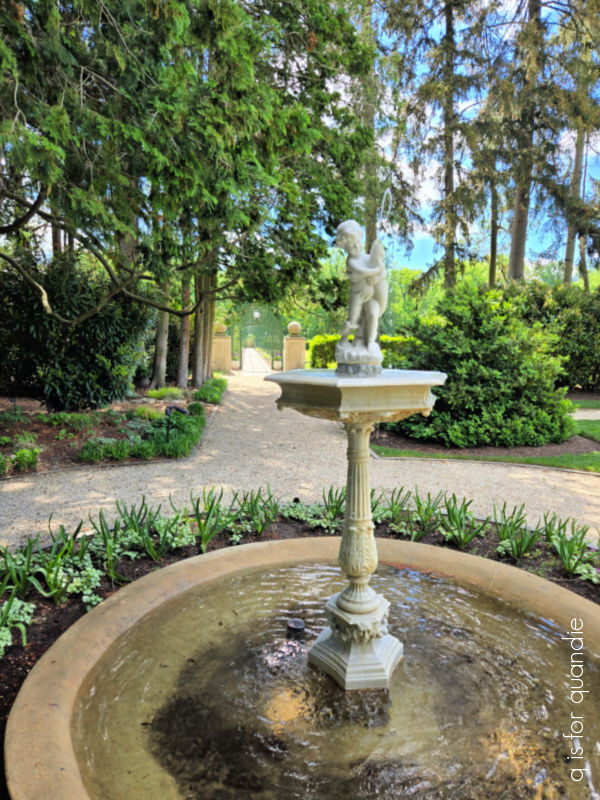
There are fountains and statues including this guy in gold.

He reminded both Mr. Q and me of our visit to Peterhof in St. Petersburg, Russia which is sometimes referred to as the Russian Versailles, so that makes sense.

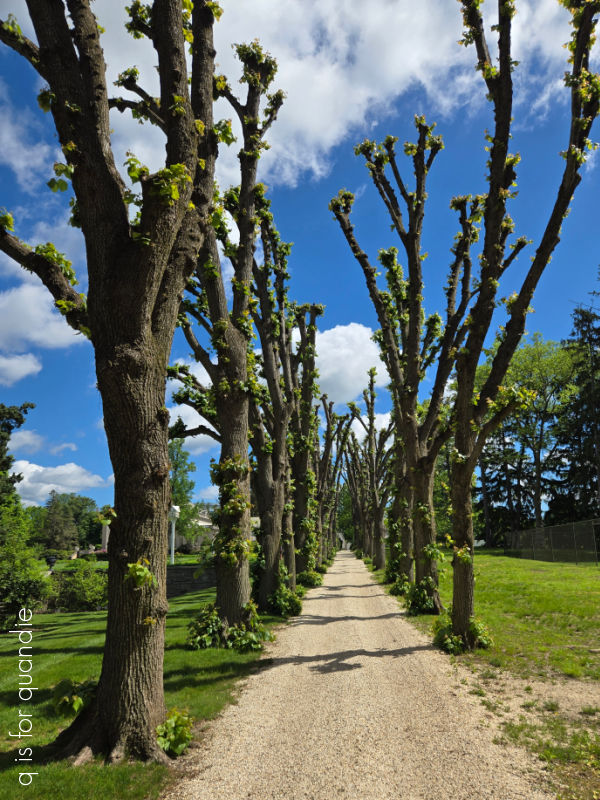
We chatted with one of the Nemours gardeners who explained that this is a French style of tree pruning called pollarding …

It certainly creates an interesting look, although I’m not sure I like it.  Those trees look like I did in kindergarten when my mom cut my bangs right before school pictures.  Not a good look.

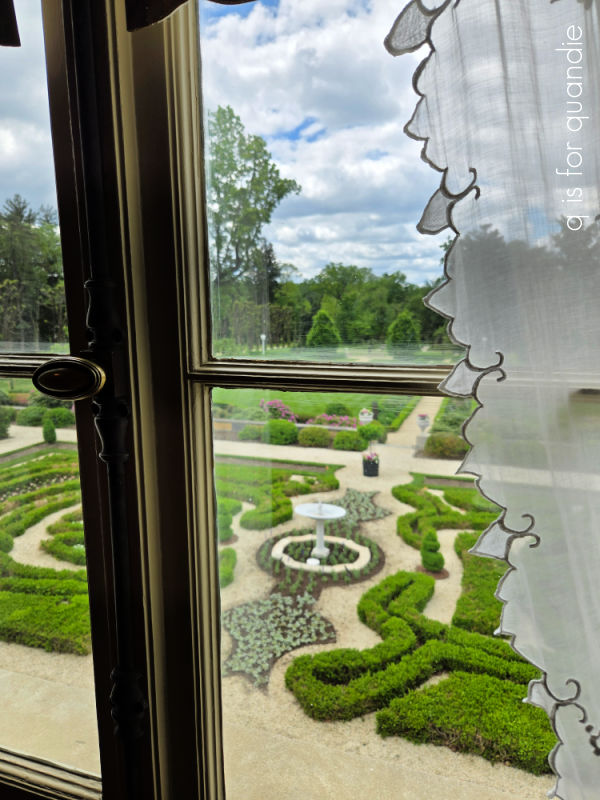
There is a Parterre Garden that was prettiest when viewed from the 2nd floor of the house (I assume that was intentional).

This next spot was probably my favorite in this garden.

I think that tells you that I’m not really a fan of formal French style gardens, I prefer something a little less grand.

Now, French style interiors on the other hand …

shades of pink or pale blue and lots of gold.  So pretty!

The French had it going on when it came to painting furniture.  Check out this piano.

That could be some serious inspiration for adding some embellishments in gold to a painted piece.

It was interesting to learn that the plaster ceiling in the Reception Hall was originally painted to look like wood, but later painted in the French style.  They’ve left a section to show that original wood look, which must have made the room much darker.

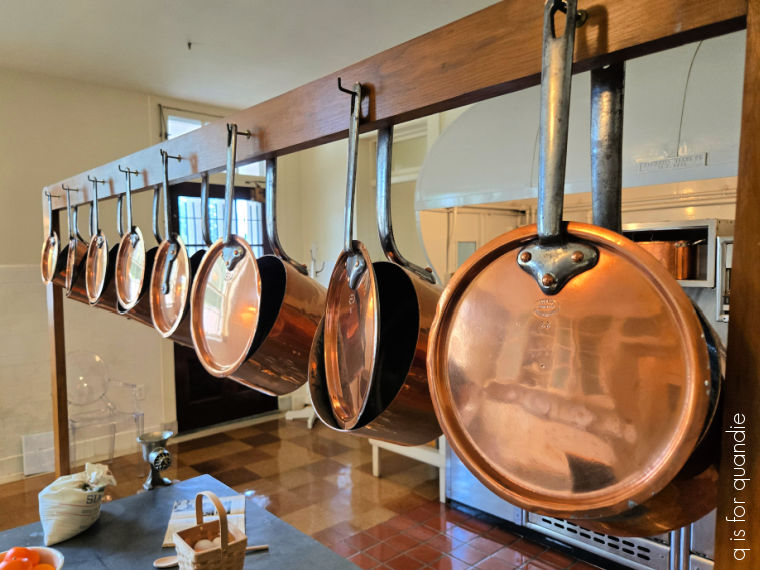
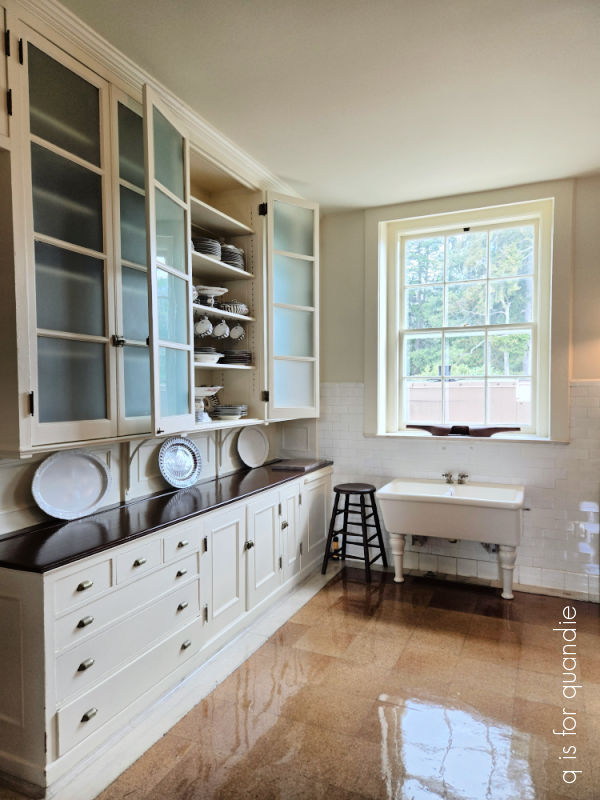
All of that fanciness aside, I think my favorite rooms were the kitchen, pantry and bathrooms.

Those copper pots are just gorgeous.

I don’t know what it is about these utilitarian rooms that appeals to me so much.  I’m certainly not normally a fan of housework.

Maybe it’s just that in a sense they feel much more obtainable to me.  I have pretty ironstone platters on display in my own home for example.

I love the floor to ceiling tile in the bathrooms, and I really like the sink below too.

Although the Nemours Estate was not my favorite of the duPont properties that we toured on our trip (I preferred both Longwood and Winterthur), I definitely think it’s worth adding to your itinerary if you ever find yourself in the Brandywine Valley.

And after touring the estate you can stop off at the Charcoal Pit, ‘home of Delaware’s best burgers and shakes since 1956’, for a late lunch.

Although we didn’t try the burgers, we did have some amazing shakes.  Mr. Q also had the Rueben Dog …

but I stuck with a basic chili dog.

OK, hot dogs for lunch was a stark contrast to a morning spent viewing the opulent grandeur of the Nemours Estate, but those were some tasty dogs!

grandma’s peonies.

Good morning from the garden!

I think right now, early June, is my favorite time in the garden.  Everything looks fresh and new.  The fern bed is lush and green.

  There isn’t any insect or storm damage on the hostas.

  Nothing is suffering from drought.  And best of all, the peonies are blooming!

Most of my peonies are planted out back behind the carriage house in my cutting garden.

I put them there so that I wouldn’t feel bad about cutting them and bringing them inside.  They aren’t there to look pretty in a garden, they are there to harvest for bouquets.

This year has been the perfect peony season because the weather has been relatively cool, our highs have been in the 70’s, and even just the 60’s on a few days.  This cool weather definitely helps the blooms last much longer.

I can’t tell you how often we’ve gotten hot spells just in time for the peonies to open, and then they last just a few days.

But this year they are sticking around a bit longer, they even last longer in a vase indoors since we’ve been getting down into the 50’s at night and we have turned our heat off.  The house stays nice and cool all day.

Did you know that peony plants are remarkably long lived?  I’m not talking about the blooms, but about the plants themselves.  They can live for 100 years or more, and once established they basically thrive on neglect.  I can vouch for the neglect part since I don’t really do much of anything for those peonies behind the carriage house.  I really even only weed that bed once or twice a season.

I also now have proof of that of sorts.

Yesterday my sister and I went to the Nokomis neighborhood garage sales in Minneapolis.  We like to go to that one because both of our parents grew up in that neighborhood.  We always make a point of driving by their old houses.

This year we got lucky and the people who live in my mom’s parent’s old house were out and about.  My sister, who definitely isn’t shy, rolled down her window and said hello, explaining that we weren’t weird stalkers or anything, just making our annual pilgrimage to grandma’s house.

Turned out that the current owners are the very people that purchased the house from our grandparents over 45 years ago!  They even remembered their names.  I mentioned how happy my grandmother would be to see that they had continued on having a beautiful garden (I’m pretty sure I inherited my gardening skills from that grandmother).

They invited us to take a tour of the gardens, and even to come inside to see the house.

As I was admiring one of the peonies in the garden, the new home owner said “Oh, that one was here when we bought the house”.

That means it was planted by my grandma!  And I’m sure she would have planted it long before they sold the house.  I believe they’d lived in the house for more than 50 years themselves, so this peony could be nearly 100 years old.

How fantastic is that?  And how special to see that my grandma’s peonies are still happily blooming away in her garden.

Now I wonder how long the peonies out behind the carriage house will be there.  Hopefully at least 100 years or more too!

a visit to winterthur.

Remember that time I went to Charleston in April to see the azaleas in bloom?  And then there was a huge storm the night we arrived that knocked the blooms off most of them?

Well, who would have expected that a trip to Delaware in May would make up for it?

I have to admit, it never even occurred to me that Delaware would be full of azaleas, but welcome to Winterthur.

Winterthur is the creation of Henry Francis du Pont.  It includes a massive 175 room house that he built to house his ginormous collection of American decorative arts (over 90,000 items).  There’s no way this guy could pretend to be a non-collector 😉

Not only did he collect American decorative arts, he also collected plants including azaleas.

And as you can see, they were in their full glory while we were there.

The ticket for Winterthur includes a 30 minute tram tour of the gardens, so we took advantage of that to get the lay of the land.  Afterwards we headed back to explore a few of the areas that I wanted to see up close starting with the Azalea Woods.

They were beautiful and definitely made up for the lack of blooms in Charleston.

The Peony Garden was our next stop.  The flowers were just beginning to open, but this single variety was in full glory.

The Quarry Garden was filled with blooming primroses.

It makes me want to add more of these to my own garden, currently I have just one small plant.

Unfortunately they were doing some restoration work in this garden while we were there so we couldn’t get any closer.  We had to settle for looking down on it from above.

The Enchanted Woods were a later addition to Winterthur.

This area was added about 20 years ago to encourage more families with children to visit.

I think I preferred the authenticity of the reflecting pool.

Next up was exploring the rest of the area around the house, if you can call a 175-room building ‘a house’.

I was fascinated by this rain water tank, at least I’m guessing that’s what this is.

As you can see, the downspout goes directly into that box so I assume it’s meant for storing rain water.  And just check out the concrete lions that are holding up the box.  No decorative detail was spared on this functional item.

We also took a self-guided tour inside the house where you can see just a handful of the 175 rooms.

Several of the rooms were decorated with hand-painted wallpaper.

And there were lots of spaces that were simply designed to display collections (because let’s face it, we can’t really call these non-collections can we?).

This room was just for candlesticks.

To be fair, I guess one could say that my own pantry is also mainly just a space for displaying collections 😉

As if the house and gardens weren’t enough, there is also a museum at Winterthur.  It’s a small museum, but by the time we got there we were getting pretty worn out so it was lucky there weren’t too many exhibits to see.

I really enjoyed the one called “On Tour: Lafayette, America’s Revolutionary Rock Star“.

I have to admit that I didn’t really know much about Lafayette prior to this trip.  Of course, I’d heard the name, and I knew he fought in the Revolutionary War, but that was about it.  Check out the link above to learn just a little bit about him and his ‘farewell tour’.

There were also a couple of exhibits in the museum that I found very relatable such as the exhibit about the Dominy’s, a family of skilled woodworkers that made furniture among other things.

This display pointed out all of the details that went into creating this piece of furniture.

There was also an interesting exhibit about furniture restoration.  This 17th century cupboard had been significantly altered over time.

The bottom section had been removed to reduce its height so that it would fit in a smaller room.  It has now been restored to its original design.

This next piece was once thought to be two separate pieces that had been ‘married’ together, so the two pieces had been separated.

It was only later that the conservators determined that no, these two pieces did belong together.

Another exhibit explored the use of toxic pigments in decorative items such as books, wallpaper and fabrics.

Arsenic was used to create the vibrant green on the items shown above.

In case you haven’t already figured it out, I will warn you that it takes the better part of an entire day to visit Winterthur and see everything there is to see.  We never did find the collection of soup tureens that I wanted to see, but in the end we were too worn out to look for them.  Luckily there is a cafe with grab-and-go sandwiches and salads, so we were able to get some sustenance before tackling the museum exhibits.

I highly recommend a visit though, I think Winterthur gives Longwood Gardens a run for their money as my favorite place we visited during our recent trip.  If you ever are in the Brandywine Valley area be sure to visit both of these!

rolling with the punches.

Good morning from the garden!

Are you ever plagued by indecision?  Afraid of making the wrong choice, or just unable to make up your mind?

Well, I’ve gone almost 6 years without being able to decide what tree to put in our front yard, or really even whether or not I wanted to plant a tree again.

Let’s recap.

When we moved into our house 35 years ago or so, there were two trees in the front yard.  A maple to the right, and a black walnut to the left.  My sister was visiting the summer that the maple came down.  We were sitting on the front enclosed porch watching a storm roll in when it came crashing down.  Lesson learned; when the warning sirens go off, take shelter in the basement or at least an interior room.

The tree missed our house, but it was a close one.

Back then we ended up also removing the black walnut (it was not a great tree, dropping those huge walnuts all over the yard) when we had the fallen maple cleaned up.

I replaced that maple with a 2nd maple, and the walnut with a flowering pear tree.  Here is a photo taken in autumn when the maple had its fall color.

I loved that tree.

Flash forward to 2019.  The maple was looking really good and finally serving its purpose of providing some shelter from both street noise and from the street light directly across from our bedroom windows.

Then another storm took out maple no. 2.

Ugh!

Once again, I chose to have the pear tree taken down when the maple got cleaned up.  It had gotten rather misshapen next to the maple and it didn’t look good on its own.  You can sort of see that it was mostly bare on the right side of it in the photo above.

Then came five years of being unable to decide what to do next.  I really wanted to plant a Princeton Gold Maple.

I love that bright lime green color.

But did I really want to put yet another maple in that spot?

I thought about doing a Honey Locust instead.  It has a similar golden color, plus the added benefit of tiny leaves that don’t really need to be raked up in the fall.  But I just couldn’t pull the trigger on it.

I finally decided that I would just take a chance on another maple, so I started looking around for the Princeton Gold.  I found one at Abrahamson’s Nursery two years ago, but the price tag was $250.  Yikes!  That seemed a bit much for a tree.

So once again, I put off making a decision.

However, the other day I headed over to Fleet Farm to see what they had in their plant section and lo and behold, there was my Princeton Gold Maple … and only $149.  I bought it on the spot, even though that meant putting the top down on my VW Bug convertible and very carefully driving home with a tree sticking up out of my car.

  Will it be three time’s the charm, or three strikes and you’re out?  I guess time will tell.  But at least I’ve made a choice!

In other garden news, I’ve started filling in the some of the bare spots in my garden that were the result of winter kill.

I lost three brunnera next to the potting shed, and I’ve replaced them with Heucherella ‘Pink Revolution’.

I lost my ‘Rozanne’ perennial geranium, or Cranesbill, under the ‘Limelight’ hydrangeas, and I liked those so much that I replaced them with more of the same.  Last year these bloomed all summer and up until the first freeze for me.

Then I addressed the large dead spot next to the front porch.  I started by replacing the ‘Sun King’ Japanese Spikenard.

Then I added three ‘White Diamonds’ fern leaf bleeding hearts.

They have a lovely blue green foliage and white flowers.  Fern leaf bleeding hearts like partial shade, and this spot is what I would consider full shade.  But I have another fern leaf bleeding heart in this area and it has done really well in this amount of shade.  It’s one of the first things to bloom in spring and then it keeps blooming all summer.

I’m hoping the white ones do as well.

I also added in some ‘Unique Ruby Red’ astilbe just behind the fern leaf bleeding heart.

Up until this year I had a white astilbe in this spot that was loving its life.  So hopefully this replacement will thrive, and hopefully we won’t have another killer winter for a few years.

Last up, I replaced the hostas that didn’t come back with some freebies from my neighbor nnK’s mom’s garden.  Judy was kind enough to tell me that I could divide any of her hostas and help myself to the divisions.

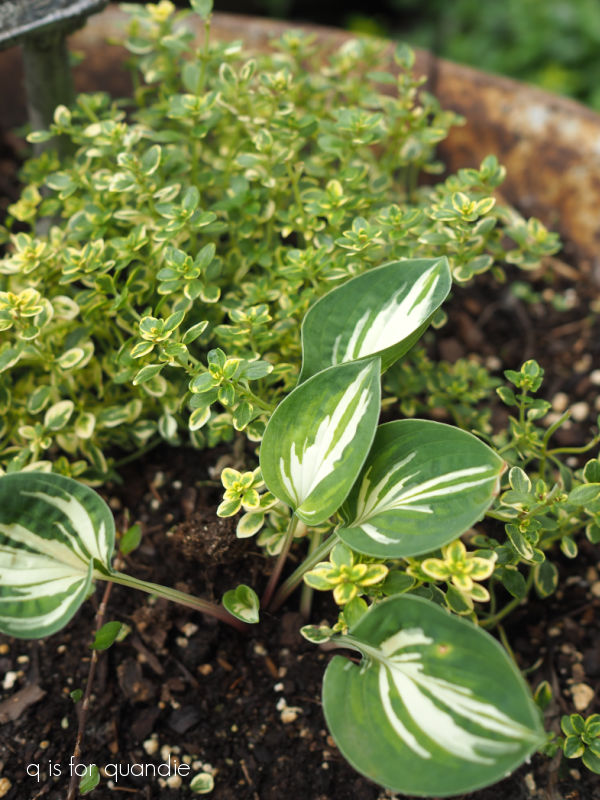
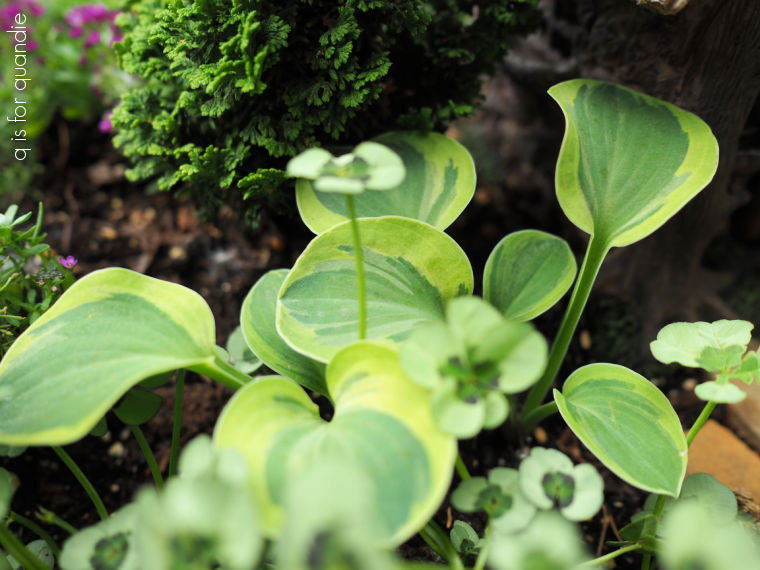
I started with this pretty little one with rounded leaves.

And I also chose this one that is a little bit larger and had pointed leaves and a bit more variegation.

So, how about some progression shots?

Here is how this space looked last summer.

So fab!

And then nearly every one of those plants died over the winter with the exception of the ‘Stiletto’ hosta that you can’t actually see in the photo above because it’s behind a larger hosta.

Here’s how this space looked a week or two ago.

So sad!

I just don’t know what happened here.  As I’ve mentioned before, I do have jumping worms in my garden.  So it’s possible this is jumping worm damage.  However, this spot wasn’t particularly loaded with the worms last summer.  I definitely had other spots in the garden that were worse, and they are doing fine this spring.  Thank god all of my gardens don’t look this bad!

And here is how it looks now.

By the way, all of those extra pops of pink are impatiens.  I decided to fill in with some annuals this year since the perennials are not going to fill out for at least a couple of years.

You may also have noticed that I am using cocoa bean shells as mulch here.  I read that there is anecdotal evidence that jumping worms don’t like them, so I’m giving them a try.  I’ll report back at the end of the summer with any results I notice.

In the meantime, today’s gardening lesson?  You have to be able to roll with the punches.  You just never know when Mother Nature is going to take you down.  You just have to dust yourself off and start over again sometimes, right?

vintage garden style.

I recently picked up a copy of Better Homes & Garden’s Vintage Garden Style magazine at the supermarket.

This is one of those special publication re-print sort of magazines, ‘back by popular demand’.  Which tells me that people still love vintage garden stuff as much as I do.

As I’ve been getting ready for the Carriage House Sale (which starts tonight!), I realized that ‘Vintage Garden Market’ is definitely the theme of our sale.

We have quite a few items from the various categories featured in the magazine starting with watering cans.

This first one is a no-brainer.  Of course we have vintage watering cans …

and some that are maybe not so vintage.

Next up, vintage enamelware.

Yep,  we’ve got this too.

The article in the magazine on collecting (or non-collecting in my case) vintage garden books really struck a chord with me.

There were so many lovely books featured.  Now I’m tempted to be on the lookout for vintage garden books myself.

And Sue brought a few for the sale.

We’ve got a few newer garden books too!

There was also a feature in the magazine on filling unique vintage items with succulents.

We have quite a few wooden totes like the one shown above that you could fill, plus any number of other vintage pieces that would be perfect as succulent planters.

For example, I’ve decided to sell on my antique newspaper roller that I used to plant with succulents myself.

I loved the look of the succulents in rusty iron urns shown in the magazine …

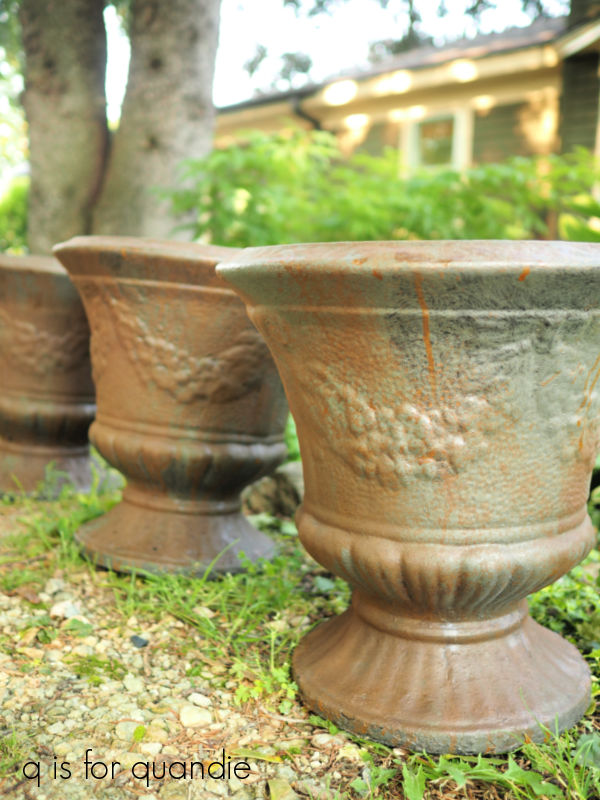
And I just happen to have a very similar faux rusty urn for sale …

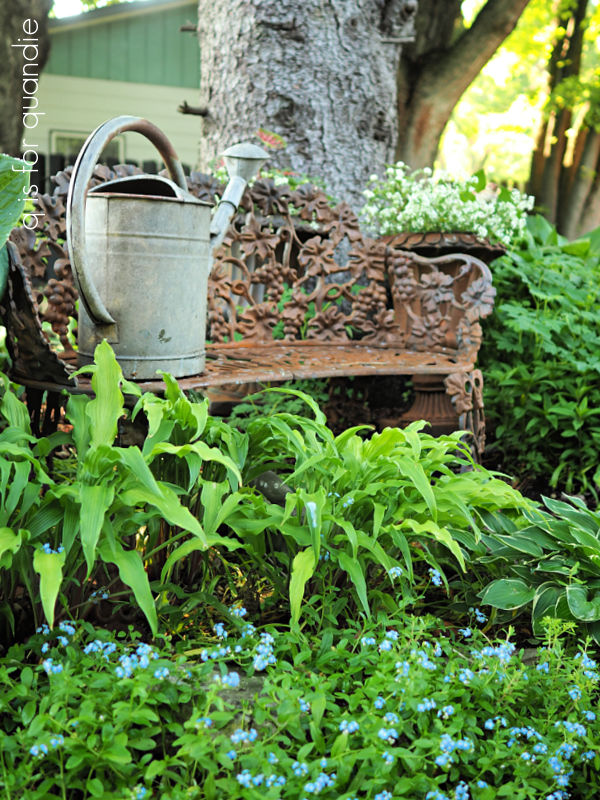
along with a bunch of other rusty pieces of salvage for the garden like these old iron headboards.

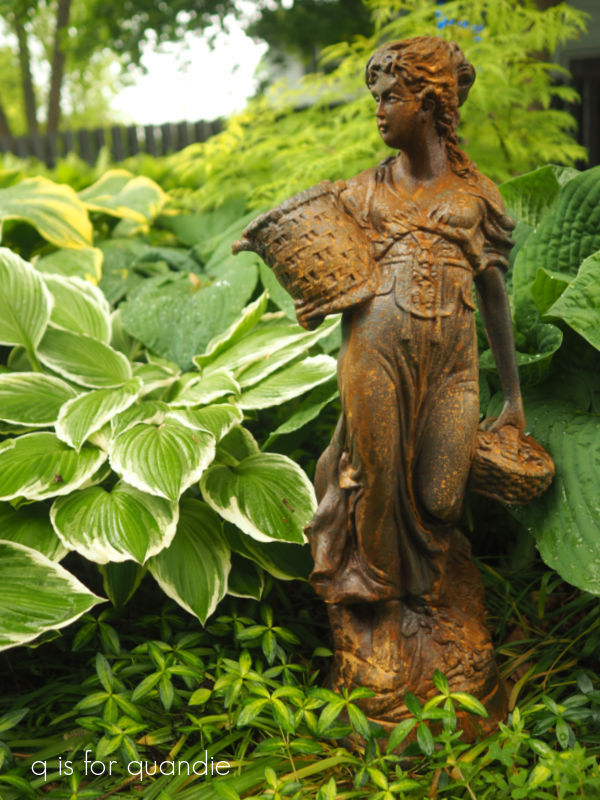
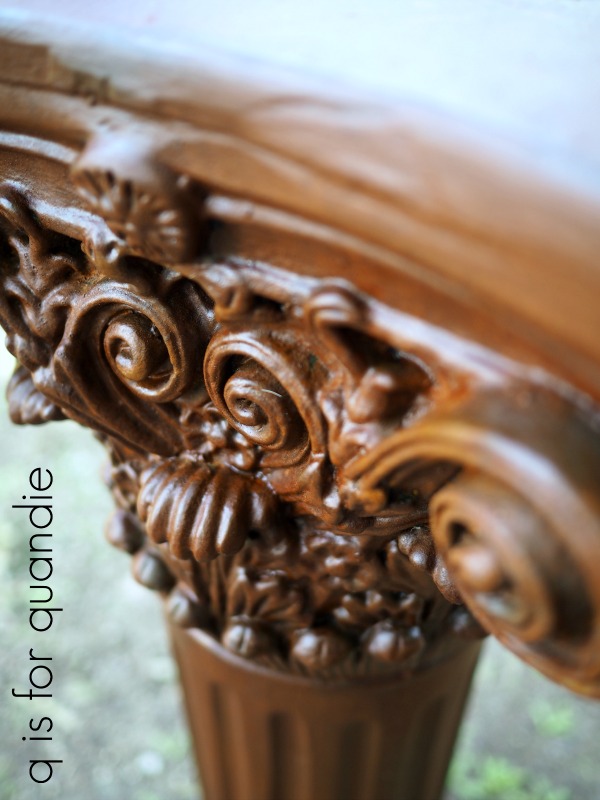
I also am selling this rusty lady …

Remember when I purchased her in bright white?

Doesn’t she look so much better rusty?

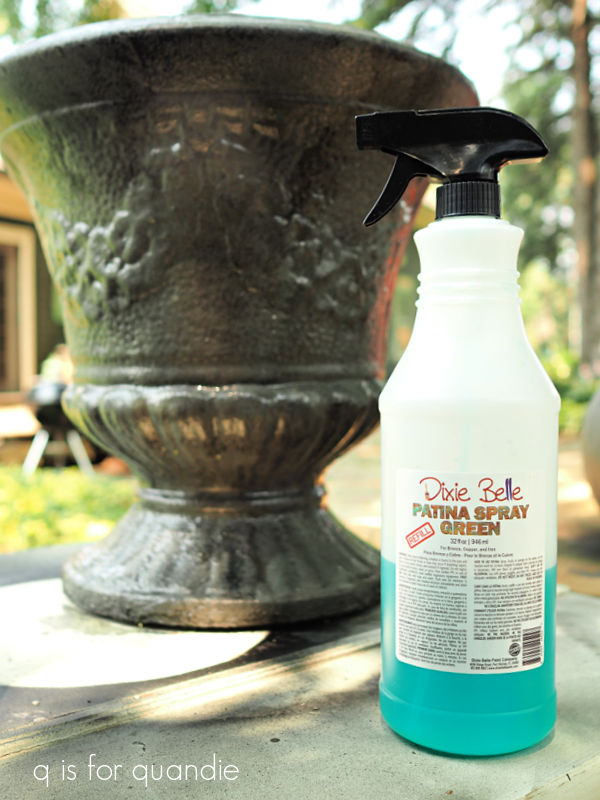
FYI, I use the Dixie Belle Iron Patina Paint with the Green Spray to achieve that rusty look.

There’s another fun article in the magazine about giving an old structure a new life as a potting shed.

While I don’t actually have an old shed for sale, I do have one in my back garden and if you come to the sale you are welcome to pop your head in and check it out.

I recently recovered the seat of my wicker chair with some gorgeous vintage bark cloth that I purchased at my friend Lisa’s sale (one of these days I really have to share her sale with you).

Not that I didn’t love the bark cloth that was previously on the chair, but I needed to scavenge that for a chair that I am including in my sale.

The florals on it were perfect with the Miss Mustard Seed Apron Strings milk paint color on the chair.

By the way, there are three different shades of pink in that photo from three different brands.  The chair is in the Apron Strings (read about that original makeover here), the French flower bucket is in Dixie Belle’s Apricot (read about that project here), and the oval lidded tin on top of the box is painted in Fusion’s Little Piggy (read about that paint job here).

We’ve got a slightly bigger selection of pink/floral items this year.  I feel like the floral trend is coming back around, what do you think?

Although this next article doesn’t specifically pertain to items at our sale, I still thought it was worth a mention.

It features 7 tips about shopping at a vintage market and the photos are all from the Oronoco Gold Rush held at the end of August about an hour south of the Twin Cities.  I’m sure that most of my local readers have been, right?

I suppose some of the tips might apply to my sale, especially tip no. 6.  Love it?  Buy It Now!  Because if you don’t grab it quick, someone else will.

As I mentioned, the sale starts tonight from 5 pm to 8 pm.  We’ll also be open tomorrow morning from 9 am until the noon whistle sounds in North St. Paul.

We are accepting Venmo and Cash only.

Hope to see you local readers there!

another rainy garden tour.

Good morning from the garden!

Or maybe I should say good morning from a garden, because this garden is not my own.  Today I’m sharing Longwood Gardens located in Kennett Square, Pennsylvania.

As you’ll soon be able to see, we visited Longwood Gardens on a rather rainy day on our recent trip to the Brandywine Valley.  But you know what?  I actually don’t mind visiting a garden in the rain.  It was raining during my visit to de Hortus in Amsterdam, and during my visit to the Munsinger and Clemens Gardens in St. Cloud.  I think you can get some of the prettiest garden photos on a rainy day.

So … Longwood Gardens … have you heard of them?

USA Today recently named them the no. 1 best botanical garden in the U.S.  Consisting of more than 1,100 acres, Longwood has pretty much everything you’d want to find in a botanical garden.  The map shows 32 ‘districts’ including a cascade garden, a bonsai courtyard, an Italian water garden, a meadow garden, a rose garden, the oak & conifer knoll, and the topiary garden shown above plus more.

The land that Longwood Gardens sits on was originally purchased by a Quaker farmer in 1700.  In 1798 his grandsons began planting an arboretum.  Their heirs weren’t interested in the project though and over the next 100 years the arboretum was allowed to deteriorate.  Then in 1906 Pierre du Pont purchased the property to save the trees from a lumber mill that had been contracted to remove them.

The Flower Garden Walk was du Pont’s first addition to the arboretum.

I loved the way the flowers are grouped by color in this area.

I think my favorite is the purple section.

I’ve always thought it would be fun to try something like this in my own garden, but I’m not sure I could pull it off.

In 1929, du Pont added a 61′ tall carillon, or chimes tower.

It has had a variety of different bells over the years, but it has been kept in running order and it was lovely to hear it chime out throughout the garden.

I took so many photos, and there was so much to see.  I don’t want to bore you guys with a million garden pics, so maybe I can just share the highlights.

There is a ginormous conservatory and this next photo might give you some indication of just how large it is.

It’s filled with beautiful things.

All of that pink?  That’s hydrangeas!

I sure do wish I could get these kind of results with a macrophylla hydrangea, but they really don’t like our cold weather.

They also had a beautiful display of blue ones too.

In case you are wondering, that tall purple flower behind the hydrangeas is a Canterbury Bell.

That’s another plant that I’ve never had much luck growing.  It’s a biennial, and I just don’t have the patience for a plant that takes two years to bloom and then dies.  Same with foxgloves.

The perfectly round globe shaped hanging planters in the conservatory were gorgeous.

This is the sort of thing you can do if money is no object, and you happen to have a greenhouse to grow them in.

Beautiful to see, but hard to emulate in real life.

There was also a fern wall in the conservatory …

and a children’s garden …

and an orchid room.

There were so many beautiful orchids (I thought of you when I saw this room Monica!).

There was a bonsai display tucked just behind the conservatory.

Some of the bonsai were 80 to 100 years old.  I can’t imagine the skill it takes to create these beautiful pieces of plant art.

I’ve saved the most spectacular aspect of Longwood Gardens for the end and that’s the fountains.

Remember the fountain show at the Bellagio in Las Vegas that I shared a few weeks back?

Well, the fountain show at Longwood is about 10 times more spectacular.

Unfortunately, I didn’t actually get any photos of the ‘show’ where the fountains dance to music.  By the time we got to that part of our day I was a bit worn out (we spent nearly six hours exploring Longwood), and the rain had decided to come down a bit harder just at that moment.  My photos above show the basic fountains while they aren’t ‘performing’.

So I guess you will just have to head to Longwood Gardens yourself to see the fountains dance.  It is definitely worth the trip.

Have any of you been there?  If so, what was your favorite district?  Or do you have a botanical garden to recommend near you?  Leave a comment and let me know.

the flower market tote.

Remember the wood tote that I picked up while garage saling a couple of weeks ago?

Well, I’ve given it a quick makeover.

I started by cleaning it well.  While doing that I noticed that there was some sort of oily looking stain on the inside bottom of the tote.  So I gave just that bottom two coats of Dixie Belle’s Bonding Boss, just in case that stain wanted to bleed through my paint.

After letting that dry for 24 hours, I painted the inside of the tote in Dixie Belle’s Kudzu.

And so far, so good.  No oily bleed thru.

Next I painted the outside in their Drop Cloth.  Once that dried, I taped off some grain sack style stripes and painted those in the Kudzu.

I followed that up with adding just a portion of Dixie Belle’s Flower Market stencil.

Here’s the full stencil …

I taped off everything except the “Flower Market” wording for my tote.

I then gave the entire tote a vigorous sanding to age it up a bit.  I finished it all off with a coat of Dixie Belle’s Big Mama’s Butta in the Fresh & Clean scent.  If you haven’t tried this product, I describe it as halfway between hemp oil and wax.  It comes in 5 different scents, plus an unscented version.  I think I like the Orange Grove the most.  The Fresh & Clean is a little bit more subtle, and … well … fresh and clean smelling.

Next up I filled the tote with a load of lilacs.

I came home from the Brandywine Valley to find my lilacs in full bloom, and since then we’ve been having very cool weather (as low as 38° one night this week) so the blooms are sticking around a bit longer than usual which is nice.

Those purple lilacs are the Albert F. Holden variety, FYI.

But you wouldn’t have to fill the tote with flowers.  You could display lots of things inside, like pretty china and a lovely vintage floral tablecloth.

or maybe some books.

Speaking of books, I am planning to include ‘a year at Brandywine Cottage’ in an upcoming giveaway.

I just need to get that pulled together.  Some of you may know that I used to always bring something home from my travels to give away here on the blog.  But I looked back and I haven’t done that since my Amsterdam trip back in 2023.

I’m really slipping, and time is flying by so fast!

But, stay tuned.  At the conclusion of my posts about our trip to the Brandywine Valley I will have a giveaway that includes that book.

As far as the tote is concerned, I’ve put it in the pile of merch that I’m gathering for my upcoming occasional sale.  And that’s coming up awfully quickly as well!

If you’re local, be sure to save the date!

a disappointing spring?

Good morning from the garden!

As you may remember, last year’s gardening season ended on a bit of a low note.

First of all, I discovered that I had jumping worms, and secondly, my neighbor removed a huge, glorious shade tree and now my back garden feels like it’s baking in the sun (#stillnotoverit).

It probably hasn’t helped matters that I just returned from a trip to visit some of the most spectacular gardens in the U.S. (more on those visits in future Sunday posts) only to find that my own gardens are a hot mess.  Apparently we had a freak heat wave while I was gone that encouraged the weeds to completely take over while I wasn’t looking.

In addition to all of that, I seem to have lost quite a few plants over the winter.  It seems that little to no snow cover and sub-zero temps combined to create a winter that was quite hard on gardens.  According to the Minnesota Department of Natural Resources, the frost line was deeper in 2025 than any year since 2019.  Here in Minnesota we need that snow to protect our plants from the cold and we just didn’t get enough of it last winter.

All of these factors have contributed to what has been a rather disappointing spring in my garden.

Most of the perennials that I planted last year have bit the dust including a Lemon Meringue baptisia, a hosta Wu-La-La, a couple of azaleas, several Queen of Hearts brunnera, a Rozanne cranesbill, and some Japanese Forest Grass.  Although I have to point out that the azaleas and the forest grass were iffy propositions in our climate in a good year, so it’s not surprising that they didn’t make it.
But I also lost some things that had been in my garden for years.  One of the biggest losses was my lamium.

I had a lot of this ground cover in both my hosta garden and the front garden.  In the past it has been semi-evergreen, meaning it would retain some of it’s leaves through the winter.  As the snow would melt in the spring it would reveal mostly intact plants that were even still a bit green.

This spring there is little sign of it.  The arrow in the photo below is pointing to one tiny sprout that has managed to survive.

I’m not entirely sure if this loss is a result of the winter, or from the jumping worms, or maybe a combination of both.  However, my neighbor nnK belongs to a local Facebook garden group, and apparently many of the members are complaining about having lost ground covers in particular this past winter.  So I’m hoping it’s that.  Otherwise, I have little hope for replacements surviving in the future.

I’ve also lost a good bit of my ajuga, although it’s trying to come back.  Last year it was finally filling in …

And now it’s quite sparse and barely blooming.

I’ve also lost my gorgeous Aralia cordata, or ‘Sun King’ Golden Japanese Spikenard.

This would have been its 3rd year in my garden.  I may also have lost some of those hostas around it.  In fact, I’m quite baffled by this spot …

As you can see, it looks quite decimated.  I’m taking a wait and see approach for now, maybe those hostas are still going to come up?  Fingers crossed.

Either way, I’ve already purchased a replacement for the aralia, and FYI, I found it at Home Depot.  So this plant is definitely more readily available than it was when I first planted it.

Alright, enough of this dismal reporting on garden failures.  Let’s look on the bright side.
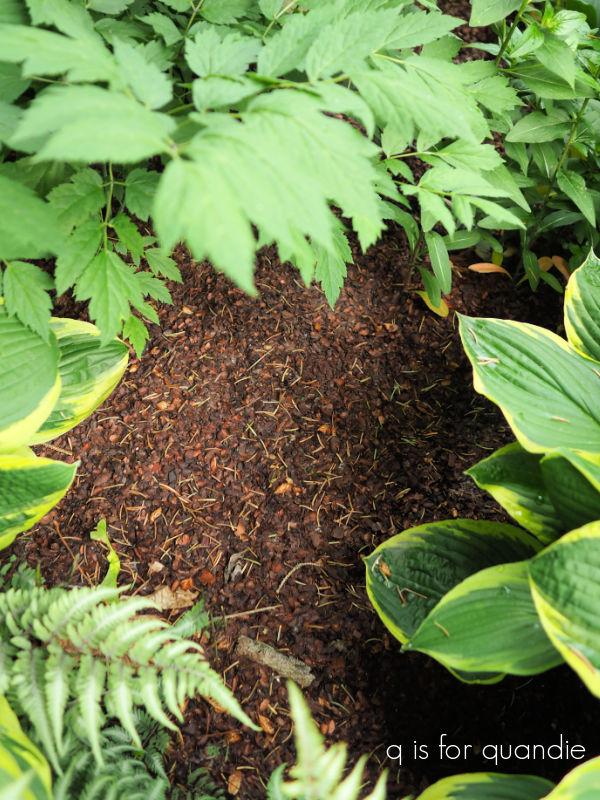
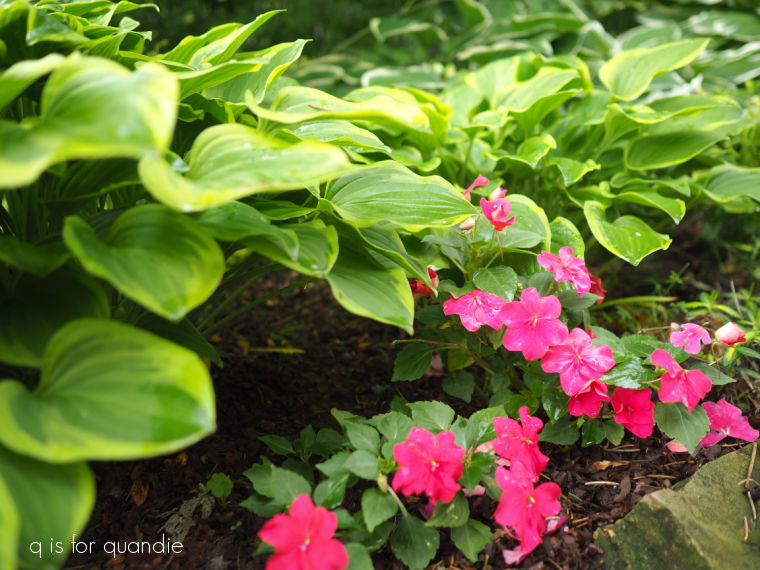
My Pagoda Dogwood looks great this spring.

I planted it back in 2022, so this will be its fourth season.  It’s finally tall enough to really see it above the tops of all of those ferns, so I’m very relieved that it came through the winter.

I’m also happy to see that my lilacs are full of blooms right now.

If you’ve followed me for long, you know that I’ve really struggled with this lilac hedge.

I started out planting all hybrids with gorgeous flowers, and they never took off.  I eventually had to replace all of them.  I replaced two of them with the Common Lilac, and those have grown like gangbusters.  They are over 15′ tall, and they are blooming like mad.  They had a bad case of leaf spot fungus at the end of last summer, so I wasn’t sure if that would affect the spring blooms but apparently it didn’t.

Unfortunately, their flowers are just a bit blah.  So I succumbed to temptation and added a few more hybrids on either end of the hedge a couple of years ago.  Just look at how much prettier the flowers are …

But the hybrids continue to look more straggly overall compared to the Common Lilac and I’m just not sure they are going to fill in enough to provide a screen from the unsightly neighbor’s fishing boat storage area behind us.

I’m incredibly relieved to find that all of the new Quick Fire Fab hydrangeas that I planted to create a hedge have survived.  Especially since I didn’t plant them until August of last year, so they didn’t have a lot of time to establish.  I also underplanted them with some muscari and daffodils, and they look great.

That is Muscari Valerie Finnis, isn’t it the loveliest pale blue color?

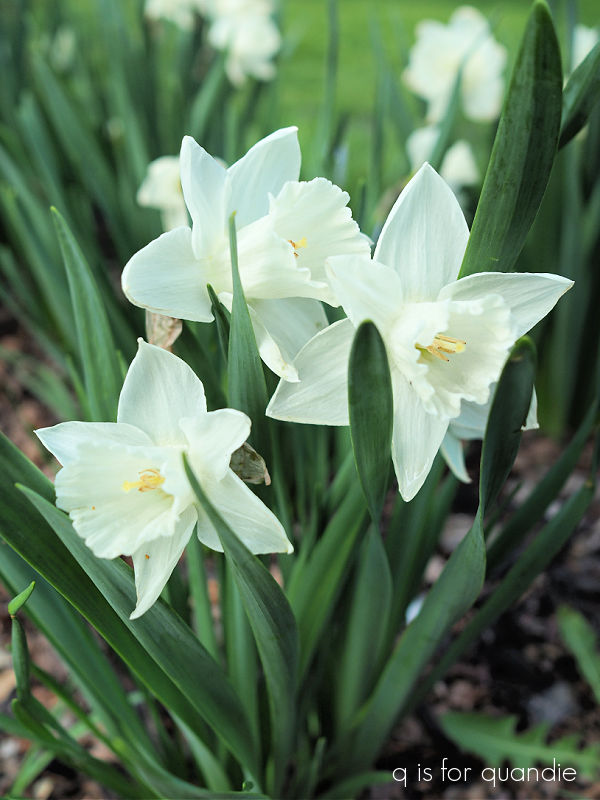
The daffodils are an all white variety called Trumpet Mount Hood.

I’m hoping that both of these naturalize (ie. multiply) and fill in all of the space under the hedge eventually.

This area is sunny enough now that the bulbs should do well from year to year.

I’m slowly starting to get over my dismay at the number of plants that didn’t make it this year.  On the bright side, this gives me an opportunity to get some new plants, right?

And as for the jumping worms, I’m going to have to learn what works and what doesn’t going forward.  Leaf mulch is definitely out, but I recently read that using cocoa bean mulch might be a good option.  I used to use cocoa bean mulch all the time, but it is difficult to find around here.  Also, FYI, it is highly toxic to dogs, so if you have a dog that likes to munch on stuff in the garden you definitely don’t want to try it.  Another study suggested that slug bait might work to help control the jumping worms.  Some of you might remember that I had to give up using slug bait because our cat liked to eat it, but now that she’s gone (#stillnotoverit) I can go back to using it.

How about you?  How has your spring been so far?  Did you have many plant losses over the winter?  Are you dealing with jumping worms?  Leave a comment and let me know!

you win some, you lose some.

Good morning from the garden!

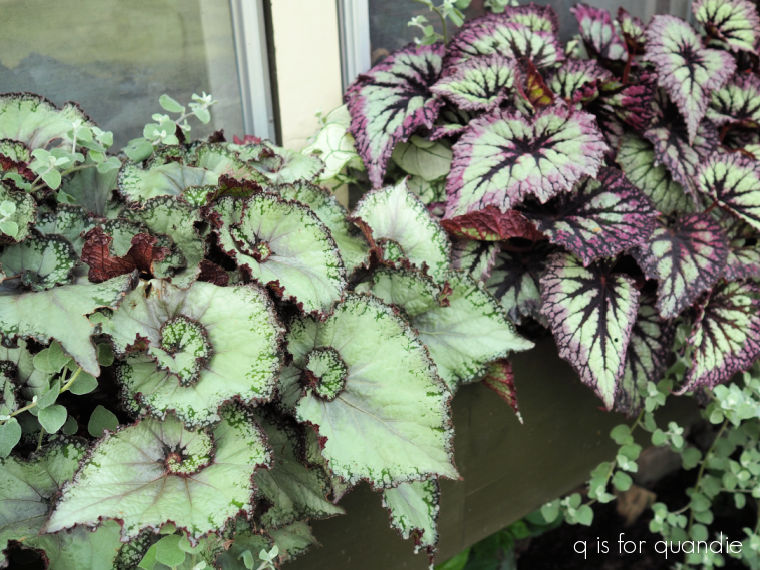
My gardens are slowly but surely starting to wake up for spring, but while I wait for that to happen I thought I’d report back on some of my over-wintering experiments starting with those gorgeous rex begonias.

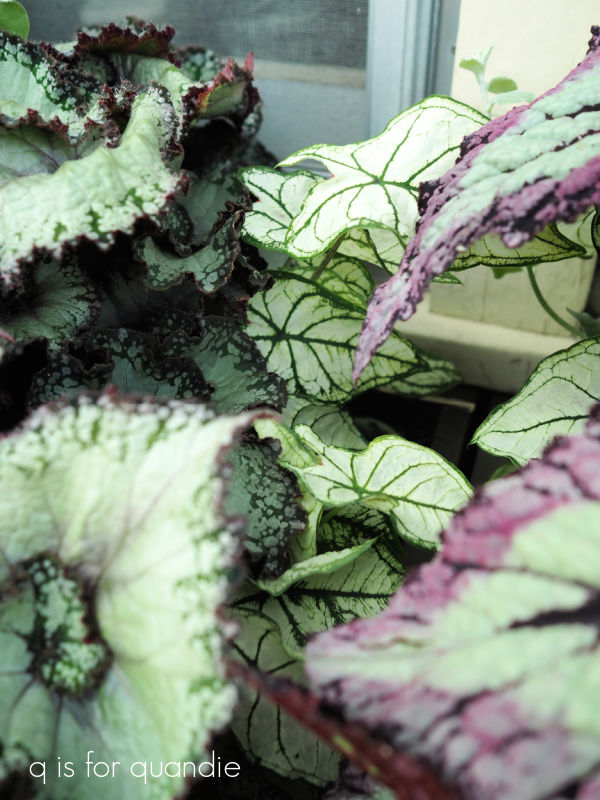
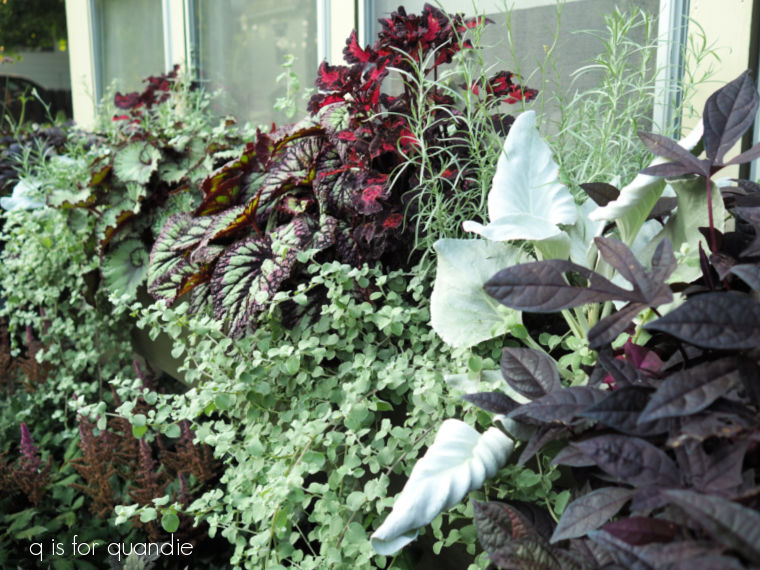
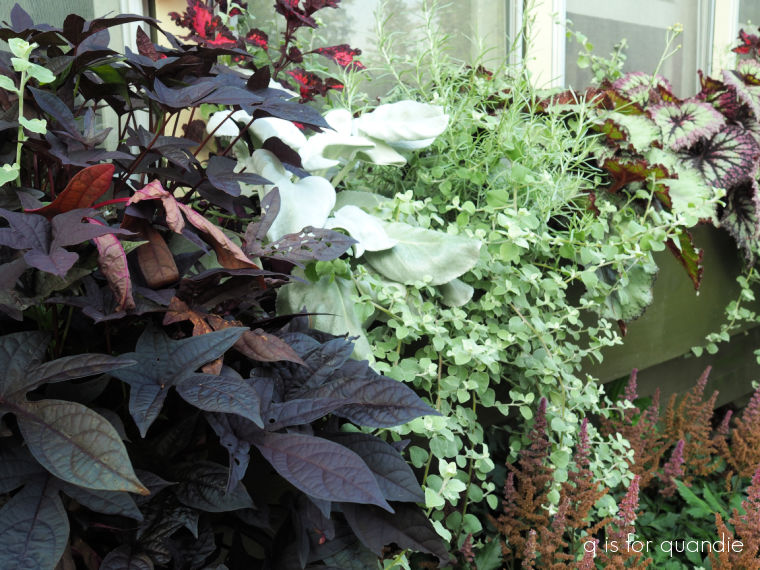
You may remember that I planted two different varieties of rex begonia in my front window box last year.  I think you can get a feel for how small they were when I purchased them in this next photo from last May.

I really wasn’t sure whether or not they would do well for me in that north facing window box, but as it turned out they loved it there.

Last fall I decided that they were too fabulous to just discard, so I potted them up to see if I could save them indoors over the winter.

I also took some cuttings to root in water.

Both cuttings developed nice roots within a couple of weeks, and ultimately I potted them on for winter.

In the end, one of them dried up once it was in the soil, but the other one continued to live.  I wouldn’t exactly say it thrived over the winter though.  It was basically a single leaf sticking out of a pot of soil for the bulk of the winter and I did not have high hopes for it.  But then, earlier this spring, I noticed that there was some growth sprouting out of the base of that single leaf.

And then a week or so later I noticed that there was also new growth coming from the soil too.

Eureka!  It lives!

Now I kinda wish I’d started more new plants from cuttings.  But that being said, the two original plants also did well over the winter.

I may have lost a little bit of bulk, but I’m sure that as soon as I get them outside they are going to take off again this year.

I think I will give both of these a little hair cut and see if I can root up a few more cutting before planting these out in mid-May.

Since I typically spend around $200 on annuals to fill that front window box, it would be nice to save some of that money by keeping rex begonias going from year to year.

That brings me to my 2nd overwintering experiment, the succulents.

As you may remember, I planted an antique newspaper roller with succulents two years ago.

I overwintered them in the roller the first winter, but it took up quite a bit of space in my window sill, and it leaked all over when I watered it.  That’s OK for an outside planter, but not so great on a window sill.

So last fall I decided to pull the succulents out of the newspaper roller and put them all in a pot together.

I placed the pot in a south facing window for the winter, and here is how it looks now.

As you can see, not everything made it.  Particularly that lime green sedum in the front, and that one succulent on the right.  But other things really thrived, like that rather spindly sort of succulent in the back right.

I don’t plan to put these back in the newspaper roller this year.  I never really did have a good spot for displaying it.  We’ll see what I can come up with for a unique succulent planter this year.

Finally, that brings me to my massive over-winter gardening failure, the bulb lasagna.

If you’ll remember, I found some half price bulbs at Home Depot quite late in the season last year.  Too late to plant them outside really, so I decided to try planting a bulb lasagna.

I filled two pots with a couple of layers of different spring blooming bulbs.

After watering them in, I placed the pots on my front three-season porch and I wrapped them in blankets.  I set a reminder on my calendar to give them just a little water once a month so they didn’t dry out completely.  Then as the weather started warming up this spring I uncovered them and set them in a sunny spot indoors.

And …

Nothing.

So I waited.  One week.  Two weeks.  Three weeks.  Still, nothing.

So I thought maybe they had to be outside at this point and I put them on the deck.

Still nothing.

So I decided to dig into the soil to see if I could find the bulbs and sure enough I found a bunch of rotted bulbs.

In hindsight, the porch must not have been a suitable location for them.  It probably got far too cold even though I’d protected them with blankets.  Or maybe I gave them too much water (although I really did only give them a very small amount).

Regardless, it was rather disappointing to get zero results.  Maybe a bulb lasagna just isn’t for me.

How about you?  Have you tried growing bulbs in pots?  Did you have success?  Have you got any tips to share?  If so, be sure to leave a comment.