if it’s broken.

If it ain’t broken, don’t fix it.  But if it is broken, well … sometimes you still can’t quite fix it.

A few weeks back my handyman/neighbor Ken and his wife asked me whether or not I would like to have their cast iron garden furniture.  It’s your typical set that includes a bench (not pictured below), two chairs and a little round table, all in the classic grapevine pattern.
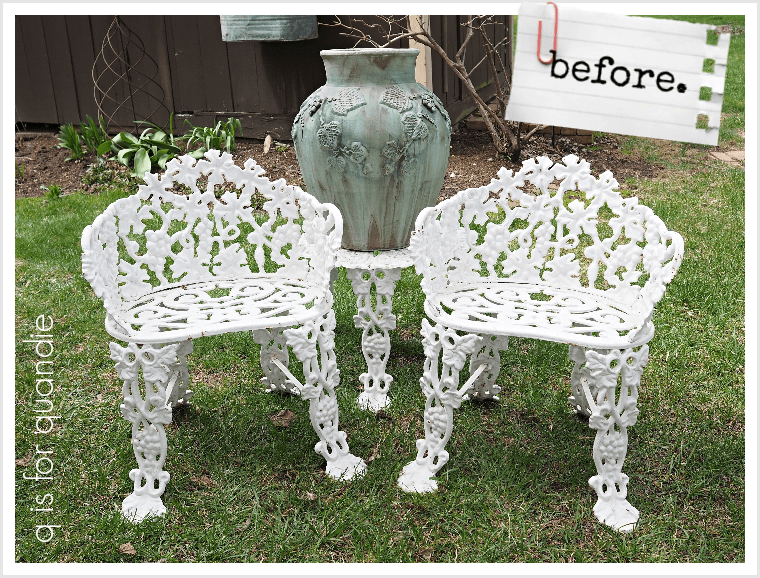
By the way, the giant pot is not from the neighbors, I only put it in the ‘before’ photo because I was working on it at the same time.  Kinda wish I hadn’t done that, but that’s water under the bridge now.

Ken and Arlene have had this set for decades.  I’m sure at least 40 years or more.  Every year they would haul it into their shed for the winter to save it from the elements.  But over the years, Ken has found that task more and more difficult because these pieces are pretty heavy.  For the last few years my other neighbor (the athletic trainer at a nearby high school) has gotten some football players to help with that task.  Still, Ken wanted to be rid of the furniture.  He’s tired of storing it in the shed every year (and I also suspect he’s tired of re-painting it bright white every few years), but his wife won’t have it any other way.

When they offered the set to me, I had to point out that I would leave it out in the winter.  Not only would I leave it out in the winter, but I would purposely make it rusty.  So if they couldn’t handle seeing that, they shouldn’t give it to me.

But they were still willing, so I took it!

There were a couple of issues though.  Both the bench and one of the chairs have broken legs that Ken wasn’t able to repair.  If you’ve followed me for long, you know that Ken is my fixer.  So if Ken can’t fix it, well, I’m not even going to try.  Apparently he even went so far as to have a welder attempt to weld the legs in place, and that didn’t work.

So basically, neither of those two pieces are suitable for actual sitting.

Well, that’s OK with me.  I planned to use the Dixie Belle Patina Paint to make them rusty, and unless you seal them, that makes them unsuitable for sitting on anyway.  Plus, let’s face it, it’s not like this furniture is comfortable, right?  Does anyone ever actually sit on it?  This is definitely one of those form over function sort of situations.

So I made them rusty.  The bright white just wasn’t ‘me’.  As per usual, I started off in the wrong direction.  I decided to give them a dark base color so there wouldn’t be any patches of white poking through the rust.  I also decided to use spray paint for this, simply because it would be way easier than painting them with a brush.  I had a couple of cans of gloss black on hand, so I thought it would be OK to use that.  So I sprayed them up … and boy was that gloss spray paint SHINY.  Like so. very. shiny.

I didn’t want to see super shiny black spots behind my rust, so I switched directions and gave the pieces a base coat of flat red spray primer.  Much better.

One caveat re: the primer, if I was concerned about these pieces rusting for real I could have used the Dixie Belle Prime Start.  It contains an acid blocker that prevents the activator (green spray) that you apply later from eating through the paint and degrading your metal item.  But I’m OK with these pieces rusting away for the next decade or two.

Next I followed the normal process with the Dixie Belle Patina Paint in Iron, followed by the green spray (you can get detailed info on that process by clicking on the image below).

For reference, it took most of the 8 oz. container of the Iron paint to do the two chairs and the round table (I haven’t gotten to the bench yet).  So if you’re planning a rusty project, maybe this gives you an idea of how far the paint goes.

I really loved the rusty look I achieved on these pieces.

Yep, rusty is much more to my taste than the bright white … or the glossy black for that matter.
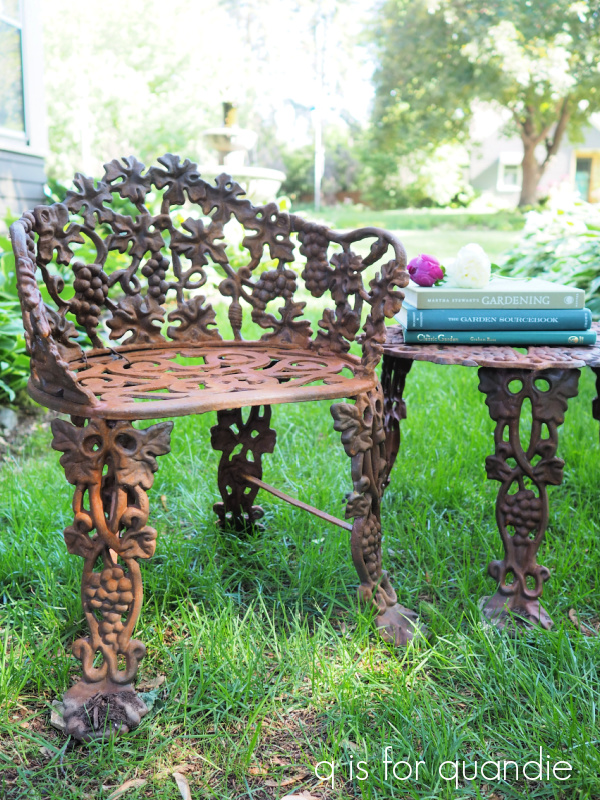
As I’ve mentioned in the past, the rusty patina can take a while to fully develop.  I’ve also noticed that a little rain falling on the items will speed up that process.

Dixie Belle does make a sealer specifically for use over their patina paint called Patina Guard.

You may want to consider using this sealer to protect a rusty finish, or more importantly to protect yourself from sitting on a rusty finish.  But personally I don’t like the sheen it imparts, so I prefer to leave my rusty pieces unsealed.  You can read more about that in this post.

I’ll be splitting up all of these pieces rather than keeping them together as a set.

One of the chairs has found a home in my front garden next to the fountain.

I also have a spot picked out for the bench (once it’s done).

I did have a plan for the other chair and table, but ended up not liking them in the spot I picked out.  So now I’m going to attempt to sell those two unbroken pieces.  So if any of you locals are in need of a rusty table and chair for your garden, be sure to check out my ‘available for local sale‘ page for more details.

As for that pot, I made that rusty too, and here is how it turned out …
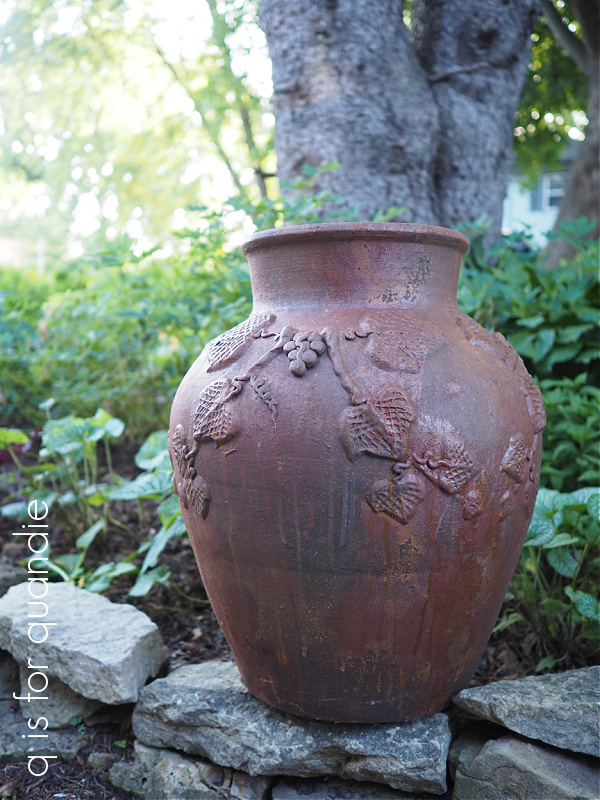
The pot also has a grape vine motif that looks great rusty.

It’s also available for local sale.

While I’m at it, I also have this pair of tall rusty planters and obelisks available.

These are quite tall and would look amazing flanking a door, or maybe a path in your garden.

Be sure to check out my ‘available for local sale‘ page for the details on all of these rusty items.

Have I gone overboard with the rusty look?  I don’t think so.  In fact I have another pair of planters that are going to go rusty next, and I still have to get to that bench!

As always, thank you to Dixie Belle for providing me with their Patina Paint products.

everything’s coming up daisies.

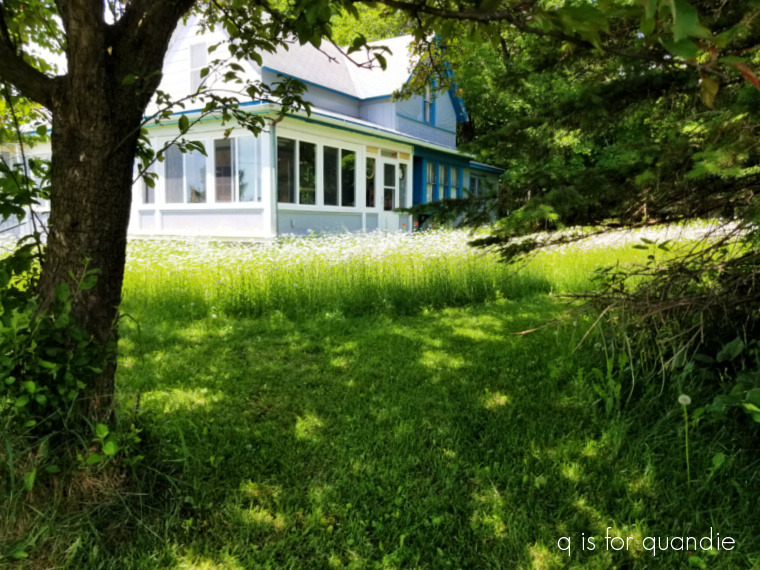
The day before I left for my mom’s house, Mr. Q and I drove out to my in-law’s place to see their daisies in bloom.

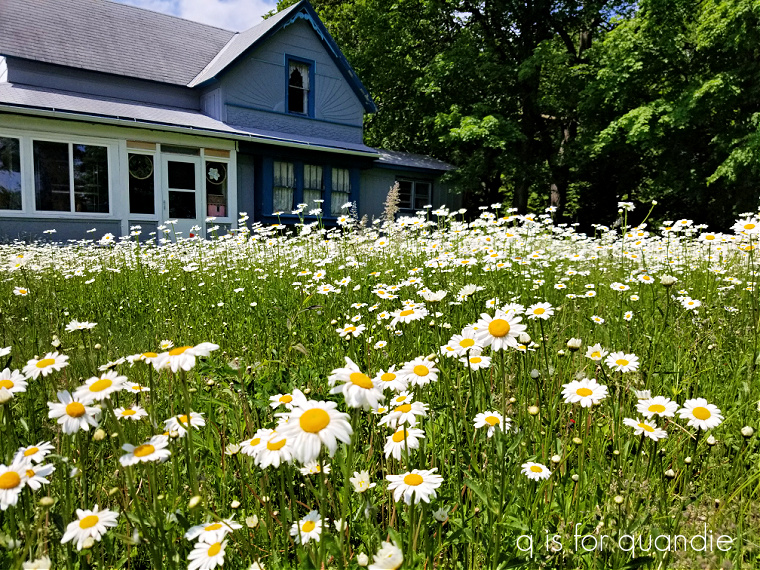
I just had to share their field of daisies with you guys, so even though I forgot my camera that day I snapped a few photos with my phone.

Mr. Q’s mom and step-dad, Naomi and Tom, purchased this old farmstead in Wisconsin a few years back.  One spring their lawn mower was on the fritz and they weren’t able to get it fixed right away, so the front lawn didn’t get cut.  That was when they discovered that it wasn’t just a weedy lawn, it was actually a field of daisies.

Since then they have left it to bloom every spring.

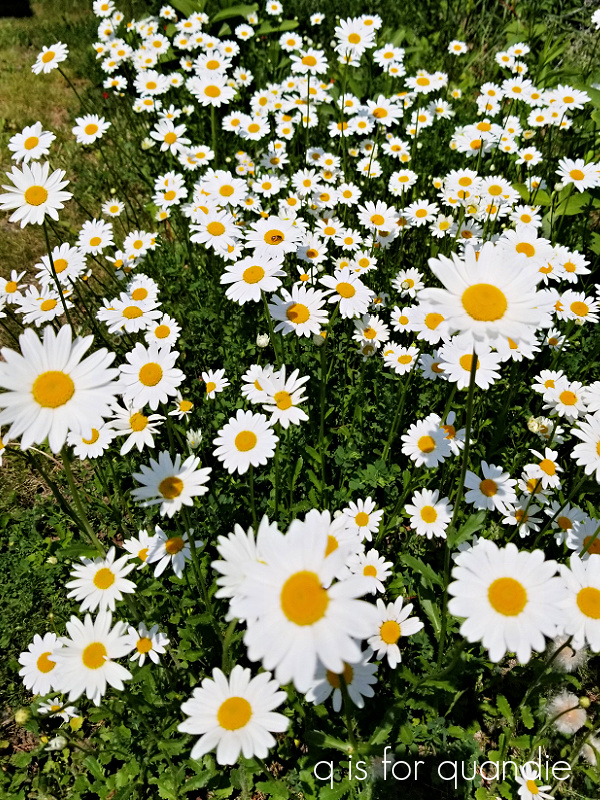
Once the daisies are done blooming, they mow it all down to normal lawn height.  But before then, they get to enjoy this beautiful field of daisies for several weeks.

There are a few other wildflowers mixed in with the daisies, but the daisies are definitely the star of the show.

This is such a great life lesson.  You never know when a broken lawnmower might lead to the discovery of a field of daisies!

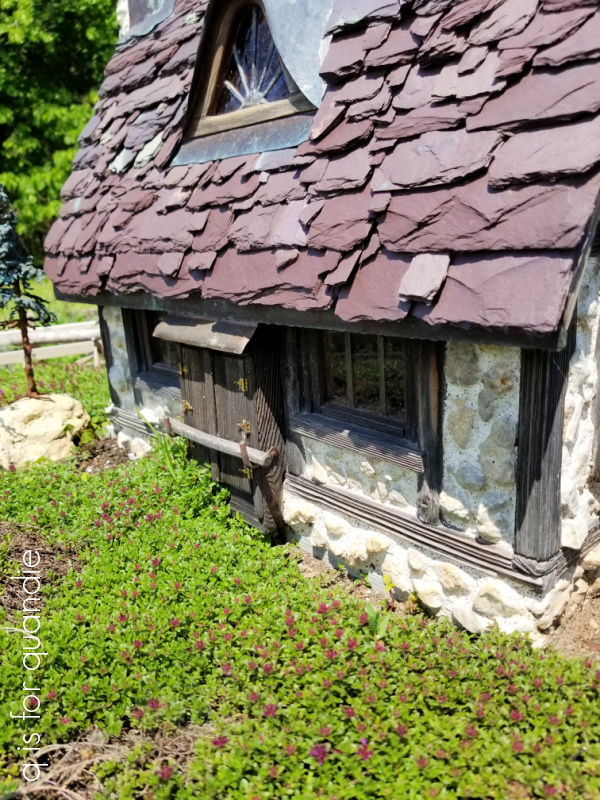
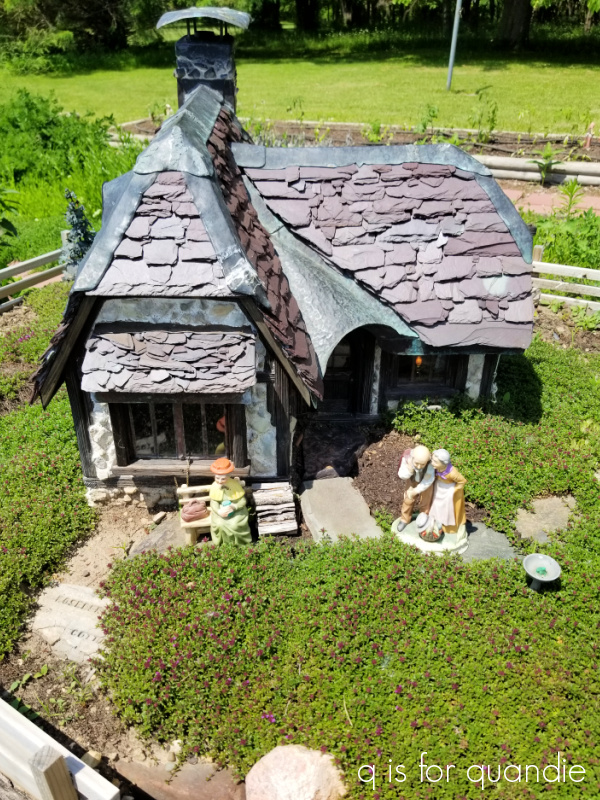
While I was out there, I thought I’d also get a few pics of one of Tom’s fairy houses.

This makes my fairy garden look like child’s play, does it not?  I’m going to have to consider expanding.

The creeping thyme was just starting to bloom while we were there as well, isn’t it perfect for a fairy garden?

Tom built this fairy house from scratch, carving all of the wood elements by hand, cutting stone for the roof and even making the leaded glass windows.

It’s furnished inside and even has electricity, see the lights burning in the windows?

It does not, however, have indoor plumbing.  That’s what the outhouse is for.

Usually when I share photos of this fairy house people ask if Tom sells these creations, but I have to say that if he did the price would have to be exorbitant.  He puts so many hours of labor into them.  This is one of those things that you can’t really put a price on.

I hope you enjoyed this visit to see Tom & Naomi’s field of daisies as much as I did!

the peak of peony season.

I’ve returned from my visit out west a little blonder (thank you Sun In), and with a bit of a tan.  I wasn’t sure I would survive the heat (well over 100 degrees most days), and the sunshine feels a bit relentless to me out there (I love a good drizzly day in the garden).  My mom is doing much better though.  My sister and I helped her out with a few things while we were there, and her broken ankle is healing nicely according to the doctor we spoke with.

When we weren’t ferrying mom to appointments, replacing her screen door, and re-planting her pots (I seem to do this every time I visit, flowering annuals don’t last long in her climate, I’m trying moss roses this time around), we just floated in the pool at her townhouse complex.  It was definitely too hot to do any hiking, or really even much sight seeing.

Although it was relaxing, I was definitely ready to come home and get back to my painting projects!  And my garden!

When I scheduled the visit to my mom’s, I wasn’t really thinking about what I would be missing in the garden.  It wasn’t until shortly before we left that I realized I would likely miss the peak of peony season (which was a little late this year).

Jeesh!  I wait all year for the brief blooming period of those babies!  And I planned a trip smack in the middle of it.  What was I thinking?!

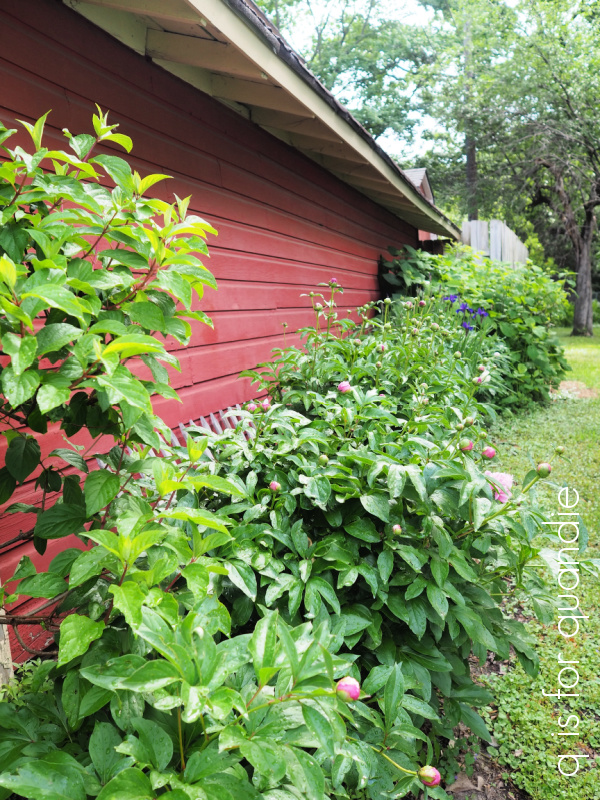
Before I left I grabbed a quick photo of my cutting garden …

My cutting garden, by the way, is out back behind the carriage house.  It’s a nice sunny south facing spot, and you can’t actually see any of it from the rest of our yard.  That makes it perfect for a cutting garden because you never feel guilty about cutting all of the flowers to bring inside.

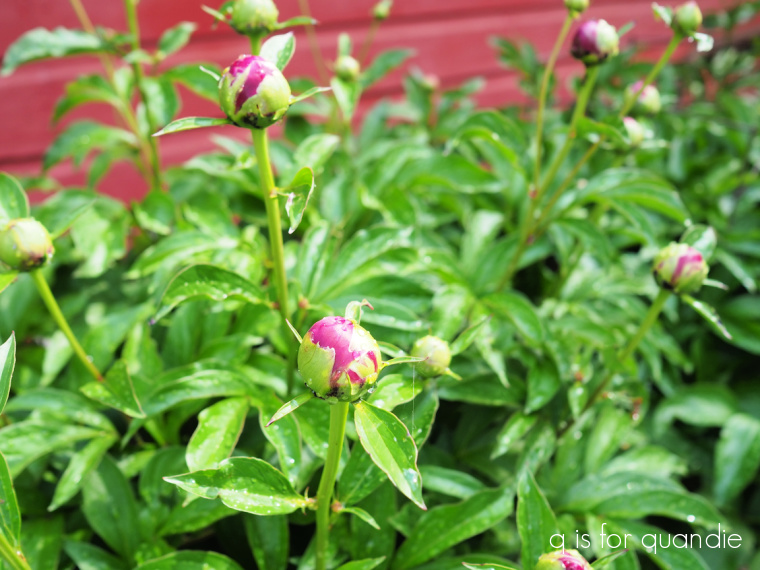
Before I left for mom’s, the peony buds were just beginning to show some color.

And the siberian iris were just starting to open.

But I knew that some hot weather was headed for Minnesota while I was gone, and hot weather is the kiss of death for peony blooms.  Also apparently for the iris, because they were pretty much done when I returned.

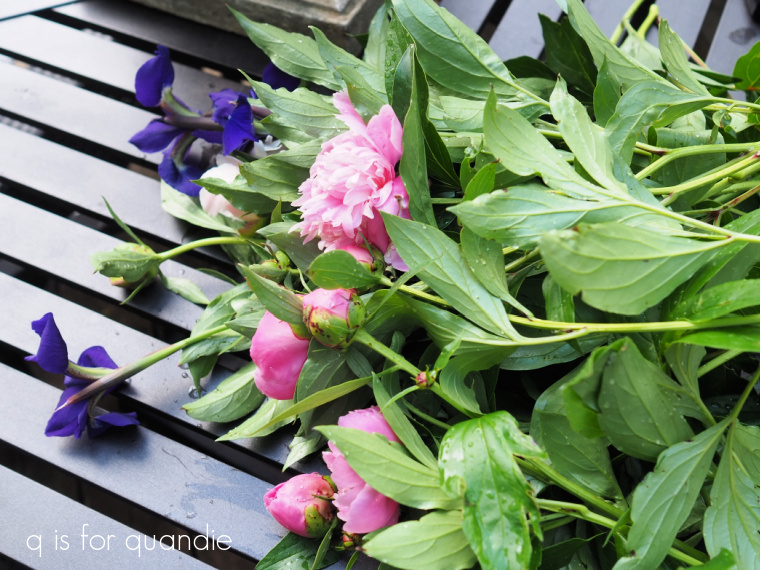
So I decided to try a couple of peony saving measures.  First of all, I cut those few things that were already open.

I popped them into a jar of water, and put that in the fridge next to my peach sangria.

That actually worked quite well, when I got home the flowers still looked just as good as when they went in.

I also decided to save some peony buds in the fridge.  You may remember that I experimented with this process last year (for the full details, you can read that post here and the results of the experiment six weeks later are here).

So once again I cut stems with buds that were at the ‘soft bud’ stage, in other words they feel like a large marshmallow when you squish them a bit.

After removing all of the leaves, I simply popped them into a large Ziploc bag and then put them at the back of the fridge.  I’ll pull them out sometime in July and be able to enjoy peonies again then.

The first thing I did when I got up in the morning after returning home was check on the peonies.

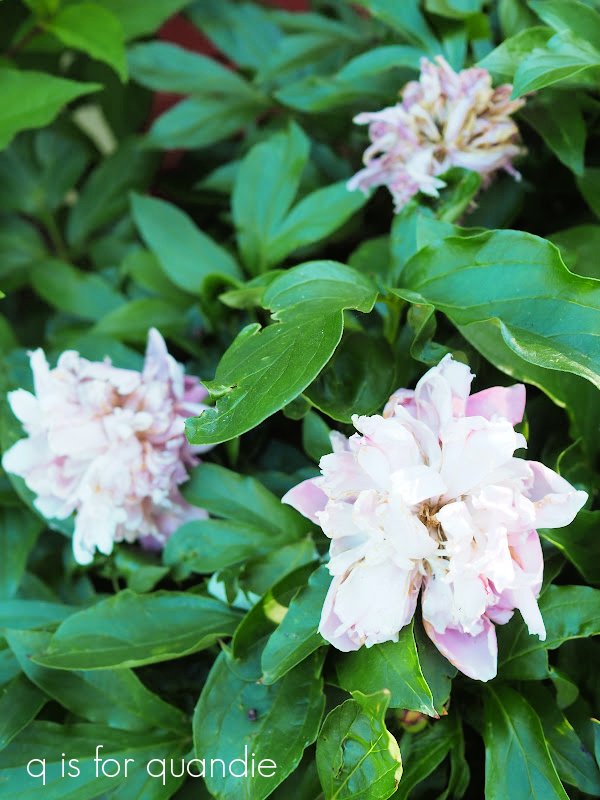
Sure enough, quite a few of them were already spent.

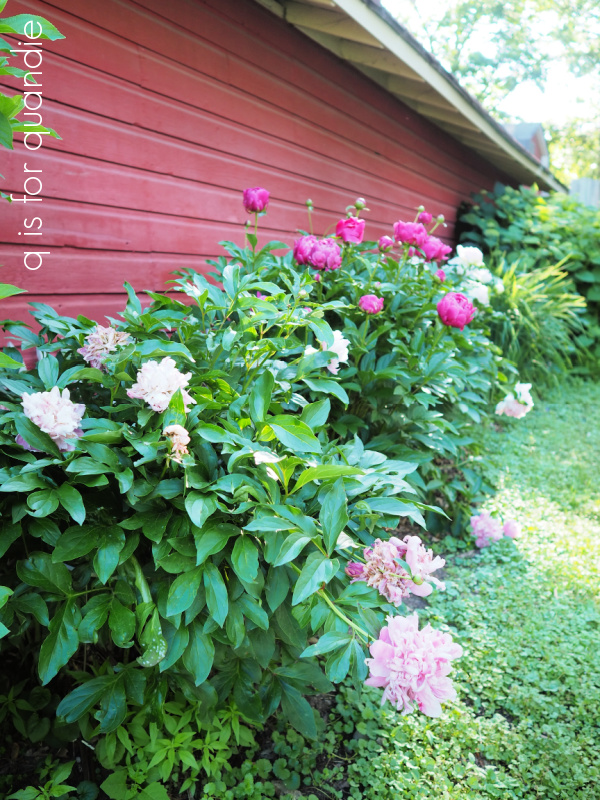
But luckily I have a lot of peony plants, and quite a few of them still looked pretty good too.

Since the forecast for yesterday was hot and humid with a high of 96, and by today we’re supposed to have a high of 99 (ugh, did I bring it home from Nevada with me?), I decided to cut all of the open flowers and bring them in the house ahead of the heat wave.

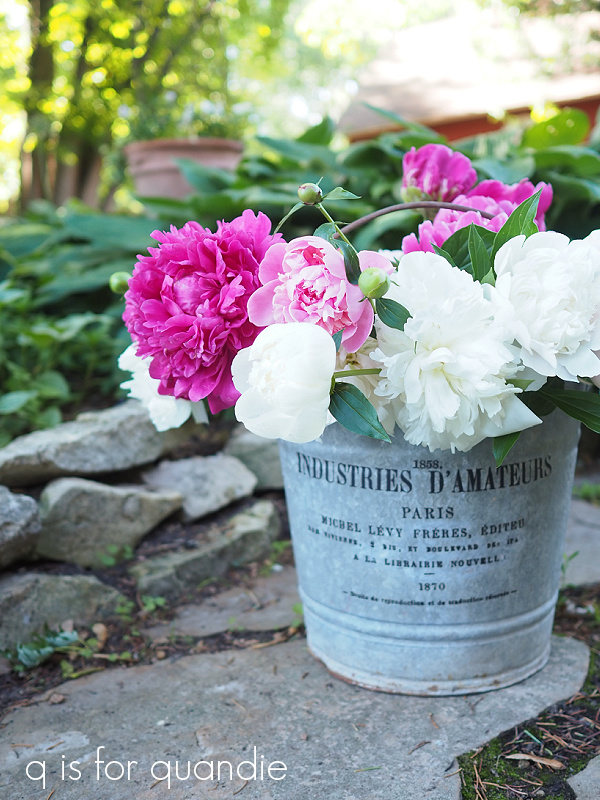
I ended up with three very lovely arrangements.

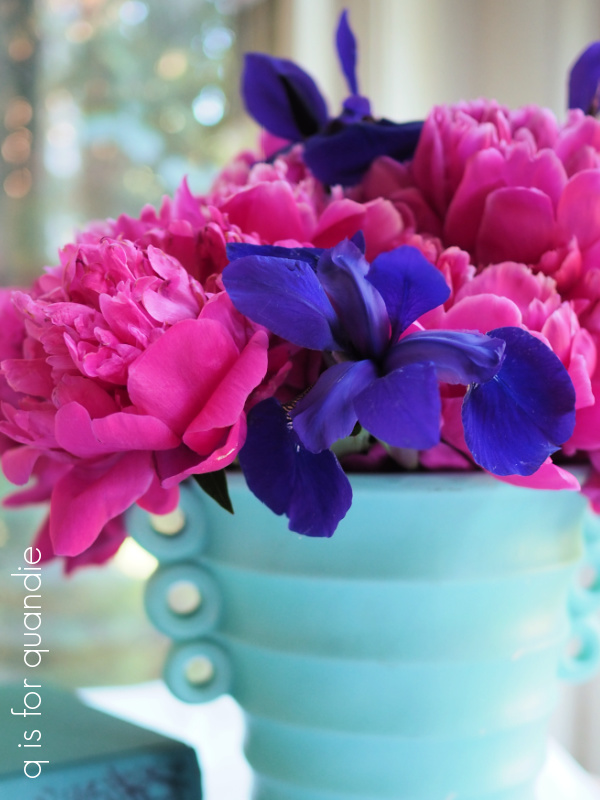
The vibrant dark pink peonies went into an aqua vase, and I added in the irises that I’d saved in the fridge.

This arrangement is perfect for those who love a big pop of color.

I put the medium pink peonies into my paint inlay watering can.

Those medium pink peonies were growing in the garden here when we bought our house 34 years ago, and I suspect they’d been here for quite some time even then.  I eventually had to move them to a sunnier location, but they are still going strong.

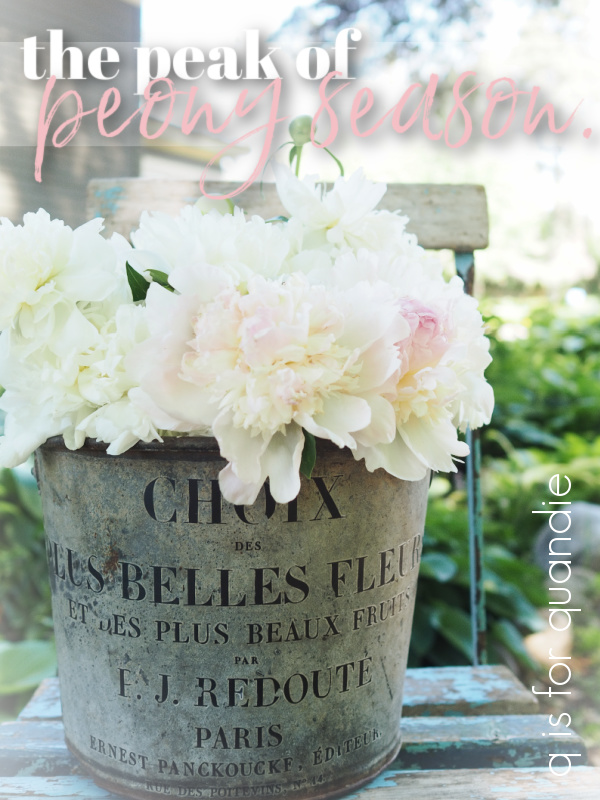
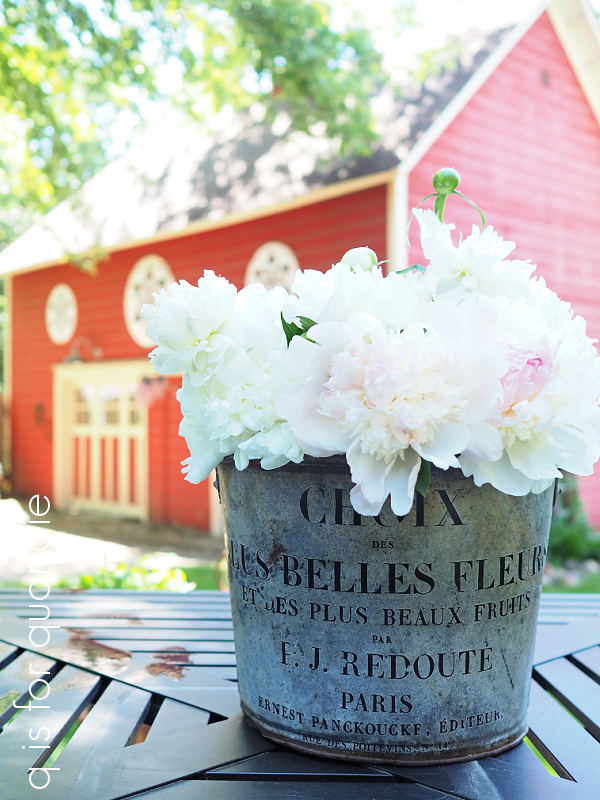
Finally, I put mostly white peonies into one of my buckets.

I say ‘mostly white’ because in addition to the solid white peonies, I also have these gorgeous peonies that have just the tiniest hint of pink.

Personally, these are my favorite.  I love that delicate little bit of pink in the centers.  So pretty!

Unfortunately, I haven’t retained knowledge of most of the peony varieties that are in my garden with the exception of that one.  It’s called Raspberry Sundae.

My advice to you if you’re looking to add some peonies to your garden is to shop for them while they are in bloom.  Photos of the blooms seem to vary wildly, you want to be sure you know what you’re getting.

I’ve been toying with the idea of adding a yellow peony to my line up, maybe that will happen next year.

In the meantime, I’m going to bring all of these arrangements inside my air conditioned house and see if I can keep them looking good for another 4 or 5 days.

How about you?  Do you grow peonies?  Have you tried saving them in the fridge?  Have you got any other peony tips to share?  If so, be sure to leave a comment.

the flower and grain tote.

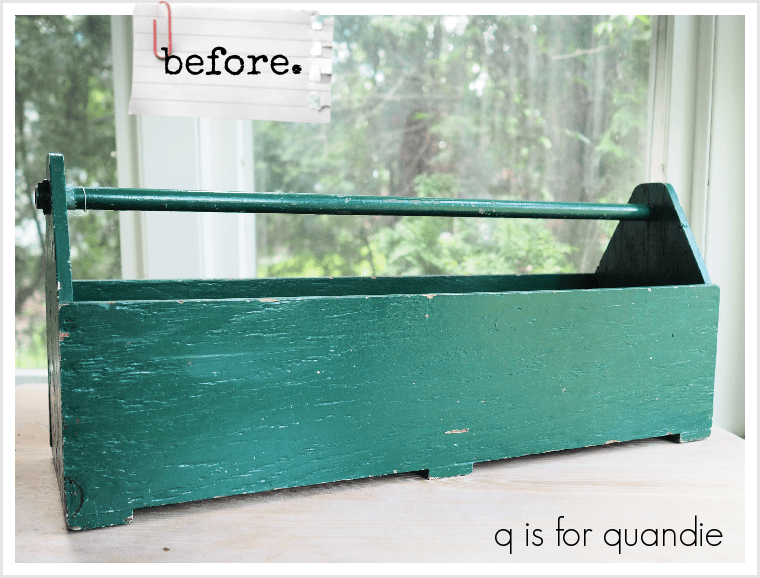
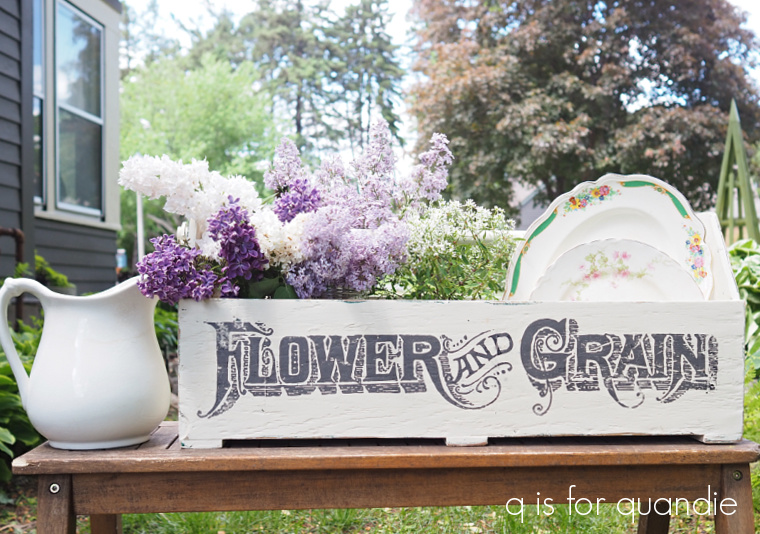
I purchased this large green wooden tote at the Linden Hills sales.

I love reviving these.  This one wasn’t a terrible shade of green, but it was a bit too shiny for my taste.  So I sanded it thoroughly and then gave it a couple of coats of Dixie Belle’s Drop Cloth.

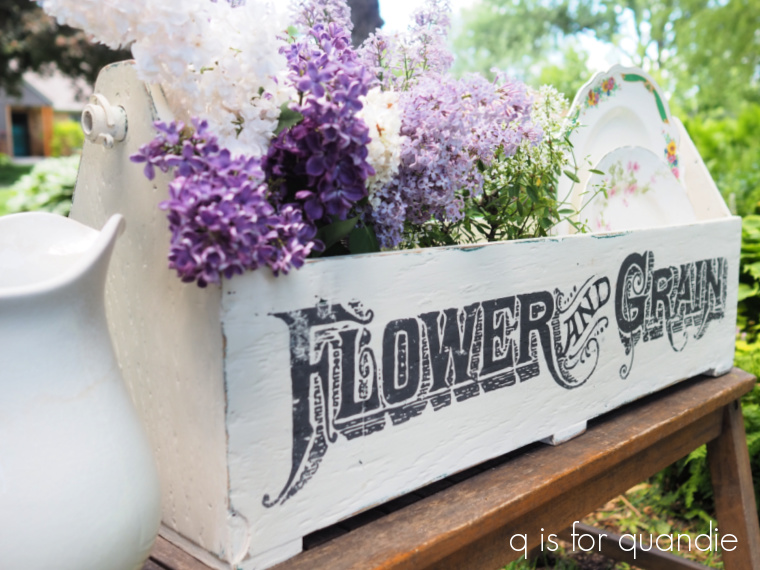
Next I pulled out a small section from the I.O.D. Gregory’s Catalogue paint inlay that I used on the bench I shared last week.  They say you can re-use the paint inlays up to 3 times, so I thought I’d give that a try.

I’m not sure if you can tell in the photos, but the 2nd time around the color fades to more of a dark grey rather than the original black that was on the bench …

It’s just a bit more washed out.  That’s not a bad thing, but just something to be aware of.  Especially if you’re thinking about trying to use a paint inlay over again on the same piece.  Some areas would look more faded than others.  Still, not necessarily a bad thing, but something you want to be aware of.

I also found that the backing paper was a little flimsier the 2nd time around, and in fact I couldn’t keep one section from tearing into pieces, so a 3rd use is out of the question for this section of my paint inlay.  Keep in mind that I had trimmed the inlay down to fit on this tote, had I kept the entire sheet intact it would likely have held up better for a 3rd use.

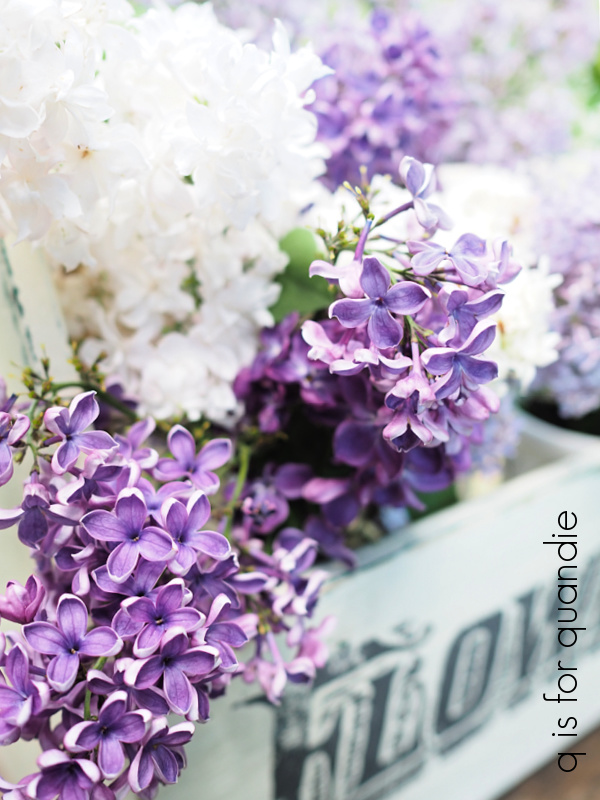
I simply had to stage my photos with the last of my lilacs.

They are about done for this year.

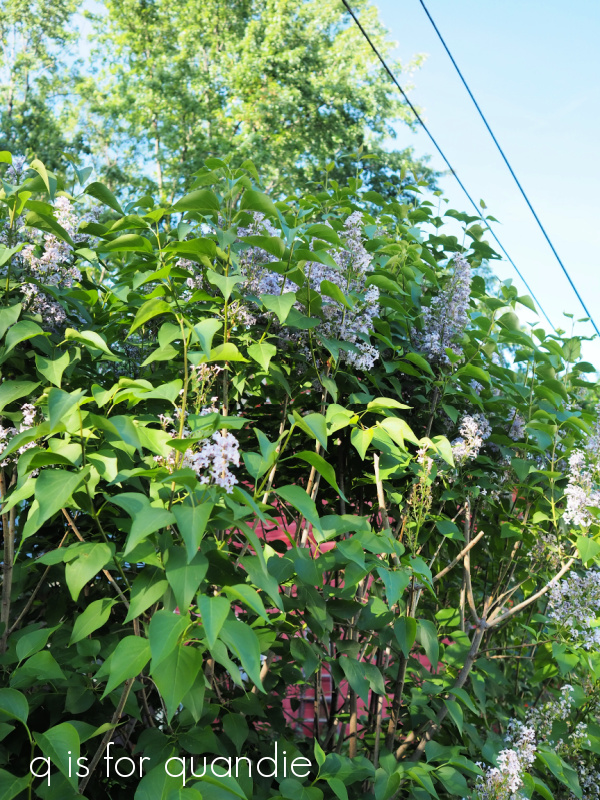
If you’ve been following me for long you may remember the story of my lilac hedge fail (you can read all about it here).  Looking back at that post I realize that I’ve been working on my lilac hedge for 11 years now.  Man, talk about determination!  Or maybe I’m just unwilling to admit defeat.  Either way, this year we ripped out one more of the non-performing lilacs and then added three new ones at the end of the row.

But the lilacs in the middle of the hedge are looking great.

They are about 10′ tall, and a couple of them have filled in nicely.  Now I just have to get the rest of them to look as good.  Maybe in 11 more years it will be as I envisioned it.  A tall, dense hedge that completely blocks the view into our neighbor’s back yards.  Fingers crossed on that one.

Well, even if my hedge isn’t providing the privacy we want quite yet, it is providing some pretty lilacs for staging photos.

This tote is for sale locally, so be sure to check my ‘available for local sale‘ page for more details.

Thank you to Dixie Belle Paint Co for providing the paint and sealer used on this project.

a real cold item?

Unlike the painted toolboxes, which are a real hot item, my painted suitcases can be very hit or miss.  I’ve painted quite a few suitcases in my day, you can check out most of them in this post from April 2021.

One of my favorite suitcases was this one …

Although I guess technically that one is not painted.  I just added some I.O.D. transfers to it.  It did sell really quickly though.

But lately my suitcases are mostly a miss, rather than a hit.

Last Christmas season I painted this one …

I loved how it turned out.  But you know what?  It didn’t sell.

I think it would be adorable just sitting under the tree, or maybe placed in your foyer to greet Christmas guests.  As an added bonus, you could store Christmas ornaments in it when you pack it away with your decorations at the end of the season.

I still have it available if any of you locals are interested.  It’s priced at $45.

More recently I painted this one …

This time I also spruced up the inside thinking maybe that would help sell it.

But last I checked, this one is still unsold (it’s at the shop where I sell on consignment).

It’s priced at only $35 if any of you locals are interested.

Due to lack of sales, I’ve placed a moratorium on bringing home any more vintage suitcases.  Well … maybe I should clarify.  The moratorium is on paintable suitcases.  I’ll still grab fabulous vintage suitcases for my own non-collection.

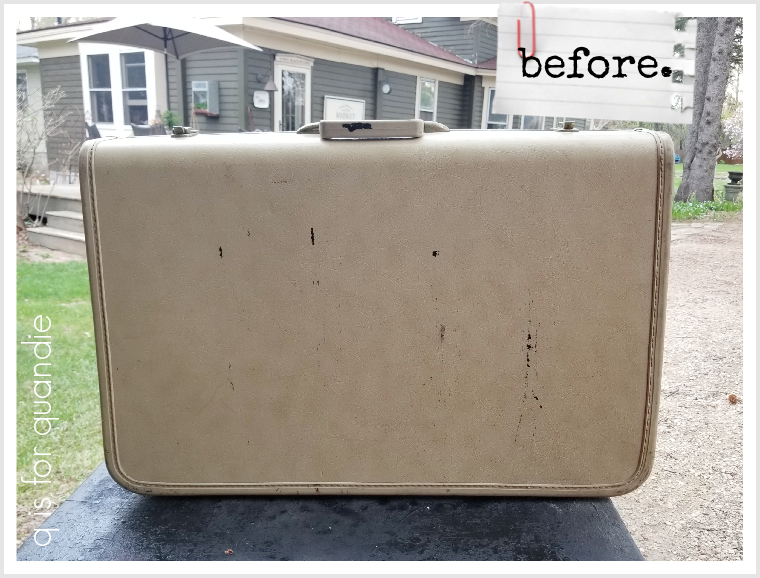
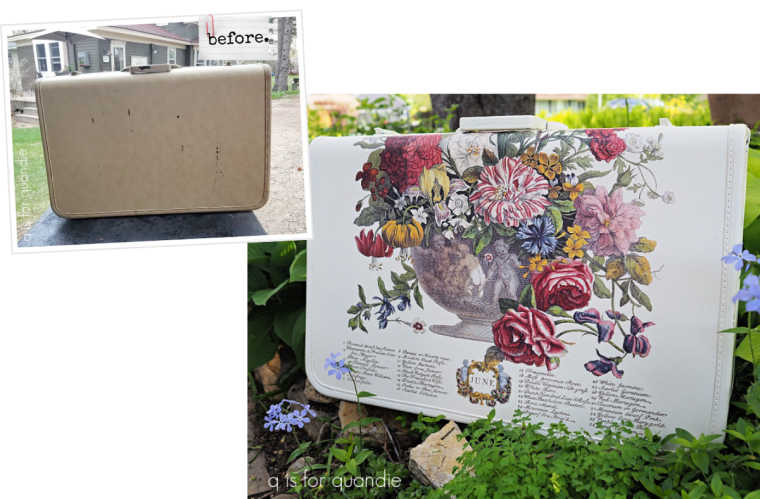
However, I still have a couple of suitcases remaining in my ‘to be painted’ inventory including this one …

So decided to go ahead and get this one painted up.

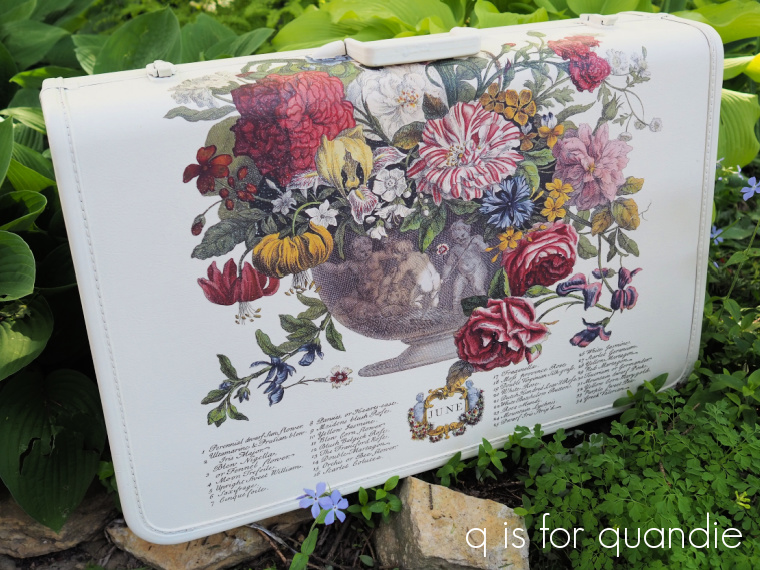
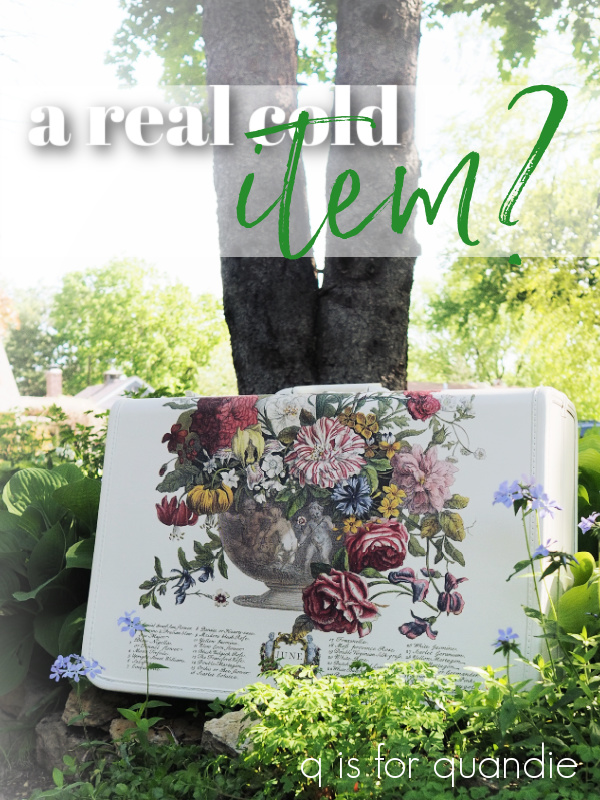
This time I used Dixie Belle’s Drop Cloth paint, and then I added I.O.D.’s June, Ode to Henry Fletcher transfer.

This was a super simple project.  I just painted the suitcase, gave it a light sanding with 220 grit paper, added the transfer and then finished with a topcoat of Dixie Belle’s flat clear coat.

Oh, and I did also sand over the transfer very lightly with 220 grit to give it a more worn appearance before applying the topcoat.

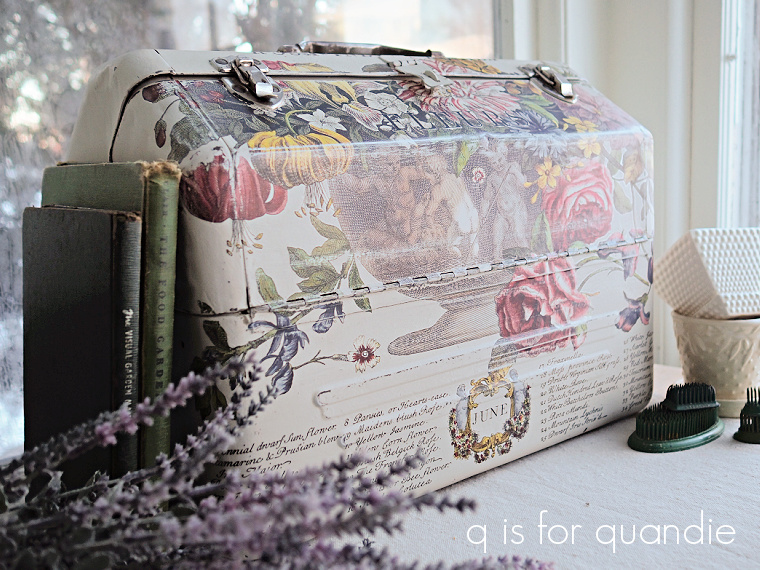
That is such a pretty transfer!  The last time I used it was on this toolbox …

It sold really quickly and one of my regulars missed out on it.  So when I finished up this suitcase, I shared it with her and she called dibs on it.  So today’s suitcase is spoken for.

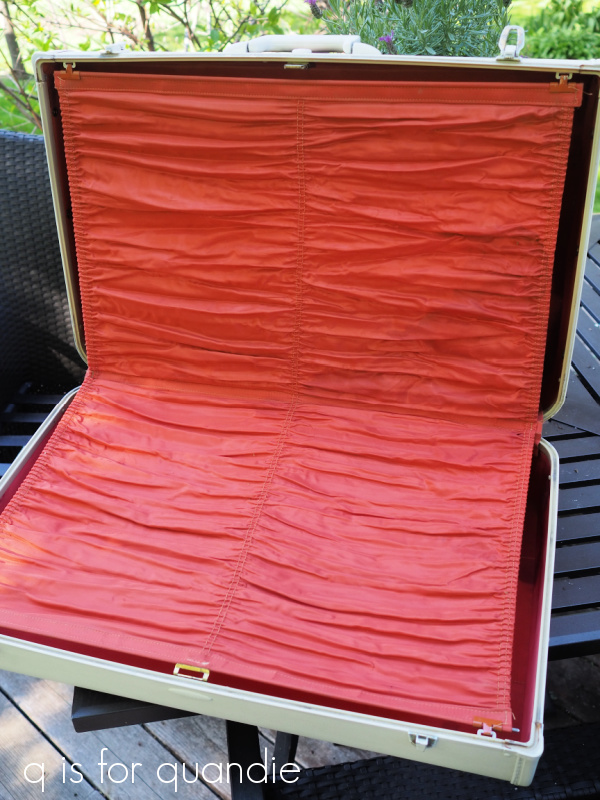
But I wonder if part of the reason the suitcases don’t normally sell as well as the toolboxes is because they are often musty inside.  This one actually isn’t too smelly, but it is quite orange.

Here are some q tips for mitigating that ‘I’ve been closed up for 50 years’ smell.

no 1 – fill the suitcase with crumpled newspaper and close it back up for a week or so.  The newspaper will absorb some of the odor.  Repeat several times with fresh newspaper if necessary.

no 2 – throw a scented dryer sheet inside.  Maybe pick a nice lavender scented variety.

no 3 – spray with Fabreeze.

no 4 – give the suitcase its day in the sun.  Open it up and set it outside in a sunny spot to air out.

no 5 – if you’re really fancy, create your own lavender sachet to place inside the suitcase.

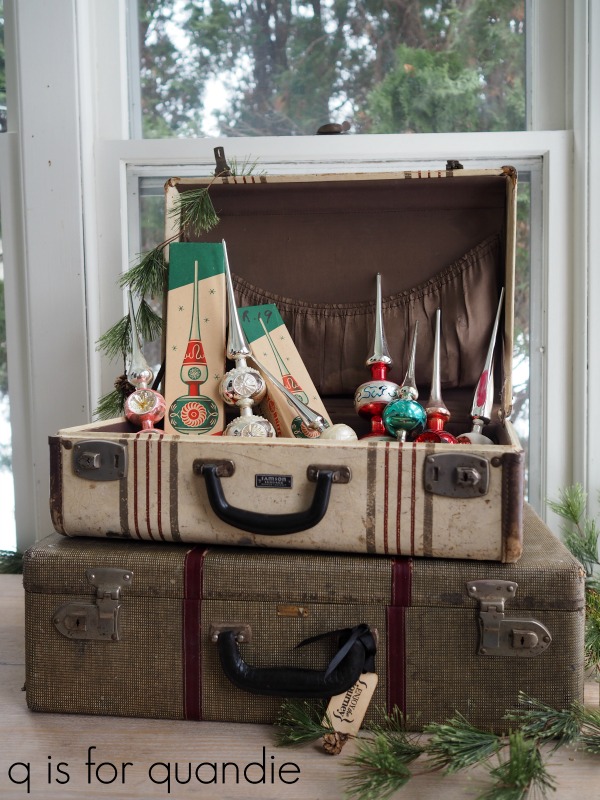
I’ve tried all of these options … well, except I’ve never made my own sachets.  Usually I employ several of these options at once.  But, I haven’t found a 100% fool-proof way of totally removing that musty-ness.  Once the suitcase goes back to sitting around closed up all the time, it will likely return.  For that reason, I use my own vintage suitcases to store things that won’t pick up odors like my glass tree toppers.

If nothing else, a suitcase like this one is just pretty to look at.  You can put it at the foot of your bed, or next to your dresser, or anywhere really.

Do you have any tips on freshening up the inside of a suitcase?  If so, please be sure to share them in a comment!

gardening small.

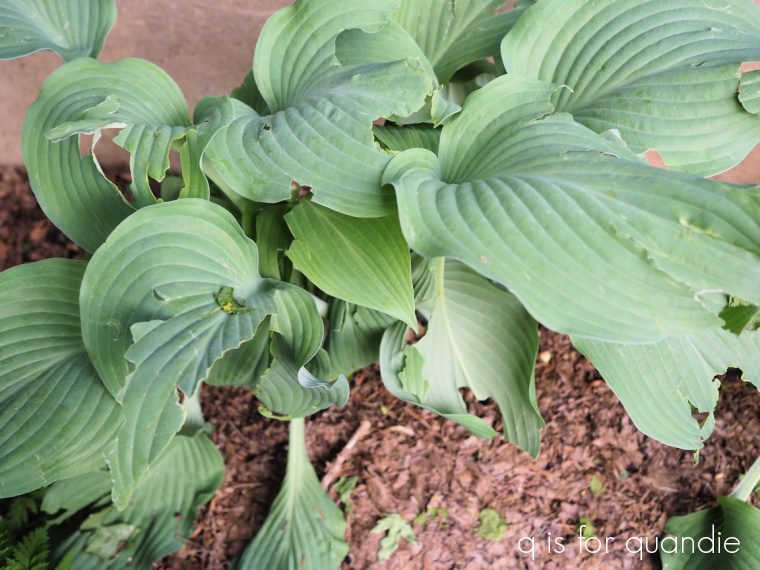
After taking some time to evaluate my garden after our recent hailstorm, I’ve realized that although some plants were quite damaged, some weren’t really impacted too much.  My large leaved hostas are toast.

At least the ones where the leaves were unfurled.  There were still a few varieties that weren’t up all the way yet, so that was an unexpected bonus to the cool spring we’re having.

My tulips all bit the dust as well.  Ironic, right?  They survived the winter, and then the deer, only to succumb to hail.

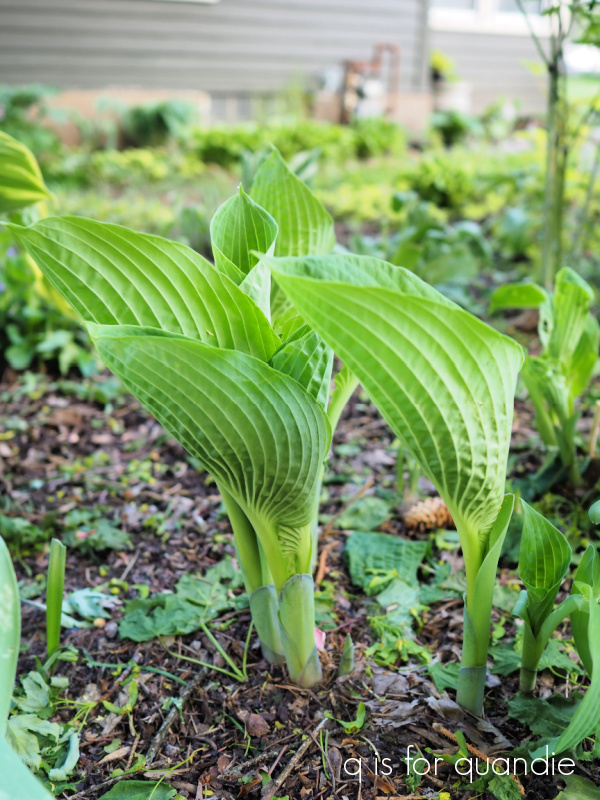
But for the most part, plants with small leaves, like the sweet woodruff …

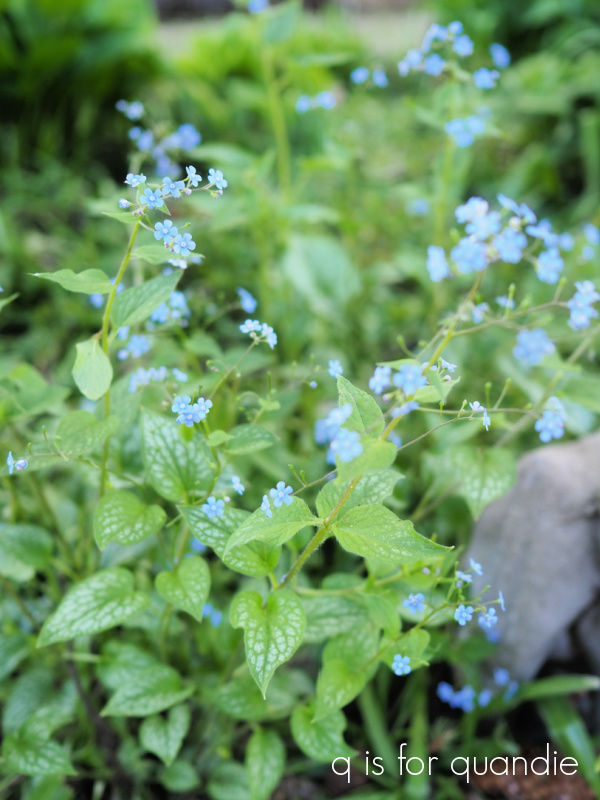
and the brunnera were just fine.

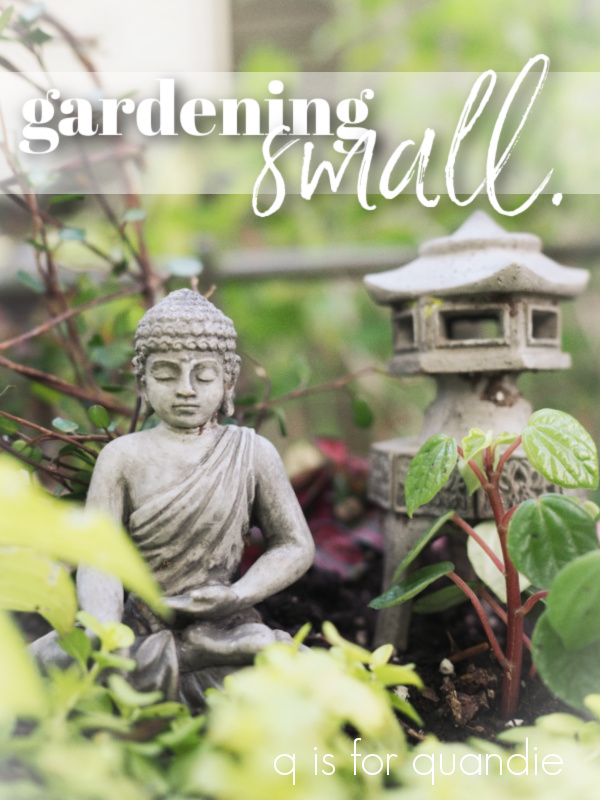
Which brings me to my smallest plants of all, the ones in my fairy garden.

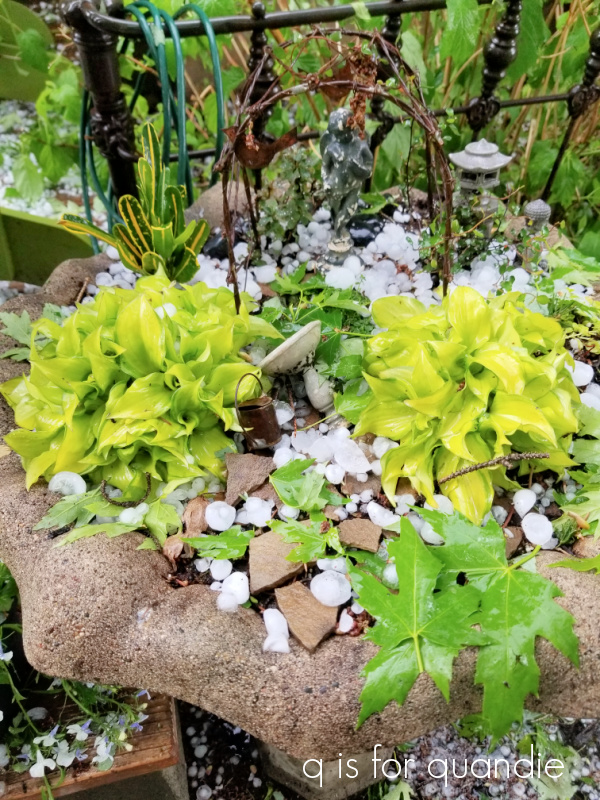
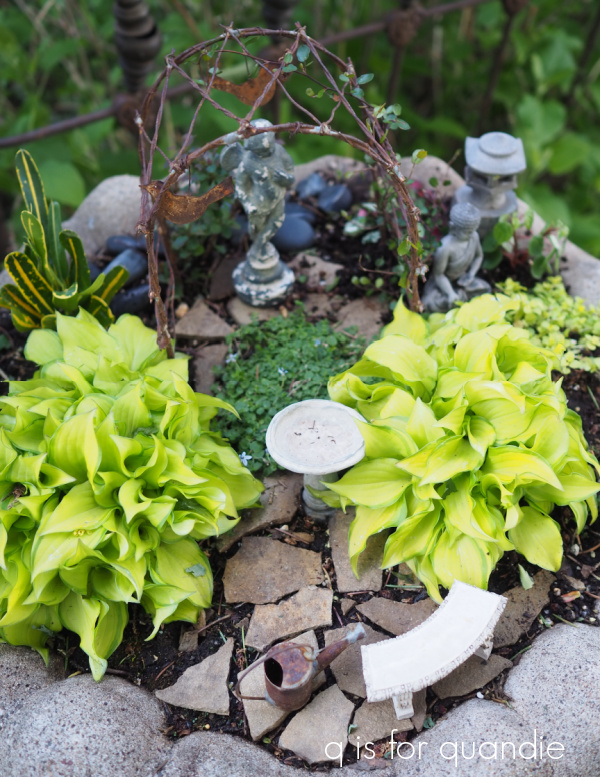
As you can see, the fairy garden fell victim to the hail much like the rest of my garden.  But it’s easy enough to fix a toppled birdbath when it’s only 3″ tall, and once the hail melted I could see that there wasn’t much damage done to the fairy garden at all.

This seems like a good opportunity for a fairy garden update.

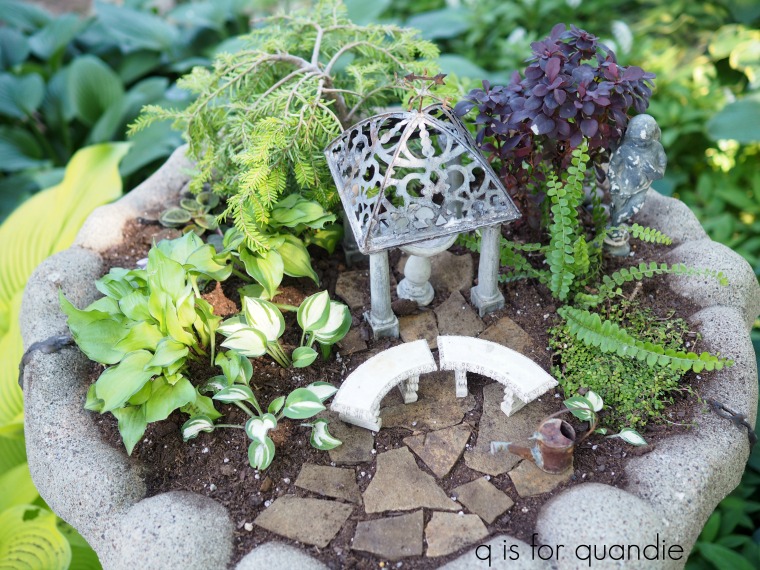
My fairy garden lives in an old cracked bird bath that I purchased at a garage sale.  The crack meant that it would no longer hold water and function as a bird bath, so that made it perfect to plant in since it has drainage.

If you’ve been following me for long, you may remember that I gave it a refresh back in 2018.

Since then only two of the perennials have reliably returned each year.  One is the bright lime green mini hosta called Feather Boa, and actually it’s doing so well that it’s threatening to take over.  I’m going to have to pull it up and divide it again soon.

I keep trying other miniature hostas, but so far none of them have made it through a winter.  We bury the fairy garden in a big pile of leaves up against the house for winter to give it some extra protection from our ridiculously low temps.

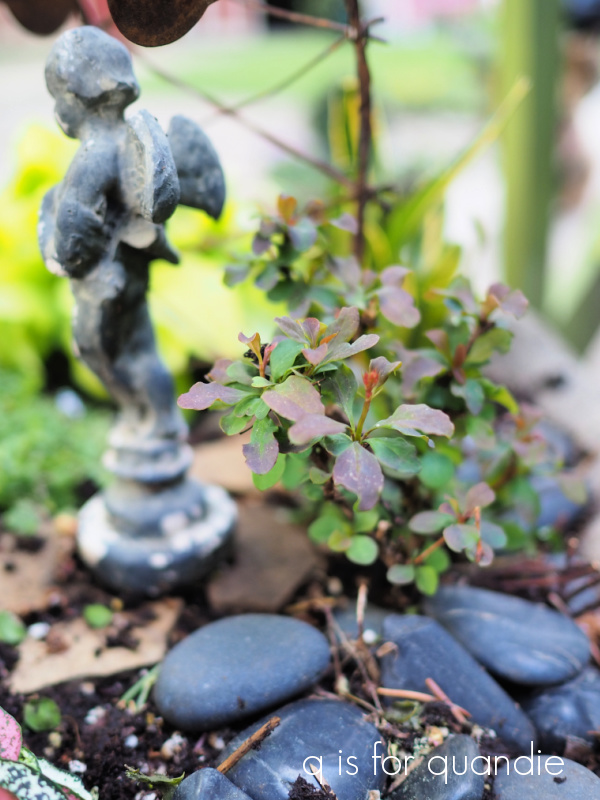
The Berberis thunbergii ‘Concorde’, the dark purple ‘shrub’, has also come back each spring.  The Barberry has not retained that dark purple coloring though, now it looks like this …

I suspect this is because it doesn’t get enough sun.

I always add a few annuals to the fairy garden each year.  Unfortunately, I rarely know the names of them.  I buy most of them at Bachman’s (my local garden center) and they are just labeled as ‘pixie plants’.

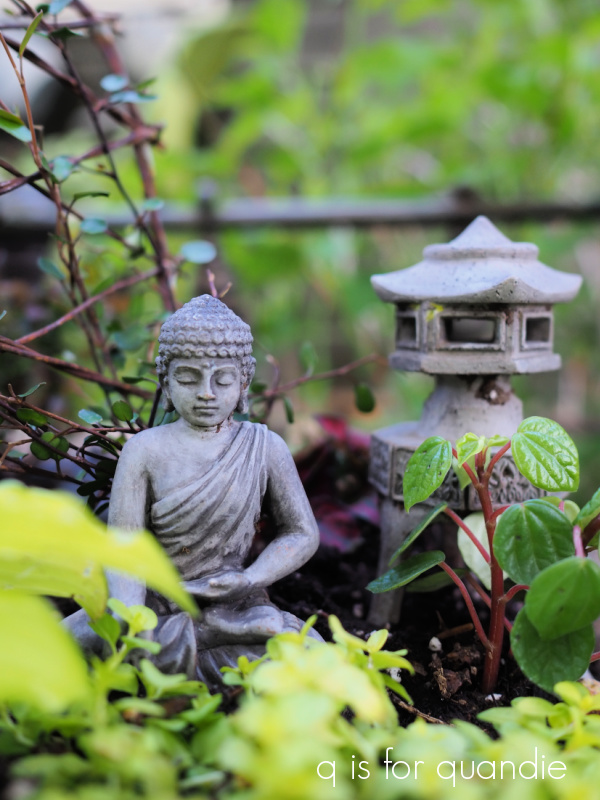
I added a little vertical interest with this next one …

It will be interesting to see how that one performs.

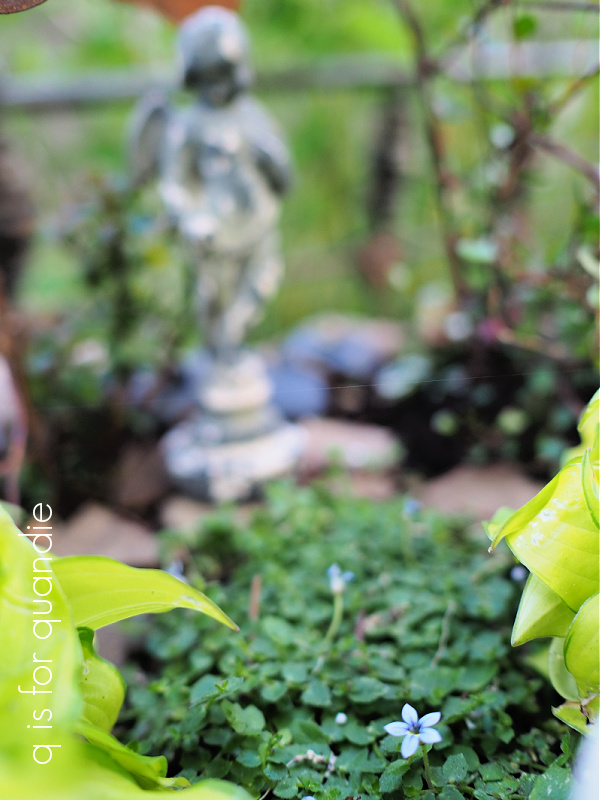
I also added something from Stepables this year.  Are you familiar with them?  They are low growing ground cover plants that can handle some foot traffic.  They are supposed to be good for planting in the crevices of a flagstone walkway, for example.

This one is called Blue Star Creeper and I hope I can keep it blooming in my fairy garden this summer because those tiny blue flowers are super cute.

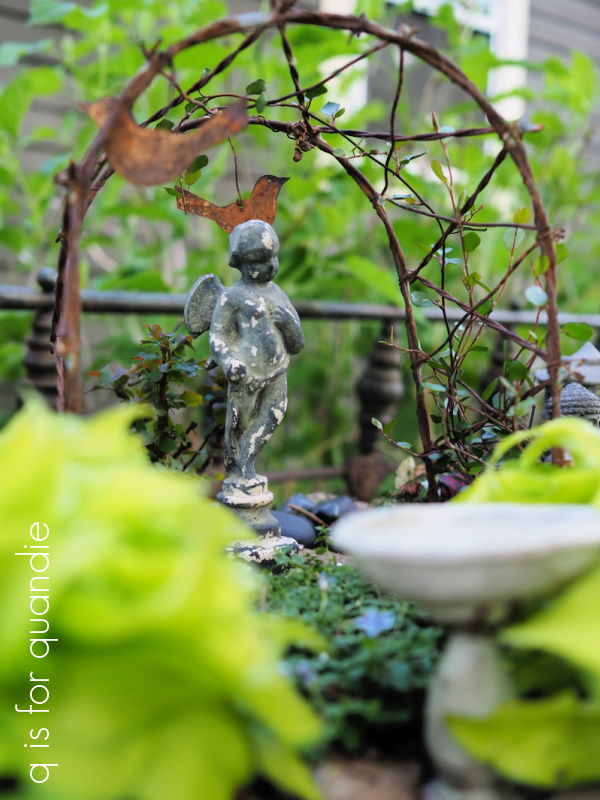
My little garden angel is getting pretty ratty looking …

I may have to do some experimenting with the Dixie Belle Patina Paint on him next!

If you like my fairy garden, you should see my in-law’s!  I’m going to make a point of getting some photos of it to share with you guys this summer.  But until then, do any of you have a fairy garden?  If not, I highly recommend it.  You can fit one in just about anywhere, it’s much cheaper, it’s much easier to take care of than a full sized garden, and apparently it won’t suffer much from hail damage.  So I say, garden small!


my bronze buddha.

First up, congrats to Sue Pagels.  I drew her name at random to win my giveaway from last week.  Not to worry if you didn’t win, I have another fab giveaway today!  Be sure to read all the way to the end of today’s post for the details.

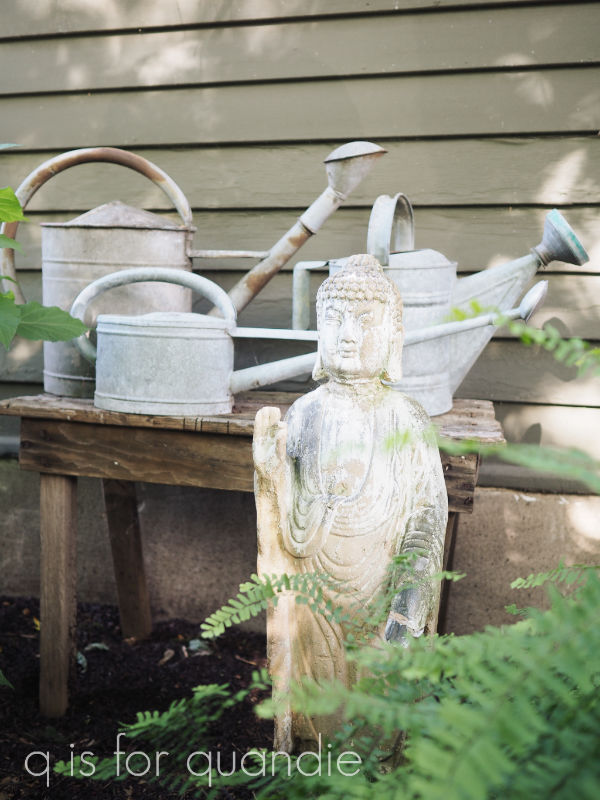
You may have seen my buddha statue in previous posts about my garden.

I’ve had him for years … possibly even decades.  I have absolutely no memory of when or where I purchased him.  He’s just been hanging around in the garden for a long time.

I’ve always left him outside year round, and over the last couple of years he’s been looking pretty rough.  The last two, or maybe even three, springs I’ve said to myself “I really should do something about that.”  But, I never got around to it.

Well, now that I’m retired from the day job, this is going to be the summer of getting around to it!  Starting with buddha.

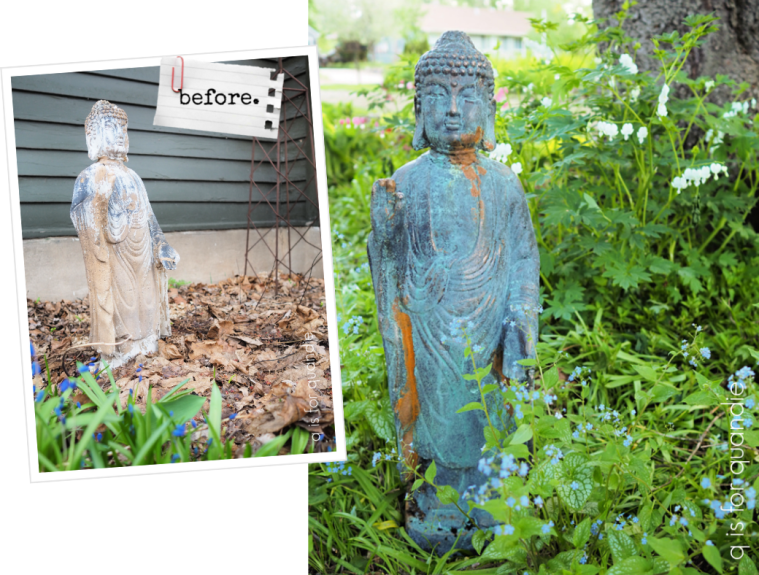
So here’s how he looked this spring, prior to his makeover.

I believe he is made out of some sort of pinkish/orange concrete.  I had once thought he was terracotta, painted to look like concrete, but he’s far too heavy to be clay.  He must be concrete of some kind.  He’s heavy and solid.

Anyway, I lugged him out of the garden and brushed the dirt off a bit before I brought him inside.

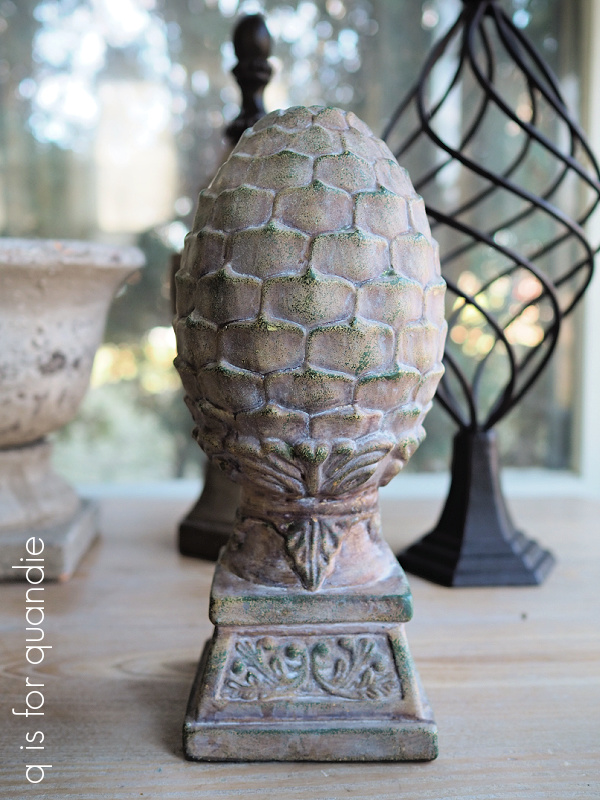
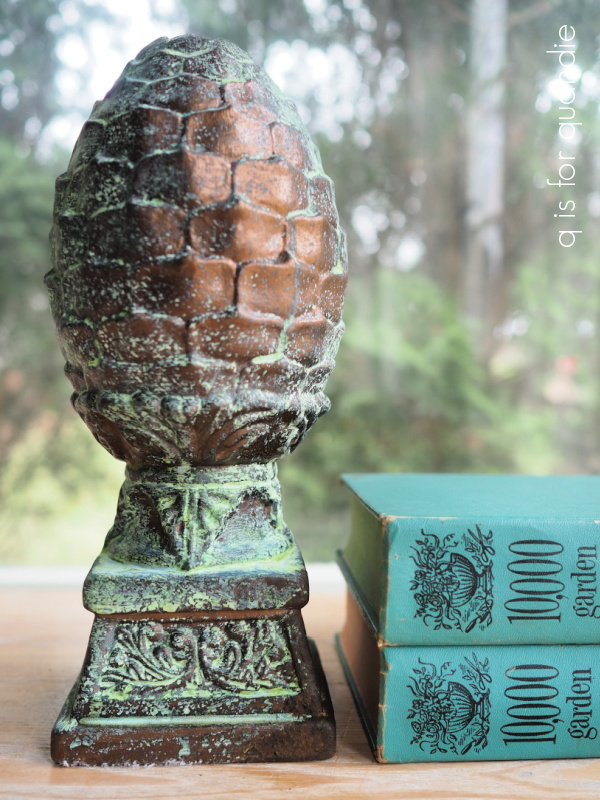
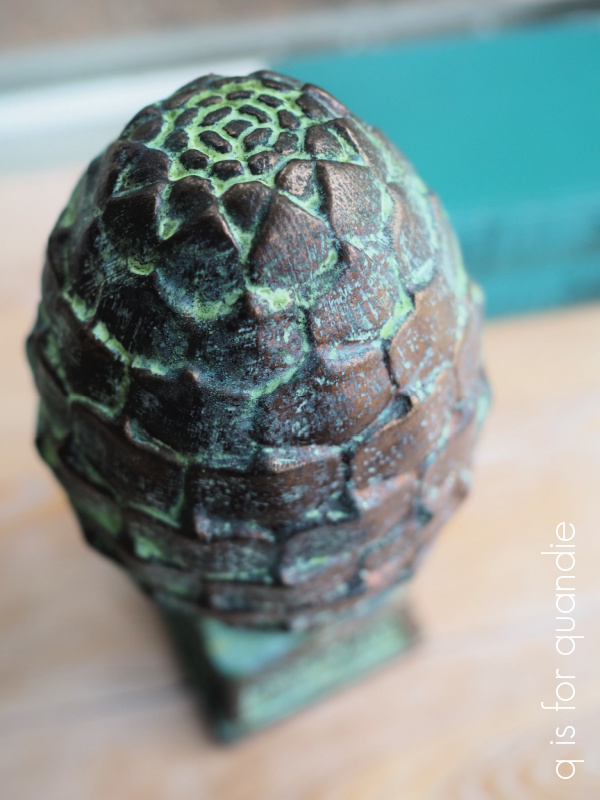
But before I got started on him, I decided it would be wise to practice my technique on a smaller item first.  So I pulled out this acorn finial.

You may remember that I found this while thrifting a while back and I was going to leave it ‘as is’.  But I decided this piece would be a good guinea pig.

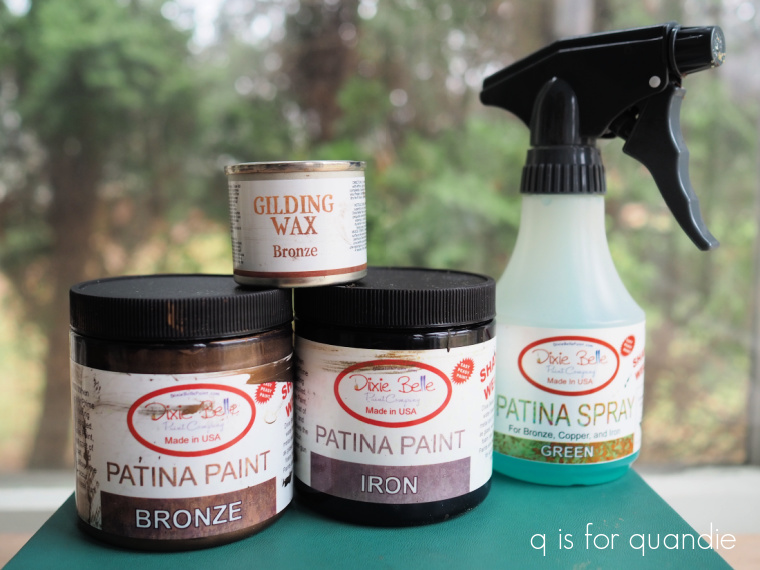
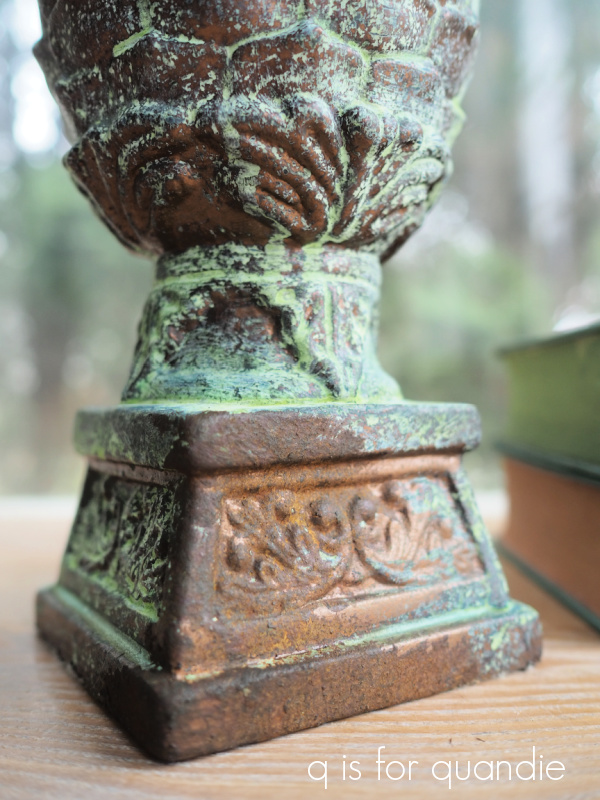
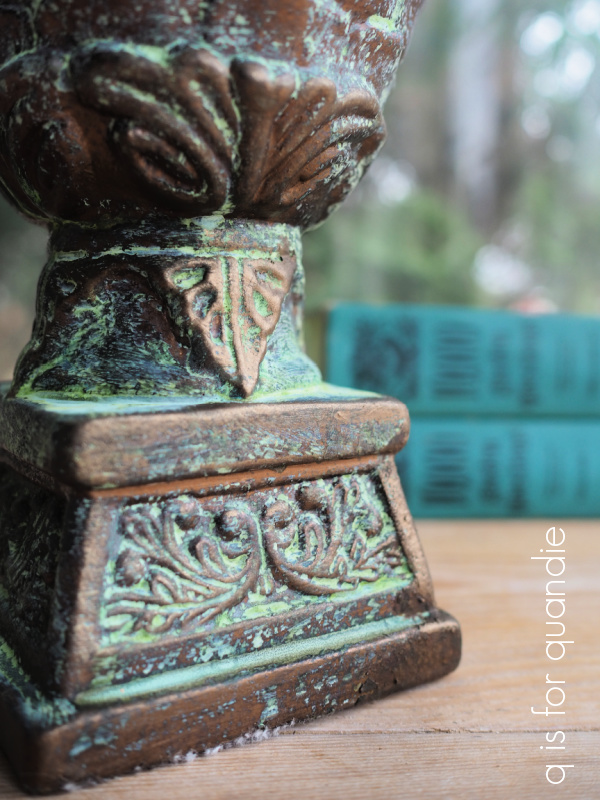
So I pulled out my Dixie Belle patina paints in Bronze and Iron, the Green spray and some of their gilding wax in Bronze.

I started out by painting the acorn in a coat of Bronze paint.  Once dry, I added a 2nd coat and while that coat was still wet I sprayed it with the Green patina spray.

To add a little more authenticity to the look, I then dabbed some of the Iron paint just on the corner and sprayed it (while still wet) with the Green spray to add a little rust.

Lastly, I used my finger to rub some of the Bronze gilding wax on some of the high points on the piece to bring some of that bronze back out again.

Yep, perfect.  This is the look I wanted for my buddha.  So I followed the same process; base coat of Bronze, allow to dry, 2nd stippled coat of Bronze, spray with Green spray while paint is still wet, allow to dry, stipple some Iron paint to add patches of rust, spray again with Green spray while wet, allow to dry.  Step back and evaluate the results.  Add some more rust spots.  Allow to dry and then bring out some highlights with the Bronze gilding wax.

I applied the gilding wax using my finger, just rubbing it on to add some highlights on his nose and brow for example.

He turned out fabulous.

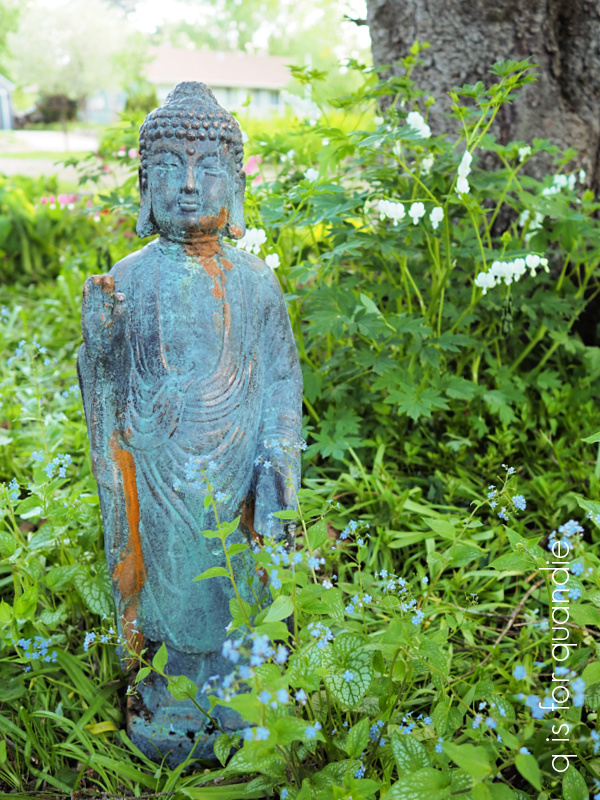
I put him back out in the garden a couple of weeks ago, and here’s how he’s looking now.

He’s looking pretty genuine, right?

Here are some q tips for you on using the Dixie Belle patina paints.

no. 1 – the verdigris patina develops a lot more quickly than the rust patina.  The rust patina can take days to fully develop in fact, so if you don’t see as much rust as you want right away just be patient.  If a couple of days go by and you still want more rust, you can always stipple on more Iron paint and spray again.

no. 2 – whether shaken or stirred, be sure to mix your paint thoroughly, and often, as you’re working with it.  There are actual metal flakes in the paint that create the patina and they tend to settle to the bottom of your jar of paint rather quickly.

no. 3 – if you have distinct brush strokes in your paint, the spray may settle in those lines making them more apparent.  For that reason, I recommend stippling the 2nd coat (or any subsequent coats) of paint.  Stippling is just pouncing the paint on with an up and down motion.

no. 4 – you don’t have to seal your patina projects.  However, if you’re adding patina to something that will come into contact with people’s clothing you may want to seal it (the patina will likely rub off on clothing).  In addition, the patina will continue to develop over time, so if you want to halt that process, you can seal it.  Dixie Belle does make a sealer for the patina paint called Patina Guard, but I find that it adds a bit of shine and I personally don’t like that look.  That’s just my personal preference though, you may be just fine with it.
no. 5 – if you’re working on a flat surface, you may find that the verdigris looks like droplets on your piece (because you sprayed it on in droplets).  I think this product gives a more authentic look on items with some texture and detail.  The spray settles in the crevices and looks amazing.

I definitely think my buddha benefitted from a little patina.

And now you can benefit too!

I’m going to draw the name of one lucky winner to receive all of the products I used to create my bronze buddha.  You’ll receive Patina Paint in Bronze and Iron, the Green Spray and some Bronze gilding wax.

The rules:  To be eligible to win, simply leave a comment on this blog post.  Maybe let me know what item you would turn into bronze!

Your comment must be left on this blog post, not on Facebook or Instagram.  You are not required to follow my blog, although it would be awesome if you did!

I will randomly draw the name of a winner for today’s prize from all of the comments left on this post by Sunday, May 29, 2022 at the stroke of midnight (U.S. Central time).

The fine print: no purchase necessary, you must be 18 years of age or older to win, void where prohibited by law, the number of eligible entries received determines the odds of winning, approximate retail value of prize is $69, if the prize is not claimed by Friday, June 3, 2022 another name will be drawn at random to win, blah, blah, blah.

Thank you to Dixie Belle Paint Co for providing the Patina Paint I’m giving away today.

an old favorite.

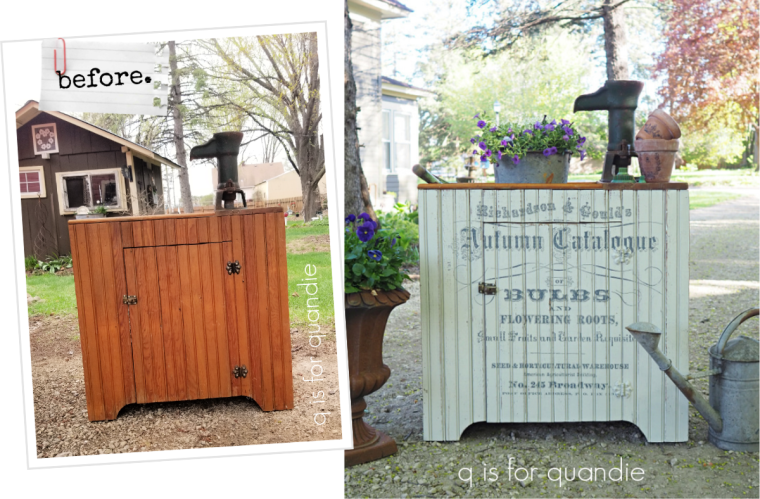
Remember I mentioned that I purchased a vintage dry sink at a garage sale a few weeks back?  Well, here it is in its ‘before’ state.

How could I resist that?  It even had the old green pump still attached.  Well, part of it anyway.  The handle is missing.

This one was definitely the perfect candidate for some milk paint.  I just happened to have some Homestead House milk paint on hand in a color called Stone Fence.  I’d used this color quite a few years ago and I really liked it, so I’d ordered more of it recently.  It was just waiting for the right project.

I went very minimal on prep because I knew I’d be OK with some chipping.  So I simply cleaned the beadboard on all four sides with some TSP substitute, and then rinsed with clear water.  Next I painted the beadboard with two coats of the Stone Fence leaving the top of the dry sink unpainted.  Once dry, I sanded with 220 grit paper.

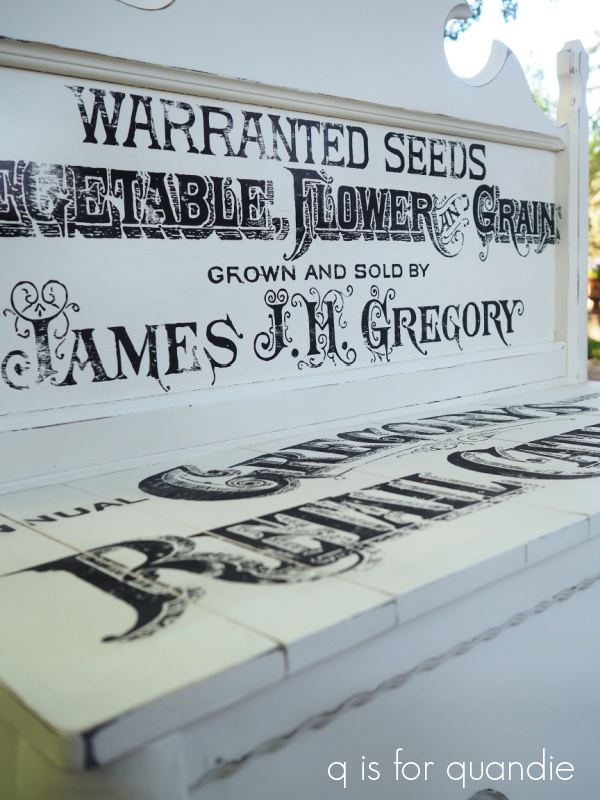
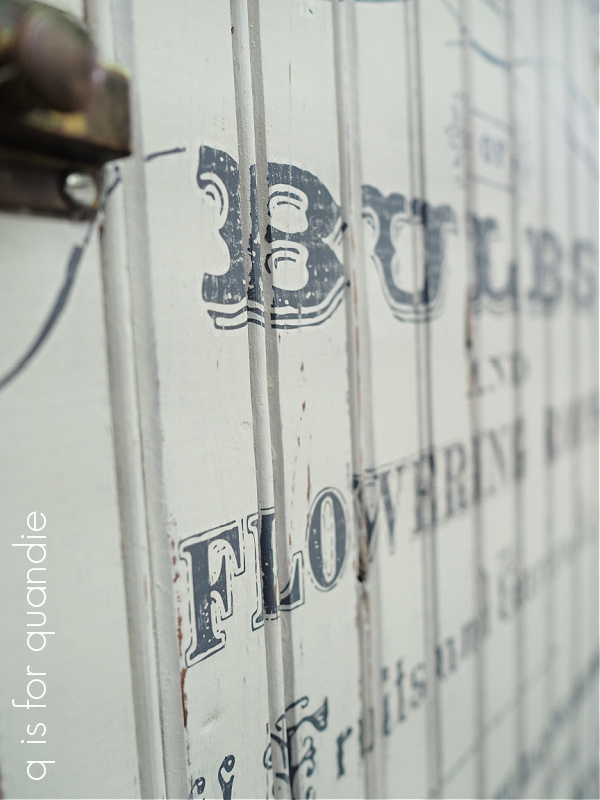
I then vacuumed away any dust, gave it a wipe down with a clean, dry microfiber cloth, and then applied my old favorite transfer called Seeds.

That transfer could not have been any more perfect for this piece (although I didn’t use the entire transfer, there were a couple more lines at the bottom that I cut off and will save for another project)!

This is an old Prima Marketing transfer from before they parted ways with the I.O.D. sisters.  I was just looking back at one of my blog posts about a pair of twin beds that I put this transfer on back in 2018, and I mentioned in that post that the transfer cost $17.99!  Dang, what happened to those prices?!  Now you can’t find transfers this size for less than $29.99.  That’s a 65% increase in 4 years.  What’s up with that?

(Sidebar:  that urn planter on the left is another that I used Dixie Belle’s patina paint on to give it a rusty iron look, it’s really just plastic!)

The Seeds transfer came in a larger size (which is what I used on this dry sink), and a smaller version.  I used part of the smaller one on this chair …

I used this design on A LOT of pieces, and I was hoarding this last one for something special (the transfer is retired, so no longer available).

Just a quick q tip to say that I don’t necessarily recommend storing (a.k.a. hoarding) transfers for more than a couple of years.  They can dry out and then become difficult to apply.  I’ve also had them come unstuck from their backing and stuck to the protective sheet instead, and then they are worthless.

But I was ignoring my own advice and hanging onto this one until just the right piece came along.  Luckily, the transfer was still in good shape and went on fairly easily.

That being said, it can be a little more challenging to apply a transfer over an uneven surface like beadboard …

You just have to go slowly and continually press the transfer down into those grooves.

As for the top of the dry sink, I decided to just clean it up a bit.

I sanded it with 220 grit paper to remove some smudges of paint left on it by a previous owner, and then revived the finish with a coat of Dixie Belle’s Big Mama’s Butta.

It’s not perfect, but that was my point.  I didn’t want to totally remove the patina that showed its age.

The remainder of the piece received a top coat of Dixie Belle’s flat clear coat.

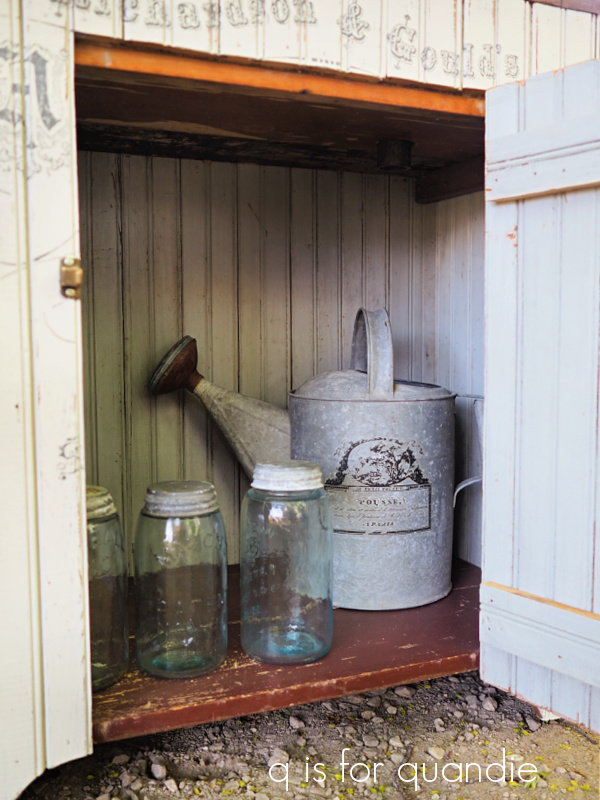
As for the inside, I cleaned it and that’s it.  I like that it looks authentic inside with original chippy paint.

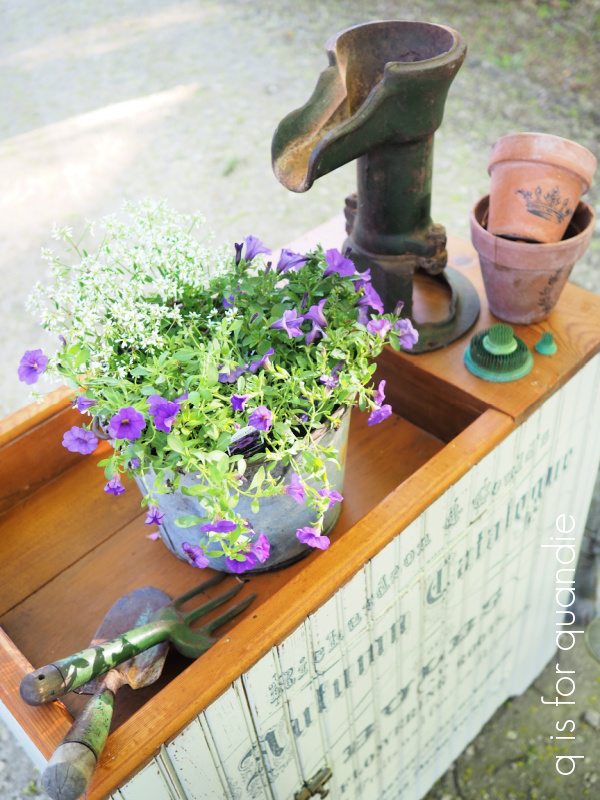
I think this piece would be adorable as a plant stand.  You could fill the ‘sink’ area with potted plants and store all of your plant supplies underneath.

In the end, this was the perfect piece for my last precious Seeds transfer, don’t you think?

This piece is for sale, so be sure to check my ‘available for local sale‘ page for more details.

stuff is happening.

Now that spring has finally sprung here in Minnesota, stuff is happening.  I have to admit, those last couple of months of winter were tough ones.  I’m going to have to adjust to being retired and figure out what to do with all of my time in the winter.  But that’s a (first world) problem for next winter.

Now that the weather has warmed up, the gardens are growing, garage sales are everywhere, and I can work out in my carriage house workshop … so, as I said, stuff is happening!

In fact, I have so much stuff to share with you guys this week that I’m going to post daily, at least on the weekdays.

First up for today, the garden.  I would say that this time of year is when my gardens are the most work.  I keep them packed full with perennials that don’t require much maintenance throughout the summer.  If I get everything pruned, weeded and mulched with compost now, before the plants get too big, the rest of the summer just involves occasional watering and deadheading.  If you want my top q tip for gardening, I think this is it.

If your plants take up every available space and you add a good layer of mulch, weeds have a much harder time taking over.

Here’s what my garden looks like once it has filled out (early June).

See?  Jam packed.

Of course, I know this isn’t easy if you’re starting from scratch.  Plants can be expensive (and the prices are going up this year, just like with everything else).  But you don’t have to spend an arm and a leg.  I recommend buying plants at garage sales, getting divisions from friends, or keeping an eye on Facebook Marketplace for people dividing their perennials.  You can often get them free, or in exchange for helping to dig them up.

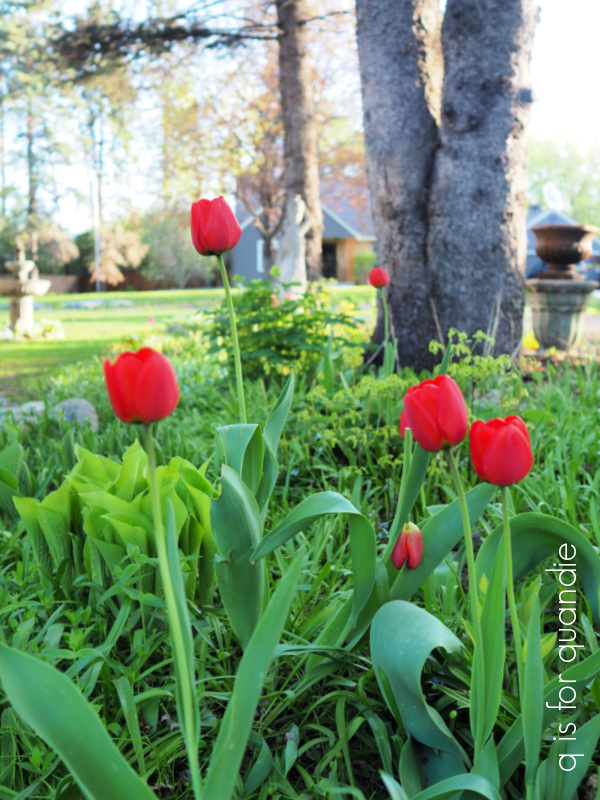
My tulips seem to have done really well this year.  For the last several years, deer have treated my spring garden as a salad bar, munching all of the flower buds right off the tulips before they could even open.  As a result, I decided to give up on planting tulip bulbs again last fall.

So now, of course, we seem to be having a really good year for tulips.  The red ones in my photo above are tulips that I planted at least 20 years ago.  They literally hadn’t bloomed in years.

Now I wish I’d planted more tulips!

Here’s another q tip for you.  Take photos of your garden regularly throughout the season, and keep notes regarding where you’d like to add things like tulip bulbs.  I plan to get more in this fall, especially since my neighbor has one of those fancy garden augers to make planting easy.

But wait a minute, this post isn’t supposed to be about gardening.  It’s actually supposed to be about sharing last week’s garage sale haul.

I went out on Thursday with my friend/picker Sue.  Now that we are both retired we can take advantage of sales that start on Thursday.  We went to a small neighborhood sale around Como Park in St. Paul.  Not all of the participating homes were starting their sales on Thursday (some started on Friday, some were Saturday only), but we were able to hit up all of the ones that were.

Although I didn’t bring home a huge load of stuff, I did get some really cool finds.  Plus Sue had a box load of stuff for me as well.

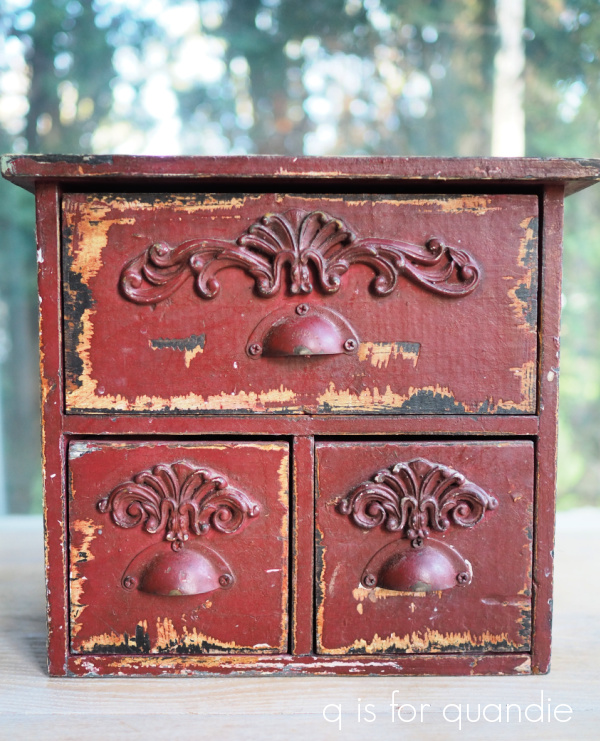
I found the mini dresser on the left (below) at Como, Sue found the rest of the items in this photo including that really, really tiny dresser.

I’ve already added an I.O.D. white transfer to the tiny oil can.

It’s hard to judge the size of it from my photos, but in total it’s only 6″ tall, but the can part is only about 2″ tall.

I like to add little clips to these and use them as photo holders.

And of course I’m going to give both of the small dressers a new look.

I feel like the combination of the cup pulls plus the scrolly embellishments on this one is too much.  I may remove those embellishments.  Or, I could remove the cup pulls and replace them with little glass knobs. What do you think?  And of course I’ll be painting both of them.

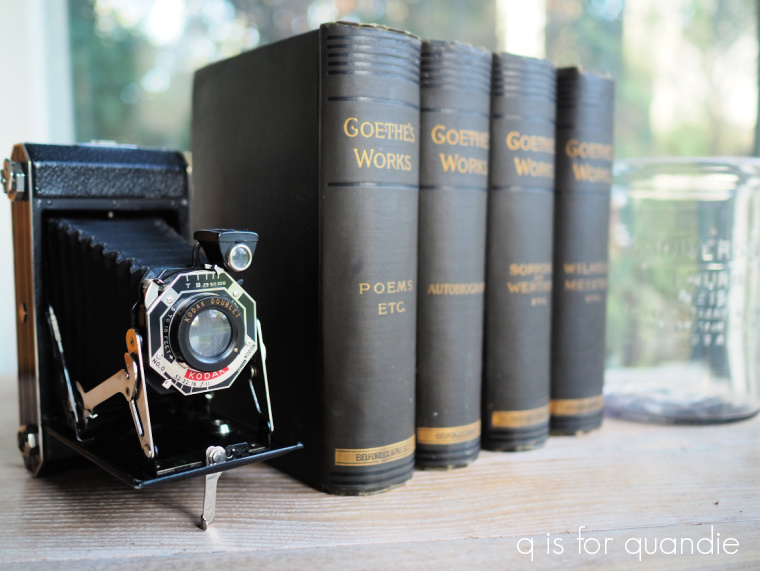
I also picked up these things.

I thought Mr. Q might like to have the books, since he tends to be a Goethe fan, but no, he didn’t want to keep them, so I’ll be selling them on.

They are a nice looking set to add to someone’s décor, even if they don’t want to read them.

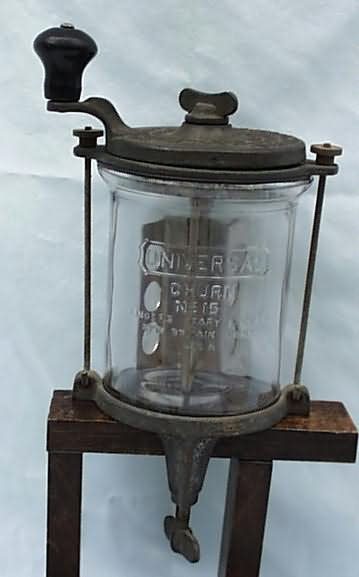
Sue spotted the glass vessel at one of the sales we visited and handed it over to me.

Neither of us really knew what this was, we just liked the ‘writing’ on it.

I googled it later and discovered it would have been part of a butter churn like this one.

Isn’t that kind of cool?  I think it would make a great vase, or one could fill it with pens and pencils on a desk, or use it to corral your paint brushes.

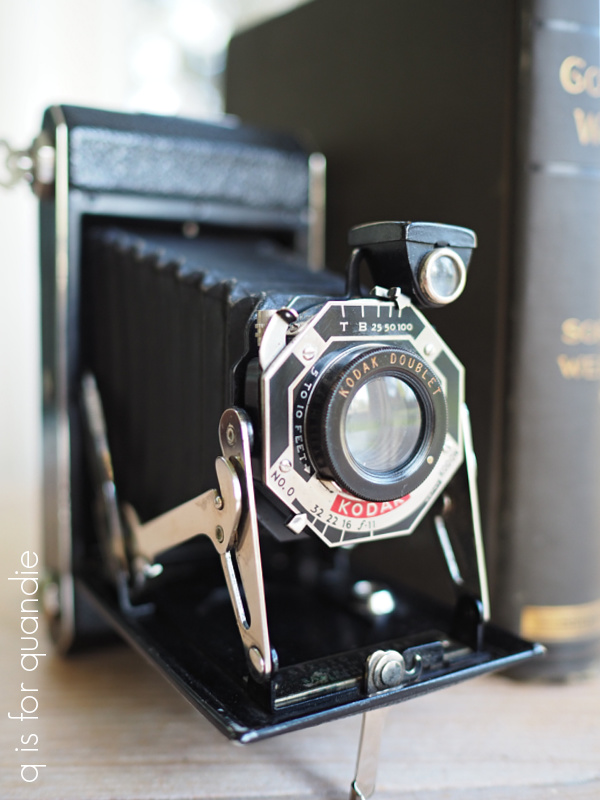
I purchased the camera from a guy who was a collector.  He was refining his collection and thus getting rid of some.

I’m not sure why this one didn’t make the cut for him.

I thought I’d take this opportunity to show you guys how these cameras work, and especially how to identify them if you see them and they are closed up (as this one was when I found it).

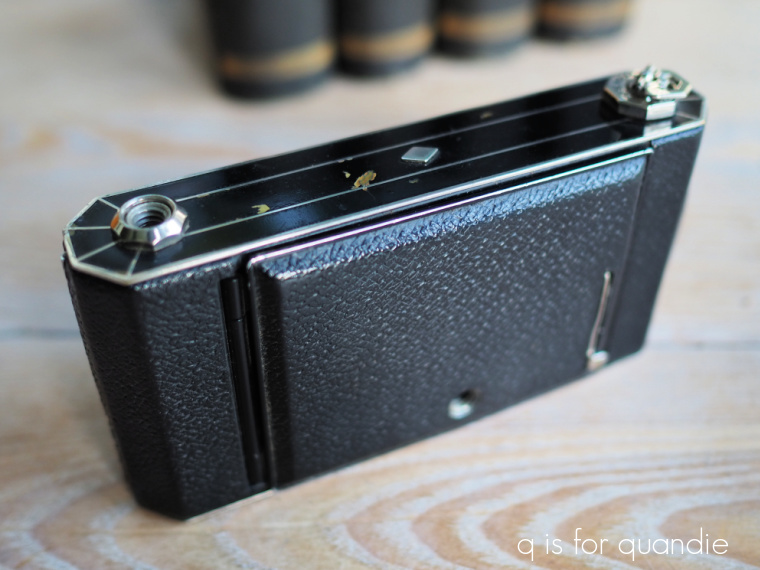
They really don’t look like much when they are closed, right?

There is always some sort of lever or catch that opens it up.  In this case, I had to ask the seller how to open it because it wasn’t obvious.  I was trying to slide that little lever on the lower right in the photo above, but you had to lift up rather than slide.

The case opens up and then the lens can be pulled out all the way.

So the next time you see a closed case like this, be sure to take a closer look.

Sue had also brought me a camera, along with this little train case.

Check out the back of this camera …

Doesn’t that look complicated?  Imagine having to putz with that before each shot.  We’ve got it so easy now!

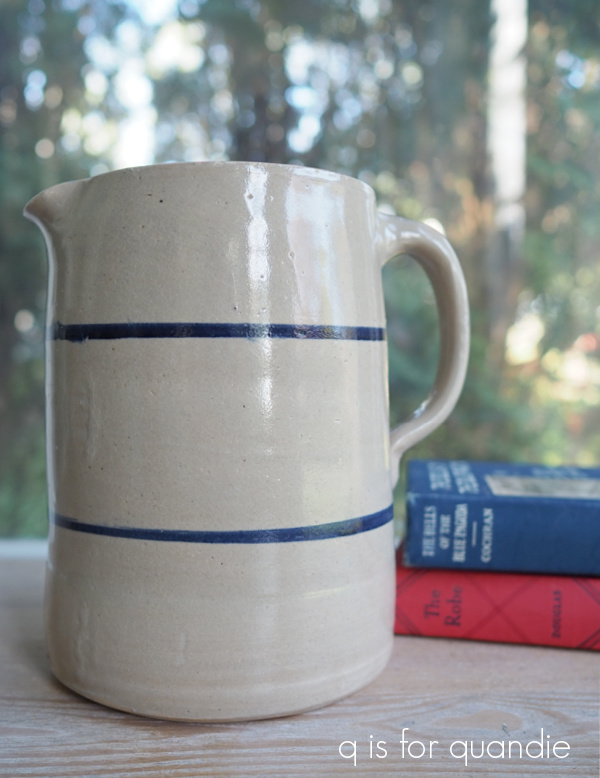
In true Baader–Meinhof phenomenon fashion, I came across another stoneware pitcher.

If you aren’t familiar, the Baader–Meinhof phenomenon “is a cognitive bias in which, after noticing something for the first time, there is a tendency to notice it more often, leading someone to believe that it has a high frequency of occurrence.”

I’m sure it’s just a coincidence that I found a similar stoneware pitcher at the thrift store back in April …

but we’ll see if finding these pitchers really has a ‘high frequency of occurrence’ this summer!

I’m still picking up nice copper pieces when I see them.  They seem to be selling like hotcakes at the shop.  If only I could raid my handyman Ken’s kitchen!  His wife has a serious collection of vintage copper … and when she originally purchased it, it was not vintage.  I’m sure those pieces have been in her kitchen since they built their house 50 years ago.

That gorgeous ironstone platter is one that Sue had and is now passing on to me.  It’s a nice big heavy one, and just check out the mark on the back …

I sometimes will hang an ironstone piece on the wall backwards just to show the mark because they can be so pretty.  I’m not sure if I’ll keep this one, or sell it on.  I have to look around to see if I have a spot for it first.

I’ve saved my ‘find of the day’ for last.

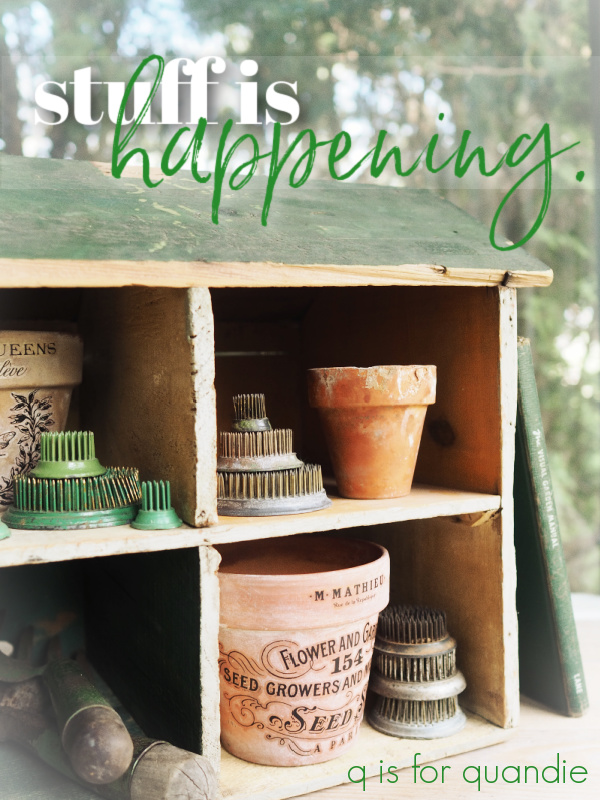
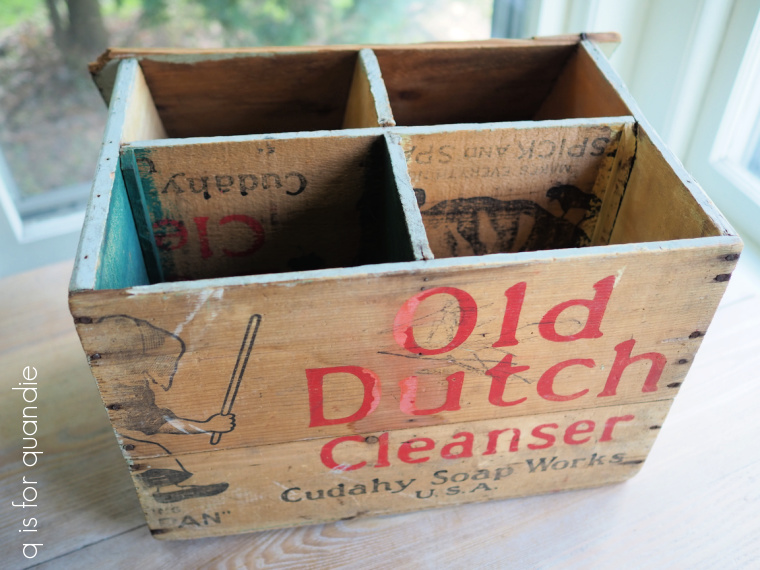
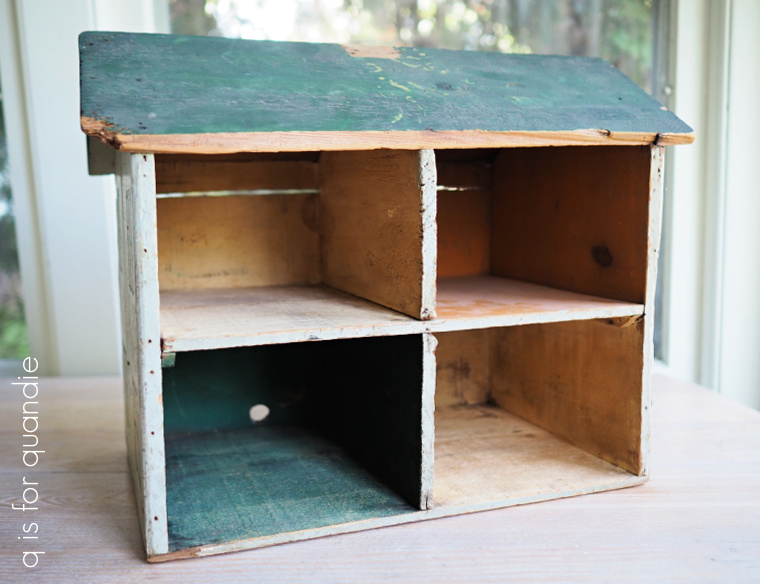
Now, I’m sure this primitive dollhouse made out of an Old Dutch Cleanser crate isn’t everyone’s cup of tea, but I found it totally charming.

I just love that someone made this out of simple items they had on hand, and they took the time to paint a couple of the ‘rooms’ in different colors.

And add those shaky looking windows painted onto the sides.

But I bet some little girl absolutely loved it and spent hours playing with it.

I’m not sure what the fate of this piece will be.  I may keep it, I may let it go.  Those little cubbies (rooms) could be used for all kinds of things …

I like the idea of using it on a potting bench.

Hmmm, yeah, I may not be able to part with this one.  I’m considering turning my photo cottage back into a potting shed this summer, so this is going to go in the pile of potential décor for the potting shed.

So tell me, what is your favorite from amongst my finds this week?  And if you’re local, did your tulips do especially well this year, or is it just me?  Also, are you OK with five posts this week, or will it seem like I’m flooding your in box with blog posts?  Oh, and P.S., there will be a giveaway included with one of them, so be sure to stay tuned for that!

the best laid plans.

One thing I don’t think I’ve mentioned about our recent trip is why we originally chose to visit Charleston in April.  The timing was supposed to coincide with the blooming of the azaleas.

According to my research, azaleas bloom anywhere from mid-March to late April in South Carolina.  I was never able to take a trip during azalea season while I was employed because that was also the exact timing of our annual audit.  So one of the items on my post-retirement bucket list was a trip to see the azaleas in bloom (another is a trip to the Netherlands to see the tulips in bloom, maybe next year?).

But as all of you gardeners out there know, the timing of spring blooms can be somewhat unpredictable.  The weather can have an impact, it can depend on how soon things start to warm up.  So even though we visited Charleston the first two weeks of April, we pretty much missed most of the azaleas, except for that little patch of them in Waterfront Park that I shared earlier.

  I suspect that the storm we flew in on (with torrential rain and high winds) didn’t help either.

My grand plan for viewing azaleas included a trip to Middleton Place, the oldest landscaped gardens in America.  The gardens were originally laid out in 1741 and they were inspired by the gardens at Versailles.

Here is how I was picturing the gardens at Middleton (photo borrowed from the web) …

And here is how they actually looked.

Well, you know what they say about the best laid plans …

And although I was disappointed to have missed the azaleas, I definitely was not disappointed with our visit to Middleton Place.

You have to remember that when we left home there was still snow on the ground, and actually, it was snowing when we returned home too!  So I was quite happy to wander around these gardens and just admire the green.  The fact that is was also a gloriously sunny day and around 70 degrees didn’t hurt either.

It was not crowded at all the day we visited.  Probably because most people were aware that the azaleas were done.  I suspect that when the azaleas are at their most magnificent, the place is packed.

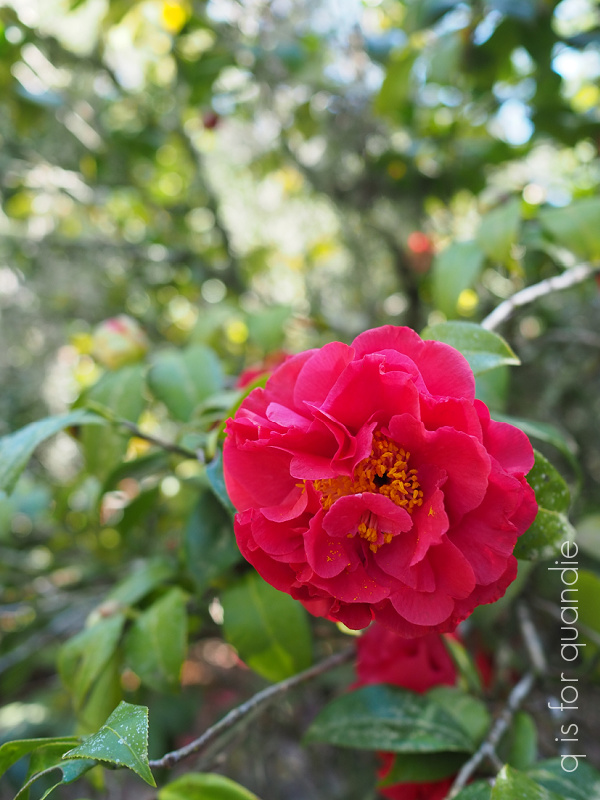
There were a handful of azalea blooms here and there, and a few of the camellias still had flowers as well.  So I did see some color.

But Middleton Place is definitely worth a visit even if there isn’t anything blooming.

There are 110 acres full of paths, formal gardens, and secret gardens to explore.

Just beware that, as all the signs say, the gators are real.

Yikes!  I have to admit, those guys freaked me out a little.  But they pretty much seemed to be minding their own business, and we didn’t get too close to them.

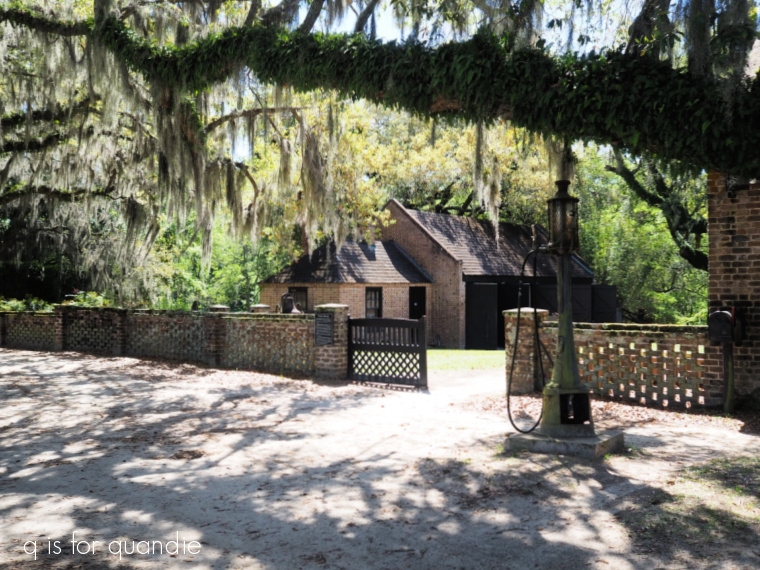
Prior to the civil war, the house at Middleton Place consisted of a main center building with a ‘flanker’ on either side.  It was burned down by union troops in 1865.  The south flanker was the least damaged and thus was repaired and continued to function as a home until 1975 when it was turned into a museum.

It’s certainly a lovely building, but probably not quite what you picture in your head when you hear ‘plantation’.

You can pay extra for a guided tour of the inside (which is the only way to get inside), but we chose to forgo that.

You don’t have to pay extra to explore the stable yards which serve as an open air museum with costumed artisans explaining the functions of the various buildings and the craftmanship of the era.

We chatted with the blacksmith who showed us how they made nails, the cooper who was making wooden buckets, the potter who was making clay pots, and the seamstress who was spinning wool.  All four of them knew a lot about their craft and it was very interesting to visit with them.

They also have livestock including cattle, goats, sheep, pigs and horses at Middleton.

Now you know I’m always keeping an eye out for furniture inspiration, and I found some in the candle making building.

Isn’t that an awesome chippy cupboard?  I love the zinc top that is nailed all around the edge.

Despite missing the azaleas, I enjoyed visiting Middleton Place.  However, if you’re looking for a more traditional visit to a “plantation” while in the south, this may not fill the bill.  There are a few other options in the area including Drayton Hall and Magnolia Plantation.

Do you have any recommendations to share with others?  If so, be sure to leave a comment and let us know!