updating a parlor table.

I shared the parlor table that I picked up at the East Isles sale last weekend on Monday.

I’d painted another six-legged table a few years ago and it turned out quite nice …

so I thought I’d try my hand at giving another one an updated look.

With that table, I stripped and then refinished the top with Homestead House Stain & Finishing Oil in Driftwood.  I don’t often use that product though, simply because it’s oil based.  It takes forever to dry, and it’s pretty smelly.  However, if you’re working outside and you have some time, it does create a lovely finish.

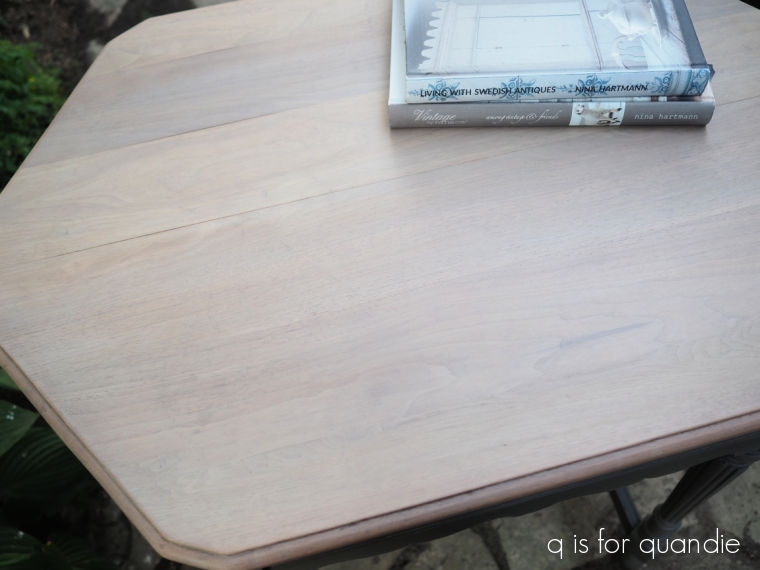
But this time I decided to go for a similar look using a different technique.  Once again, I stripped off the original finish from the top of the table using CitriStrip.  I used Klean Strip After Wash after the stripper to make sure I’d gotten all of the stripper residue off.  Once that was dry, I sanded the top with 220 grit paper to smooth it out.  Then I added just one coat of Varathane’s Sunbleached fast drying stain.

I let that dry for a full 24 hours, and then added a couple of coats of Dixie Belle’s flat clear coat over the stain for protection.

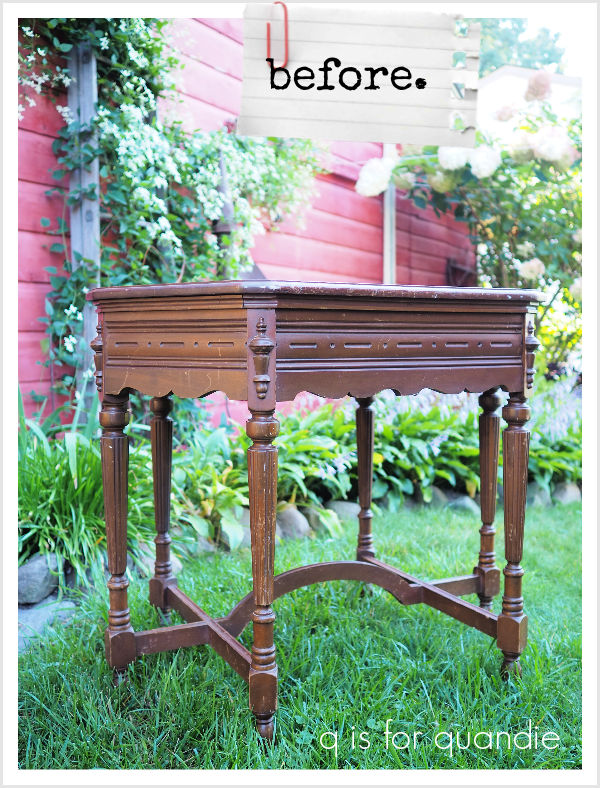
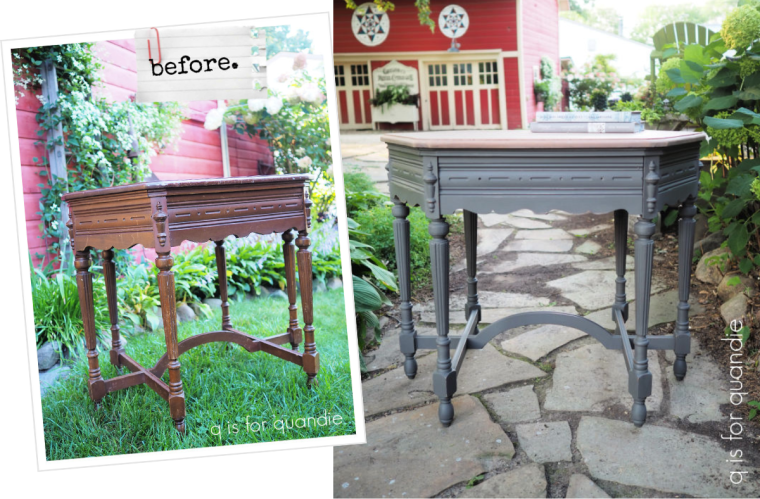
First, here’s how the table top looked when I brought it home.

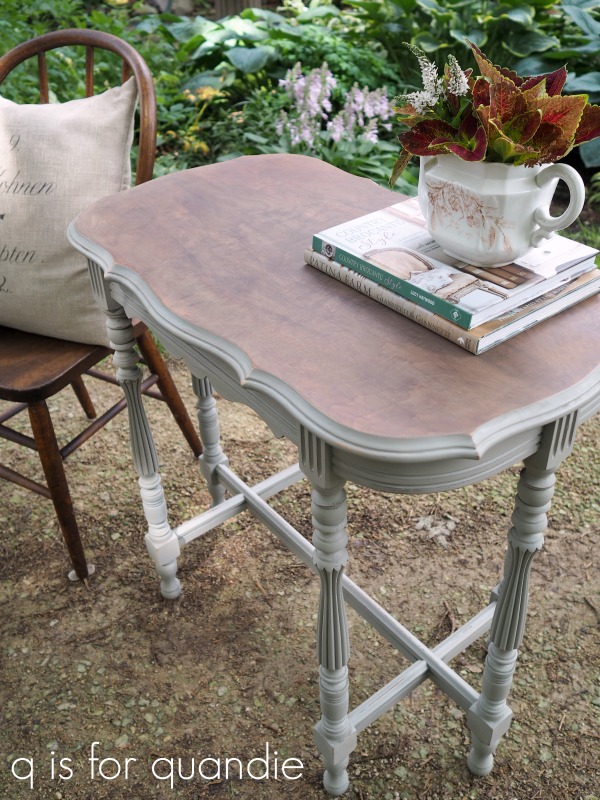
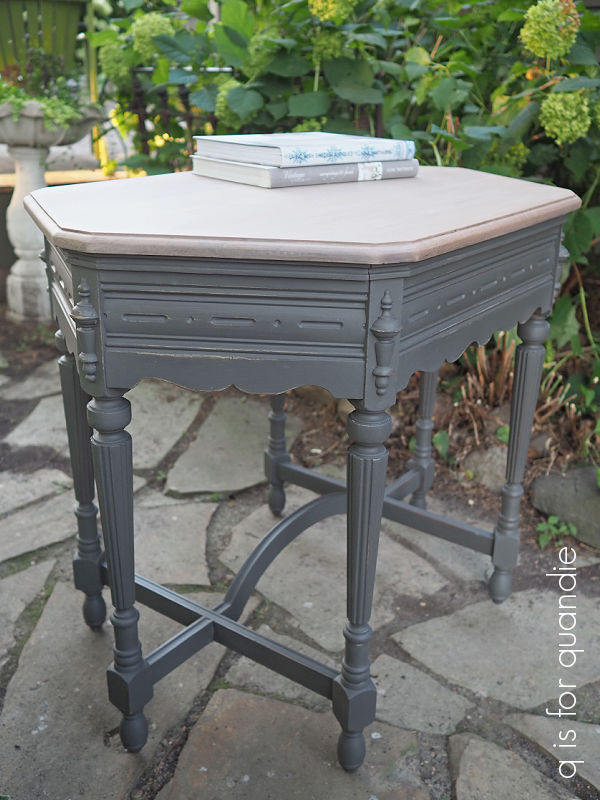
And here is how it looks now.

Um, yeah.  Night and day, right?  I am constantly amazed by how much you can change the look of something with a little stripping, sanding and staining.

I had used Rust-Oleum Chalked spray paint to paint the base of that first six-legged table to make it easier to get those six legs covered with paint.

I debated going that direction with today’s table, but have you priced that spray paint lately?!  The last time I looked it was up to $11.48/can at Menards.  I did see it for $9.99/can at Target, but there weren’t many colors available there.  It would likely take most of a can to cover the base of this table.  And you know me, I’m nothing if not cheap.

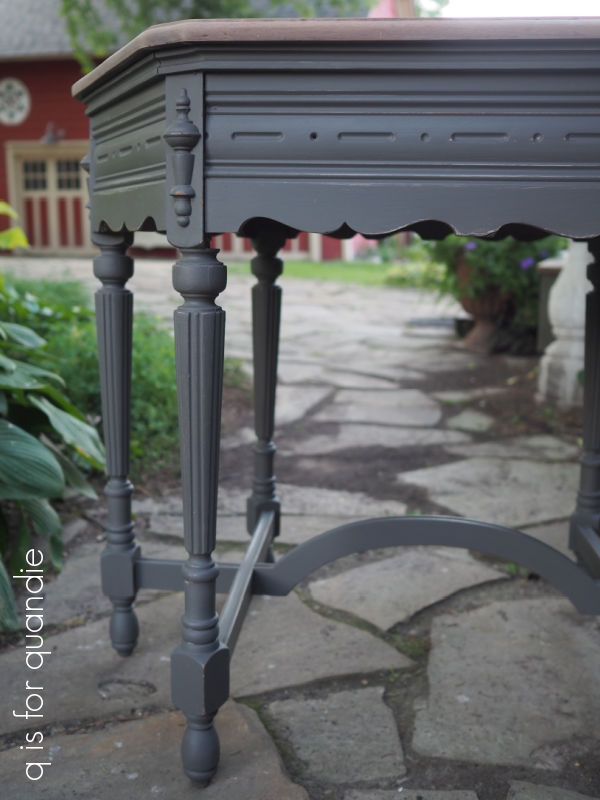
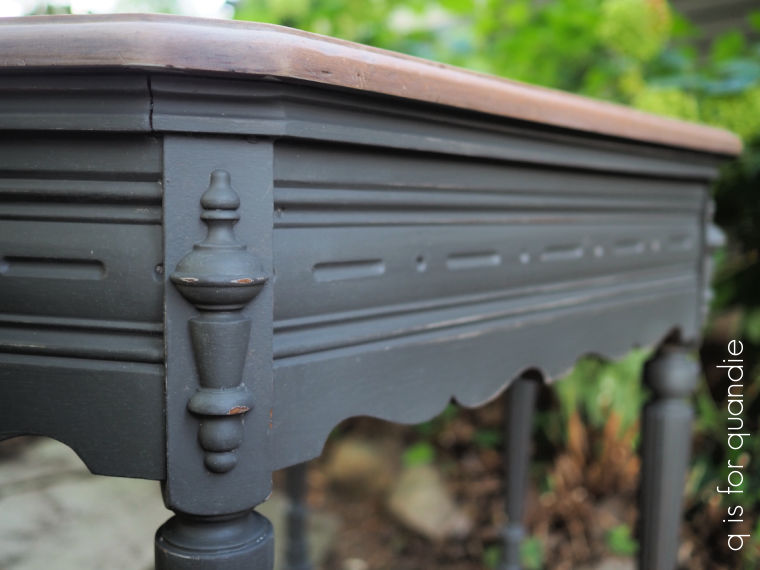
So instead, I decided to go ahead and paint the base with a brush and paint that I already had on hand.  I just wasn’t sure which color, so I tested out a few ideas.  I painted a swatch of three different Dixie Belle colors onto sections of the base; French Linen, Dried Sage and Gravel Road.  In the end, I decided the Gravel Road looked best with the stained top.

That kind of surprised me a bit.  I really thought I was going to like a lighter color with that light top, but nope.  In the end, the Gravel Road won out.

Once the paint was dry, I sanded lightly to distress and then added a coat of clear wax.

In the 1800’s, a parlor table like this one was meant to be the focal point in the center of one’s parlor.  It would have been surrounded by seating, perhaps a small sofa and several chairs.  It would likely have held the oil lamp, and in the evening the family would have gathered around to read or sew.  Since they didn’t have electric lamps, the lamp didn’t need to be on a table near an outlet on the wall, so it could be in the center of the room.

These days having a parlor table in the middle of your room would feel a bit odd I think.  However, this table would make an awesome alternative nightstand.  It would also work really well in a large foyer or hallway.

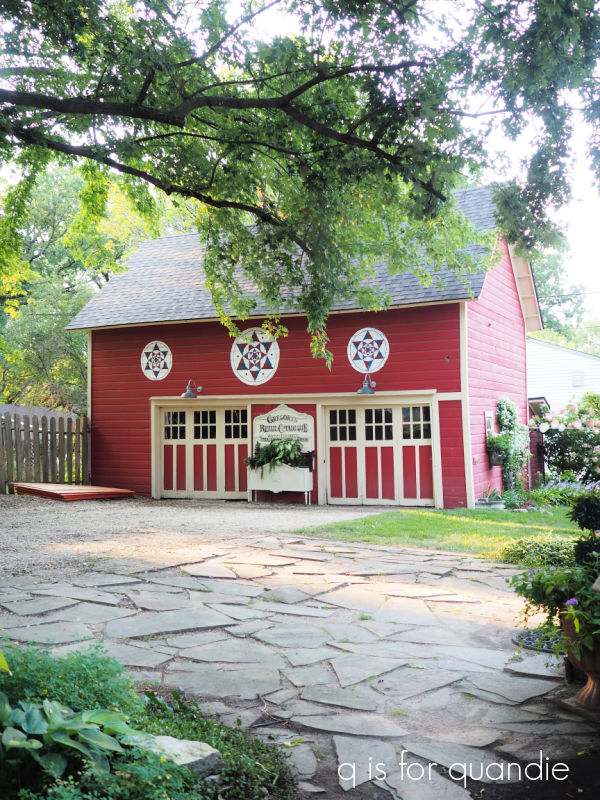
And hey, notice anything different about the carriage house in the background of that photo?

Well, I’m sure no one would notice but us, but we have a new roof!

While I was working on refinishing the parlor table, there was massive chaos all around me as a team of brave souls clambered around on our roofs.  They worked two 12 hour days to get it all done.  I feel a bit lame that all I accomplished was one small table makeover in the same timeframe.

It feels great to have a nice, new roof to take us into the fall and winter.

Anyway, back to the table.

What do you think?  Did I meet my goal of updating an antique parlor table?

This table is for sale so be sure to check my ‘available for local sale‘ page if interested.

Thank you to Dixie Belle Paint Co for providing the Gravel Road paint used on this project.

the chateau dresser.

I have another do-over for you guys today.

Remember the fine print dresser?

I painted this one back in March, and it did not sell.  Now granted, as I’ve gone on and on about, sales have slowed way down for me overall.  As a quick update on that, the pair of modern end tables I painted in July did sell within a few weeks.  In addition, I took the bench with the Gregory’s Catalogue paint inlay on it into the shop where I sell on consignment and it sold pretty quickly there.  So things are starting to move a bit.

But back to this one.  I have to admit, I didn’t absolutely love the color combination of the Drop Cloth background with the Sawmill Gravy stencil.  So I decided to re-work just the front of this piece.

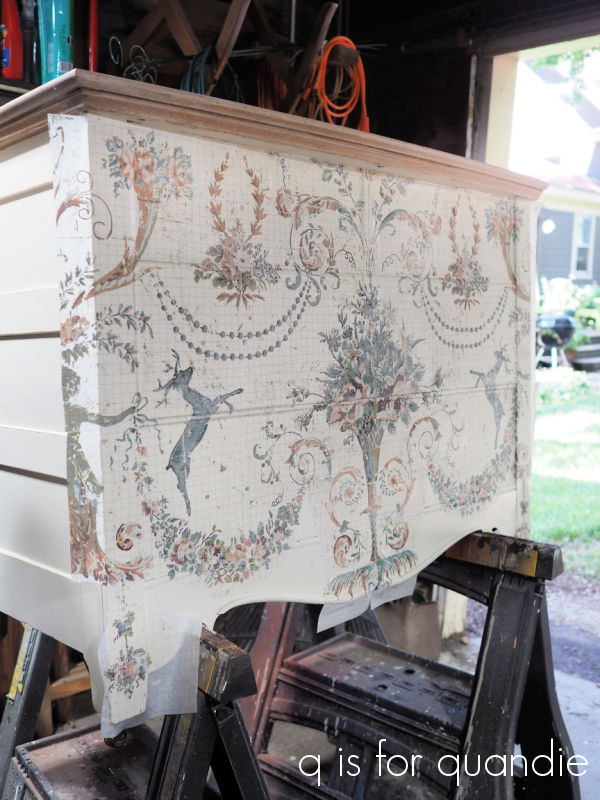
Plus, I really wanted to use the Chateau paint inlay from I.O.D.

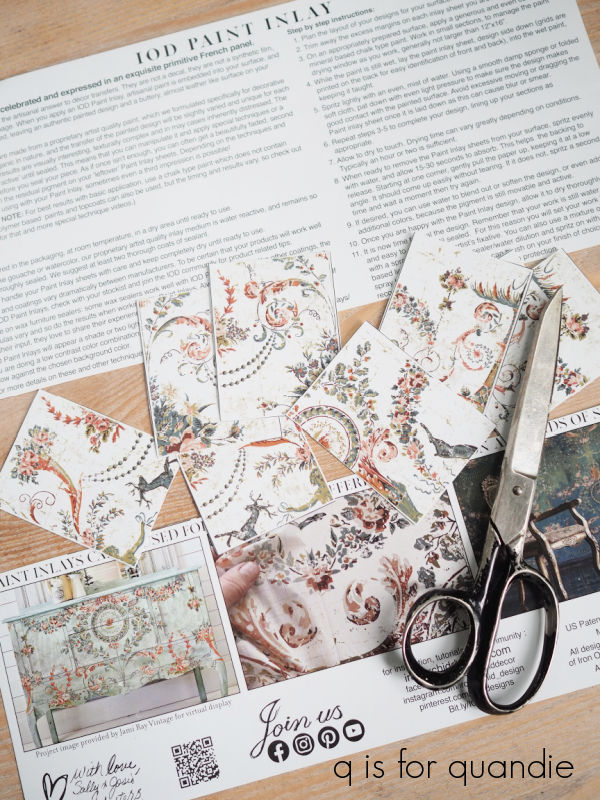
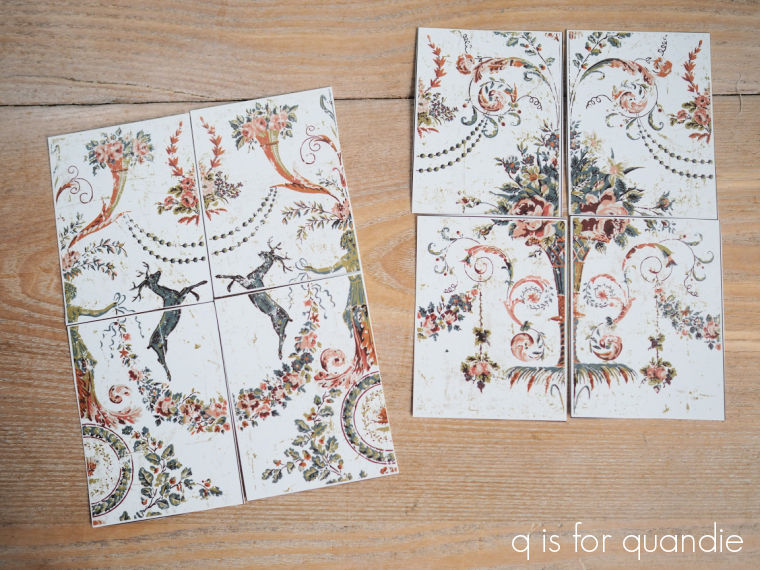
I learned a really great tip by watching a YouTube video from Lynne at ellen j goods, and that is, you can cut up those pieces on the packaging that show the layout of the design and then move them around like puzzle pieces to create different looks.

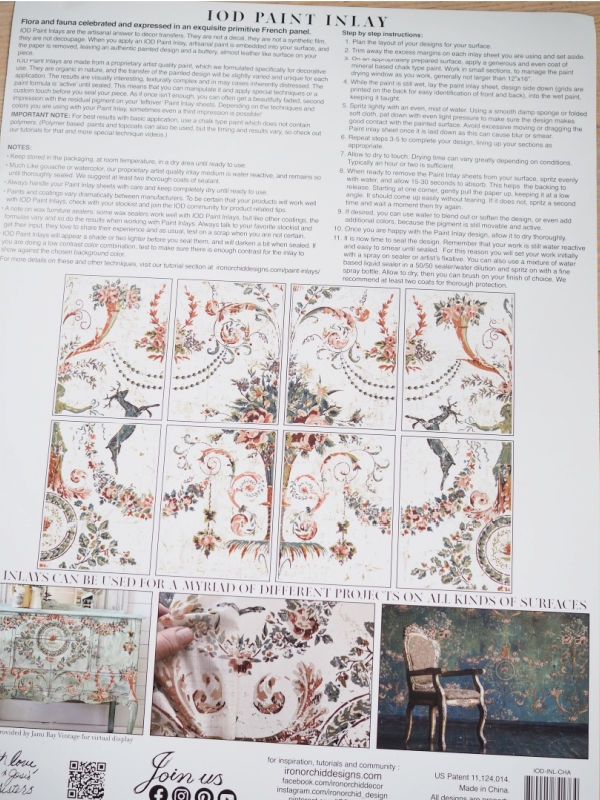
So I cut up my packaging and started playing around.  First, here is how the design is shown on the packaging.

You could also turn the one design into two separate designs.

And both of them could be flip flopped, the deer could face outward and the floral urn could be split up on either side.

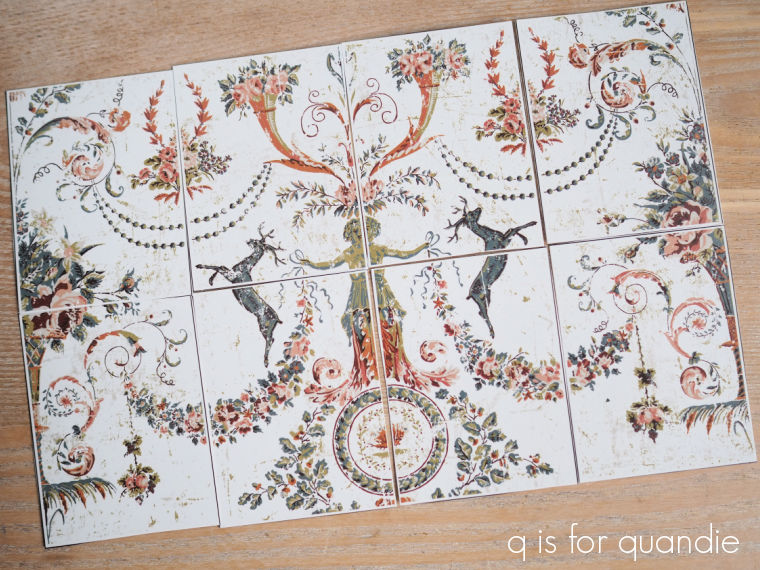
Here’s another option for using the entire design.

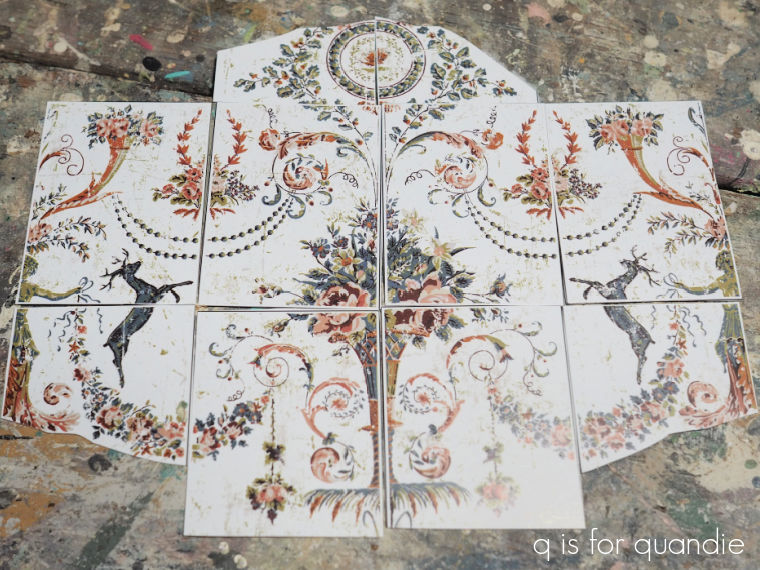
You can continue to create even more options if you’re comfortable with cutting up the individual sheets a bit.

If you have a tall, more narrow piece rather than a wide piece you could use that look above and just remove the side pieces with the deer on them.

Hats off to whoever designed this paint inlay, I’m impressed by the ability to move it around in so many ways and still have the different elements line up with each other.

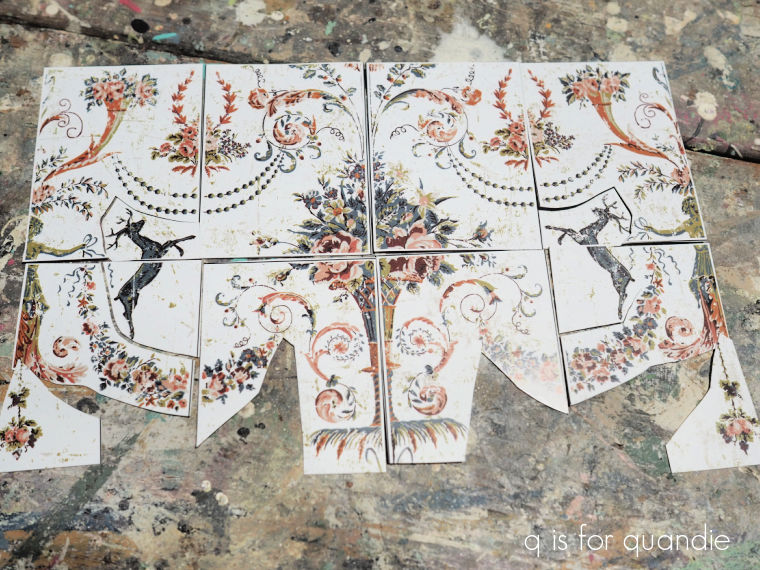
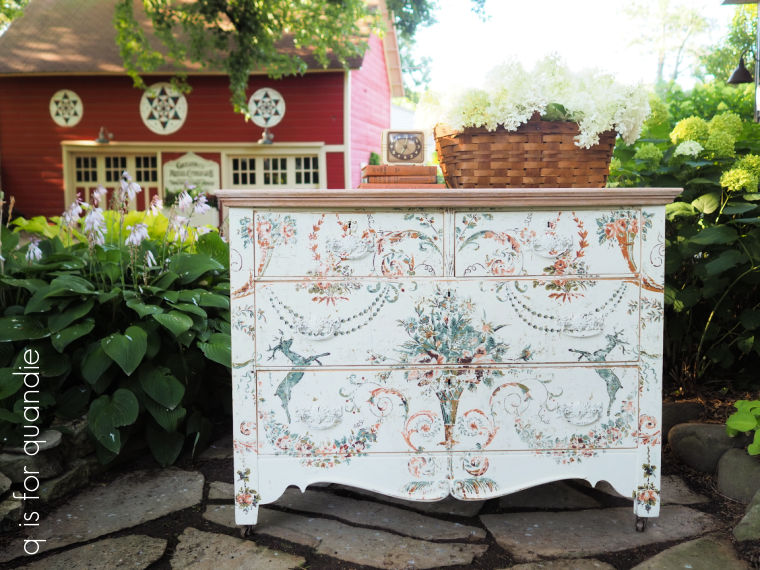
Here is what I came up with for my piece.

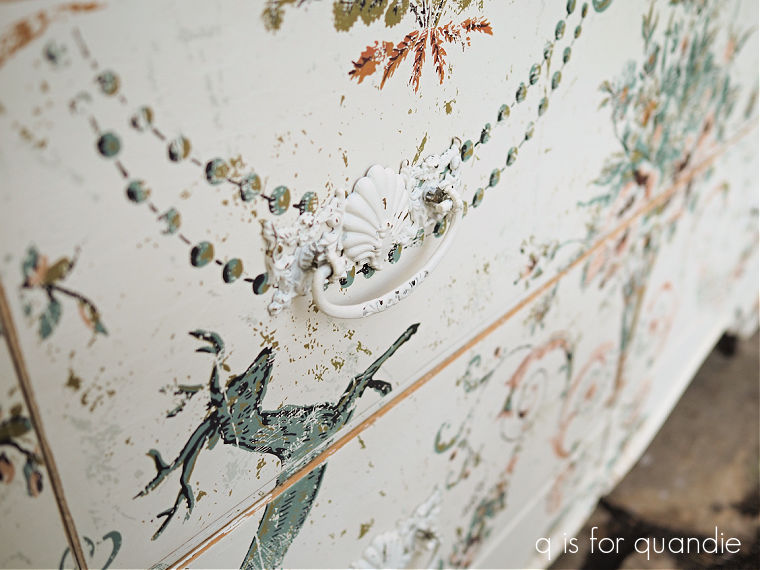
I debated removing the deer (if you look closely you can see they are cut out), but in the end I decided to leave them in.

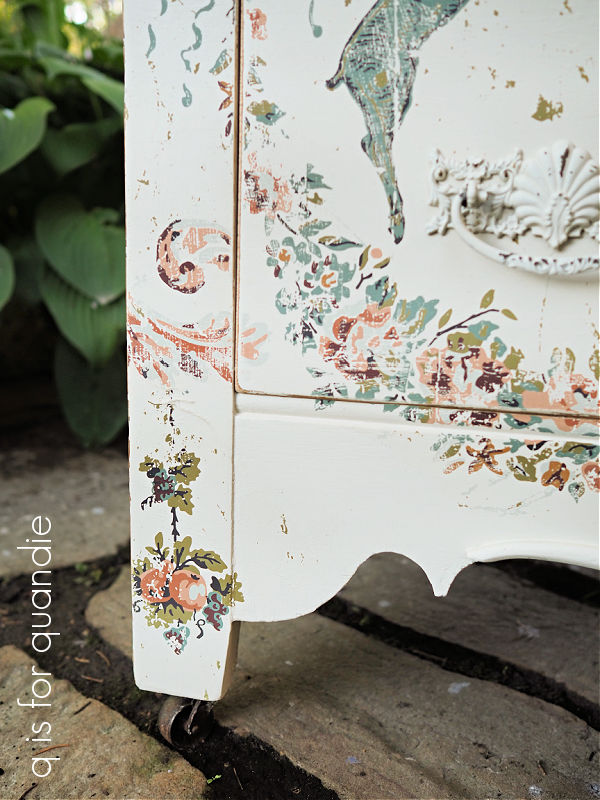
The full design was just a bit too tall for my piece, so I removed a section that I didn’t use at all and I moved those swags to either side at the bottom where they will actually be on the legs of the dresser.  Had I left them where they were in the original design they would have fallen off the bottom of the dresser.  Here’s how one looks on a leg.

Once I had my layout figured out, I trimmed the blank edges of the paint inlay (for more on the complete process of using a paint inlay, see my how-to post) and then cut up the sheets to match my final design and laid it out on a table so it was ready to go.

To prepare the dresser I first took the drawer pulls back off (I left the keyhole escutcheons in place) and sanded down the stenciled front of the dresser.

Today’s q-tip:  if you’re painting over a stenciled design you will see the ridges of the stenciled paint if you don’t sand them down.

You may also be wondering about painting over a previously waxed finish.  This dresser was finished with clear wax back in March, so about 5 months ago.  You can paint over cured Dixie Belle wax, and the cure time is about 30 days.  In addition, the fact that I sanded the piece pretty thoroughly to knock down that stencil was enough to prep this piece for another coat of paint.

Next I gave the dresser front a coat of Dixie Belle’s Drop Cloth.  No need to repaint the sides, of course they still looked good and I wasn’t going to bring the paint inlay around to the sides.   I let my first coat dry, and then applied the paint inlay to a 2nd wet coat of paint.

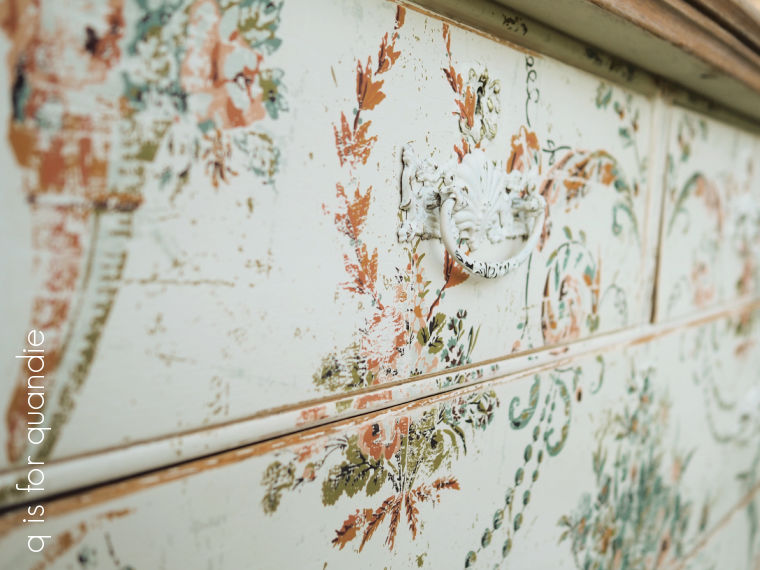
After pulling the backing paper back off and letting the paint dry, I sealed it with some Rust-oleum matte clear spray sealer.  Then I sanded to distress, cleaned away any dust, and followed up with a quick coat of clear wax.

Next I decided to add more paint to the drawer pulls.  If you’ll remember back to the original treatment of this dresser, the pulls and escutcheons looked like this …

When I put one back on the dresser with its new inlay, I thought they looked way too busy.  So I toned them down by adding two coats of Drop Cloth and then wet distressing them only slightly this time.

Now they blend in quite a bit more.

And as for the keyhole escutcheons, as I mentioned earlier, I left them in place while applying the paint inlay and it worked well to just go right over them.

In hindsight, another option would have been to remove them completely and save them for another piece of furniture.  But as they say, hindsight is always 20/20.  I didn’t think of that originally.

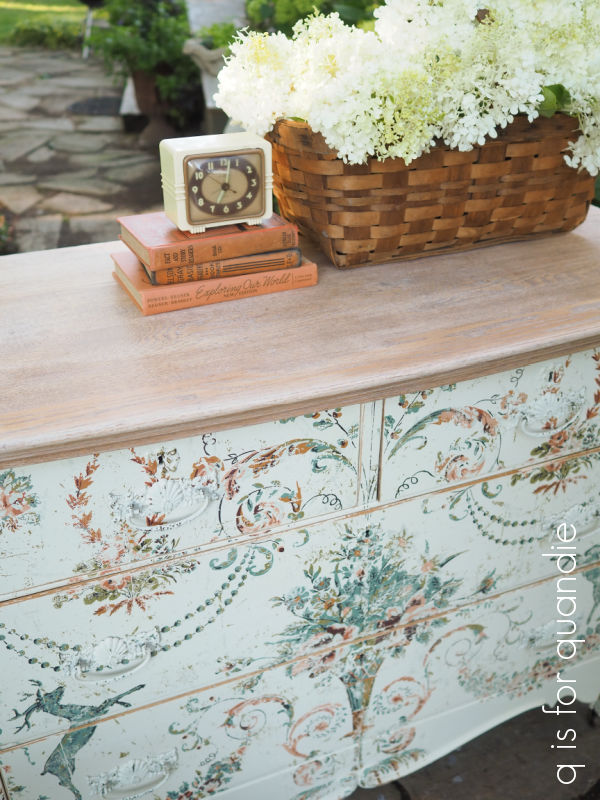
I left the top of the dresser as it was, stripped and finished with white wax.

I staged my photos in the garden with the carriage house in the background.  Lately this has become my favorite spot for photo taking.

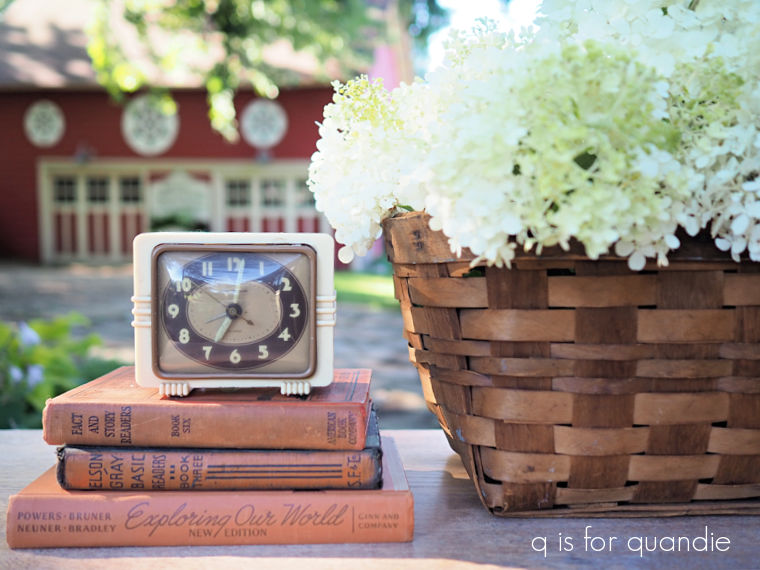
I included an old Bakelite clock,  some vintage books in a color found in the inlay and a basket full of hydrangeas.

These blossoms are from my Vanilla Strawberry paniculata hydrangea.  As you may have noticed, there is a lot of vanilla and not really any strawberry.  The pink does develop over time, and these blooms have only just started to open.  I’m sure I’ll be doing a Sunday mornings in the garden post about my hydrangea in the next few weeks as the paniculata’s come into their full glory.  So stay tuned for that.

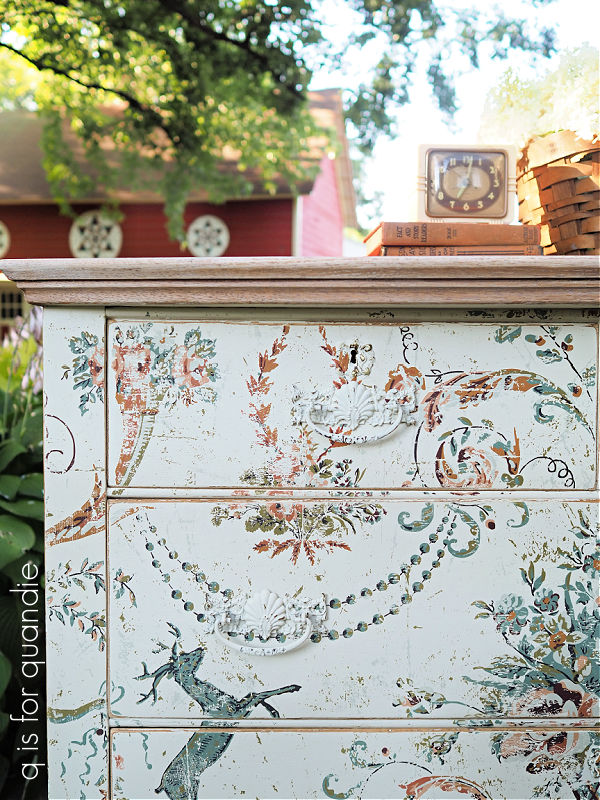
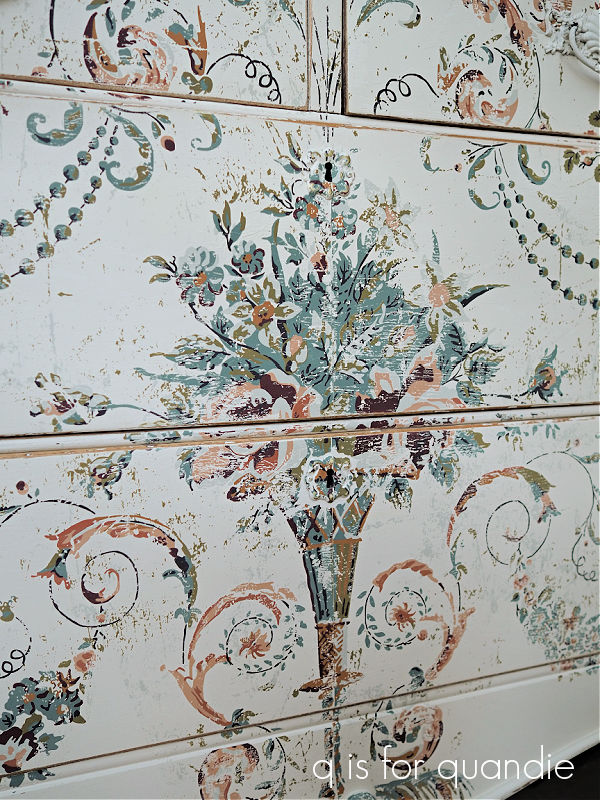
I’m a fan of the muted colors in the paint inlay, they have a bit of a fall feel to me.

There is a fabulous olive green, some terra cotta colors, and a smoky teal blue.

I really enjoy working with these I.O.D. paint inlays.  They certainly give pieces a unique, hand-painted look.  Personally, I feel like once you have an understanding of how they work, they are easier to use, and somewhat more forgiving, than transfers.  However, I wish they weren’t so expensive!  If you can manage to get more than one use out of them (they say you can use them up to three times), the cost per use goes down considerably though.  I’ll be experimenting more with that in the future.

In the meantime, what do you think of this do-over?  Did you prefer the more subtle look of the fine print dresser?  Or maybe you even preferred the original orange oak look of this one.

The chateau dresser is for sale so be sure to check my ‘available for local sale‘ page for more details if interested.

Thank you to Dixie Belle Paint Co for providing the paint used on this project.

the potting bench.

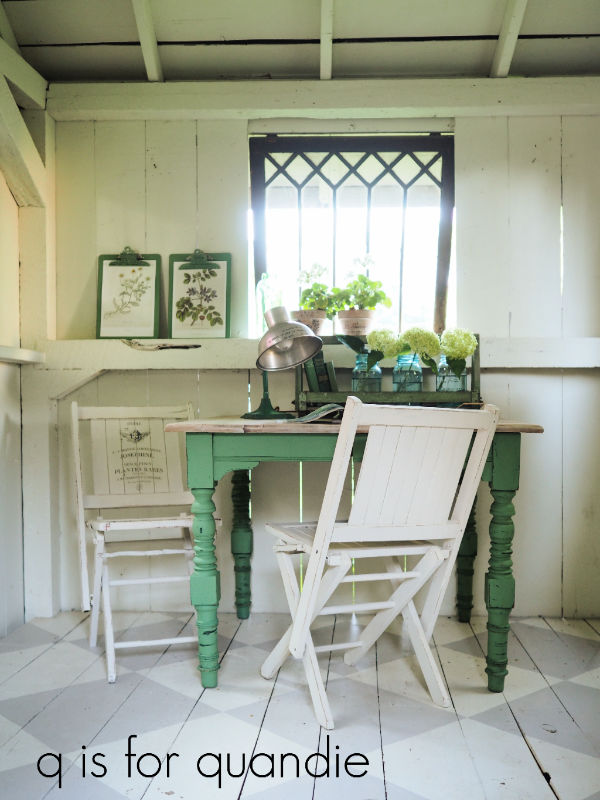
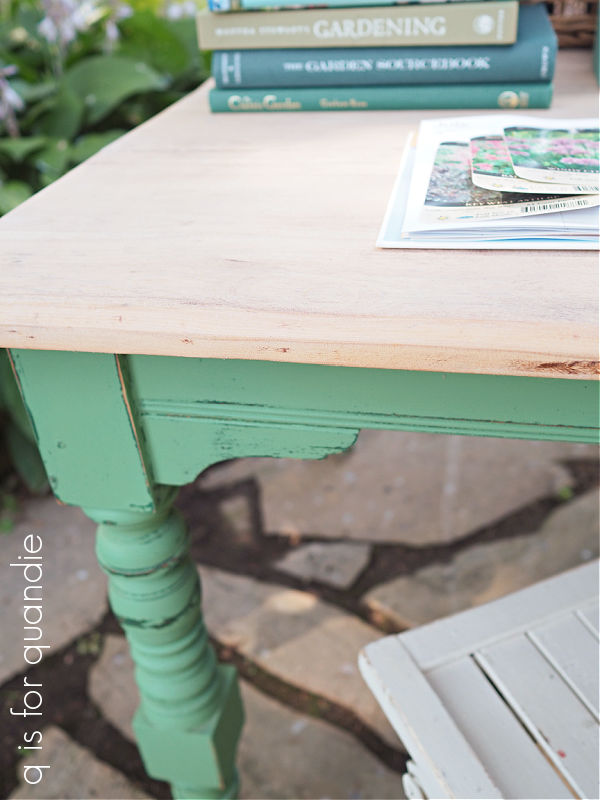
First, an update on Wednesday’s post about the green table.  Shortly after publishing that post I realized that I didn’t want to part with the table.  If I could solve its weight problem, and put some casters on it to make it more mobile, it really would provide the perfect neutral surface for staging photos of small items outdoors.

After flipping the table over, I realized that a lot of the weight was coming from some heavy wood pieces that were attached underneath to allow you to slide the table apart and add a leaf in the middle.  Since I no longer even have the leaf, I could just remove those.  I also realized that the table had once had casters and thus already had the sockets in place to hold them.  I found 4 matching casters in my stash and just had to add them.

And just like that, my problems with the table were solved and now I’ll be hanging onto it.

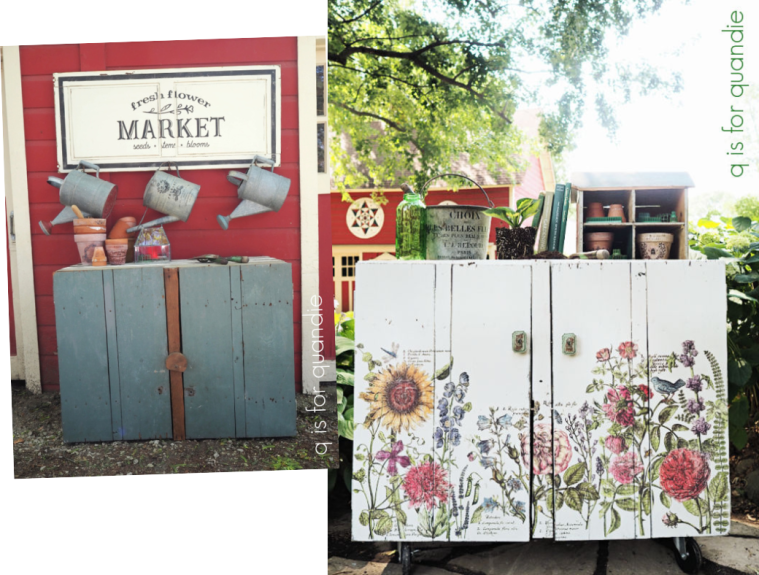
Do you guys remember back in May 2021 when I contemplated putting a primitive sort of cupboard in front of the carriage house?

At the time I thought it would be a convenient spot for a potting bench, but those who commented on that post almost universally voted against it.

And P.S., after taking that photo above I realized I had the cupboard upside down.  Ooops.

Anyway, I didn’t put the cupboard in that spot, obviously, since I now have my fabulous repurposed guest bed planter there.

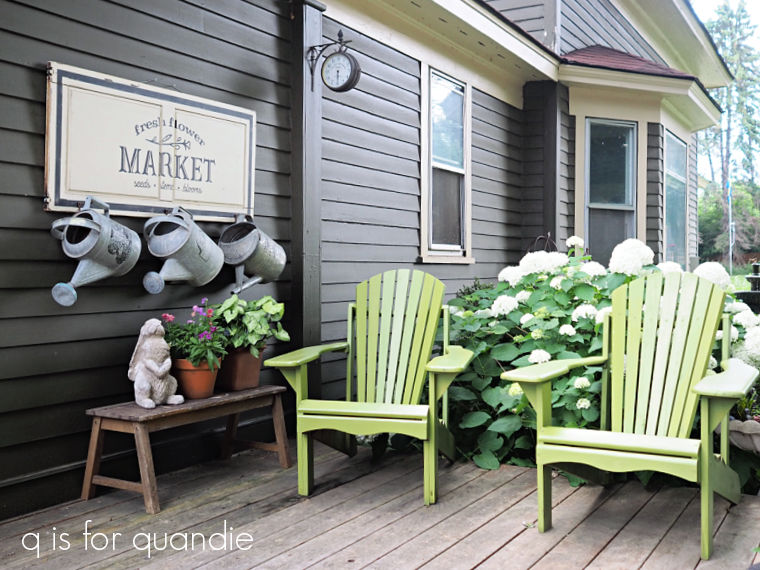
And FYI, the Fresh Flower Market sign that was there has moved up to the deck.

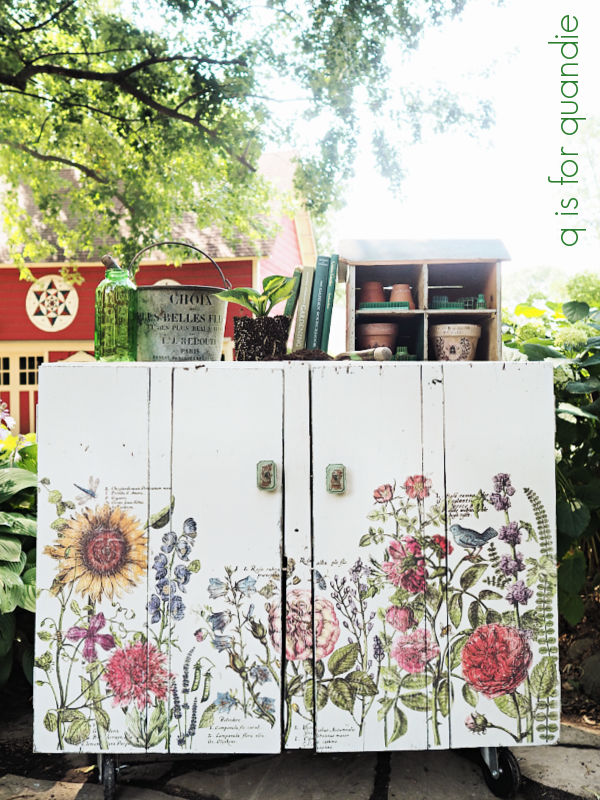
But I tucked that cupboard away for a rainy day, and although we haven’t had very many rainy days this summer, I’ve now given it a whole new look so that it can serve as the potting bench inside the potting shed.

Let’s start at the beginning.  First up I had Ken add those large casters to the bottom.  It makes it easier to move it around when necessary, plus I felt like the piece needed to be elevated somehow.  Casters worked perfectly for that.

Next up, after my usual prep of cleaning and scuff sanding, I painted the outside in a mix of 3 different shades of white milk paint.  I was trying to use up colors that I already had on hand.  I had Homestead House Sturbridge White (which was too stark white), Fusion’s London Fog (which was too creamy), and Homestead House Stone Fence (which would have been perfect on its own, but I didn’t have enough of it).  Between the three of them, I came up with a shade of white that was just right.

I got quite a bit of chipping with the milk paint on the top of the cabinet.

But none on the front.  Mostly likely something was spilled on the top in its former life, and that substance resisted the paint.  But I’m OK with that.  I like chippy paint.  After sanding well and vacuuming away any loose paint, I sealed the milk paint with two coats of Dixie Belle’s flat clear coat.  That will help seal any chipping paint, and I can easily wipe the top down when it gets dirty.

Today’s q tip:  Always seal chippy milk paint with a clear coat before trying to add transfers over it.  Otherwise the transfer will pull off your paint, rather than the transfer sticking to your surface.

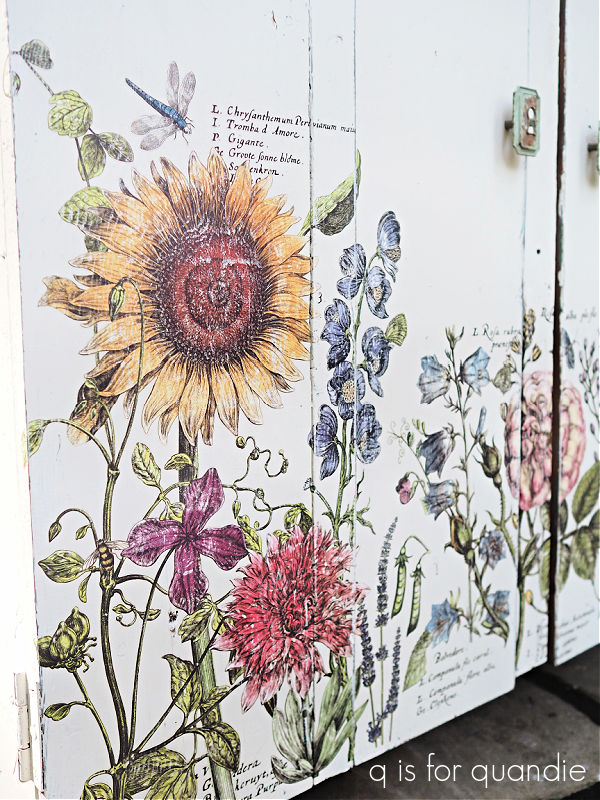
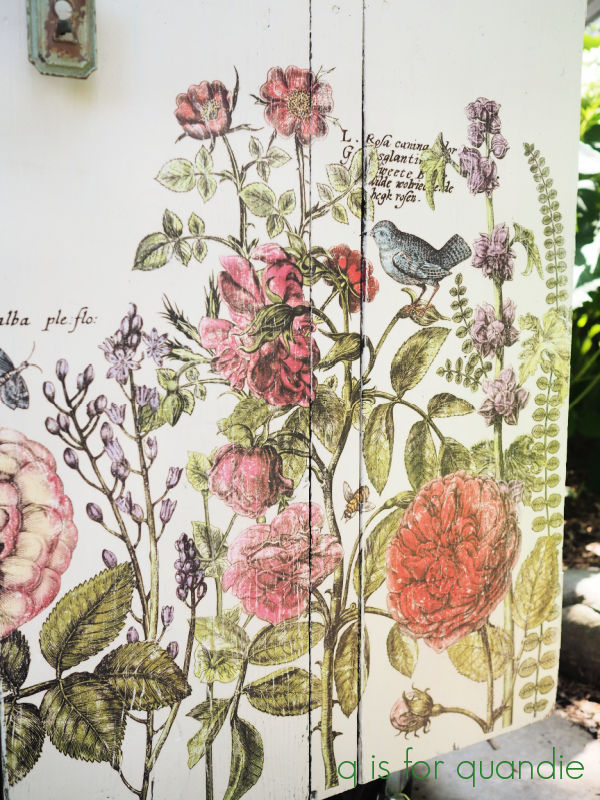
Next up I added some I.O.D. transfers to the front doors.

I used all of their Botanist’s Journal transfer (a section on either end) and then filled in the middle with some of their Ladies in Waiting transfer.

  I felt like these graphics were perfect for a potting bench!

I have to mention here that once again I ordered the I.O.D. transfers from The Painted Heirloom.  I ordered them on Saturday, and received them on Monday!  I was super impressed by the speedy turn around.  I’ve ordered from Vonda a few times and have always had great results.

Once the transfers were applied, I sanded lightly over them with 220 grit paper to distress them and give them a more faded appearance.  Then I sealed them with another coat of flat clear coat.

You may also have noticed by now that I removed the original round wooden door closure thingie from the cabinet.  I didn’t like the look of it.  Instead I added magnetic closures to each door to keep them shut, and I put some knobs in holes that were already there.

These knobs came from Hobby Lobby, but I purchased them a long time ago so I’m not sure if they still have them.

I debated whether or not to paint the inside of the cupboard.  Since I was keeping it for myself, I considered taking the easy way out and leaving it alone.  But I knew it would look great painted in Dixie Belle’s Gravel Road.  I love using this warm, dark grey inside cupboards.

There’s lots of space inside this cupboard for storing extra clay pots and other gardening supplies.

To be honest, it’s not likely that I’ll do much actual potting in the shed.  It will really be utilized more for storage of gardening supplies and possibly the occasional flower arranging.

I tend to plant up most of my larger pots where they sit.  Most of them get rather heavy once they are full of dirt and plants.

With the completion of the potting bench, I pretty much have all of the pieces completed for my potting shed makeover.

But now I’m stuck.  I really should re-paint the interior of the shed, but … well … I’m not looking forward to that task.  I’m struggling with lack of motivation to get that done.  We’ll see if I get to it before the end of summer.

In the meantime, I’m cutting myself some slack (the benefit of being your own boss) and working on a few toolboxes (such as the one I shared at the beginning of this post) instead.  So stay tuned for that.

So tell me, which version do you prefer?  ‘Before’ (and upside down) or ‘after’?

a homeless table.

I know I sound like a broken record when I say this, but gosh, time flies doesn’t it?  I could have sworn that I restyled the photo cottage last summer, but turns out it was actually back in 2020.

At that time I was going back to making the shed into a ‘summer house’ and I didn’t want to actually spend any money on it, so I used things I had on hand including an old farmhouse table.

This is an old, super heavy table that I’ve had for quite a few years.  I used to use it for display at my carriage house occasional sales.

Before placing it in the ‘summer house’, I repainted the table base in Dixie Belle’s Kudzu 

and gave the top a fresh coat of Fusion’s Liming Wax.

  Even after two years in the shed it still looks great.

But now that I want to turn the space back into a potting shed, the table needs to make way for a potting bench.  So I pulled it out of there.

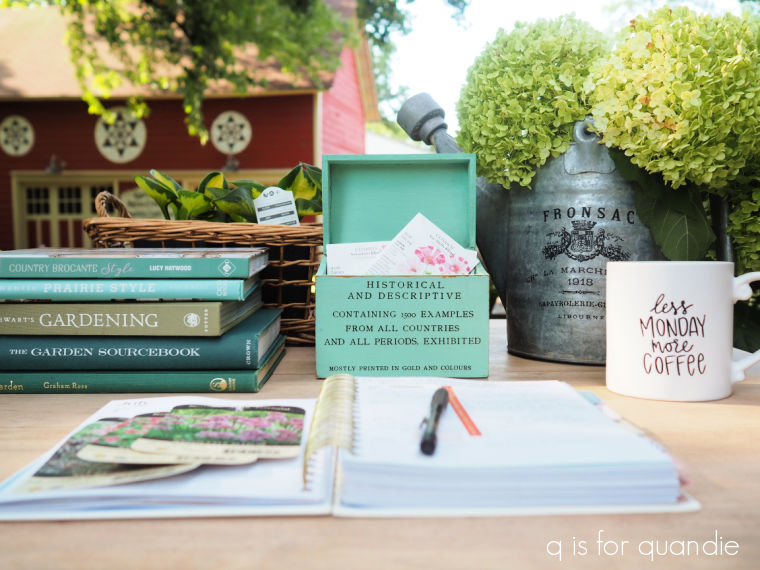
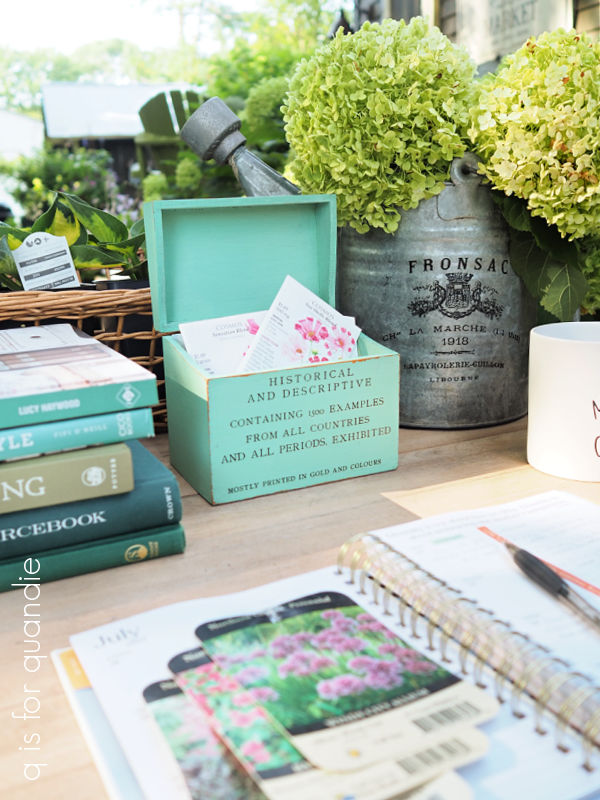
Then I had a little fun staging it in the garden as a spot for making notes in my garden journal.

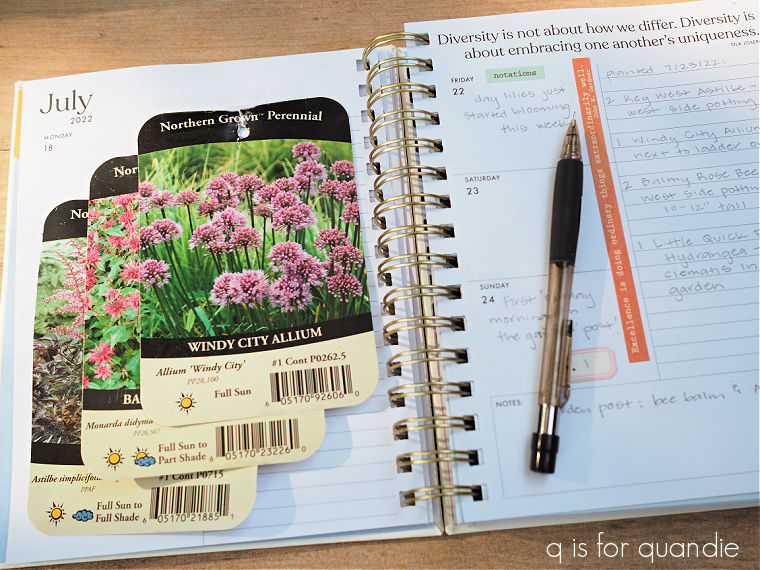
I searched high and low for a garden journal that I liked earlier this summer and didn’t have any luck.  However, my sister will attest to the fact that I had some rather picky requirements for it.  It had to be spiral, it had to have lots of space for making notes, it had to have a pretty cover, etc., etc.  I dragged her to various shops where I hemmed and hawed over the possibilities.  Eventually I ended up going with a 18 month planner that I found at Barnes & Noble.

This will get me through next summer anyway.  I mainly want to keep track of what I’ve planted where, and when.

OK, so I don’t actually sit in this spot to write in my garden journal …

but maybe I should!  It seems ideal for such things.

If this table were slightly more portable, I’d keep it on hand simply as a photo prop.  It provides a nice blank surface for staging smaller pieces, like toolboxes or product photos.

(that’s a little ‘foreshadowing’ for an upcoming post)

Maybe I should look into adding casters to the table so I could more easily wheel it around.  I don’t know, even with wheels, this table is a bit heavy for me to be man-handling it around all the time.

But for now, this table is homeless.  So here’s what I’m going to do.  I’m going to list it here on the blog for local sale and if someone snatches it up, great.  And if it doesn’t sell, well, I think I’ll continue to use it for photo shoots.

If interested in the table, be sure to check my ‘available for local sale‘ page for more details.

a leafy green garden chair.

First up, I’ve drawn Deb’s name at random to win my 15 minutes of fame giveaway.  I know there are a few of you Deb’s out there, but I have been in contact with the Deb that won and she knows who she is (sorry other Deb’s!).

Continuing on with my theme of ‘projects for me’ … wait, that sounds so selfish, doesn’t it?  Me, me, me.  As a reminder, since my furniture isn’t selling so hot these days, I’m focusing my energy on finishing up items that I’ve wanted to refurbish for my own home instead of items to sell.  Some of these things have been hanging out in my carriage house for years just waiting for their moment to shine.

I finally have time to get to them!

So, one of the things I’m working on is a refresh of my photo cottage a.k.a. summer house a.k.a. potting shed.  Yep, it has been called all of those things over the years, most recently it was the photo cottage.

If you’ve been with me since way back, you’ll remember that I restyled this shed in my back yard into the ‘photo cottage’ in 2014.  My plan was to create a space where I could stage all of my furniture photos.

As it turned out, it wasn’t really suited for that.  The space wasn’t quite big enough, and at certain times of the day sunlight reflecting off the nearby red carriage house turns the lighting decidedly pink.  So a few years back I gave up on the photo cottage and lately I have been mainly using it as storage.

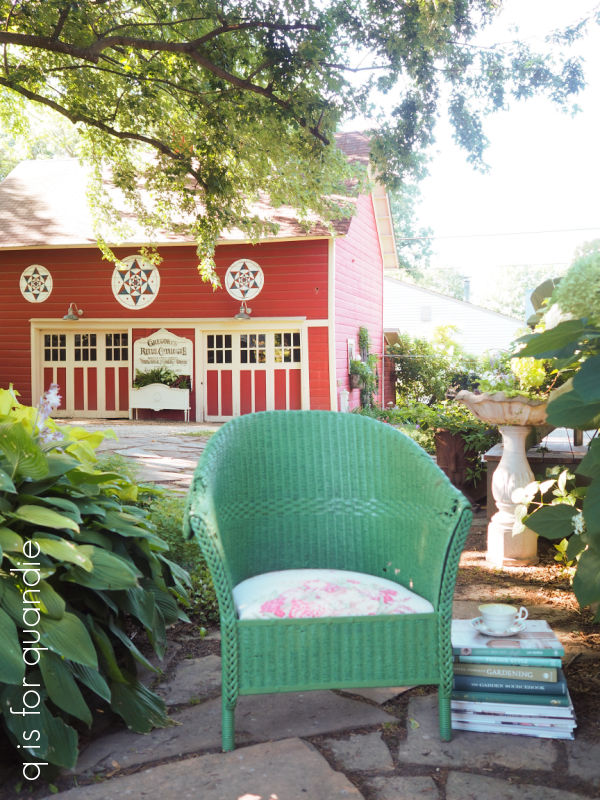
That led to my decision to go ahead and turn it back into a potting shed.  I’m working on a couple of pieces that will make their new home in the potting shed starting with an old wicker chair.

While considering what I wanted in the space, I knew I wanted some sort of chair in that corner shown above.  The chair in that photo has since been moved into my Q branch and is actually the chair I’m sitting in as I’m typing this.  I really like it in this space, so I needed a replacement for the potting shed.  I started surfing Facebook Marketplace and Craigslist for suitable chairs and didn’t find much in my price range (super cheap) that I liked.  I did find an old, beat up wicker chair that was a possible candidate, but then I remembered!  I already had an old, beat up wicker chair upstairs in the carriage house.

Does it sometimes seem like the upstairs of my carriage house is this magical space that I can continuously pull fabulous pieces out of?  Sort of like pulling a rabbit out of a magician’s hat?

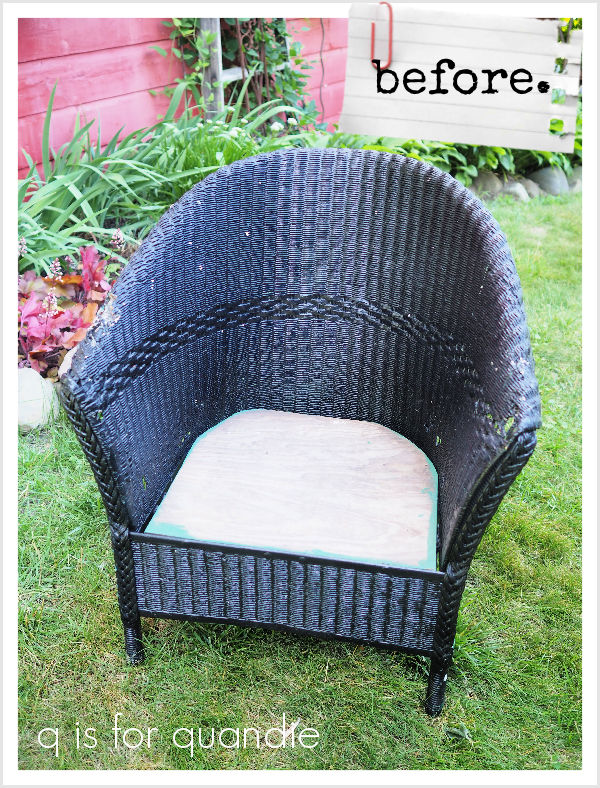
Anyway, I had this chair up there.

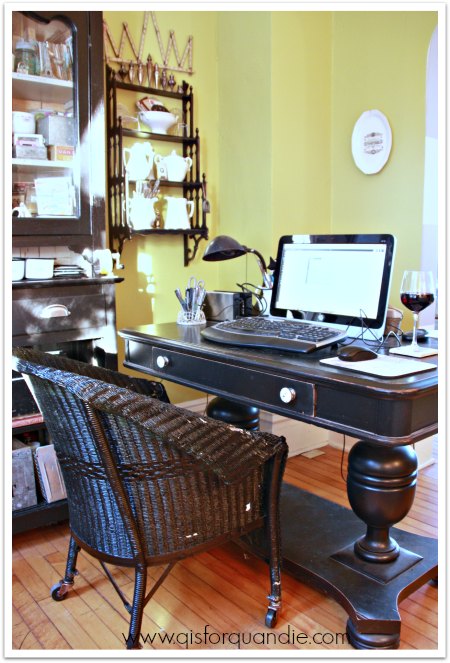
Way, way back I had Ken add casters to the legs on this chair and I used it as my desk chair before I gave the Q Branch a makeover and it still looked like this …

In case you’re curious, the added casters were a bit of a disaster.  Drilling the holes in the legs required for the casters ended up compromising their integrity (never a good thing), and they didn’t hold up to a lot of rolling around.

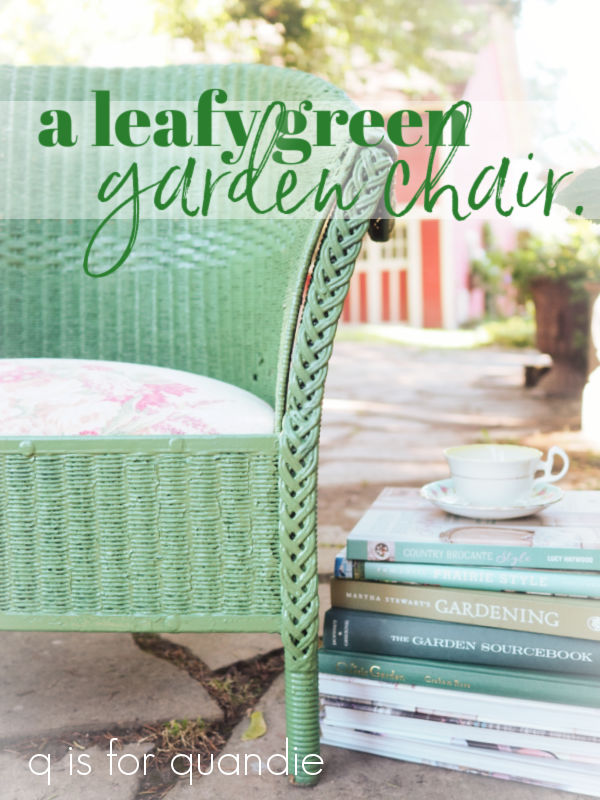
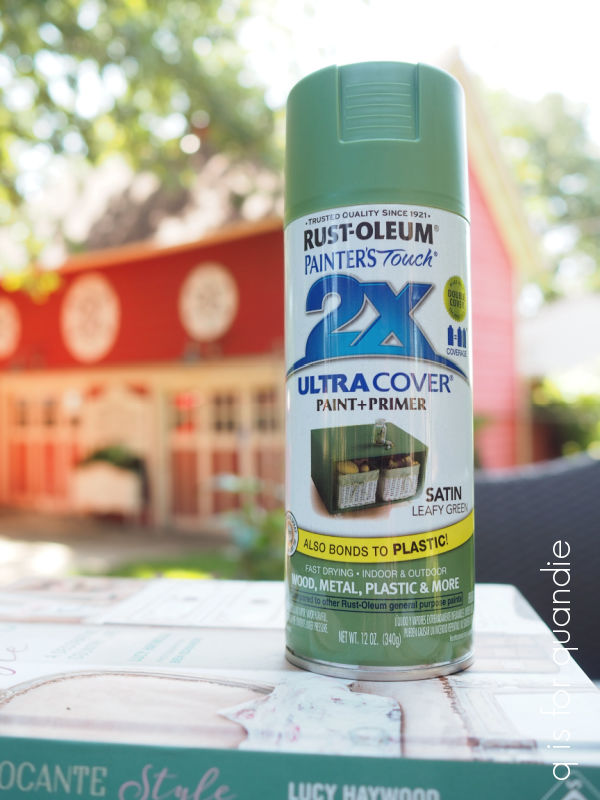
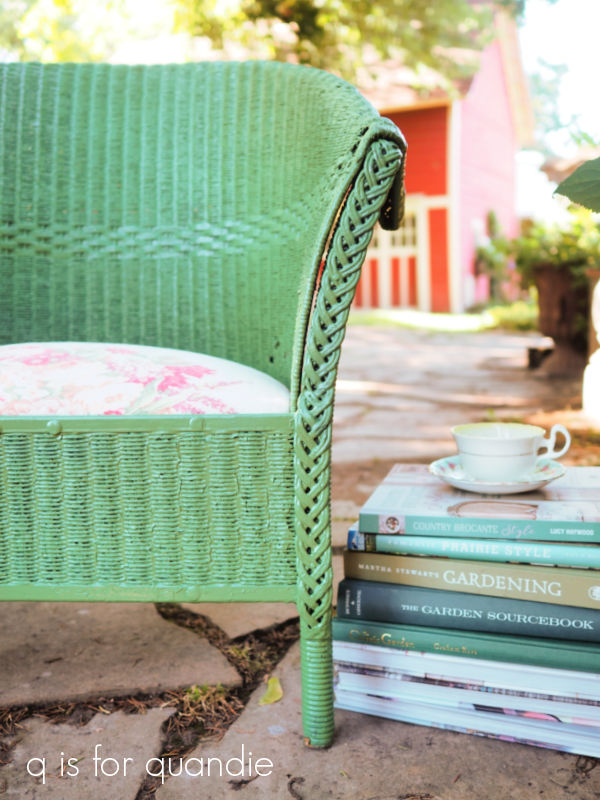
So, I removed the casters, glued a broken leg, and then gave the chair a fresh paint job using Rustoleum spray paint in Leafy Green.

I typically use spray paint on wicker because it’s so much easier to get in all the grooves with spray.

Next I reupholstered the plywood seat by adding 4 layers of batting and some fill first, then covering that with an old scrap of vintage floral bark cloth that I had in my stash.

The scrap I had was just the right size for this seat, so it felt meant to be.  I know I’m taking a step back to my old shabby chic days with this piece, but that’s OK.  I’m putting it in my potting shed, I can choose whatever makes me happy for in there … and this does.

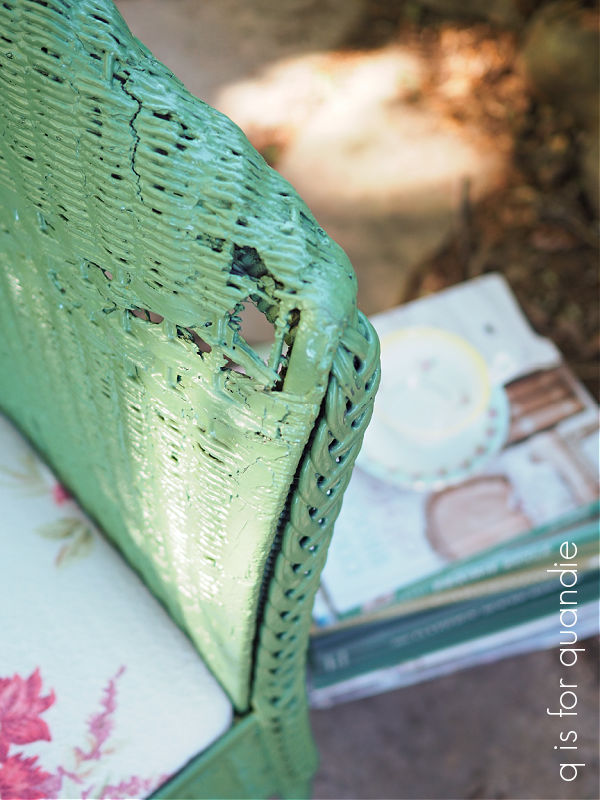
Now, I will admit, this chair is pretty beat up.

But I don’t care.  It just gives it more character.  It shows that this chair has lived a full life, and it’s continuing to serve a purpose even if it’s showing its age a little … sort of a metaphor for my own life.

Here’s one last photo that I’m sharing specifically for Honoré who asked to see a wider photo of the carriage house with my new guest bed sign/planter in front of it.

I’m not sure if that gives you the full effect you were looking for, but there it is.

So, the chair is done and next up I’m working on a potting bench sort of piece for the shed.  I’ve got it painted but am waiting for some transfers that I ordered to finish it off.  So stay tuned for that one!

the repurposed guest bed.

As I’ve mentioned, since furniture sales have slowed way down for me, I’m taking this time to focus on projects for myself that I’ve been putting off for a while (OK, maybe years in some cases).  Today I have a really fun one to share with you guys.  There is a bit of a long story behind this one, so you may want to refill your coffee before diving in.

Several years ago, Mr. Q and I swapped our guest room for his home office.  Prior to that, the guest room was the larger room, and his office was the smaller one.  We finally came to the realization that he uses his office every day, and we rarely have house guests.  It didn’t make sense to have the larger room going mostly unused, especially in a smaller home like ours where space is at a premium.

But switching to the smaller guest room meant getting rid of the full sized bed we were using and replacing it with a twin.  We actually traded the full sized mattress and box spring with my neighbor, nnK.  She took the full size, and gave us her twin sized versions.

That left us with a spare full size headboard and foot board (and side rails).  We stuck them up in our carriage house and there they’ve sat since 2017.

Now, you might be wondering why I didn’t sell the bed, so let’s go back a bit.  Here is the bed when it was part of the guest room.

Sorry, that’s the best photo I could find of the bed in its ‘before’ condition and it doesn’t even show the foot board, which is one of those ones that curve around the mattress.

There’s a little history behind this bed.  Mr. Q and I purchased our home around the same time that his great uncle’s estate was being divvied up.  We ended up with this bed, a matching dresser and a dining room set from Uncle Roy’s house.  This was back in 1988.  When we got the bedroom set, it was already painted.  I wanted to return it to the natural wood (that was the trend in the late 80’s), so I sent them off to be ‘dipped’.  Does anyone else remember that?  Maybe it’s even still a thing, I don’t know.  But basically your furniture is dipped in a large vat of stripper to remove the paint.

When we picked the pieces back up from the dipper, he explained that the manufacturer intended for these pieces to be painted.  This was obvious after they were stripped because they were each made out of more than one kind of wood, plus the ‘carved’ details were molded plaster, not carved wood.  So after all of that dipping, I had to repaint the pieces rather than staining and varnishing them.

Keep in mind, this was the late 80’s, I was still in my 20’s (ha, ie. a long time ago), I knew nothing about painting furniture!  So I went to the paint store and asked for help.  They explained that I should absolutely use oil based paint for durability (eeekkk! I can’t stand using oil based paint!), so that’s what I did.  I painted them in an oil based warm white.

Flash forward another decade or two.  I decided to redecorate and paint the pieces black.  I painted over the oil based paint with latex paint.  As you may be guessing, that did not hold up well over time.  That’s the reason I’m telling this rather long winded story.  It’s a cautionary tale of what not to do when painting furniture.  Do not paint over oil based paint with latex paint.  Over time it starts to peel right off, and that’s why I couldn’t sell this bed frame.  The black paint was peeling.  The only way to make this bed suitable for sale would have been to completely strip all of the paint layers and start over, and there is no way that would have been worth the effort.

So I stored it for a few years.  Last winter I thought I’d make the headboard into one of my Christmas signs (like this one).  I had Mr. Q bring it down from upstairs in the carriage house, and that’s when I drove over it.

LOL, didn’t see that coming did you?  But yep, it was leaning up against the wall in the carriage house and it fell over.  That’s where I park my car in the winter, and because the headboard is black and it was dark in there, I didn’t notice it on the floor and I drove over it.

That did a bit of damage.  So I put off working on this project once more.

And that brings me to today.  I finally had the time to work on this one, and I had a really cool plan for it.

I started with removing the plaster wreath from the headboard, and filling the giant crack I made driving over it with some of Dixie Belle’s Mud.
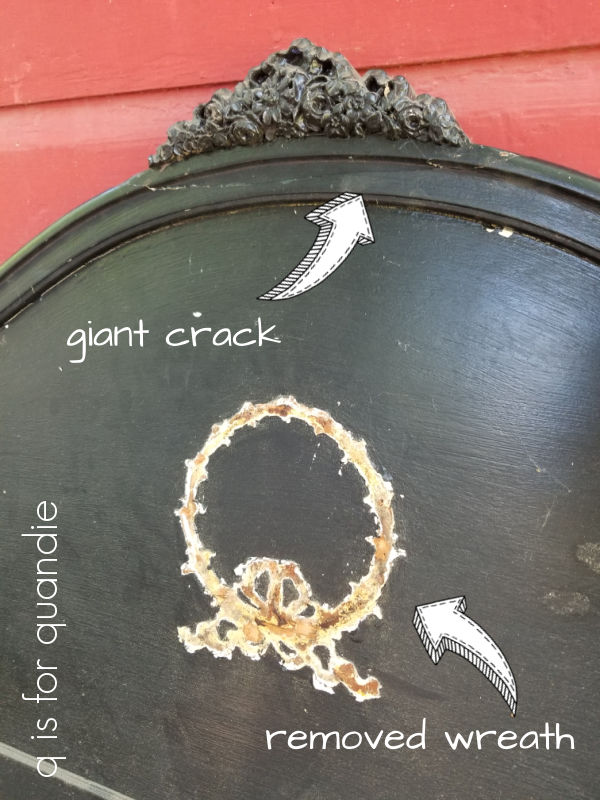
Next up I tried to remove as much of the peeling latex paint as I could, and then sanded the entire piece to prep it for new paint.

In an effort to improve adhesion, disguise an uneven surface, and create additional age with more layers of color, I next pulled out some Dixie Belle Sea Spray and The Gulf paint.

I mixed the two to create a brownie batter-like consistency and painted a coat of that on the headboard.
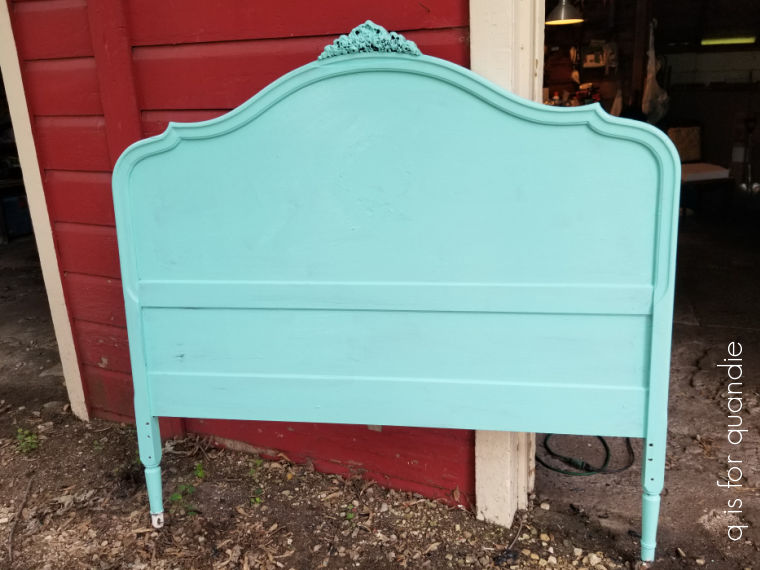
This was just an underlayer of color though, I painted over it with two coats of Dixie Belle’s Drop Cloth.  I purposely allowed both the black and the aqua to peak through in some spots.

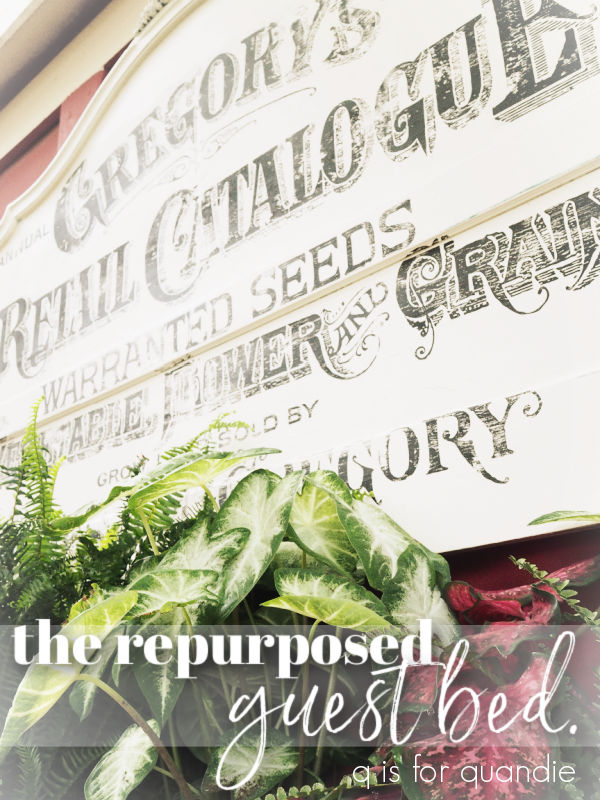
Then I added the Gregory’s Catalogue paint inlay from I.O.D. (for a full tutorial on using the paint inlays, check out this post).

When using a large design that comes on multiple sheets like this one, I start in the middle and work my way out adding wet paint to each section as I’m ready to place that piece.
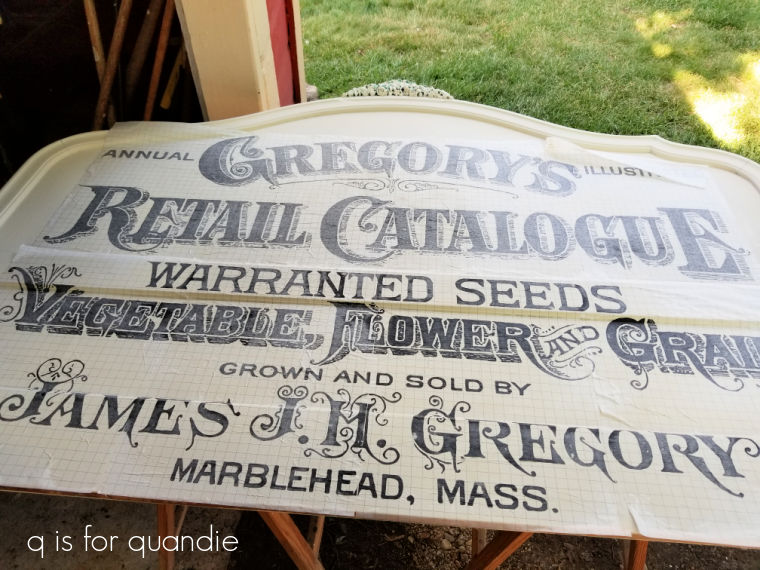
Be sure to follow all directions with these paint inlays, especially keeping in mind that it’s best to seal them with a spray sealer first rather than a brushed on finish (the paint of the inlay is easily reactivated with a water based finish and will smear).  So once I had the paper backing off and everything was dry, I sprayed my headboard with Rustoleum flat clear sealer.  Once that was dry I also added a couple of coats of Dixie Belle’s flat clear sealer over it.  Since I’ll be hanging this outside, I wanted to protect it fairly well.
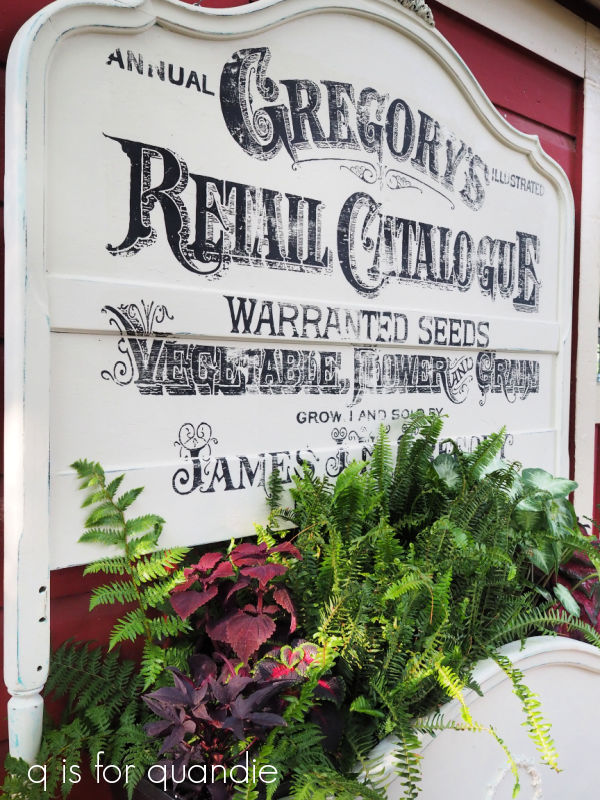
Now, let’s look at what we did with the footboard.

Once again, I need to add a disclaimer here.  Since this project was a keeper for me, I didn’t go as all out as I would have if I intended to sell it.  Were I selling it, I would have asked Ken to build a proper box on the back of the foot board.  Instead I just had him add a shelf with a couple of legs at the back to support it.  My plan was to use this as a ‘planter’ by placing it up against the carriage house and putting plastic planter boxes on that shelf.

I painted the whole thing using the same process as the headboard, The Gulf with Sea Spray followed by two coats of Drop Cloth.
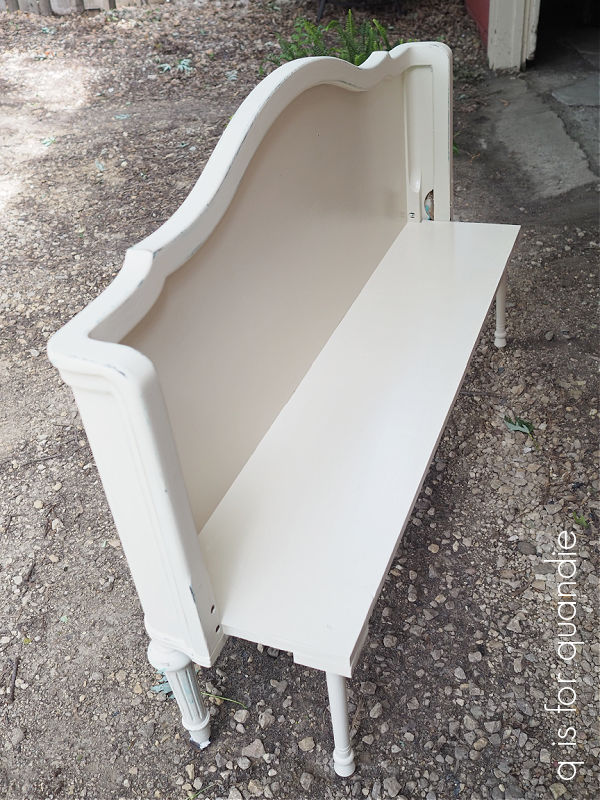
I then sealed the inside of the ‘planter’ with Dixie Belle’s Gator Hide.  Gator Hide is their most durable, water repellant finish.  Since I will be placing potted plants on that shelf, I know it will be getting wet so I’m giving it the best chance of holding up.

If you’ve never used Gator Hide, I will tell you that it has a bit more sheen than my usual flat finish.  Personally I’m not a fan of shine, so for that reason I only used it on the inside of this piece where it won’t show.  I used the flat Dixie Belle clear coat on the front.

If you’ve stuck with me so far, here’s where we are with this project.
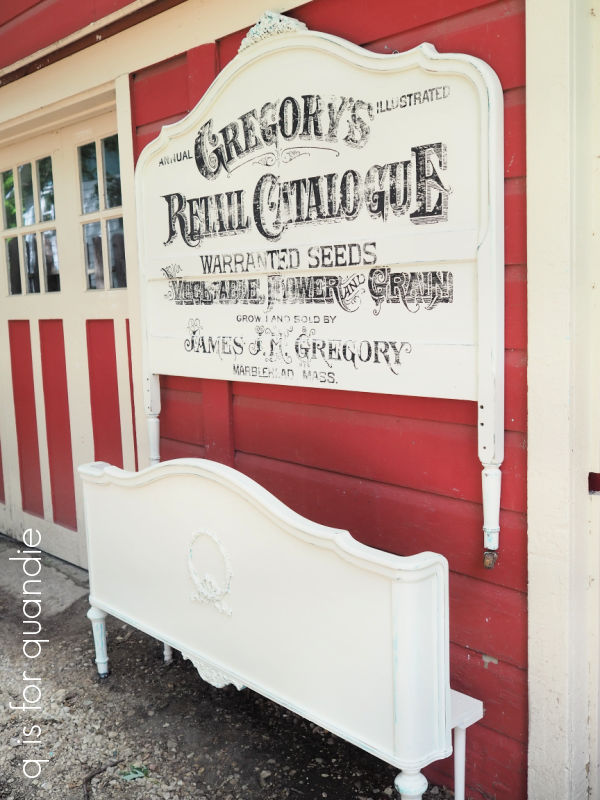
I’ve hung the headboard sign on the carriage house between the doors, and placed the foot board planter beneath it.  All that’s left is to fill it up with plants.
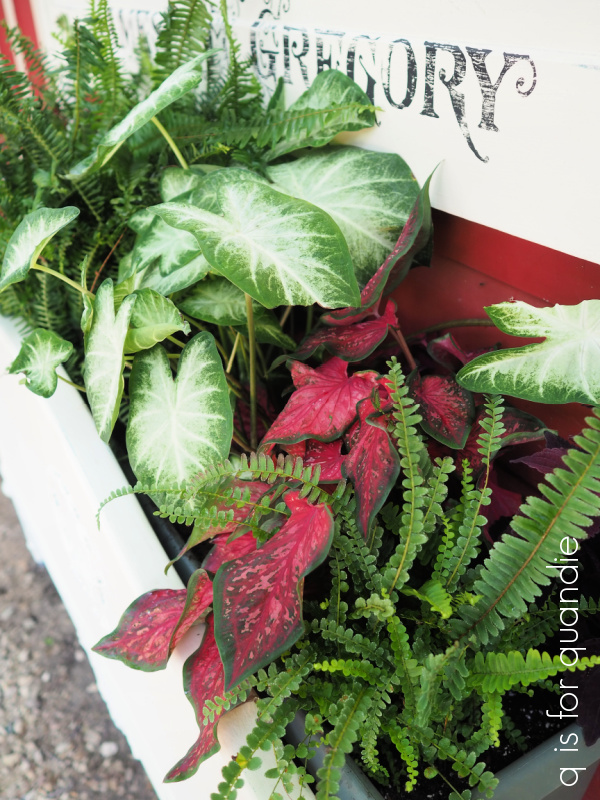
I learned another valuable lesson here, or at least one that is worth sharing with my local readers.  Don’t go to Gertens first for your plants.  I purchased two small ferns for $14.99 ea, two white caladium for $18.99 ea, and two dark red coleus for $4.99 ea from Gertens.  Then several days later I went to Home Depot and found caladiums that were twice the size for $9.98 and a fern that was 4 times the size for $14.98.  I really wish I had checked Home Depot first!

Well, live and learn, and either way, I am loving this combination of shade plants for my foot board planter.

I’m relying on foliage for the interest and color in this north facing spot.

So, several weeks and … uh … quite a few dollars later, I have created a focal point with lots of impact at the end of my driveway.
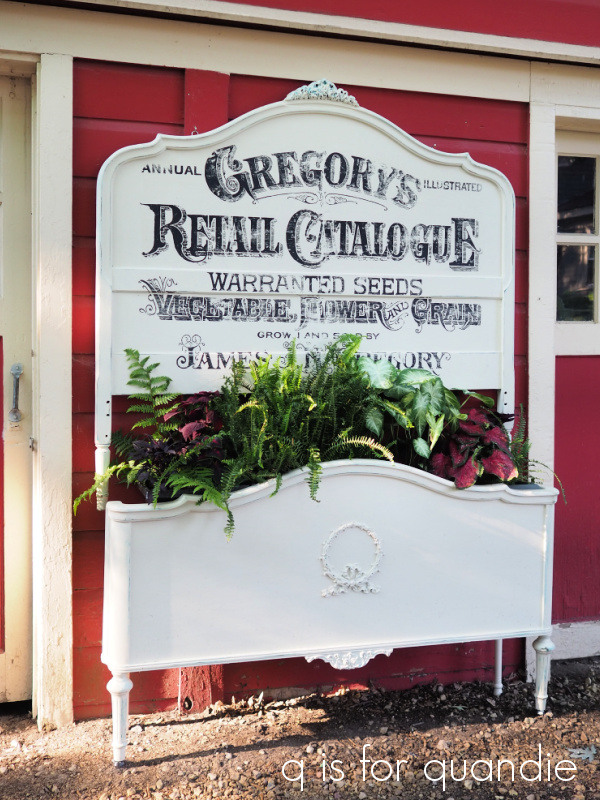
I learned a few lessons along the way with this one; (1) don’t assume all painted furniture can be stripped and stained, (2) don’t drive over your headboard, (3) don’t paint over oil based paint with latex paint, and finally (4) check Home Depot for inexpensive plants before resorting to Gertens.

I won’t say this was an inexpensive project.  By the time you add in the cost of the board Ken added to create a shelf, the paint inlay and especially the plants, pots & potting soil, this one added up.  If I’d also had to buy the bed itself, plus all of the Dixie Belle products I used (two colors of paint, Sea Spray, flat clear coat, Gator Hide) … well, yikes!

But I sure am happy with the results.  It’s definitely a keeper.

What do you think?

Thank you to Dixie Belle Paint Co for providing all of their products used on today’s project.

deconstructed.

Let’s start the weekend early and play a drinking game.  Get yourself some tequila (or your booze of choice), or OK, if you’re reading this first thing in the morning maybe it had better be coffee.  Now, every time I say ‘deconstructed’, take a drink.  We’re up to three already if you count the title and title photo.

As I’ve mentioned, since my furniture pieces aren’t exactly selling like hot cakes these days (and yes, I even still have that pair of mid mod end tables, go figure), I’m working on both smaller projects as well as projects for myself.  Which brings me to today’s project.
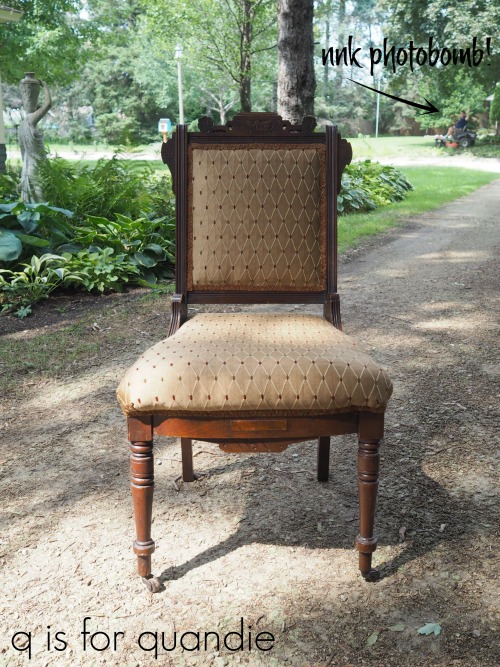
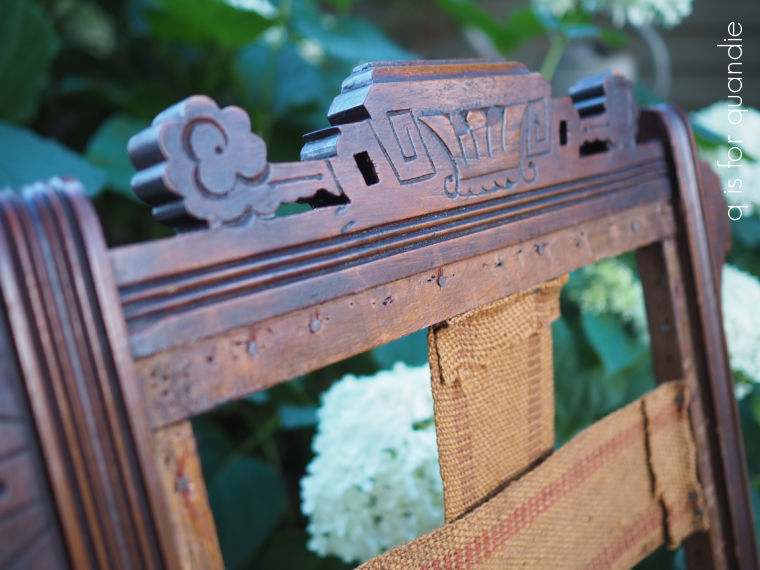
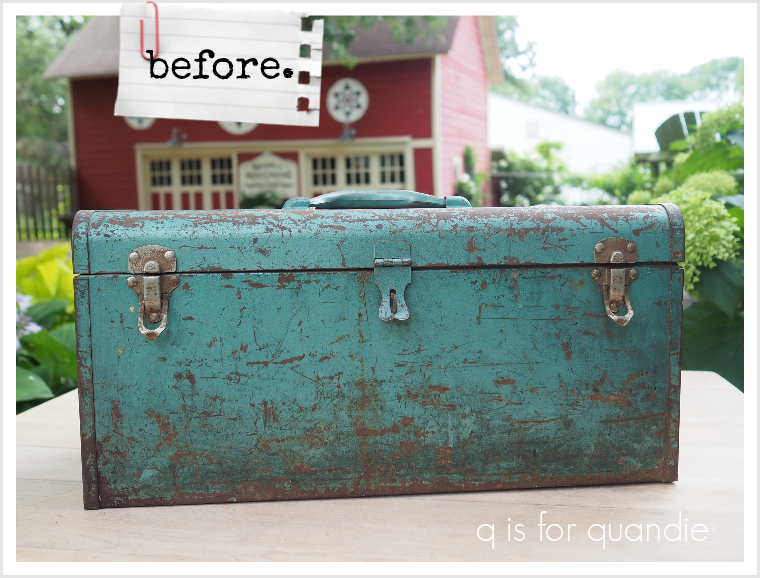
I brought this chair home from the Mac-Grove garage sales back in 2018.

So, yeah, that was four years ago.

Good gracious, it’s about time I got around to it.
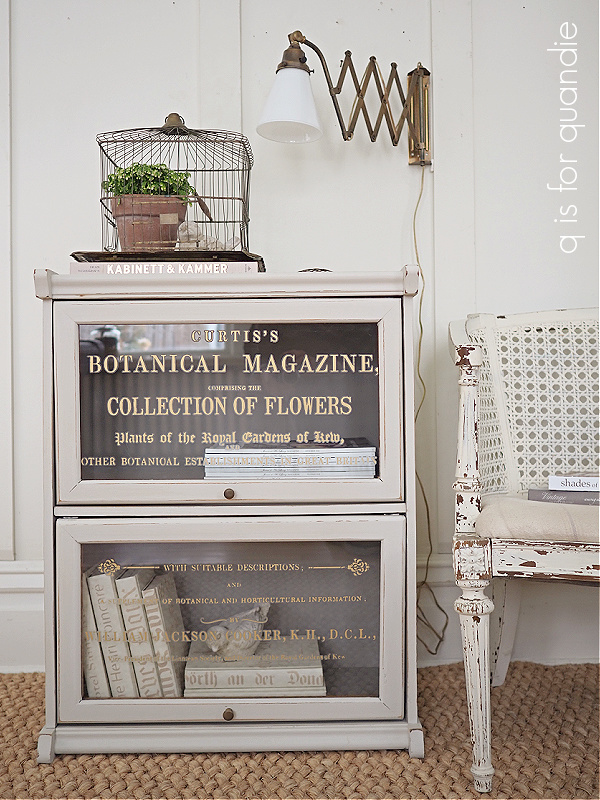
Anyway, I purchased it because I thought it would be a great candidate for creating the ‘deconstructed’ look.  If you aren’t familiar with that look, go to pinterest and search for it.  You’ll find lots of examples, like this one from lizmarieblog.com …
I know the deconstructed look isn’t for everyone, but I kind of love it.
Some deconstructed pieces are more functional than others.  I don’t think anyone would want to sit on the example above from Liz Marie, but there are versions out there that are more suitable for actual use too.

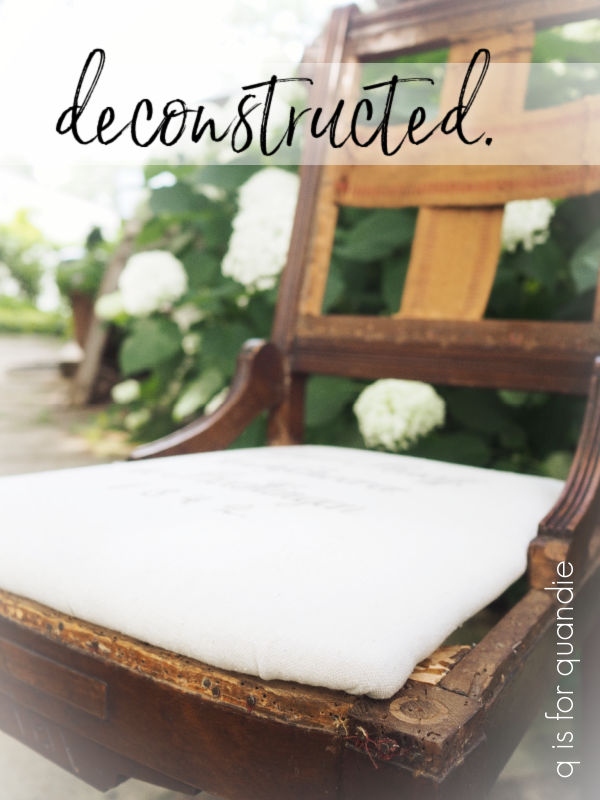
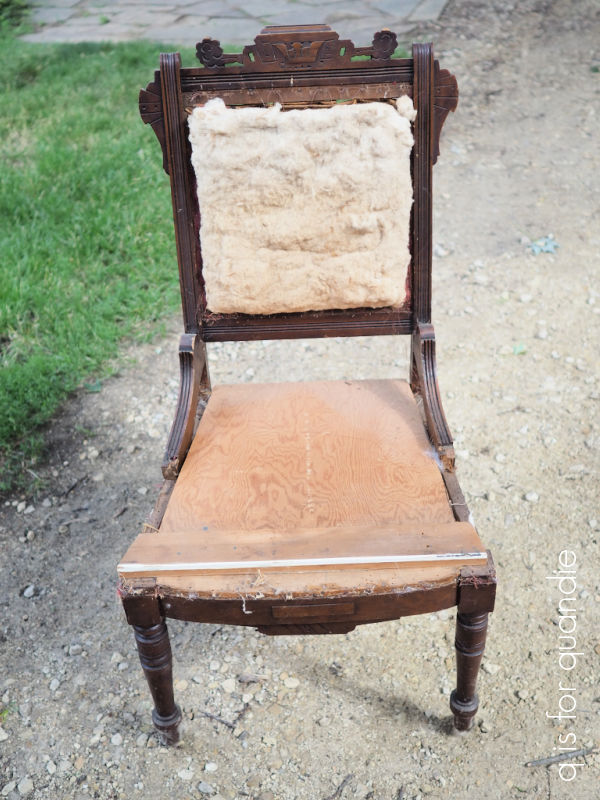
First up, I removed the upholstery, which involved pulling about two million upholstery tacks.  Then I removed the really thick foam that was on the seat and clearly was not original to the chair.  That left me with this …

Of course I then removed that batting from the chair back, that may have been original but it was pretty gross.

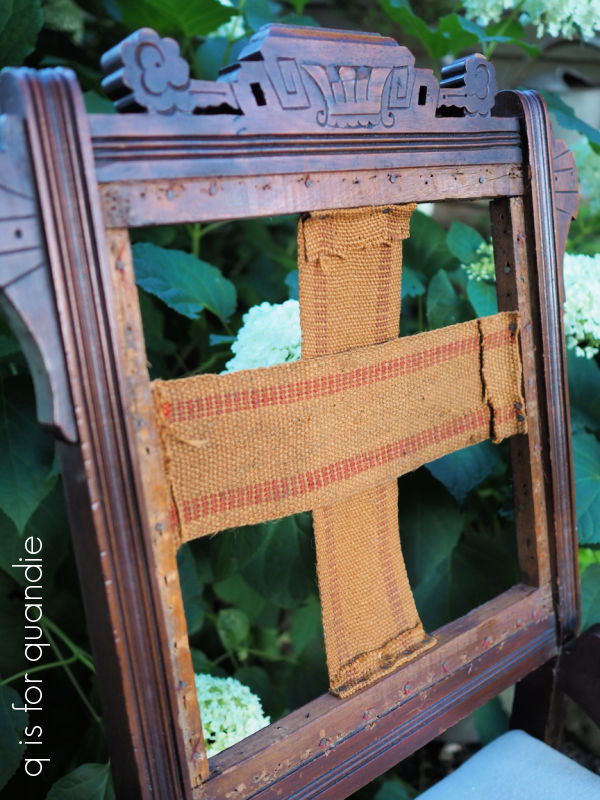
Then I stood back and evaluated.  I could replace the strapping on the chair back with new strapping.  But … at that point, what would be left of the original chair?  And would it have that deconstructed look that I love?  I decided to leave the old strapping in place.

I also debated keeping the plywood support that was in place on the chair bottom, but I’m fairly sure that wasn’t original either.  And I didn’t like the way that section at the front was half an inch higher than the rest of the seat.  So I asked Ken to cut a new seat bottom for me from a piece of thick particle board.

We didn’t get fancy, and rather than notch out the seat to fit exactly, I asked Ken to just cut it to fit front to back.  That means some raw edges are exposed, but again … it’s deconstructed.

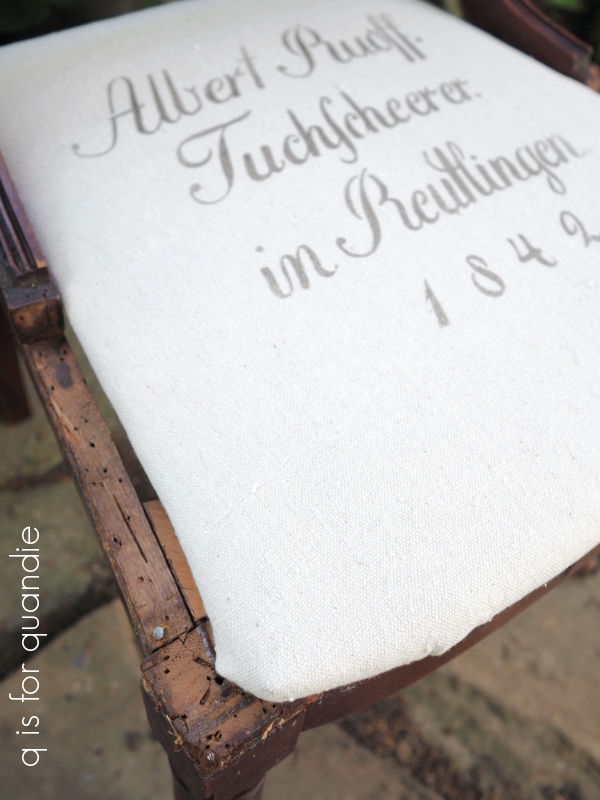
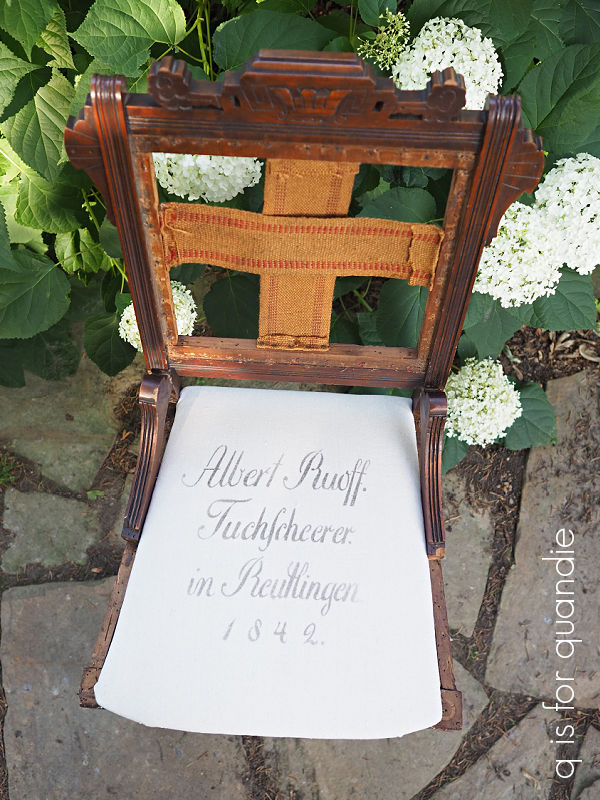
Then I covered the new seat with batting followed by a piece of drop cloth that I had stenciled with the Albert Rouff 1842 stencil from ellen j goods.

I used Dixie Belle’s Gravel Road paint to do the stenciling, I wanted it to look a bit more faded than it would have using black paint.

For those of you who struggle to get a clean line when stenciling, try stenciling on drop cloth.  It’s super easy and nearly fool-proof.

All of the exposed raw edges where the original upholstery was tacked into place just add to the deconstructed look.

Well, I think so anyway.

I also think the little wooden casters on the front two legs are a fabulous detail.

But I do wonder, why casters only on the front two legs?  There are no holes in the back legs, so they definitely never had casters.  What was the purpose behind having just two, or maybe it was simply for aesthetic reasons.

Four years ago I definitely planned to paint this chair with a creamy white milk paint and hopefully get some chipping.  But now I have to confess, even I am starting to veer away from painting everything.  So instead I applied Dixie Belle’s Big Mama’s Butta to the frame of the chair to clean up the wood a bit, but otherwise left it alone.

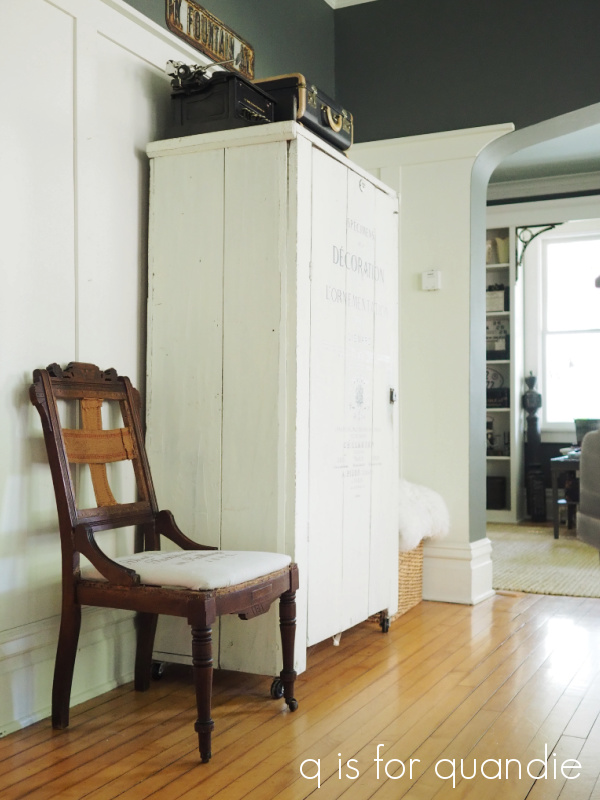
I have to say, I’m not sure if this dark wood works in the spot (shown above) where I plan to keep the chair though.  There is a lot of black (the baby grand, just off to the right), dark grey on the upper walls, and white.  It feels a little odd to throw in some dark wood.

So now I’m debating.  Do I go ahead and paint it?  Since I plan on keeping it, and I love me some chippy milk paint, maybe I should paint it.  What do you think?  Let’s take a vote.  Leave a comment below, paint or no paint?

Now, for those of you that played the drinking game with actual liquor, please don’t drive or operate heavy machinery.

Thank you to ellen j goods for providing the stencil used on my deconstructed (that’s 10, if you’re drinking) chair.

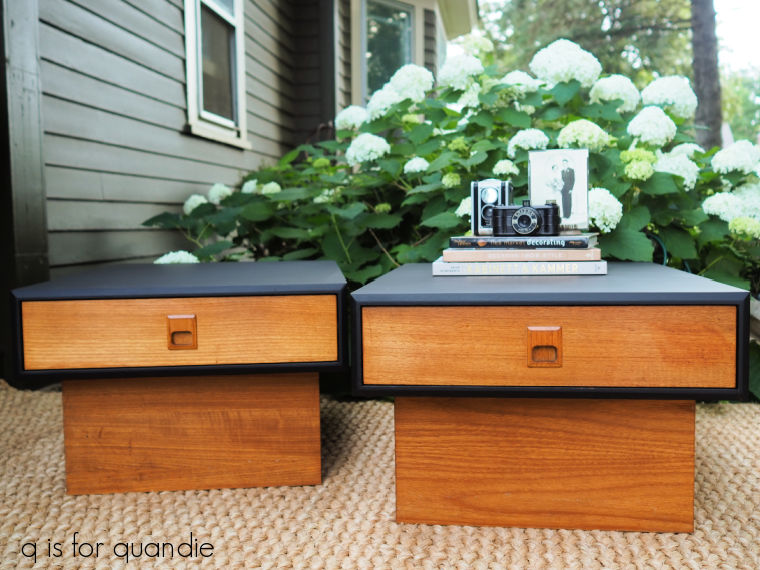
scandi end tables.

Moving forward on my plan to unstick myself, creatively speaking, I decided to work on this fabulous pair of end tables that came from my neighbor nnK’s parents.

She’d grown tired of them and replaced them with chrome and glass of some kind.

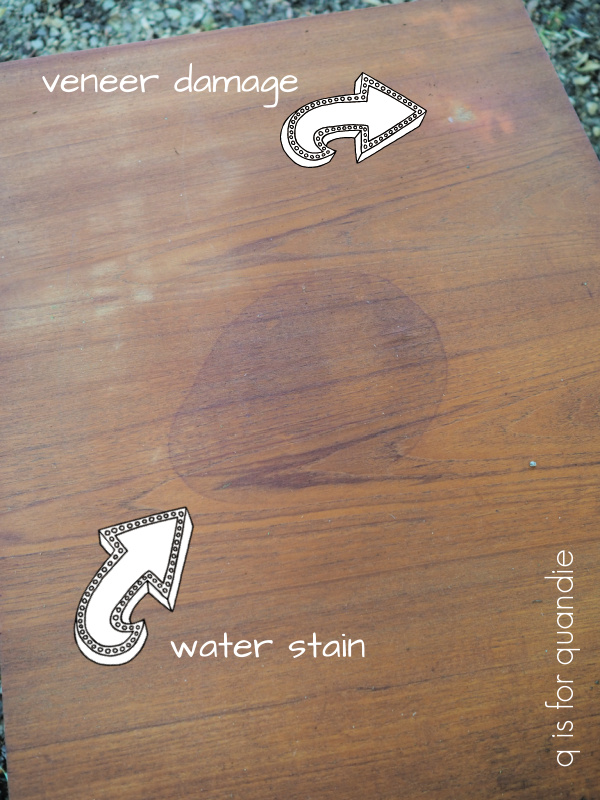
They look great from that angle, but nnk’s mom had kept houseplants on these tables resulting in water damage to both tops.

There was also a spot where the veneer was worn through, I’m not quite sure how that happened.  In addition, the pieces were discolored from years in bright and sunny living room overlooking the lake.

All of which meant that these tables were great candidates for some paint.

I decided to keep it super simple, just painting the damaged shells of the tables and leaving the drawer fronts and legs in their original finish.

Since the previous owners had often spruced up these tables with a coat of furniture oil of some kind, I gave them an extra thorough cleaning with Dixie Belle’s White Lightning which contains trisodium phosphate.  I usually use a TSP substitute, but in this case I thought I should go for the big guns.

Today’s q tip; always wear gloves when using TSP.  Also, be sure to rinse your piece with clean, plain water after cleaning it with White Lightning to remove any residue.

Once the tables were dry again, I sanded them with 220 grit paper to rough up the surface a bit and thus improve the adherence of the paint.

Finally, I painted the shell in Dixie Belle’s Silk paint in Anchor.  Just a reminder, Anchor is the black in the Silk line, Black Sands is a charcoal grey.  I was confused by that once and ordered the wrong color and I don’t want you guys to make the same mistake.

Once again, I chose the Silk line from Dixie Belle because of its built in primer and top coat.  It was super simple to add two coats of Anchor to each table.

The Silk paint has just a tad more shine to it than the very flat chalk paint, but I’d say it’s comparable to the sheen you get with a waxed chalk paint finish.

I then spruced up the existing finish on the areas that I didn’t paint using some of Dixie Belle’s Big Mama’s Butta.

By the way, the backs of the tables look like this …

And here is the completed pair.

I like the clean, modern lines of this Scandi looking pair.

Although this isn’t my usual style, it was still fun to breath new life into these tables with just a little paint and some butta’.  The next step will be to find out whether or not they will sell!  I’ll keep you posted.  Of course, if any of you locals are interested in purchasing this pair, be sure to check my ‘available for local sale‘ page for the details.

As always, thanks to Dixie Belle Paint Co for providing the White Lightning, Silk paint and Big Mama’s Butta used for this makeover.

getting unstuck.

As I’ve mentioned recently, my furniture is not selling very quickly (or at all) for me these days.

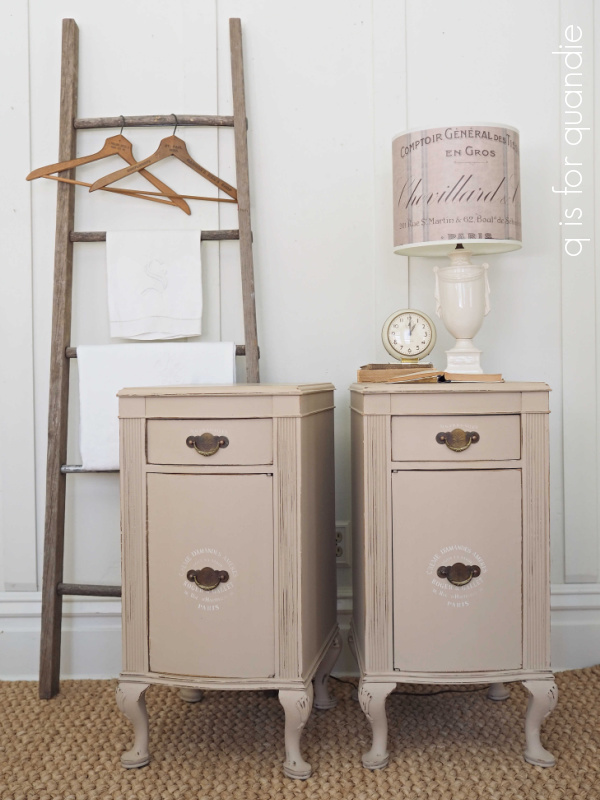
I had a really strong start to 2022.  I sold a number of pieces in January and February including the nightstands made by separating the two sides of a vanity …

this gorgeous armoire …

the barrister bookcase …

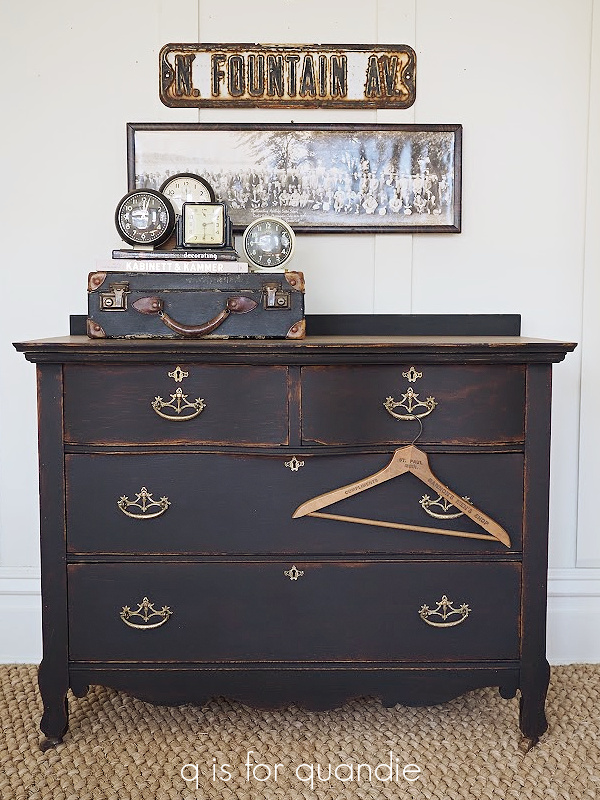
a primitive chippy dresser …

and the botanical cupboard …

But since then the only piece of furniture I’ve sold is the dry sink.

Well, and also the rusty garden furniture, which I suppose does count as the sale of furniture.

I’ve been selling refurbished furniture for a long time, and if there is one thing I can say for sure, it’s that it is very difficult to predict what will sell and what won’t.  Mainly because it changes all the time.

For a while there, dressers were a sure fire seller for me while more unique pieces like dry sinks, armoires, book shelves or restyled radio cabinets were likely to be more difficult to sell.  Now the opposite seems to be true.

One of the problems I have when unsold pieces start backing up is that I have nowhere to store them safely.  Sure, I could put them out in the carriage house, but it is damp and dirty out there (not to mention the bugs and critters).  Definitely not a great environment for storing my finished pieces.  They really need to be inside the house, so I line them up in the dining room.  And currently I’m out of space out there.

But really, the bigger problem I have when pieces aren’t selling is that I get stuck creatively.  I totally lose my motivation for working on more furniture.  I just can’t continue to add to the pile.  It starts to weigh me down.

So I took some time this past holiday weekend to try and brainstorm some potential solutions to this problem and I came up with a few ideas.

First up, I have this washstand that hasn’t sold.

I decided that I really liked this piece myself, and it could possibly work in my front hallway.  So I put it out there just to see how it would look.

It turned out to be a good fit.  So at least it’s out of my dining room and freeing up some space in there for now.  I’ll continue to list it for sale, but in the meantime I’ll enjoy it in my hallway.

Next up is the bench.

As you may remember, this is look number 3 for this bench.

If it still doesn’t sell in the next month or so, I may possibly take it into the shop where I sell on consignment.  I don’t usually take big pieces of furniture to them, and I have to wait until they have space for it, but maybe I can reach a wider audience … or at least a new audience … there.

I’ve also decided to try something a little more trendy on this piece …

I’m going to strip the drawer fronts and then either leave them as raw wood or add a white wax.  Then I’ll repaint the rest of the shell in a closely matching chalk paint, maybe Dixie Belle’s Putty or maybe the Burlap that I used on those nightstands.  Or maybe I’ll just strip the whole thing.  I’m not sure yet.  But it will be getting a new, raw wood sort of look.

If that ends up helping it sell, I may have to rework the other two dressers that aren’t selling.  This one …

and this one …

Another idea I had is to try going in a little different direction with the style of pieces I work on, starting with this set of modern end tables.

I’ll be sharing their makeover with you tomorrow.  And then we’ll see if these sell quickly or not.  If so, maybe I need to change up my inventory and focus more on mid mod pieces?

And finally, I’m also going to spend some time working on a couple of projects for myself.  I have a cabinet that I’ve been meaning to get to that will be part of a makeover of my shed/photo cottage, and I also have a headboard that I’m making into a sign to hang on the carriage house.

So hopefully in the end some/or all of these options will help me get unstuck.

I’d love to hear from any of you that are furniture refurbishers.  What is selling for you these days?  And when you get stuck, how do you get unstuck?  Leave a comment and let me know.

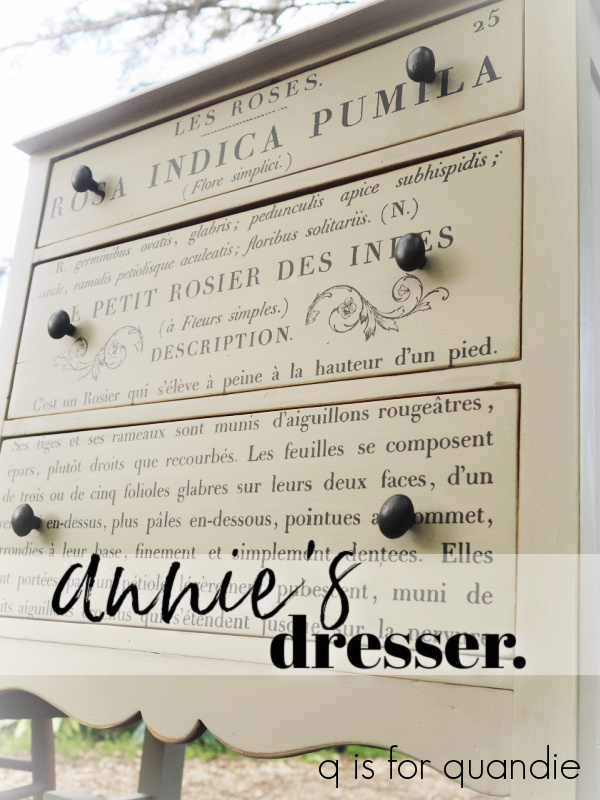
annie’s dresser.

Back when my friend Annie gave me the toolbox that I shared back in May, she also had two dressers that she wanted to part with.  I really thought I would get to these sooner, but here it is the end of June!

I have to say, I thought time would slow down a bit once I was retired from the full time job.  But if anything, it just goes even faster!  I also thought I’d have plenty of time to get EVERYTHING done.  Ha!  Jokes on me.

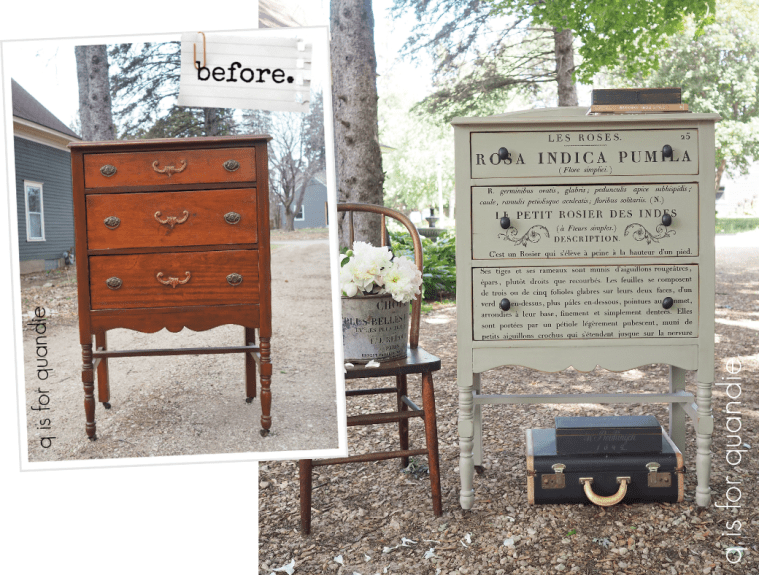
But I finally have the first dresser finished.  Here’s how it looked when I brought it home way back in April, before there were leaves on the trees or plants coming up in the garden.

If you predicted that I would remove those carved details from the drawer fronts, you were right.  It’s funny, there was a time when I was adding details like that to plain pieces.  Now I’m taking them off.  Just goes to show how trends change.

They were easy to remove using a chisel to pry them away from the drawer.  They had been both nailed and glued, so once I had them off I sanded any remaining glue off the drawers.

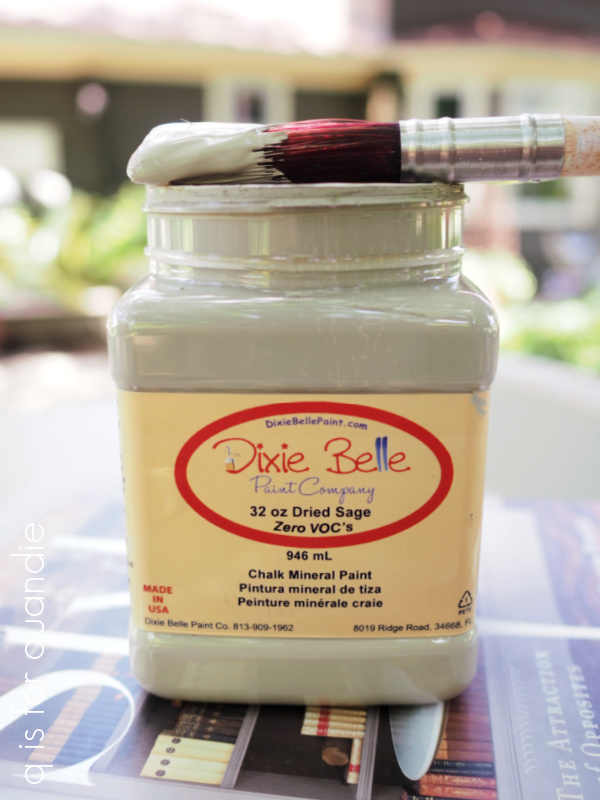
I wanted to break out of my Drop Cloth/Midnight Sky (ie. warm white/black) comfort zone and try a new color, so I pulled out Dixie Belle’s Dried Sage.  They describe this color as a soft gray with green undertones, which is pretty darn accurate.

So, OK, maybe I didn’t take a really huge leap out of my comfort zone.  More like a baby step.

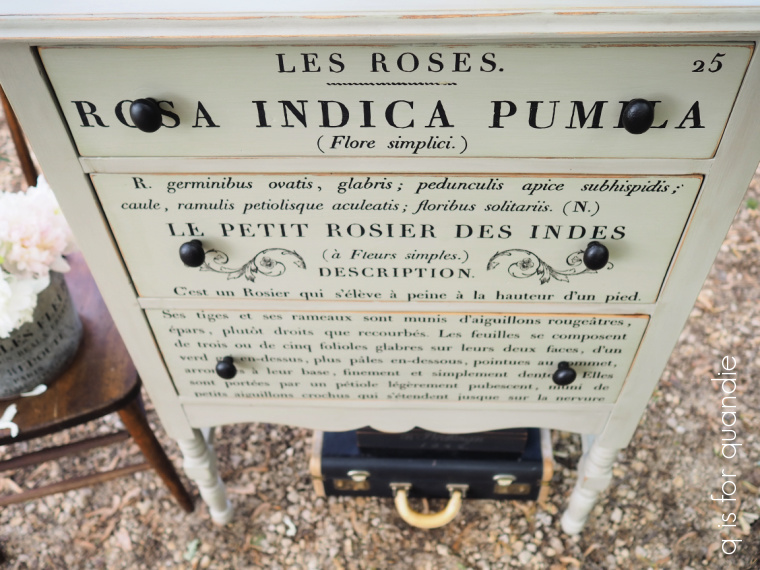
After my usual prep process of lightly sanding and cleaning this piece, I gave it two coats of Dried Sage.  Once it was fully dry, I added I.O.D.’s Petit Rosier transfer to the drawer fronts.

Once I had the transfer applied, I top coated the piece with Dixie Belle’s flat clear coat.

After the clear coat was on, I got busy with other things and the dresser sat for a few days.  That was when disaster struck.

Well, OK, ‘disaster’ might be a bit of an overstatement, but basically the water based topcoat drew the stain through the paint.

I’ve had this happen before, and quite honestly I should have known better with this piece.  Looking back at the reddish orange stain on the piece in the ‘before’ photo, I don’t know why I didn’t just head this problem off at the pass with a coat of Dixie Belle’s B.O.S.S. to block stain bleed through.  Often times you’ll see bleed through right away with the first coat of paint, but every once in a while the stain won’t bleed through the paint until you add that topcoat.  And even then, it can take a couple of days to show up.

Normally at this point I would just start over with a coat of B.O.S.S. followed by another coat of paint.  But in this case I’d already applied a slightly pricey transfer to those drawer fronts.

Fortunately, the drawer fronts didn’t look that bad.  So I added a coat of B.O.S.S. to the top and sides of the dresser and then headed off on my trip to my mom’s house.  When I returned a week later, I added another coat of Dried Sage to the shell of the dresser.

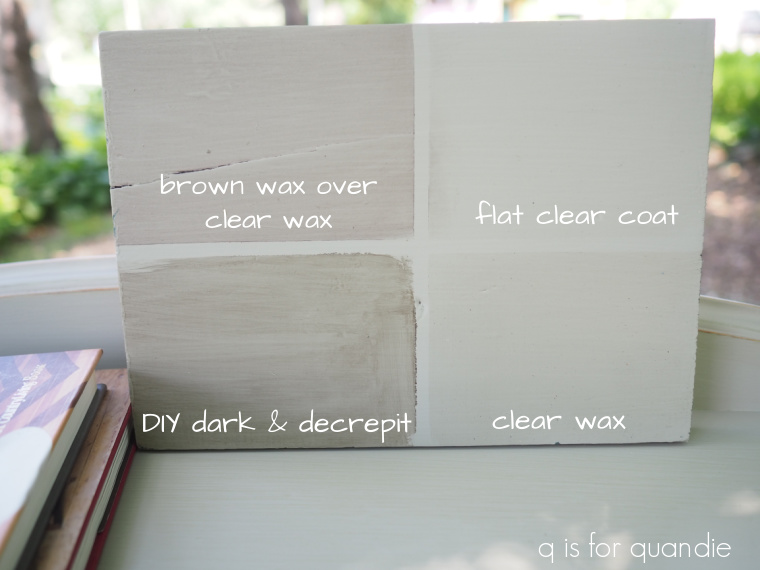
As I expected, the areas with the B.O.S.S. were a slightly lighter color than the drawer fronts.  So I decided to see what I could do with different top coats to darken them up.  I dug out a practice board, painted it in the Dried Sage and then tried four different top coats.

As you can see, the flat clear coat just barely darkened up the color of the paint.  Clear wax darkened it just a teeny bit more.  The DIY Dark & Decrepit was too much.  But I decided that I could work with the Dixie Belle brown wax over an initial coat of clear wax.

Today’s q tip:  if you start with an initial coat of clear wax, the dark wax you add over it will be easier to manipulate and blend.  It will also make it easy to remove any excess dark wax if you put too much on your piece.  You can go back with clear wax on a rag and use it like an eraser to remove some of the dark wax.

So, I clear waxed the shell of the dresser first, then added some dark wax here and there, especially around the drawers to blend the color of the drawer fronts with the color of the shell.

I think it worked out fairly well.  Obviously this is a case of do as I say, not as I do.  I’m reminded to hedge my bets by starting with a coat of B.O.S.S. whenever I encounter a stain that even remotely looks like it might bleed.

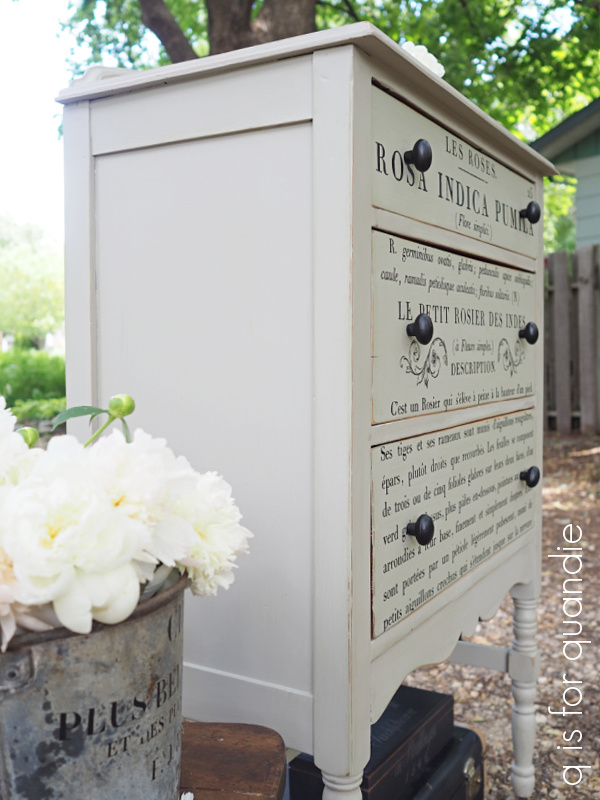
The sides of the dresser are much improved.

You may have already noticed that I did not put the original hardware back on this piece.  I planned to initially, but after seeing how nicely the black transfer contrasted with the Dried Sage, I decided to go with a simple black knob from Hobby Lobby instead.

Finally, I lined the drawers with some pretty paper.

And with that, Annie’s dresser has been made over.

What do you think?

This dresser is for sale, be sure to check my ‘available for local sale’ page for details.

Thank you to Dixie Belle Paint Co for supplying their products used in this makeover.