My favorite way to fill time in an airport is by checking out the magazines. I almost always find some that I never see at my local supermarket. Of course, when I am on foreign soil, that is especially true. My recent trip was no exception. We had some time to kill in the Nuremberg airport, so I nabbed a few German magazines.

In case you are wondering, no, I pretty much can’t read any German. I just got them for the pictures!
It’s fun to compare decorating styles. Of course, European and American decorating styles aren’t going to be wildly different. I am sure that a lot of our trends here come from Europe, and vice versa. I saw a lot of things that would be right at home in an American magazine. The plaid wool throws in the picture above for instance.
Or the lovely grey sofa in this one …

To me though, the furs feel undeniably northern European.
And even though I know we can get SMEG refrigerators in the U.S. now, I still think of them as quintessentially European.

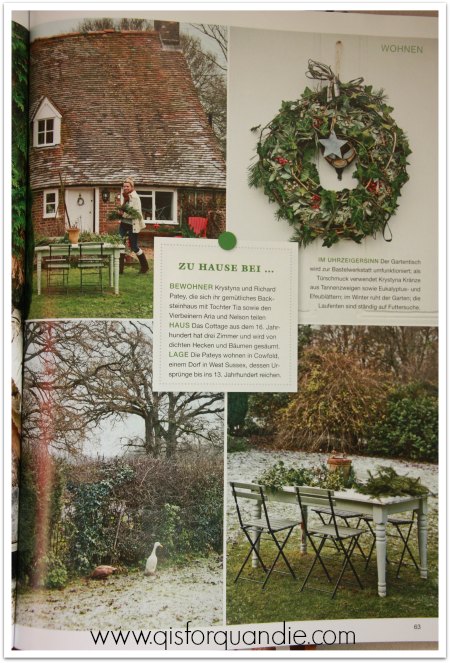
Some things need no translation, like the Christmas wreath and a fab farmhouse table with French bistro chairs. Apparently these are coveted over there too.
And then you have something like this next one. Title in English, decor in English (poster on the wall), but the rest of the article in German. Is this room in Germany? Look at the funky radiator under the window (at least I think that is a radiator), is that a clue?

I just don’t know, but I do know that I love this sort of industrial chic look.
Now that I have finished perusing my German decorating magazines, I thought it might be fun to share them with you. If you leave me a comment, I’ll put your name in a drawing and 4 lucky winners will get a magazine (sorry, drawing open to U.S. residents only). We have to make this quick, since I want you to get your magazine before Christmas, so the drawing will close on Friday, December 5. Leave me a comment if you’d like to have one!