when is rusty just a little too rusty?

My friend Sue snagged this rusty old Cosco stool for me last summer.  I posted it on my Facebook page at the time with this caption.

I struggle with this question.  More so when I’m going to sell something rather than keep it.  Personally I like distressed, beat up items that show their age (no wise cracks about Mr. Q here please).  I sometimes cringe when people cover up a beautiful distressed patina with fresh new paint.  If I had been keeping this for myself, and if I liked the yellow and white, I would have cleaned it up and kept it as is.

But alas, I don’t need another stool, and I really feel like this item will sell better with a paint job.  This led to the next question, how should I prep it?  I have found that if you don’t seal a rusty metal piece, the rust will seep through your new paint.  Again, I don’t necessarily mind that.  It’s a fun way to change up the color of a metal item, but to instantly re-gain some of that rusty patina.

But again, how rusty is too rusty?  This stool had a lot of rust.  So I decided to go ahead and seal it.  I started by vigorously sanding the seat and back fairly smooth and lightly sanding the rest.  Then I painted on a coat of the Rachel Ashwell Clear Primer.  Once dry, I painted a coat of Fusion’s Laurentien on the base and Fusion’s Raw Silk on the seat back.

I know I’ve said it before, but it bears repeating.  I absolutely love Laurentien.  It’s a gorgeous pop of turquoise!

When the paint was dry, I felt like the stool looked far too crisp and freshly painted though.  So I sanded down the edges of the seat back.  And the tops of the steps.

But when I started sanding the edges of the seat itself I quickly realized that I didn’t like seeing the yellow peek through, so I decided against any further sanding.

As I studied the ‘finished’ stool, I really felt like it needed just a little something more.  So I pulled out my Iron Orchid Designs transfers.  The bottom section of the small “Richardson Seeds” transfer was a perfect fit for the seat back (I used the full transfer on the green window recently).  This is another of the cool things about these transfers, you can use just a portion of one and save the other part for another project.

To give the transfer a little extra protection, I waxed over it with clear furniture wax.  But I assume the future owner of this stool won’t actually be sitting in it leaning against the back too terribly often.  If I was expecting that kind of use I would add a matte finish poly over the transfer.

Although this would be adorable in a potting shed, I think the comments on my post for the Blue Alligator dresser on Monday pretty much established the fact that most of us aren’t lucky enough to have one.

 So, how about just using it in your kitchen as intended?

After all, when a step stool is handy, everything else is too!

happy birthday to reclaiming beautiful.

Hey local readers, Reclaiming Beautiful is celebrating their 2nd birthday today!

They will be open from 3 pm to 8 pm, and they’ll have door prizes, special event pricing and refreshments.  Plus as a added bonus they are giving away a Reclaiming Beautiful Candle with every purchase over $50!!!! (while they last, so get there early)

Reclaiming Beautiful is located in beautiful historic Stillwater, Minnesota next to the post office at 216 Myrtle Street West.  Hope you can swing by!

copper patina.

In Monday’s post I mentioned that I used a new (to me) technique on the hardware for the blue alligator dresser.

The original drawer pulls on the two bottom drawers of the dresser (which I kept) were a very well aged brass, but my 4 replacement knobs for the top drawers were a kind of tacky new ‘brassy’ color.

I realized this would be the perfect opportunity to pull out the Modern Masters Metal Effects patina kit that I purchased last year at Hobby Lobby and use it to unify my old and new hardware.

(By the way, I used the rust kit on my rusty bull last year)

The copper patina kit comes with a small jar of primer (which I ignored), a small jar of copper paint and the activator.

I started by painting my knobs and the original drawer pulls with the copper paint.

Before the second coat of paint was dry, I sprayed on the “green patina aging solution” that came with the kit.

As it dried, I could see the patina beginning to form.

Which made these knobs just about perfect for the blue alligator dresser.

They blend quite nicely with my custom Blue Alligator milk paint color, thus allowing that gorgeous transfer to be the star of the show.

The only thing I’m not sure about is how well the finish will hold up to use over time, and whether or not I should be sealing it with something.  Here is what the Modern Masters website has to say about it:

Applying Sealer Effect, a protective sealer and top coat is highly recommended over the Iron/Rust Finish. Particularly on interior surfaces where there may be contact or exterior surfaces to prevent runoff of the rust finish caused by rain or sprinklers onto surrounding areas. It is not necessary to seal/topcoat the Copper/Green Patina or Bronze/Blue Patina finishes, except if the patina surface is subject to repeated hand contact, such as hand rails.

So … yes?  no?  maybe?  Do any of you have experience with how these finishes hold up over time?  If so, please share your knowledge in a comment!

blue alligator.

I had been keeping an eye on the Craigslist ad for this dresser for at least a month.  I thought it had potential, but at $100, it was overpriced (which is why it sat on Craigslist for so long).  I finally decided to send the seller a lower offer and they agreed to my price.

When Mr. Q and I arrived to pick it up, the seller told me that she’d had it posted for $200 originally and it never sold.  She’d ultimately realized that she really just wanted it out of her garage, so that’s why she lowered the price to $100 and then further agreed to my even lower offer.  The implication being that it was worth way more and I was getting a heck of deal.

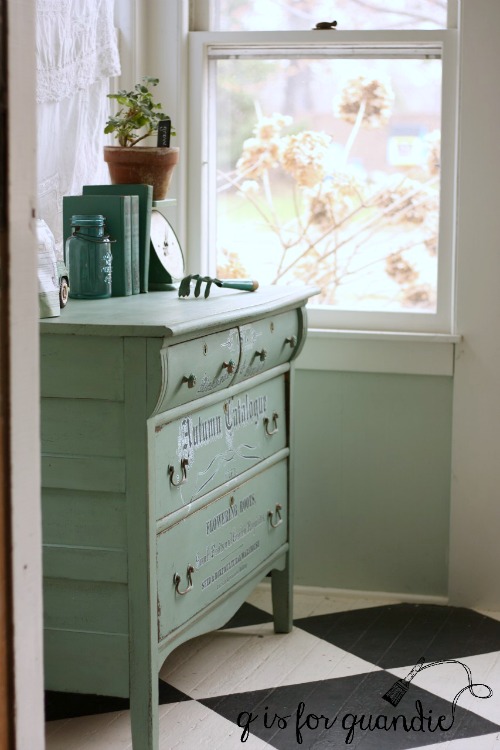
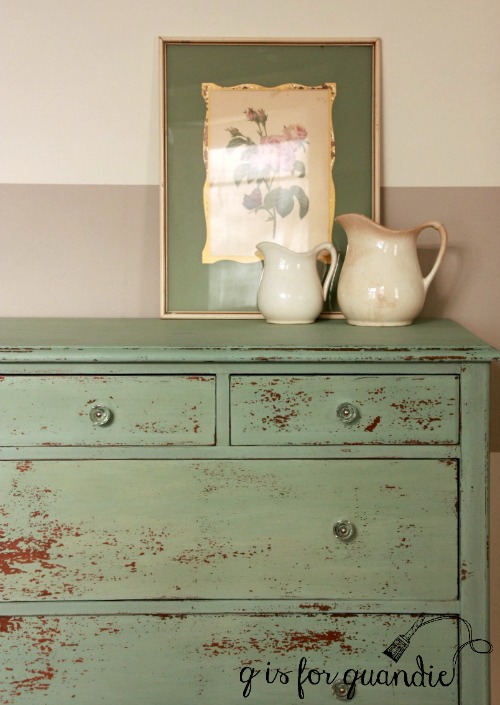
Some people seem to think that anything that is more than 80 years old is a valuable antique.  Not true.  Condition is everything in the world of antiques, and this dresser was in pretty poor condition.  Starting with the fact that at some time in its life someone cut the sides off the top.  I assume they needed to fit it into some narrow space and the only way to accomplish that was to trim it down a little.  In addition, just check out this alligator-ed finish …

On top of that, the knobs on the top drawers were completely bent and misshapen, the drawers were hard to open, and there were paint drips all over the top.  And did I mention that it was positively filthy and obviously had been in that garage for quite some time?

But I bought it anyway.  I could see it still had potential, just not $100 worth of potential and certainly not $200 worth!

To get started, I sanded it down just slightly and then cleaned it with vinegar water.  Next I sanded down the sides of the drawers (where they sit on the glides) and then rubbed a block of canning wax over them so they would glide more easily.  Then I once again used my ‘perfect chipping method‘ and added some Homestead House Salad Bowl Finish (you can also use Miss Mustard 100% beeswax) in spots that I wanted to chip.

Choosing to go with milk paint on this dresser was a no-brainer.  Milk paint and alligator are the perfect pair.  The tricky part was deciding on a color.  Since I’d gotten several comments recently from readers who love seeing more color and are bored with white, I thought it would be fun to go more colorful with this one.  I wasn’t in the mood for any of the straight up milk paint colors I had on hand though, so I decided to create my own.

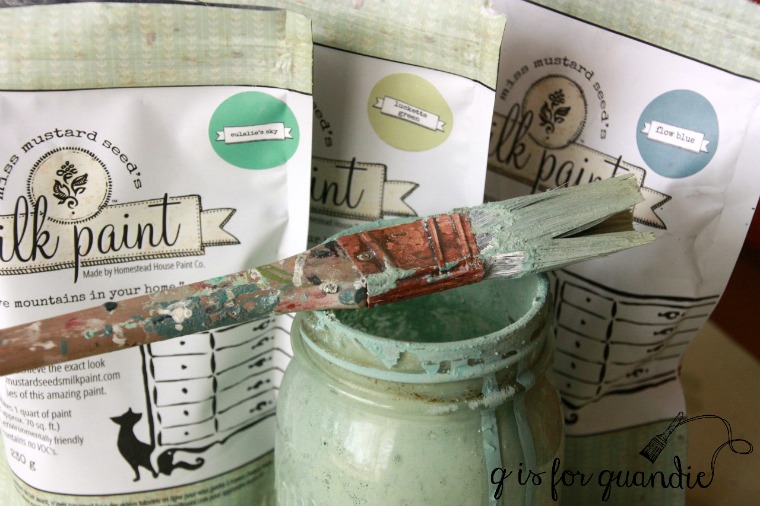
Now I’ll just go ahead and apologize right now to those of you who might want to try and recreate this color.  Not that you can’t do it, but it will require three different colors and two different brands of milk paint because this color is a mix of equals parts Homestead House Loyalist, Homestead House Upper Canada Green and Miss Mustard Seed Kitchen Scale.

I think I’ll call this color Blue Alligator.

And see what I mean about milk paint and alligator?  Such an awesome effect.

I’m not sure any of my photos do justice to Blue Alligator, and I don’t think I can adequately describe how it differs from straight up Kitchen Scale.  It has a little more green than Kitchen Scale (thanks to the Upper Canada Green), and it’s a little more muted (thanks to the Loyalist), and it’s a little bit lighter.

And I have to tell you, I loved this color so much I painted two more things with it.  A chalkboard and another piece that you’ll be seeing in the next week or two.

Painting this piece ended up being the easy part.  Two quick coats and it was done.

Next came the exciting part.  I pulled out another of my Iron Orchid Designs transfers.  This is the larger version of the same design I used on my green window last week.  In fact, this transfer was actually too large to use on this dresser ‘as is’, so I cut it apart and just used the sections that worked.  If you look closely you’ll see that my dresser is a mishmash of various pieces of it. I did each layer (top, middle, bottom) of drawers separately.

According to the Iron Orchid Designs YouTube videos, you can put any typical top coat over their transfers.  So I went ahead and waxed the dresser with Homestead House furniture wax next.

Finally, I found some knobs in my stash for the top two drawers.  They looked a bit too new next to the original drawer pulls though, so I decided to try a new technique on them and added a copper patina.  I’m going to post about that process in more detail later this week, so be sure to check back for that.

So now, what do you think?  Is this thing just gorgeous or what?

OMG!  Right?

Wouldn’t this dresser be amazing in a potting shed?

I could also see it working perfectly as a small buffet in a dining room.

It actually looks pretty much perfect right in that spot on my front three season porch.

But I’m not planning to keep it.

Of course, if it doesn’t sell … well, let’s just say I won’t be crying in my coffee.

For now though, this dresser is for sale, so if you are local and need a gorgeous dresser be sure to check out my ‘available for local sale’ tab.

use extreme caution.

I told you guys that I ordered a half dozen more of those gorgeous Iron Orchid Designs transfers from Sweet Pickins.  They arrived last Friday and I was so excited!

I had decided that I wanted to use one of them on an old window.  I actually nabbed this window last year at a neighborhood trash to treasure day (you can read about that here).

The window is leaning against the back of that pile of stuff, on the left, see it?

Just your basic old window.  Not super old, probably from the 50’s or so, but it had a cute little handle which gave it a little extra personality.

To give it a little additional appeal, I first painted it with Sweet Pickins’ milk paint in a color called In A Pickle.  I love this rich green color!

Next I cleaned the glass thoroughly.  I got out one of my new transfers, removed the backing paper and went to place it on the glass.  That’s when disaster struck, well, sort of.  I forgot about how glass and rub-on transfers are attracted to each other like magnets.  As soon as that transfer hits the glass there is no picking it back up again.  This was quite different from the experience I had with the Specimens cupboard.  With that I was easily able to move and re-position my transfer several times before I got it straight.  Not so this time.  I put it down and it was not going anywhere.

I definitely should have known better.  I’ve used plenty of transfers before, on glass, metal, wood, paper and plastic.  I just wasn’t thinking.

Luckily I had placed it down fairly centered and straight!  I would have preferred to have the design centered a little bit better vertically, but it wasn’t a total fail.

The instructions on the box this transfer came in say “these rub ons adhere best to a matte surface” so I guess I was breaking the rules a bit by putting it on glass.  Forewarned if forearmed though people!  So if you decide to try using a transfer on glass, use extreme caution when you place it.  Be sure you’ve got it in exactly the right position the first time.

I added some eye hooks and chain to the window so that it would be hung somewhere.

By the way, I used the smaller version of this transfer which is 11″ x 17″.

There is also a larger size and I’m hoping to use that on a dresser I’m working on next, so be sure to stay tuned.

reinventing the wheel.

Have you ever seen a rusty, crusty old item with amazing patina and decided you simply must have it?

But what to do with it?

Such was the case with this old metal wheel.  I have no idea what it was on originally, by the time it came to me it was just a single chippy wheel.  Maybe it came off a vintage toy baby carriage?

Whatever its original use was, I turned it into a photo holder of sorts.  The photo of my grandmother is just clipped on with little metal clip and the metal label holder is a Tim Holtz product from his Idea-ology line (although they may be hard to find as they have been ‘retired’).

I’ve recently been moving some stuff around in my house and this wheel found a new home resting on the door handle on my Specimens cupboard.

I love the way it looks hanging there, but I have to admit it isn’t very practical.  I have to move it every time I want to get into the cupboard.

The combination of the old photo, the chippy wheel and that delicious furniture transfer is just about perfect though.

So until I get absolutely tired of moving it every time I open the cupboard, I think it will stay in this spot for now.

Do you have any odd little items that you’ve found a use for?  If so, I’d love to hear about it.  Be sure to leave a comment!

rescued from a bad 80’s makeover.

For a little while there I was having a serious furniture dry spell.  I had one piece in the Carriage House that was waiting for warmer weather and for Ken to perform some handy-man miracles (Ken is very susceptible to the cold).  Other than that, the Carriage House was empty.  Yep, you heard that right.  I am not one of those furniture re-vampers who has a storage facility full of pieces waiting for their moment in the sun.  I actually get a little twitchy when I have too much stuff being stored.  I prefer to turn pieces over quickly.

But the downside is that sometimes I run out of furniture to work on and there is nothing available on Craigslist.  And when I say nothing, what I mean is nothing that meets my criteria of not too far away, not too expensive, and with lots of potential.

As usual though, when it rains, it pours.  I went from finding nothing to spending three evenings in a row picking up pieces.  I came home with a three dressers, a bed, a desk and this washstand.

I paid a little more than I normally would for this piece.  Why?  Because it was crying out for a rescue from its 80’s style makeover.  Just check out those grape cluster decals.  Gack!  And those horrible knobs.  Ugh!  I have to tell you guys, one of my pet peeves is when people put two knobs in the holes that were originally meant for a drawer pull with two screws.  I get why they do it, but every time I see it I cringe a little inside.  It’s just not right.

But if you look past the bad knobs, those awful grapes, and that really splotchy orange-y stain, this is a gorgeous little washstand.  Such pretty details, right?

The prep on this piece started with stripping the top.  The wood was so lovely that I wanted to show off some of it.  While the stripper was doing its job, I scraped off those decals.  They came right off with a sharp razor blade.

Next I dealt with those pesky knobs.  I was really hoping that I had 4 matching vintage pulls that I could use, but no such luck.  I did have a pair of absolutely gorgeous pulls that I have been saving for special piece though.  And it just so happened the holes on the upper drawer were spaced exactly right for them.

So I decided to use those on the upper drawer and just simple single knobs on the two lower drawers and the door.  To accomplish that on the drawers, I had to fill in the existing holes and later drill a new single hole in the middle.  Filling holes like this is really very easy.  Put some tape across the hole inside the drawer so that as you add wood filler from the front it doesn’t just escape out the back.  Then, fill the hole with wood filler.  I used Elmer’s Pro Bond Wood Filler in Walnut on these drawers, mainly because that’s all I had on hand.  The walnut was a bit dark, but I was painting over it anyway.  All of the wood fillers claim to ‘resist shrinking’, but I find that they all shrink.  In other words, when your fill dries it will recede back a little.  So go back with another application of fill.  Sometimes you’ll even have to do this a third time (I did with this piece).  But you want that filler to be nice and flush with the surface of the drawer, not sunken in at all, or they will show later.

I let my stripper and my drying wood filler sit overnight.  The next day I scraped the stripper off the top and gave it a good cleaning.  Then I sanded the body of the whole piece lightly and gave it a good cleaning too.  I decided to use my method for perfect chipping again on this piece (more details on that method here), so I added a little beeswax to all of the edges.

Then I painted three coats of Miss Mustard Seed milk paint in Marzipan.

Once again, perfect chipping, just where I wanted it!

See my little photo bomber?  My cat Lucy is hiding underneath the washstand.  I couldn’t get her to stay out of my photos.

I was initially considering staining the top of this piece, but the wood was so pretty in its bare and natural state so I waxed it with Homestead House furniture wax.  But that brought out a little too much of the golden hue of the wood, so I toned it down by adding some Homestead House white wax over that.

Not so golden, and definitely no longer orange!

What do you think?  Did I successfully rescue this washstand from the 80’s?

This little charmer is for sale while it lasts.  Pieces this size make a perfect bedside nightstand!  Check out my ‘available for local sale’ tab for more details.

a swing and a … miss?

I have a decorating split personality.  I really struggle with it.  You see, the problem is, I like more than one style.  As a result I often find myself going sort of half-way there and ending up missing the mark entirely because I can’t commit fully one way or the other.

For example, I love the French Nordic look with mostly white painted pieces, lots of age showing and maybe a hit of black or grey.  Love, love, love this look.

source

That’s the direction I headed in with my new Specimens cupboard.

But I also love color.  Especially pale aqua, but also blue and greens, and I don’t mind mixing in some pinks or yellows as evidenced by the collection of stuff in my pantry.

You can’t really mix these two styles without diluting them somewhat.  Certainly not in the same room, or rooms that are visible from one another.

So my problem is, I really want to gravitate towards the French Nordic look, but I can’t bare to part with some of my favorite more colorful pieces.  I’ve been making a concentrated effort to head in that direction over the past year or so though.  That is partly behind my switch from the Kitchen Scale buffet (even though I still love that color!) to the Specimens cupboard, although function also played a part in that decision.

As part of that switch, I also recently repainted my grandmother’s chair.  If you’ve been following me since the beginning you may vaguely remember when I painted this chair in Miss Mustard Seed’s Flow Blue.  That was three years ago!  My how time flies.

I wasn’t too sure about the Flow Blue on this chair.  It was the first time I’d used that color and I was a little startled by how bold it was.  But it grew on me over time and it worked well with my blue walls.

But in keeping with my switch to a more neutral palette, I decided a muted grey would work well on this chair.  Since I have a ton of milk paint on hand already, and I’m pretty frugal, I also wanted to use a color I already had.  I went to my milk paint supply cupboard and looked for some Miss Mustard Seed Trophy.  Nope, didn’t have it.  How about some MMS Schloss, that’s what I really wanted.  Nope, didn’t have it.  Then I saw my bag of Homestead House milk paint in Bedford.  I love this color, but it is definitely a very warm greige rather than a typical grey.  But I thought it might work.  So I mixed some up and painted the chair.

Hmmm.  A swing and a miss?  When I put the chair back in place, I really didn’t love it.  I don’t think it works that well with the blue walls.

But then I moved it over next to the Specimens cupboard …

And it seems to be much more at home.   So for now I think I’ll leave it in this spot, and I’ll keep on working towards that French Nordic style.  The next thing to go might be those horizontal stripes on my walls in this room.  Be sure to stay tuned!
methods for transferring graphics.

After reading some of the comments on Monday’s post about my ‘specimens de la decoration’ cabinet, I realized that a post comparing rub-on transfers, gel transfers, stencils and hand-painting might be worthwhile.

Are you a fan of adding words or other graphics to furniture?  Or even perhaps to your walls or other items of décor around your home?

I’m sure I’ve already established that I am definitely a fan, and I think I’ve tried just about every method there is to get them on there.  There are pros and cons to each.

Are you familiar with the project management triangle?

The theory behind it is that you can’t have all three things on the triangle at once;  fast, good and cheap.  You can only achieve two out of the three on any one project.  You can have cheap and fast, at the expense of quality.  You can have quick and high quality at the expense of low cost.  Get the concept?  It applies well here.  The cheapest options are also the most time consuming.  The most expensive are the easiest and produce the highest quality result.  But let’s go ahead and evaluate each one, shall we?

Rub-on transfers.

Not to be confused with gel medium transfers, which I’ll discuss in a minute, a rub-on transfer is a ‘dry transfer’ that is on a ‘backing material such as paper or plastic sheeting much like a transparency’ (Wikipedia).  They are applied by placing the sheet with the transfer down over your intended surface and rubbing the sheet with a tool of some kind until the transfer is adhered to your surface.  Rub-on’s will give you a high quality appearance and are fast to apply, but they cost more than other options.

Pros:  I think rub-on’s have the most professional look.  The designs can be much more highly detailed than stencils; in fact they are absolutely gorgeous.  They are easy to apply.  You can use them on painted surfaces, wood, metal, glass, plastic, paper … have I missed anything?  Until now I was only aware of rub-on’s for small craft projects, but I’m thrilled to have found large transfers for furniture!

Cons:  They are expensive and can only be used once each.  There is a little bit of a learning curve if you’ve never used them before because you have to get used to making sure the entire design is properly adhered before you remove the backing.  I wouldn’t use a rub-on transfer on a surface that will get a lot of wear such as on the seat of a chair or a table top.  I don’t think it would hold up well under that kind of use.

Stencils.

Stencils are usually made out of a piece of Mylar with the design cut out of it, although sometimes they are made with heavy paper or even metal.  They are applied by placing the stencil over your intended surface and using a stencil brush and paint with a pouncing motion to fill in the design.  Stencils will also give you high quality and fast, but not cheap.

Pros:  Stencils also have a very professional look when done well.  They are very quick and easy to apply.  You can re-use them over and over and over, thus lowering the cost per use.  You can easily use a painted stencil design on a chair seat or table top as it will wear the same as any other paint treatment.

You can get creative with stencils using just a portion of the design, or pairing up multiple stencils to create a larger design.  Another big plus to stencils is that you can use them on fabric, one of my favorite techniques.

Cons:  Stencils are also rather expensive.  Especially if you are only going to use it once on a specific project.  In addition to the cost of the stencil itself, you’ll also need to purchase a stencil brush and paint.  The price of stencils really only makes sense if you are going to be able to use them multiple times.  In addition, there is a bit of a learning curve with stencils.  Some people I’ve talked to claim they have never been able to develop the knack for getting a clean line with a stencil.  It does take some practice.  A sloppily done stencil is not a good look.  Also, stencil designs aren’t quite as delicate or detailed as a rub-on can be.

Gel transfers.

A gel transfer is made by printing a mirror image of your intended design onto paper with a LaserJet printer, then applying transfer gel to it and placing it face down on your surface being careful to eliminate any bubbles or creases in the paper.  You wait 12 hours, then use water to gently remove the paper leaving the design behind.  This method is cheap and creates a good quality transfer, but it isn’t fast since you have to basically wait overnight before removing the paper.

Pros:  This is a very cost effective way to add transfers.  A container of the transfer gel is under $20 and will last quite some time.  I haven’t even gotten halfway through my jar of Fusion Transfer Gel and I’ve done countless projects with it.  I’ve had the best success using transfer gel on freshly painted surfaces such as wood, cardboard, or metal.  I’ve read that you can use this method to transfer images onto fabric as well, but I’ve never tried it.

Cons:  I’ve also had some failures trying to use transfer gel on metal.  It always works over freshly painted metal, but I’ve had the gel peel right off both unpainted metal and metal with an old paint job taking the design with it.  It would also not work on unpainted cardboard or paper, or anything else that can’t get wet.  I’ve read that people use it on glass, but I’ve never tried it (do any of you have experience with this?), I wonder whether the gel can peel off the glass in the same way it did for me on unpainted metal.  Transferring a design larger than the letter or legal size available on your home printer will require having it printed at a Kinko’s or other print shop, adding a little bit to the cost and a bit of extra time to the process.

Tracing and hand-painting.

There are two ways to trace a design onto your surface and then hand paint it.  The first is to print your design on paper, then use tracing paper (in either white or black depending on the color of your intended surface) to trace the entire design onto your surface.  Then go back with a small artist’s brush with paint and fill in the design.  The second option is to print your design on a letter sized piece of paper, then use an overhead projector to project the image onto your intended surface.  Trace the design using a pencil, then go back and fill in with paint by hand.

Pros:  If you happen to already own a projector and you have excellent painting skills, this is a cost effective way to add a graphic.  Using a projector is also a good way to add a really large graphic to a piece of furniture and be able to size it correctly.  The alternative tracing paper method is very cost effective.  I still use this method for chalkboard designs, to be filled in with chalk, but I almost never use it for painting a design anymore.

Cons:   Back in the day though, this was the way I did all of my graphics.  Can you imagine?  Looking back I am astounded at how time consuming it was, and I was never entirely happy with the end result.  If you don’t have a steady hand and a couple of spare hours, this option is definitely not for you.

Cutting vinyl.

I almost didn’t include this option because it’s not exactly a ‘transfer’, but since I tend to use it fairly frequently I decided I should throw it in.  I use a Cricut machine to cut adhesive backed vinyl, but there are other types of machines out there as well like a Silhouette.

Pros:  Once you’ve made the initial investment in a machine, it’s relatively inexpensive to buy the adhesive vinyl and then the sky is the limit for the quantity of stuff you cut out.  Once you’ve learned how to use your machine, it’s relatively easy and quick to do.  The vinyl will adhere to painted surfaces, glass, metal and plastic.  It is flexible as well, so it works well on surfaces that aren’t flat.  Also, you can print out any word or saying that you can think of.

Cons:  You have to invest in a die-cutting machine like a Cricut or Silhouette, and they aren’t cheap.  You also have to spend some time learning how to use it.  The investment is not worthwhile unless you are going to do a fair amount of cutting.  In my case, with a Cricut that is not attached to my computer, I am limited to designs on font cartridges that I have purchased.  The cartridges themselves can be rather expensive.  If I was starting from scratch I’m not sure I would invest in a Cricut and multiple cartridges, but since I already had them for scrapbooking I’m now finding that I get a lot of use out of them for home décor projects.

That wraps up my synopsis of the various options available to you for adding graphics to your projects.  I don’t have an overall favorite, different projects are better suited to different techniques and aside from tracing and hand-painting I’m sure I’ll continue to use all of them.  How about you?  Do you have a favorite?  Or maybe you have another method that you like to use.  If so, please share with a comment.

the specimens de la decoration cupboard.

I’m not terribly savvy when it comes to Facebook.  I don’t seem to notice when people leave me messages there, so if you have ever left me one and it took me forever to get back to you, please don’t take it personally.  Somehow I just don’t see them.  I also rarely post stuff on Facebook.  I do have my blog linked to my Facebook page so my blog posts appear there automatically, but if you really want to interact with me the best way is to leave a comment here on the blog.

That being said, I recently joined a new Facebook group, How to Paint like a Pro, that was started by the Fusion people.  It has reminded me to never underestimate what you might learn from a group of like-minded individuals on Facebook.

I was randomly perusing the posts and I stumbled across one about some new furniture rub-on’s that are available from Sweet Pickins.

Seriously, are you freakin’ kidding me?  How long have I been wishing I could find large furniture sized rub-ons??  And how did I not know these were available?

I immediately dropped everything I was doing and went online and ordered two.  Each one was $23, plus I paid a flat $6 for shipping.  I think that is a bargain when you consider that one is 24″ x 36″ and the other is 18″ x 36″.  These are large rub-ons (or transfers, if you prefer).

They also arrived lickety split.  I ordered them on Wednesday and they arrived on Friday.

And I simply could not wait to give one a try and luckily I had the perfect ‘canvas’.

A couple of summers ago I purchased a pair of primitive cupboards.  I sold one, but kept the second one.  It was a bit dingy and had some water stains.

I was planning to use it in my bedroom, and I even went so far as to paint it with one coat of Miss Mustard Seed’s Eulalie’s Sky, but that was as far as I got.  It had been sitting out in my carriage house ever since.  I even removed the door and used it to display merchandise at my last Carriage House Sale.

I wanted to go back to white, so I started by painting the cupboard with a couple of coats of Rachel Ashwell’s Clear Primer.  Those water stains that I mentioned earlier had bled through the Eulalie’s Sky, and I didn’t want to see them coming through the white.  Next I added three coats of Miss Mustard Seed’s Linen milk paint.  The primer did its job perfectly, no stains.

I intentionally left the area around the door’s hardware unpainted and blended my paint around the edges of that area, I love the worn look it gives the cupboard.  I also sanded the edges a bit to distress.  You can’t see that very well in the photos but it did make a difference.

Next I separated the transfer from its backing paper and taped it in place on the door.

I adjusted it a couple of times to get it centered and straight.  Once I was satisfied with the placement, I used the little wooden tool that came with the transfer to carefully rub the entire design onto the door.  This was a little putzy and a bit of an arm workout to be honest.  It took close to 30 minutes to do the entire thing.  But it was so worth it!

Once I was satisfied that I had the design rubbed on sufficiently I very slowly and carefully pulled away the plastic sheet it came on making sure as I went that the entire design was adhered to the cupboard door.

It worked beautifully.

By the way, these transfers are charcoal grey rather than black.  I like that about them too.

In fact, I could not be any more in love with this product, or this cupboard.  So much so that I am going to keep it right here in this spot.

You may have realized at this point that this is where my Kitchen Scale buffet used to reside.

Yep, it’s being replaced.  I’ve actually been thinking about making this switch for a while.  You see, the thing is, this is the room that I paint in during the winter.  Instead of housing china and silver, my buffet was storing paint supplies.  This cupboard is going to work so much better for that.

Somehow it now seems entirely appropriate that the door to this cupboard says “specimens de la decoration et de l’ornementation” right?

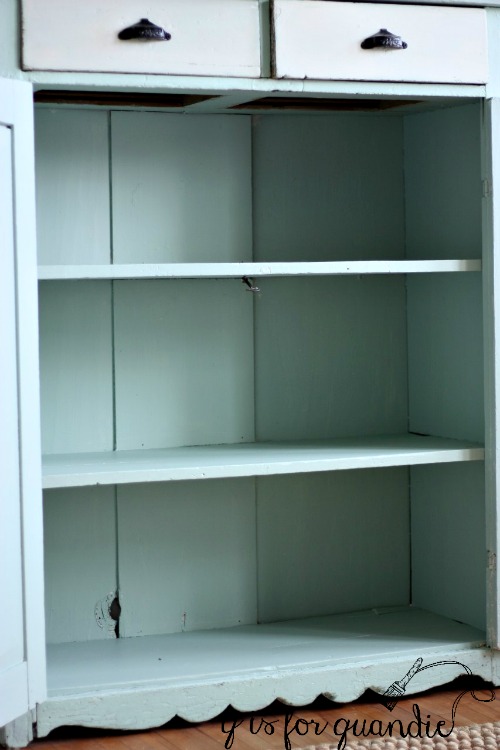
By the way, I didn’t alter the inside of the cupboard at all.  It came with these painted boards as shelves and I just love their chippy patina.

After all, I’m just storing painting supplies in this cupboard.  If I was going to use it for clothes or linens I would add a coat of two of some kind of sealer to the boards.

What do you think?  Would you have kept the buffet, or made the switch like I have done?  And what do you think of the cupboard’s new look?

If you’re thinking of ordering a couple of transfers yourself, I should warn you that I went back and ordered six more yesterday so you better get on it before they are all sold out.

And P.S. the Kitchen Scale buffet is for sale.  Check out my ‘available for local sale’ page for more details.

Sharing at Silver Pennies Sunday.