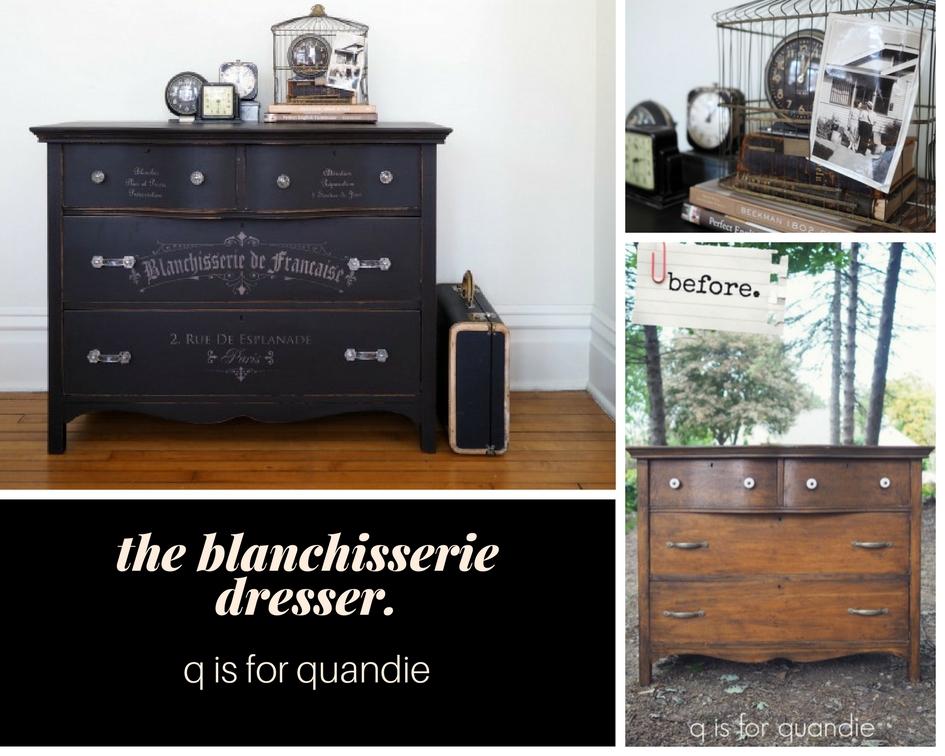
the blanchisserie dresser.

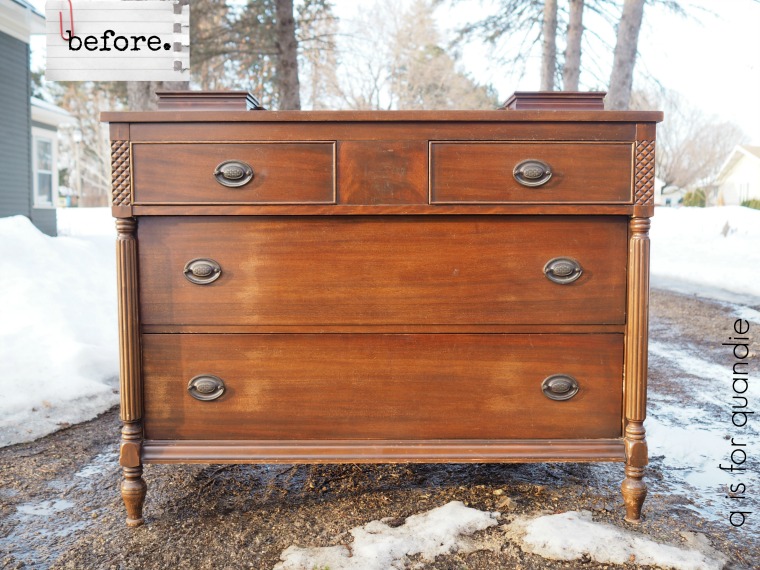
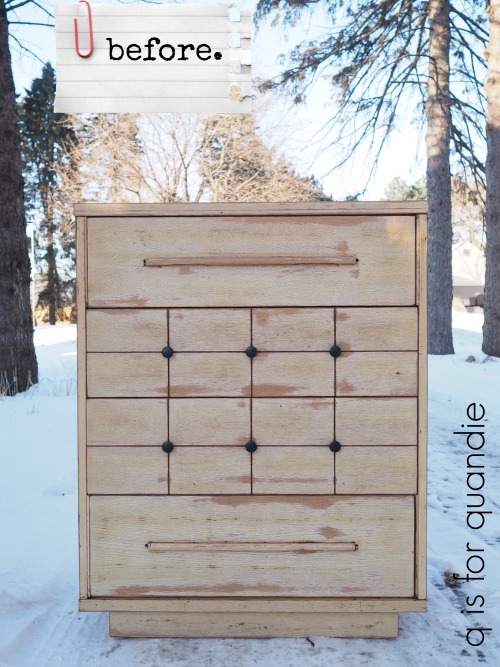
As you can probably tell by the ‘before’ photo below, I purchased this dresser back at the end of summer when I was trying to stock up some projects for the winter.

I think we can all agree that the previous owner had made some rather unfortunate hardware decisions, but otherwise this piece didn’t look all that bad at first.

I wanted to strip the top and then wax it with a dark wax, but after stripping the top of the dresser it looked like this.

I’ve run into these black streaks before.  I’m not 100% sure, but after doing some quick google research I think they might be iron oxide stains (if any of you have any insight, please share in a comment).  Iron oxide stains can occur when the tannins in the wood interact with moisture and turn black over time.  There are methods for removing these stains, but I didn’t think it was worth it to spend that much time and effort on this dresser.  The wood just wasn’t that pretty.  So, in the end I opted to just paint the whole thing.

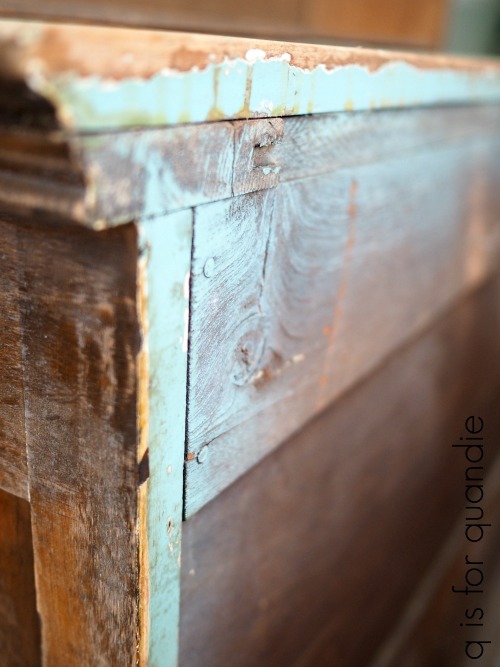
I also found some clues to tell me this dresser was probably originally intended to be painted.  In fact, it had been painted at least twice and possibly three times.  Clue no. 1 is on the back side.

Isn’t that a gorgeous aqua?  I know I would have loved that color!

Clue no. 2 was inside the openings for the drawers …

So it was probably also pink at one time, and maybe even white.

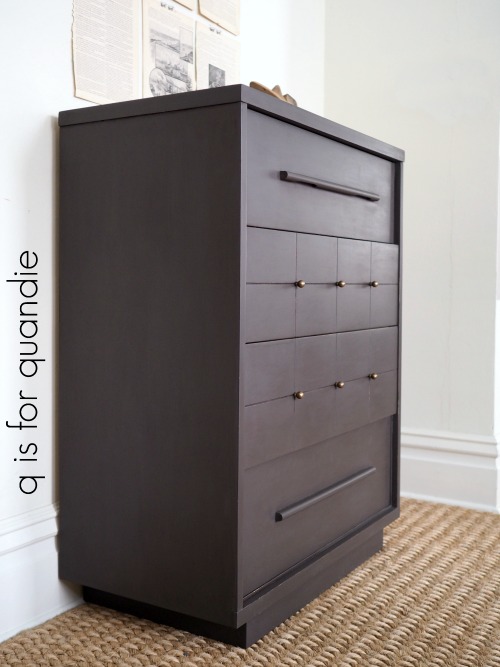
Whoever bought the dresser, then stripped off all of those colors and refinished it, was probably pretty disappointed in the lackluster results.  But I was happy to take it back to its roots.  Except I didn’t choose aqua, pink or white.  At least not on the outside.  Instead I chose black.  More of Dixie Belle’s Caviar to be precise.

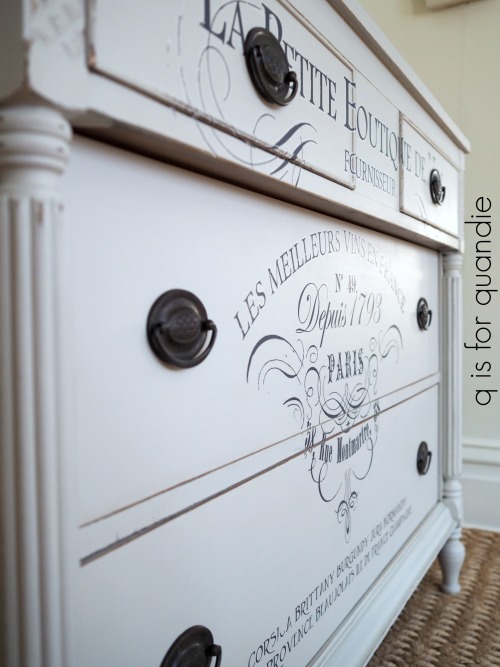
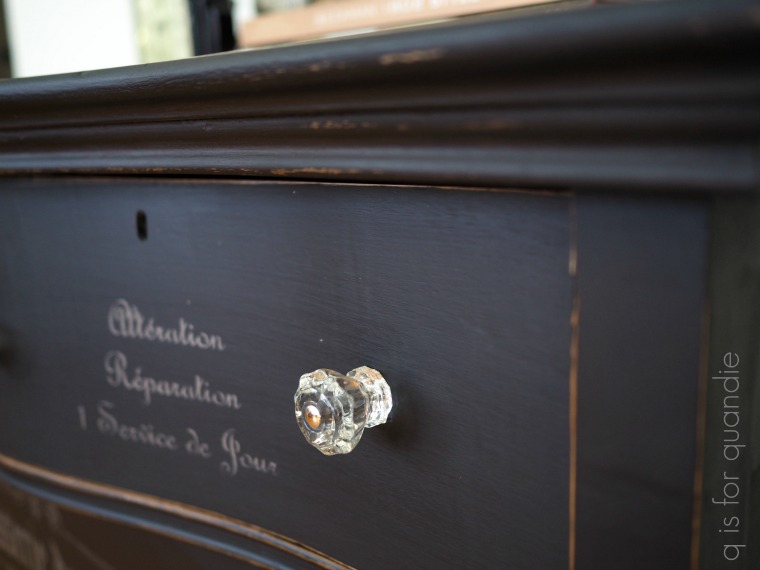
Once the paint was dry I added bits and pieces of my french laundry stencil to the drawer fronts.  Once again, I’d love to share a source for this stencil but the company I purchased it from via Etsy seems to no longer be in business.

To keep the stencil subtle I used a warm, dark grey acrylic craft paint rather than a white.

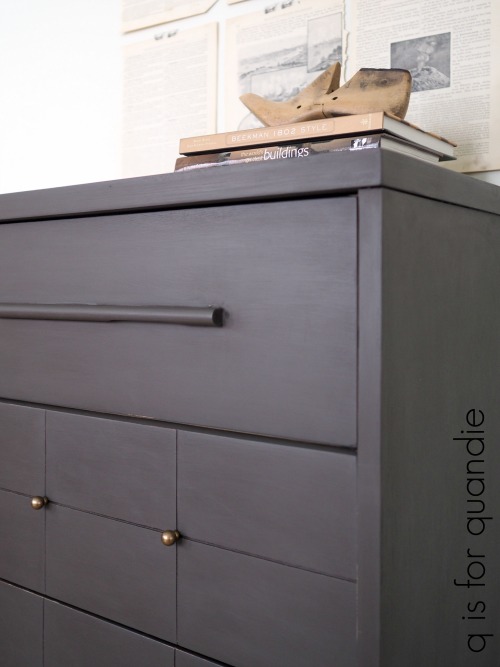
Once the stencil paint was dry, I sanded lightly by hand over the entire dresser with a fine grit paper and then waxed it using Dixie Belle’s Best Dang Wax! in brown.  I think the amount of sheen I got from this wax is just about perfect.

I ended up using clear glass knobs and drawer pulls on this dresser because I happened to have them on hand.  My friend Sue gave them to me and I had just the right amount for this dresser, plus they were just the right size for the existing holes.  It seemed like it was meant to be.

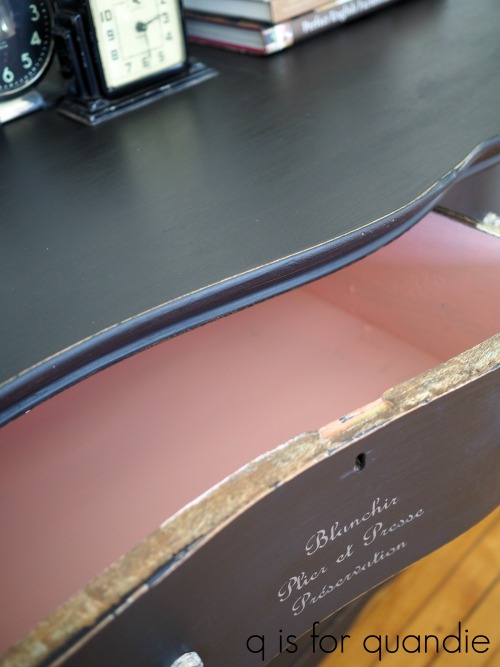
 As a nod to the remnants of pink paint that I found inside the dresser, I painted the interiors of the drawers in Fusion’s English Rose.

I like to use Fusion paint in spots like this because it doesn’t need a topcoat, yet is still fully washable once cured.  A great quality for the insides of drawers.  It only took me about 20 minutes for each coat of paint (I used two) and that fabulous pop of pink when you open the drawer is a lot of bang for your buck, time wise.  I generally only resort to painting the inside of drawers when they are really stained up and scary looking.  These drawers had a few ink stains that needed to be covered up.  In order to prevent the ink stains from bleeding through my paint I tried out the new clear sealer that Dixie Belle provided me with last month, B.O.S.S.

B.O.S.S. stands for Blocks Odors, Stains, Stops bleed-thru.

Had I wanted to block odors, or stop a reddish stain from bleeding thru I would have painted the B.O.S.S. over the entire surface.  However in my case I just had a couple of stain spots that needed blocking, so I just painted two quick coats of B.O.S.S. over the stains themselves.  It worked perfectly.

You might be wondering why I didn’t paint that edge of the drawer.  That is because the drawer fits fairly tightly as it is.  If I added paint, it would not open and close freely.  Always beware of adding too much paint to the edges of your drawers when they are a tight fit.  Nobody wants sticky drawers!

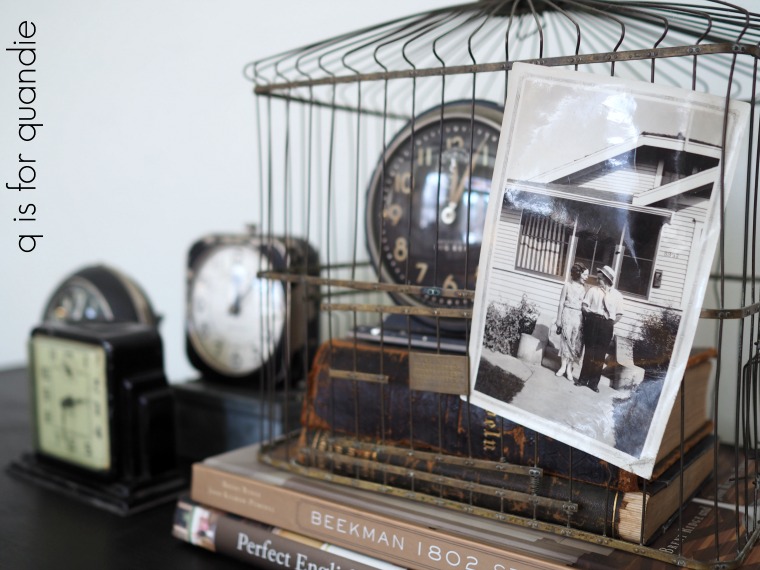
I staged the dresser with some of my favorites from my non-collection of vintage alarm clocks, plus one of my favorite old photos.

That photo was taken on the stoop of my grandparent’s home in South Minneapolis, but no one in the family seems to know who the people are.  They look like such a fun couple though, don’t they?  I imagine that it was a sunny spring day and they were on their way to a picnic at Minnehaha Falls when the photo was taken.

This was back in the day when ladies wore dresses and men wore ties on picnics in the park.

They probably had fabulous painted dressers with glass knobs too, but maybe not with french stencils on them.  Their loss, right?

I gotta tell you guys, I’m kind of in love with this Dixie Belle Caviar.  Lucky they sent me the big jar, because I’m going to be using a lot of this color.

The blanchisserie dresser is available while it lasts, be sure to check my ‘available for local sale’ page for more details!


the windsors.

You might think I’m about to talk about England’s royal family, but no.  I’m talking about the chair kind of Windsors, not the royal kind of Windsors.

I picked up these Windsor chairs at one of the neighborhood garage sales last summer .

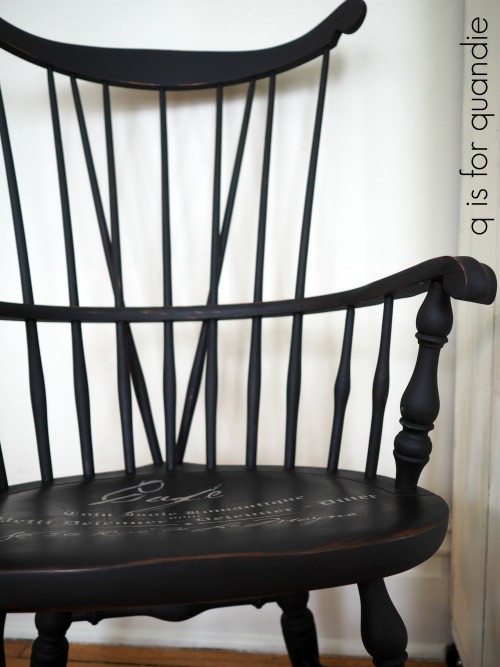
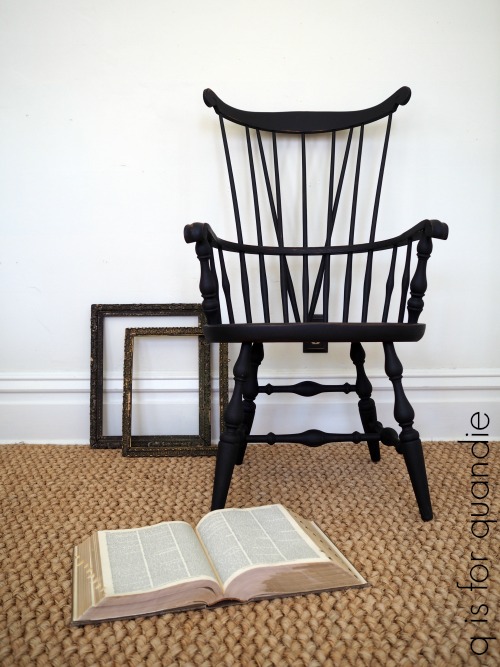
Structurally they are in great shape, they just have a bit of an outdated finish on them.  As soon as I saw them, I pictured them painted black.  Black is a classic color for a Windsor.  So when Dixie Belle sent me some of their chalk style paint in a color called Caviar I dug these chairs out of the carriage house to give them a makeover.

I did not sand the chairs before painting them, I just gave them a good cleaning with some TSP Substitute and started painting.  I used the same damp brush technique that I mentioned in my post on Monday, simply dipping my brush in a cup of water occasionally while painting.  It took two coats to fully cover mainly because the paint thins out using this technique, but it also goes on ultra smooth.  So for those of you who prefer to see a brush-stroke free finish, this is definitely the way to go.

Once dry I wet distressed the edges of the chairs using a damp rag and then used a 320 grit sandpaper on the seats, flat arms and flat top at the back.

I did not sand any of the spindles because that would likely have pushed me over the edge.  Painting them was putzy enough, just look at all of those spindles!

Can we just stop here a minute though and talk about this color?

The Caviar is a gorgeous deep, rich, saturated black.  It looked deep and dark even before I waxed it.

In fact, here’s a secret.  I didn’t wax the legs yet.  Obviously I have to get to that before I sell the chairs, but I was trying to take advantage of a sunny day to get my photos done so I saved the legs for later.

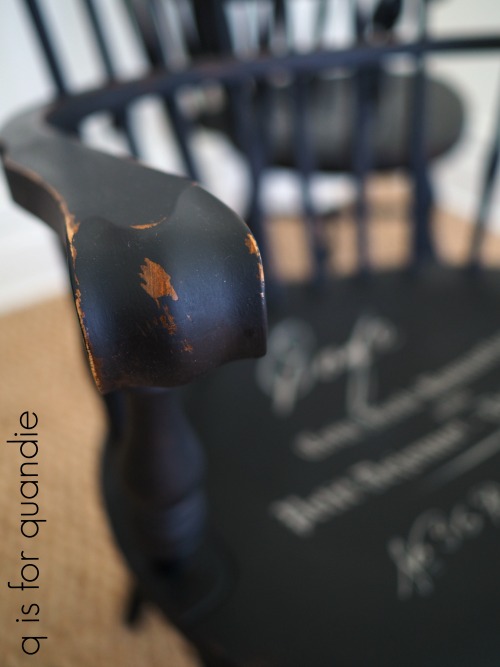
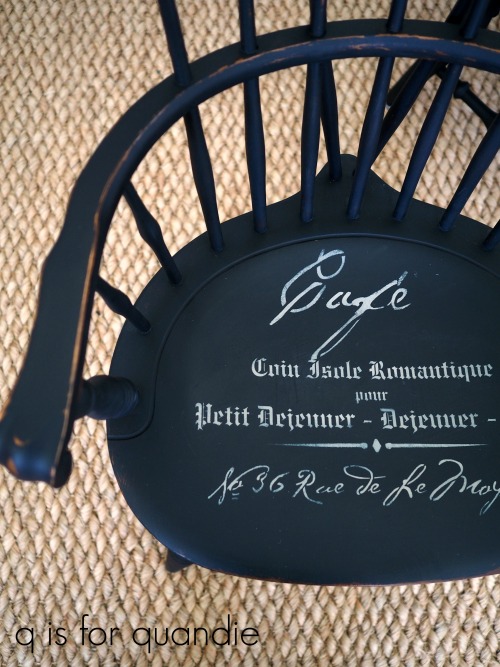
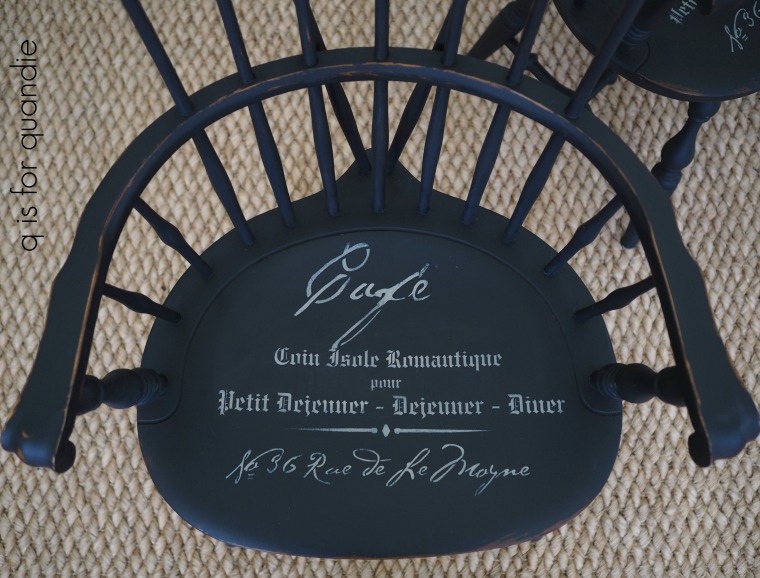
Before waxing I stenciled the seats with a fab french design.  I’m fairly sure I ordered this stencil via Etsy, but once again the shop I ordered from is no longer there.  I seem to have bad luck in this way with stencils.  So I’m sorry that I can’t give you a source for this one.

The stencil was just the pop of something special that took these chairs from ho-hum to fab.

Once I had the stencils done, I sanded lightly over them with 320 grit sandpaper and then waxed the chairs (and I will get to those legs!) with Dixie Belle’s Best Dang Wax in clear.

If you’re used to using Miss Mustard Seed, Homestead House or Fusion wax (like I am), don’t be freaked out when you open up the Dixie Belle clear wax and it looks really white.  I thought for sure I had gotten a white wax by mistake.  But no, ultimately it dries clear.

Also, you really won’t need a dark wax (like brown or black) to deepen the black color of this paint.  It looks gorgeous even with the clear wax.

I love how the chairs turned out.  If I had a spot for them I’d definitely keep them.  But there is no room at the inn, so they have to go.  If you are local and need a pair of Windsors, be sure to check my ‘available for local sale’ page for more details.


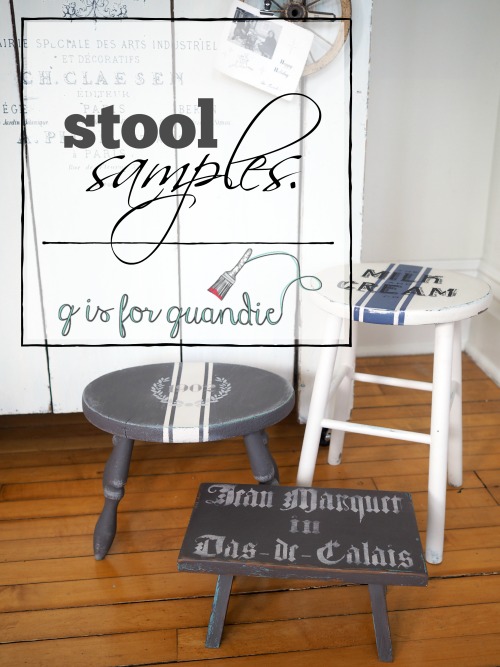
stool samples.

Back in the beginning of January I was pondering my blog content and thinking about potential ways to grow in the new year.   I felt like it was time to try some new products.  Don’t get me wrong, I absolutely love Fusion, Homestead House and Miss Mustard Seed products and I’ll definitely continue to use them on a regular basis.  I’m also still officially addicted to the IOD Décor Transfers.  But I felt like I needed to add a good chalk style paint to my line up and also just take a look around at what other sorts of products are out there and what they can do.

After all, variety is the spice of life, right?

My painting philosophy is that there is no one perfect paint that is best no matter what the project.  Some projects are better suited for milk paint, some are better suited for an acrylic paint and some are better suited for a chalk style paint.

I decided to do a little research by looking at what other furniture painters that I admire are doing these days.  One of those painters is Denise at Salvaged Inspirations (be sure to check out her blog post today about painting with black).  She recently painted this gorgeous dresser in Dixie Belle chalk paint in a color called Caviar

and this stunning blue buffet painted in Dixie Belle’s Bunker Hill Blue

So I went to the Dixie Belle website and just browsed around a bit.

And guess what?  They had some really cool stuff, like their Patina Collection for creating an aged metal look and a stain-blocking, smell-blocking clear primer called BOSS.  I was also intrigued by their Easy Peasy Spray Wax and Dixie Belle Mud.

That was when fate intervened in an amazing way.  I received an email from Teri at Dixie Belle out of the blue.  She had seen my blog and wondered if I’d be interested in trying any of their products.

Seriously!  What a wild coincidence right?  The timing could not have been any more perfect.

Of course I said yes!  I’d definitely be interested in trying a whole bunch of their products.  Like all the ones I listed above, and certainly some paint too!

So last week I received a big heavy box in the mail from Dixie Belle!  I’d asked them to ship it to my day job.  The Dixie Belle paint should not be allowed to freeze.  Since it’s January in Minnesota, having the box shipped to my office meant it wouldn’t be left sitting outside on my porch for any length of time.

Now I was fully stocked with some gorgeous paint colors and some fun, unique products that I couldn’t wait to experiment with.

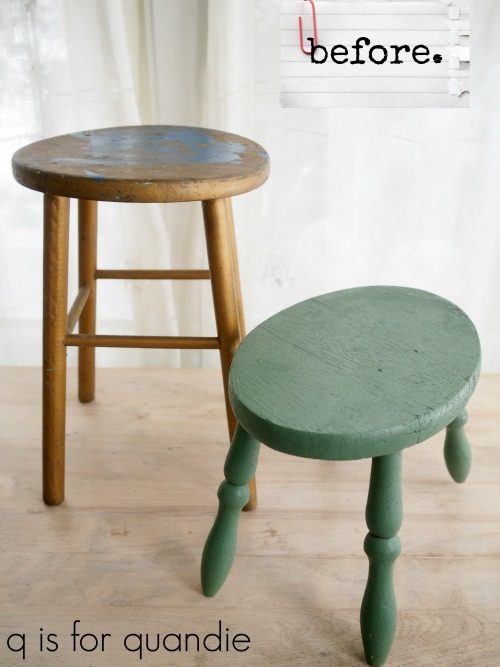
Having made my share of mistakes with new products over the years, I’m learning to start out slowly; test them out on something small to get a feel for how they work before jumping right in to the deep end and painting a big piece of furniture.  So this time I pulled out a pair of stools that my friend Sue recently passed on to me to sample some of the paint colors and top coats.

And hence, the title of this blog post was born.  Stool samples.  Seriously, how could I resist?

The ‘how-to’ guide for Dixie Belle chalk paint says that you don’t have to sand your piece, just clean it and then start painting.  I would have followed that advice to the letter except the seat of the taller stool had a big glob of spilled blue paint on it.  Although I could have painted right over that and the paint would have adhered, you still would have been able to see the texture from it.  In other words, it would have looked like I painted over a glob of something.

Q-tip of the day: if you don’t want to see texture (including drip marks and brush strokes) from a previous paint job (or spill), you will need to sand it down before painting with any kind of paint.

So I sanded the top of the taller stool pretty vigorously, but left the rest alone.  It really was a relief to not have to sand all of those legs!

I didn’t want to see either of the existing colors on each stool when I distressed them after the final coat of paint, so I gave them an undercoat of a color that I wouldn’t mind seeing, Savannah Mist.  Dixie Belle recommends using a damp paint brush and painting in thin coats.  I’d never tried the damp paint brush technique before so I thought I would give it a try.  You simply dip your brush into a bit of water, just a quick dip, not a big, swooshy, saturate your brush sort of dip, then dip your brush into the paint.  You don’t have to re-dip your brush into the water with every fresh dip of paint, maybe just with every 4 or 5.  I just kept a plastic cup of water handy.

Turns out I really like this technique which basically just waters down your paint as you use it.  It makes the paint easier to apply and it definitely goes further.  It also helps prevent brush strokes.  Despite the watering down, I still got great coverage with just one coat of the fairly light base color.

I used the same technique to paint each stool with a top layer of a different color.  The smaller stool got one coat of Gravel Road and the taller stool got two coats of Drop Cloth (white tends to require more coats for good coverage no matter what kind of paint you are using).  Then, while I had the paint out anyway I also painted a third even smaller stool in the Gravel Road.

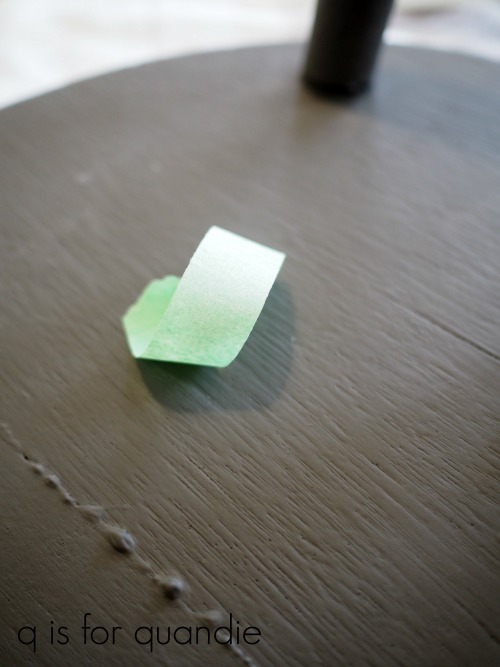
Since I was going to add some grain sack style stripes using tape next, I flipped over to the underside of one of the stools (which I had also painted) to test whether or not the tape would pull off any paint.

Nope.  I was good to go.  By the way, this is the color called Gravel Road.

I taped off some stripes on the two larger stools.  One got striped with Drop Cloth, the other got Yankee Blue.

Next I decided to try wet distressing them.  I think a chalk style paint is easier to wet distress than other types of paint.  The trick is to do it right away as soon as the paint is dry, but before it hardens too much.  In case you’ve never heard of it, to wet distress a piece you just use a damp cloth and wipe the paint off wherever you would normally distress the piece.  I like to use a nubby terrycloth fabric for this and I have a bunch of old towels that I’ve cut down into rag sized pieces for jobs like these.

Here’s how the wet distressed edge looks up close …

 There are a couple of benefits to wet distressing.  First of all, you don’t create any dust.  This is a big plus when you are working indoors in the middle of winter.  Second, you can more easily control how far down you distress.  I didn’t want to see much of that original green color of this stool.  As soon as I could see the coat of Savannah Mist coming through I stopped rubbing.

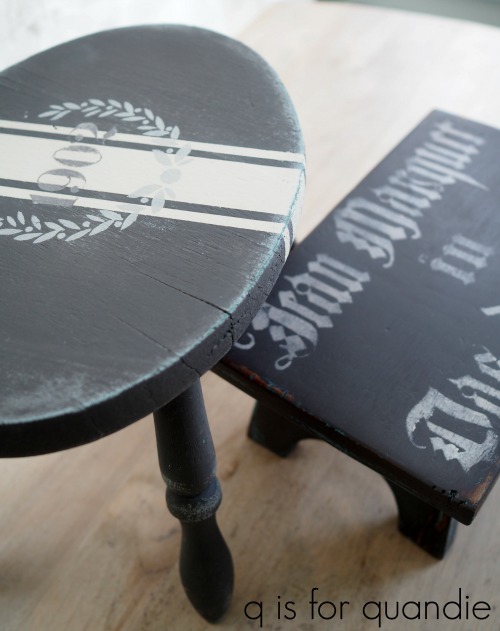
To add a little something extra, I stenciled the two smaller stools.  After the painted stencil designs dried, I sanded the top of each stool with a fine 320 grit sand paper to smooth them out.

Next I sampled two of the Dixie Belle top coat options, the Easy Peasy spray wax and their Best Dang Wax! in Brown.  The ‘1902’ stool was finished with the spray, the smaller stool with the brown wax.

The Easy Peasy spray definitely lives up to its name.  You simple spray it on in a fine mist, wait 5 seconds and then wipe.  Done.

The Best Dang Wax! is very creamy, soft and workable and it has no smell (which translates to no petroleum distillates and you know I like that).  I also like the rich, dark color of the brown.  I’m planning to test it out on some bare wood soon.

After sealing the tall stool with the Real Milk Paint Co’s Dead Flat, I used Fusion Transfer Gel to add a graphic (click here to read more about that technique).

Remember, if perfection is your goal then graphics added with transfer gel might not be right for you.  If you want to compare various methods for adding a graphic to something check out my post on that {here}.  Using transfer gel is definitely one of the most cost effective ways.

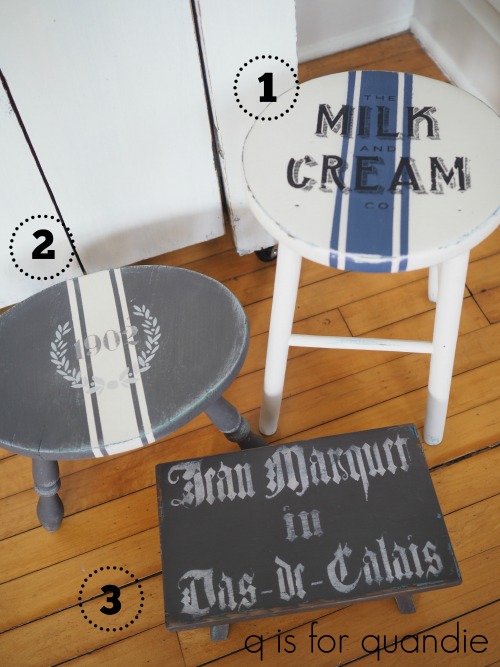
I had fun playing around with the various Dixie Belle paint colors and top coats while creating my three stool samples.

To recap …

stool sample no. 1 – painted with a base coat of Dixie Belle’s Savannah Mist, then painted with Dixie Belle’s Drop Cloth, striped with Dixie Belle’s Yankee Blue, sealed with Real Milk Paint Co’s Dead Flat, graphic added using Fusion’s Transfer Gel.

stool sample no. 2 – painted with a base coat of Dixie Belle’s Savannah Mist, then painted with Dixie Belle’s Gravel Road, striped with Dixie Belle’s Drop Cloth, stenciled with Martha Stewart acrylic craft paint, sealed with Dixie Belle’s Easy Peasy Spray On Wax.

stool sample no. 3 – painted with Dixie Belle’s Gravel Road, stenciled with Martha Stewart acrylic craft paint, waxed with Dixie Belle’s Best Dang Wax! in brown.  You’ll notice that the Gravel Road looks darker on this stool as a result of adding the dark brown wax v. the Spray On wax.

I’ve already started my next project using the Dixie Belle products, so be sure to stay tuned!


the rest of the desk.

Today I’m sharing the rest of the desk makeover.

As a refresher, here is the ‘before’.

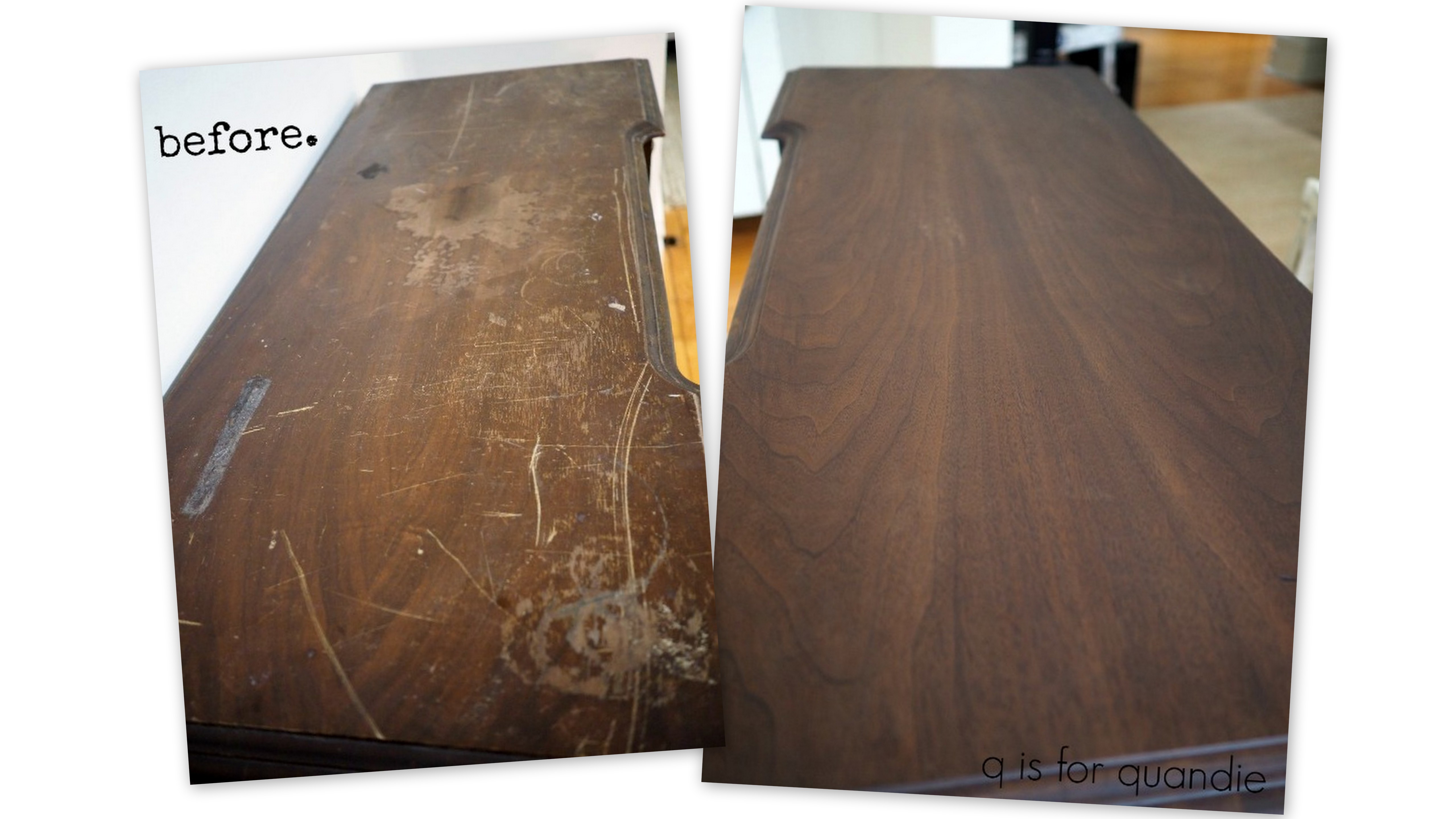
And here is the ‘before’ and ‘after’ of the desk top.

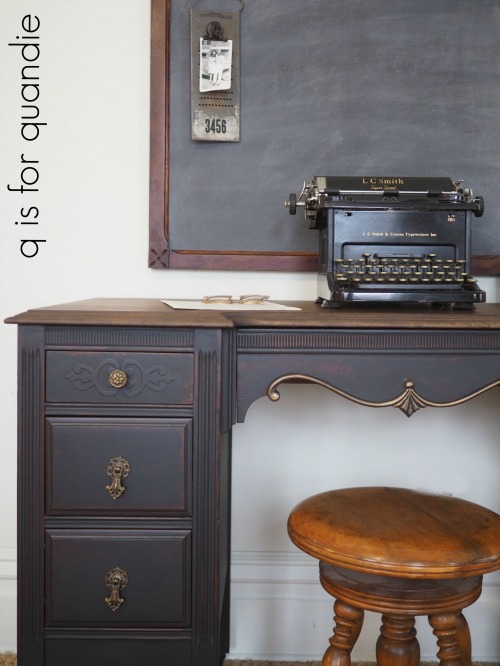
If you’ll remember, my initial plan was to paint the entire desk green.  But then I decided to try and save that wood top.  I still could have painted the rest of the desk green, but I decided to go with black milk paint instead.

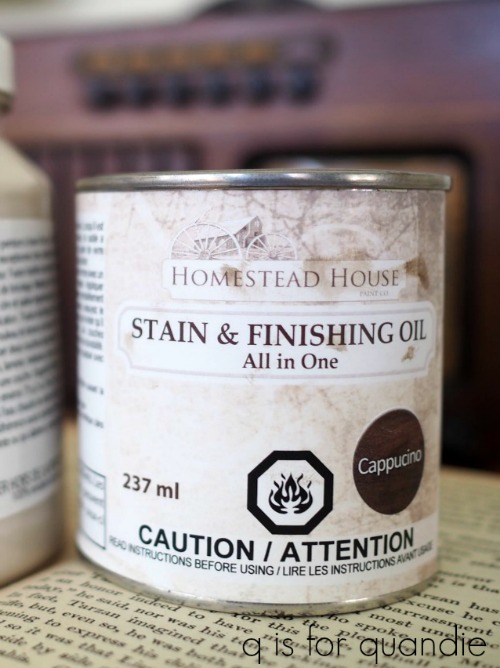
I used Homestead House milk paint in Coal Black, and this seemed like a good opportunity to try the Homestead House Stain & Finishing Oil in Cappucino as a topcoat over the milk paint.

The technique for this is fairly simple.  Once your milk paint is dry, sand it with a fine grit sandpaper to smooth it out, distress the edges as desired and loosen any flaking milk paint.  Vacuum away the dust, and then wipe your piece down.  I like to use a dry microfiber cloth for that.

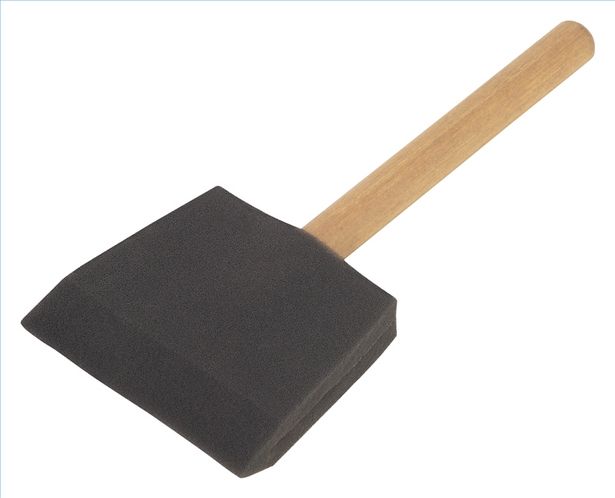
Next, apply a coat of the SFO.  You can wipe it on with a lint free cloth or you can apply it with a stain applicator pad, but I chose to apply it with one of those cheap sponge brush thingies.

The angled tip of the sponge worked really well for getting the SFO into corners and grooves.

After allowing the SFO to absorb into the surface for a few minutes, wipe away the excess with a lint free cloth.  I used an old black t-shirt.

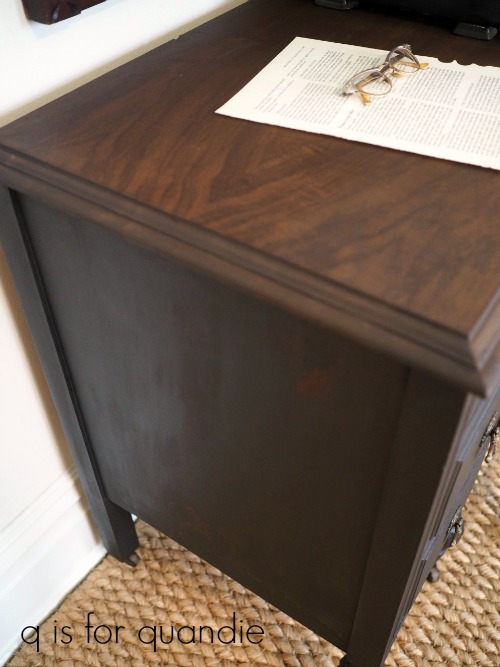
One coat of SFO will give you a matte finish.  Subsequent coats will increase the shine, deepen the color and increase the durability.  I had this crazy idea that I wanted a little more shine, so I added a second coat (after waiting 24 hours for the first coat to dry).  As it turns out, I had a little trouble keeping the gloss consistent with the second coat.  You don’t notice that on the front of the desk at all, but it’s more apparent on the sides when they catch the light just right.

I’m sure this was the result of ‘user error’, this is the first time I’ve used the SFO over milk paint on a larger piece.  Perhaps I wiped too much off in some areas and not others, or perhaps I didn’t wait long enough for the SFO to absorb before wiping.  I’m not sure.  Either way, I definitely prefer more of a matte look over my milk paint so next time I will stop after one coat of SFO.

Regardless, I absolutely love how the Cappucino SFO darkened up the black milk paint and really brought out the richness of the color.

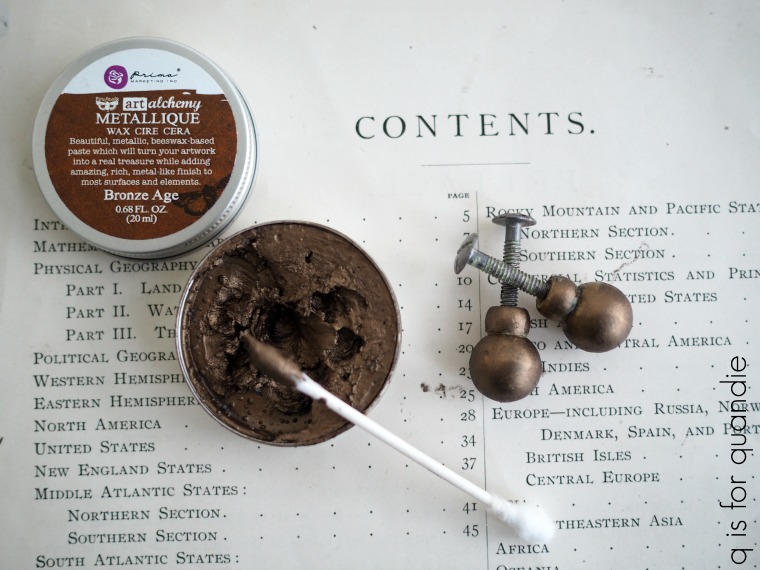
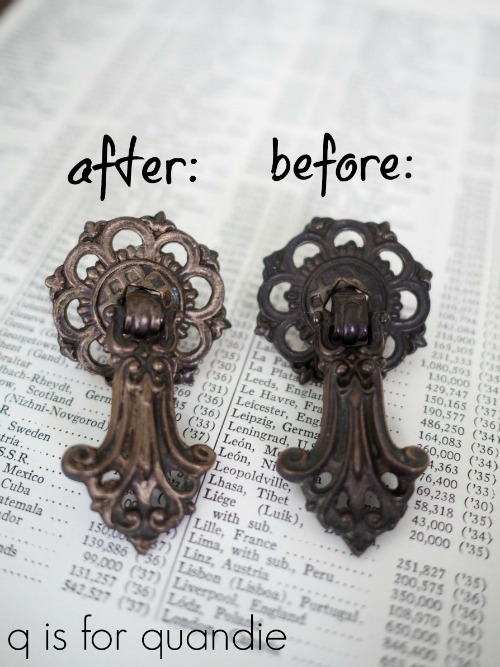
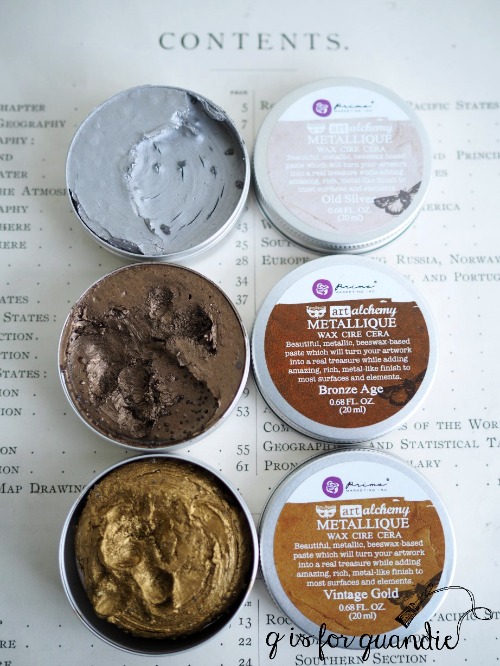
As for the hardware, I kept the original drawer pulls that came on the desk but I dressed them up a bit with some of the Prima Marketing art alchemy Metallique wax in Bronze Age.

If you remember back, Prima Marketing provided me with several different colors of this wax a month or two ago.

I really love how subtle the Bronze Age is.  Not too bright or too shiny.

To apply the wax simply dip a q-tip into the wax, swirl it around and then use the q-tip to apply the wax to your piece.  Allow it to dry and harden for a couple of hours and then buff to bring out some shine.

Since I loved the look of the Bronze Age wax against the black milk paint so much, I added some of it to the raised detail on the middle drawer.

I applied this in the same way, using a q-tip and rubbing it over the surface.  Be careful to not get the wax anywhere you don’t want it, it is hard to remove again.  So be sure to use a steady hand while doing this.

By the way, the chalkboard hanging on the wall is an old mirror frame taken off a dresser with a piece of hardboard cut to fit the opening which was then painted with two coats of Miss Mustard Seed milk paint in Typewriter.  Once the last coat of milk paint is dry, I sand it smooth and then ‘season’ the chalkboard by rubbing chalk all over it and wiping it away with a microfiber cloth.  I wiped the wood frame down with a little Miss Mustard Seed hemp oil just to freshen it up a bit.

If you’re wondering why I suddenly switched from the Homestead House Coal Black that’s on the desk to Miss Mustard Seed Typewriter for the chalkboard, it’s simply because I used up all of my Coal Black on the desk and I had the Typewriter on hand.  I’ve painted with both of these colors side by side and I don’t think there is any difference.  Of course they look different here because one has the SFO topcoat and one just had white chalk smeared all over it.

We’ve come to the part of my blog post where I normally share a side by side collage of the ‘before’ and ‘after’ of the desk, but earlier this week Mr. Q gifted me with a new computer!  It has a huge display screen, which is amazing, and it’s so much faster than my old computer.  However, I don’t have Picasa on it which is the software I used to make those side by side collages.  Picasa was retired back in March 2016 so I can’t load it on this computer.  And as it turns out, Windows Live Photo Gallery was discontinued back in January 2017, so I couldn’t load that either.  I’m going to have to learn all new software for organizing my photos, and I’m going to have to find new photo editing software that will let me make those collages.  But I still have my old standby, PicMonkey so all is not lost there (but I’m not impressed with PicMonkey’s collage options).

In the meantime, you’ll have to excuse me while I take some time to learn some new tricks and just be content with seeing the ‘after’ all by itself.

This desk is for sale, so be sure to check my ‘available for local sale’ page for more details.

mind the gap.

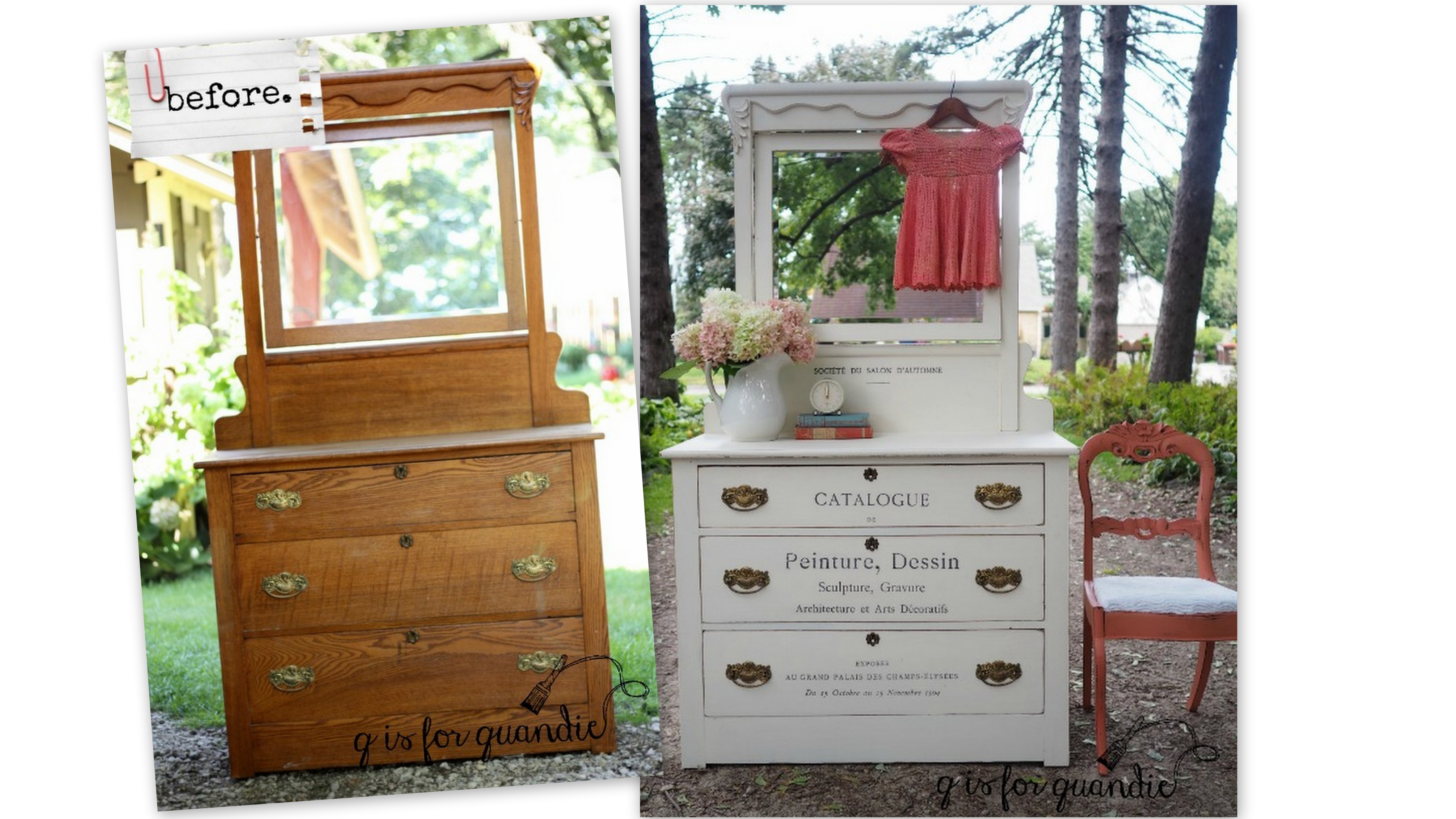
Remember this dresser that I painted last September?

I mentioned at the time that I don’t usually keep the mirrors that come with dressers.  I have found that it takes much longer to sell a dresser with a mirror than one without.  But this mirror was so gorgeous and it added so much to the dresser that I decided to keep it.

But I didn’t literally want to keep it.  I wanted to sell it.  I posted it on Craigslist and it sat, and it sat, and it sat.  I got a couple of nibbles, but no one even so much as came out to look at it.

Honestly it’s not often that my pieces don’t sell within a month or so, sometimes even faster.  But it does happen.  When it does I usually go back to the drawing board and try to figure out why and what I can re-work to make the piece more marketable.

First I figured it couldn’t possibly be the color.  Right?  It’s white.  Anyone can work a white piece into their existing color scheme.

I supposed it could be the transfer, or the hardware.

But I don’t think its any of those things.  I think it’s the mirror.

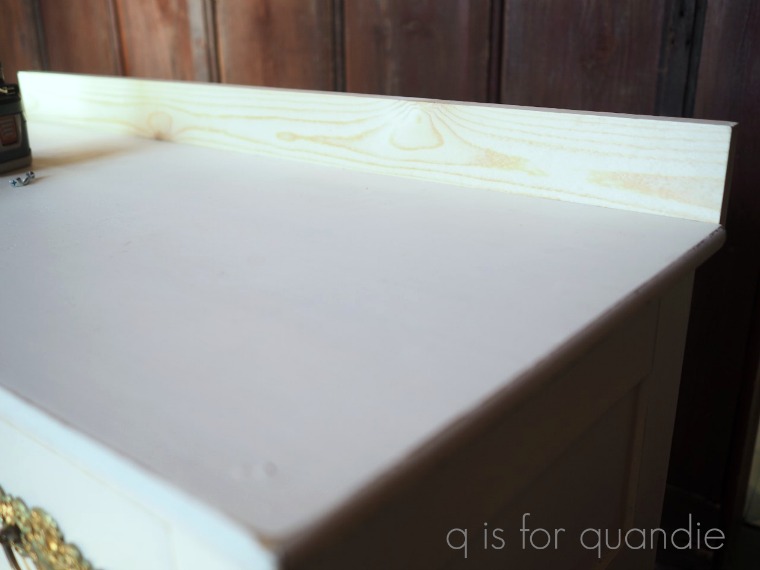
So it’s time to cut my losses and remove the mirror.  However, removing the mirror leaves a gap at the back of the top of the dresser because the mirror sat down into that gap.  So it wasn’t quite as simple as just removing the mirror and calling it good.

Luckily, I have a handy neighbor who can help me out with such things!

Ken made short work of cutting a board to fit down in that gap.

I painted it up to match the dresser (in Fusion’s Limestone) and attached it.

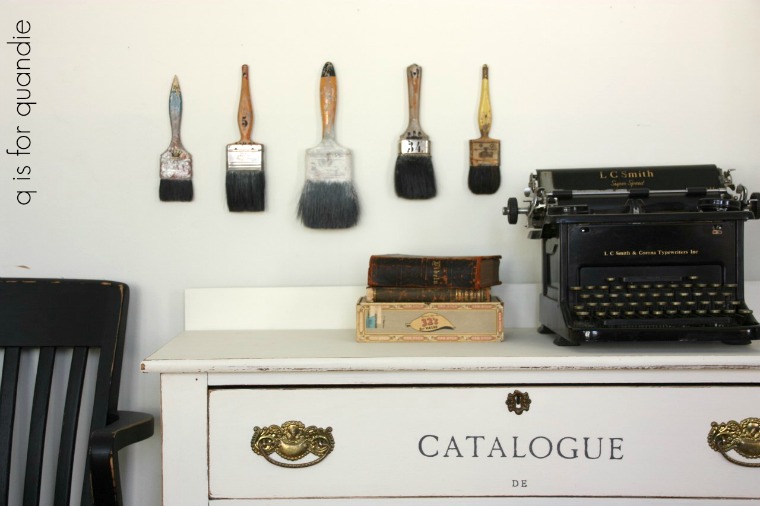
And presto, the dresser has a whole new look.

Now this dresser could hold a widescreen TV, or it could be used under a window.  It could work in a living room, dining room or foyer.

It would also work well in a home office to hold the printer and office supplies.

  It’s just so much more versatile without a mirror, don’t you agree?  I also have to say that I like it much better this way myself.

And in case you are wondering what the fate of the mirror will be, Ken and I are going to turn it into another chalkboard shelf so it won’t just be going to waste.

So now we’ll just have to wait and see whether or not my theory about mirrors is right.  I’ll be sure to keep you posted.  In the meantime you can see some of my other do-overs here, here and here.

s.f.o.

I purchased this table back in September at a garage sale.

I loved the detail on the base of the table, but didn’t love the dated dark, shiny, reddish finish which also was not in very good condition.  So of course I planned to give it a makeover.

I started by stripping the top of the table using Citristrip.  Although I stripped this piece outside in my driveway back in September, I like using the Citristrip because it can be used indoors also and it’s not as toxic as some of the stronger strippers.  But the trade off is that it doesn’t work as quickly as the stronger strippers.  Usually it works great to just remove some old varnish, but this piece had some serious red colored stain that just kept coming up.  In fact, even after three passes with the stripper I still hadn’t gotten quite all of it.  So I put the table in the back corner of the workshop to think about its bad behavior for a while.

Then over a frigidly cold weekend recently I pulled it into the house to finish the job.  Since the tabletop was not a uniform color, I decided to forgo my original plan of just waxing it and instead try the Homestead House Stain & Finishing Oil All in One (or SFO for short) in Cappucino.

Homestead House sent a complimentary sample of this product to me a while back, but this is the first chance I’ve had to try it out.  Although this product isn’t designed to cover up discolorations, my hope was that the dark color of the Cappucino would help disguise the fact that the wood tabletop was still just a little bit splotchy from that red stain.

First things first, the SFO is ideally meant for bare wood.  It is designed to soak into the wood rather than sit on top of another finish like a gel stain does.  Also, it is color and topcoat in one, no need for the multiple steps of stain followed by poly.  Once cured this stuff is even durable enough to use on floors.

Here is what Homestead House has to say about the ingredients:  “Our Stain & Finishing Oil is composed of plant products, Safflower oil, Tung oil, Linseed oil, Vegetable wax, safe odourless mineral solvent and cobalt free siccative which means effective drying without toxic cobalt dryers while being virtually odourless.”  And based on that, I felt comfortable using this product inside my home with no windows open.  It was -12F outside when I was working on this, so opening a window was definitely not an option.

To prep the table top I sanded it with 220 grit sandpaper, vacuumed the dust, and then wiped it down with a clean microfiber cloth.  I applied the SFO with an old brush, but next time I think I would just use either a lint free cloth or a stain applicator pad either of which can then just be tossed.  This is not a water based product and cleaning an oily brush is just not something I enjoy spending time on.

After applying the product I let it sit for about 10 minutes to absorb into the wood.  Then I used an old t-shirt to wipe away the excess.

And that was it.

Yep.  Done.

No need for an extra topcoat.  After 3 days this finish is cured enough for normal use and after 10 days it is fully washable making it a great choice for table tops.

Although you can use multiple coats to deepen the color, I found that just one coat was plenty dark for my table.  However, keep in mind that multiple coats will also improve the durability and increase the shine slightly with each coat.  If you don’t want to darken the color, but do want to increase durability or shine you can do your first coat in the color you want (Cappucino for example) and then add subsequent coats of SFO in Natural (allow 24 hours of drying time between each coat).

Seriously though folks, I am pretty much a novice stain-er.  I don’t have a lot of experience with wood stain and I am pretty intimidated by it.  It seems like you have to be very careful to keep the color even, etc. etc.  But this stuff was super easy to use.

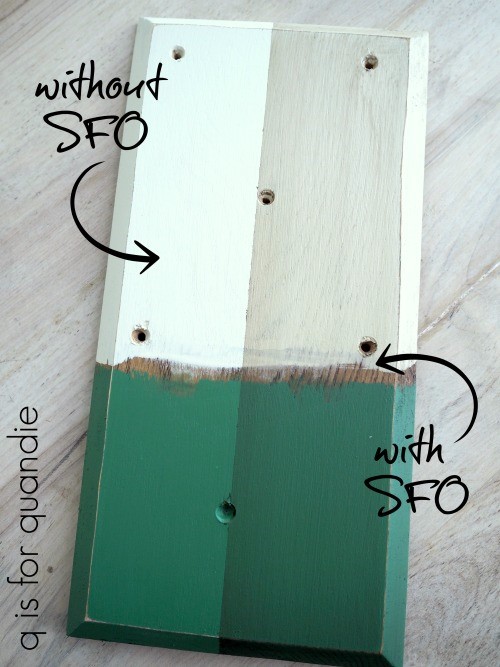
I mentioned that the SFO is best suited for bare wood, but it also works great over milk paint.  I did a double take the first time I read that one myself.  I do a lot of painting with milk paint so I’m always interested in alternative top coats.  When you think about it, it makes total sense that the SFO will work well over milk paint since the paint itself is porous and will allow the finish to soak in.  I did a little practice board to see how the Cappucino SFO would look over both some Coal Black (top) and some Midnight Blue (bottom) Homestead House milk paint.

By the way, please try to ignore those white specks in my paint.

Don’t use sandpaper that was previously used over white paint to sand your dark milk paint, it will leave little flecks of white paint behind.  Lesson learned.

But hopefully you can see that the SFO looks fantastic over the milk paint.  It adds a richness to the color, but not a lot of shine.  I plan to try this technique on a piece of furniture that I’m working on currently.

With all this talk of SFO being an oil, designed to soak into porous surfaces like bare wood and milk paint, you might be thinking that you can’t use it over an existing sealed surface (such as Fusion or other acrylic paints).  While it’s true that it’s not ideally meant for those surfaces, you can do it.  Much like you can put hemp oil over Fusion paint.  It won’t soak in like it does over bare wood or milk paint, but it will harden as it dries and provide both color and added protection.  I tried a practice board for that too, using Fusion’s Plaster and Park Bench.

The difference when using the SFO over non-porous surfaces is that you need to wipe carefully.  If you wipe too vigorously you will just wipe away all of the SFO.  Wipe gently leaving a thin coat behind and then let it dry.  I think it gives a similar look to using a glaze, but again with very nice matte finish.  I love the Cappucino over the Park Bench.

I hope that some of this info about the Stain & Finishing Oil has helped give you a better understanding of how this product works.  I definitely plan to use it on a couple of upcoming projects, so I’ll be sure to keep you posted on that.  But meanwhile, back to my little table.

For the base of the table I pulled out some Fusion paint in a color that I’d never tried before called Cathedral Taupe.

I’d always thought this color had a bit too much pink in it for me, and it definitely does have a pink undertone.  I think the pink shows up more in photos than it does in real life actually.  The combination of the Cappucino colored top and the Cathedral Taupe base is gorgeous in person.  I feel like I didn’t really capture it well in my photos.

Once again I applied a little beeswax before painting to help make distressing the edges of the table base easier.

I plan to bring the table in to Reclaiming Beautiful to sell, unless one of you wants it first?  If interested, check out my ‘available for local sale’ page for more info.


the cottage dresser.

I don’t often buy pieces of furniture that are already painted.  There are a few reasons for that.  First of all, you may not know what kind of paint you are painting over.  Is it oil based?  If the previous paint is oil based you will not get good adhesion over it with a water based paint.  Second, you don’t know how well the previous painter prepped the piece before painting.  If their coat of paint is not stable, your’s won’t be stable either.  Third, if the existing paint job is full of drips and brush marks you will need to fix those before you paint (by sanding them down).  Fourth, if you are going to distress your piece by sanding it you risk having the existing color of the piece show through on the edges, so if you don’t like the color you are out of luck.  Lastly, while stripping the existing paint might be an option for some, I am not a fan.  It’s a messy, time consuming job.

None of these things are obstacles that can’t be overcome, but it takes time to deal with them and why bother when I can just keep looking and find an unpainted piece to work on?

But as always, there are exceptions to every rule.  This dresser is one of them.  I broke my own rule simply because this piece was dirt cheap.

Since this piece is already painted, I thought I would take a moment to critique the previous paint job and explain what I think isn’t working for this dresser

No. 1 – The terracotta paint color.  This is just kind of a hideous color.  I’m sorry if any of you out there are lovers of terracotta, but I’m definitely not.  I’ll put this color right up there with faux tiger oak, I just don’t like it.

No. 2 – The oversized, over-shiny, bulging brass drawer pulls.  Ugh.  Could these be any more unattractive?  They really aren’t suited for the style of this dresser.

No. 3 – The two-toned look.  Normally I enjoy a good two-toned piece and I’ve certainly done a few in my day (here, here, here and here are some good examples).  In the case of this dresser though, the two-toned color scheme seems to be emphasizing the fact that the upper drawer is different than the rest.  In my opinion it just throws off the balance of the entire piece and makes it look strangely top heavy.

No. 4 – The bad distress job on the drawer fronts.  These drawers look like they were just hit randomly with the sandpaper.  They don’t look naturally distressed over time.  I know that some people are OK with this look, but it just doesn’t do it for me.

The trick here is going to be whether or not I can improve upon this piece.

I started by removing the hardware and sanding the piece.  I sanded it a bit more heavily than I would normally just to be sure I was going to get good adhesion over that existing paint.  I also wiped the piece down with some TSP Substitute.  Next, I filled some of the holes left by the original hardware.  I had some new pulls in mind and although they also require two holes each, they are spaced just a little wider than the existing holes.

I started painting with a base coat of Fusion’s Inglenook.

Ah, better already I think.  Inglenook is such a lovely color I was tempted to just stop here, but I didn’t actually have enough Inglenook for a second coat.  Plus, I was going to add these drawer pulls …

Aren’t they sweet?  They are from Hobby Lobby and their full price is $8.99 each.  Kind of high if you need 8 of them.  So of course I waited for the half-price sale and then paid $4.50 each instead.  Even then it was $36 just for the pulls.  However, since I’d gotten such a great deal on the dresser itself I felt like I could splurge a bit on the hardware.

Anyway, these pulls are just a little bit more green than the Inglenook, so in came Fusion’s Brook which is almost a perfect match for the pulls.  These two colors are really very similar.  The Brook, much like the pulls, is just a little darker and a tad more green.

You’re probably wondering why I didn’t just paint the first coat in Brook too.  Well, it’s simple, I didn’t have enough of that color for two coats either.  And since I’m a total cheapskate (and I already splurged on those drawer pulls!), rather than buy more paint I just made do with a basecoat of Inglenook followed by a second coat of Brook.  It was a simple solution and a great way to use up two jars with not a lot of paint left in either one.

You might have noticed that I said I needed 8 drawer pulls, but this dresser originally came with 10.  There was a mismatched pair on the top drawer.  The top drawer itself is mismatched with the rest of the drawers.

As I was working on this piece I realized that it looked far better without any knobs on that top drawer.  You can still easily open and close it from the sides of the drawer.  So I filled the holes from the previous knobs and just left the drawer without hardware.  Now it’s sort of a ‘hidden’ drawer.  It looks like it’s just part of the trim that wraps around to the sides as well.  It’s a great place to hide the family jewels!

As you can also see in that photo, I just barely distressed the edges of this dresser.  I didn’t want to reveal too much of that terracotta color that is underneath.

I used a lot of vintage greens in my props for the photos including some old wallpaper and that awesome green bird cage.

So there you have it.  A pretty blue-green cottage style dresser.

I think I improved upon the existing paint scheme, what do you think?


aging british rockers.

Before we get on with today’s regularly scheduled blog post, I promised to report back on how long it took the sell the ‘young at heart’ green dresser that I posted on Monday.  I was a little nervous about painting it in the vibrant green of Fusion’s Park Bench and wasn’t at all sure how easily the piece would sell in that color.  Well, I posted it on Craigslist on Tuesday morning.  By Tuesday evening I had two potential buyers expressing an interest in the dresser.  The first buyer in line showed up on Wednesday and bought it!  So if you’ve been hesitating about painting something in Park Bench (or perhaps some other more vibrant color) I say go for it.  I’m starting to think that I might just start painting everything green!

I also want to share the story of selling it.  The buyer was a young woman furnishing her new apartment.  She loved the dresser and promptly handed over the cash.  But when we went to load it into her vehicle it was just a hair too wide to fit.  Flipping it up on its side wouldn’t work either.  Mr. Q and I don’t usually deliver my pieces, but on a whim we offered to load it into our van and follow her home with it.  After all, we didn’t have plans for the rest of the evening and she had mentioned she lived in Minneapolis so I knew we wouldn’t be going all that far.  So we loaded it up and headed out.  Turned out that she lives in a huge old mansion just off Hennepin Ave that has been sectioned off into apartments.  The foyer had the most gorgeous original hex tile floor, beautiful oak wainscoting with a stunning arts and crafts style wallpaper above.  The apartment was full of old leaded glass windows, a built in china hutch in the dining room, gorgeous original wood floors.  Even the radiators were amazing.

It’s so fun to get to see where the dresser ended up and to know that it’s going to look amazing in that space.

But enough with the green dresser, let’s move on.  Today I thought we could talk about aging British rockers.

No, no, not that kind of rocker, this kind …

Although I will admit that I am a Rod Stewart fan, after all blondes do have more fun.  I especially like his more recent Great American Songbook recordings and I often listen to those while painting.

But seriously, this post is about that 2nd rocker.  You might be wondering what makes it British, but we’ll get to that in a minute.

I picked up this aging rocker at a garage sale last summer.  I have found that I really enjoy painting these little chairs.  They are perfect for an afternoon project, and also as a way to try out new paint colors, or conversely use up the little bit that’s left of some already well-loved colors.

In this case I pulled out my bin of milk paint.

Am I the only one with a bin of milk paint?  These are all of the opened and partially used bags of milk paint that I have.  Let’s face it, those zip lock tops are really hard to get sealed back up again properly and I store my milk paint in my somewhat damp basement so I need to make sure that it is kept dry.  I used to store each individual opened bag of milk paint inside another gallon sized Ziploc storage bag but that got to be cumbersome, so now I store them all in this plastic bin with a tightly fitted lid.

I pulled out a few colors, Eulalie’s Sky, Luckett’s Green and Flow Blue (all Miss Mustard Seed) to mix together and see what I could come up with for the rocker.  The first batch I mixed ended up far more blue than I wanted.  I think it was the Flow Blue that threw it off.  So I went back to the drawing board and mixed 3 T Eulalie’s Sky with 1 T of the Luckett’s, leaving out the Flow Blue altogether.  That combo was far too green.  So I simply added in some of the previously mixed ‘too blue’ paint one teaspoon at a time until I had the color I wanted.
I’m calling this one British Rocker Mint.  Isn’t it pretty?

I once posted a piece painted in a mix of milk paint colors like this and someone commented that it was a bit much to expect people to go out and buy three bags of milk paint to paint one piece of furniture.  Yes, I totally agree.  I don’t mean to imply that you need to do that.  What I am suggesting is that you can use up your left over milk paint in a similar way.

If you don’t have enough of any one color to paint an entire piece of furniture, mix a few of your leftovers together and see what you can come up with.

Now, back to that aging British rocker.

The only prep I did on this piece was to wipe it down with a damp rag.  I was feeling pretty flexible about any amount of chipping I might get.  There were spots of pre-existing shiny finish, but there were also lots of areas where the existing finish was completely dried out and I knew the milk paint would adhere well in those spots.

I got great coverage with British Rocker Mint.  I did use two coats, but I prefer a more opaque finish.  Once dry, I sanded lightly to remove any loose flakes of paint.  I followed that up with vacuuming away and dust and further flakes of paint.  Then I finished with a coat of Fusion clear wax (same as Miss Mustard Seed clear wax).

Oh, and I almost forgot … what is it that makes this an aging British rocker?

Well, it’s the portion of an IOD transfer that I added to the seat before I added the wax.

This section of transfer was left over from the IOD Gilded Gander transfer that I used on the handmade hutch last year.  This leftover bit fit perfectly on the seat of the rocker, and  gave it a little British style.

This was definitely a project that was good for using up some left overs!

And the end result is an aging British rocker even more adorable than Rod Stewart!


the thrift store library chairs.

Remember the thrift store library chairs?

My friend Meggan who was shopping with me when I purchased them suggested I paint them black, and several of you agreed.  Mark this day down on your calendars, because it’s not often that I follow good advice.  I ask for opinions all the time, but then usually go and do my own thing, often to my detriment (and I bet this annoys my friends to no end).  But not this time.

This time I gave it some thought and decided black would be perfect on these chairs.  I started by sanding the chairs a bit and then wiping them down with TSP Substitute.

Next I debated which paint to use.  Milk paint, chalk paint or Fusion’s acrylic paint?

I love the look of hemp oiled black milk paint.  I definitely wanted a distressed look for the chairs, so milk paint would have been perfect for that.  I even had plenty of black milk paint on hand (both Miss Mustard Seed’s Typewriter and Homestead House’s Coal Black).  But the existing finish still had a bit of shine left to it so I knew it might possibly resist the paint a little too much.  I could have solved that problem with a little extra pre-sanding  but the chairs have all of those legs, slats and stretchers.  So.  Many.  Surfaces.  I just didn’t want to sand them all.   Plus then there is the added work of applying a topcoat to the milk paint as well.  Chalk paint was out for the same reason, and also because I didn’t happen to have any black chalk paint.  So in the end I decided to go with Fusion’s Coal Black.  Two coats of paint and done (well, not exactly as it turns out, but almost).

Before I started painting I remembered some advice given by Sue at My Painted Door for making it easier to distress Fusion paint and decided to give it a try (read her post about distressing Fusion paint here for more details).  This must have been an advice-following day for me!

So, as Sue recommended, I added a little Homestead House Salad Bowl Finish (a.k.a. Miss Mustard Seed beeswax) to all of the areas of the chairs where the paint would naturally be worn away.  Then I painted them with two coats of the Coal Black.

Here is how they look before being distressed.

I imagine some of you prefer this look (especially you Betty!).  But I think distressing is what brings out the life in a piece.  So I sanded the areas that had beeswax applied to them by hand with some 220 grit sandpaper and voila!

And yes, it was much easier to distress the Fusion paint this way.

Applying beeswax first in areas that you want to distress before painting with Fusion acrylic paint will make them much easier to distress.  Even after the paint as cured for a few days.  Although I haven’t tried it, I would assume this is true of other acrylic paints as well such as General Finishes Milk Paint (which is really an acrylic paint, not a true milk paint).  Also, this is basically the same technique that I use to get perfect chipping when using milk paint.  However, the acrylic paint doesn’t chip.  It just becomes easier to sand away.

Normally I don’t add a topcoat to my Fusion paint because it has a built in top coat and is very durable and washable on its own. However, in this case the bare wood in the distressed areas looked a bit fresh.  Plus once you have sanded through to the bare wood, those areas are not protected.  So I got out my Fusion black wax and added just a bit of it to the distressed areas to darken up and protect the freshly exposed wood.
Although you are only seeing one chair in my photos, I do have a matched pair.

However I think I’ll price them separately since some people might need just one chair, for a desk for example.

If you are in need of a distressed black library chair (or two), be sure to check my ‘available for local sale’ page for more info.

young at heart.

Recently my friend Terri has been sending me messages about furniture for sale on Facebook Marketplace.  I’d never purchased something via Facebook before, but one of the pieces she forwarded really appealed to me and it was a good price so I followed up on it.

I found it a little clunky going through Facebook to make arrangements for the purchase.  I ended up wasting about 2 hours because initially the seller said he was available at 4:00, but then when 4:00 rolled around I was still waiting to get his address and not getting a response to my IM on Facebook.  So there sat Mr. Q and I with our boots on, ready to head out.  Finally around 6 p.m. the seller messaged me with his address and we headed out.  From there on out it was smooth sailing.  The seller’s home was easy to find and only about 20 minutes away.  He had the dresser out in the garage ready to go.  I looked it over, handed him the cash and then he and Mr. Q loaded it into our van.  Easy peasy.  And of course, this kind of thing can also happen with Craigslist.  I just seem to have better luck communicating via text rather than via Facebook messaging.

Anyway, here it is.

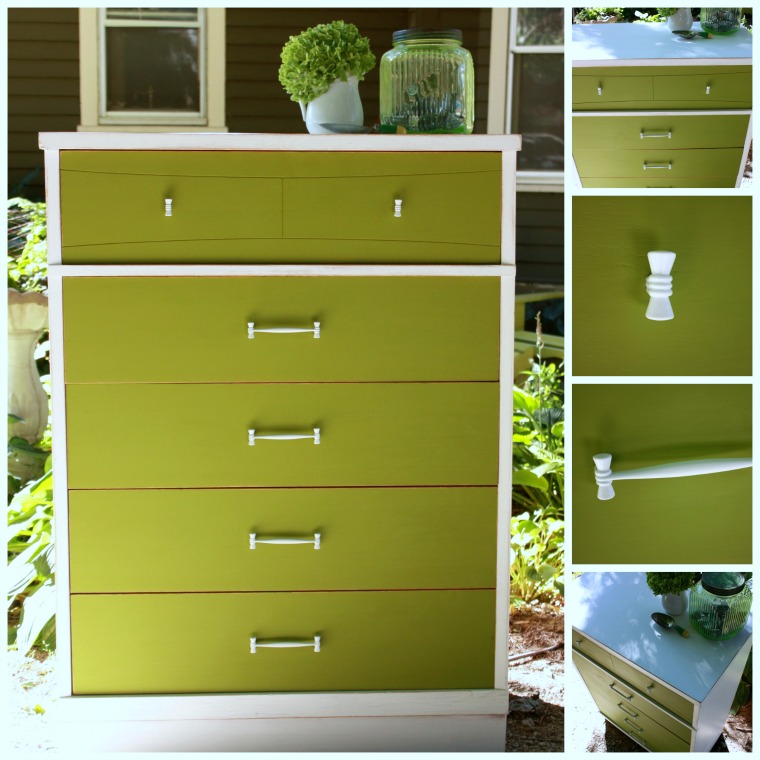
Perhaps you are wondering at this point what gotten into me.  This is not at all my typical style.  But I was in a mood and I knew that with some paint and some new hardware I could bring out some amazing mid-century mod style with this piece.

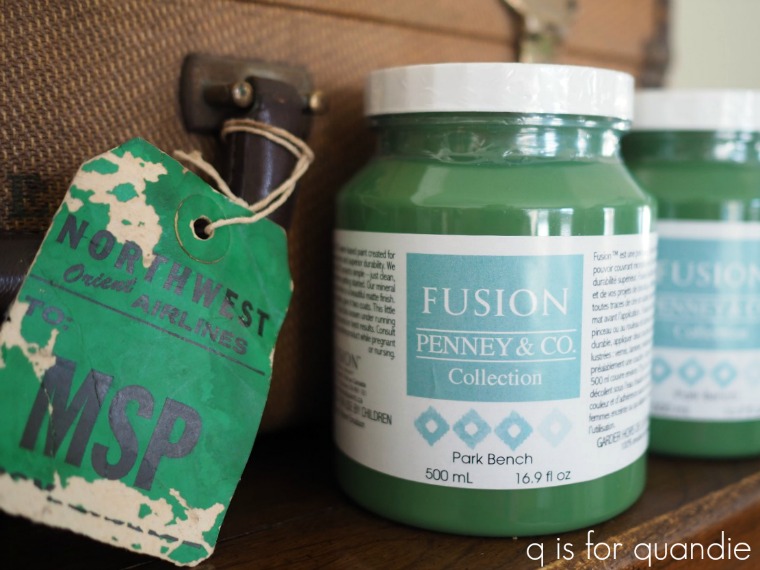
As soon as I saw it I was picturing it in a crisp fresh green.  Specifically Fusion’s Park Bench.  Perhaps it had something to do with the shortage of green things to look at this time of year in Minnesota!

But then I hesitated.
That’s a lot of COLOR.  It’s a larger piece of furniture, could it really handle it?  I definitely won’t be keeping it, so I had to wonder if I would be able to find a buyer for a large-ish, very green, mid-century dresser.

But the universe kept shouting ‘green’ at me.  Starting with that Northwest Orient luggage tag.  How many of you remember the days of Northwest Orient?

Then I was watching a colorized version of an old episode of the Dick Van Dyke show.  I have to say, I only made it about halfway through the show before I had to give up on it but that’s a whole different story.  I just had to change the channel when Dick told Laura he wouldn’t allow her to dye her hair.  Um, excuse me?  Allow?  As if.  Some mid-century things should definitely not come back in style.  But what I couldn’t help but notice was the fab green chair in the background of Dick & Laura’s living room.

Clearly this shade of green was a popular mid-century color.

Next I was thinking that this piece would work beautifully in a nursery so I checked on pinterest to see if people were doing this color in nurseries these days.  And why yes, they certainly are.

And doesn’t it work beautifully?

source for both nursery color schemes: https://www.laybabylay.com/

I’ll definitely be marketing this piece for a nursery, but it could also work well as a liquor cabinet/bar.

But I’m getting ahead of myself.  Let’s go back to the beginning.  Since I went so far off track, here’s the ‘before’ photo as a refresher.

This piece was in almost perfect condition.  The drawers glide beautifully, the piece is solid and well made.  The only problem was a missing drawer pull (see the middle drawer).  As I’m fond of saying, if you’re missing one you might as well be missing them all.  It would be very tricky to find a replacement part for that one pull.  I could have tried to find three new pulls for the drawers that worked well with the hardware on the top doors.  But I didn’t much care for the look of those anyway, so I opted to go with new hardware overall.  That meant filling the holes left by the old pulls on the drawers.

It’s not difficult at all to fill and disguise previous hardware holes if you’re planning to paint your piece.  I don’t think you’d know that there used to be holes here, would you?

Here is how I do it.  Start by placing a piece of tape over the back of the hole on the inside of the drawer.  Next, fill the hole with Elmer’s ProBond Wood Filler (or whatever brand of wood filler you like, as long as it is paintable).  Make sure the entire hole is full of filler, then smooth off the excess and let it dry.  Most fillers claim that they don’t shrink, but I have yet to work with a brand that doesn’t dry a little bit concave (maybe technically they don’t shrink, but they do settle into the hole).

So here’s today’s q-tip:  Once dry, sand your wood filler and then go back with some lightweight spackle and fill again.  I find that the spackle is smoother and does a better job of filling in that last little bit of concave space that was left after the wood filler dried.

Once dry, I sand smooth again and then I’m ready to paint.

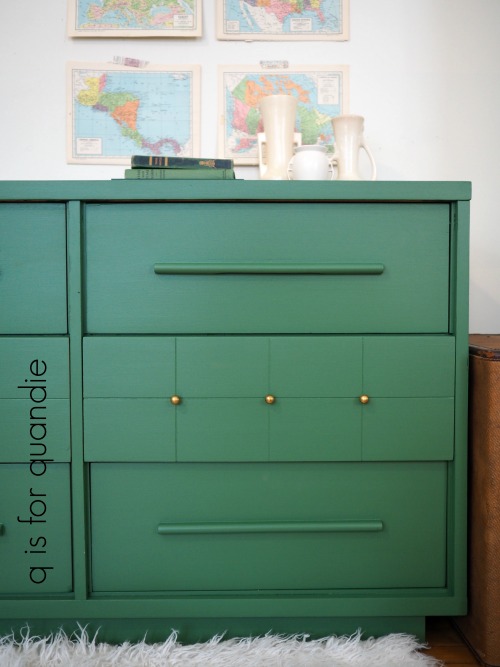
After my usual prep (light sanding following by cleaning with TSP Substitute) I painted the piece with two coats of Fusion’s Park Bench.  I purchased two pints of the Park Bench just in case one wasn’t quite enough.  There is nothing more frustrating than running out of paint near the end of your project.  But I didn’t even use one full pint.  I probably used about 3/4 of it.  So on the plus side, I have lots of Park Bench left for another project down the road!

Since this is a mid-century piece I opted not to distress it by sanding the edges.  However, I felt like the result looked somewhat one-dimensional so I decided to add some dimension in another way.  By adding black wax.

You do not have to top coat Fusion acrylic paint for durability or water protection.  However, you definitely can wax over it for aesthetic reasons like this one.

I find that wax behaves a little bit differently over acrylic paint than it does over a more porous paint like chalk paint or milk paint.  It doesn’t soak in quite as much, which can be an especially good thing when you are working with black wax over a lighter color.  You are better able to wipe away the excess without leaving a ‘stain’ of sorts behind.  With this piece I really just wanted to add more definition to the trim around the edges of the drawers and door fronts.  I used a wax brush to apply the wax just to those areas working it into the creases.  Then I used a clean rag to wipe away the excess from the raised areas, leaving some wax behind just in the creases.

It was just enough to give the dresser a bit more dimension by accentuating that trim.

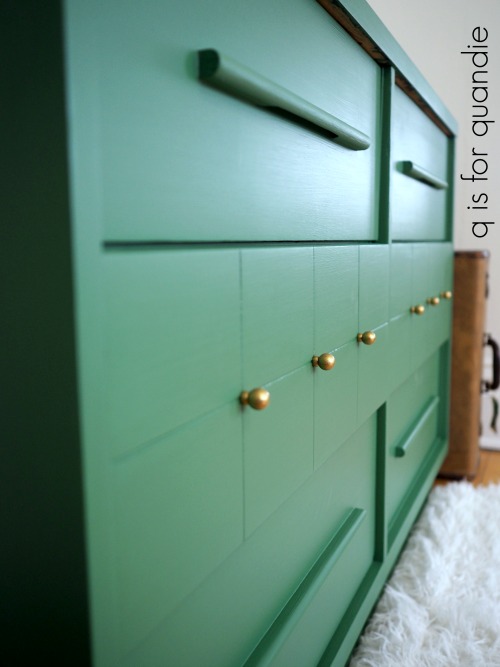
I replaced all of the original hardware with these gold knobs from Hobby Lobby.

I wish Hobby Lobby had more mid-mod style knobs.  They do have some, but not a huge selection.  This particular style also comes in silver, but I thought the gold paired with the green had more of a mid-century feel.

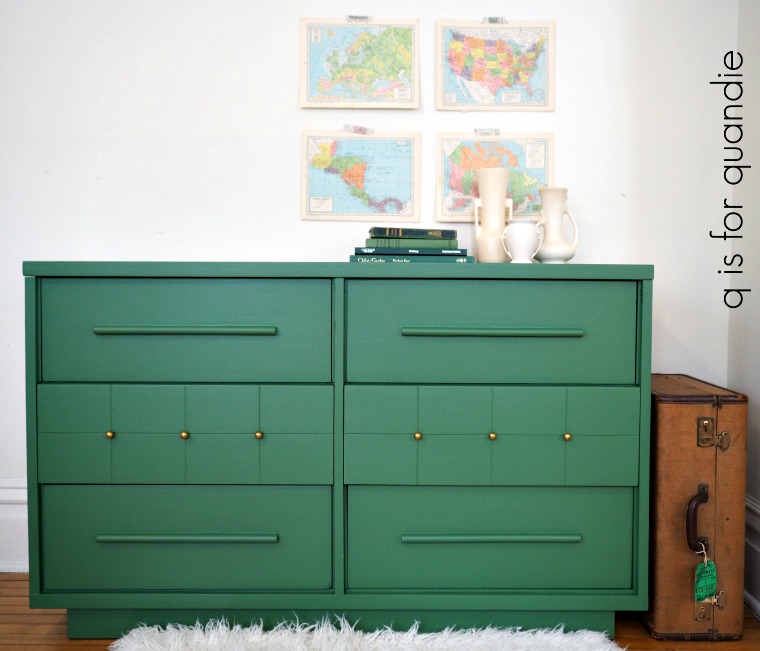
Are you wondering what the whole piece looks like?  I’ve been teasing you a bit with all of these glimpses.  Enough already, here it is …

This is my attempt at staging it for a nursery without having any real nursery type props other than some pretty vintage baby dresses and a fabulous vintage green kid’s book.

I also felt like most of my vintage, cottage-y, farmhouse-y style props weren’t quite right for the more mid-mod look of this piece.

I did much better staging it as a bar.

I found this old record album at the thrift store for $1.49.  Perfect for providing some mid-century art to the wall.  I’ll probably just re-donate it after using it in my photos.  Not only did it have the perfect shade of green, but the title is perfect for staging a piece of furniture meant for the very young at heart!

I found the round tray that I’m using in the photos at Target.

It’s part of the Hearth & Hand with Magnolia line.  While I was standing in that aisle of my local Target I ran into my friend Donna (also a loyal reader of my blog, thanks for that Donna!) and we had a whole conversation about how the final season of Fixer Upper has really transitioned toward more of a mid-century modern style rather than their previous farmhouse style.  Have you noticed that?  It’s definitely noticeable in their Hearth & Hand line.

As you can see, I did not paint the inside of the upper cabinet portion of the piece.  It’s in perfect shape, so I felt that leaving it alone was the right choice.  At first I wasn’t sure why this top section is divided vertically like it is.  But looking at it again I realize that each section is the perfect width for folded shirts.  Also, those dividers are removable, so if you did want the use the entire space without dividers you could.  And coincidentally this section is also the perfect height for most liquor bottles or baby clothes, or maybe diapers?

How convenient.

Now the real trick is going to be seeing if this dresser will sell.  Wish me luck on that!