an industrial vibe.

Man you guys, I am scoring toolboxes right and left these days!

Last Friday I brought 4 more home from the South St. Paul city wide garage sales.

My favorite is the black one simply because I love that shape.

I also really like the blue one because it’s so unique, it has a handmade vibe.

I purchased both the black toolbox and the blue one at an amazing garage sale.

Honestly, it was thanks to my friend Amy that opK and I even found this sale.  Amy was also in the neighborhood and she sent me a text letting me know that this particular sale had a lot of toolboxes.  If Amy hadn’t given us the heads up I’m not sure we would have ended up here.

I did quite like that box on the top of the pile above, but at $20 it was a bit pricey for me.  I like to keep my toolboxes at $10 and under.  So I passed on that one.  Although I did splurge on the black toolbox at $12, and the blue one was $8.

This was one of those sales where you really had to go around multiple times to be sure that you saw everything.

I have to admit, I may have a little garage sale regret that I didn’t purchase that little fan in the middle.  I like to use these as decor, rather than as actual functioning fans (they are a little unsafe with their old wiring and those sharp blades that could easily chop off a finger).  I usually cut the electrical cord right off just to make them safer for display.

They had several cool vintage scales …

But my own non-collection of scales already takes up two shelves in the pantry.

Plus, I had a few at my last sale and they didn’t go.  So I gave those a pass as well.

Still, this was one of those sales that just makes your heart go pitter pat.  So many cool things with an industrial vibe.

They had some business cards available at their checkout, so I grabbed one on the way out.  If you’re curious, you can check out their Instagram account at reimagined_industrial_design.  They have a nice reel showing their sale.

I did also buy a pair of old cupboard doors from them for $1 each.

I plan to paint them up and turn them into wall decor.

I purchased this oval shaped bucket from them because I just couldn’t resist it.

It was perfect for filling up with the stash of old paintbrushes that I grabbed from another sale, and I’m calling them my find of the day.

I have to give credit to opK because she spotted them in a covered plastic bin with the world’s tiniest little note on top that said something like ‘old paintbrushes’.  I hadn’t even noticed them.

Old crusty paint brushes might seem like an odd score to you, but they are perfect for including in a gallery wall like the one in my q branch.

Or to just display in a glass cannister.

I’ve already taken some time to dress some of them up with transfers.

That snippet of wording is from the Dixie Belle Vintage Post transfer, and this next bit is from the I.O.D. Home Sweet Home transfer.

Is it weird that I love these old brushes so much?

The 2nd pair of toolboxes that I brought home from South St. Paul also came from the sale with the brushes.  The seller told me that both the toolboxes and the brushes had belonged to her grandfather.  Both of them are Craftsman toolboxes (sorry Neal), and both are pretty rusty.

And yes, once again I brought home another red one, but this particular shape is my favorite to work with even though the color isn’t.

In the end almost everything I brought home from South St. Paul had a sort of industrial vibe.  It will be fun to get creative with these items and see what I can do with them.

Which find is your favorite?  Or do none of these things appeal to you?  Leave a comment and let me know.
those wascally wabbits.

Good morning from the garden!

I think I’ve tempted fate.

Over the years I’ve voluntarily added a number of adorable rabbits to my garden.  This first one was a Goodwill find.

Unbelievable, right?  It’s rare to find such a nice concrete garden ornament at a thrift store.  And in fact, Goodwill had two of them that day and I bought them both.  I kept one, and sold one on.  I’ve yet to find another score as good as this one at a Goodwill.

I also have a 2nd concrete rabbit in my garden, and he was a garage sale find.

Isn’t he sweet?

I like to place both of the rabbits as though they are poking their heads up through the greenery in the garden.

I’ve also recently added another rabbit to the garden.

You could say that this was a Carriage House Sale find.  My friend Sue brought it to our sale and I snatched it up.  There was just something about it that really appealed to me.

I’ve hung him up on the outside of the potting shed above an old rake.

As much as I love these sweet faux rabbits, the real ones are starting to get on my nerves.

As you may remember, we lost our beloved cat Lucy a few months back.  It turns out that she was doing a pretty good job of keeping rabbits out of my garden (she was an indoor/outdoor cat).  In the end I think it was simply her very presence that kept them away, she certainly wasn’t up for chasing any rabbits in her later years.

Now that she’s gone, the rabbits seem to be celebrating by dining on any tender new plants that I put in.

So far I’ve found six plants that have been munched including a brand new sanguisorba that I recently planted (I put that green mesh around it after the fact, and as a temporary measure).

And here’s what’s left of one of my heucherella plants, but several more of this variety were also chomped on.

Apparently the cocoa bean mulch does nothing to deter rabbits.  As many of you have reminded me, cocoa bean mulch is toxic to dogs.  I should point out that many other things in my garden are toxic to dogs as well including Lily of the Valley, hydrangeas, daffodils and alliums.  So if you are a dog owner, you should always research anything you’re adding to your garden.  And you should also keep a close eye on your pets, especially if they are prone to chewing on things.

One way to deal with my rabbit problem would be to use a rabbit repellant like Liquid Fence.   I haven’t resorted to that quite yet because I hear that those sorts of products are really stinky, and I don’t necessarily want a stinky garden.  That being said, I may have to give one a try if my next solution doesn’t work out.

Which brings me to these wire mesh cloches that I purchased from Amazon.

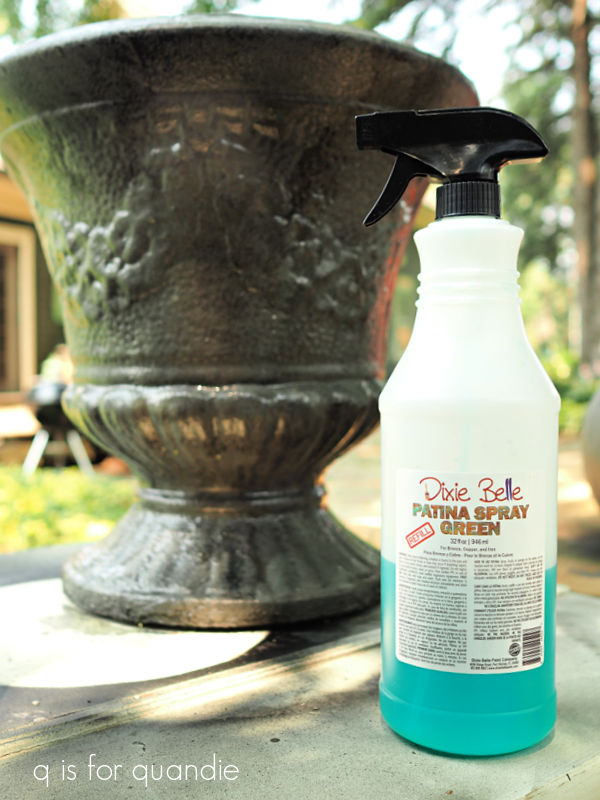
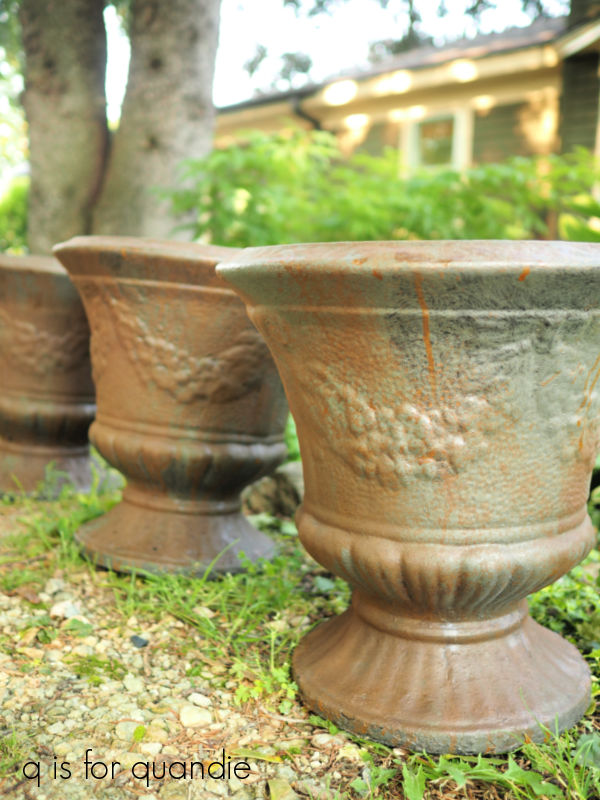
I’m not sure I like the shiny black finish on them, although the color does sort of help them fade away in the garden.  I may give them another look down the road … perhaps a rusty finish using Dixie Belle’s Patina Paint?  We’ll see.  But for now I have to get them out in the garden a.s.a.p. to get those plants protected.

I purchased a set of six, so I guess that means I can save just six plants.  Right now the plants I’m covering are all short enough to fit under the cloches, and the heucherella will stay shorter.  But these cloches come apart, so if you have a taller plant you can remove that top section to allow the plant to pop through.

I’m wondering if once I cover these plants, will the rabbits just move on to other plants in my garden?  Only time will tell.

In the meantime, the plants are already bouncing back under their protective cloches.  Here is that sanguisorba after just a couple of days of protection.

Clearly I’m going to have to do some experimenting to see what works and what doesn’t going forward, but for now I’m happy with my rabbit proof cloches.  They seem to be keeping those wascally wabbits at bay.  I’ll be sure to report back at the end of summer on how they worked out.

the toilet soaps toolbox.

I’ve got another toolbox from the stash to share today.

First up, I have to admit that I don’t love working with these newer, shinier toolboxes.  Especially when they are red.  That red is going to show when I distress the edges (although after finishing this one I did come up with an idea for the next one that I will report back on when I try it).

That being said, I really like the shape of this one, and the price was right so I went for it.

I started by removing that ‘BISON’ label.  It was made of metal and I was able to pry it off fairly easily.  I then gave the toolbox a good cleaning with hot water and Dawn dish soap.

I followed that up with a coat of Dixie Belle’s clear Bonding Boss.  I didn’t need to block any rust stains this time around, but I did want to improve the adhesion of my paint over that slick, shiny surface.

Next up I added two coats of Dixie Belle’s Apricot inside and out … and I forgot to mention … this one has a tray, so I gave that the same treatment.

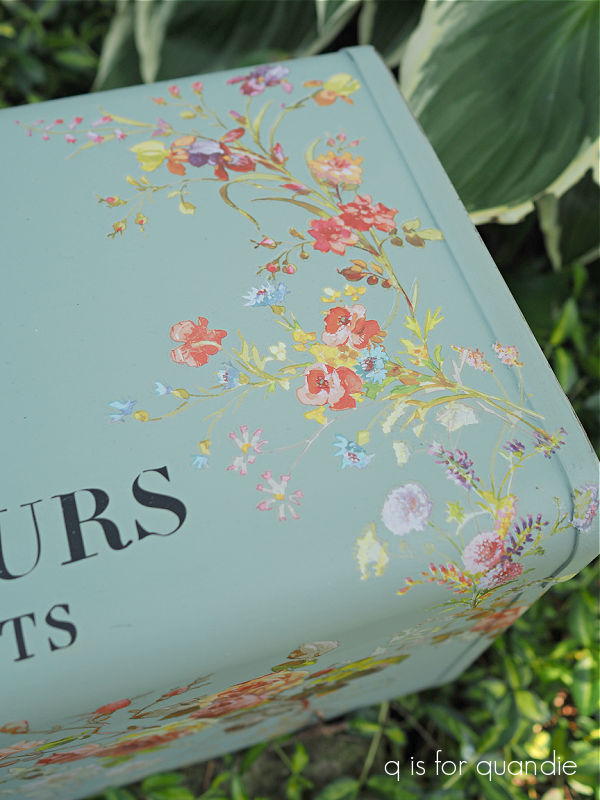
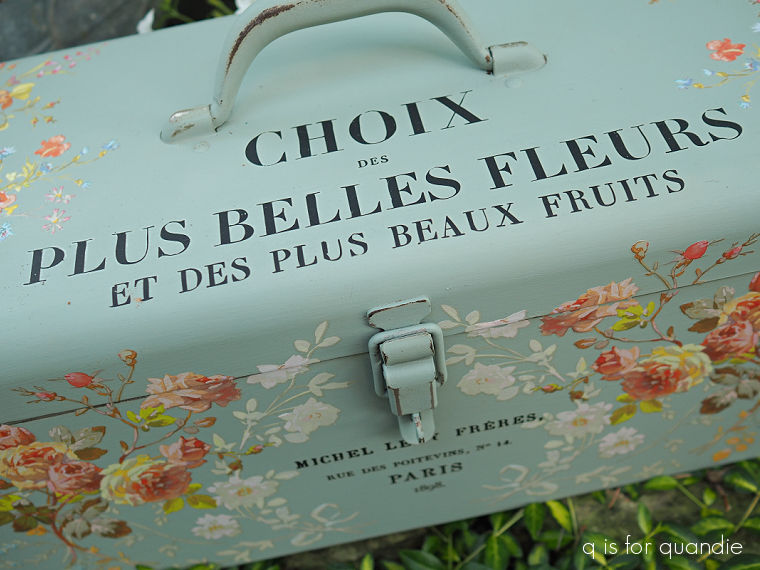
Once the paint was dry, I pulled out one of I.O.D.’s newest transfers called Saint Germain.  It has the most gorgeous florals in lovely rich colors.

I wrapped the florals around both sides of the toolbox …

as well as up and over that top.

Once all of the florals were in place, I pulled out the I.O.D. Floriography paint inlay and chose a few things to layer over them.

You may be wondering how to apply a paint inlay over a transfer, since typically you have to apply it to wet paint.  The trick is to apply the inlay into a wet clear topcoat instead.  In this case, I used Dixie Belle’s flat clear coat.  I’ve been doing a little experimenting with this and so far it’s working out beautifully.

I also added a paint inlay to the inner lid of this toolbox by applying it into wet paint (see this post for full instructions on applying a paint inlay).

I finished off the embellishments with one more paint inlay on the top of the box.

To avoid smearing any of my paint inlays, I gave the toolbox a final top coat using Rust-Oleum matte spray sealer.

Oftentimes people ask me what in the world do people do with these dressed up toolboxes?  My standard response is that they can use them to hold art supplies, which is what I use most of mine for.  Or, you could store your old photographs in it.  Some people use them to hold sewing or knitting supplies.

Of course, you could keep your gardening tools in this one.

But last week I sold the ‘rusty crustiest’ toolbox to Ellie and she intends to use that one in a totally unique way.  She’s going to put it in the outhouse up at the cabin!  It will be perfect for keeping the extra t.p. dry, and she can also add in a can of air freshener and some hand sanitizer.  I absolutely love that she’s doing that, and that toolbox with its array of bugs and wildflowers is perfectly themed for an outhouse in the woods.

She has promised to send me a photo of it when it’s in place, so I’ll be sure to share that with you guys too!

And now that I think about it, today’s toolbox with its ‘toilet soaps’ wording would also be perfect in a bathroom!

This toolbox is for sale locally, so be sure to check out my ‘available for local sale‘ page for more details.  As always, thank you to Dixie Belle Paint Co for supplying their products used in this makeover.

an old favorite.

Last weekend one of my favorite neighborhoods, MacGrove, was having their neighborhood garage sale.  They joined forces with Summit Hill and Highland Park as well.  So all in all there were over 100 homes participating with garage sales.

My friend opK and I headed out on Friday morning to see what we could find.

I’ll admit that we ended up driving around in circles half the time.  Although the organizers of the event published a list of the participating sales that included info on whether the sale was in the alley or the front yard, and whether they were open on Friday & Saturday or just Saturday, they did not publish a paper map.  Instead they used an online map created with Google My Maps.

So, go ahead, call me stuck in my ways.  But I prefer a paper map.  One where I can cross off the sales that we’ve already been to.  And I’d also prefer that it be color coded with one color of dots for sales open on Friday and another for sales only open on Saturday.

We spent a fair amount of time heading towards a dot on the Google map only to discover it wasn’t open on Friday.  We also spent a fair amount of time circling back to a sale we’d already been to because there was no way to mark them off.

Sometimes an old school paper map really is better.

That being said, we did find a few fun things while we were out driving in circles.

The prices were really quite good too.  The most expensive thing I purchased was this old ironstone wash bowl at $15.

I have an idea for turning it into a birdbath.  I’ll be using the scoop for potting soil.

The next highest priced item was another vintage sled for my stash that was $10.

I’ll dress it up for Christmas.

Everything else I purchased was $5 or less including this set of vintage books …

this cool old blue bottle …

and this set of cannisters.

I also scored a watering can for just $2.

I’m not sure if I’m going to dress that one up with paint or a transfer, or just leave it alone.

I’m giving ‘find of the day’ status to some dollhouse furniture that I purchased.

While I’m not sure I’ll even use the tall cabinet, I just love the little plant stand.  I’m currently working on putting together a few things for the dollhouse porches (there is an upper porch and a lower one) and this plant stand will be added to that pile.

I don’t often find dollhouse items at garage sales, but not only did I get those pieces, but I found this one too.

I was hoping it would fit in the foyer of my dollhouse, but unfortunately it’s too wide.  I’ll still paint it up at some point though.  Just for fun.

I also purchased this little doll sized cupboard at that same sale.

I really just felt like it needed to be rescued from a bad paint job.  It will be another fun one to make over.  I may save this project for winter though, just because it would be easy to work on indoors.

So, although I didn’t find anything especially ground breaking at MacGrove this year, I did come home with a few fun projects.  Is there anything in my haul that you would have picked up?  Leave a comment and let me know.
the $4 desk.

Boy oh boy, it felt good to work on an actual piece of furniture again!  It has been awhile.

You may remember that I found this shabby, primitive desk at a garage sale a couple of weeks back, and I only paid a whopping $4 for it!

It was definitely in rough shape.  And it got even rougher after I dropped the drawer on the pavement while loading it up in the car.  It broke into more pieces than I would have thought possible.

The desk itself was super wonky too, it definitely had some loose joints.

So the drawer went to Ken’s workshop to be repaired, and in the meantime I glued up all of the joints and now the desk feels quite sturdy.

I had initially thought I would try to salvage the original chippy paint finish by just cleaning it really well, but after spending about 15 minutes cleaning just one 3″ x 3″ section I decided that was going to require way too much effort for minimal results.  It would be so much easier to just paint it, and then distress it back again.

I really liked the original color, which was sort of a pale blue-green, so I decided to stick with a similar palette.  After going through all of my paint looking for a suitable candidate, I pulled out one of Dixie Belle’s new colors called Olive Wood.

It definitely doesn’t have as much blue in it as the original color, it’s more of a pale grey green rather than a blue green.  It has that perfect primitive vibe though, and I thought it would work beautifully on this desk.

I prepped the piece for paint by giving it a scuff sanding with 220 grit sandpaper, followed by a good cleaning with TSP substitute.

I followed that up with two coats of Olive Wood.  Once dry, I sanded with 220 grit paper again to distress the edges and smooth out the finish.

You’ll notice that I didn’t paint the top.  In fact, I didn’t do anything to the top except give it a good cleaning.

I think that the scratches and ink stains speak to a life well-lived for this desk.

Plus, if I haven’t already mentioned it, I plan to hang onto this desk to use as a display piece for the Carriage House Sale.  So the only person who has to like the end result is me.

Once the drawer came back from Ken’s workshop, I removed the old knobs (one was broken in half) and found a different pair of wood knobs to paint up and add.

As a final touch, I added one of the paint inlays from I.O.D.’s Floriography collection to the front of the drawer.

After a quick spray with Rust-Oleum matte spray sealer over the inlay, I gave the entire desk a final topcoat of Dixie Belle’s clear wax.

I love how it turned out, a sweet, rustic, slightly primitive writing desk.

It will be perfect for displaying other items for sale at our next Carriage House Sale, although I’ll probably pop a price tag on it just in case someone is in the market for a simple desk.

Thank you to Dixie Belle Paint Co for providing their products used on this desk.

gardening in miniature.

Good morning from the garden!

Although I just started my dollhouse reno last winter, I’ve been working in miniature in the garden for years now.

My fairy garden started out in a cracked birdbath.

That worked beautifully since the crack allowed for drainage.  We would take the bowl section of the birdbath off its pedestal and bury it in a big pile of leaves up against the house for the winter which worked well to protect the plants.

But then one spring we pulled it out to find it had fully cracked in two.  In addition, my sister had given me a cute little fairy house for Christmas, so my miniature garden really needed to expand.

So I moved it into an old rickety wheelbarrow a few years back.  There were some spots where it was rusted through, also providing good drainage for a fairy garden.

Although I piled about 12″ of leaves over it, and then covered it with burlap this past winter, I still lost the bulk of the plants.  Apparently last winter was hard on miniature gardens as well as the full sized ones.

Only three things survived, the tall Alberta Spruce ‘tree’, a Primo Arborvitae and a creeping sedum.  Everything else bit the dust, including the mini Japanese maple (I knew that one would be risky), a 2 year old creeping thyme, and all of my miniature hostas.

Oh well, that gives me the opportunity to try new plants.

That being said, I have found that ever since Covid it has been more difficult to find miniature plants.  I asked about it at one of the nurseries that used to carry lots of mini’s and they said their miniatures grower had decided to close up shop permanently during Covid.  I do wonder if most of the local nurseries all got their mini’s from the same grower.

So I feel like it was my lucky day a couple of weeks ago when I happened to come across a yard sale just a few blocks away from me where the proprietor was selling miniature hostas.

Hostas are classified as miniature if they stay less than 8″ tall when full size.  Of course, that would translate to 8′ tall in 1:12 scale, which would be rather large for a garden.  But you can keep them smaller by regularly dividing them.

And actually, it’s lucky that I have regularly divided my Feather Boa hosta, planting the extra chunks in the ground.  The ones in the fairy garden have died off the past two winters, but I’ve been able to replace them with divisions from the ones that are doing really well in the ground.

One mini hosta wasn’t enough for me though, so I purchased three new mini hostas for my fairy garden at the yard sale.

No. 1 is a Tears of Joy.

This one is only supposed to grow to 4″ tall, so it should be perfect for the fairy garden.  I have to admit that it’s a bit odd looking.  Well … let’s call it unique looking instead, OK?  I think it will look better once it fills in a bit.

Next up, a Pandora’s Box.

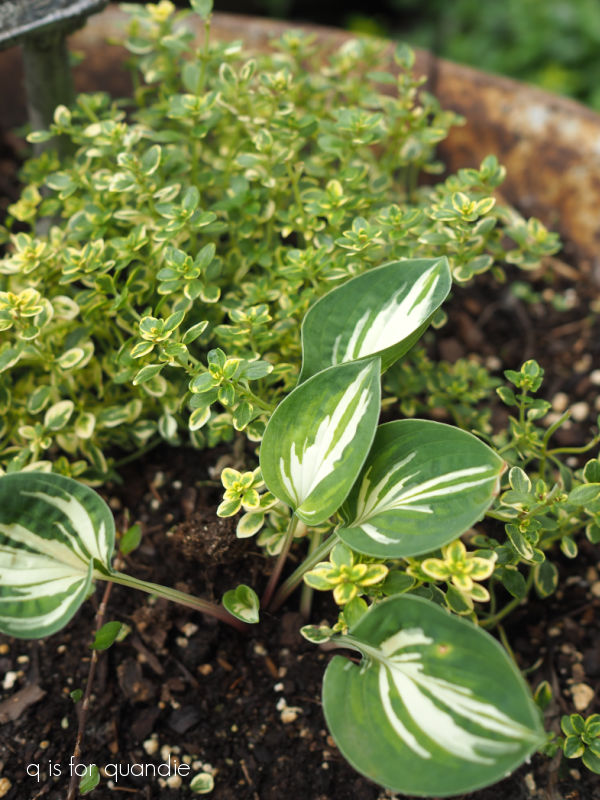
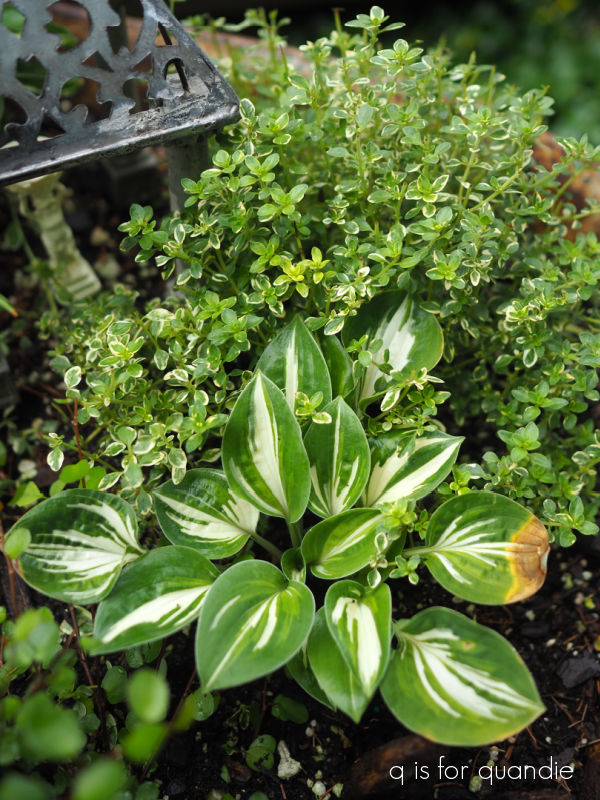
This one gets 4″ – 6″ tall and I’ve planted it just in front of a Golden Lemon Thyme.  Isn’t that variegation lovely?

And finally, I also grabbed a Frosted Mouse Ears.

This one can get up to 7″ tall, so we’ll have to see whether or not it looks believable in the fairy garden going forward.

It’s planted right in front of the Primo Arborvitae that survived from last year.  I moved it from next to the arbor to beside the fairy house this spring though.  I love how easy it is to transplant a tree in miniature, lol.  No heavy lifting required.

Although this variety, Thuja occidentalis Primo, can get up to 4′ tall, it grows slowly and should work well in the fairy garden for quite a few years. It’s also cold hardy down to -30°, which explains why it survived the winter in a wheelbarrow.

I added a Myrtle topiary to the fairy garden this year as well.

It’s only hardy down to 32° though, so I will have to pot it up and bring it in the house for the winter.  I just hope I remember to do that before our first frost.

Ultimately I also found an online source for fairy garden plants called Two Green Thumbs.  I ordered two plants and a few other miniatures.

The plants are a Dusseldorf Seathrift (Armeria maritime ‘Dusseldorf’) …

and a variegated English boxwood (Buxus sempervirens ‘Variegata’).

I’ll be giving him a bit of a prune to shape him up, but I thought it would be wise to let him settle in a bit first and get over the shock of transplanting.  Plus, we are under a heat advisory with temps in the upper 90’s, so not weather for pruning.  Seems somewhat ironic seeing as I had to turn the heat on last week when we didn’t even make it out of the 50’s one day.  Welcome to Minnesota.

I also purchased those three little faux ‘rocks’ that you see in the photo above just below the boxwood, a small birdbath statue …

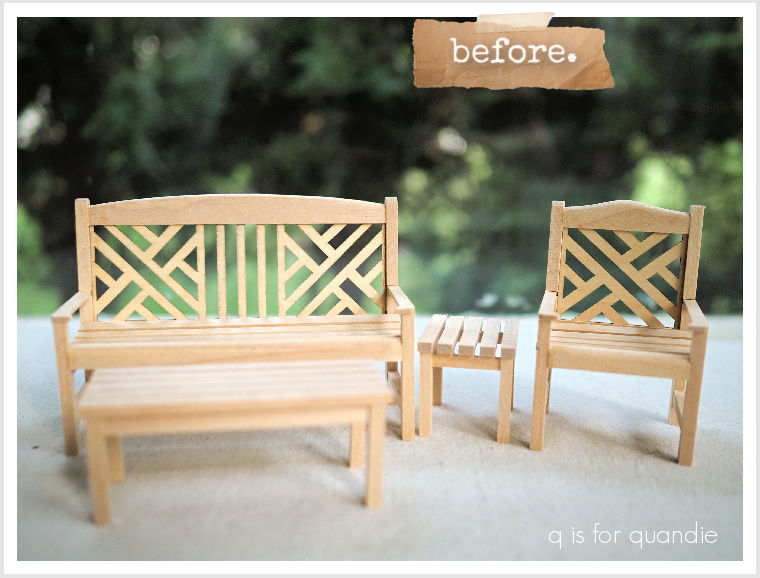
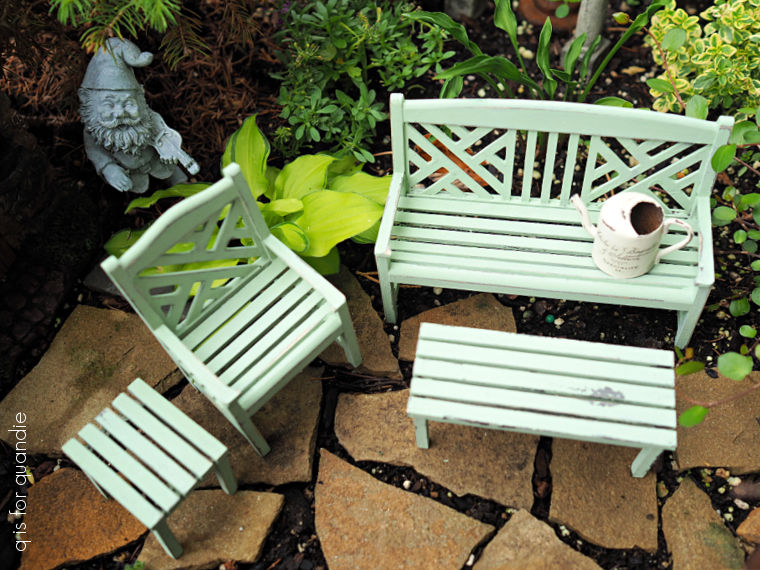
and a sweet little bistro set.

This set is actually intended for the dollhouse porch rather than the fairy garden though, and it will be getting some sort of makeover.  I’m not sure what yet, but plain white feel a bit boring for me doesn’t it?

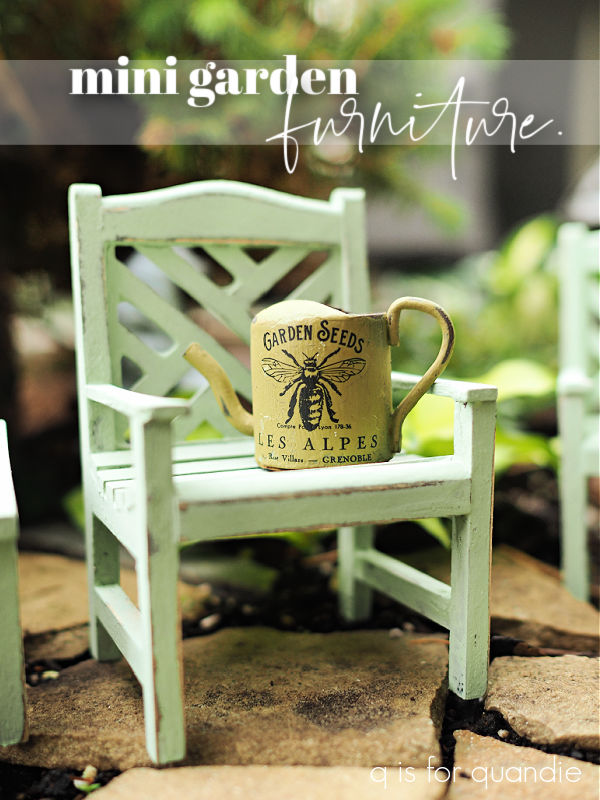
Back to that yard sale with the miniature hostas, I also purchased a pair of little watering cans there.

But of course I couldn’t leave them simply plain like that, I had to ‘quandie-fy’ them.

I painted one of the watering cans in Dixie Belle’s Drop Cloth and the other in their Holy Guacamole.  Then I added some knob transfers from re.design with prima.  If you aren’t familiar, the knob transfers are meant to fit on those round wooden knobs that would go on a dresser or a cupboard door.

But I have found that they work beautifully for miniatures.  For example, I used them on my dollhouse dining chairs.

A couple of them worked perfectly for these watering cans too.

I can’t really pick a favorite.  I like the Drop Cloth version (above), but I really like the Holy Guacamole version as well.

But that’s OK, I have a home for both.  The green one will go in my fairy garden, and the white one will go on the porch of my dollhouse.  More on that in a future post.

I’m curious, do you have any favorite plants that work well as a miniature?  And which watering can is your favorite, green or white?  Leave a comment and let me know.
the rusty crustiest one.

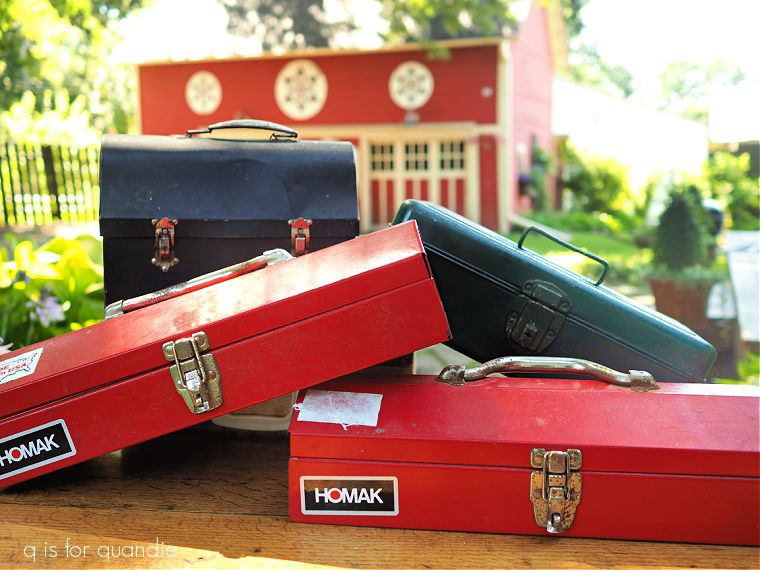
I’ve been scoring a lot of toolboxes lately.  I seem to be finding them at nearly every garage sale.  Last week my friend Sue texted me on a Tuesday to let me know that there were a couple of toolboxes at a garage sale just down the road from me.

A garage sale on a Tuesday?  Weird, right?  I guess any day is a good day for a garage sale now.  Anyway, I popped over there and brought home these two toolboxes.
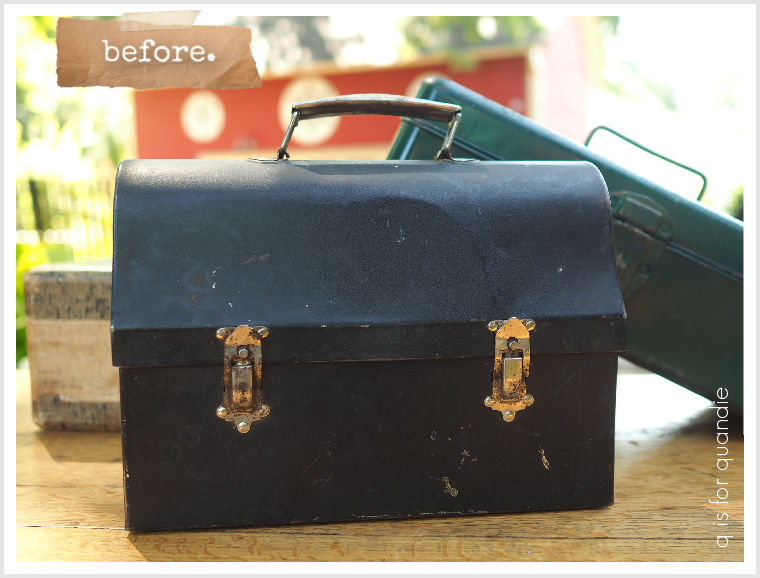
Meanwhile, I also had these toolboxes from a previous garage sale day.

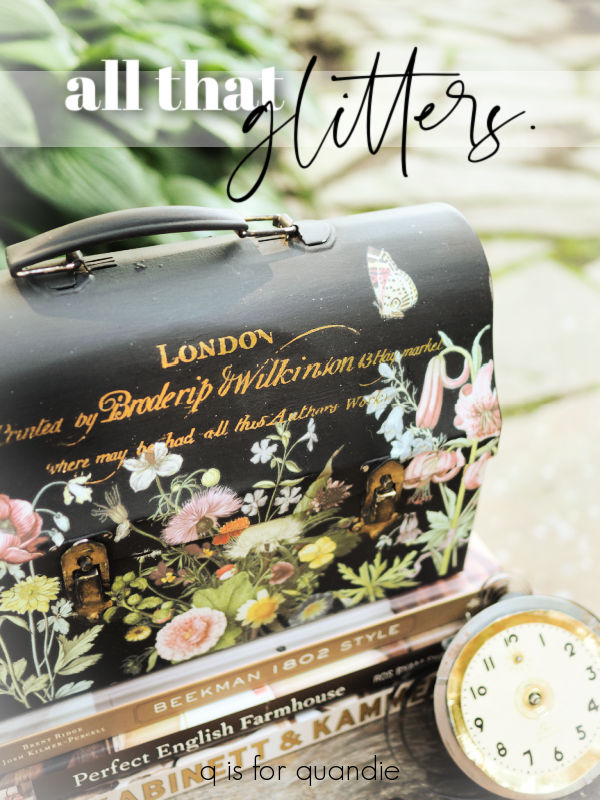
Plus I still have a couple that I acquired over the winter including this black one.

So, some toolbox makeovers were definitely at the top of my to-do list this week.

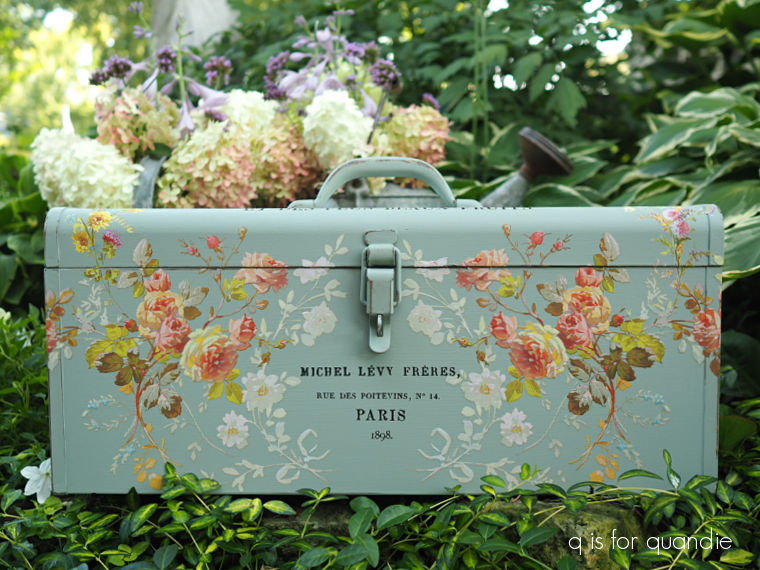
I decided to start with the rusty crustiest one.

I also decided to try a little different prep this time around to see how it worked.  I started by giving the toolbox a good scrub with hot water and Dawn dish soap.  Next I sanded it inside and out with my Mouse sander.  My goal with the sanding is to knock down the texture of the rust a bit, but I don’t go so far as to sand all of the rust away by any means.

Then after another good cleaning to remove any loose dust, I gave it a couple of coats of Rust-Oleum satin clear coat.

Here’s a look at the result.

And here’s the inside.

My goal was to see if this would work just as well as the Dixie Belle Bonding Boss that I usually use to prep my toolboxes.

Next up I painted the inside of the box in Dixie Belle’s Cactus Silk Paint.

The Silk Paint line is an acrylic paint with a primer and top coat built in.  So two coats of Cactus and the inside was done.  No need to add another top coat.

Next up I painted the outside of the box in one of the colors from Dixie Belle’s new Southern Roots collection called Ecru.

How can I describe this color?  A very warm white?  A less yellow cream?  A pale beige?  It’s something like that.

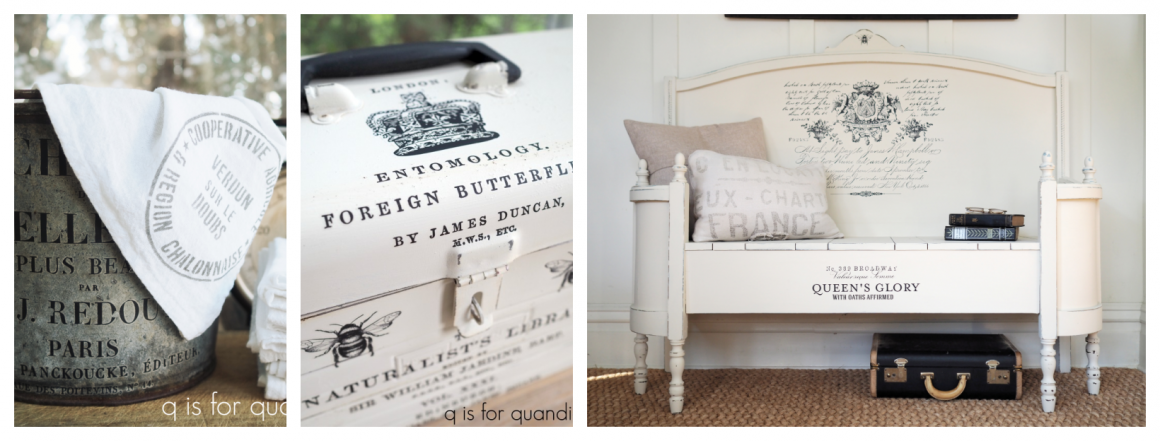
As you can see above, I then added some lovely florals from the I.O.D. Wilde Bloemen transfer, wrapping the florals up and onto the top of the box.

The little daisy below is my favorite!

I also added a few moths, butterflies, dragonflies and bugs.  Not to mention a frog or two around the sides.

All of these elements from nature made this toolbox perfect for some typography from the I.O.D. Label Ephemera transfer.

If I was a naturalist, I’d certainly love to keep my tools in this toolbox.

Wouldn’t you?

Although I have to admit, I’m not sure what those tools would be.  Certainly some binoculars, and maybe a magnifying glass or two.

As for my experiment using a spray sealer rather than the Bonding Boss, I think it worked out just fine.  The benefit of using the spray is that it’s a bit faster and easier to spray something like a toolbox rather than applying Bonding Boss with a brush.  On the downside, there is a good chunk of the year here in Minnesota when I can’t really use spray paint because I don’t have a heated workshop.  In addition, if you’re painting a lot of toolboxes (which I seem to be), it’s definitely more cost effective to use the Bonding Boss.  But either one of these options might work for you.

This toolbox is for sale locally, check out my ‘available for local sale‘ page for more details.

As always, thank you to Dixie Belle Paint Co for supplying their products used in this makeover.

the high price of war.

Some of you may have been thinking that Mr. Q really enjoys gardening, seeing as we spent three full days touring gardens on our recent trip to the Brandywine Valley.

But, au contraire, it would be more accurate to say that he tolerates gardening and garden tours.  He was willing to put up with it though, because I paid him back by tolerating battlefield tours.

OK, to be fair, ‘tolerate’ is too strong of a word.  I think we both enjoyed the gardens and the battlefields … maybe just one more than the other.

We visited two different battlefield sites on our trip, the first was where the Battle of Brandywine took place during the American Revolution.

The photo above shows Birmingham Hill where much of the battle took place.  Mr. Q and I spent a very pleasant evening following a walking path around the area, but there was not a lot to see outside of some beautiful scenery.

And there is a large monument to Lafayette at the nearby Birmingham Meeting House.

From there it’s about a 10 minute drive to the Brandywine Battlefield Visitor’s Center which is only open on Friday and Saturday.  So we waited until Friday to head over there.  At the Visitor’s Center you can purchase a ticket that includes guided tours of two buildings nearby (FYI, neither are original to 1777 but have been restored to reflect their original look).

The first is the Benjamin Ring house.

Although this is called Washington’s Headquarters, our guide explained that it’s unlikely Washington actually stayed inside the house.  He likely stayed in a tent on the grounds.

They did have the front room, or parlor, set up as Washington’s office, but this is probably not historically accurate.  After all, Benjamin Ring, his wife and six children and two servants were living in this small house at the time.  So it’s unlikely that this room was empty except for one small desk.

Washington and his officers definitely did take meals in the Ring house, and Mr. Ring presented them with an invoice for those meals that is still in existence today.

Since Benjamin Ring was a Quaker, that meant that he was banished from his congregation for allowing this since it went against their pacifist beliefs.  Furthermore, since the British won this battle, Ring’s farm was mostly destroyed, his fields burned and his livestock stolen after Washington’s troops retreated in defeat.

We next headed over to the Gilpin farm.

See that giant tree on the right?  That is a sycamore tree that has been dated to 1730, so it was there at the time of the battle.  Sycamore trees can live for 200 to 400 years, and there are even some known examples that are over 500 years old!

We were able to tour the inside of the Gilpin farmhouse, but once again, it’s a reproduction and nothing inside is original to the house.

Gilpin was also a Quaker, and in contrast to Benjamin Ring, he refused to choose sides or fight during the battle.  However, the British left his farm in ruins and thus he later chose to side with the Continentals.

I found a great blog called Two Nerdy History Girls with some good info on both the Rings and the Gilpins, so check those out if you’re interested in learning more about them.  Although they quit writing their blog back in 2018, there is some good content to explore from before that.  Also, sidebar, I decided to try one of the author’s books so I’m currently reading The Secret Wife of Aaron Burr by Susan Holloway Scott and if you like historical fiction I would recommend it.  I only wish I’d read it before we went on our trip.

In the end both of these Quaker farmers paid a very high price after the Battle of Brandywine, although not as high as the approximately 1,300 Continentals or the 600 or so British soldiers who lost their lives (FYI, I find that those numbers vary depending on where you look).

The high price of war indeed.

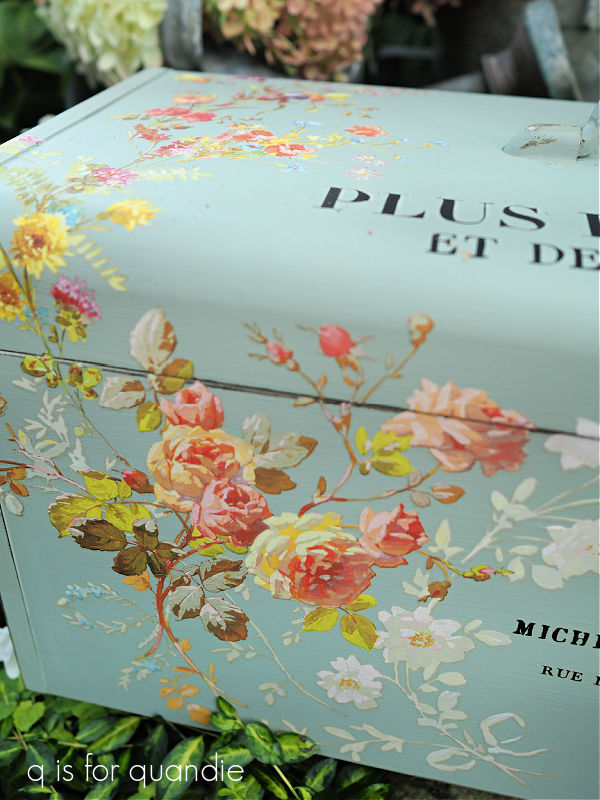
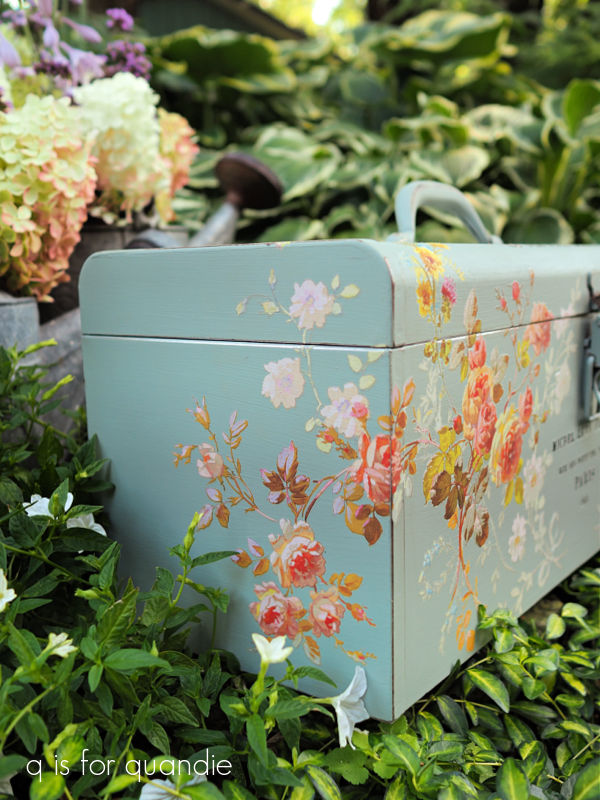
the corabelle box.

Remember the box I picked up while garage saling recently?

I’m not sure what this box was originally intended for.  It definitely looks homemade, so I assume it was made to hold something specific but it was empty when I purchased it.

I know the wood grain looks pretty in that ‘before’ photo, but it was damaged on the top of the box.  But honestly, even if it hadn’t been damaged I still would have painted it.  Painted boxes sell for me, wood boxes don’t.

I started with the inside of the box by painting it with two coats of Dixie Belle’s Drop Cloth.  I then applied one of I.O.D.’s paint inlays into the 2nd wet coat of the Drop Cloth (you can find full instructions for applying the paint inlays here).

Isn’t that pretty?  That is from the new I.O.D. Floriography paint inlay.  You’re going to see a bit of that one in upcoming projects because I absolutely love it.  Now, do I wish it was a transfer rather than a paint inlay?  You betcha.  If only.

When I ordered the Floriography inlay and a couple of other I.O.D. items from The Painted Heirloom recently, I needed to spend $5 more to get free shipping.  So I decided to add a sample size packet of Sweet Pickins Milk Paint for just $7.

I chose a coral/pink color called Corabelle.

I have to admit, this color totally reminds me of Calamine lotion, and thus a really bad case of poison ivy that I had when I was younger.  Nonetheless, I think it’s a very pretty color.

I mixed up just half of the sample (half powder to half water) and it was plenty for two coats on the outside of this box.

I wanted to try a technique that I’ve seen Yvonne on Ginger Chick Rehab (on YouTube) use to get a lot of crackling with milk paint.  Basically you spray seal your piece first with some kind of sealer.  I believe Yvonne typically uses a spray shellac, but I used the Rust-Oleum matte clear spray on my box.  Next you brush on your milk paint and then add heat to dry it.  I used an old hair dryer for that (I think Yvonne uses a heat gun).  I’m not sure if you really have to add heat to both coats of paint, you may be able to get away with just heating the final coat, but I did both just in case.

It worked beautifully.

See that crackle?

Once dry, I sanded lightly to distress the edges and remove any loose chippy paint.  There wasn’t much, but a little here and there.  Then, and this is important if you’re going to add transfers, I gave it another coat of the matte spray sealer.  That makes sure that your paint is sealed in place and won’t lift up with the transfer.

As you can see, I went back to the I.O.D. Rose Botanical transfer for the florals and my old standby Label Ephemera for the typography on this box (yes, sadly, Label Ephemera has been retired for some time now and is difficult to come by).

I think it’s a little difficult to tell the size of this box by looking at these photos, but it’s 16.25″ wide, 8.5″ deep and 6″ tall so you could fill it up with all sorts of different things!

This box is for sale locally so be sure to check out my ‘available for local sale‘ page for more details.

no more whining.

Good morning from the garden!

Recently I came to the realization that I need to quit whining about my garden and its jumping worms, pathetic lilac hedge and all the plants that died over the winter.

I’ll admit that I was worried earlier this spring.  Especially when we came back from our trip out east to find the garden bone dry, with plants that were very slow to break dormancy, and weeds everywhere.

But as it turns out, it was the freakish hot and dry weather while we were gone that was the problem, not the jumping worms.

Flash forward a month and add in some much cooler weather, a fair amount of rain, a few plant replacements and a bit of weeding and things are looking really good right now.
If you aren’t familiar with my gardening style, I like to call it ‘jam packed’.

I prefer not to leave any space for the weeds to take hold.

I know not everyone likes this look, and I also know that it can lead to problems with increased insect pressure and plants that get crowded out.  But it’s still my preferred style.

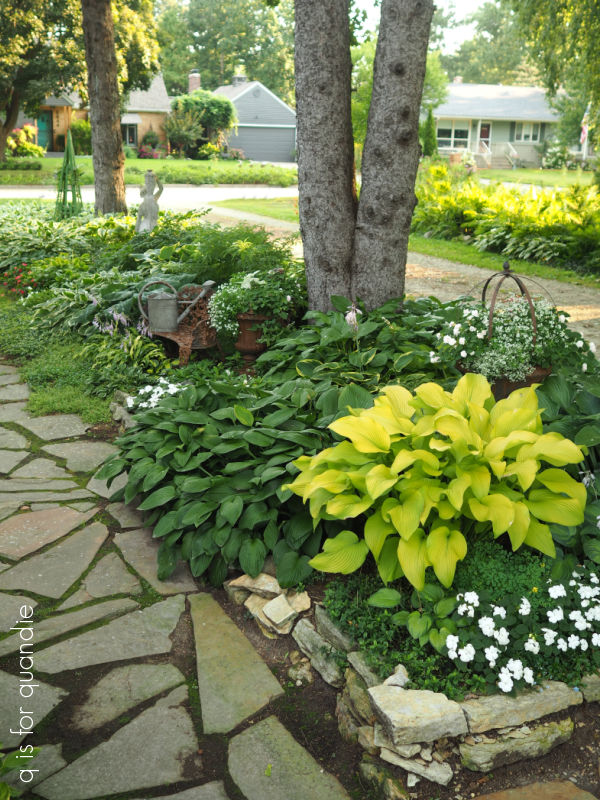
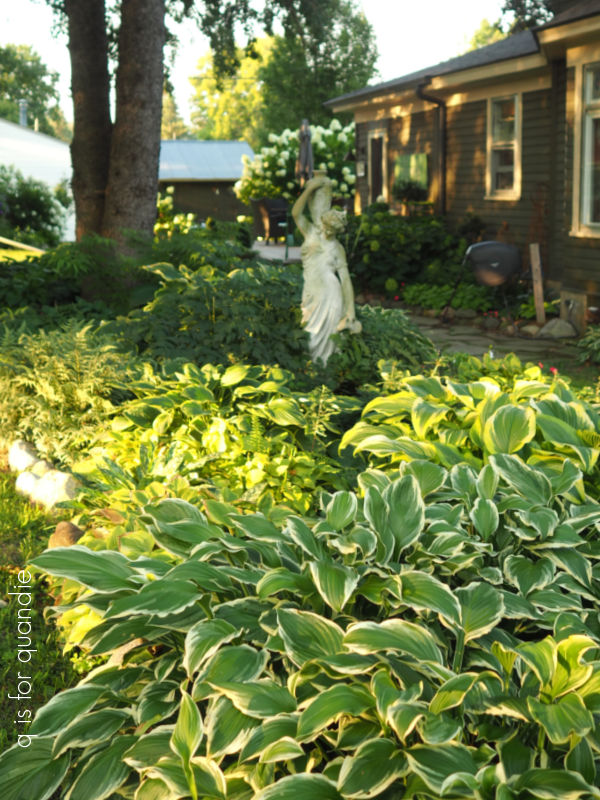
Most everything in my shade garden is doing well, and this is the spot where I found the most worms last year.

As I mentioned recently, the Forget-Me-Nots (low ground cover with blue flowers in front left) are having their best year ever.  Clearly they aren’t being impacted by those pesky worms.

Neither are the hostas.

Although I did lose a few hostas over the winter, and there are another several that are coming up very slowly, the rest are looking larger than ever and super healthy.

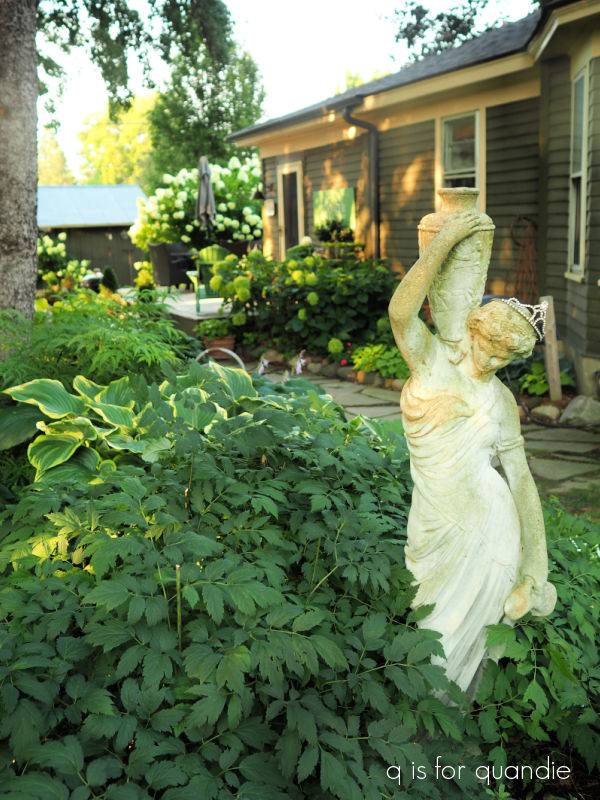
FYI, that plant in the background that looks sort of like a Japanese maple (seen from both sides in the above two photos) is actually a Morden Golden Glow Elderberry.  Laura of Garden Answer recommended elderberry as a good substitute for Japanese maples when you live in a cold climate.  Visitors to my garden often do think it’s a Japanese maple.  Some elderberries can grow to 10′ tall, but this variety is more compact and only grows to 4′ to 5′ tall and wide.  Also, since I have this in full shade, it will likely remain somewhat smaller.

My Lakeside Dragonfly hosta is looking especially nice right now.
I am trying a few different things to mitigate worm damage in this bed.  First, I fed everything this spring using Espoma’s Plant Tone.  It’s an organic, all purpose plant food and I simply sprinkled it on top of the soil early this spring before the plants were up.  For best results you are supposed to work it in to the top 4″ of soil, but in existing beds like mine you can just sprinkle it onto the soil around the dripline of plants and then water it in.

Second, I’m mulching this area using cocoa bean shells.

There is some anecdotal evidence that jumping worms don’t like cocoa bean mulch.  The pros to cocoa bean mulch; it has a nice dark color and it makes your garden smell like a chocolate factory.  The cons; it’s expensive and it will get mildewy in wet weather (which is definitely what we are having this week).

Finally, I’m hand pulling worms when I find them.  And yes, that’s as gross as it sounds.  The recommended disposal involves sealing them in an airtight container, setting it in the sun for a bit and then tossing it.  So I’ve been stocking up on empty mayo jars, sour cream containers, etc all winter (with the help of nnK and her mom Judy).

Hopefully one or all of these extras will help my garden stay happy this summer.

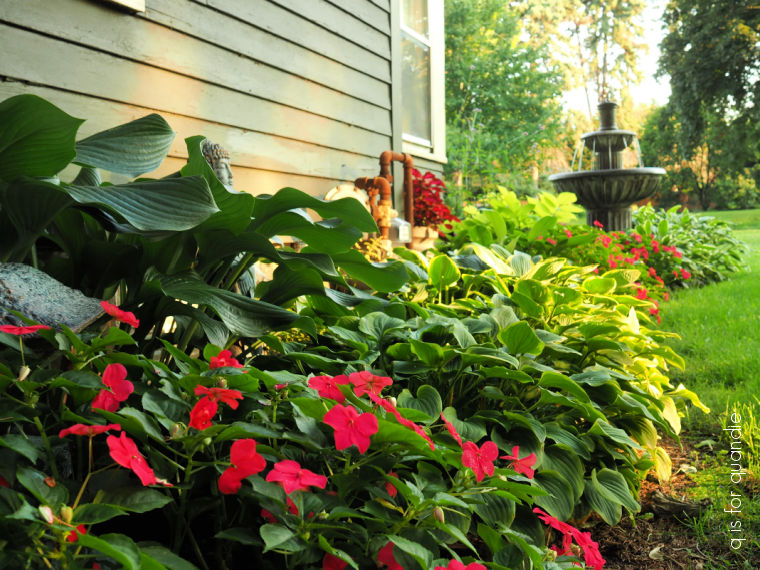
You may remember that I mentioned in an earlier post that most of my lamium didn’t survive the winter.  That was a bit of a bummer, but it gave me the opportunity to fill in some bare spots with annuals this year.  So I added some bright pops of color with some impatiens.

I know that a lot of the popular gardener influencers consider impatiens to be passé, but then I’ve never been one of the cool kids anyway.

But wait, now there is one small patch of that lamium coming back!

I’m so happy to see it since I’ve been scouring the nurseries trying to find more to put in and haven’t had any luck.  Sure, they have lots of other varieties of lamium, but I can’t find this fabulous chartreuse variety.  I had two different chartreuse lamiums in my garden, the Lamium maculatum ‘Lemon Frost’ which has a more pronounced white center (and so far none of that is coming back).

And I believe my older plants were Lamium maculatum ‘Aureum’.

As you can see in the photo below, I had lots of it last year.

I plan to baby that little patch that is coming back, and hopefully I can start to divide it and spread it around again soon.

With that I’m going to head out into the garden now to pull some weeds.  But hey, if you have any tips on controlling jumping worms, please be sure to leave a comment!  And even if you don’t have any tips, let me know how your garden is looking so far this season.