adding colorful foliage.

Good morning from the lush, and very wet, garden!

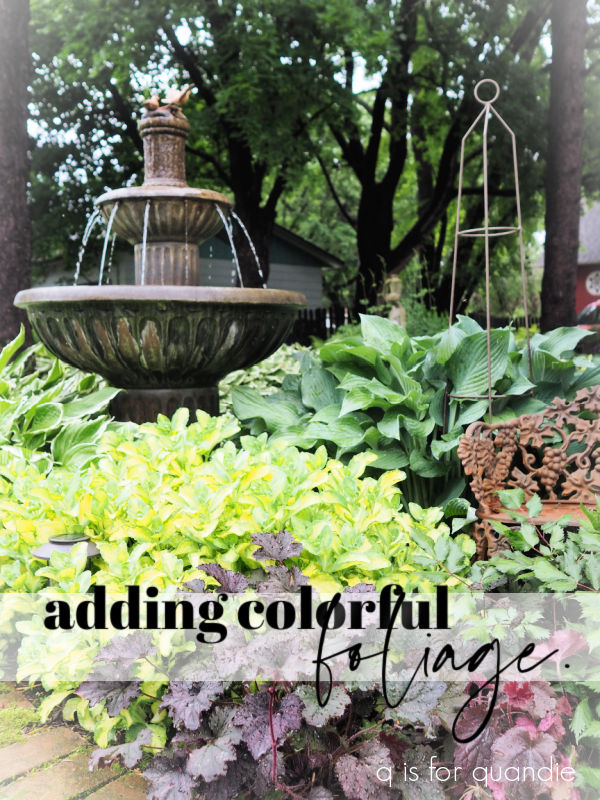
Today I thought I would share the advice that Laura on Garden Answer gives about foliage color.  She says that to create interest in a garden bed you should include something in green, something in yellow, something in blue and something in red.  Unless, of course, you are going for a monochromatic look, such as with an all white moon garden.

You might initially think that would be easy with flowering plants, but impossible to do with plants grown strictly for their foliage.  Aren’t they all just green?

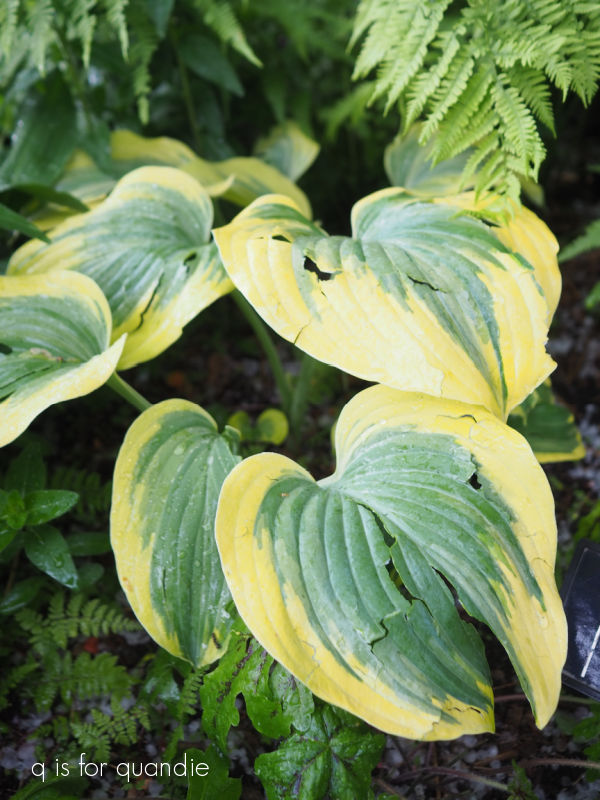
Well, not in garden terminology.  Obviously there aren’t any plants with truly ‘blue’ foliage. But in plant lingo, ‘blue’ means something like this …

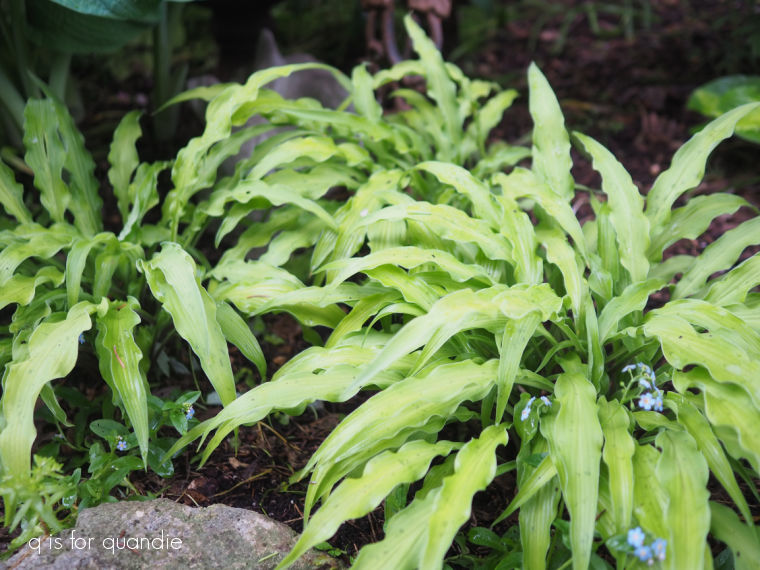
And ‘yellow’ refers to a brighter chartreuse-y green, like the color on this Sun Power hosta.

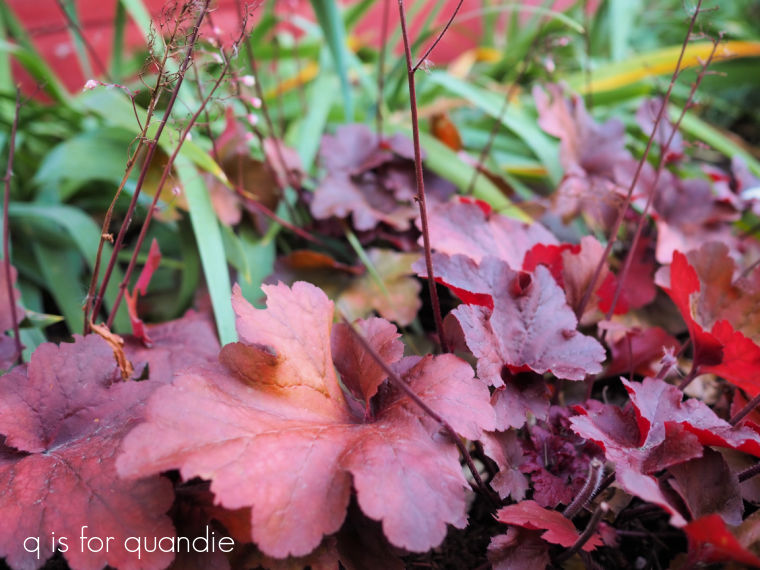
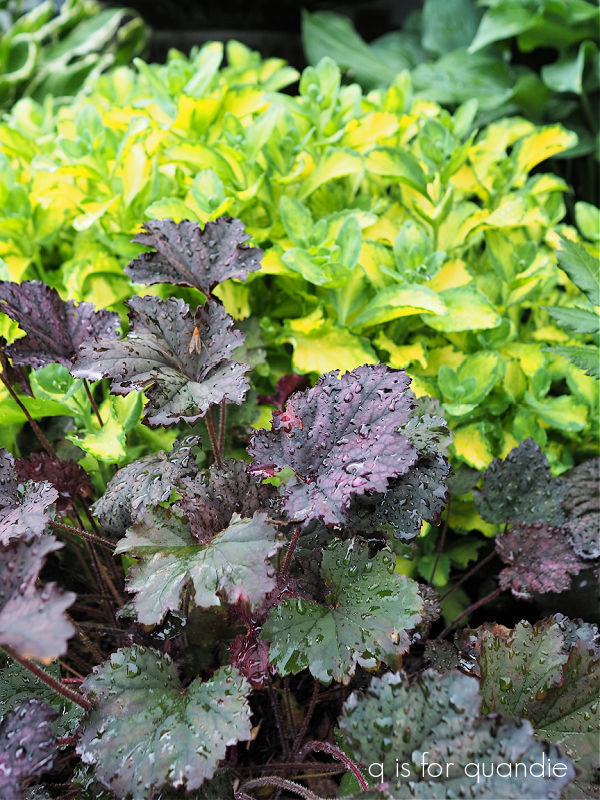
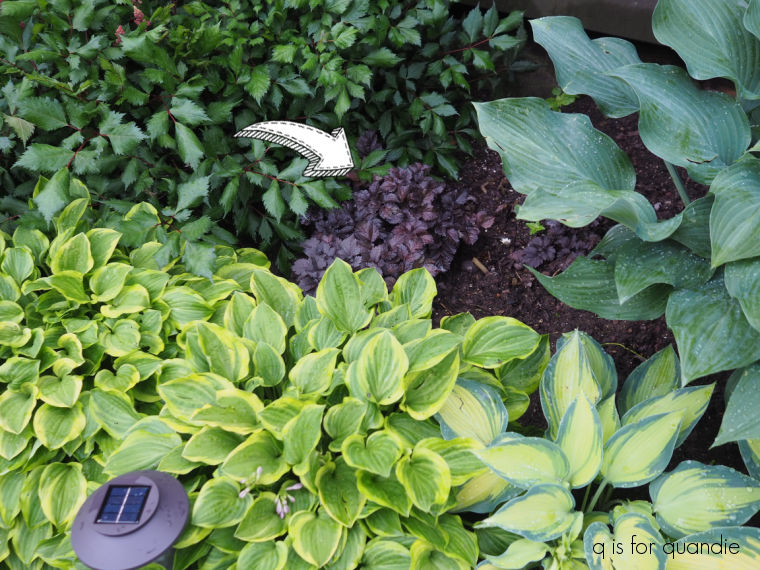
And red foliage can be found in lots of heuchera.

As for ‘green’, well, that one’s easy.

It’s just green.

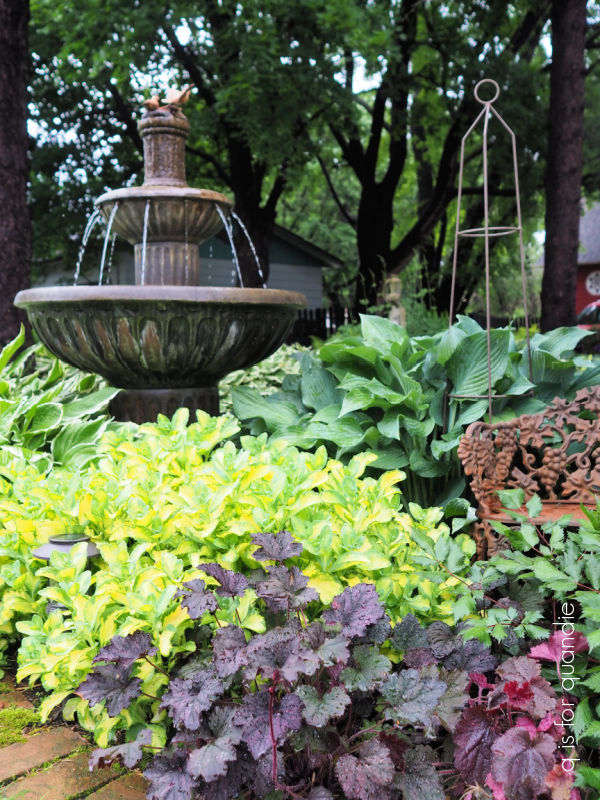
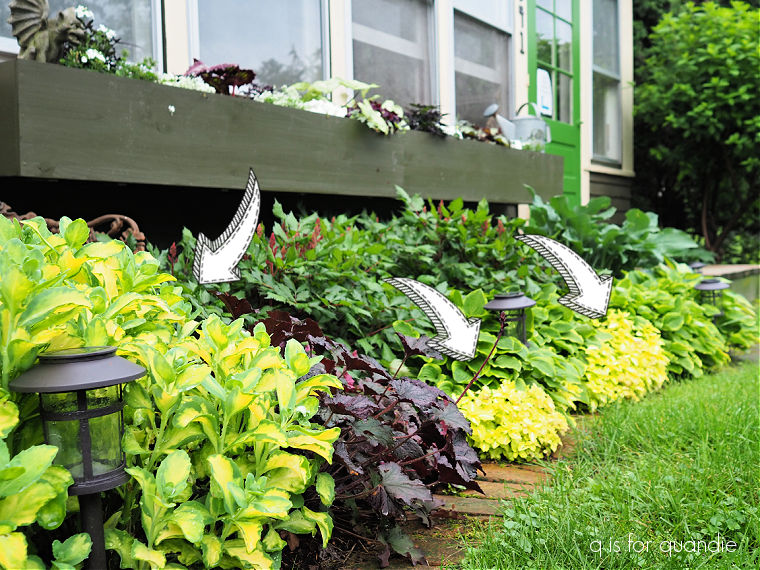
Ever since the first time I heard Laura give this piece of advice, I’ve been trying to put it into practice.  I started with my front garden.

And I really love the results.

I think it packs a lot of punch, even when nothing is blooming which is the case right now.

The ‘yellow’ is provided by the varigated sedum, as well as the Lemon Frost lamium.

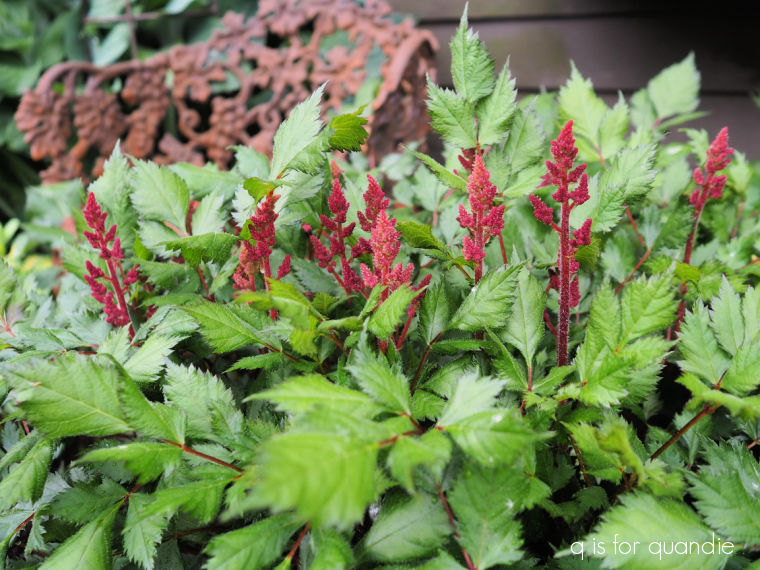
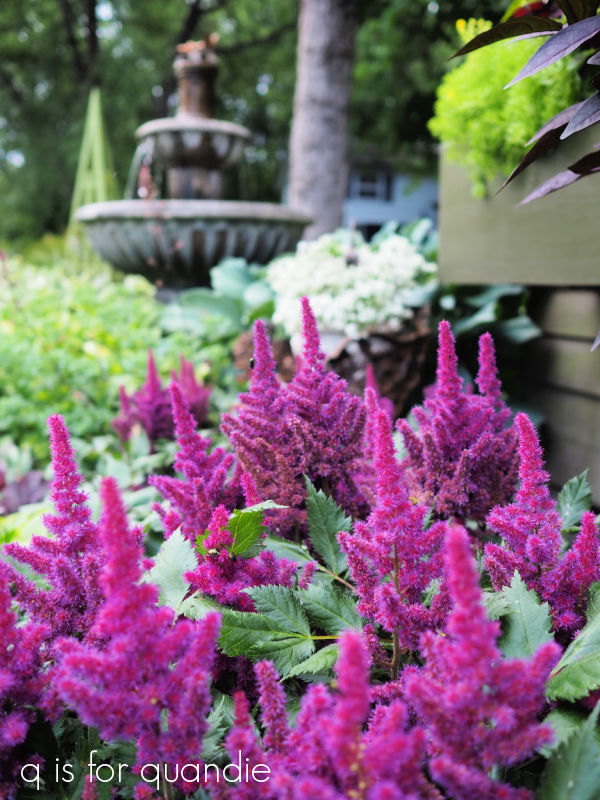
The ‘green’ is provided by the large swath of astilbe in the back.

Quick sidebar on that astilbe, I divided it early last year and it had a very mediocre season with just a few blooms last summer.  But this year it has more than doubled in size and is loaded with buds right now.  One bonus of delaying my sale is that it just may be blooming by Thursday, if we ever get any sunshine.

I don’t have a lot of blue in this garden, just three large Krossa Regal hostas anchoring the corners.

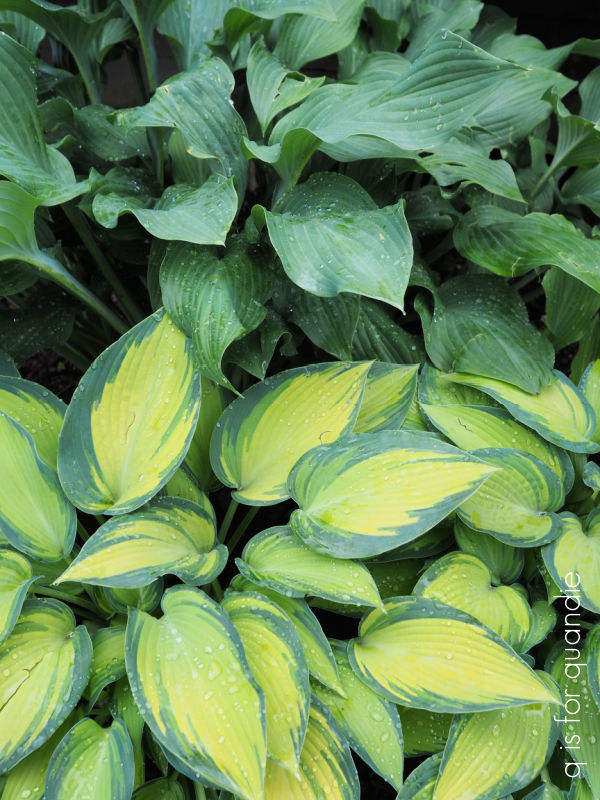
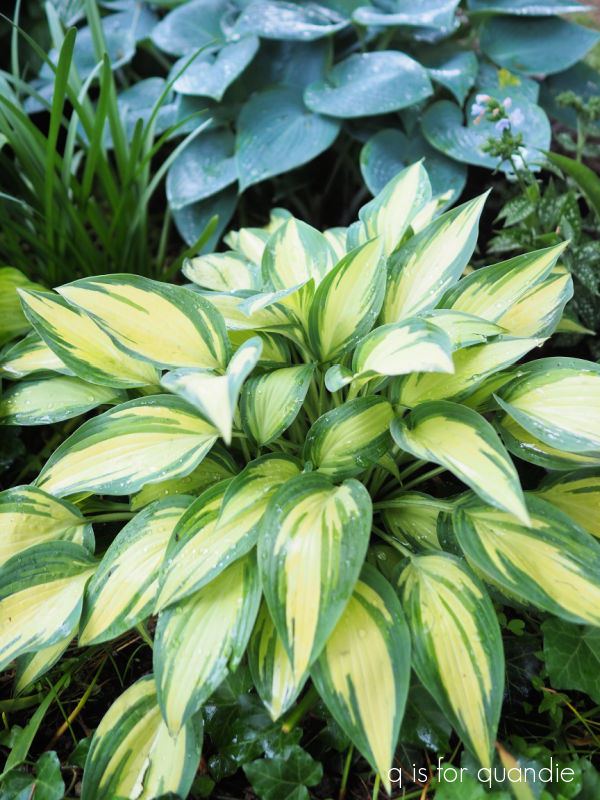
Well, I guess I can also include the blue that is in the June hosta as well.

In fact, that one can count as both ‘blue’ and ‘yellow’.  Well, and even just a touch of plain old green.  It’s one of my favorite hostas, isn’t it pretty?

And finally, the ‘red’.  For that element I’ve got a Northern Exposure Black heuchera, along with a Palace Purple heuchera.

It’s only been within the last couple of years that I began to appreciate the impact of adding dark foliage to contrast with the brighter colors.  I had planted a May hosta beside a Palace Purple heuchera and it was ended up being a lovely combo.

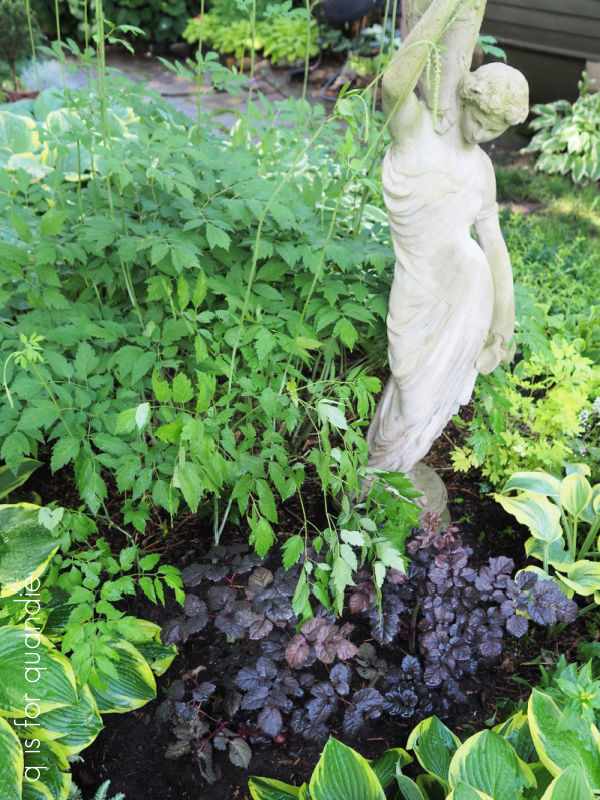
When I divided those astilbe that I mentioned a minute ago, I also removed some white flowering astilbe from that spot and replaced them with one of the newer astilbes from Proven Winners called Dark Side of the Moon.

They are looking pretty small so far, this being only their second year (plus, I rather tortured them by moving them three times last summer before I decided on this spot).  But hopefully next year they will ‘leap’ and fill out that space a bit better.

I’ve been so happy with the results in this front garden that I’m planning to systematically apply this approach to my other garden beds as well, starting with the shade garden.

I’m doing pretty good with the blue, yellow and green, but I need a bit more red.  So far I just have a few Black Taffeta heuchera (front right corner of photo).

So earlier this week I pulled out the Boston Fern that I had planted in front of my statue, Cossetta, on a whim many years ago (just to see if it would overwinter, and spoiler alert, it did).  I replaced it with some more of that Dark Side of the Moon astilbe (and FYI, I purchased them at Home Depot).

It feels a bit scandalous having revealed Cossetta’s ankles.  Now I have to wait for the astilbe to sleep, creep and then leap.  Gardening definitely requires some patience.

By the way, if any of you locals are planning to come to my sale, please feel free to take a wander around the garden while you’re here.  I won’t mind.

And maybe, just maybe, things will have dried out a little bit by then!

Now, how about you?  Do you try to add all four of these foliage colors to your gardens?  Do you have any favorite plants with blue, yellow or red foliage?

Leave a comment and let me know!

from tasteful to tacky.

Good morning from the garden.

When it comes to garden ornaments, do you ever ask yourself ‘how much is too much’?

We’ve all seen them, those yards that have more garden ornaments than actual living plants.

At what point do you cross the line from tasteful into tacky?

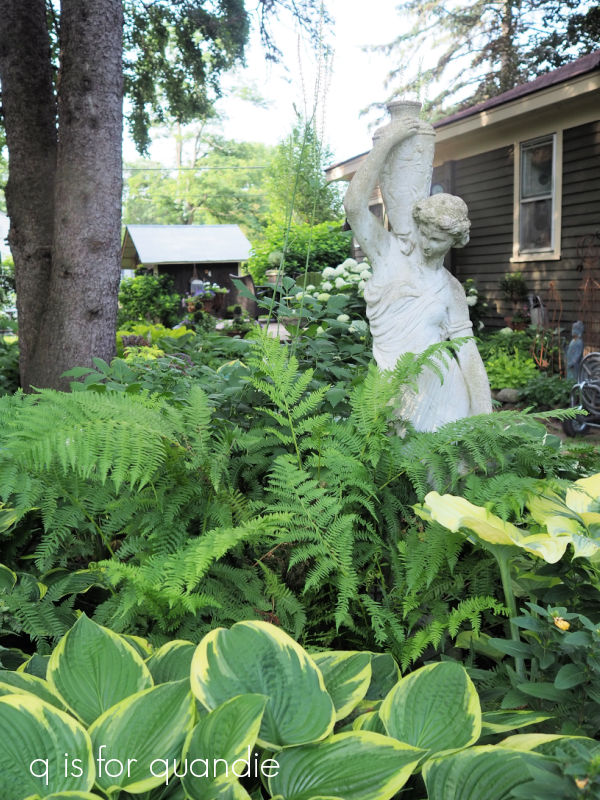
When I brought my statue home from a garage sale (yes, I purchased her at a garage sale), I was a little worried that might be the moment when I crossed that line.  But I think she works because I have her tucked in among plants that get nearly as tall as she is.

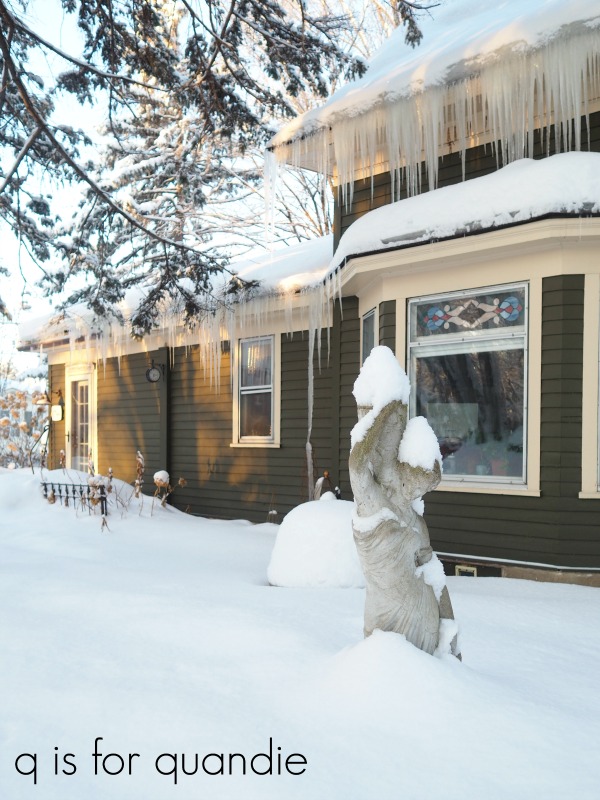
But even without the plants, in winter she looks quite lovely too I think.

Well … maybe that’s not a good example, lol.  She is half buried in snow.

I do have another smaller concrete ‘statue’, this one is of St. Francis and he is watching over the remains of our two dogs, Buck & Sasha (we’ve buried their ashes at his feet).

I also have quite a few metal obelisks scattered about my garden.

Nearly all of them have also come from garage sales.  Whenever I see one at a sale, I grab it.  I think I might be getting close to the metal obelisk saturation point now.

But will you just indulge me for a moment while I admire that clematis once more?

It is absolutely stunning right now.  I just can’t get over what a little fertilizer will do.

I only have one arbor in the garden.

And that’s probably plenty for my space.  The bell shaped flowers on the Roguchi clematis on the right are just starting to open.

I do also have two fountains.  The larger one was purchased at a garden center …

But the smaller one is from a garage sale.

It does have a repaired crack in it, so I have to add more water about every other day.  But the hostas, irises, astilbe and hydrangea planted near it are all fans of moist conditions so they don’t mind having a leaky fountain nearby.

I’m pretty sure that two fountains is the maximum allowance for a yard the size of mine.

I have two pieces of iron furniture tucked into the garden.

They also provide some good winter interest too.

Then there is my buddha and my Japanese lantern (free at the curb), both of which have been given a paint job using Dixie Belle’s Bronze patina paint.

I also have a couple of concrete bunnies scattered about.

At this point they feel a bit like an invitation for the real bunnies.

I definitely have one living under my deck and she comes out every evening to eat the clover in my lawn, and for that reason we are now calling her ‘Clover’.  I’m willing to put up with her as long as she sticks to the clover and doesn’t start going for the hostas!

And I can’t forget to mention my concrete gargoyle.

Fortunately I don’t have any real gargoyles living under the deck.

I have to admit, I also have three vintage iron bed headboards in my garden.  That might sound like a lot, but two of them are barely even visible.

The most visible one is beside the potting shed and I keep trying to grow a clematis on it.  I’ve had little success so far, possible because I suspect this spot was a former sandbox (the potting shed was a playhouse when we moved in), the soil here is really sandy and doesn’t retain much moisture.

I also have a brass headboard out back in the cutting garden, although once the peonies are at full height you can’t even see it.  And then I have one that helps support the Annabelle hydrangea under the kitchen window, although you can barely see it under there either.

Then there are the vintage watering cans.

There are definitely a few of those scattered about.

After seeing this listing of garden decor, you will probably doubt the veracity of my next claim, but I have been working on editing the number of ornaments in my garden.  I’m definitely getting too close to having too many things.  I’ll be parting with a couple of vintage watering cans at my upcoming sale along with a few other garden items.

I’m planning to sell the concrete basket toting dog that I purchased at the Bryn Mawr garage sales, even though I think he’s totally adorable.  I did think about keeping him, but then I might be crossing that line from tasteful to tacky.

The rusty St. Francis has to go as well.

As well as this planter that I rustied up recently.

I’ve also got another larger planter that I used the Dixie Belle Patina Paint on.

Fingers crossed that they all sell so that I don’t have to be tempted to add them to my own garden anymore!

How about you, are you a fan of garden ornaments?  Do you worry about crossing that line from tasteful to tacky?  Leave a comment and let me know.

q tips for growing clematis.

Good morning from the garden.

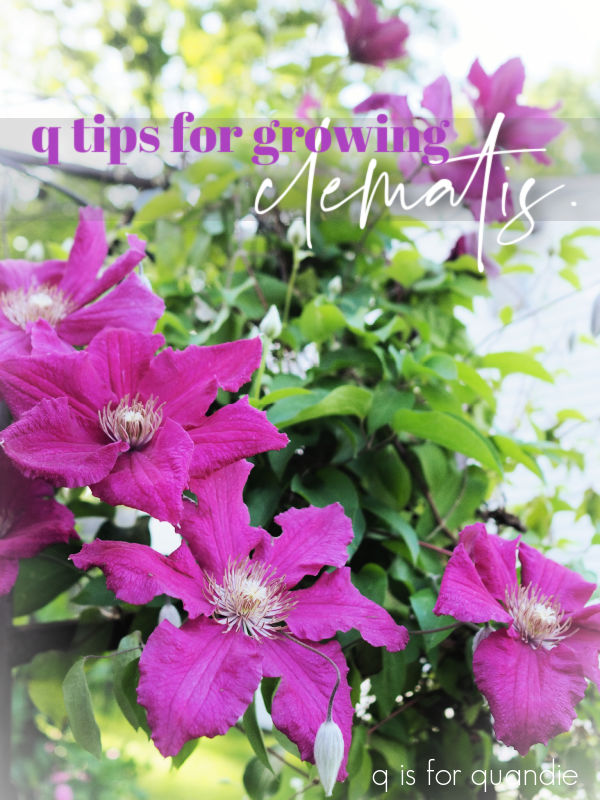
Last week I shared some photos of my three earliest blooming clematis, which are doing incredibly well this year.

Especially that one.  Wait, let me back up the camera a minute and show you the entire plant …

See what I mean?  It is spectacular.

Last year it was a bit of a bust, with only a few flowers at the top …

So its performance this year is quite a lot better.

This particular plant is well over three years old, so it’s not just that it finally came into its own.  There have to be other factors at play.

So I’ve been taking note of what I did differently this year (so that I can do it again next year), and there were a couple of things.

First, and probably most significantly, I fertilized my clematis in early spring.  I’d never done that before.  I used the Espoma Plant-tone which is an organic all-purpose 5-3-3 fertilizer.  That’s not precisely the formula recommended for clematis, but it was what I had on hand and I figured something was better than nothing.  To apply I simply sprinkled about 1 cup of Plant-tone around the base of each clematis.

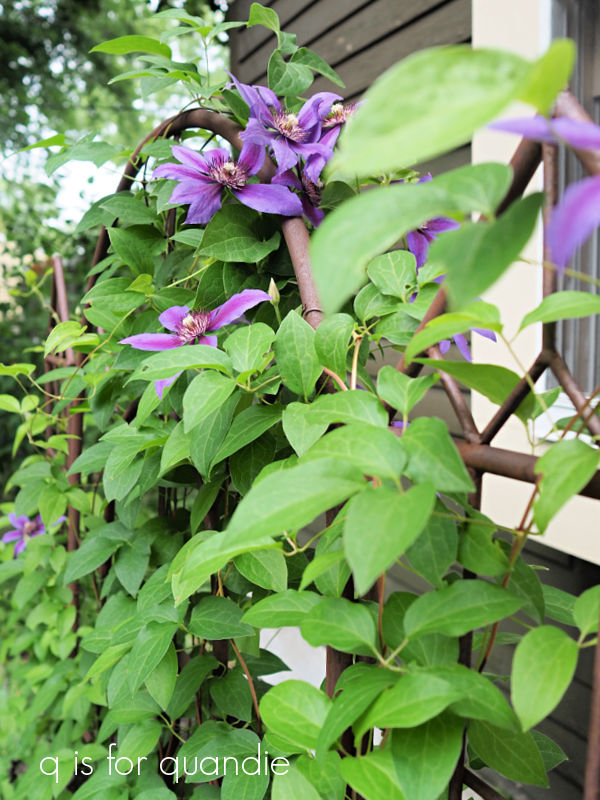
I was also more diligent about helping the clematis climb the trellis this year.  As it was emerging and growing in the spring, I went out every few days and tied stems to the trellis.

According to several sources, the growing end of a clematis vine will stop growing if it can’t find anything to grab onto.  In previous years I left a lot of this plant sprawled into the garden rather than guiding it up to the trellis.  Although, as you can see in that last photo, it still reached the top of the trellis, it just didn’t have many flowers.

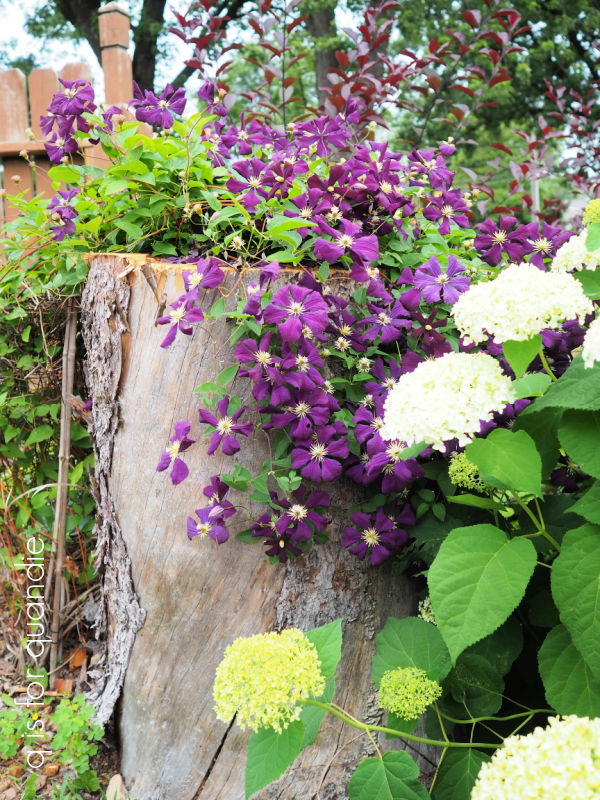
So I’m not sure I can attribute its remarkable performance this year to helping it climb.  As an example, here is a clematis in my neighbor Arlene’s garden …

She doesn’t help that one climb at all, it just scrambles over that stump.  And yet, it’s still covered in blooms.

There may some other variables at play when it comes to blooms.  For example, we had a really mild winter and so far lots of rain this spring.

Also, I suspect due to the mild winter, the rabbits must have had plenty to eat because they didn’t nibble on my clematis like they did the prior winter.  That year they systematically chewed through all of my clematis at about maximum rabbit height (a foot or so from the ground).

And that brings me to the subject of pruning.  If you start going down that rabbit hole (pardon the pun) online you’ll find all kinds of info on the different clematis pruning groups.  And if you aren’t sure what clematis you have, or what pruning group it belongs to, you are totally lost.  After a while your head will be swimming.  Or mine was anyway.

But then I found The Frozen North Pruning System from humingbirdfarm.net.  One caveat here, this system is recommended for northern gardeners specifically.  Those of you in the south may not have success with this method.  But here in my Minnesota, now zone 5a, formerly zone 4b, garden I should be OK with this pruning method.

They’ve simplified clematis pruning into two groups; Don’t Bother and Full Prune.

It’s easy to tell which group your clematis belongs to by its bloom time.  Those that bloom in May or early June (the three I have blooming now), are in the Don’t Bother group.  You can prune out the winter kill once you see live buds on your stems, but otherwise don’t bother pruning at all.

All other clematis that start blooming in late June or later , like my Roguchi, are in the Full Prune group.

That photo of the Roguchi is from last year, it does not have any flowers open yet this year.

Jackmanii, a very popular hybrid clematis, is also one that belongs to the Full Prune group (pictured blooming last year below).

For the Full Prune group, simply give them a hard prune by cutting them off about a foot from the ground in late winter or early spring.

In other words, the winter before last the rabbits gave all of my clematis a Full Prune without regard to which group they were in.  That may be why my Don’t Bother group didn’t have nearly as many blooms last year.

Which brings me to the final bit of advice from Hummingbird Farm, no one has ever killed a clematis by making a pruning mistake (including rabbits).  So don’t get too wound up about whether or not to prune your clematis.  Just pay attention to bloom times this summer, and then act accordingly next spring when it’s time to start pruning.  And while you’re at it, give them a little fertilizer in the spring as well.

Do you have any clematis in your garden?  Do you fertilize, or follow the pruning ‘rules’?  Leave a comment and let me know.

rusty pot refresh.

Back in 2019 I picked up a pair of garden planters made out of some sort of molded composite material.

I turned them into faux ‘rusty iron’ planters using Dixie Belle’s Patina Paint.

I used the Iron paint and the green spray to create a rusty look (you can find the details for that project here).

I did not add a protective top coat to them.  Dixie Belle does make a top coat called Patina Guard for the Patina Paint, but it adds a little too much sheen for my taste (you can read about that here).

Even without the Patina Guard, my pots have held up remarkably well considering that they have spent 5 years outside, rain or shine (or snow), hot or cold.

But sitting in wet snow or on damp pavement for long periods has taken a toll on the bases.

The upper parts of the pots still look good though.

So I thought I’d take advantage of some gorgeous, sunny weather we had back in early April (which explains the decidedly not green background in that photo!) and just touch up the bases.

I started by brushing away any dirt, and then I used a scraper to remove the loose paint from the base.

You’ll note that the paint peeled right down to the original substrate.  When I purchased these pots they’d already been painted a dark brown and I have no idea what kind of paint was used, but that original layer of paint is what failed here.

Next up I added a base coat of Dixie Belle’s Midnight Sky.

DB does make a primer that is specifically for use under the Patina Paint …

But you also can just use any of their chalk style paints for the same purpose.

Once the black paint on the base of my pot was dry, I stippled on the Iron paint and then sprayed with the green activator spray while the paint was still wet.

Out of the three patina paints that are offered (Bronze, Copper and Iron), I find that the rusty patina with the Iron paint takes the longest to develop.  Luckily I had some time between when I refreshed these back in early April and the actual arrival of gardening season here in Minnesota.  Initially these pots looked a bit two-toned (as you can see above), but the rust continues to develop over time.  So don’t panic if you try this and immediately think it didn’t work at all.

Today’s q tip:  I’ve noticed that the addition of water will help speed up the rusting process.  With outdoor items, I just leave them outside and wait for a good rain.  But for indoor items I will often give them a spritz of water using my Dixie Belle Fine Mist Spray Bottle once the initial Green spray has dried.

It ended up taking a few weeks for the bases on my planters to rust up enough to match the rest of the pot.

But it looks pretty seamless to me now.

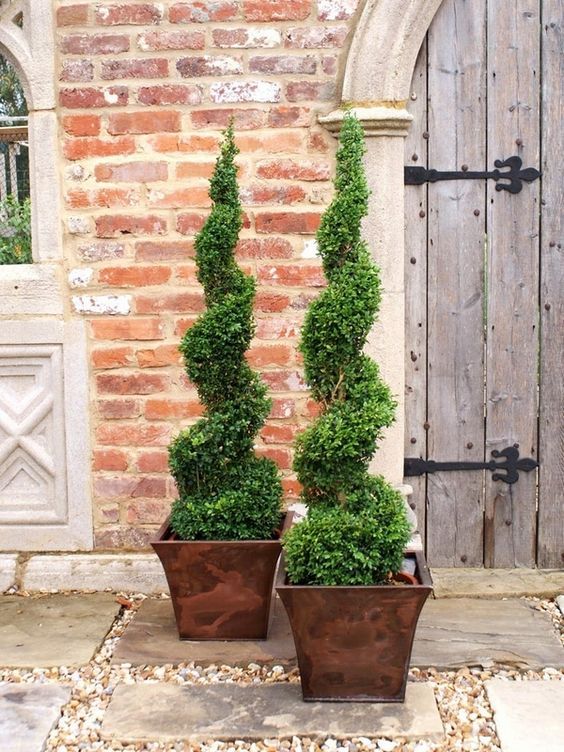
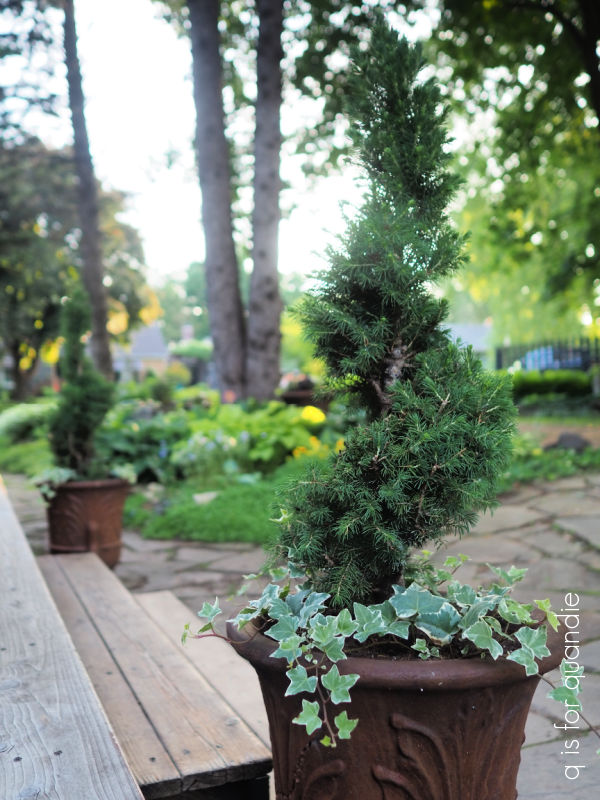
I usually fill this pair of pots with flowering annuals in the summer, but this year I decided to try something a little different.  I wanted to go with boxwood spirals, like these.

I looked all around for a pair of boxwood spirals, and I eventually found some at a fancy nursery in Minneapolis … with a price tag of $249 each!  LOL, if you know me at all by now, you probably know that I wasn’t about to spend $500 for a pair of spirals.

I also found some Eugenia spirals, but even those were $149 each.  I did put some Eugenia topiary pom poms in these pots back in 2022 …

So I knew that Eugenia would work for me, but I still didn’t want to pay $300 for a pair of them.

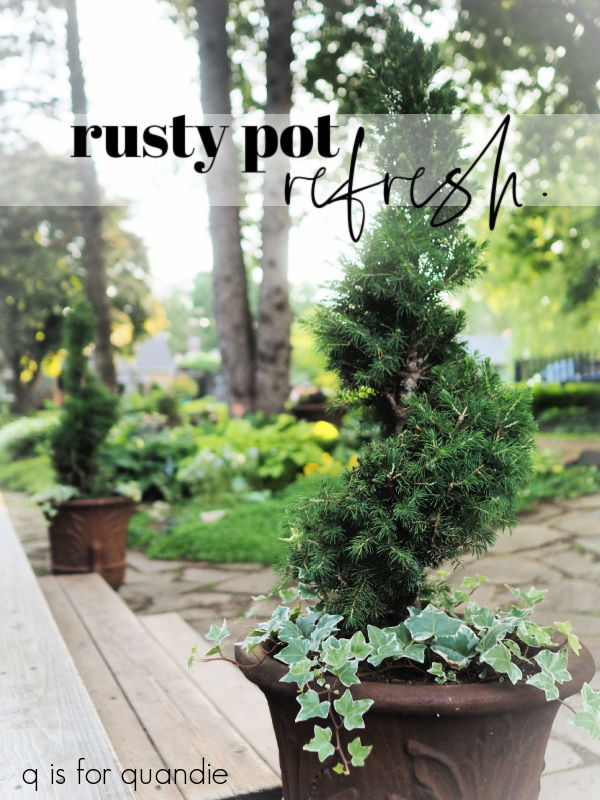
But then my sister and I were checking out the plants at our local Lowe’s store and I found a pair of Dwarf Alberta Spruce spirals for only $57 each.

They aren’t quite boxwoods, but the added benefit to the Alberta Spruce is that they are hardy down to zone 2 (some sources say 3).  In other words, it should survive the winter here, even in a pot.  A plant needs to be hardy to two zones colder than your zone to survive winter in a pot.  Since I’m a former zone 4b, now zone 5a, the Alberta Spruce should be OK.

I’ve also inadvertently experimented with that.  I put a Dwarf Alberta Spruce in my wheelbarrow fairy garden last summer (to the right of the fairy house).  It came through the winter beautifully.

I did mound leaves on the wheelbarrow, and cover it with some burlap for protection over the winter.  So I may possibly do the same with the spirals, or I may just try to overwinter them in my unheated three-season front porch.  That would be the easiest spot for me to be sure to keep them watered.  I’d love to keep them in their pots for several years.  I should be able to keep them smaller with regular pruning.  We’ll just have to see how that goes.

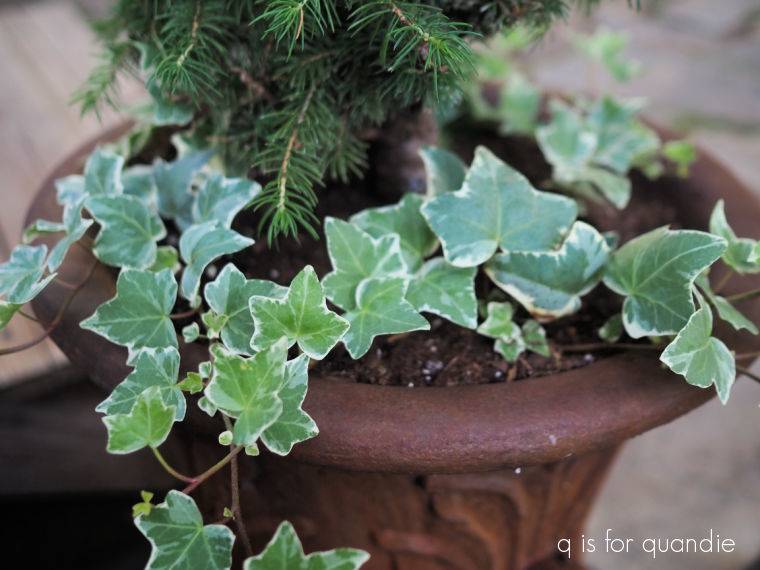
I underplanted the spirals with some ivy.

I’m looking forward to seeing that fill in a bit more.

But for now I’m quite happy with how my spirals look on either side of the steps to our deck.

I’m also quite happy with how easy it was to refresh my rusty pots!

Speaking of making stuff rusty, I rustied up a bunch of items for my upcoming sale including the St. Francis statue that I picked up at the Tangletown garage sales.

Remember him?

Now he looks like this …

I consider it a vast improvement, but I suppose the rusty treatment isn’t for everyone.

What do you think?  Leave a comment and let me know.

oh, hail no.

Good morning from the garden!

Just when everything was really starting to look good, mother nature stepped in to remind me who’s boss.

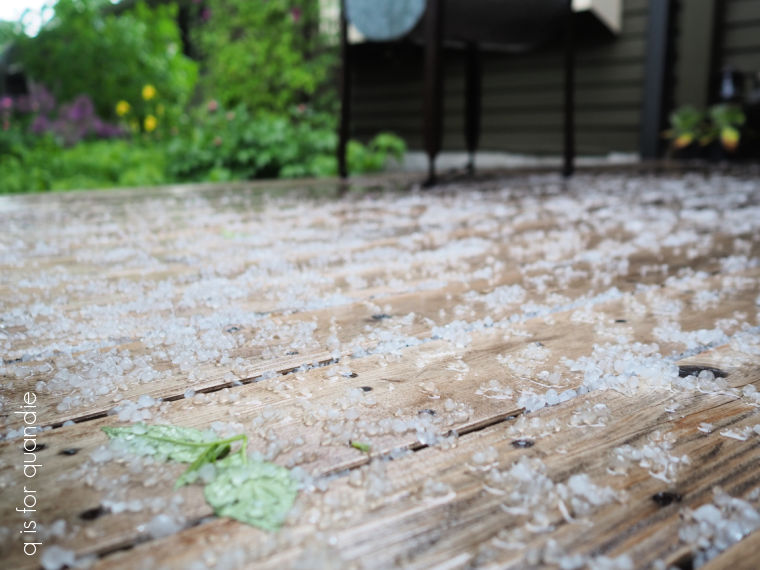
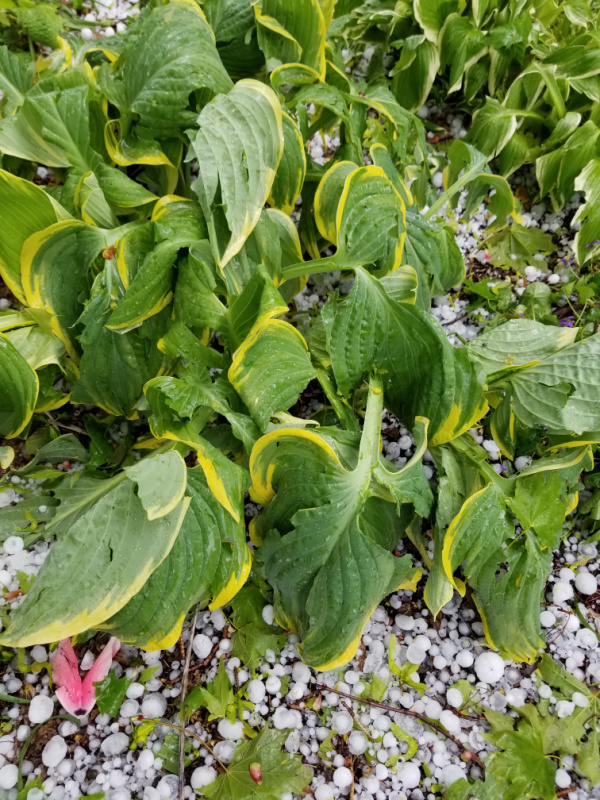
We only had about 5 minutes or so of hail on Memorial Day, but it was enough to do some damage.

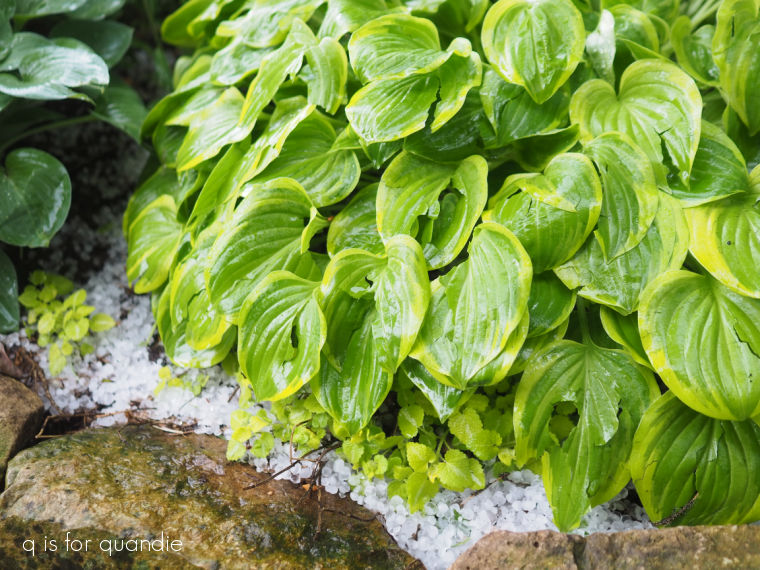
Especially to my poor hostas.

My irises, which had literally just opened that morning, took quite a beating as well.

But I easily removed the damaged blooms and there were lots more buds waiting to take their place.

That was about the worst of the damage though.  Some things came through relatively unscathed, like my Curly Fries hosta …

and my favorite Lakeside Dragonfly hosta.

Hostas that are sheltered by the trees overhead fared better than those out in the open, as did those with both smaller and/or thicker, more robust leaves.

Quite a few plants weren’t bothered by the hail at all, like the lungwort …

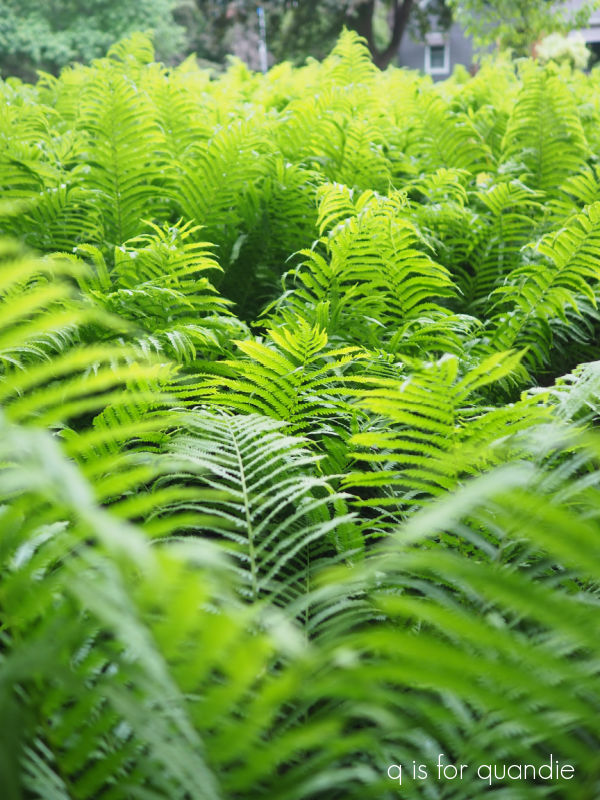
and the ferns.

The variegated sedum wasn’t damaged at all either.

Speaking of which, it’s time to get out and give this sedum the chelsea chop.  If you aren’t familiar with that process, check out this post

My plan this year is to pot up the cuttings and then give them away at my upcoming occasional sale.  For those of you locals who may be interested, I will be potting them up with fresh potting soil so no need to worry about jumping worms.

All in all, I can’t be too mad about the hail.

It definitely wasn’t as bad as the hail storm we had back in May 2022.

That hail was much larger, and pretty much decimated my hostas.

But in the end we got a new roof out of it, so it was truly a blessing in disguise.  We badly needed our roof replaced anyway.

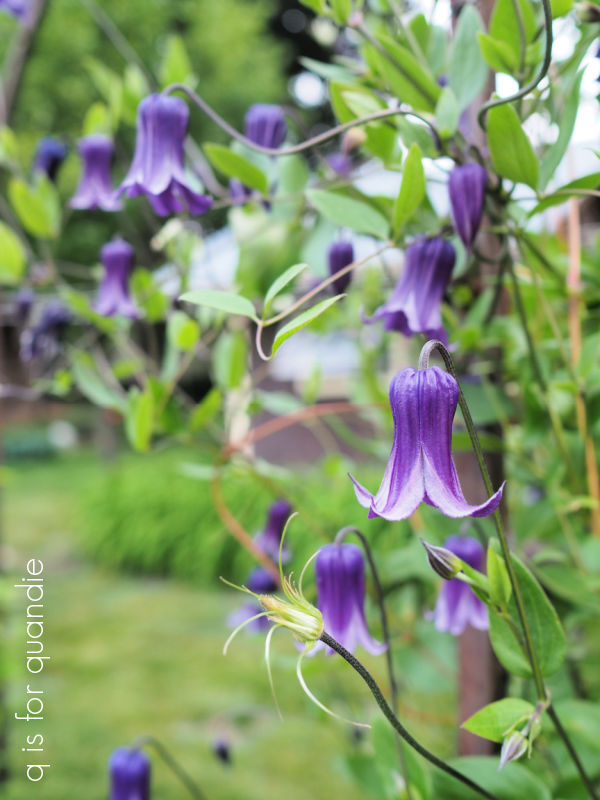
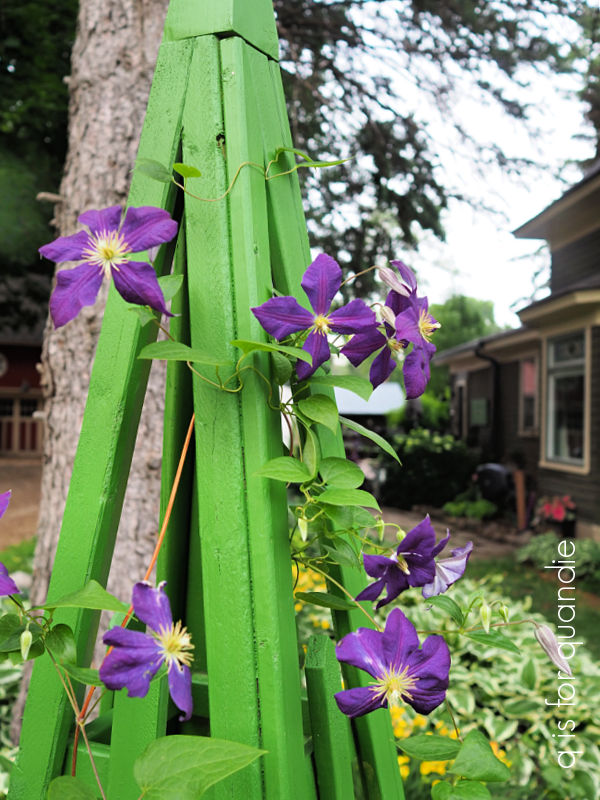
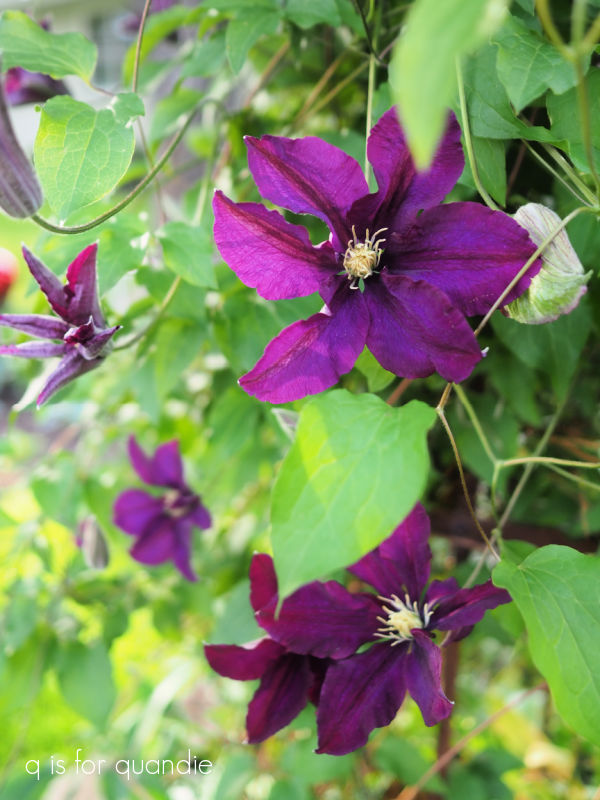
This time around, things have mostly bounced back quickly, and lots of stuff is blooming now such as three of my prettiest clematis …

Unfortunately, the names of all three of these have been lost to time.

I should have written them down.  I am trying to get better about that.

The one above is looking particularly good this year, it’s covered with blooms.  Last year it had a rather poor showing, possibly because the rabbits had chewed on it quite a bit the winter before that.

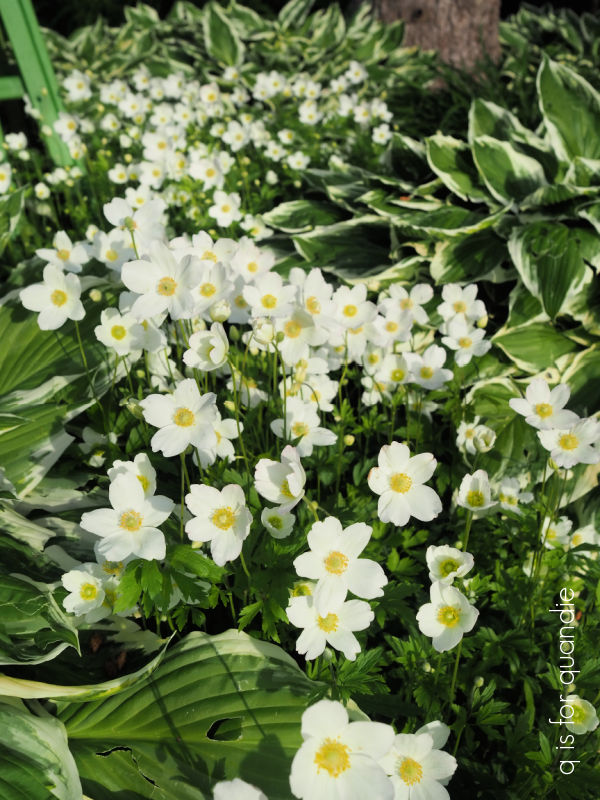
The anemones are looking quite good this week too.

My friend Sue gave me this plant quite some time ago, but I’m pretty sure it is Anemone sylvestris.  They will spread like mad if you let them, but mine are planted in between some quite vigorous (and huge) hostas that keep them in check.

Before I let you go, I want to share my new favorite YouTube garden channel.  It’s called Garden with Marta.  She is located in Poland, but her vlog is in English (her command of English is so impressive).  Both Marta and her garden are absolutely charming.  In her most recent vlog, she is also chelsea chopping her sedum so be sure to check that out!

What have you got blooming in your garden this week?  Are you trying the chelsea chop this year?  Leave a comment and let me know!

a late spring garden tour.

Good morning from the garden!

I’ve had a few requests for a full garden tour, so this morning I thought I would attempt it.

My gardens are broken down into … hmmm … let’s see … 8 areas.  There is the front garden, the fern garden, the shade garden, the carriage house garden, the potting shed garden, the cutting garden, the fairy garden and the sunny perennial border.  Phew!  You may want to grab your favorite beverage because this may be a long one.

The front garden.

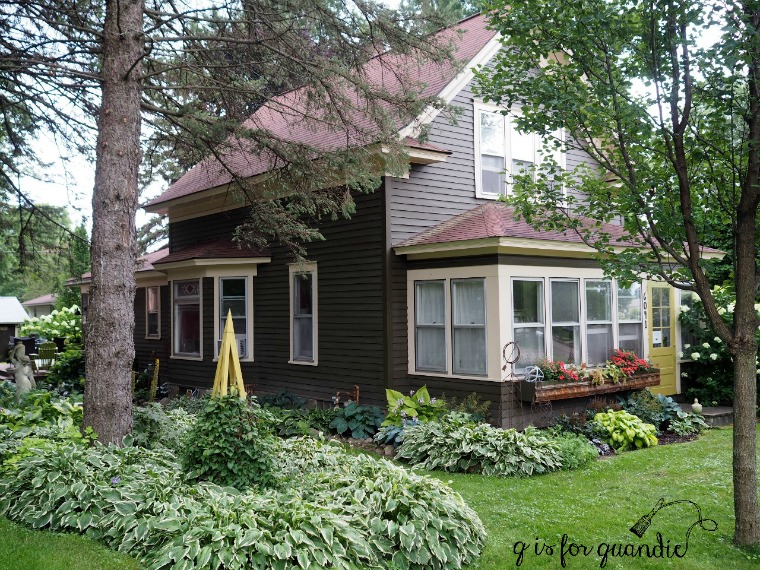
Let’s start out in the front garden.  This is just the bit of garden that runs along the front of our house, and it’s where the long window box is.

The box doesn’t look too impressive at this time of the year, but it should fill in quickly.

This area faces north and is very much shaded by the house for most of the day.  This is always where the very last bit of snow melts in the spring, and where plants take the longest to emerge from their winter slumber.

But things are starting to fill in nicely now.  This space is filled with a variegated sedum, a purple astilbe that loves this location, some dark purple heuchera and plenty of hostas.

The heuchera looks the best it ever has for this early in spring, I suspect due to our very mild winter.  Last spring I had decided to give up on heuchera because it did so poorly over winter, but it’s back in my good graces now.

This garden also contains our fountain, and my rusty chair.  My neighbor/handyman Ken gave me a set of this grape cluster iron furniture back in 2022.  It was painted a crisp white when I got it, but I like something a little more subtle.  So I gave the pieces a makeover with Dixie Belle’s patina paint.  This chair and the bench both have broken legs, so no one can actually sit on them.  I also did not seal the rusty finish, so rust would rub off onto your clothing if you did sit on them.  So I tuck them into the garden where no one will make the mistake of trying to actually use them.

There were a few tulips and daffodils in this space that looked good earlier this spring, but right now I’m mostly still waiting for things to fully emerge.  The big star of the show in this garden is the astilbe.  I divided it last year and found that there weren’t as many blooms, but I’m hoping it rebounds this year.  When it blooms in mid-summer, it should look like this …

The fern garden.

Our driveway runs alongside the house all the way back to the carriage house.  The fern garden is on the east side of the driveway.

The ferns look gorgeous right now, especially with my newly blackened fence behind them, but if we have a dry summer they will start to fade by mid-August and then they don’t look so good.

But I’ll enjoy them while they last along with some vinca vine and lily of the valley, both of which are currently flowering.

The shade garden.

On the opposite side of the driveway is my shade garden.

I have to admit that this is my favorite, and thus it gets the most attention from me.  It’s filled with all kinds of shade loving perennials including bleeding heart, brunnera, maiden’s hair fern, japanese painted fern, lungwort, and more.

It’s also home to quite a few hostas including a few of my favorites like Lakeside Dragonfly

Sun Power (on left) and June (on right).

Autumn Frost is one of my newest hostas, and it’s looking really good so far.

My garage sale find statue, Cossetta, also lives in this garden.

Right now the foam flower, or Sugar & Spice Tiarella, is in bloom.

I have these sprinkled throughout the front of the shade garden and I like the way they repeat here and there.

There are some foundation gardens alongside the house that I consider part of the shade garden as well.

You may remember that I used the Bronze patina paint with the green spray on the buddha and the Japanese lantern in the background.

The carriage house garden.

I call the garden that runs along the side of the carriage house the carriage house garden (creative, right?).  I struggle a bit with this one because it is shady all morning, then gets hit with the blazing sun in the hottest part of the day.  Most plants prefer the exact opposite of that, morning sun and afternoon shade.

It also is backed by that red wall of the carriage house, shades of pink looks positively awful next to it and it has taken me about 35 years to accept that.

But this is the first year that it’s starting to come together.  It looked awesome a couple of weeks ago with grape hyacinths, bright yellow daffodils, and that new white azalea.

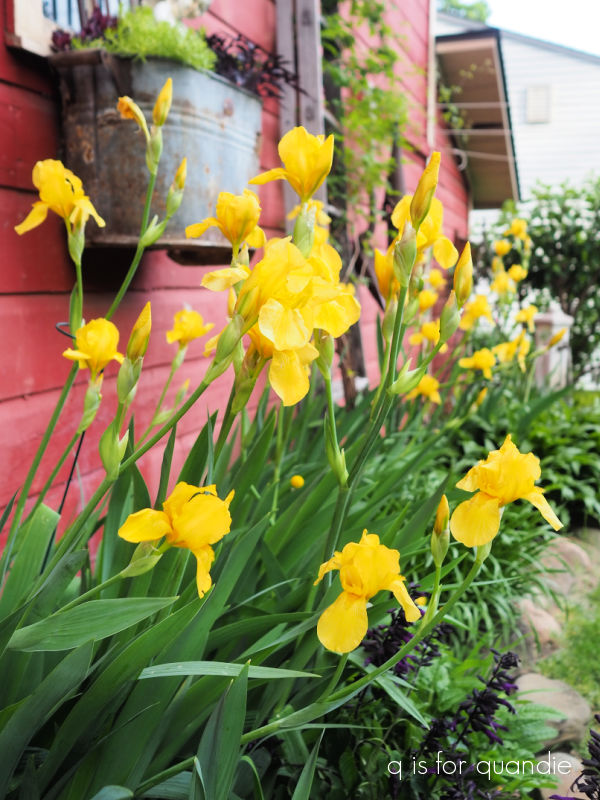
Right now the only things blooming are a handful of alliums, but the yellow iris are going to open up any day now.

Wait, I take that back.  There is also a fabulous cranesbill, or perennial geranium, blooming at the far end.

This plant was a garage sale purchase back in May 2022, this is its third year so it’s time to leap (first year sleeps, second year creeps, third year leaps).

Here’s how big it was when I brought it home.

So while I still want to caution you to be careful about those jumping worms, you gotta love a garage sale plant.  You can always count on them to be hardy in your area, and prolific (which is why the seller has extra to part with).

The potting shed garden.

Again, another creative name, the potting shed garden comprises the beds around the potting shed.

This garden is mostly shaded on the east side, but gets afternoon and evening sun on the west side.  I popped a few allium in on both sides last fall to see if they would grow, and they seem to have done quite well.  I think I may move these elsewhere and replace them with white allium for next year.  Wouldn’t white allium just pop against my dark green paint color?

The bugleweed, or ajuga, is in full bloom on the east side right now.

And over on the west side the geranium macrorrhizum, or Bigroot geranium is full of flowers now too.

If you need a plant that will grow in sun or shade, will fill in any available space, requires absolutely no maintenance, then this is the plant for you.  It does wilt a bit in hot afternoon sun, but it recovers quite quickly.  It’s very easy to pull out if it spreads more than you want it to.  I have a lot of it, as you’ll see when we get to the perennial border.

As for growing just about anywhere, along the west side of our house we have only about 8′ or so of fully shaded space between our house and the property line.  The previous owners of our house put down plastic and then rock, and planted a row of arborvitae that has gotten massive.  After all of this time enough dirt has accumulated amongst the rocks that I have to weed that area.  So a couple of years ago I decided to see if this geranium would grow in the rocks.

The answer is a resounding yes!  it will.  Quite happily in fact.  And it looks so much better than weeds.

So if you have a problem area in your garden, keep this plant in mind.  Also, if you’re local, keep me in mind.  I have plenty to share if you want to try it.

The fairy garden.

My fairy garden is planted in an old rusted out wheelbarrow that is nestled in a bed of variegated vinca.  Last year it was ended up totally overgrown, so I decided to be a little more minimal with the plants this year.

Usually I plant a wire vine on that arch, but it totally takes over and requires a lot of maintenance to keep it from completely covering it and the path beneath it.

So this year I’m going to leave that out.  Instead I added a couple more miniature hostas compliments of my neighbor nnK (sorry, don’t know the names of them), and I also added a tiny Japanese maple tree to the left of the fairy house.

nnK’s mom, Judy, planted one of these in her fairy garden last year and it did not survive the winter, so I’m taking a bit of a gamble with that one.  Especially since I paid $25 for it a Abrahamson Nursery.  I may pull it out of there in the fall, put it in a pot, and try to overwinter it somewhere more protected.  Japanese maples do require a period of cold dormancy, so I can’t bring it in as a houseplant.

The sunny perennial border.

This garden is directly behind the house and it used to be my sunniest space.  Over time the trees in handyman Ken’s yard next door (yes, that is his house in the background) have grown so big that they shade this bed most of the time except around high noon.  As a result, I’ve been struggling with this one over the past several years.

Can I just point out that the grass in our area is looking particularly fabulous at the moment.  We’ve had plenty of rain mixed in with lots of sunshine and the grass is flourishing for now.  I’d love to keep it looking this good all summer, but if we get dry weather again this year all bets are off.

I have a border of small green hostas along the front edge of this garden that do really well here.  I also have a big mass of that Bigroot geranium in the middle section.

Right now the alliums are definitely the stars of the show, I just wish they would last longer.

There are three clematis in this bed, two on the trellis …

and one on the obelisk.

They are all loaded with buds, but only one of them has started to open so far.

I do have a couple of pink peonies in this garden.

Fortunately they will be done flowering before the self-seeding red bee balm takes over in mid-summer …

The cutting garden.

The cutting garden is hidden away behind the carriage house.  There used to be nothing but weeds back there, but then one day I realized that it was the sunniest spot that I had left for a garden.  Why not use it to grow peonies?

So now I have about 6 peonies back there, plus some siberian iris and a big Annabelle hydrangea.

None of them are blooming quite yet, but the peonies should be opening soon.  Here’s a picture from June 11 of last year that shows them all in bloom.

Since the cutting garden isn’t visible from the house, or really anywhere in our yard, I don’t feel bad at all about cutting all of the blooms and putting them in vases where I can appreciate them.

That about wraps it up for this morning’s garden tour.  I hope you enjoyed it!  And now I’m off to do some work out there.  It seems as though there are always tasks waiting to be done in a garden!

thinking outside the box.

Good morning from the garden!

If you’ve followed me for a while, you’ll know that I have a large window box that goes across almost the entire width of our front three-season porch.  Our house faces north-west-ish, so it’s basically full shade in that spot although it does get some evening sun.

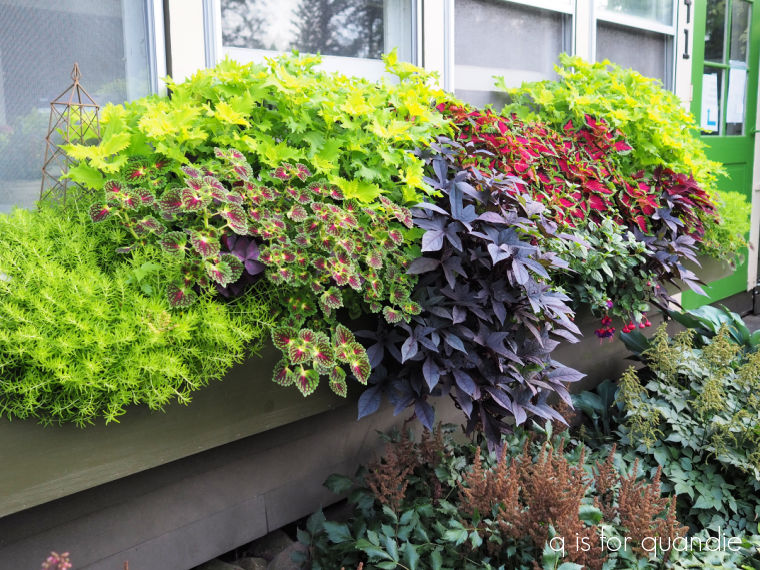
I’ve tried lot of different looks over the years, but so far there is really no contest for the most successful plant for this shady window box, it’s definitely coleus.

It absolutely thrives, and it creates quite a dramatic show along with some sweet potato vine and lemon coral sedum.

In fact, it’s almost too successful as it grows high enough to block any breezes that might want to try to get through those windows.

Quite honestly, it almost feels like cheating to just fill up the window box with coleus and sweet potato vine and call it good.  It’s a little too easy, and it also seems a bit … well … uninspired.

So sometimes I try to change it up, think outside the box a little (pardon the pun).

Unfortunately that can lead to what I consider to be window box fails.  Last year is a good example of that.  I tried experimenting with some new things, and the combination really didn’t work.

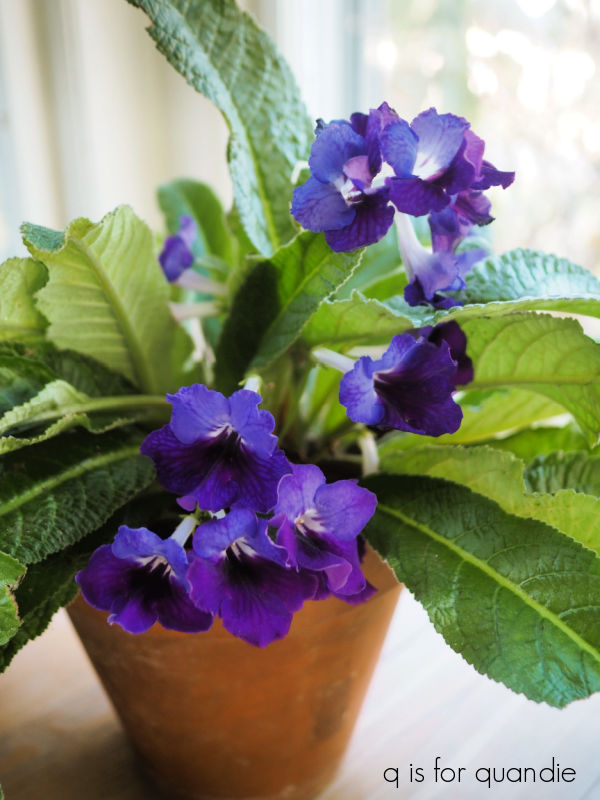
The silver of the Dusty Miller and the Dichondra Silver Falls just wasn’t me.  I put in some lovely coral pink begonias that ended up being totally swallowed up by other more vigorous plants, as did the Streptocarpus Ladyslippers™ Deep Blue Vein.  Although those did become some really pretty houseplants.

The very worst year for the window box had to be 2015 though.

Oh my gosh, does that look like a hot mess or what?  That was the year I tried angelonia.  I don’t know what I was thinking.  They clearly require full sun, and I definitely don’t have full sun here.  Plus, I combined the angelonia with a purple annual salvia and some Diamond Frost euphorbia, all of which have a delicate, airy look about them.  I definitely needed to add something more substantial to the mix.

I did have some success in 2017 when I decided to go with a deep coral pink sort of color scheme.

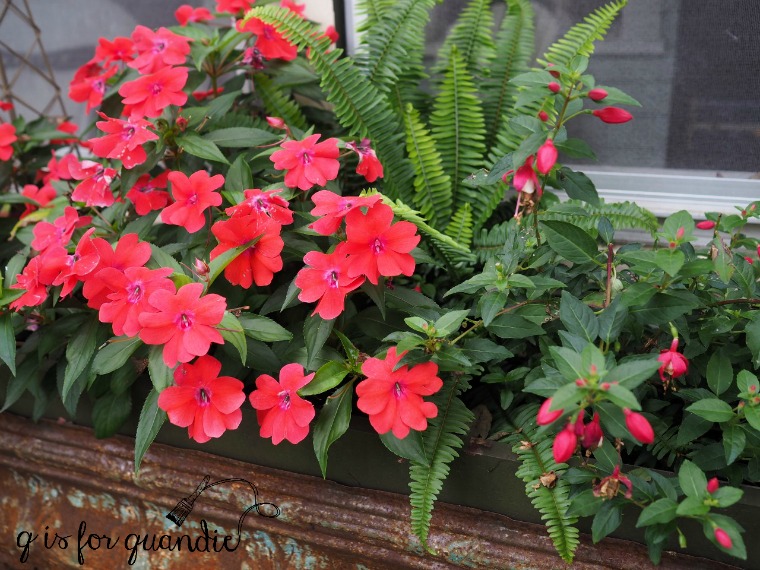
The New Guinea impatiens did well, and paired nicely with some fuchsia.

But when the cooler purple astilbe that is in the ground right below the window box was in bloom, it didn’t really pair well with those colors.

I did enjoy the monochromatic white color scheme that I tried back in 2014.

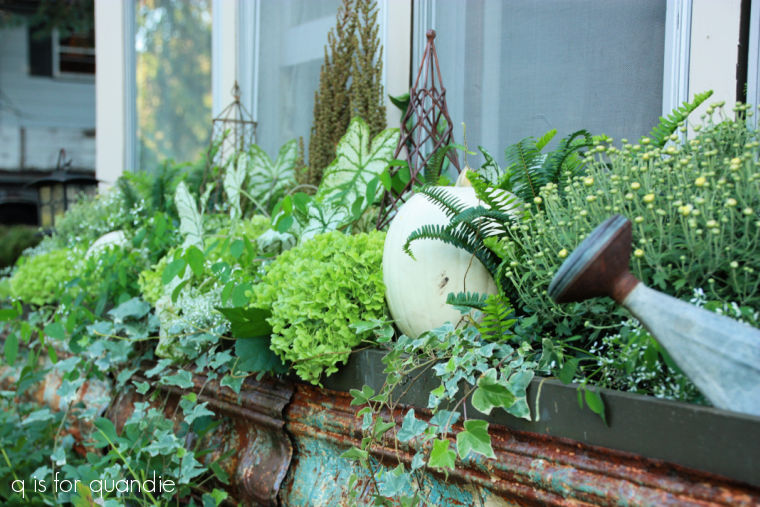
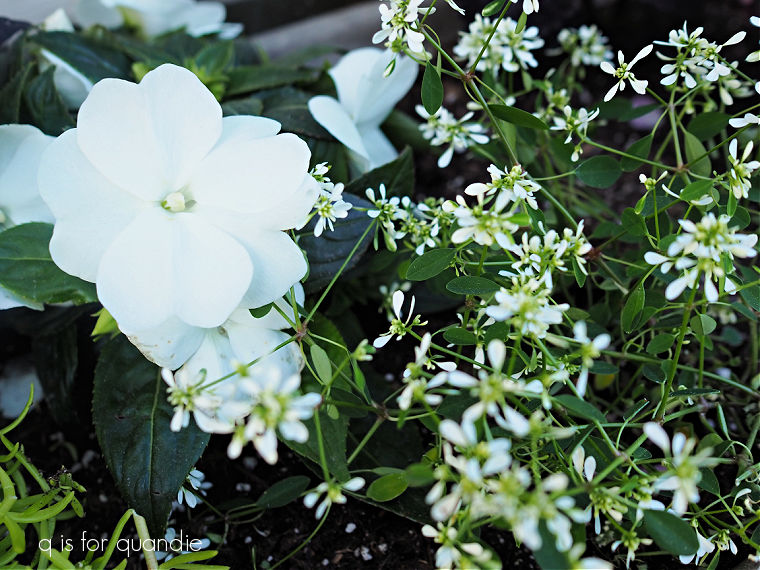
That year I used white impatiens, euphorbia, jester’s crown ferns, a swedish ivy and a gorgeous white and green caladium.

And when fall came around I pulled out the impatiens and replaced them with white mums.  Then I popped in a couple of white pumpkins, and added some cut Annabelle hydrangea blooms for a less traditional autumnal look.

As much as I love that look, I will admit that it doesn’t have the same impact from the street as the brighter coleus combinations.

Once again this year, I was in the mood to do a bit more experimenting instead of falling back on the tried and true coleus/potato vine combo.  After checking out what was available at a few of my favorite nurseries, I ended up with a ‘black and white’ theme.

First of all, you have to know that gardeners call colors by the wrong names.  Anything called ‘blue’ is typically really purple, while ‘purple’ is often a hot pink or magenta color.  And ‘black’ is really a very deep purple.

I based my ‘black’ on this coleus that I found at the Amish farm that my neighbor nnK and I visit every spring to buy plants.

It didn’t have a label, but I think it may be a variety called Black Coral.

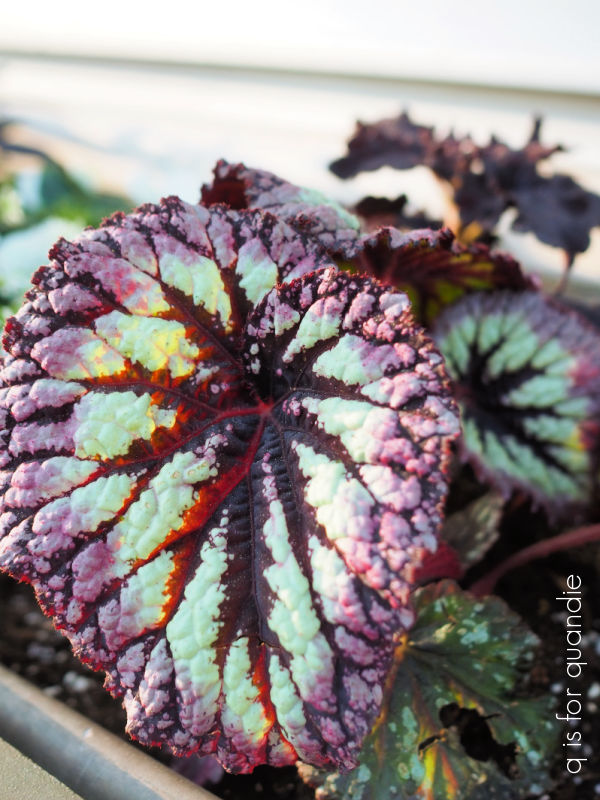
I know it doesn’t look too exciting at first, it’s not bright, it’s not wildly variegated.  But I next found this rex begonia to add to the mix, and it is pretty exciting.  Paired together, I think this is going to make a fantastic combination.

Once again, no label, but I think the begonia may be Curly Mint.

I also added this rex begonia to the mix …

Both of the begonias have that rich plum color that ties in with the ‘black’ coleus.  I’m just hoping that they won’t be overpowered by the more vigorous growth of the coleus.

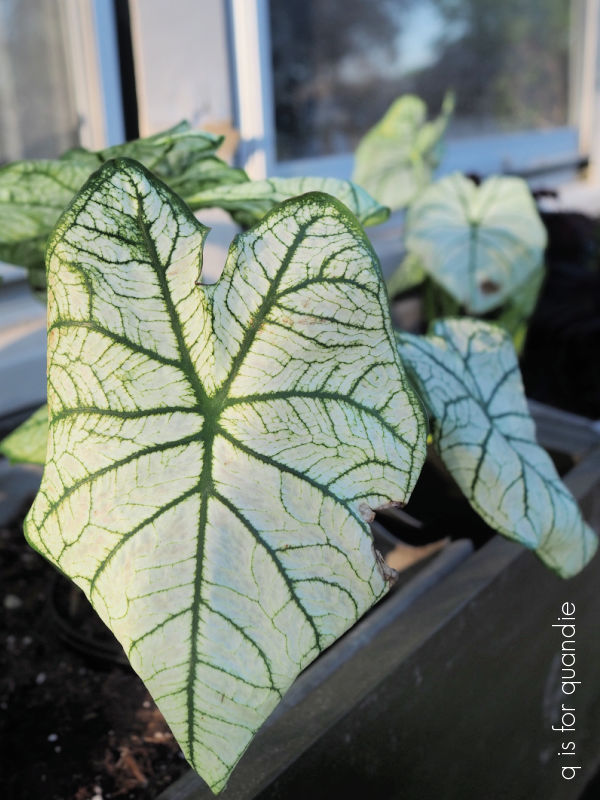
For the ‘white’ component in my window box I went back to that white caladium that I loved so much.

I also added a bunch of white New Guinea impatiens, and some Diamond Snow euphorbia.

The Diamond Snow euphorbia is supposed to be a more dense and compact, less ‘airy’, version of the Diamond Frost that I usually use.  And again, I’m hoping this one won’t overpower the other plants.

Finally, I also threw in a Firehouse White trailing verbena.

I may have trouble getting the verbena to bloom in this shady location, but I thought I’d give it a try.  For now all of those blooms are compliments of the greenhouse that grew it (Country Sun in Stillwater, FYI).  Also, you do need to deadhead trailing verbena to encourage more flowers, so we’ll just have to wait and see if I keep up on that.

I added some more ‘black’ to the mix with this Charmed Wine Oxalis from Proven Winners.

It will have white flowers when it blooms as well, so it’s perfect for my black and white theme.  However, I grow it mainly for it’s foliage, it won’t bloom profusely.  Much like the Streptocarpus I mentioned from last year, Oxalis can be taken inside and wintered over as a houseplant.  I may give that a try in the fall.

Finally I put in a couple of Blackie sweet potato vines.  I guess I couldn’t fully escape the coleus or the sweet potato vines.

Now, I just have to be patient and wait for all of these to fill in.  I’m guessing that’s going to take at least a month or so.  Gardening is not a hobby for the impatient.

I’ll try to remember to give you all an update on how my black and white window box turned out at the end of summer.

How about you?  Have you ever tried a black and white theme?  Or do you have another combination that you love for containers?  Leave a comment and let me know.

the garden herbs tote.

I’ve posted before about the Trash to Treasure day hosted by a neighboring town, White Bear Lake.  Basically the home owners in WBL can put things that they want to discard at the curb, and the rest of us can drive around and take anything that catches our fancy.

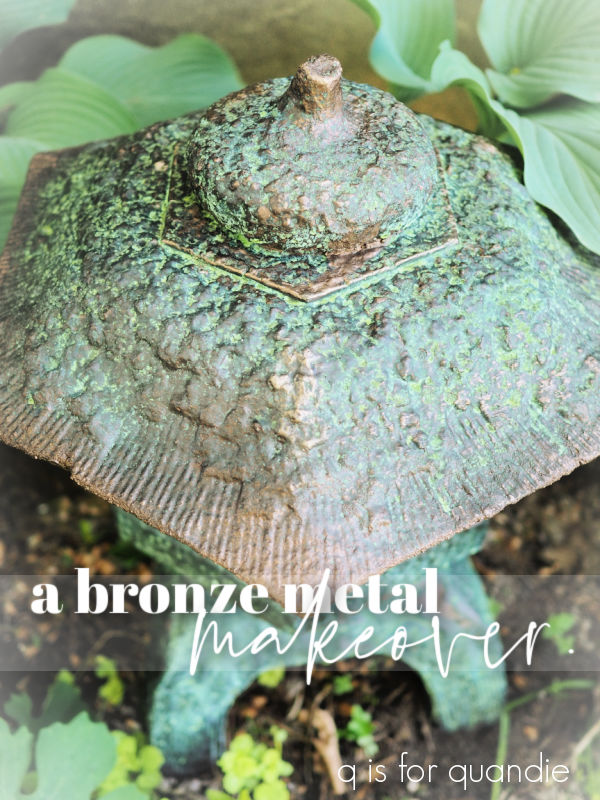
I’ve found a few fun things there over the years including my concrete Japanese lantern.

I gave it a bronze metal makeover last year, and it still looks great in my garden.

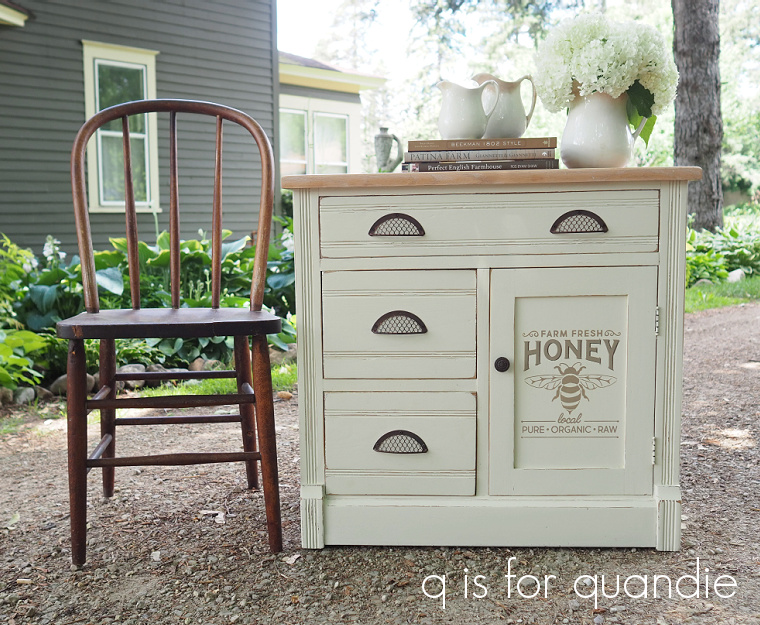
I often even find a couple of decent pieces of furniture.  I brought this washstand home for a makeover back in 2021.

I did check out this year’s Trash to Treasure day back in April, and I brought home a small pile of goodies.  However, I didn’t get a photo of my haul because it was raining for most of the day.  So I tucked it all away in the carriage house thinking I’d pull it out later and get a photo.

Yeah, that didn’t happen.

But as time goes by, and I give the items some much needed makeovers, I’ll be sure to share them here on the blog starting with today’s project.

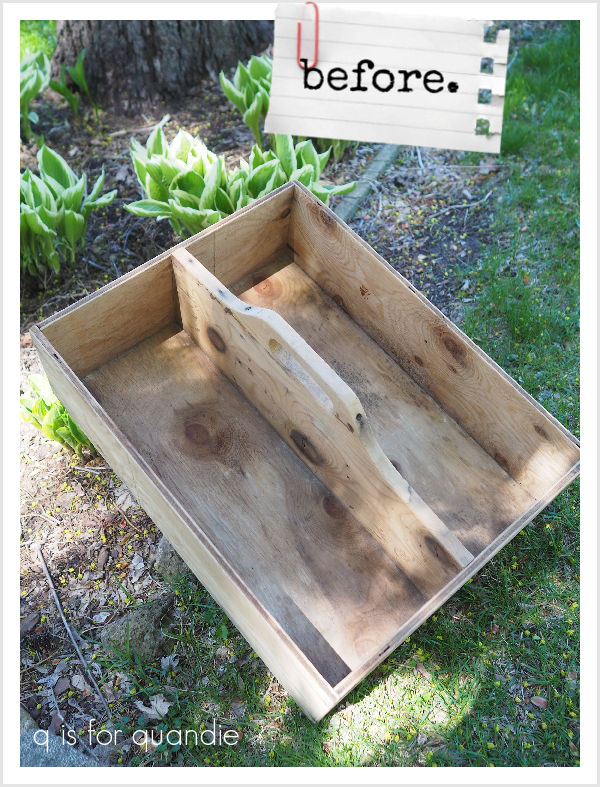
This large wooden tote was sitting at the curb filled with plastic pots and other junk.  It was half full of rain and quite bedraggled.  But I sensed some potential.

After bringing it home, I gave it a good scrubbing with some hot soapy water and then hosed it down.  I left it out in the sunshine to dry out.  Once dry, I gave it two coats of Dixie Belle’s Caviar.  Once the paint was dry, I sanded the entire piece to distress it.

Next up I pulled out my Garden Herbs stencil.  I first stenciled ‘Garden Herbs’ and the herb names in DB’s Dried Sage.  Then I shifted my stencil up and over just a tiny bit and stenciled ‘Garden Herbs’ again in DB’s Drop Cloth, thus creating a bit of a shadow behind those words.

I finished it all off with a topcoat of Dixie Belle’s Big Mama’s Butta which really brings out the deep rich color of the Caviar.

The tote is quite large at 24″ by 18″, and it’s also a bit heavy.  So it wouldn’t be practical to use for actually toting things around the garden.

But wouldn’t it be fab for your potting shed?  You could fill it with gardening books, or magazines, or just empty clay pots and vintage garden tools.

Of course, you could also fill it with potted herbs and put it outside, but since it’s made of plywood, it wouldn’t hold up forever.  But then again, who needs it to last forever?  Isn’t it kind of fun to have pieces like this that last for two or three years and then you move on to something else?  Or is that just me?  I would recommend drilling some drainage holes in the bottom if you were going to go that route.

This tote is headed to the pile of merch that I’m accumulating for my upcoming sale.  Locals, don’t forget, save the date for June 21 and 22!

Thank you to Dixie Belle Paint Co. for supplying the paint and topcoat for this makeover.

from plastic to fantastic.

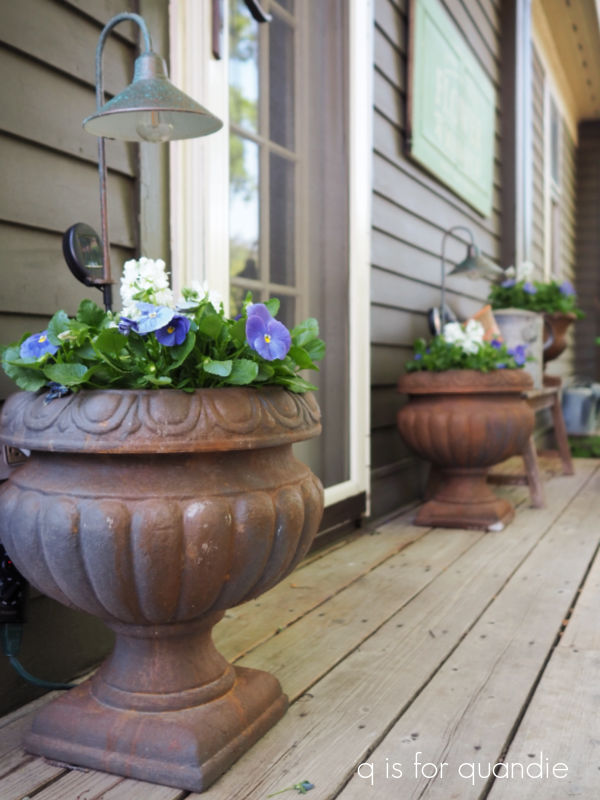
Last summer while out garage saling I saw a house with fabulous lights in big flower pots on either side of their driveway.

I have to laugh, because initially I was completely flummoxed as to how they accomplished that.  I thought they’d had to run electrical wiring to the pots somehow.  But duh, of course, they were solar lights.

Seriously, how did I not just realize that immediately?

Well … anyway … I thought they were fabulous, so I decided to copy the idea myself this year.

But I didn’t want to spend the $70 for the really pretty copper lights that I found online, so I decided to see what I could do to dress up a pair of plastic lights that I found at Fleet Farm for less than half that price.

I’m not sure that photo shows it, but these are made out of black plastic and that’s exactly what they look like up close.  In other words, not terribly nice.

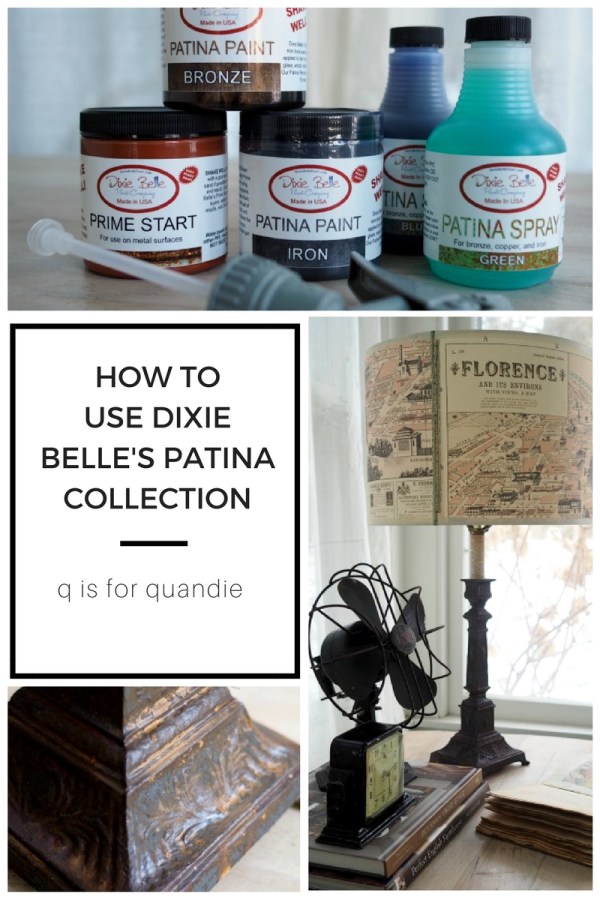
So I pulled out Dixie Belle’s patina paint and went to work on them.

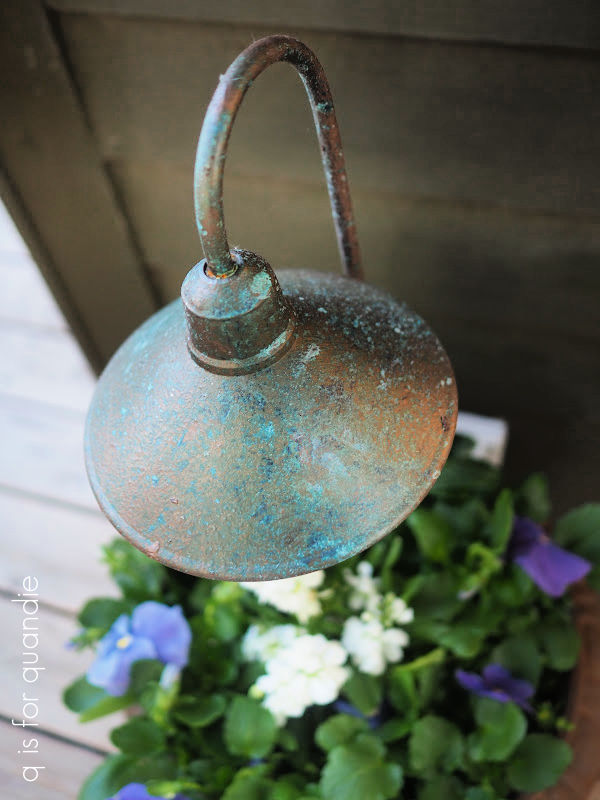
Rather than doing my usual rusty finish using the Iron paint and Green spray, I brought out the Copper paint and Blue spray.

Full disclosure, I probably should have used the Bonding Boss primer in this situation since I was painting over slick plastic.  But I was being impatient and I skipped it.  I may pay for that later, especially since these lights will be out in the elements.  I’m willing to risk it though.

So although I skipped that important step and went right to stippling on two coats of the Copper paint, you should do what I say and not what I do and use the Bonding Boss over slick surfaces.

While the 2nd coat of Copper was still wet, I sprayed on the Blue spray.  It was looking really blue though, and I wanted more of that green verdigris sort of color, so then I quickly added some Green spray as well.

Perfect!

I think the lights look totally legit with this paint treatment.

If you want to see the full instructions on how to use the Dixie Belle patina paint, check out my how-to post by clicking here.

My only complaint about the lights is that big honkin’ solar power collector thingie.  No one would mistake these for proper electric lights!

Although the panel is not very well disguised right now, as my plants get a little taller it will be a bit more hidden … but I can’t let it get too hidden or it won’t work properly.

But aside from that, I love how these turned out.

I’ve had them outside for a couple of weeks now, and so far the paint is holding up just fine as well.  I’ll be sure to give you an update at the end of the season to let you know how they did.

By the way, speaking of plastic to fantastic, those planters are also plastic.

I gave them the rusty treatment (Iron paint with green spray) last year … or wait … maybe two years ago?  I’m not sure.

Either way, they definitely don’t look plastic anymore, right?!

Leave a comment and let me know if you’ve tried any of the patina paint, or if you have something that you think would benefit from the rusty treatment, or the verdigris copper treatment.

Thank you to Dixie Belle Paint Co for providing the patina paint used for these projects.

practicing jumping worm safety.

Good morning from the garden, and Happy Mother’s Day to all of you mothers out there (wait a minute, that sounded a little wrong)!

Earlier this week I mentioned having purchased some plants while out garage saling last weekend.  I have always been a big fan of what I call garage sale gardening.  So many of the plants in my garden came from garage sales, such as the Bigroot Geranium (or Geranium macrorrizum) that grows like mad in just about any conditions.

So when I saw some of the plants on my ‘wish list’ being sold for $5 each at a sale in Tangletown last week, I couldn’t resist.

For one thing, I found a Sweet Autumn clematis.  You may remember seeing this growing on the side of our carriage house (the vine with the little white flowers on the left below).

It was spectacular in the fall, but last spring it didn’t come back.  I find that this happens sometimes with clematis, possibly due to clematis wilt, I’m not really sure.

Anyway, I picked up a new one for $5 and we’ll try again.

But, that brings me to today’s q tip!Have you heard about jumping worms?  They are a non-native earthworm that strips the nutrients from top soil.  And according to Ramsey County they are an emerging problem in our area.  They can be introduced to your garden in mulch, compost and potted plants.

For that reason, I am now hesitating to continue recommending buying plants at garage sales because it puts you at risk of bringing home jumping worms.

However, garage sale perennials can still be a good bargain, so if you have jumping worms in your area (check with your local University Extension program if you don’t know) you should practice some jumping worm safety if you purchase plants at a garage sale, or even at a garden club plant sale for that matter.

Here are some recommendations from the U of M Extension:

  • Accept only plants from gardeners that have looked for jumping worms and use these practices to prevent their spread:
    • Plants and materials do not come from an area known to have jumping worms.
    • There is no reason, like soil that looks like coffee grounds, to suspect there are jumping worms at the site that produced these plants or materials.
  • Remove soil from all plants before transporting them to limit the spread of weeds and worms. This helps to remove earthworm cocoons (egg cases) or weed seeds.
  • Completely submerge plant roots in water and wash away remaining soil. Actively look for worms. Protect clean roots for transportation and sale.
    • Water is sufficient to remove soil and other materials from the roots.

I questioned the person I purchased plants from and she said they were not grown in soil from her garden, but in a potting medium (sorry, my eyes glazed over at the exact details).  So they should be jumping worm free.

OK, let’s move on from the worms.

The garden has just exploded over the last week, so I thought I’d share some of my favorite spots with you this morning.

Remember the tulips that the deer like to eat?

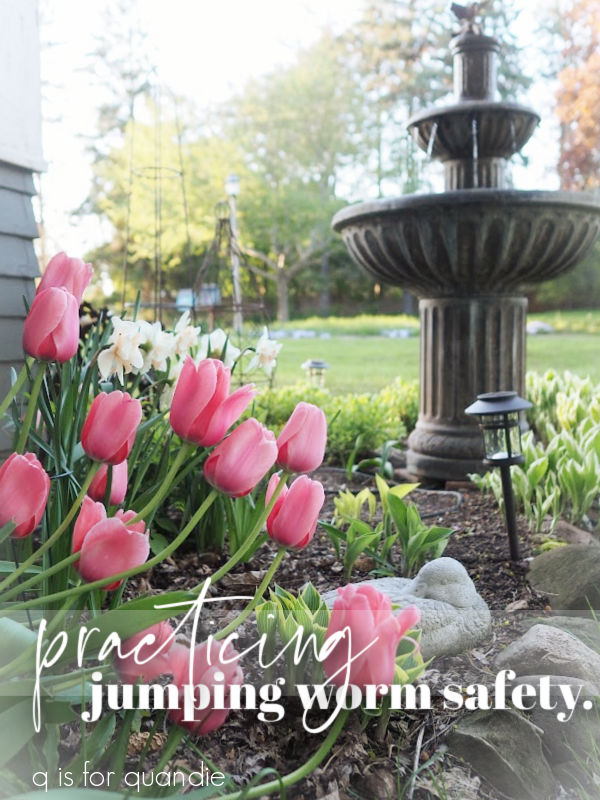
I saved a couple of patches of them by enclosing them with chicken wire and they look amazing right now.  Unfortunately, only a handful of the patch of 100 that I planted in fall of 2022 came back this year.  I had chosen Darwin Hybrid Pink Impression tulips specifically because that variety is one that will naturalize.  But apparently not for me.  However, I’d also planted 100 new ones this past fall and those look fantastic.

In the end, I have come to realize that I need to treat tulips as an annual in my garden, and an annual that has to be protected from deer at that.  I tell myself that they just aren’t worth it, but right now they look so good that I know I’ll be tempted to plant them again this fall!

The Double Sherborne Narcissus that I planted last fall are also looking good.  They add a bright pop of yellow next to the red carriage house.

I’ve mixed in some muscari (grape hyacinth) and I love the combination.

In the background of that photo you can see the azalea that I added a few weeks ago.

I can’t take any credit for all of those flowers since this shrub was already covered in buds when I purchased it at Home Depot.  This particular azalea is supposed to be hardy in zones 5 thru 9, and my area was bumped from 4b to 5a last year.  Will it survive our winter?  That remains to be seen.  I plan to protect it over winter for a few years until it gets established.

The Sugar and Spice tiarella (foam flower) that I put in last year is just starting to bloom.

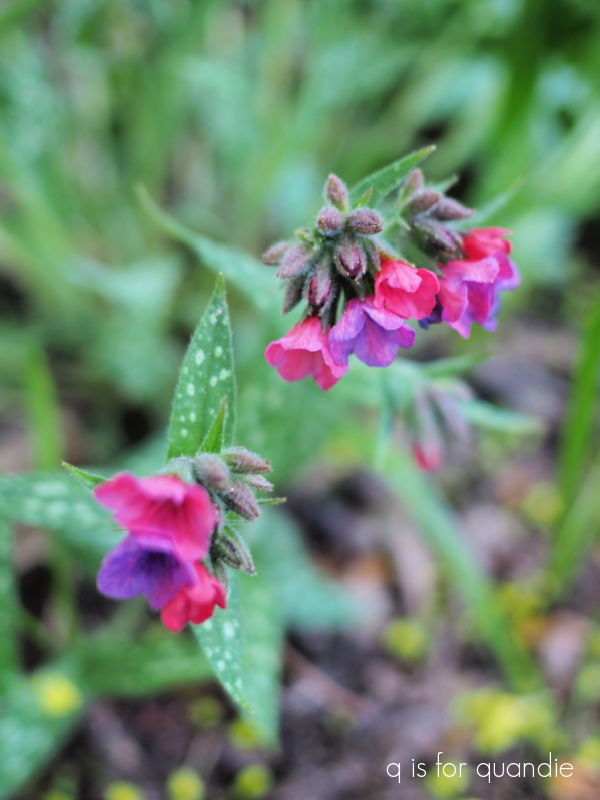
As is the Raspberry Splash lungwort.

Aren’t those color gorgeous?

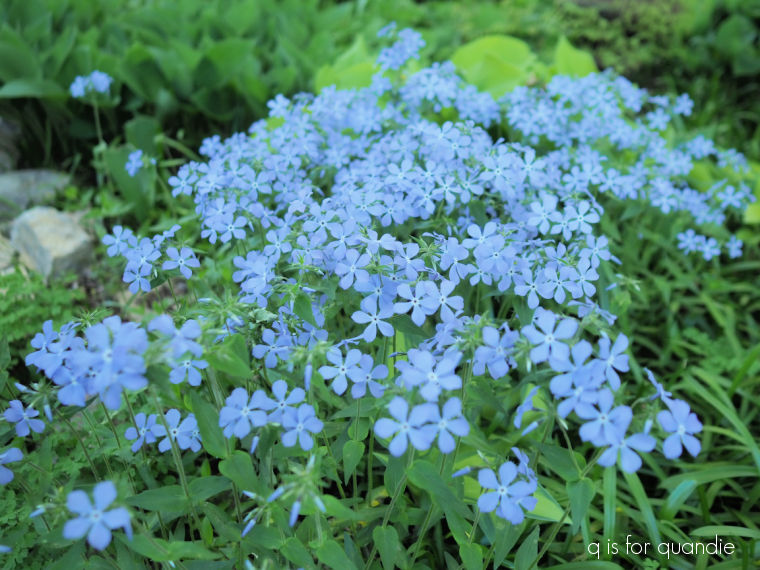
The star of the garden this week has to be the Phlox divaricata, or wild blue phlox.

It has created a lovely patch of bright blue.  I have it planted ‘under’ a Sun Power hosta.  You can just barely see the Sun Power in the early stages of emerging behind the phlox.

I love this combination because although the phlox looks gorgeous right now, after it blooms it looks fairly weedy.  But that’s when the hosta takes over and fills in the space and I just cut back the phlox.

Last, but certainly not least, the lilacs are just starting to pop.  We’ve had some cool nights recently (in the 40’s Fahrenheit), and I think that is slowing them down a little.

Also, I’m finding that they last a lot longer in a vase if I cut them before the flowers are completely opened up.

So tell me, do you have jumping worms where you are?  Have you gotten many plants at garage sales?  And what’s blooming in your garden this week?  Leave a comment and let me know.