early bloomers.

Good morning from the garden.

Well, we’ve had some exciting times in the garden lately.  We had severe thunderstorms blow through, two nights in a row a week or two ago.

We survived the first storm with just a few small branches strewn about, but the second one took down a sizeable limb from our neighbor Ken’s remaining tree.

If you’ve been following me for long, you’ll remember that Ken had a very large tree in his backyard cut down last year because he was worried it would come down in a storm.

They cut it into sections and then lifted it out (right over the top of our house) using a crane.

At the time he also had some deadwood cut out of his remaining smaller tree.

So in an ironic turn of events, he lost a big branch from that smaller tree in the 2nd storm.

And of course, the branch fell right onto the new hydrangea hedge that I planted last summer after Ken had that larger tree removed.

Fortunately it didn’t really do any damage.

The hydrangeas bounced right back.

These are Quick Fire Fab hydrangeas.  So far my hedge is only about 3′ tall, and according to Proven Winners they will max out at 6′ to 8′.  However, they also say that about Limelight hydrangeas and my Limelights are easily 10′ tall or more.  So I’m hoping to end up with a tall hedge here.

The Quick Fire Fab are the earliest to bloom of the panicle hydrangeas.  The flowers start out white (as you can see in the photo with the branch on them), and then slowly go from white to pale pink to bright pink to deep red by fall.

I think the color they are right now is my favorite.

In comparison, Limelight hydrangeas are the latest of the panicle hydrangeas to bloom.  The flowers on mine are only just barely starting to open up.

And they are still the pretty lime color that gives them their name.  They will gradually fade to white, and then start to turn a pretty coppery sort of pink for fall.

I absolutely love the Limelight hydrangea, but when I was deciding what hydrangea to use for my new hedge last year I thought it would be nice to have a hydrangea that blooms a few weeks earlier to extend hydrangea season.

For those of us who garden in a cold climate (I’m in a suburb of St. Paul, MN, zone 4b to 5a), a panicle hydrangea is definitely the way to go.  So far I have found them to be pretty much impervious to a cold winter.  As I’ve mentioned before, our last winter was pretty hard on plants.  We had some days with temps well below zero, but hardly any snow.  We need that snow to protect the plants that are in the ground.  I lost quite a few things in my gardens, but the new hydrangeas came through with flying colors even though I had only planted them in August.

I wish we could get those gorgeously vibrant macrophylla hydrangeas to bloom reliably here.  You know, the ones that are bright pink …

Or blue …

But I’ve never had any luck with them, including the Endless Summer varieties (I took the two photos above at Longwood Gardens in Pennsylvania).

I’ll just have to settle for the more subtle look of the panicle hydrangeas in my garden.

Earlier this week I decided to try a bit of an experiment to see how well the Quick Fire Fab hydrangeas will hold their color when dried.

So I cut a few and popped them into a bucket with about 2″ of water at the bottom.

Next I’ll put them in a cool, dark, dry location and let them dry out.

It’s possible that it’s too early to successfully dry these, I usually wait until the flowers have started drying out just a bit on their own before cutting them to dry the rest of the way.  But these Quick Fire Fabs will have turned red by then (and of course, I’ll also dry some then), so I hope I can preserve some in this pretty blush pink.

If you’re a fan of dried hydrangeas, you may want to go back and check out my post on how to make a dried hydrangea wreath.

Or for more details on drying hydrangeas, check out this post.

Are you able to grow hydrangeas where you are?  If so, which ones are your favorites?

Leave a comment and let me know.

the blue grass chair.

It’s time for another do-over project.

Usually I call for a do-over when an item isn’t selling, but in this case I’m making over an item that I originally painted for myself and used for many years.

This is your classic child sized schoolhouse chair.  It started out looking like this …

I used this chair regularly both while painting furniture, and also while taking photos of furniture.  It put me right at the perfect height for both.

Then back in 2017 I decided to give it a paint job using Fusion’s Putty.

That made it more presentable to have around the house when I wasn’t using it.

But that was 8 years ago!  Wow, time flies.  It had gotten pretty beat up, splattered with paint, and just basically dirty since then.  Furthermore, I rarely actually use it these days so it was just collecting dust out in my workshop.

So I decided to give it a fresh look before listing it for sale.

I started by giving it a good cleaning first, then I sanded down the stenciled design on the seat and gave the entire chair a couple of coats of Dixie Belle’s Blue Grass.

The Blue Grass is from Dixie Belle’s line of chalk style paint, and it went on beautifully over that original Fusion acrylic paint.

Once the paint dried, I sanded the edges of the chair to distress the paint back to that Putty color.

This is always something to keep in mind when you paint over another paint color and you like to distress your pieces.  That original color is going to show.  I think it works on this chair though.

Next up I added a portion of the I.O.D. Label Ephemera transfer to the seat.

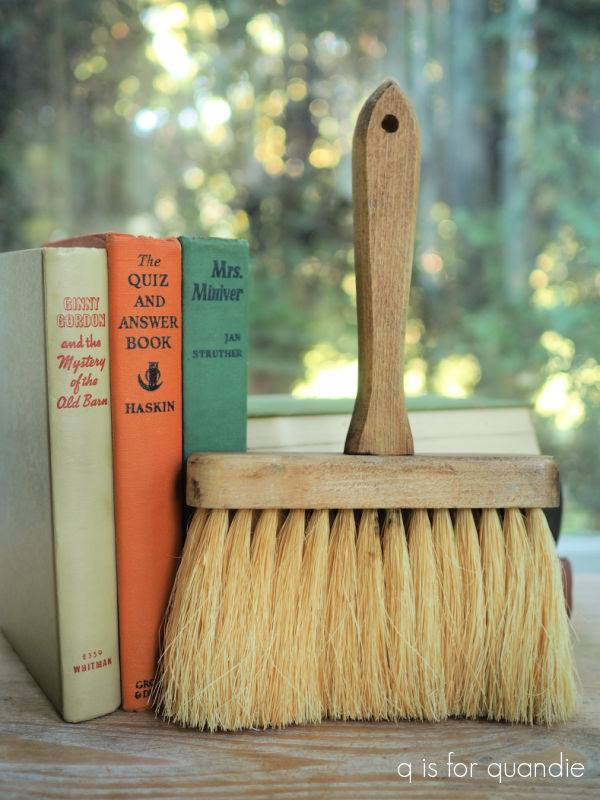
I finished it off with a coat of Dixie Belle’s clear wax, and then I staged some photos in my garden using some vintage books.

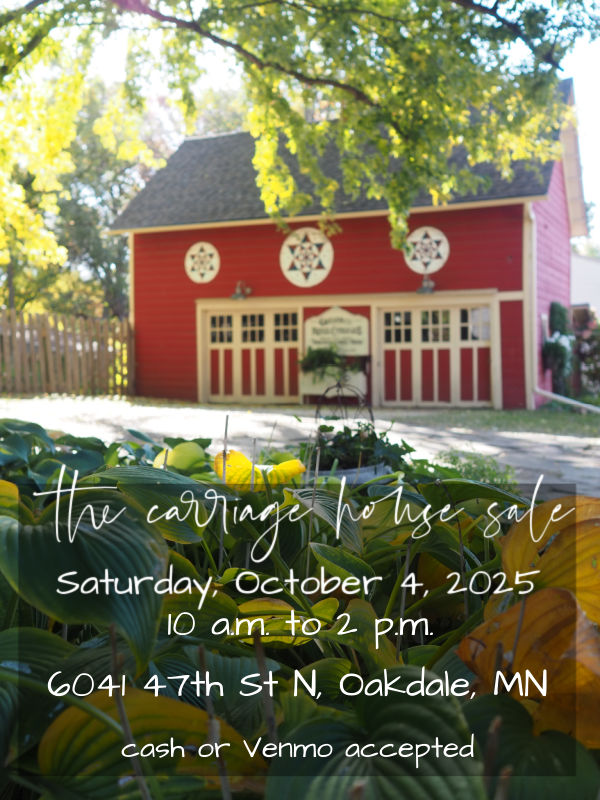
This chair is going in the pile of merch that I’m readying for my fall Carriage House sale.  I’m tentatively aiming for the first Saturday in October for the sale, so if you’re local, pencil it in!

But I’ll also list it on my ‘available for local sale‘ page in case any of you locals are interested in it now.

As always, thank you to Dixie Belle Paint Co for the products used in this makeover!

assembly line rustification.

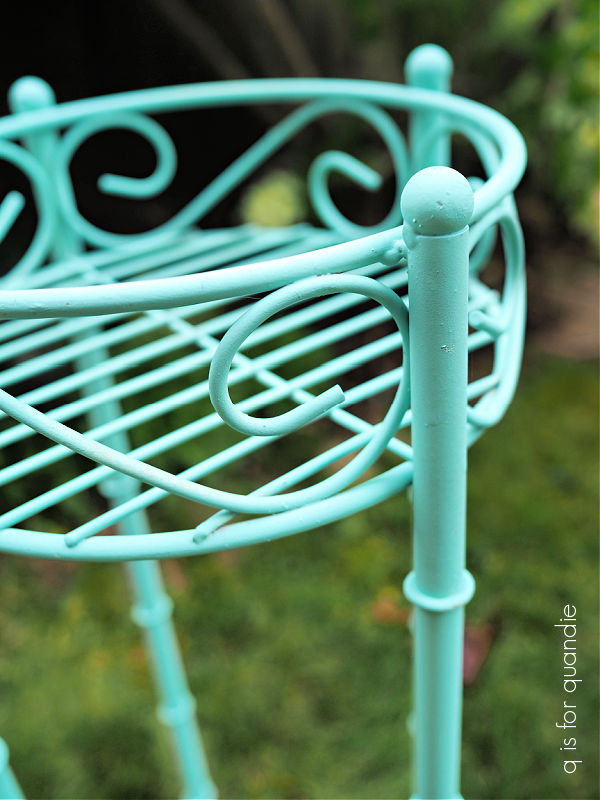
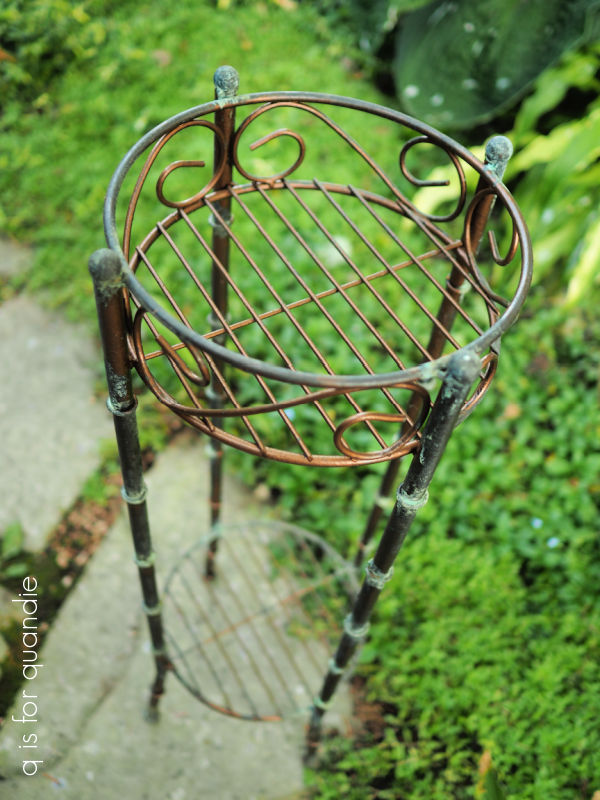
I had a couple of rusty things at my sale last May including a tall planter, some old iron bedsteads, and a small statuette.

And they were among the first things to sell.  I think that must mean that other people love this rusty look as much as I do.  So I’ve been stocking up on stuff to rustify (excuse the made up word) for my next sale.

I’ve been salvaging various planters from my neighbors Ken & Arlene.  Arlene is no longer able to garden and the pots have been sitting around empty for a couple of seasons now.  Ken was just going to toss them, so I saved them from the trash heap.

These will look fabulous with the rusty treatment.

I’ve also got a pile of random stuff like the ‘statues’ that I bought at a garage sale this summer …

And I also have some faux pumpkins to make rusty for fall.

Since I have so many things to make rusty, I decided to tackle it assembly line style.  Basically I put out a variety of worktables, line everything up and then work my way down the row with each step of the process.

Step 1:  Wash everything using the garden hose and some Dawn dish soap.

Step 2:  Spray everything with flat black primer.

I’ve found this to be the quickest and easiest way to do a lot of items at once.  I have also used the red spray primer, which is closer to a rust color, but either one will work.  Dixie Belle also makes a primer specifically for use with the patina paints, and it’s also that rusty red color.  But it goes on with a brush, and when I’m working with this many pieces at once, spraying saves a lot of time.

Step 3:  After mixing it well, I stipple on Dixie Belle’s Iron patina paint using their Oval Medium brush.

Of course, you don’t have to use this brush.  You can use pretty much any brush, but the job goes much quicker with a larger brush that holds more paint.

 Today’s q tip:  applying the Patina paint with a stippling motion rather than a brushing motion prevents brush strokes.  The activating spray (which is the next step) tends to pool in brush strokes making them more obvious, which doesn’t look natural on a rusty item.

Step 4:  After the first coat of Iron paint is dry, stipple on a 2nd coat and while it’s still wet, spray it with the Green Patina Spray.

Step 5:  Wait.

I find that out of all of the various patina paint/spray combos this rusty look takes the longest to develop.  If you use the Copper or Bronze paint, the verdigris appears almost immediately.  For example, I painted the pumpkin stems with the Bronze paint, added the green spray, and an hour or two later they looked like this.

But the rust takes a bit more time.  As in days, rather than just minutes or hours.

Here are the pots after 2 days.

They aren’t quite rusty enough yet, but they’ll get there.

I have found that leaving the item out in the rain will really get the rust going.  When the weather doesn’t cooperate, I spray the item with tap water using the Dixie Belle Continuous Fine Mist Spray Bottle and that will help too, just not as much as rain water.

Step 6:  You have a few options for the final step.  The easiest is to simply skip using any sort of topcoat over your rusty item.  That’s my choice for anything that’s going in the garden.

Those items aren’t going to be handled a lot, so no worries about rust getting onto someone’s hands or clothing.  I’m also not worried about these items continuing to rust over time.

For the most part I have found that this finish holds up quite well outdoors without a top coat on most items with plaster items being the exception.  I’ve had to touch up that plaster pedestal shown above after a year spent outside.  I haven’t top-coated any of the items in my own garden including this bench and they’ve held up for multiple years now despite our harsh Minnesota climate.

However, I purposely placed the bench in a garden bed so that no one will be tempted to sit on it.

If it were going to be used for seating, I would add a top coat.  You have a couple of options.  First, you could use Dixie Belle’s Patina Guard.

This product will stop the “rusting” process and protect your patina finish (and also your pants when you sit on a rusty bench).

However, it will also darken the color a bit and add some sheen.

Here is a rusty pedestal I painted before adding Patina Guard.

And here it is after.

So just keep that in mind if you plan to use the Patina Guard.

If you don’t like that look, another option is to use a spray matte sealer over a rusty finish.  I like to do that with items that are going to be handled more frequently.

I hope the info in today’s post has been helpful, or has inspired you to try the Patina Paint.  Or maybe you’ve already tried it?

If so, be sure to leave a comment and let me know.

Thank you to Dixie Belle Paint Co for providing the Patina Paint products used in my assembly line rustification process.

this year’s pots, 2025 edition.

Good morning from the garden.

Today I thought I’d share how my container plants have turned out this year.  Quite honestly, I really mostly write this blog post for myself each year.  It’s an easy way for me to go back and see what I did in previous years, what I liked and disliked.  But I hope some of you will find it interesting, or maybe get inspired for your own pots for next year.

So let’s get started with the two pairs of pots on our deck.  There is a taller pair that flank the stairs, and a shorter pair that sit on either side of the door.

Some of you may remember that last year I put Alberta Spruce spirals in these pots …

I was hoping to be able to overwinter those in place, but that didn’t work out.

So I pulled them out and replaced them with Eugenia pyramids underplanted with more variegated ivy.  I also added some creeping wooly thyme alternating with the ivy.

I have a couple of other Eugenia topiaries that I’ve saved over several winters now by bringing them inside as a house plant …

so I plan to do the same with these pyramids.

I love the classic simplicity of this look.  I also love that these pots are super low maintenance.  Since we’ve had plenty of rain so far this summer, I’ve only had to water them a handful of times and otherwise I do nothing with them.

As for the pair of planters flanking the door, this year I decided to fill them with mostly perennials.

On the left is a Blueberry Muffin hosta, at the back is a Rex begonia, in front is a Midnight Rose heuchera, and on the right is the White Licorice helichrysum from Prover Winners (this last one is an annual).

This is also a very low maintenance option for a planter.  I have had to cut back the helichrysum a couple of times to encourage it to fill out a little.  I’ve also had to cut off the hosta flowers when they were spent, but that’s about it.

I plan to move the perennials out into the garden in early September and replace them with a fall combo of some kind.

All four of these planters are on (or near) our deck, which is pretty shady these days.  I had to give up planting flowering annuals that require full sun here because they just don’t perform well for me.

Luckily, I like combinations of plants with interesting foliage like these.

By the way, if you’re noticing a lovely golden glow to my photos, that’s because we’ve been under an air quality warning for most of the past week due to Canadian wild fires.  The air quality is bad for just about everything except it makes for lovely photos.  No need to wait for ‘golden hour’.

Also, FYI, I have painted all four of the pots shown so far using Dixie Belle’s Patina Paint.  I’ve got a post coming up soon with details on this process, so stay tuned if you’re interested in that.

I don’t always go with non-flowering plants in my containers.  I like to attempt to add colorful blooms to some of them, like the ‘window boxes’ made out of old galvanized boilers on my carriage house and potting shed.

This year I planted them with Proven Winner’s Supertunia Mini Vista Indigo, Superbena Cobalt and a short annual salvia that I don’t remember the name of.

They look great in the planter on the carriage house, but the one on the potting shed gets less sun.

Less sun definitely equals less flowers with these plants.  I need to remember this for next year.

I also like to use some flowering plants in the trio of planters that are placed in my shade garden.

Once again, these planters are in what would be considered ‘full shade’ (less than 4 hours of direct sunlight per day).  So I try to choose flowering plants that like the shade.  In this case I’ve used an old favorite, Proven Winners® Double Impatiens Rockapulco Appleblossom.

The flowers look like miniature roses to me, and they are the prettiest delicate shade of pale pink.

I also added some of the Proven Winner’s Diamond Snow euphorbia.

In past years I’ve used the Diamond Frost euphorbia in shade planters and it has performed really well.  But this year I switched to the Diamond Snow because it is supposed to be more compact and not as airy as the Diamond Frost (check out this page for a comparison of the three euphorbias offered by Proven Winners).  Initially that was definitely true, and I really liked the Diamond Snow, but now it has sent out new foliage that is taller than the original plant, and has much fewer flowers.

It really looks rather odd now.  I may try cutting it back and then waiting to see what happens.

I also popped some caladium in these shade planters, but they aren’t performing at all for me this year.

They’ve barely put on any new growth and are hardly even peeking out from behind those impatiens and euphorbia.

One of these days I will realize that we just don’t have the hot, steamy climate here that caladiums love.  Sure, we get a handful of hot, steamy days, but it’s not the norm for us.  This summer in particular has just not been hot enough for the caladium to thrive.

The same can be said for the white caladium that I put in the front window box.

It has been totally overtaken by the Rex begonias.  In fact, when I’m done writing this blog post I’m going to pull them out of there and find another spot for them.

That brings me to the front window box.

It is a monster this year!

I started out by putting the two Rex begonias that I saved over the winter in the center (along with those two caladium that you can’t even see now).

All of the other plants were chosen to play well with the begonias.

I added two dark sweet potato vines at either end.

I then planted an Angel Wings senecio next to those, which created a fantastic contrast.

I filled in between with Icicles licorice plant, and more of the White Licorice helichrysum that I also used in the pots on the deck.

 There are also a couple of coleus in there, and some dark purple oxalis that you can’t see anymore either.

Overall I’m happy with how the front box turned out this year.  I’m definitely going to save the Rex begonia again this winter.  I may change things up next year and put them in the shade garden planters instead, and then come up with something entirely new for the front.

But that’s a long way off, so for now I’m just going to enjoy how it looks this year.

Now, how about you?  Do you have good luck with caladium where you are?  Have you ever tried using perennials in your containers instead of annuals?  And what are your thoughts on choosing plants for their foliage rather than flowers?  Leave a comment and let me  know!

my summer reading list.

I stopped off at the thrift store the other day to pick up a few books to add to my summer reading list.

LOL, just kidding.  I didn’t buy these to read, I bought them to paint.  which is not to say there aren’t a few options here that I might enjoy reading.

But I was surfing around on pinterest the other day and I came across this image …

and it inspired me to do some more book painting.

Is it just me, or does that image seem AI generated?  I don’t know, maybe it isn’t, but it just seems too perfect.  And I also saw the same exact image but in black and white.  I also couldn’t really track down the origin of this photo, it just has been shared and re-shared by individuals without any attribution.

Regardless, I was inspired by the colors and the florals on those books.

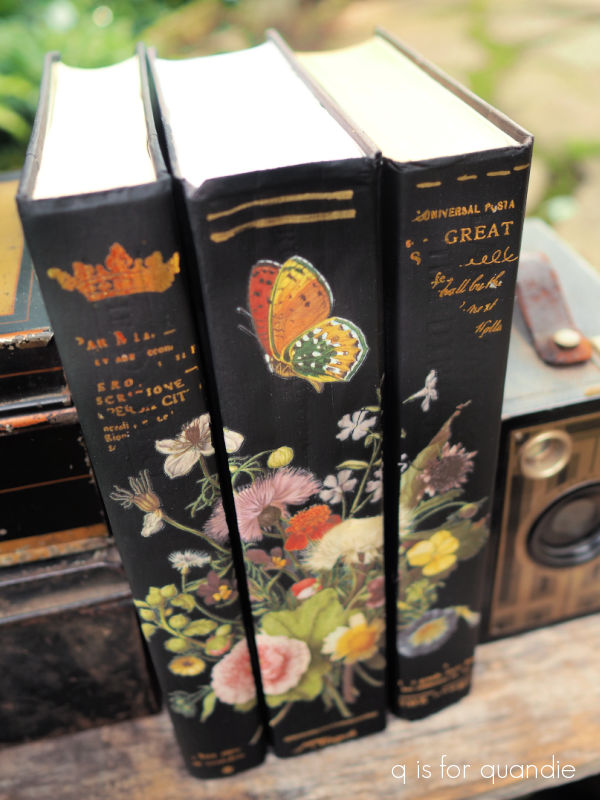
So I got out my Dixie Belle paint in Secret Path and in Kudzu to see what I could create.  After painting three of the books in each color, I started embellishing them.  I used a some floral transfers from a few different I.O.D. sets; Sarah Featon’s Botanicals, Rose Botanical and Wilde Bloemen.

Next I added a few random bits of gold typography from the I.O.D. Étiquettes transfer.

I also added some horizontal gold lines to the book spines using Dixie Belle’s Gold Marker.

Once all of those elements were in place, I gave the books a coat of Dixie Belle’s clear wax.  Then I used some of their Dixie Dirt in the color called Earth to add a little faux wear.  Dixie Dirt is a powder pigment that you can use to … well … make things look a little dirty.

I use a small artist’s brush to apply a little of the Dixie Dirt to the top of each book spine.

I kept it fairly subtle, but it definitely helped the books not look quite so freshly painted.

I kept aside 3 of the books to paint based on another inspiration pic from pinterest.

Isn’t that gorgeous?

I first painted the last 3 books using Dixie Belle’s Caviar, then I added more of the same embellishments I used on the previous books.

Only this time I used one floral transfer and applied it across all three books instead of using an individual one on each book.

And isn’t that transfer perfect over black?  It’s from I.O.D.’s Wilde Bloemen set, and it definitely has that look of a Dutch still life floral.

I have to admit that I like the black books even better than the green and purple books.

The gold elements really pop over the black.

I love the way these turned out.  So much in fact, that I’m going to keep them for myself.  I’ve already ordered more of the Wilde Bloemen transfer so that I can paint up some more too.

What do you think of these painted books?  Leave a comment and let me know.
wildflowers.

Good morning from the garden!

Last Sunday I shared the interesting desert plants that were along the Harry Reid Union Pacific Railroad Trail near my mom’s house in Henderson, Nevada.  So today I thought I would tell you about the beautiful wildflower garden along the railway trail that Mr. Q and I walk on near our house here in the Twin Cities.

Illinois and Wisconsin started turning abandoned railway lines into hiking/biking trails back in the 60’s, but the movement didn’t become really widespread until the late 80’s.  According to the Rails to Trails Conservancy, there are now over 26,000 miles of rail-trails in the U.S.

The Gateway Trail was built along the former Soo Line Railroad and goes from St. Paul to Stillwater.  The first segment of the trail was completed in 1993.  So Mr. Q and I have been walking on this trail for probably around 30 years.  Well … actually … back in the day we biked on it more than we walked on it, but these days we are walkers.

It’s unfortunate that the section of the trail nearest our house also happens to run alongside a very busy highway (because there is a lot of traffic noise).  However, back in 2020, as part of a project to replace a stoplight, they re-worked this area of the trail adding a tall sound barrier wall between the highway and the trail.

They also must have purposely planted wildflowers all along that stretch of the trail at the same time, but I can’t find any definitive info about that online.  It feels like it had to be deliberate though.

As it turns out, I’m not that good at identifying local wildflowers.  I recognize some of them, like the bee balm.

And I believe this next purple one is Blue Giant Hyssop.

I’ve always called this next one Black Eyed Susan

I did a little research and this wildflower is found in all of the lower 48 states, plus all 10 Canadian provinces.  So it’s pretty common.

I had to look this next one up, and I think it must be Prairie Fleabane.

So called because it was once thought that the dried flowers would repel fleas.

I tried to find this next wildflower on the Minnesota Wildflowers website, but without even a clue as to its name I tried to look it up by color alone.  However, there are 278 varieties of purple wildflowers in Minnesota.  I just didn’t have the patience to sift through them all.

If any of you know what this one is, please leave a comment.

As for this next purple flower, I thought it looked as though it must be in the verbena family so that gave me a starting point.

I found Hoary Vervain, and I’m pretty sure that’s it.

It’s amazing how many flowers are in the verbena family, all the way from Verbena bonariensis to the Proven Winner’s Superbena Cloudburst that I used in my planters a couple of years ago.

Even lantana, which is grown as an annual here in Minnesota and as a perennial in my mom’s area, is in the verbena family.  Who knew?

Although we can grow some of the same plants, like the lantana, there is definitely a vast difference between the landscape in Southern Nevada and the landscape in Minnesota.

But I enjoy walking on each of these trails and looking to see what sort of wildflowers I might find along the way.

How about you?  Do you have a favorite spot for wildflowers where you are?  Leave a comment and let me know.

the richardson & gould toolbox.

Welcome to the final installment of toolbox week.

Did I save the best for last?

I think that’s up to you, so be sure to leave your choice for best toolbox from toolbox week in a comment below.

Even if you don’t think that today’s toolbox is the best, it is definitely the largest.

Here’s how it started out.

Super rusty.

That much rust requires extra work in the prep stage.  I started by cleaning it with Dawn dish soap first.  Once dry, I sanded heavily using my Mouse sander and some 150 grit paper.  Then I had to clean it again, followed by leaving it in the sun to dry thoroughly.

Once dry I applied Dixie Belle’s Bonding Boss.  As I’ve mentioned before, the Bonding Boss does not specifically prevent rust.  Actually any paint job will help prevent future rust, as will keeping the toolbox dry and out of the elements.  The Bonding Boss is meant to prevent any remaining existing rust from bleeding through the paint.  Although I did sand away quite a bit of it, there is still some rust left behind.  The bottom of the box had the most rust, so I gave that part two coats of Bonding Boss (as per the instructions) to be extra sure it did the job.

Next up I painted the interior in Dixie Belle’s Cottage Door.

I then applied one of I.O.D.’s Floriography paint inlays inside the lid.

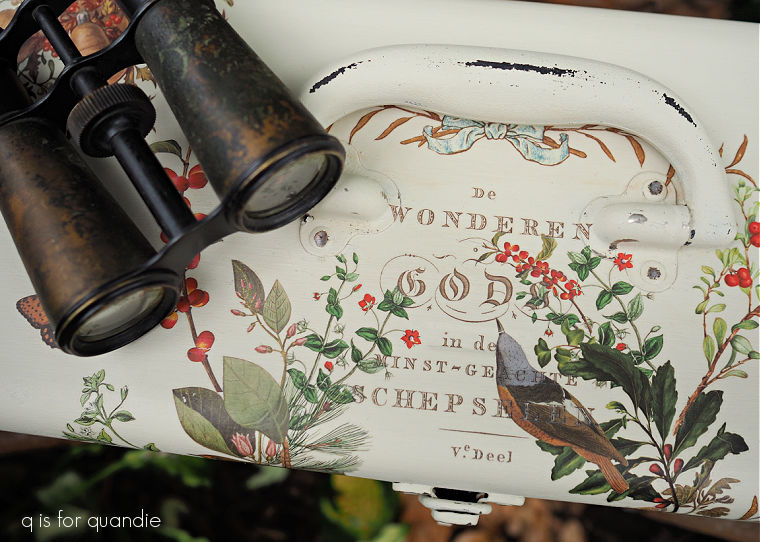
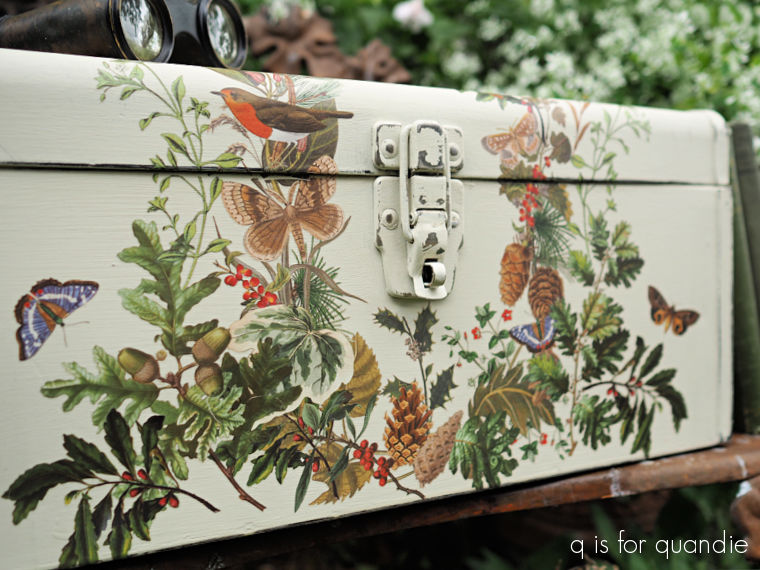
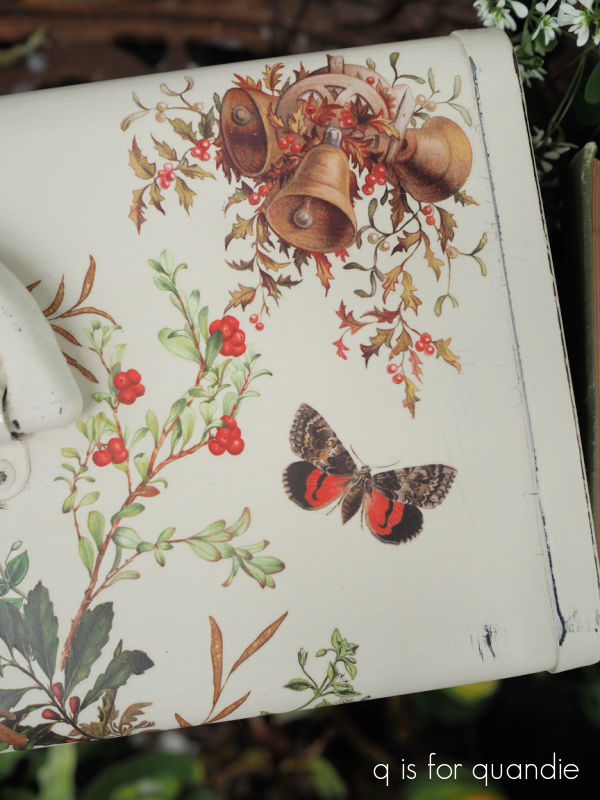
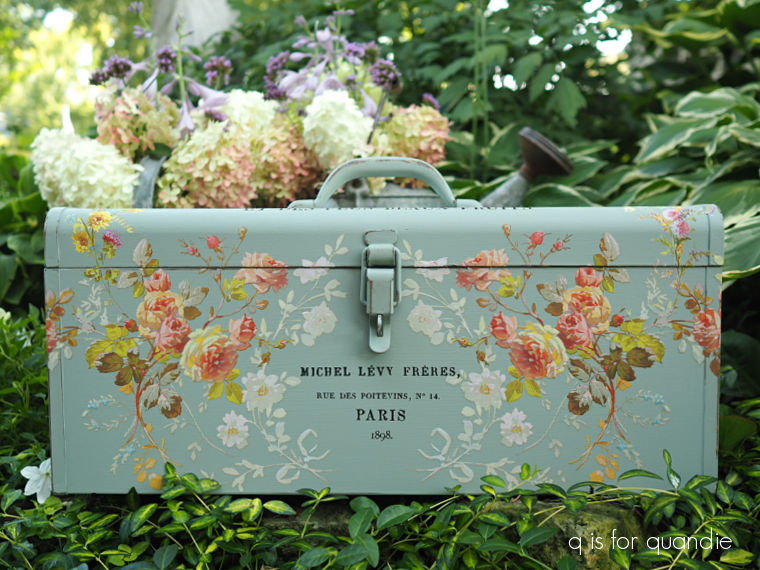
Next up I painted the exterior of the toolbox in two coats of Dixie Belle’s Drop Cloth.  Once dry, I sanded to distress the edges, wiped away the dust and then started applying roses from I.O.D.’s Rose Botanical transfer.

I started with some of the largest roses on either side of the top, and then filled in with smaller ones on the front.

Next up I cobbled together some other bits and pieces from random transfers.  The “Richardson & Gould’s” at the top is from the old Seeds transfer from re.design with prima (retired design from years ago).  The London/Edinburgh stuff at the bottom is from the I.O.D. Label Ephemera transfer (also retired, and I’m starting to scrape the bottom on my stash of those).

I’m not 100% sure where the bee came from.  I went through a bit of a bee phase back in 2022 …

and I bought a lot of transfers that included some bees from both I.O.D. and re.design with prima.

I also added some old Tim Holtz rub-on transfers to the latches.

They are a tiny detail, but tiny details can be fun, right?

I finished everything off with a coat of Dixie Belle’s clear wax.

As with all of the toolboxes I’ve shared this week, this one is available for local sale (check out the details here).

I hope you’ve enjoyed toolbox week as much as I have.  I definitely had fun giving all of these boxes a new look.

I really don’t think I can pick a favorite, I like something different about each one.  I love the homemade feel of the Northern Grown toolbox.

And I really love that pretty Dixie Belle Secret Path lavender color inside the Memoires toolbox.

The neutral simplicity of the Industries toolbox definitely appeals to me and would work best with my own decor …

and I was surprised to discover just how much I liked the deep violet colors paired with the avocado green of Holy Guacamole on the Dark Side of the Moon tackle box.

Last, but not least, I love the roses on the Richardson & Gould toolbox that I shared today.

I hope you’ll take a minute to leave a comment and let me know which of the five toolboxes was your favorite!

the dark side of the moon tackle box.

My submission for day no. 4 of toolbox week is actually a tackle box rather than a toolbox, but I hope you’ll ignore that technicality.

I purchased this way back in May 2024.  It was in good shape, and the colors were decent.

I thought perhaps I could just sell it ‘as is’, but no.  It’s been in two of my Carriage House occasional sales now with no takers, reinforcing my opinion that I have to paint and embellish these items in order for them to be marketable.

So after giving it a quick scuff sanding, a good cleaning and then a coat of Dixie Belle’s Bonding Boss, I painted the inside in DB’s Holy Guacamole.

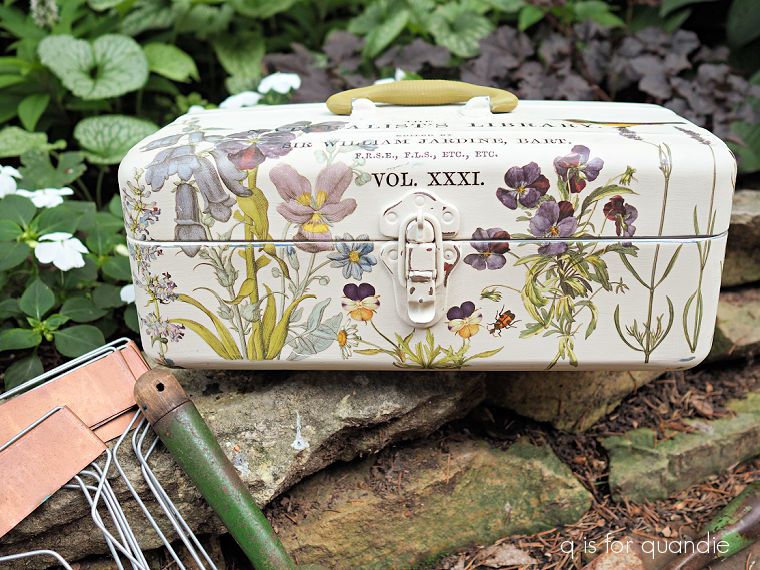
I painted the outside in Dixie Belle’s Ecru.  Once dry, I started adding some florals from a couple of different I.O.D. transfers.  Most are from Sarah Featon’s Botanicals, but some are from Wilde Bloemen.

I chose most of them based on that dusky deep violet color.

Although some I chose just because they were white and green only.

I wrapped the florals around each side from the front.

Once the florals were all in place, I added some wording from the I.O.D. Label Ephemera transfer.

And, as you may have noticed, I even added a bird to this one.

I also painted the handle in the Holy Guacamole.

I purposely chose to ‘pose’ this tackle box in the garden right in front of my Dark Side of the Moon astilbe.

That dark purple of the astilbe foliage (back right) works perfectly with those florals.

For a non-purple loving girl, I sure seem to be gravitating towards the purple these days.

What do you think of this one?  Leave a comment and let me know.  Also, be sure to check out my ‘available for local sale‘ page if you are in the market for a dark side of the moon tackle box.
the industries toolbox.

It’s Day 3 of toolbox week, and when working on today’s project I thought I’d go in a slightly different direction.  A little less floral (although yes, there are still some flowers), and a little less pink, or green.

But first, here is the before.

I thought this one was in decent shape, but when I got started sanding and cleaning it, I realized that the bottom was pretty rusty and had even rusted through in a couple of small spots.

So right from the beginning I thought I might not want to use too many expensive transfers or paint inlays on this one.  There’s a chance that no one will even want it, and I’ll certainly have to price it lower than the others.

That meant I could just play around with a bit though.

I started with a rather neutral color scheme.  I painted the interior in Dixie Belle’s Sawmill Gravy, and the outside in their Dried Sage.  It has been a bit since I’ve worked with this pair, and I forgot how much I like them.

Once the Sawmill Gravy on the interior was dry, I realized I needed to do something about those small holes.  So I pulled out some decoupage paper from re.design with prima called Dark Damask.

I used Dixie Belle’s flat clear coat as a decoupage medium and applied it to the inside bottom of the box.  It ended up working beautifully to cover up those holes, and it goes perfectly with my neutral color scheme as you’ll see in a minute.

Next I pulled out some scraps from the I.O.D. Cosette transfer.

Some of you may remember that I’ve used bits and pieces of this particular transfer on a variety of things.  Most of the wording in the center of the design went on a toolbox.

I used some of the other lines of text on toolboxes too …

and I even used some of it in my dollhouse bathroom.

All I had left of it was the floral design, which is beautiful, but I just haven’t managed to come across just the right piece to put it on.

So I decided to chop it up and use some of it on this toolbox.

After adding just that bit to one side, I rather liked the asymmetrical look so rather than add more of it on the other side, I decided to just add some typography from the I.O.D. Label Ephemera transfer.

And that was it.  After giving it a coat of Dixie Belle’s clear wax, I decided to call it done.

I think this one would be perfect to hold office supplies on your desk, or to put on a bookshelf next to some vintage books.  If your decor is more neutral (as is mine), it would fit right in.

In fact, if no one buys this one I may just keep it for myself.

Also, FYI, I decided to head over the The Painted Heirloom to order another Cosette transfer.  I happened to see that is is currently on sale (as of yesterday anyway) for $28, and since so far I’ve gotten 3 toolboxes plus one dollhouse bathroom out of it, that seems like a bargain to me.

The industries toolbox is for sale locally, be sure to check my ‘available for local sale‘ page if you are interested.

Also, be sure to leave me a comment and let me know if you like this one.

the memoires toolbox.

Toolbox week continues today with this one that was admittedly nothing special originally.

It’s not particularly vintage looking, and it’s red which is not my favorite color to work with.

However, it is in great shape and it’s a nice size.  Not too big, not too small.

After peeling off both of those labels on the front, I gave this one a good cleaning with Dawn dish soap.  Then I gave it a light scuff sanding followed by a coat of Dixie Belle’s Bonding Boss.  Although this one didn’t have any rust that would bleed through my paint, it did have a pretty shiny, slick surface.  The Bonding Boss will help my paint adhere to that.

Next up I pulled out the I.O.D. Saint Germain transfer.  I knew I wanted to use it on this toolbox, so I thought I would pick a color from it for the inside of the box.

Some of the leaves have this pretty muted purple in them …

so I decided to go with Dixie Belle’s Secret Path for the interior including the tray.

Once my two coats of Secret Path were dry, I sanded over them with one of Dixie Belle’s sanding sponges.

I like to use these when I want to have a more gentle approach to sanding.  In this case, I didn’t want to go through to the red that was underneath, I just wanted to smooth out my paint giving it a lovely buttery finish.

After sanding and wiping away any dust, I added a scrap from an old I.O.D./re.design with prima (before they parted ways) transfer to the handle.

That means ‘first edition’ in French, and will make a little bit more sense when you see the rest of it.

Next up I painted the outside of the box in one of the new colors from the Dixie Belle Southern Roots collection called Magnolia.  I would say that this color is just a wee bit brighter than the Drop Cloth that is my usual choice for a warm white.

After two coats of the Magnolia were dry, this time I sanded a bit more vigorously using my Mouse sander and 220 grit paper.  I wanted to add some wear, and I decided it would be OK to have a little red showing on the outside of the box since my transfer has some red in it too.

You may remember I used the I.O.D. Saint Germain transfer once before on a toolbox.

I’ve also used it on a 2nd toolbox that I can’t share with you just yet.  You see, I painted that one in an as yet unreleased paint color from Dixie Belle.  So I can’t share it until the official reveal date which is going to be sometime in August.  I can tell you that I absolutely love it, and I can’t wait to share.

But in the meantime, I love this Saint Germain transfer so much that I ordered two more of them.

  That ended up being a lucky thing, because I used both of them on this toolbox.  Let me try to explain.  As you can see, this transfer comes with 8 pages of different elements.  But I wanted just one particular, slightly more delicate looking section on this toolbox.

So I used just a part of the florals on pages 3 and 4 on the front of the box.  But then I decided I really wanted to continue them on up and over the top and down each side a little bit.  So I used those same bits from my second transfer to do that.

That’s probably way too much explanation for most of you, but I just wanted to make sure it was clear that you could not replicate the exact look of today’s toolbox using just one Saint Germain transfer.  Just in case anyone is want to copy this look.

It may seem a little crazy that I purchased two transfers to complete just one little toolbox, but I didn’t actually plan it that way.  I wanted two of them because this transfer is so pretty I knew I would want to use it over and over again.  I can easily get 5 or 6 toolboxes out of each one.

After the florals were in place, I added some more typography from the rest of that old I.O.D./re.design with prima transfer called Memoir.  I did alter it a bit by removing some scrolly bits that I didn’t like.

This is where the ‘first edition’ on the tray makes a little more sense since the rest of the typography basically says something about the Marquise de Cremy’s memoires ‘written by herself’.

So hey, if you’re planning to write your memoires, this would be a great place to keep the first edition.

Or, perhaps this toolbox would be perfect for holding memories in the form of old photographs instead.

I added a top coat of Rust-Oleum matte spray sealer both inside and out on this toolbox, and with that it was done.

This toolbox is for sale if you happen to be local, and in need of a stylish way to store your memoires.  Or your old photographs.  Or your art supplies, your hot glue gun, or the t.p. in your outhouse 😉

Be sure to check my ‘available for local sale‘ tab for more info.  Also, be sure to tune in tomorrow for another segment of toolbox week!