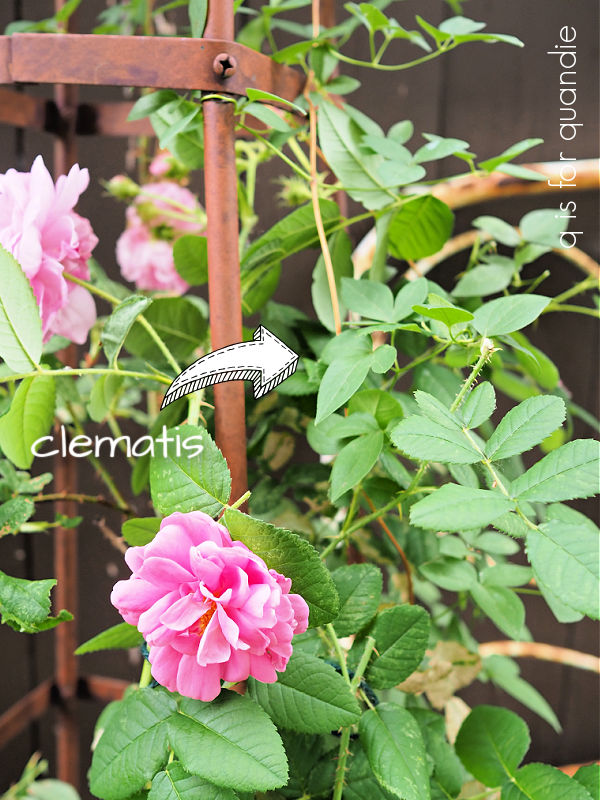
a hint of lime.

I’m not gonna lie, Hint of Lime Tostitos are one of my favorites.  Especially paired with a mango salsa.  I also love adding a hint of lime to my Diet Coke.

But today I want to talk about a different kind of lime, a vibrant pop of chartreuse foliage in the garden.  It’s a great way to brighten up a shady area, as well as a good way to add interest to a perennial border that doesn’t have much blooming currently (like mine).

One of my favorite perennials with bright lime green foliage is ‘Gold Heart’ Dicentra spectabilis, or bleeding heart.
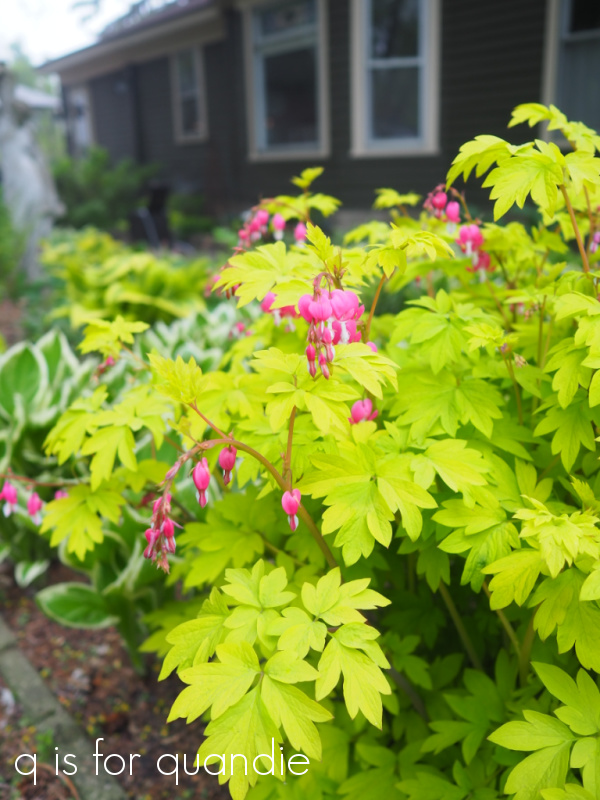
That photo is a couple of years old, bleeding heart blooms in the spring so mine is not currently blooming.  But I actually grow this one for the foliage rather than the flower, isn’t it fabulous?

Lamium, or dead nettles (which is an awful name and that’s why I never call it that), is one of my favorite lime green ground covers.  It’s practically evergreen, even here in Minnesota.  It pops up in the spring looking green as the snow is melting all around it.
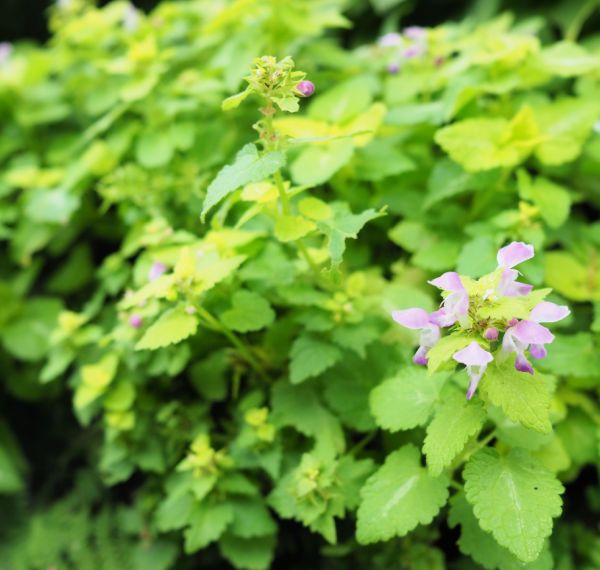
There are many different varieties of lamium with varying leaf colors including some pretty white and/or silver versions like the Pink Pewter or the Sterling Silver.  There are also a few varieties that I really don’t like at all, like the one called Yellow Archangel.

I don’t know the precise variety of the one shown above because it was a hand-me-down from a fellow gardener, however, I do also have a patch of the Lemon Frost variety in one spot that I purchased at a garden center.
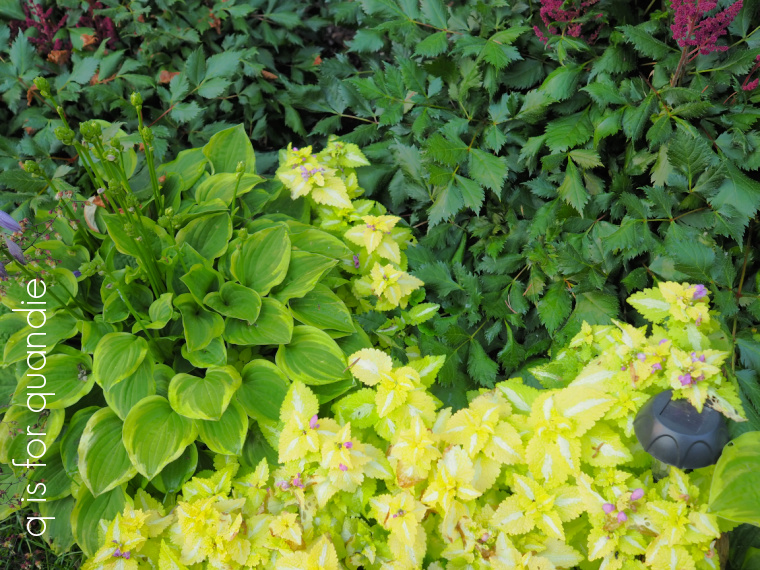
It leans just a bit more towards lemon rather than lime.

One characteristic common to pretty much all of the plants that I’m mentioning in this post is that the more sun they get, the yellower and brighter their foliage.

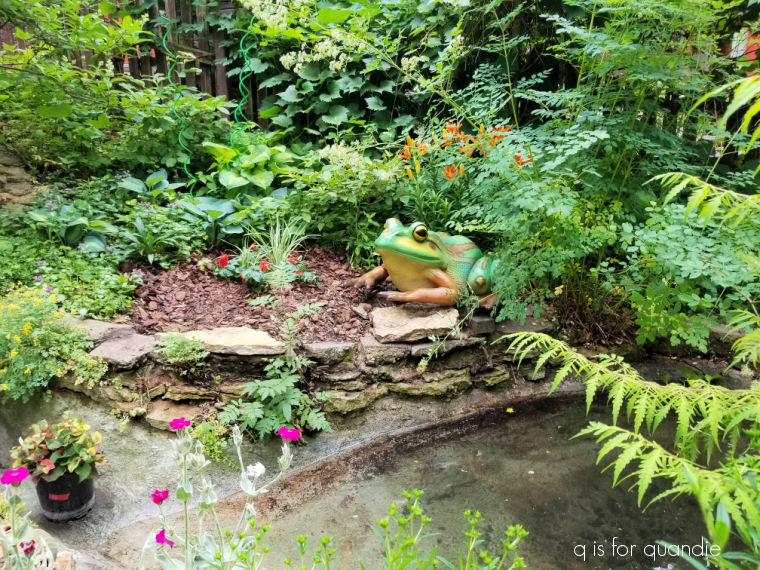
Golden Creeping Jenny, Lysimachia nummularia ‘Aurea’, is a good example of that.  I took this next photo at the St. Anthony Park garden tour a couple of weeks ago.  The creeping jenny in the lower left of the frame gets quite a bit of sun.
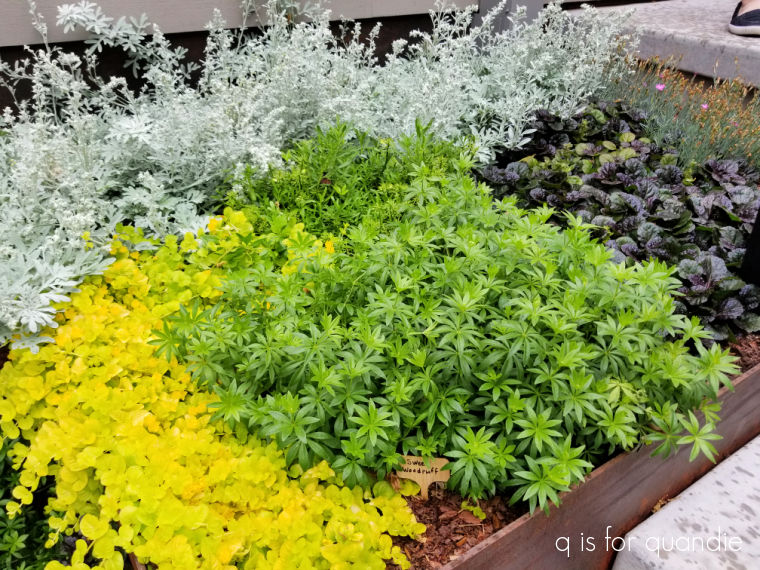
My creeping jenny is in full shade, one of the shadiest areas of my shade garden in fact, and I wouldn’t even call it lime green at this point.

So that’s something to keep in mind with all of the plants I’m sharing today.

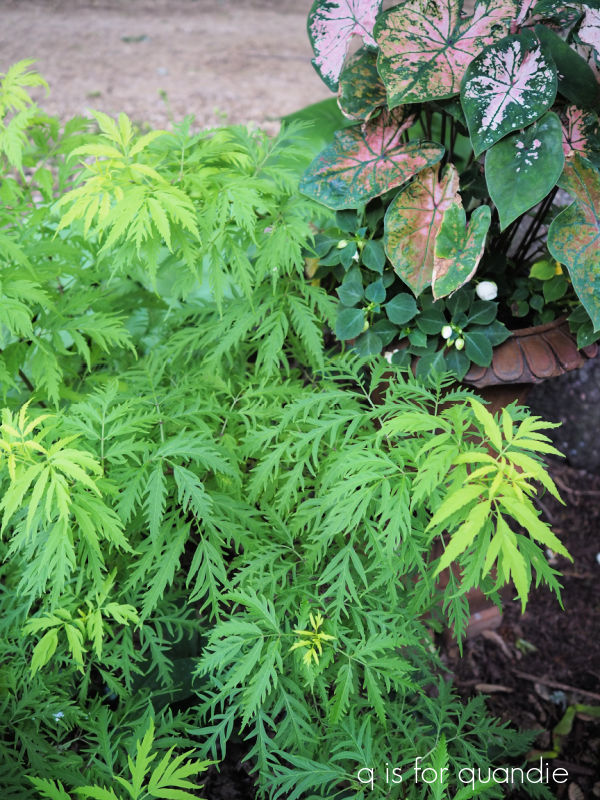
I do have a couple of shrubs that fit into my ‘hint of lime’ category.  The first is a Morden Golden Glow Elderberry.

Laura of Garden Answer recommended elderberry as a good substitute for Japanese maples.  They have a very similar leaf structure, but are much hardier in cold climates like my zone 4b garden (they are hardy in zones 3 to 9).  The photo above was taken when I first brought the plant home from the garden center.

I ended up planting it in a fairly shady spot, and the color is definitely less yellow or more lime now.
The second shrub on my list is the ‘Tiger Eyes’ sumac.  Unfortunately, my 8′ Tiger Eyes died back to the ground last winter.  If you plant one of these in our area, you’ll find that it is one of the last plants to break dormancy.  Every spring I wonder if mine is dead, and then it eventually sprouts new leaves.  But not this year.  So we cut it back to the ground.

But I’m happy to report that it has sent up some big new shoots, so all is not lost.
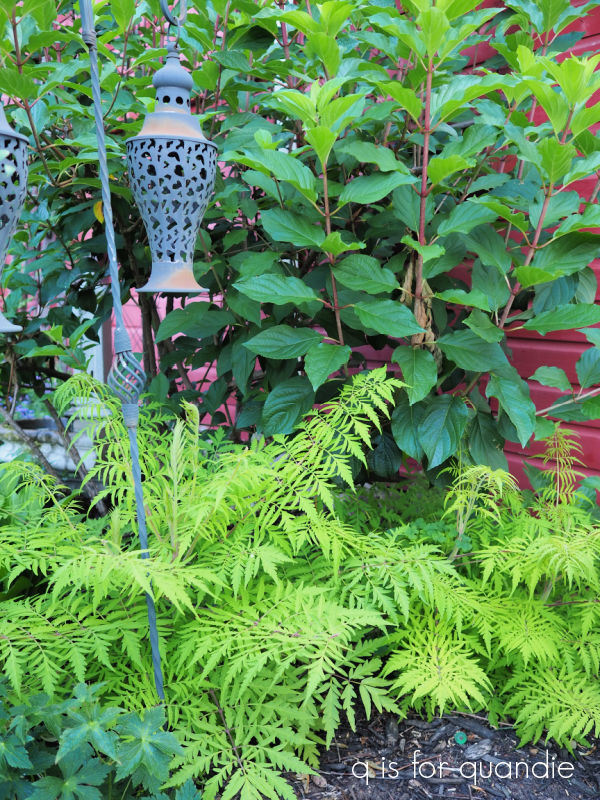
A big bonus to this one is that the leaves turn a vibrant orange to red in autumn, it’s fantastic for fall color.

Unlike most of the plants I’ve mentioned, the sumac is not a shade loving plant.  Mine gets a bit of shade from the carriage house and thus has always shot out nearly perpendicular to reach the sun.

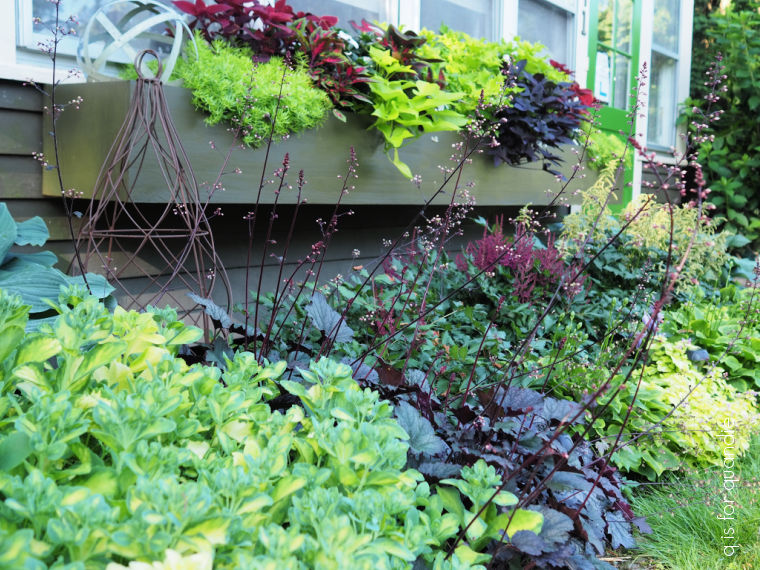
There are lots of fabulous annuals with lime green foliage too.  Last year I had Wasabi coleus and Lemon Coral sedum (far right) in my front window box.
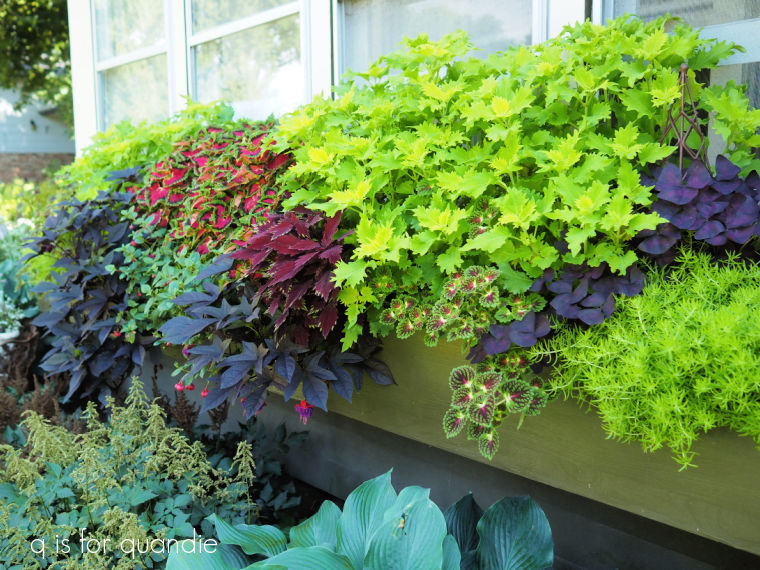
Lime green paired with deep purple foliage is always a great combo, like this sweet potato vine paired with a dark purple Oxalis.
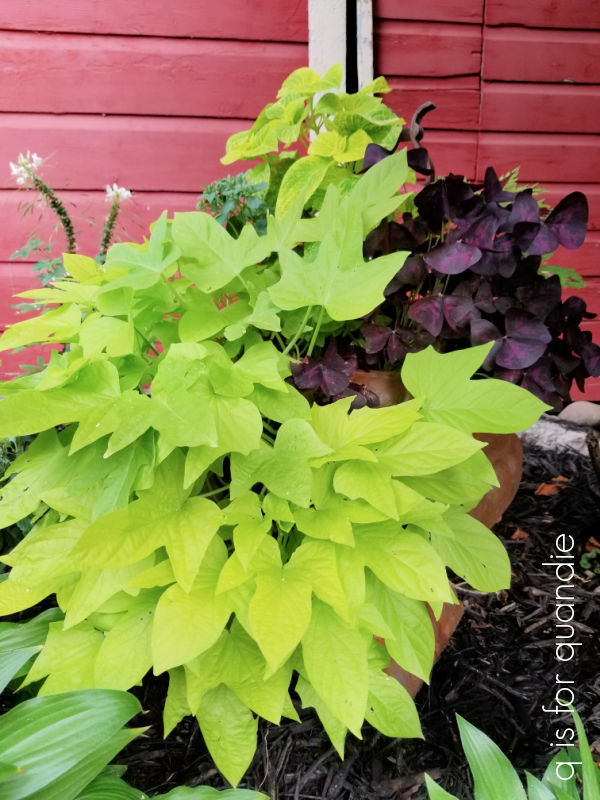
I’ve left the most obvious example of lime green foliage plants for last, hostas!  You know I love ’em.  And there are lots and lots of options for lime green in hostas.

One of my favorites is the ‘Sun Power’ hosta.

This one positively glows in the garden.
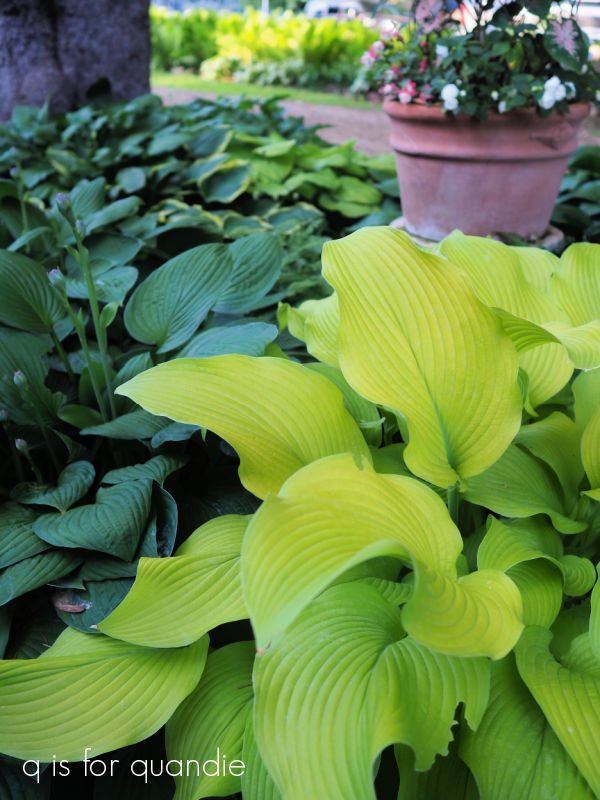
I have a smaller solid lime colored hosta in multiple spots in my garden.  Once again, this was a hand-me-down plant, probably from my friend Sue, so I don’t know the name of it.

But over the years, many divisions have given me about 20 of them scattered throughout my shade gardens.  They create the perfect background for the spotted Pulmonaria ‘Raspberry Splash’.

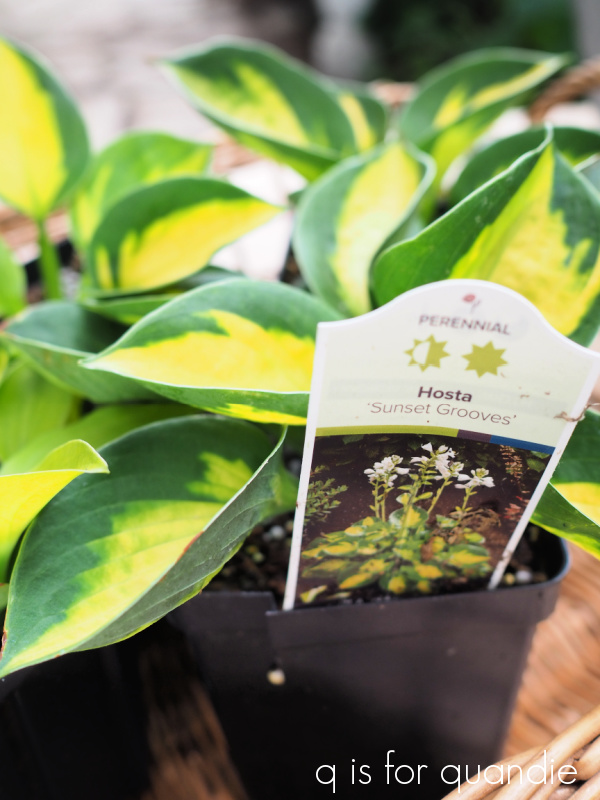
Of course, there are also many, many options for variegated hostas that can add a hint of lime to your garden.  Sunset Grooves is a smaller one that has a lovely pop of chartreuse in the middle of each leaf.
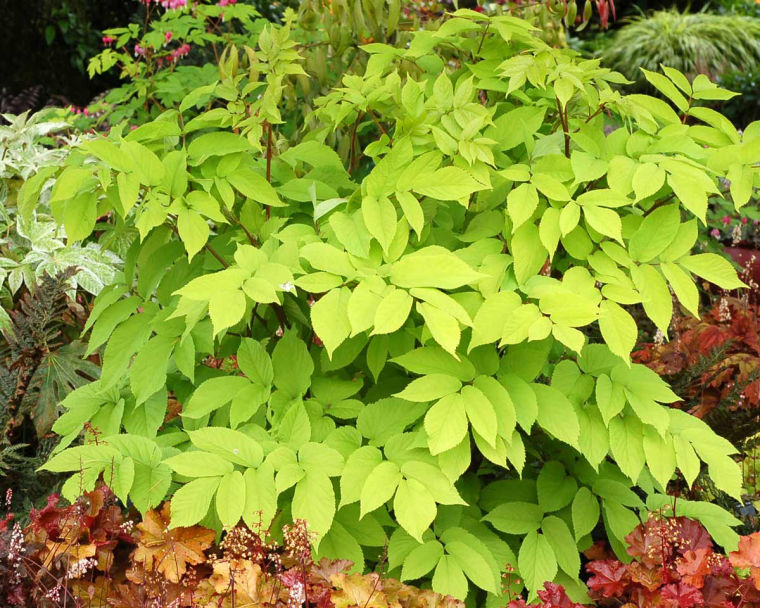
Of course, the latest hint of lime I’ve added to my garden is an  Aralia cordata ‘Sun King‘.  After seeing so many of them at the garden tour I attended a couple of weeks ago, I had to get one for myself.

It’s small right now, but I’m hoping it will grow to fill in that space entirely.  I’ll be sure to keep you all posted on how that works out.

In the meantime, my sister and I are headed out to another garden tour today, this time put on by the South Saint Paul Garden Club (thank you Jayne for the heads up on this one).  One of the gardens featured belongs to my old friend Jackie, I toured her garden for you guys here on the blog back in 2018 (you can see those posts here and here).  So I’m really looking forward to getting another tour of her garden and others today!

So tell me, what’s your favorite plant for adding a hint of lime to the garden.  Leave a comment and let me know!
a summer garden tour.

Good morning from the garden!

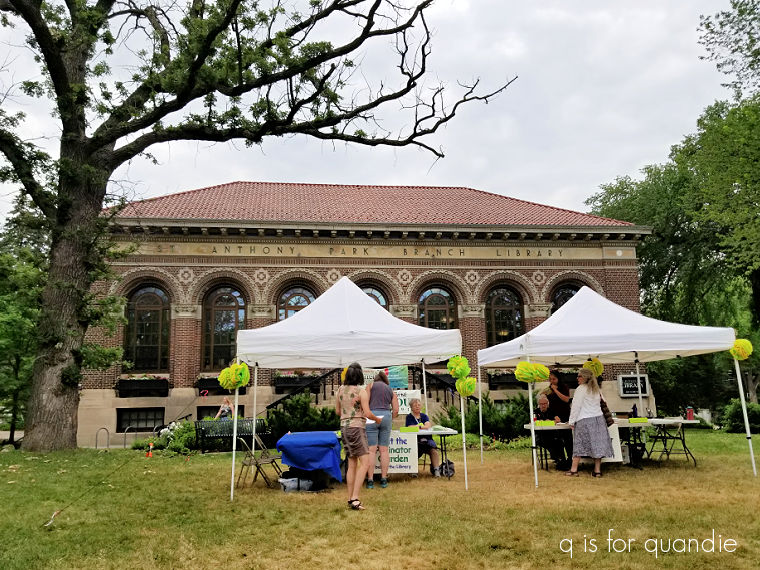
I was so excited when I saw that the St. Anthony Park Garden Tour was taking place this year.  This tour is put together by the St. Anthony Park Garden Club and usually takes place every other year, however, like so many things, it was halted during Covid.  So it has been 4 years since the last tour.

St. Anthony Park is a neighborhood in St. Paul, Minnesota.  I’ve gone to their neighborhood garage sales many times over the years, and the last time I did that was back pre-Covid as well.

The neighborhood was developed in the late 19th century as a streetcar suburb (ie. you could commute to the city via streetcar) for the wealthier residents of Minneapolis/St. Paul (wikipedia).  It’s full of large 100 year old homes and each one is unique (unlike more modern developments).

Last weekend my sister, niece and our friend Annie all joined me for the tour.  There were 11 gardens in total, but I’m just going to share some of the highlights with you.

The first garden we visited was really colorful.

Isn’t that a pretty combination of sedum and heuchera?

The back yard slopes down into a ravine and is filled with flowering plants that are bursting with yellows, reds, oranges and purples.

There is also a little pond that is guarded by a very colorful frog.

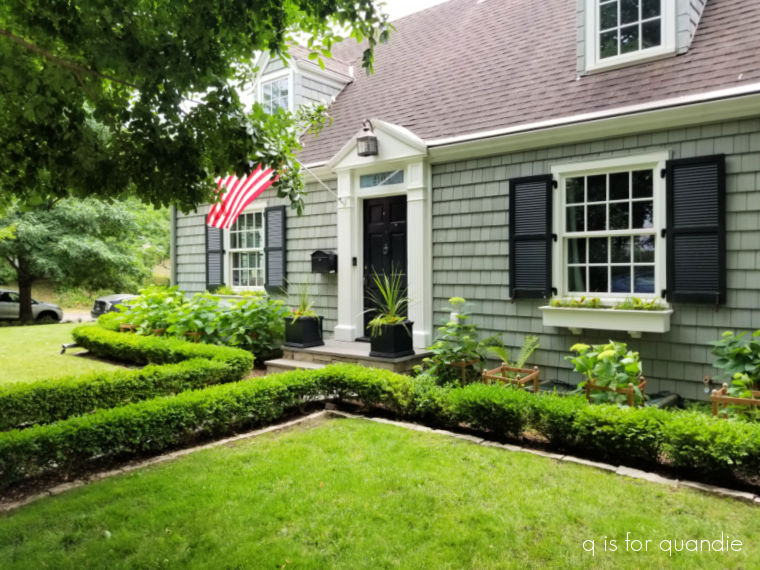
In contrast to that fairly wild look, this next garden was somewhat formal and very tidy, and I absolutely loved the house itself.

I’m not normally a fan of the combination of grey and black, but it was certainly working on this place.

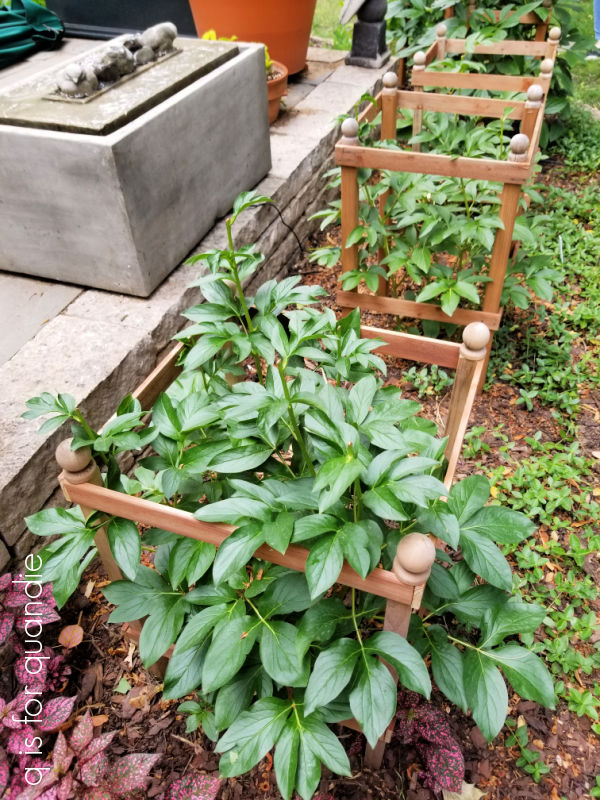
I also came away from this house with an awesome idea for making some supports for my peonies.

I spent a bit of time this spring searching for attractive peony cages that weren’t too expensive (since I have about 10 peonies), and I came up empty handed.  But these would be fairly simple to make.  They are just furring strips, 2″ x 2″ strips on each corner and 4 wooden finials.  My sister and I are going to attempt to make some of these for our gardens.

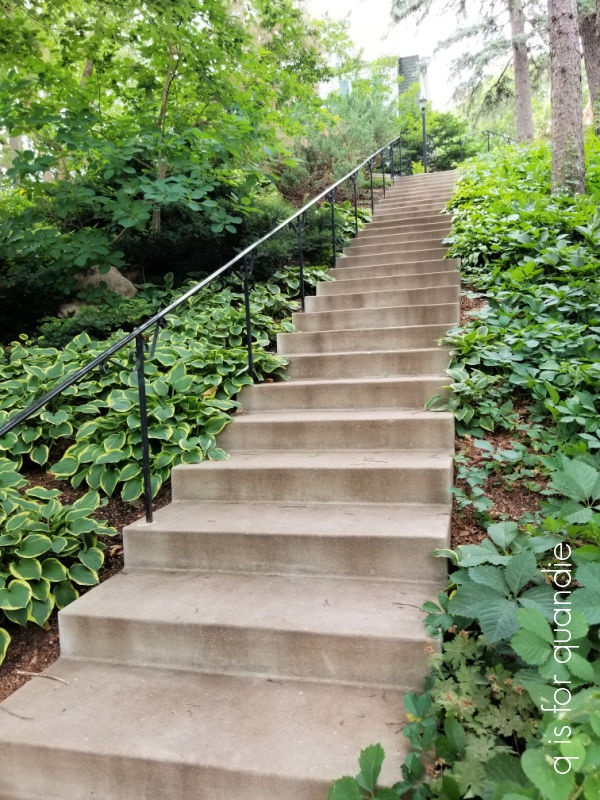
The next garden I want to share was the most difficult to get to because it involved heading up this staircase.

This is the path between the street and the house.  However, there is an alley behind the house and I’m betting that the homeowners barely ever use this staircase, especially not in the winter!

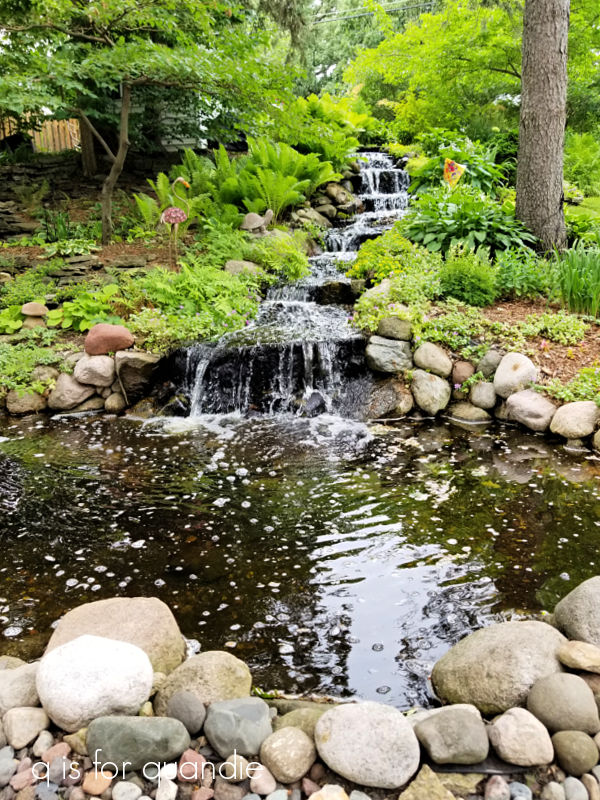
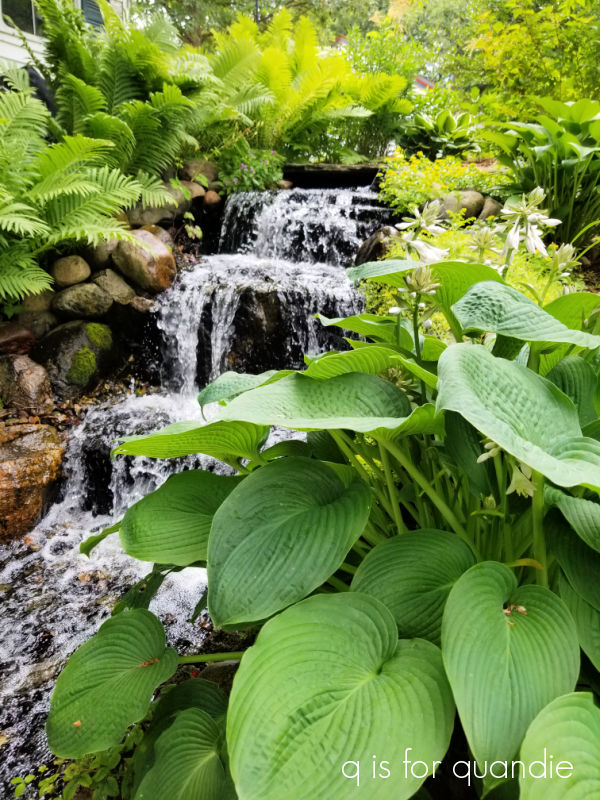
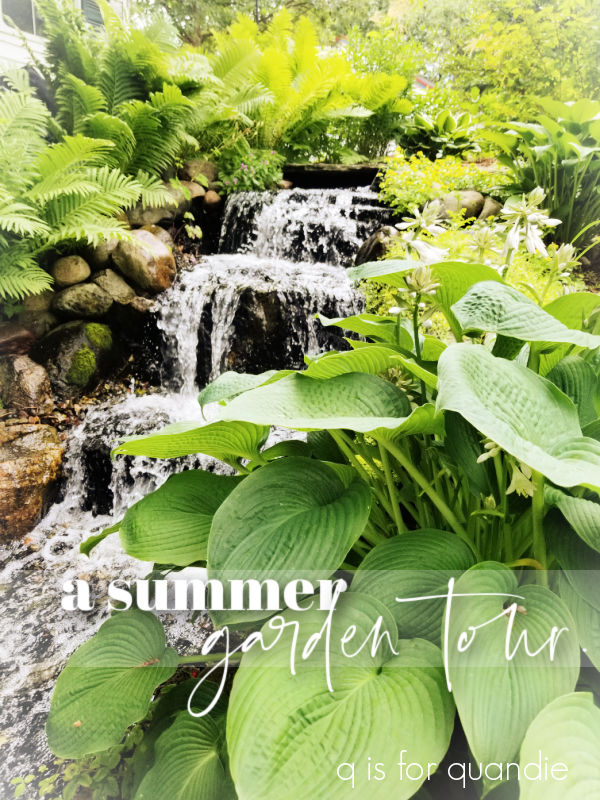
But these home owners definitely took advantage of their sloped location, because here’s what they also have out behind the house.

That stunning waterfall was worth the hike up that staircase.

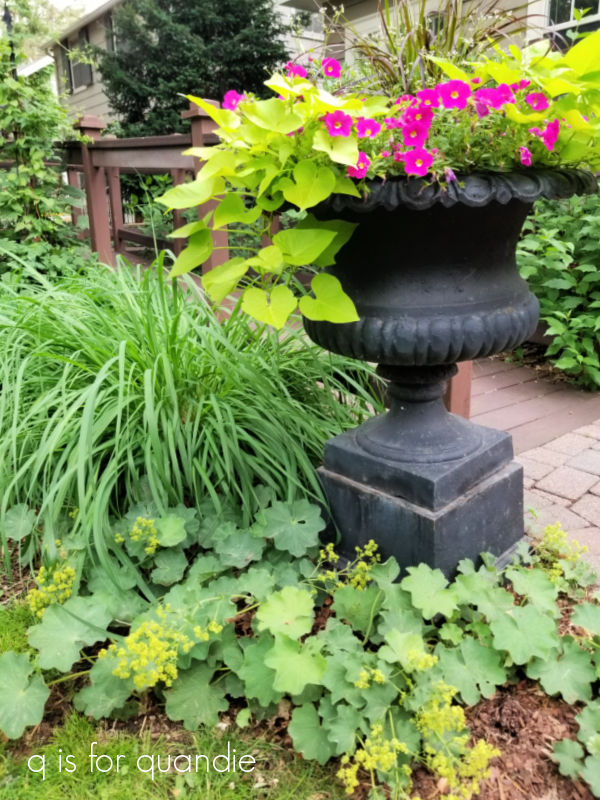
I totally coveted the iron planters in this next garden.

I have to admit that I probably won’t ever have the real thing in my garden, but instead I’ll just stick with my faux rusty urn planters.

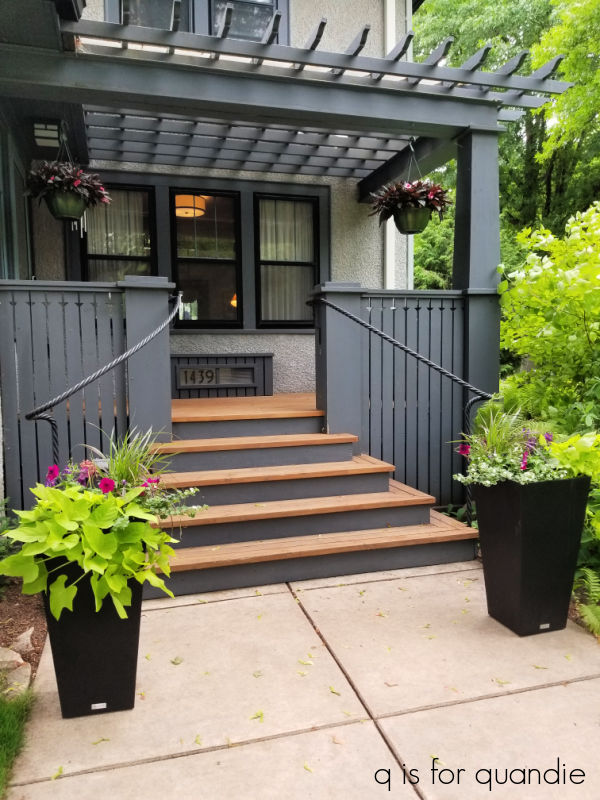
If you’re into a more modern look for your planters, the pair flaking this porch should be right up your alley.

And just take a moment to admire that porch, especially that twisted wrought iron railing on the steps.

One of the gardens had an interesting combination of ground covers planted in a small bed.

It certainly is a pretty combination of creeping jenny, sweet woodruff, ajuga, dianthus and I’m not sure what that plant with the silver foliage in the back is.  It almost felt like this was a spot where they were testing out different ground covers to see how they would do.  It was a fairly small area, and as you can see the plants have totally filled it out.  Now they are probably going to start fighting for space.

I wanted to be sure and share this clematis with you guys …

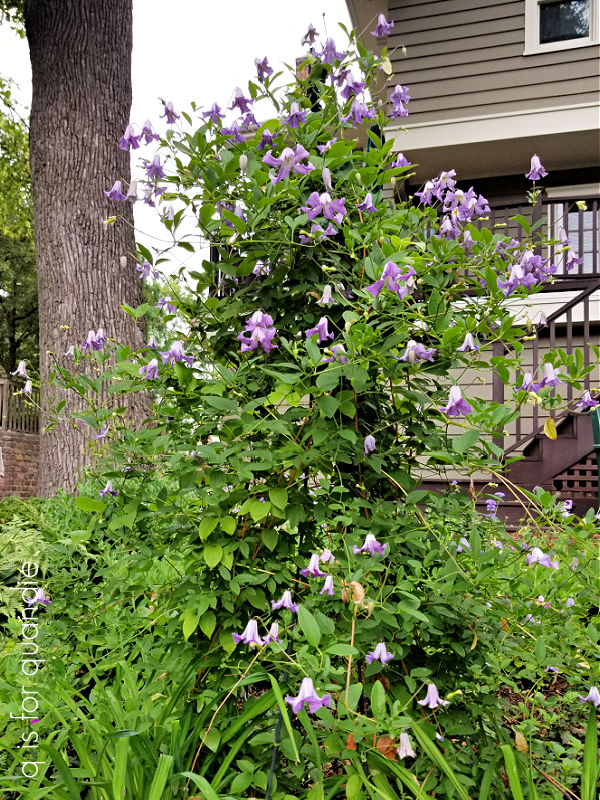
The home owner was fairly sure that this is a Betty Corning.  I just planted this variety in my own garden, and I am hoping it will be as prolific as the Roguchi that I planted last year.  If this one is any example, I think it will be spectacular.

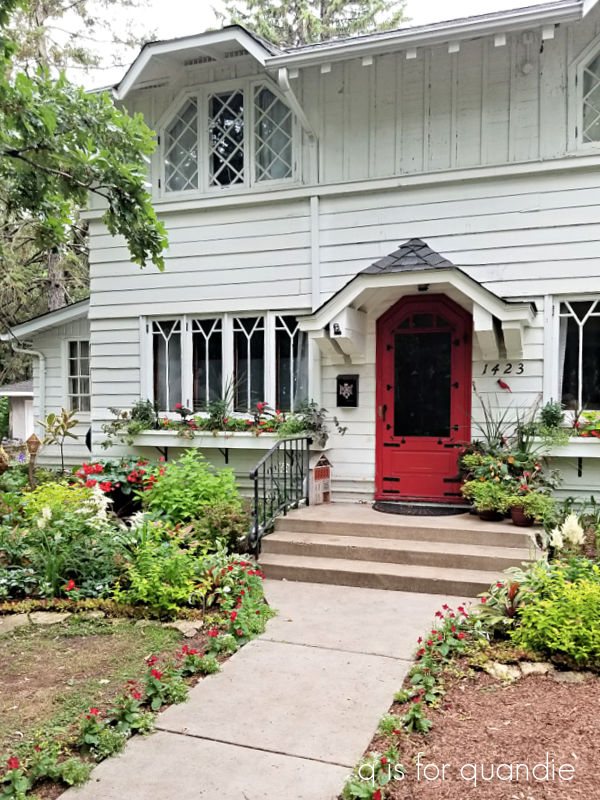
I’ve saved my favorite garden for last.  First, lets just check out the house.

Aren’t those windows fabulous?  See what I mean about all of the houses in this neighborhood being totally unique?

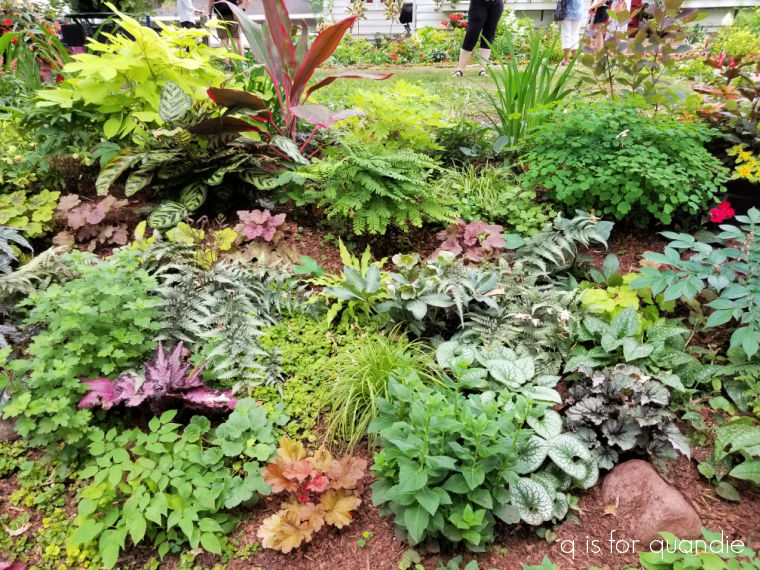
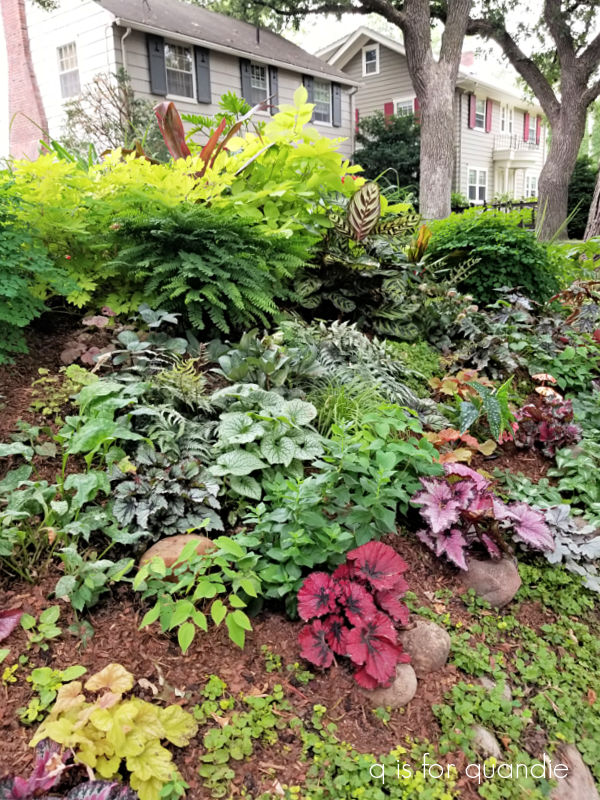
But the real showstopper for me was the sloped front border which is divided in half by the sidewalk.  I chatted with the owner of this garden, Shawna, and she explained that the two sides are meant to be mirror images of each other.

They are filled with shade loving plants chosen for their beautiful foliage colors, textures and shapes.

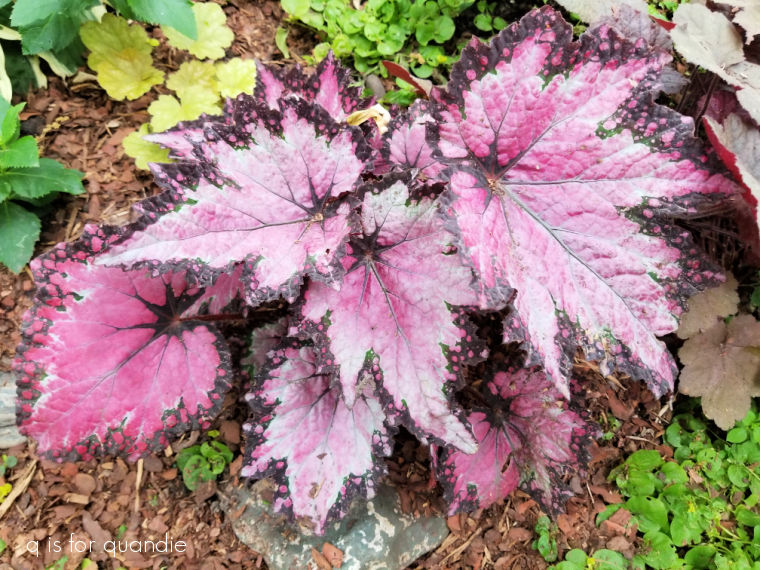
Shawna also explained that she gardens year ’round, which is quite the feat in Minnesota.  She brings many of her rex begonias and other plants indoors for winter.  She also told me that her indoor plant real estate is limited, so she also just takes cuttings from many of her plants and propagates new plants for the next year that way.

You can certainly see why she wants to save them.

In addition to these beautiful plants, she also had some really lovely copper garden ornaments scattered here and there.

And isn’t that carpet of sedum alongside her dry creek bed just fantastic?  Let me get you a little closer to that …

We all really enjoyed the tour, it’s always inspiring to see what other gardeners are doing.  I’ve been keeping an eye out for other garden tour possibilities in my area, there used to be lots of them (again, pre-Covid) and so far I haven’t seen too many coming back.  If any of you locals know of any, please leave a comment and let me know!

But before I let you go, I want to share what I’m calling the ‘plant of the day’.

That honor goes to the Aralia cordata ‘Sun King‘.

Ironically, somehow I didn’t manage to get a decent photo of one, even though I would say that almost every garden we toured had one … well, more than one actually.  They were everywhere.  I borrowed this photo from the internet so that you can get a good look at this plant.

I had seen it more than once recently on gardening YouTube videos (sorry, can’t remember which ones exactly), so when I saw them in these gardens they really jumped out at me.

The ‘Sun King‘ was the 2020 perennial of the year, and I can see why.  It provides a vibrant pop of chartreuse in a shady garden.  It grows 4′ to 6’ tall and wide.  It dies back to the ground in winter, but is fast growing and fills out quickly in the spring.  It’s hardy in zones 3 to 9, so can easily handle my zone 4b.  It’s also deer resistant.

One of the gardeners I spoke with mentioned that the color is definitely brighter if it gets some sun, but it will grow in full shade.

So now I’m off to figure out the best spot in my garden for the one I found at Abrahamson’s Nurseries in St. Croix Falls (but if you locals are looking for one too, don’t count on them, my neighbor and I bought the last two that they had!).

Do you have garden tours where you are?  Leave a comment and let me know!
don’t get attached.

Good morning from the garden!
Since I seem to have eight of them, I have to say that clematis is one of my favorite plants.  I have several of them blooming right now so I thought it would be a good time to post about them.

There are so many different varieties,  allaboutgardening.com says over 350!

There are different flower sizes from huge and showy to tiny and delicate.  And different flower shapes from star shaped to bell shaped.  They come in plenty of different colors; whites, reds, purples, blues, yellows and pinks.  Apparently there is even one called ‘Orange Peel’ that has flowers that start out yellow but gradually darken to orange.  You can find different varieties that bloom at all different times during the season from early to late.  And even some that bloom all summer long, like my Roguchi.

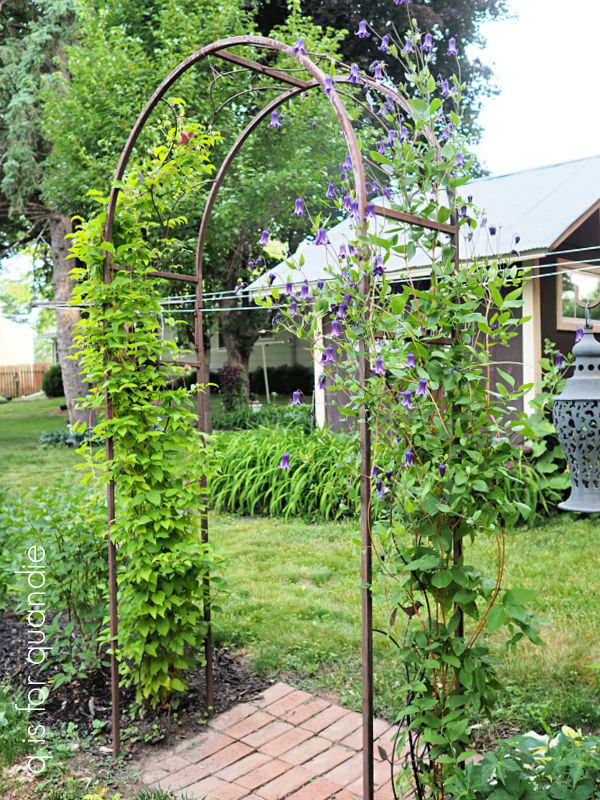
I planted this last year and found that it bloomed continuously from the time I planted it in late May to September.  It has come back strong this year and is already over the top of my arbor (on the right side).

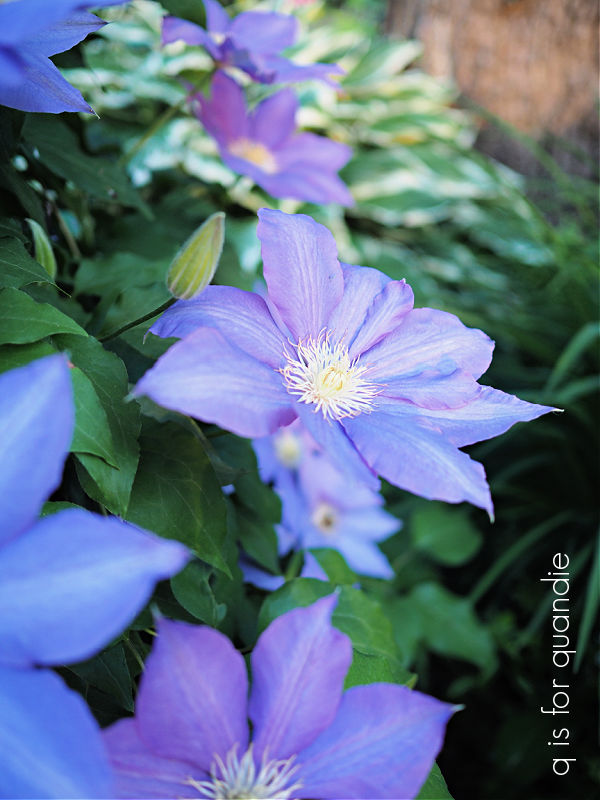
The clematis on the left side of the arbor is one whose name has been lost to time.  It blooms a bit later than some of my other ones and although it has lots of buds, they aren’t quite open yet.  But here’s a photo of how it looked last year when it bloomed.

One thing to know about clematis if you want to grow them successfully are that there are three pruning groups.

Group 1 are the spring bloomers.  They should be pruned back immediately after blooming.  They bloom on last year’s growth, so if you prune them in the spring you won’t get any flowers that year.  Luckily I don’t have any of clematis from this group because the rabbits eat my clematis to as high as they can reach in the winter.  So, in a sense, my clematis is all ‘self-pruning’ … or rabbit pruned anyway.

Group 2 are the mid-season hybrid bloomers with large flowers.  You should avoid heavily pruning this group, only pruning out the weak or dead stems in late winter or early spring.

Group 3 are the ‘late’ bloomers and I have quite a few of them.  They call them late, but several of my group 3 clematis are blooming now, and I wouldn’t call the end of June ‘late’.  The beauty of this group is that they can be cut back hard in the spring (or over the winter, by rabbits) and they will flush back with vigorous growth and plenty of flowers.

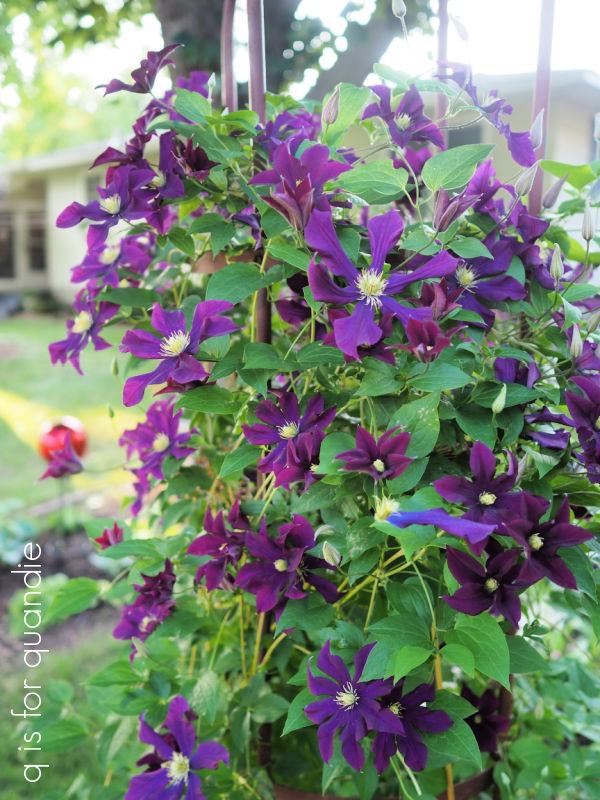
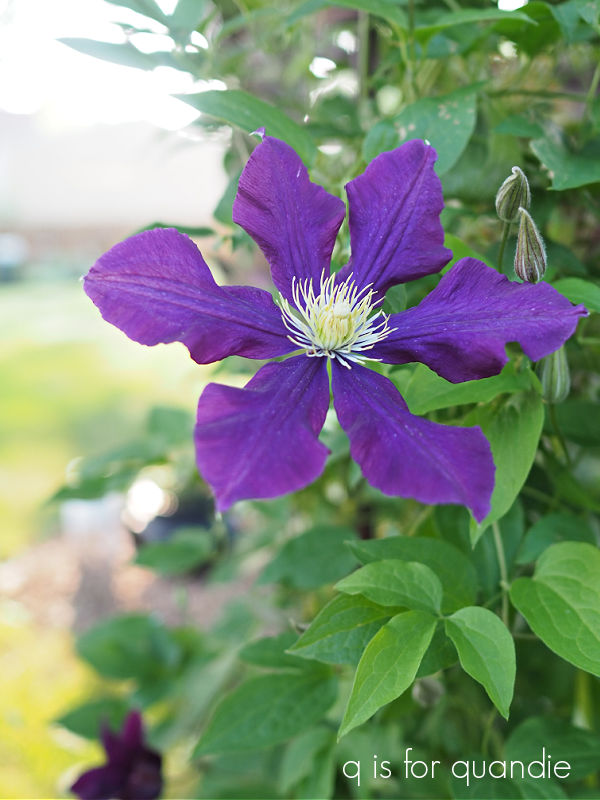
Unfortunately, I never kept track of the name of that one either, but it’s the prettiest deep violet color and it’s filled with flowers right now.

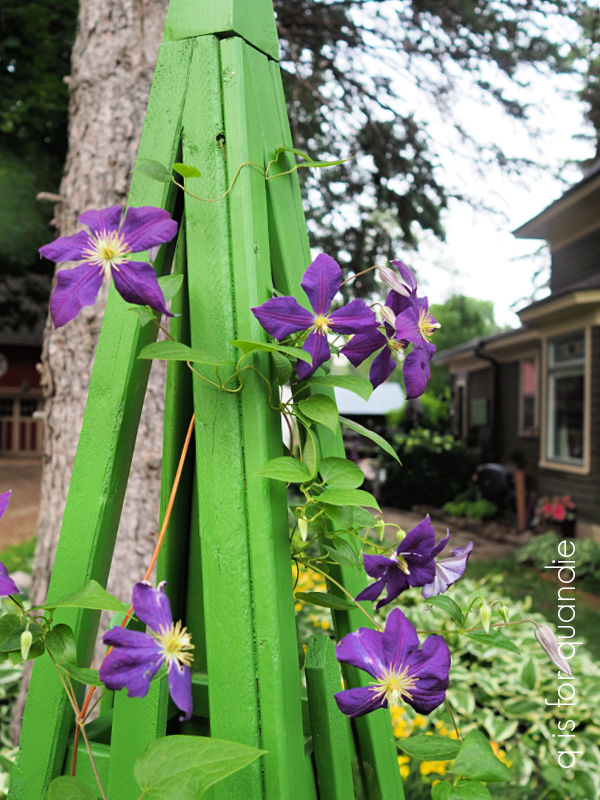
I have most of my clematis growing up structures like an arbor or garden obelisk.  Last year I planted a Jackmanii  on the pyramid that Ken made (and I painted with my English racing green earlier this spring).

I think this variety is one of the most common, you see them everywhere.  It has been around since its introduction in 1862.  I’m hoping that one day it will entirely cover that pyramid with flowers, but it’s just a bit sparse yet this year.

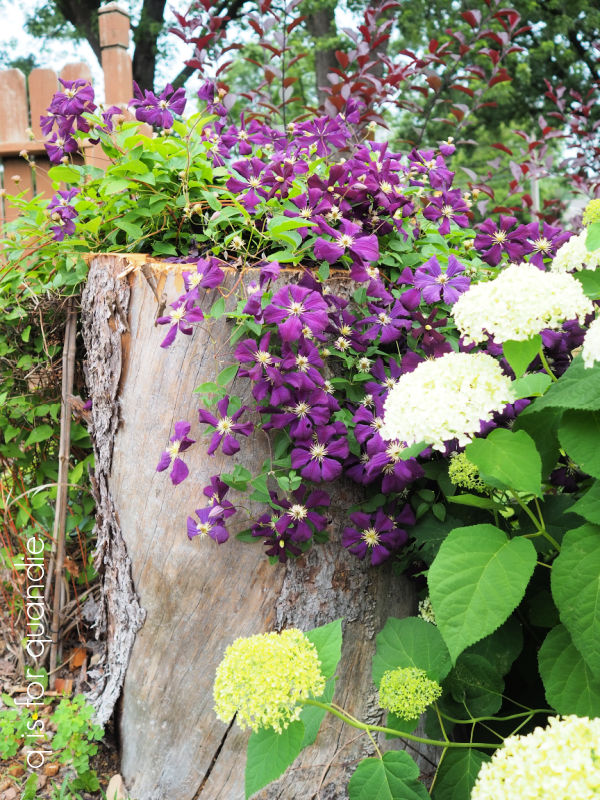
You can also use a shrub, or even a tree, as a ‘trellis’ of sorts for clematis.  My neighbors Ken & Arlene have one growing over a tree stump.

Many people also combine them with climbing roses.  I have a shrub rose that I pretend is a climbing rose.  The rose itself won’t attach to a structure, but I let the canes grow long and tie it onto an obelisk.  Last summer I planted a Huldine clematis to intertwine with it

So far the Huldine hasn’t bloomed, and I don’t see any buds on it.  I’m hoping to see it bloom later this summer though.

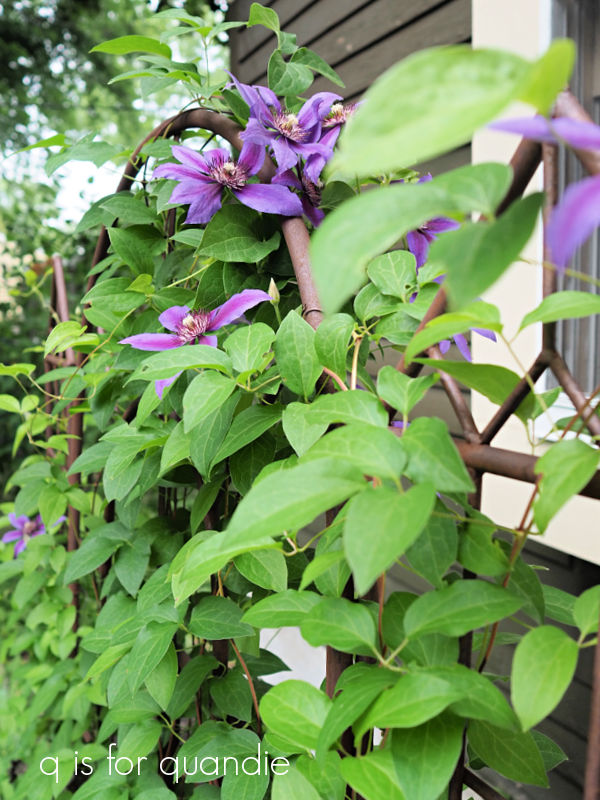
I have what I think is a variety called The President on a trellis right outside our back window.

It’s not blooming all that well this year, which would make sense since The President is in pruning group 2 and shouldn’t be heavily pruned.  But of course, mine was rabbit pruned right down to the ground along with all of my other clematis.

A few weeks ago I planted a Betting Corning clematis next to it.  It hasn’t bloomed yet, but it’s another bell shaped clematis like the Roguchi.

You’ll often hear that clematis like to have their feet in the shade and their head in the sun, and many of us planted lower growing plants around the base of them to ‘shade’ the base of the plants.  But really, what they want is moist soil.  So they don’t have to be shaded, but it’s a good idea to mulch around the base of the plant well, and also to keep it watered.

I think my biggest piece of advice when it comes to clematis is to not get too attached.  I’ve had more than one that is huge and beautifully covered with blooms one year, and then just simply doesn’t come back the next.

For example, this gorgeous clematis used to grow on that pyramid from Ken …

It was there for years, and then one spring … nothing.

I once had a spectacular white clematis growing on the side of the carriage house.  It was huge, and absolutely covered in big white flowers every year.  Until one year, it just never came back.  So disappointing!

Theoretically a clematis can live upwards of 50 years, so perhaps it’s just our harsh Minnesota winters that sometimes do them in.  Or maybe it’s those pruning rabbits!

I guess in the end, losing one just provides the opportunity to try a new variety next time, right?

How about you?  Do you have a favorite clematis?  Or do you have rabbits that provide a free winter pruning on yours?  Leave a comment and let me know.

chop or flop.

Good morning from the garden!

Can I ask you a personal question?  Does your tall sedum tend to get floppy?  Does your phlox fall over?

Well, if so, I have the solution for you, and it’s free!  It’s called the Chelsea chop and the reason it’s called that is because the timing of this process in England usually coincides with their RHS Chelsea Flower Show, which is held in late May.  However, here in my northern, zone 4b garden, mid-June is a good time to Chelsea chop (you want to do it before you see any flower buds on your plant).

The Chelsea chop encourages branching, so the plants will be shorter and more compact thus reducing, or hopefully even eliminating, the flop.

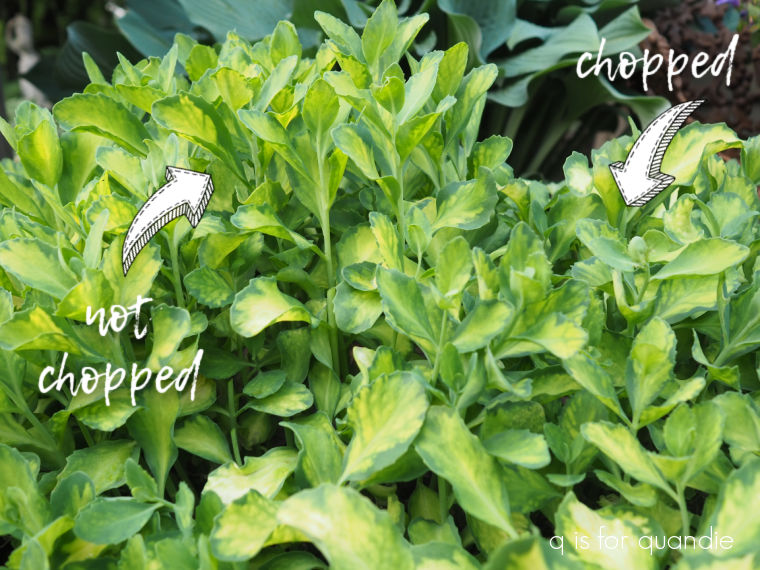
So what is the Chelsea chop?  Basically you simply cut down the stems by 1/3 to 1/2.

  You don’t need to be precise, I’ve seen some gardeners just take a hedge trimmer and go to town.  Or, you can let the deer get in on the action.  They seem to be Chelsea chopping my neighbor’s asters!

But personally I like to be a little more discriminating, so I use my handheld pruners to do the job.

There are a few things you should know about the chop.  First of all, it’s only suitable for perennials that bloom in late summer or early fall such as phlox, bee balm, cone flower, asters, veronica and of course, sedum.

Second, the Chelsea chop will delay the bloom time of your plant by as much as a month or so.  If that thought bothers you, another option is to only prune every other stem on your plant leaving the other half of them long.  There are a couple of benefits to that option.  For one, you’ll still have flowers at the normal time, plus you’ll have more flowers several weeks later.  So basically, you’ve extended the bloom time of your plant.  In addition, the shorter, sturdier stems that have been chopped will help support the stems that you left long.

Another potential benefit of the Chelsea chop, at least with sedum in particular, is that you can easily root some of your trimmings to grow more plants.

I did this a couple of years ago, and they all took off like gangbusters.

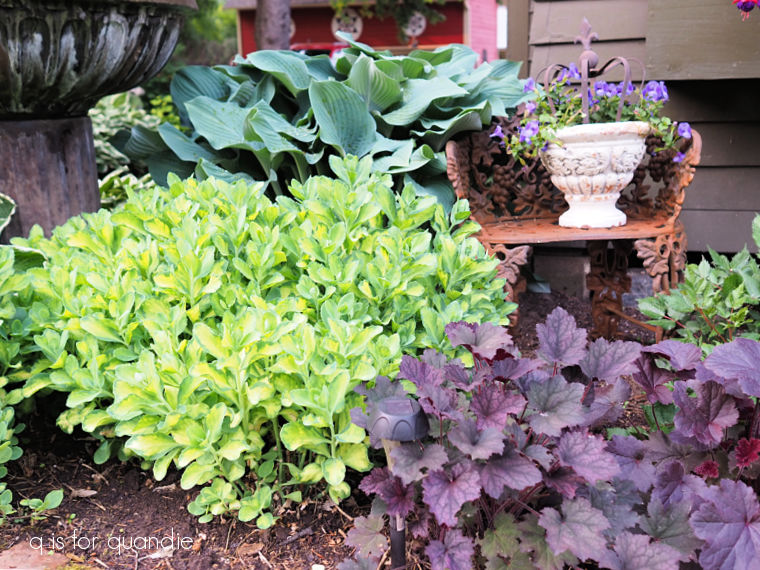
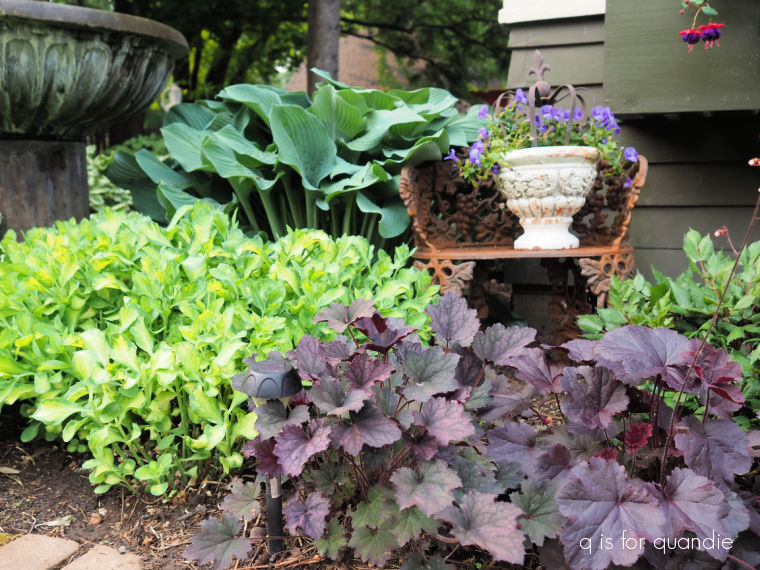
I have to say, before I discovered the Chelsea chop this variegated sedum was definitely not one of my favorite plants.  It always tended to flop over and look pretty sloppy in the garden.  Now that it stays a bit more compact, I really love the way it looks in combination with the ‘blue’ upright hosta behind it, and the purple heuchera beside it.

By the way, I believe that is Palace Purple heuchera, in other words one of the older, more reliable varieties.  If you read my post about heuchera from a couple of weeks ago, you know that I have trouble getting any of the newer, more colorful, varieties of heuchera to perform well.  But I’ve had these two plants for years now and they continue to do well.

How about you?  Have you ever tried the Chelsea chop?  If any of your late summer or fall blooming perennials don’t have flower buds yet, it’s not too late to consider it!

the cutting garden.

I know I’ve mentioned it here before, but for those of you who don’t know, I have a cutting garden out behind our carriage house.

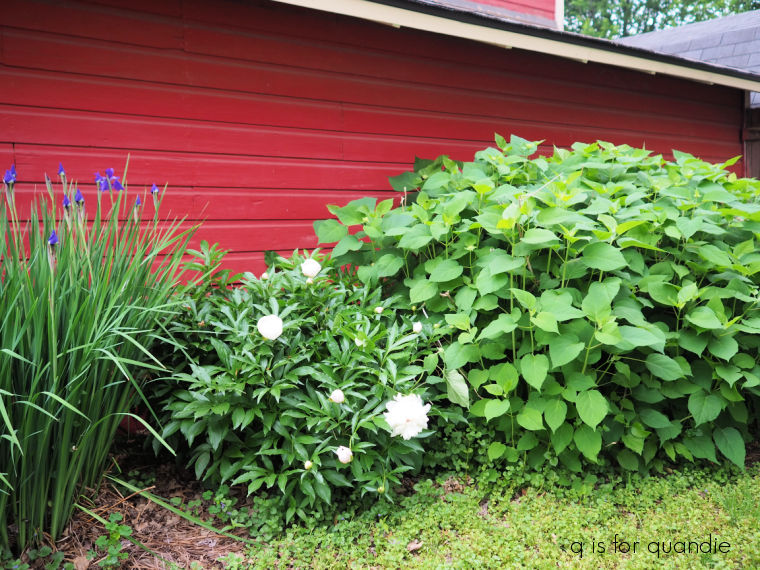
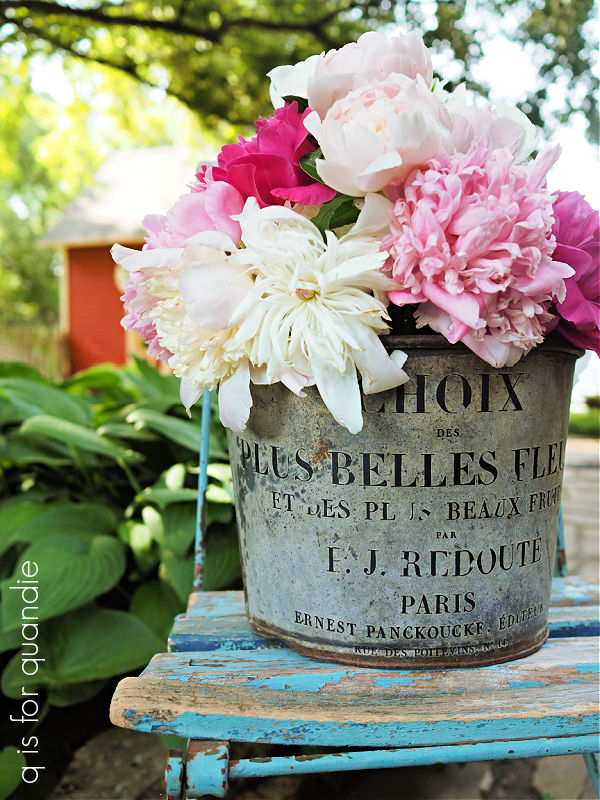
A cutting garden is full of plants grown specifically for harvesting fresh flowers for arrangements.  It’s usually in an inconspicuous place where it won’t matter if you cut all of the blooms off of your plants (hence, behind the carriage house which is the big red, barn-like building in the photo below).  It’s really just a good place to grow things that don’t look that great in the garden except when they are in bloom, like peonies.

I know, I know, some people think that peonies are pretty plants even when not in bloom, but I don’t.  And they only bloom for maybe two weeks tops.  Plus, mine always end up with powdery mildew by the end of July and then really start to look terrible.  So I’m happy to have them tucked away out of sight.

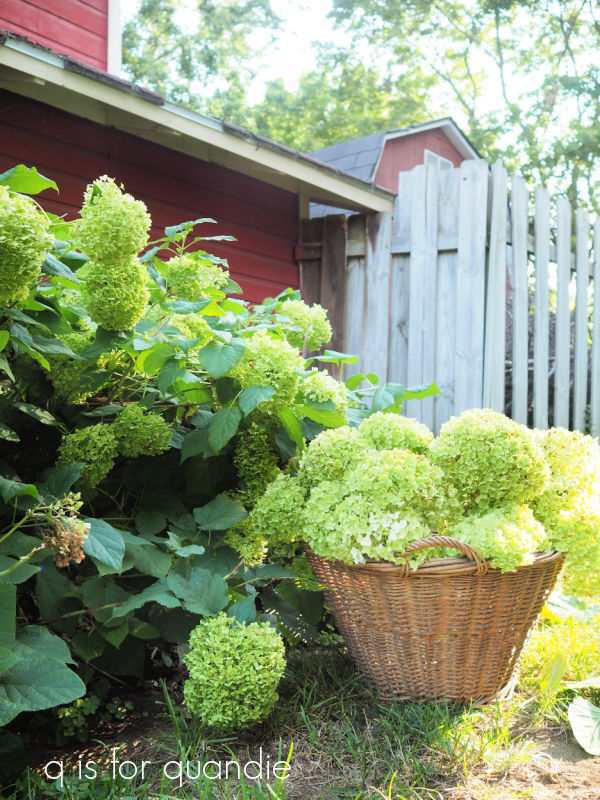
There are really only two periods in the growing season when my cutting garden looks good.  One of them is later in the summer when the huge Annabelle hydrangea I have back there is blooming.

And the other was this past week or so while the peonies and Siberian iris were blooming.

Somehow, this year it looked particularly fabulous, but I’m not sure why.  Maybe just because everything back there is firmly established now and can pretty much be left alone.

The Siberian iris are super tall, and full of flowers.  Last year I got relatively few flowers, this year it’s loaded.

I am hoping you can sort of judge the size of them in this next photo.

That is them on the left, then I have a white peony in the middle and the big mass on the right is the Annabelle hydrangea.  That thing has gotten huge this year as well.

The peonies back there all did really well this year too.

Another thing you can see in if you look closely at my photos is that I barely bother to weed back there.  Mr. Q and I usually go through once or twice a year and pull out the big weeds but we haven’t done that yet this year.  So far it doesn’t seem to be impacting the plants.

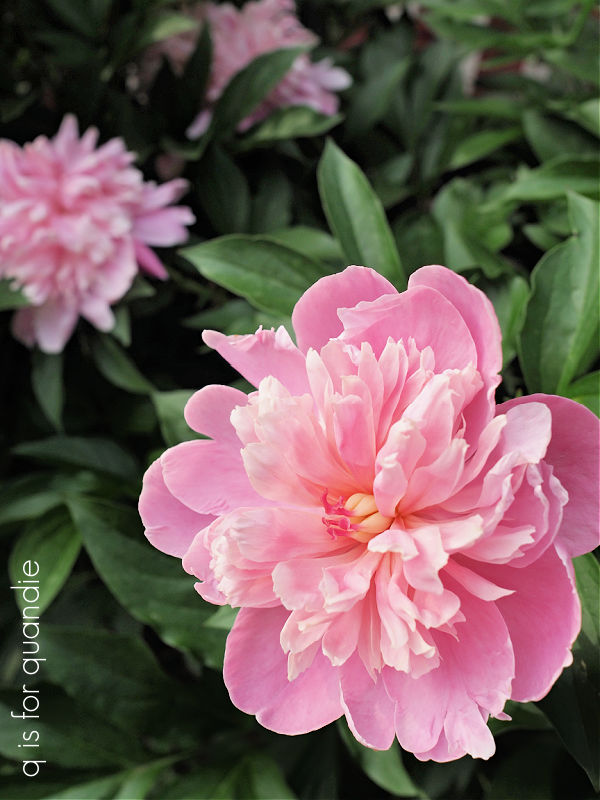
I have two top favorites amongst my peonies.  The first is this one …

It’s the most beautifully pale, blush pink in the center that gradually turns white towards the edges.  I love how delicate the color is.  I’m fairly sure that this one is called Raspberry Sundae, but don’t quote me on that.

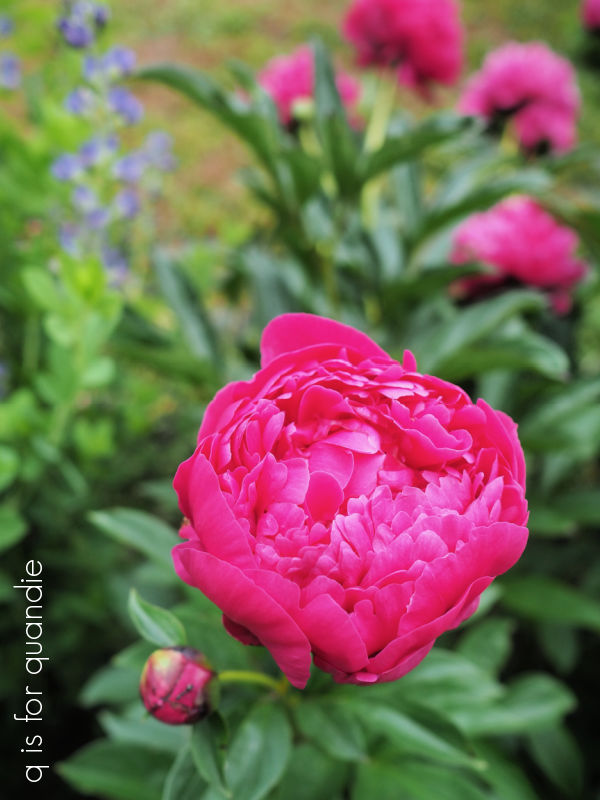
Then, in direct contrast, my other favorite is this one.

The color on that one is so vibrant that my camera doesn’t even know what to do with it.  It ends up almost looking fake.  It practically glows out in the garden.

I’ve come to realize lately that I much prefer the double peonies over the singles.

Single peonies have one or more rows of the larger petals, known as guards, or guard petals, surrounding a center of stamens.

I currently have two single peonies; the one shown above and a bright pink one that I purchased without reading the fine print (I thought it was a double).

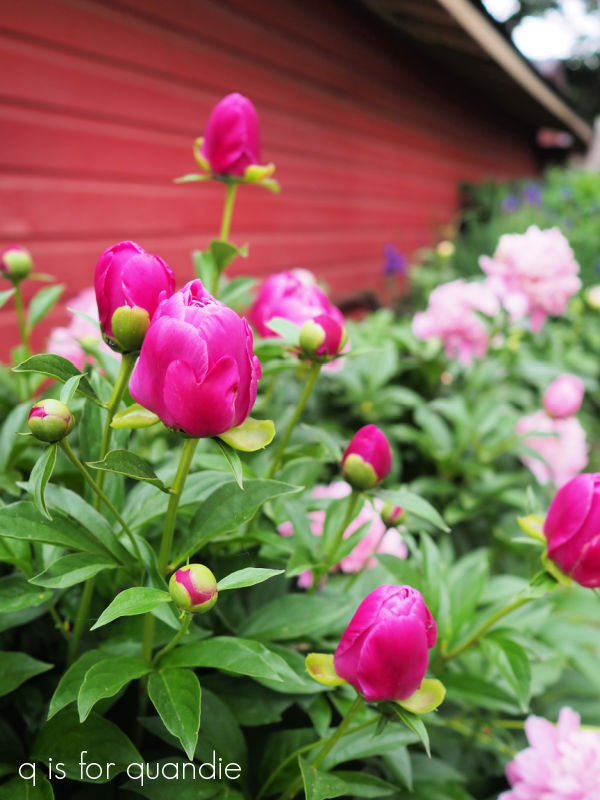
They look surprisingly like a tulip before they open …

But once they open up I don’t particularly like them.

I’m planning to dig up both of my single peonies in September and give them to my neighbor, nnK.  FYI, September is the best time to move established peonies if you must.  But be warned that peonies do not like being moved and it will take them a couple of years to bounce back afterwards.

I much prefer the double peonies with their many layers of petals and relatively insignificant stamens.

I’ve decided that life is too short, and my garden space is too limited, to have plants that I don’t like in my garden, so once the single peonies have gone I’ll replace them with more doubles.

Since I’m sharing peony photos today, I just had to include this peony that I saw growing in a MacGrove alley during their neighborhood garage sales yesterday.

Isn’t that something with its pink guard petals, white inner petals and pink stamens?

There are so many incredible options to pick from out there!

Speaking of peonies, some of you may not have been following me back when I experimented with keeping unopened buds in the fridge for a few weeks (or a couple of months), and then taking them out to use in an arrangement.  It worked out great when I did it correctly and you can read all about that process here.

Then last year when I attempted to do this again I messed up.  I wrapped the buds in damp paper towels inside the ziploc bags, and I ended up with a gross, moldy mess.  So follow that first process that I linked above if you want to try it.

Rather than save any of my peonies this year, I decided to just enjoy all of them right away.

So I’ve been cutting them and bringing them in the house to enjoy their wonderful scent.

Unfortunately, peony season is short and most of mine are already done blooming.  There will be a few stragglers left here and there for a few more days, but that’s it.  I did my best to enjoy them while they lasted though.

How about you?  Do you grow peonies?  Do you have any favorite varieties that I should know about?  Leave a comment and let me know.

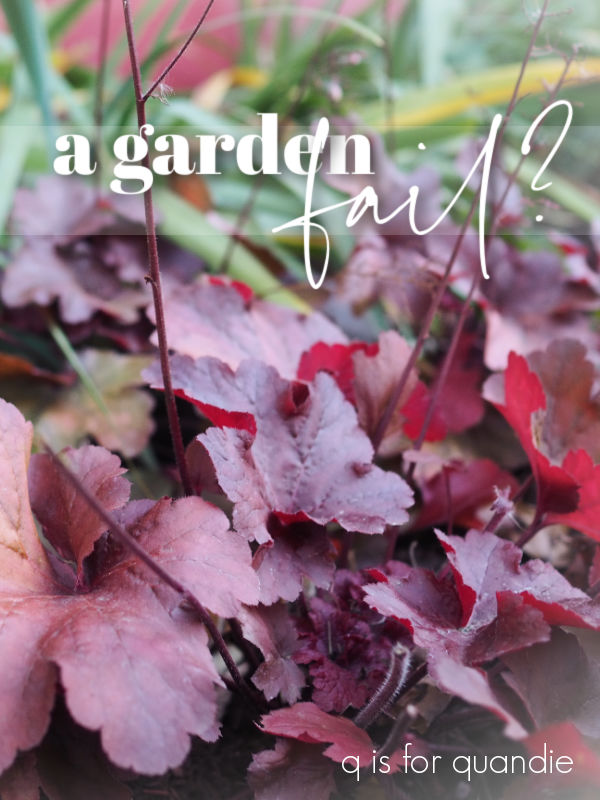
a garden fail?

Rather than bring you another post about how fabulous everything looks in the garden, I thought I’d keep it real this week and share one of my garden fails.

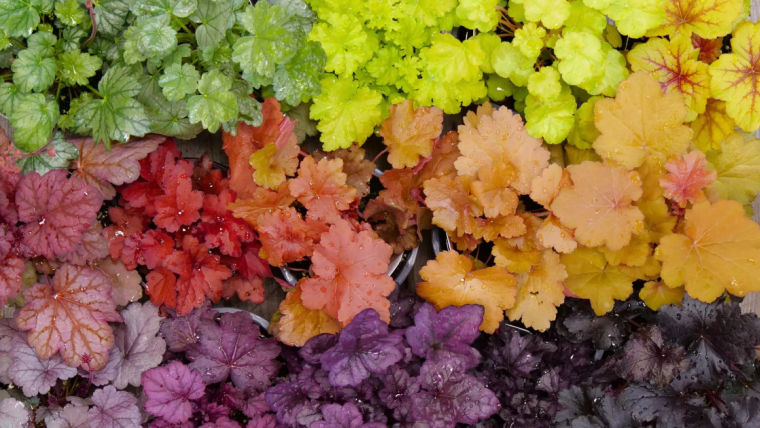
It’s called heuchera (or coral bells), and it’s all the rage these days.

If you go to your local garden center you’ll likely see row after row of heucheras in nearly every color of the rainbow.

It’s hard not to be seduced by that amazing variety of foliage color.  Especially for someone like me who gardens mostly in shade and tends to choose plants for their foliage rather than their flower.  Heuchera do flower, but the flowers aren’t at all showy.  They usually send out tall spiky stems with little bitty flowers on them, although there are varieties with flowers that are a bit showier than these …

In fact I often just cut the flower stalks off, much like I do with hosta flowers.

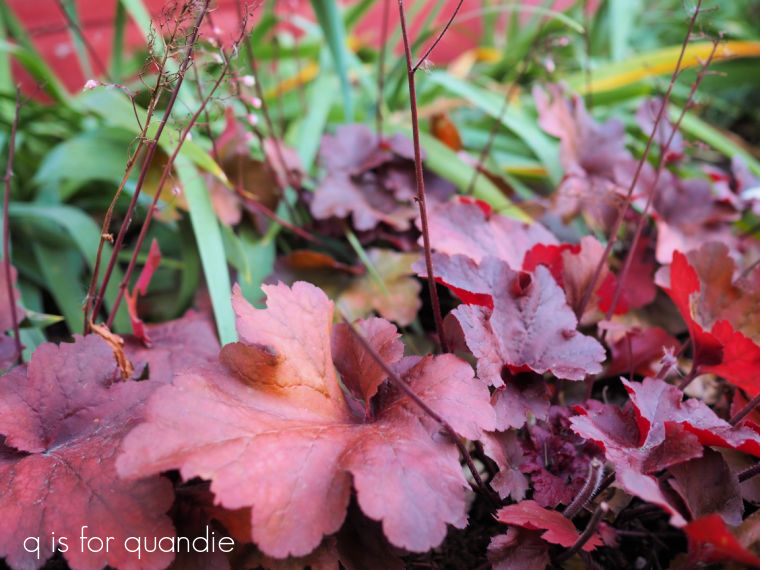
Isn’t this leaf color amazing though?

That variety is called Fire Alarm, and you can see why with that bright red foliage.  I planted three of them in the garden near my carriage house last year and the red was perfect there.

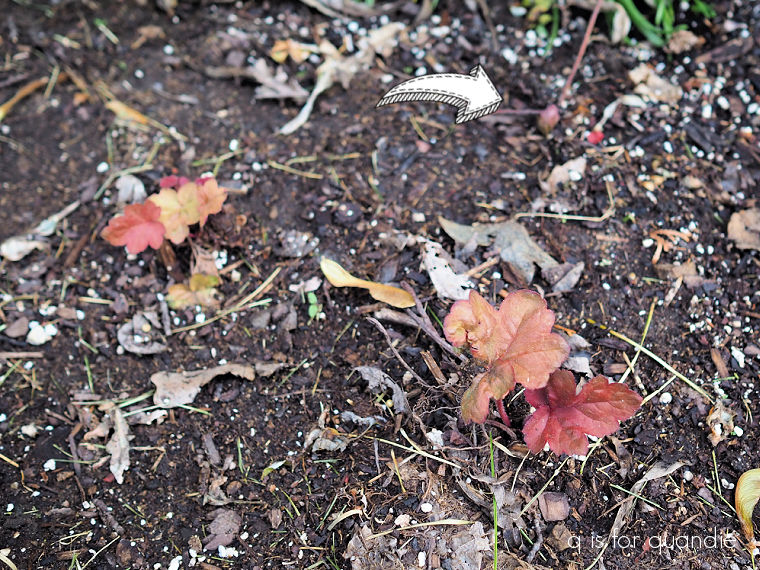
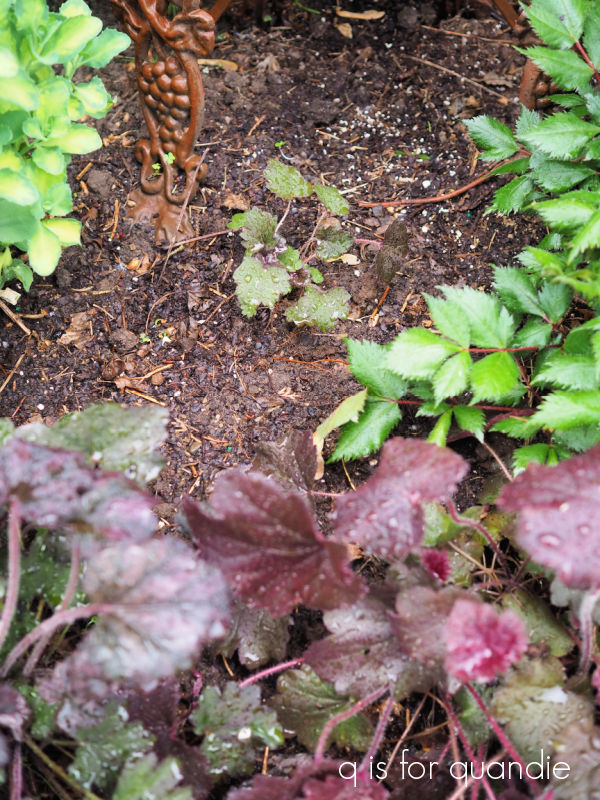
But here’s what they look like so far this year.

Yep, pretty sad.  Not entirely dead, but really barely there.  The third plant is so tiny that I had to add an arrow to the photo just so you could make it out.

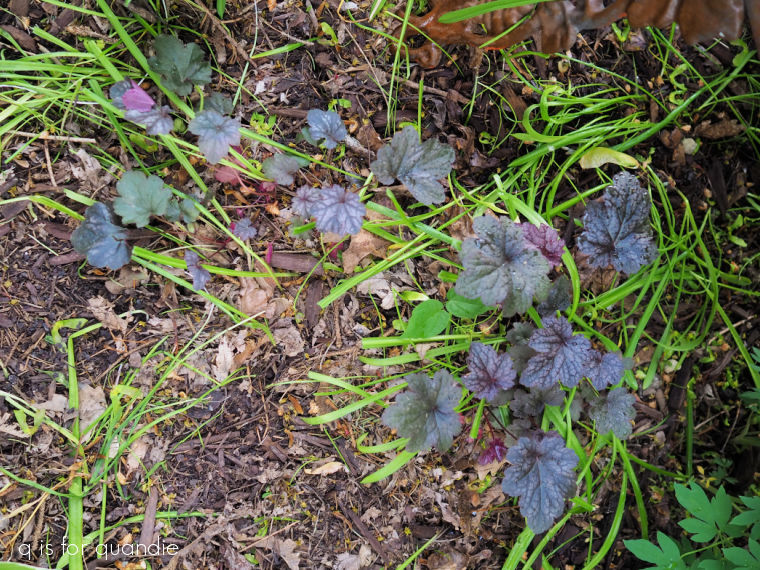
I also planted five heuchera in front of my wrought iron bench last year, and here’s how they are looking now …

Also pretty sad.

When I get results like these with a plant I tend to immediately think ‘hmmm, what did I do wrong?’

But in this case, I’m hearing some of my favorite garden youtubers mentioning that heuchera does not reliably come back for them either, especially the newer cultivars.    I’ve also read that although they are said to be hardy to zone 4, they really do better in no less than zone 5 (and I’m a 4b).

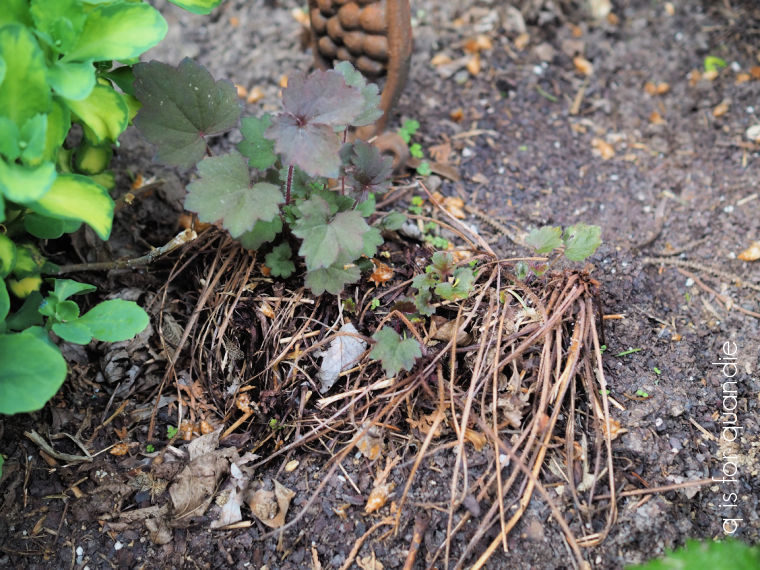
Heuchera also have a tendency to ‘lift’ over the winter, and you can see that on this one that’s in my front garden …

When that happens you can dig them up and replant them level with the soil, or simply add more soil around the crown.  I dug that one up, pruned off some dead bits and replanted it.

Now I just have to wait and see if it will catch up with its neighbors (the plants in the foreground are the same variety of heuchera, just much bigger).

Overall, I’m pretty disappointed with the performance of the heuchera I’ve planted.  And honestly, I’ve gotten similar results for several years in a row now, so it’s not just a one-time weather based anomaly.

There is one possible solution to the heuchera problem and that is to treat them like annuals and put them in a pot.  I saw lots of them in window boxes when we were in Charleston last year (that pop of bright chartreuse is a heuchera) …

That being said, they are usually priced as perennials and thus make a rather expensive annual.  They definitely won’t survive the winter in a pot in our climate.  Coleus will give you a very similar look, also comes in a wide variety of foliage colors, and is quite a bit cheaper, so it’s probably a better choice for pots.

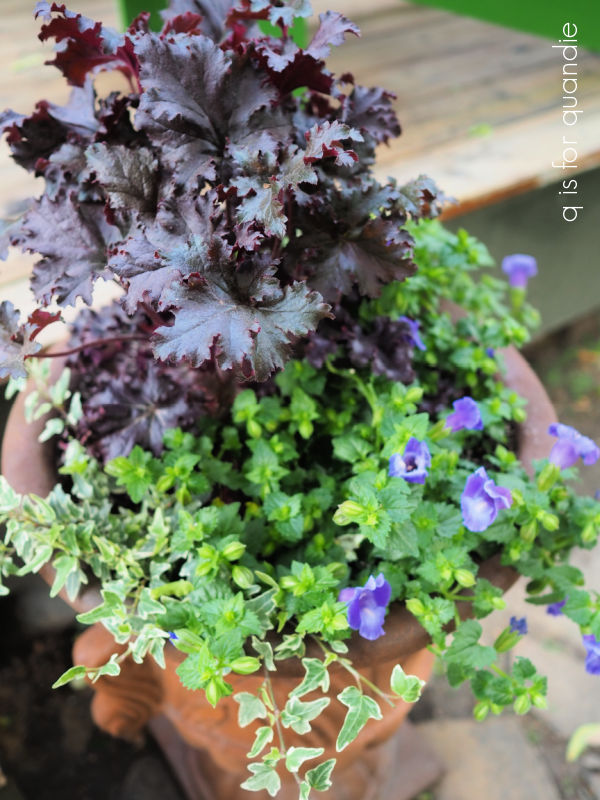
However, when you happen to find a bunch of Black Taffeta heuchera in the clearance aisle at Gerten’s for $5 each, well, then it does make sense to treat them as an annual.

So I put them in a couple of my rusty pots along with some Summer Wave torenia.

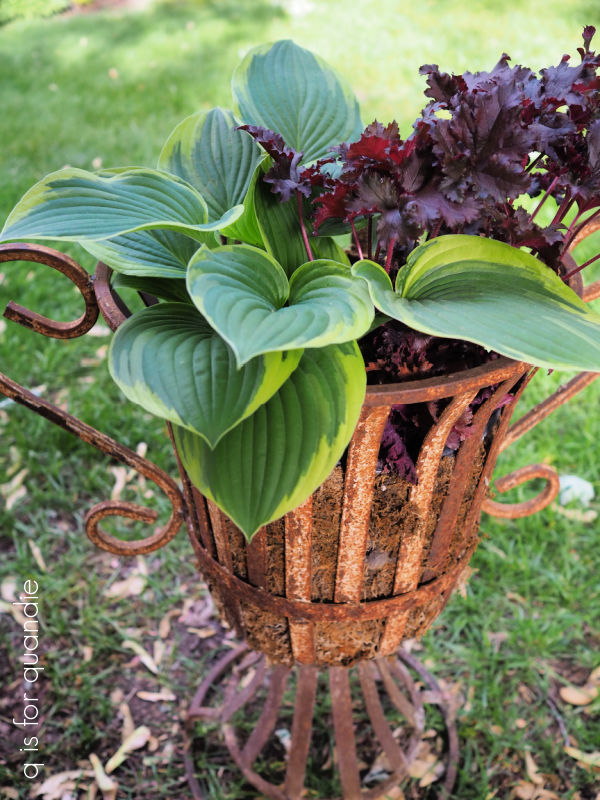
I also paired one of the heuchera with a hosta that I dug out of the garden for this pot.

These days I’m finding that we have a lot more shade on our deck than we used to, the trees are getting bigger every year!  So I’m giving up on trying to grow sun loving annuals in those pots.  I’m experimenting this year to see what I can do with more shade, so maybe hosta, heuchera and torenia will be a good combination for that.

Aside from the discount heuchera, I think I’m going to stop throwing my money away on heuchera though.

How about you?  Have you had much luck with heuchera?  Are you tempted by all of those gorgeous foliage colors?  Leave a comment and let me know.

this time last year.

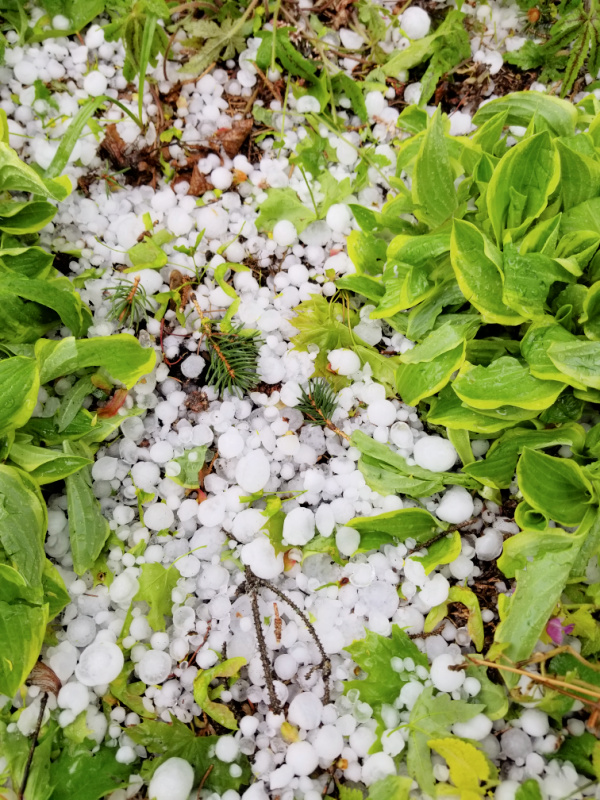
Some of you may remember that at this time last year my garden was recovering from this …

Yep, we had a massive hail storm last May.  It shredded my hostas.

In the end though, it was a blessing in disguise.  Our insurance company paid for a new roof on both the house and the carriage house, which we badly needed.  So we’re grateful for that.  And eventually the garden recovered and looked pretty good.

But this year I’m grateful for an undamaged (so far, knock on wood) garden.  Barring hail storm damage, this time of year is when everything usually looks really good.  No insect damage, no drought damage, just gorgeous fresh growth everywhere.

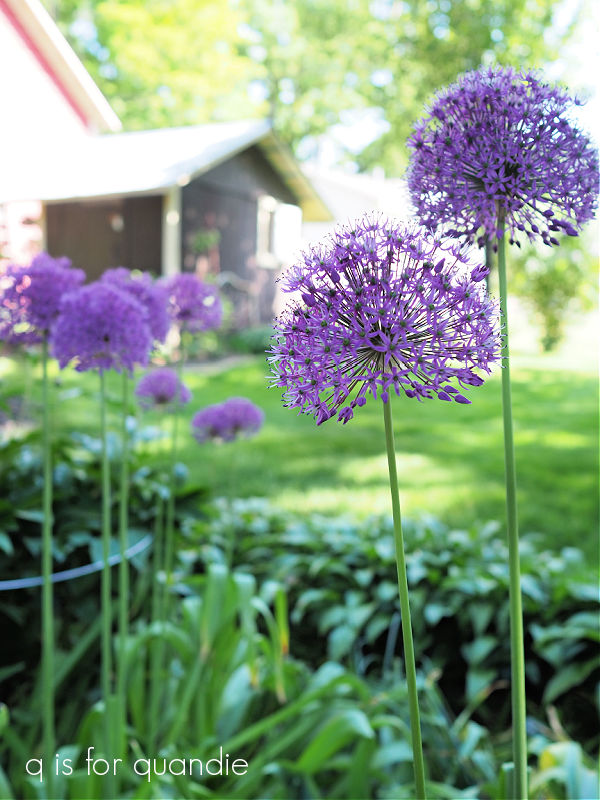
Some more of my favorites are blooming this week including the alliums.

I love the way these pop up out of the garden on their long stems.  There are lots of different kinds of alliums, these are the ones that you plant in the fall as bulbs.  They bloom the earliest in the season.  I’m sure you’ll see more alliums from me as the summer progresses, and in the meantime if you want to learn more about alliums check out this post about them from last year.

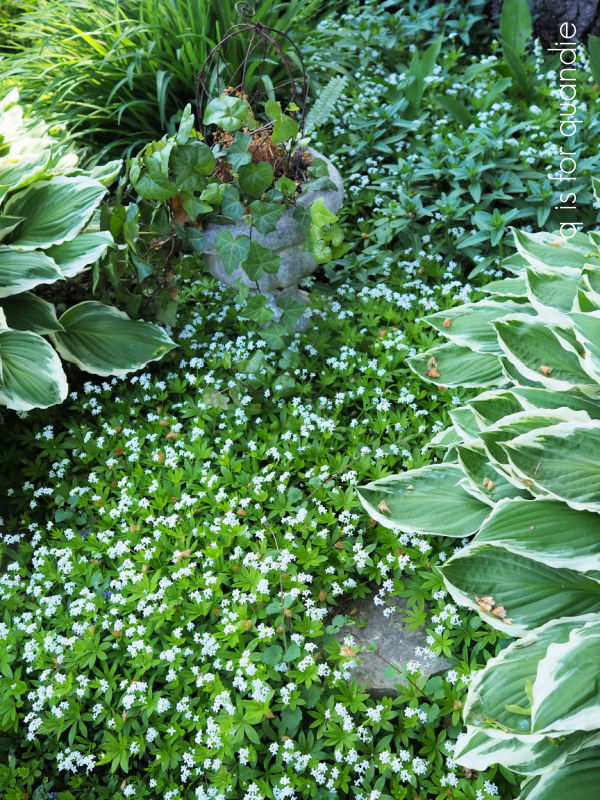
A bunch of my ground cover plants are blooming right now too including my sweet woodruff.

I love the white carpet of flowers it creates this time of year.

Ajuga is another ground cover that is blooming right now.

Isn’t that pretty?  I have to admit, this one isn’t quite as pretty once it’s done blooming but I still really like it.

Geranium macrorrhizum, or bigroot geranium, is also blooming now.

This stuff is kind of fascinating.  It seems to barely root into the ground, almost as though it’s just skimming over the dirt in a dense mat of plants that almost totally chokes out weeds.  It spreads like mad, but is super easy to pull out and thus keep in check.  You can rip up a chunk and then barely bury it in another spot and it will totally wilt and look like it isn’t going to make it, but next thing you know you’ll have a big patch of it.

The nice thing about it is that it doesn’t require much in the way of maintenance at all.  No pruning, no dead heading, and really not even any winter cleanup.  This is a semi-evergreen perennial, so for us in Minnesota that means it doesn’t really die back to the ground in winter and is one of the first plants to green up and look good in the spring.

Another ground cover that also has those same qualities is variegated vinca.  It emerges from snow cover still looking green and alive.

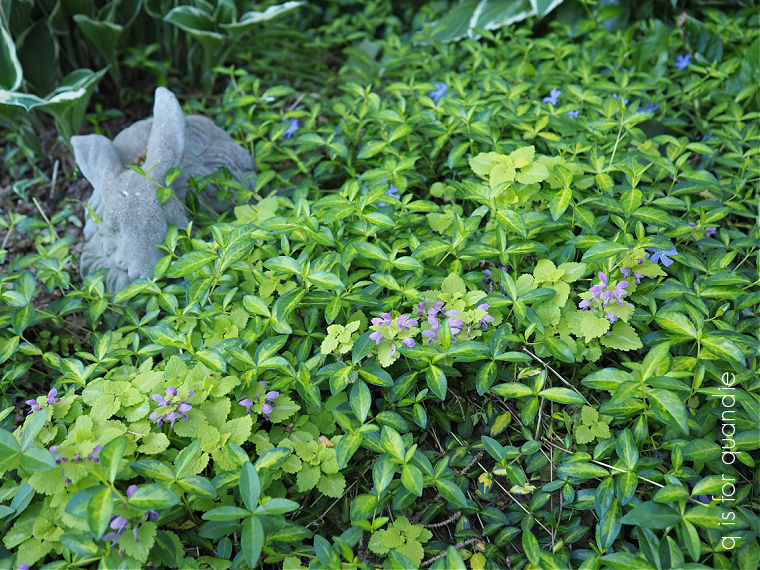
Here it is mixed with some lamium.

The lamium is the brighter lime green foliage with the pinkish purple flowers, the vinca has the shinier elongated variegated leaves with more of a blueish purple flower.  These two are duking it out for ownership of this space and I think that ultimately the vinca is going to win.

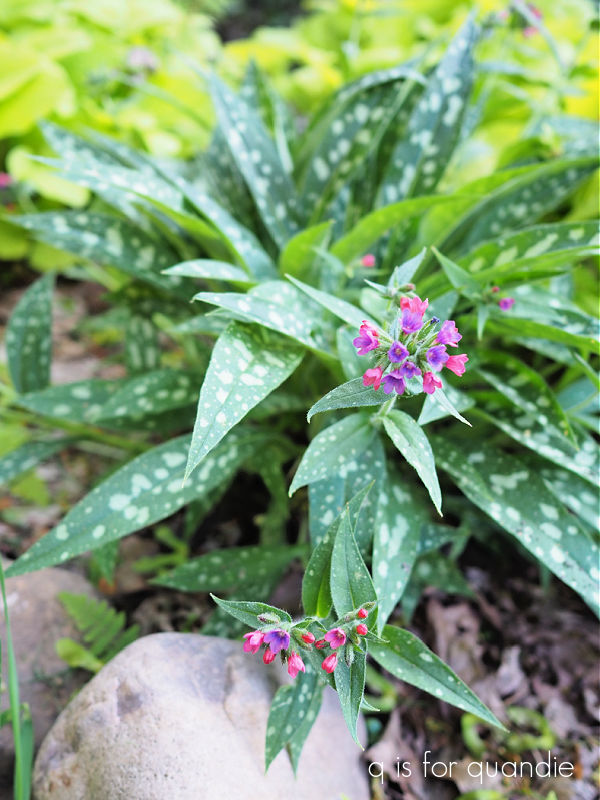
My pulmonaria (lungwort) has just started to bloom too.

This particular variety is called Raspberry Splash and I just put it in last year.  I love they way it has a mix of pink and purple flowers.

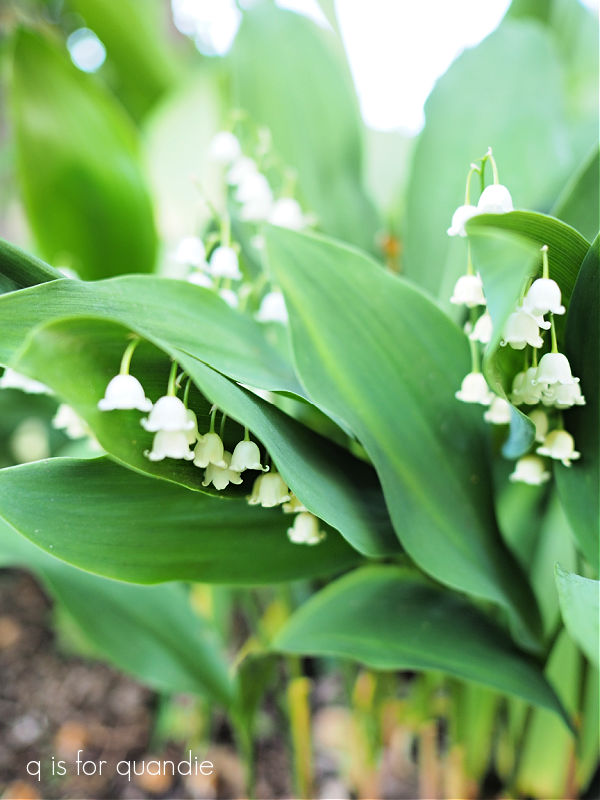
A couple of the sweetest little plants are also blooming in my garden this week, the lily of the valley …

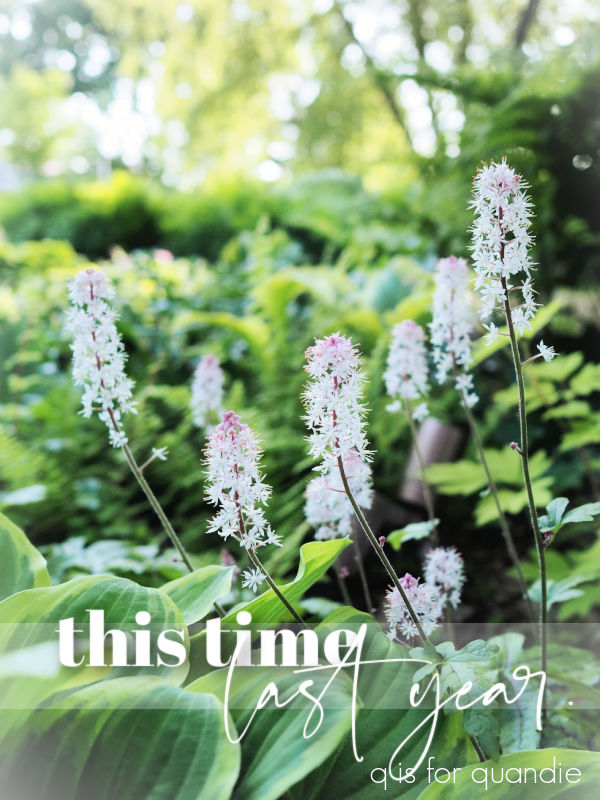
and the tiarella, or foam flower.

The only problem I have with the foam flower is that the other plants tend to overtake it on a regular basis.

As for the lily of the valley, that stuff is indestructible and will spread like mad, so be careful where you put it.  My neighbor, nnK, and I were at a local nursery the other day and saw single stems of lily of the valley being sold for $12.99 each and we just had to laugh.  We thought maybe we should just pot some up and start selling it at the curb.  But seriously, don’t ever buy lily of the valley.  You must know someone who would be happy to give you a chunk from their garden (including me).

I hope you enjoyed this little wander through my garden this morning.  Now my sister and I are heading out to nnK’s mom’s garden to help her plant up all of her pots of annuals, followed by a bbq and hopefully a boat ride.  I think it’s going to be a glorious day!

what’s blooming this week?

Good morning from my zone 4b garden!

It feels like we’ve gotten a bit of a late start this year, but then again, I’m pretty sure I say that every year.

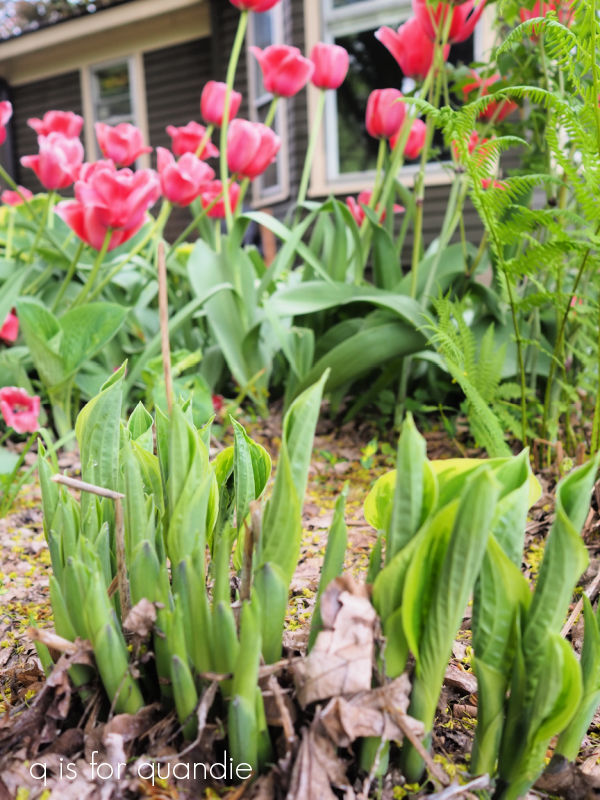
As you can see above, most of the hostas are starting to fill in, although there are still a few that are only pointy shoots just coming out of the ground …

While I wait for all of the foliage to fill in, I’m enjoying lots of early spring flowers.

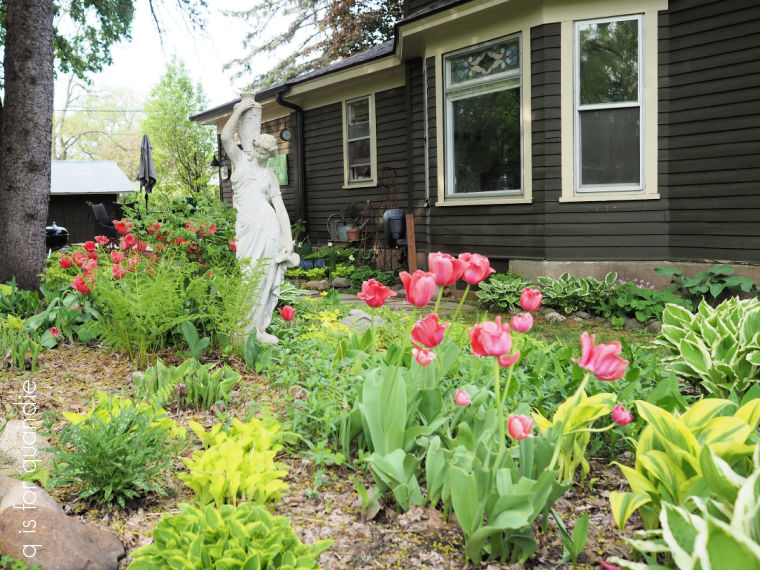
The tulips were still looking great earlier in the week, but they’ve pretty much gone over by now.  I’ll be cutting off the flower stalks this week, but leaving the leaves to store up energy for next year.

I planted Darwin Hybrid Pink Impression tulips, and I specifically chose a Darwin Hybrid because they are more likely to naturalize, ie. they will bloom again next year and even potentially multiply.  Overall though, daffodils, scilla, crocus and muscari are better at naturalizing than tulips.  So we’ll take a wait and see approach with that one.

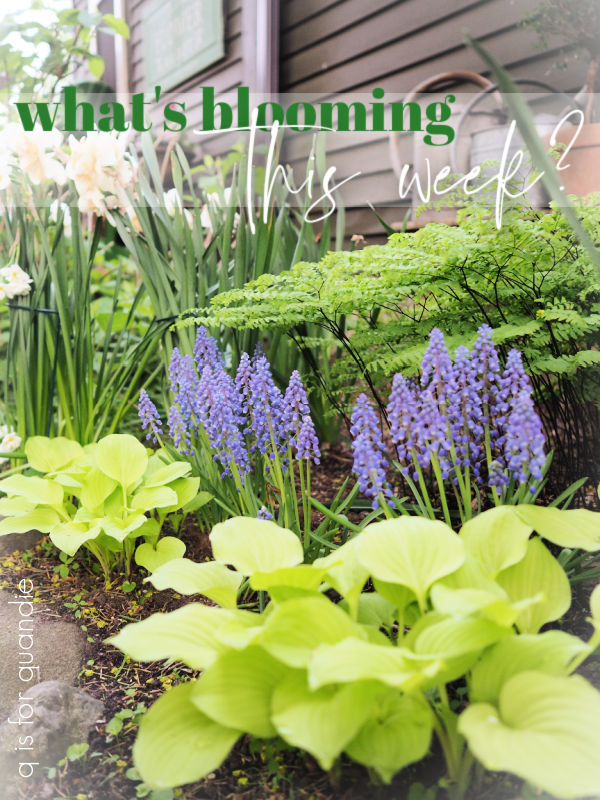
Speaking of muscari, I added some this year.  Here they are with some lovely Maidenhair Ferns (one of my favorites, I love how delicate they look) behind them, and the pop of a small lime green hosta in front (I wish I knew the name of that one, but I’m not sure which one it is).

Normally I would plant the muscari as a bulb in the fall, but I found these for sale in pots and decided to see if planting them now would work.  The employee at the nursery where I purchased them said it would, but I’m not sure she knew her stuff.  I do hope they come back next year though, because they are lovely in that spot.

It’s interesting to see how much of a difference in bloom times there can be even in a garden as small as mine.  The daffodils that I planted on the east side of the house in a very sunny spot that is rather protected from wind started blooming two weeks ago, while the very same variety planted in a spot with less sun only just opened this week.

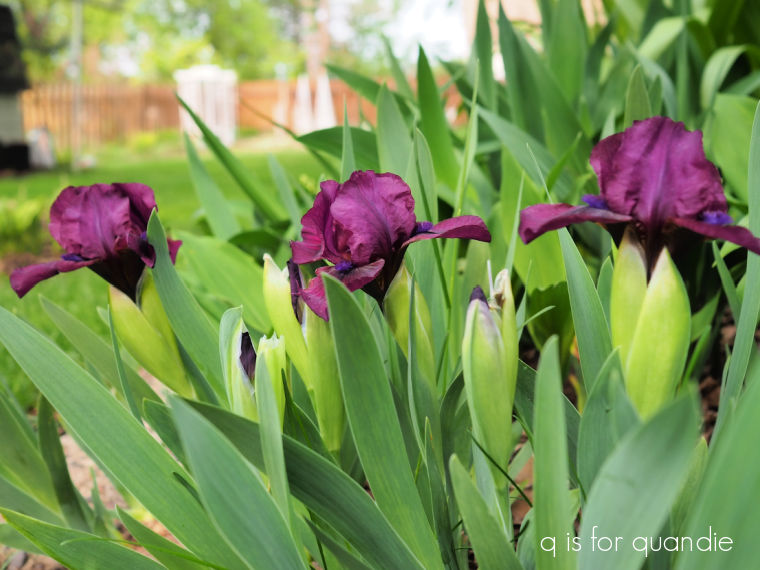
This fabulous rich, wine colored dwarf iris is blooming this week too.

It’s hard to tell from that photo, but these are only about 8″ tall.  I love them for that reason, the other bearded iris in my garden often require staking.

Someone gave these to me, so once again I don’t know what variety they are, but they certainly look like ‘African wine‘.

Another favorite of mine that is blooming right now is the Brunnera.  I have some Jack Frost which has the silver veining on the leaves, but I also have some that have solid green leaves.  The thing is, I’m pretty sure I planted all Jack Frost but some have reverted back to solid green.  Do any of you have any experience with that?

Either way, I just love the delicate froth of pale blue flowers that shoot up this time of year.

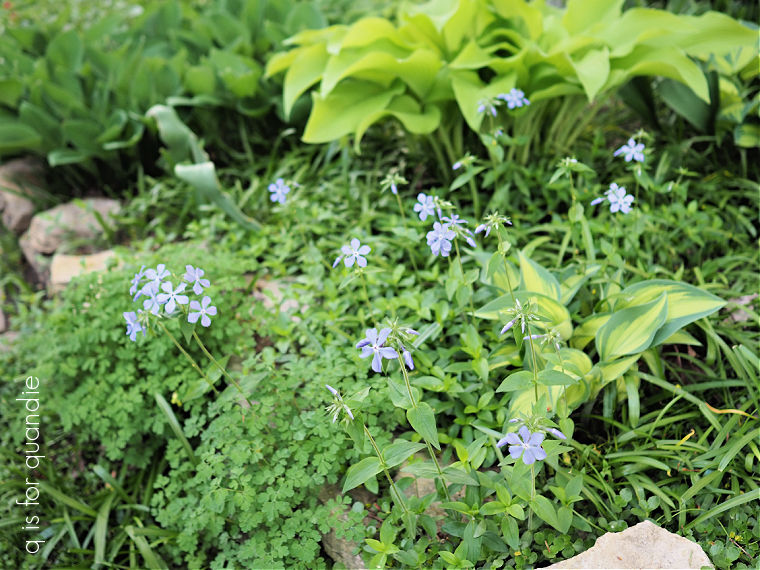
Speaking of blue flowers, my wild blue phlox is also blooming now.

I purchased this plant at a garage sale, and I didn’t know what it was.  But I posted about it here last year and one of you identified it for me.

It will eventually be overtaken by those hostas, but for now it looks rather sweet.

Now, I know I’ve called a number of the plants in my post today a favorite, and everything can’t be a favorite, but I do love the lilacs too.

They have just come into full bloom, and I think our cool weather this week is making them last (it was 44° when I woke up yesterday).  Even the flowers I cut and put in that watering can have stayed fresh looking for days (and usually I have trouble with preventing lilacs from wilting in a vase).

If you’ve followed me for long, you know that I have struggled for years to create a lilac hedge along our back property line.  In fact, earlier this week I dug out two more spindly, pathetic looking plants and replaced them with new ones.

However, the center of the ‘hedge’ has gotten to at least 8′ tall and is covered in flowers.

Now, if only either end would catch up.  I suspect it will be several years yet before these lilacs provide proper privacy, but I’m feeling optimistic.

That’s about it right now for blooms.  But before I go I thought I’d share my fern glade.

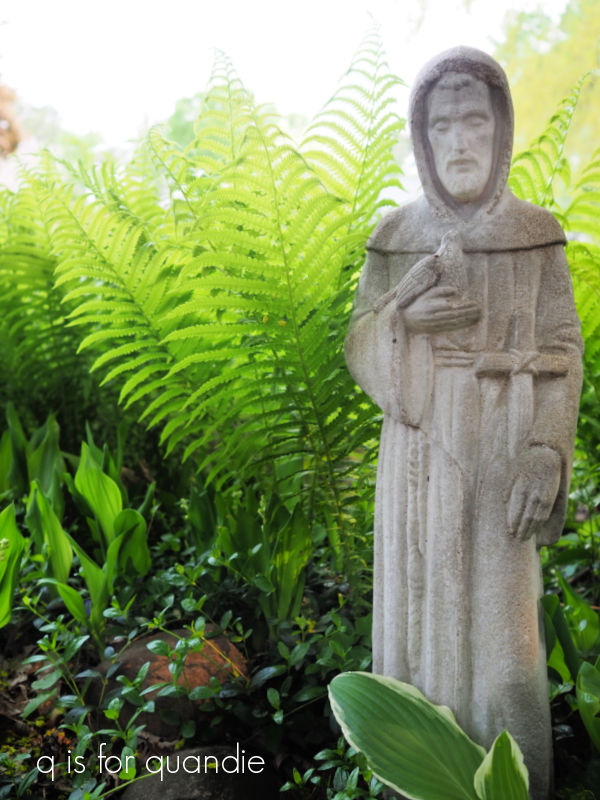
I’m fairly sure these are Ostrich ferns.  I planted them at least 25 years ago or more.  At the time that patch was under pine trees and it was only good for growing weeds.  The pines are all gone now, but the area is still in full shade from nearby trees.  It’s also a low spot in our garden, so it gets very wet in spring.  In other words, perfect for ferns.  These will take over and become almost impossible to eradicate though, so keep that in mind if you decide to plant some.

They are  are presided over by St. Francis.

It’s always amazing how fast these ferns shoot up out of the ground.  They look just gorgeous this time of year.  I wish they would last through to the first freeze, but they usually start dying back to the ground in late August, especially if we have a dry summer, and then start to look quite awful.  Also, in recent years, they’ve been plagued by the Japanese beetles too.  According to the internet, Japanese beetles aren’t attracted to ferns.  But they sure do like mine.

So tell me, what’s blooming in your garden this week?  Are your plants way ahead of mine?  Leave a comment and let me know.


the festival topiaries.

As promised, today’s ‘Sunday mornings in the garden’ post is brought to you from Disney World’s Epcot.

Normally when my sister and I go to Disney, we like to go in the fall.  The weather is perfect in late October to early November, and the crowds aren’t super awful then either. But this year we decided to go for my sister’s birthday, which happened to be during Epcot’s Flower and Garden Festival.

The mouseforless.com says that “more than 500,000 plants, trees, and shrubs are planted for the festival; 250,000 of those are annual blossoms installed for the festival.”

In other words, it’s a massive amount of plants and tons of color.

I really thought I’d be able to share all of my photos in one blog post, but as I’m working on it I realize that it’s far too much for just one so I’m going to break it down into a couple of different posts.

There are around 25 themed gardens featured for the festival ranging from the Bouquet Garden in the France pavilion to the Shishi-odoshi Garden in the Japan pavilion (and I’ll share more on those in my next post).  There are also a butterfly house, food booths featuring plant based and/or themed food and drink, and a Garden Rocks concert series.  We saw Kool & the Gang and that was super fun.

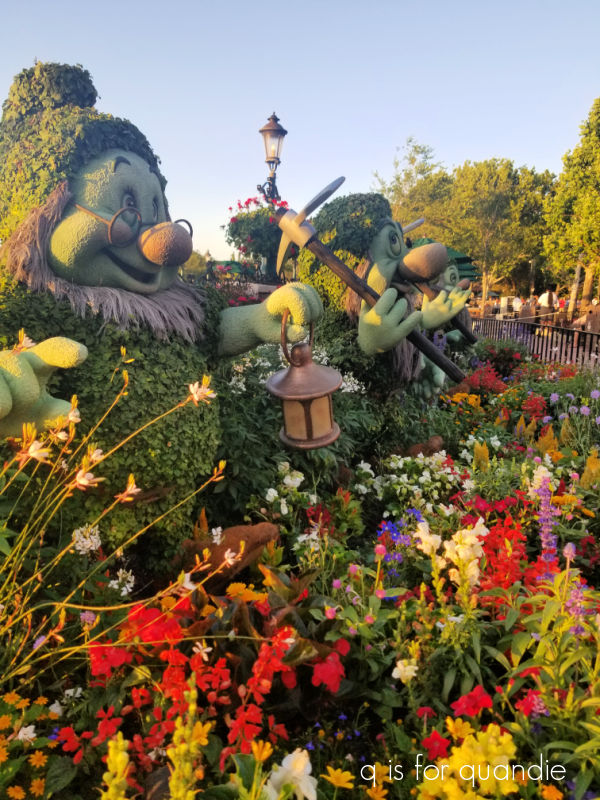
In addition, there are over 100 topiaries.

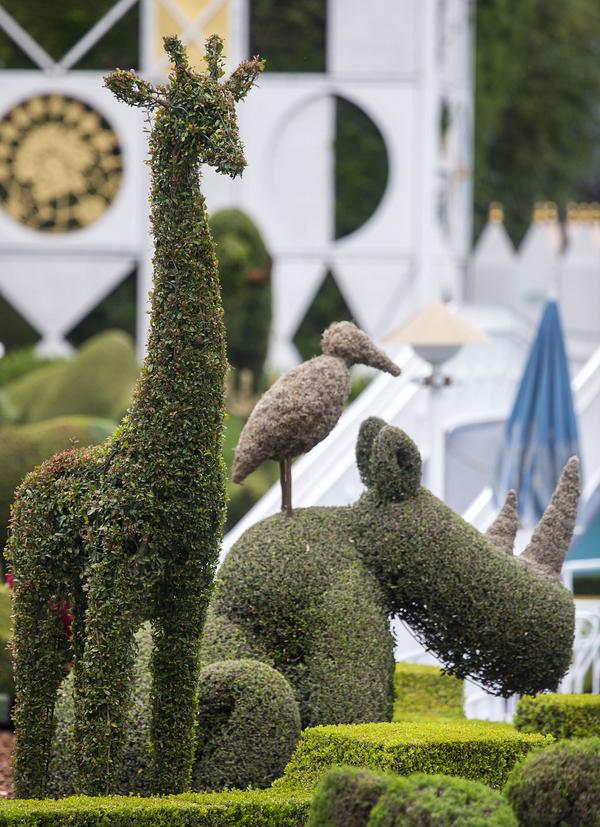
But they aren’t what I think of as legit topiaries.  When I say ‘legit topiary’ I am thinking of living shrubs that have been strategically pruned to form a shape.  In my mind, these are the kinds of topiary that Disney was originally known for having in their parks, like these examples in front of It’s a Small World in Disneyland.

Large shrub topiaries can take up to 10 years to create though, so I can understand that they aren’t very practical if you need over one hundred of them.

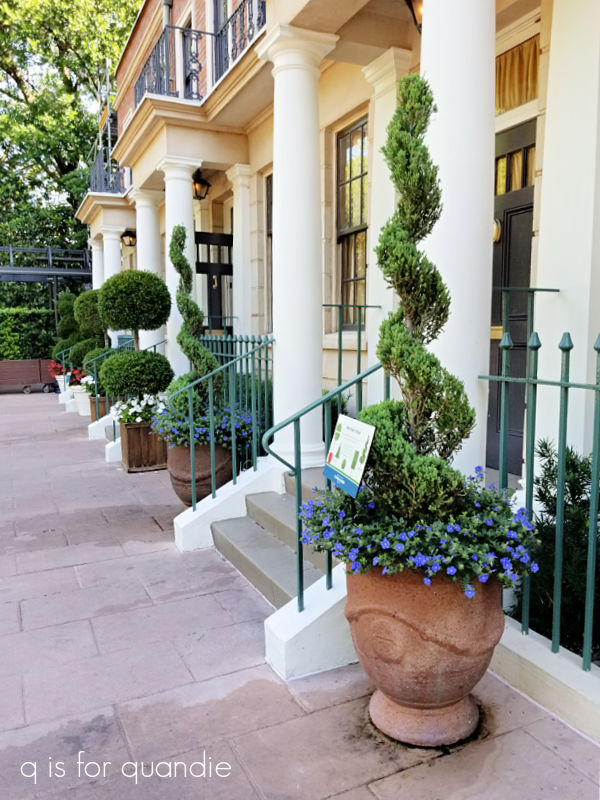
They had a Topiary Heritage Garden in the United Kingdom Pavilion where they had placards explaining the different types of topiary being used in Epcot, with examples of each.

Standard Form topiary are created by training a woody plant to a long, single stem topped with a round head of foliage.  I think the double globes of foliage below also count as standards, but don’t quote me on that.

The spirals fall into the category of Free Form topiary.

They did have an example of a shrub topiary in the Topiary Heritage Garden, but there were a couple of gardeners trimming it up while we were there so I didn’t snap a photo of it.

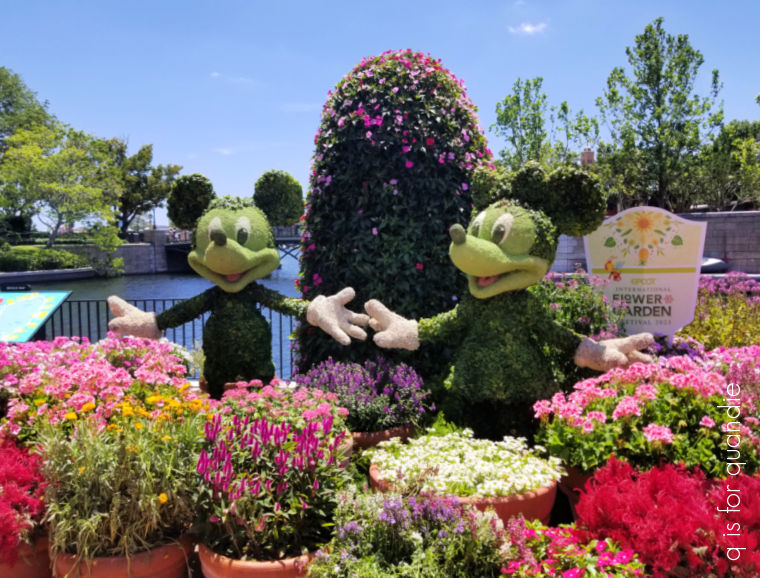
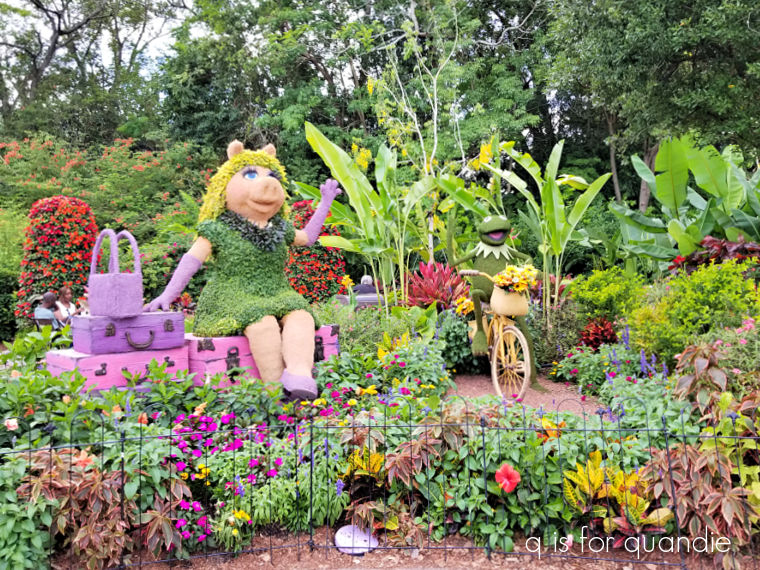
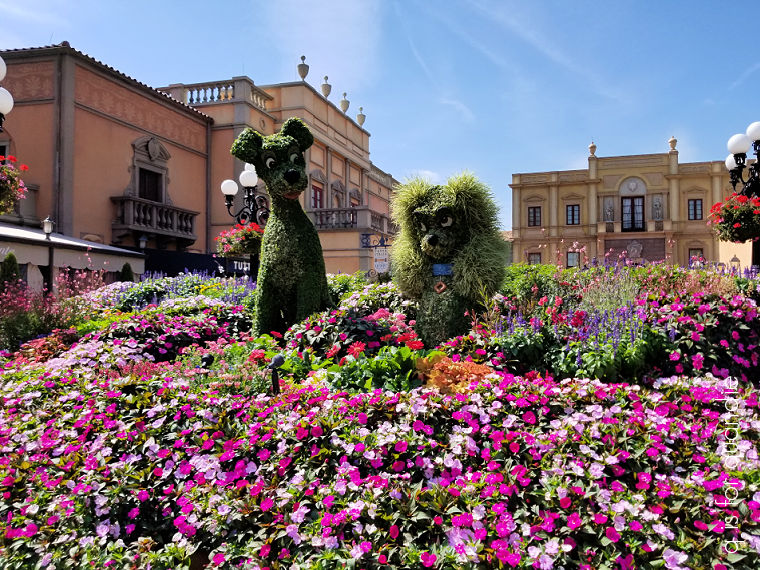
Almost all of the topiary at the Food & Garden Festival are what is called Sphagnum Topiary though.  They are created using heavy steel frames that are then fitted with sphagnum moss and fast growing vining plants.  They also will use dried plant material to create details like faces or clothing items.

For example, I’m betting that Miss Piggy’s lavender gloves and shoes, as well as her face, legs and arms are made out of dried plant material.

I’m sorry, I just can’t help but feel like that’s cheating.  How much of these are even real growing plants?

However, although these topiaries feel rather ‘fake’ to me, they are pretty cute.

And this is Disney after all, their goal is to create magical illusions, right?

And I do rather love the ‘fluffy’ ears on Lady …

But tell me, what do you think?  Are you a fan of the sphagnum moss topiaries, or do you find them a little too ‘fake’ looking?  Leave a comment and let me know.

the first flowers.

Before I headed off to visit my mom a couple of weeks ago, I mentioned that I hoped my scilla wouldn’t bloom while I was gone.

I needn’t have worried, because it held out and I enjoyed it for the full week and half between that trip and leaving for Florida yesterday.

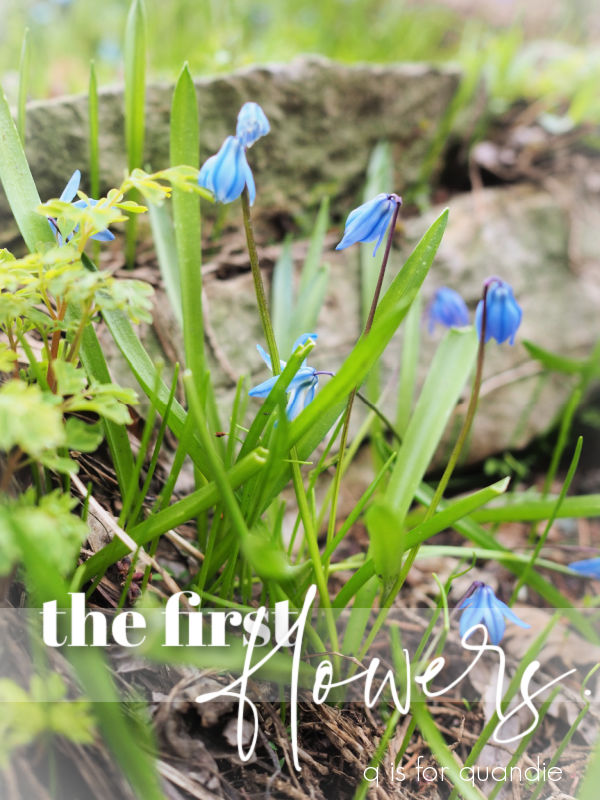
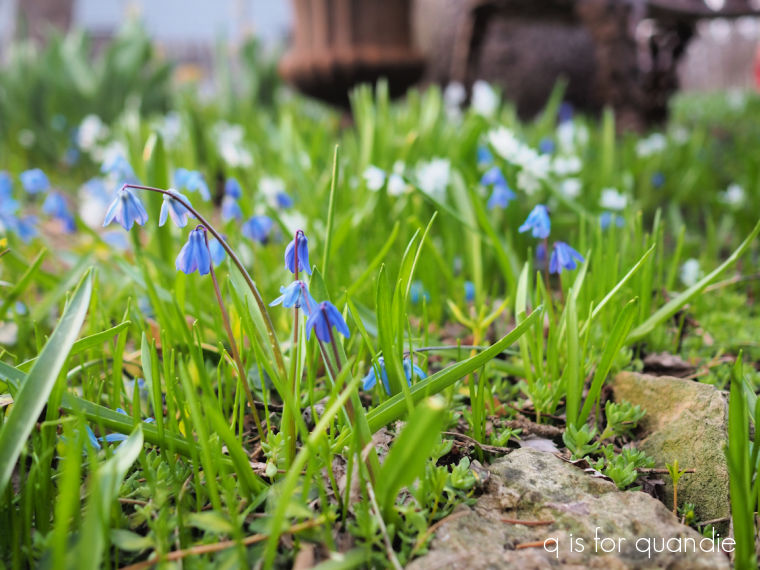
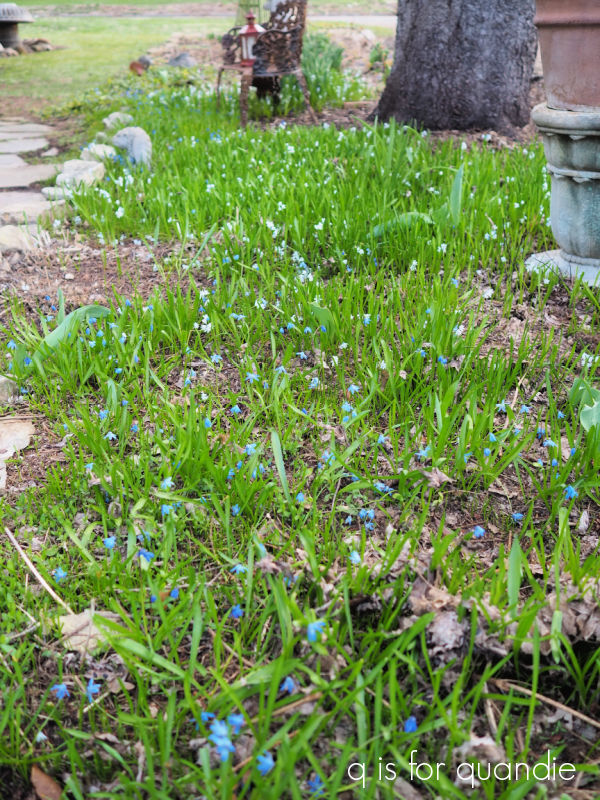
These are always the first flowers of the season in my garden.  Scilla siberica, or squill, is a bulb that blooms in late winter to early spring.  In my zone 4b garden they usually bloom anywhere from the middle to the end of April and I’m always so excited to see them after a long, cold winter.

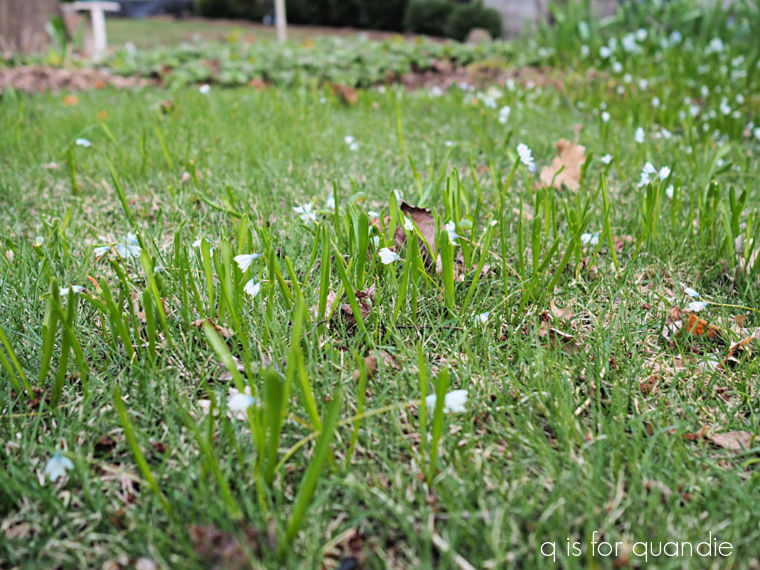
I have two colors of scilla in my garden, white and blue.  The white ones were already in the garden when we purchased our house 30 years ago.

As you can see, up close they have a little bit of a blue streak to them.  From a distance they mainly look white though.

I prefer the blue ones, so I planted some of those myself a few years back.

They are such a gorgeous, vibrant shade of blue.

Scilla is perfect for naturalizing, ie. it will spread over time filling in the space where it’s planted.

  Some consider it to be invasive, so keep that in mind.  If you decide to plant it, be sure to put it somewhere that you won’t mind having lots of it.

Over time, mine has crept out into the lawn in some spots.

It also pops up randomly, rather far away from where it was originally planted.  I’m not at all sure how it does that.

The brilliant thing about scilla is that after it blooms it dies completely back to the ground.  In the garden, it starts dying back as the perennials around it start to fill in, so it’s perfect.  And in the lawn, by the end of May you won’t even know it was there.

Another huge plus to scilla is that it’s deer and squirrel resistant.

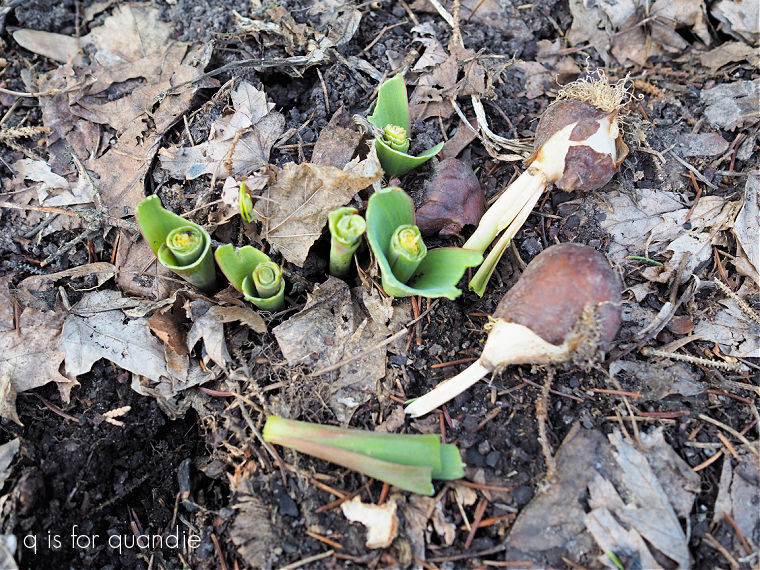
Speaking of which, I have decided to give up on tulips.  You’ll remember that I planted a bunch of new ones last fall, and here’s what I found out in the garden the other morning.

Not only have the deer munched them right down to the ground, they’ve literally pulled two of the bulbs right out of the dirt.  Argh!

I know I could do things to thwart the deer, like spray smelly deer repellant on the garden after every rain or enclose the tulips in chicken wire, but neither of those solutions are appealing to me.  I’d just as soon forgo the tulips and plant other bulbs that the deer won’t eat, like daffodils, alliums or more scilla.

How about you?  Do you have scilla in your garden?  Or are you able to grow tulips without deer eating them all for breakfast?  Leave a comment and let me know.