
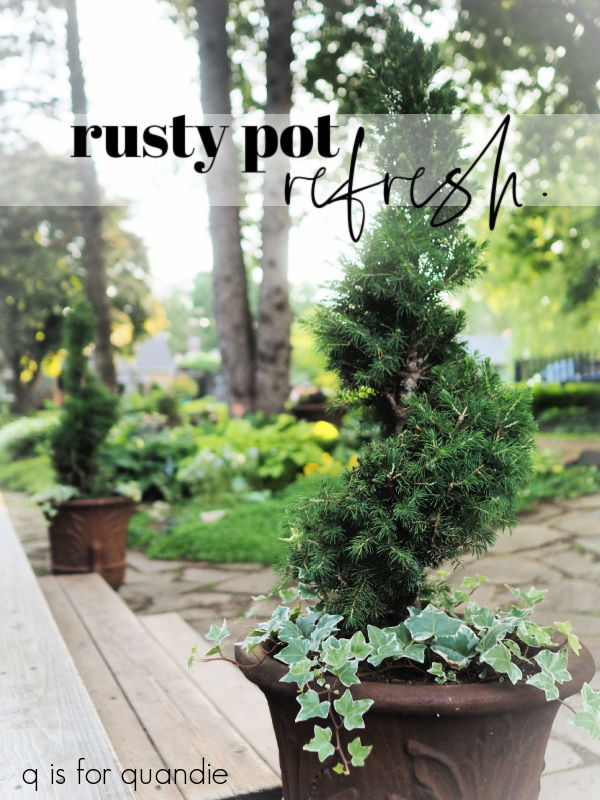
Back in 2019 I picked up a pair of garden planters made out of some sort of molded composite material.

I turned them into faux ‘rusty iron’ planters using Dixie Belle’s Patina Paint.

I used the Iron paint and the green spray to create a rusty look (you can find the details for that project here).

I did not add a protective top coat to them. Dixie Belle does make a top coat called Patina Guard for the Patina Paint, but it adds a little too much sheen for my taste (you can read about that here).
Even without the Patina Guard, my pots have held up remarkably well considering that they have spent 5 years outside, rain or shine (or snow), hot or cold.

But sitting in wet snow or on damp pavement for long periods has taken a toll on the bases.

The upper parts of the pots still look good though.

So I thought I’d take advantage of some gorgeous, sunny weather we had back in early April (which explains the decidedly not green background in that photo!) and just touch up the bases.
I started by brushing away any dirt, and then I used a scraper to remove the loose paint from the base.

You’ll note that the paint peeled right down to the original substrate. When I purchased these pots they’d already been painted a dark brown and I have no idea what kind of paint was used, but that original layer of paint is what failed here.
Next up I added a base coat of Dixie Belle’s Midnight Sky.

DB does make a primer that is specifically for use under the Patina Paint …

But you also can just use any of their chalk style paints for the same purpose.
Once the black paint on the base of my pot was dry, I stippled on the Iron paint and then sprayed with the green activator spray while the paint was still wet.

Out of the three patina paints that are offered (Bronze, Copper and Iron), I find that the rusty patina with the Iron paint takes the longest to develop. Luckily I had some time between when I refreshed these back in early April and the actual arrival of gardening season here in Minnesota. Initially these pots looked a bit two-toned (as you can see above), but the rust continues to develop over time. So don’t panic if you try this and immediately think it didn’t work at all.

Today’s q tip: I’ve noticed that the addition of water will help speed up the rusting process. With outdoor items, I just leave them outside and wait for a good rain. But for indoor items I will often give them a spritz of water using my Dixie Belle Fine Mist Spray Bottle once the initial Green spray has dried.
It ended up taking a few weeks for the bases on my planters to rust up enough to match the rest of the pot.

But it looks pretty seamless to me now.
I usually fill this pair of pots with flowering annuals in the summer, but this year I decided to try something a little different. I wanted to go with boxwood spirals, like these.
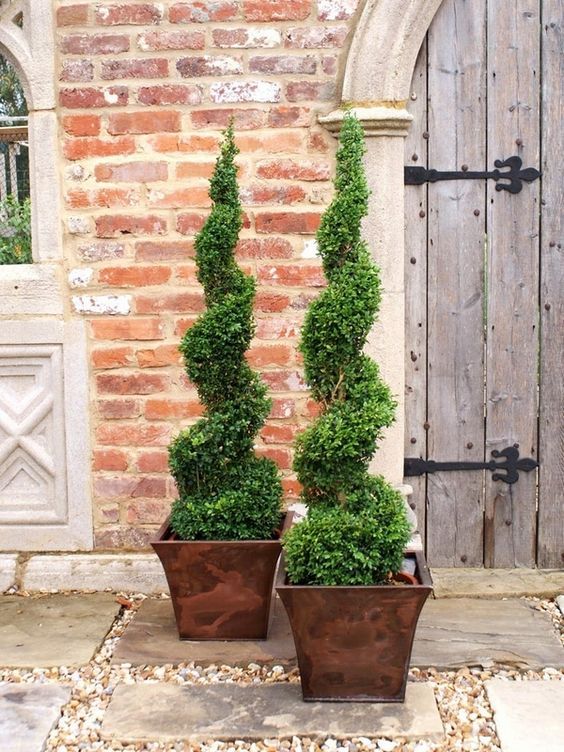
I looked all around for a pair of boxwood spirals, and I eventually found some at a fancy nursery in Minneapolis … with a price tag of $249 each! LOL, if you know me at all by now, you probably know that I wasn’t about to spend $500 for a pair of spirals.
I also found some Eugenia spirals, but even those were $149 each. I did put some Eugenia topiary pom poms in these pots back in 2022 …

So I knew that Eugenia would work for me, but I still didn’t want to pay $300 for a pair of them.
But then my sister and I were checking out the plants at our local Lowe’s store and I found a pair of Dwarf Alberta Spruce spirals for only $57 each.
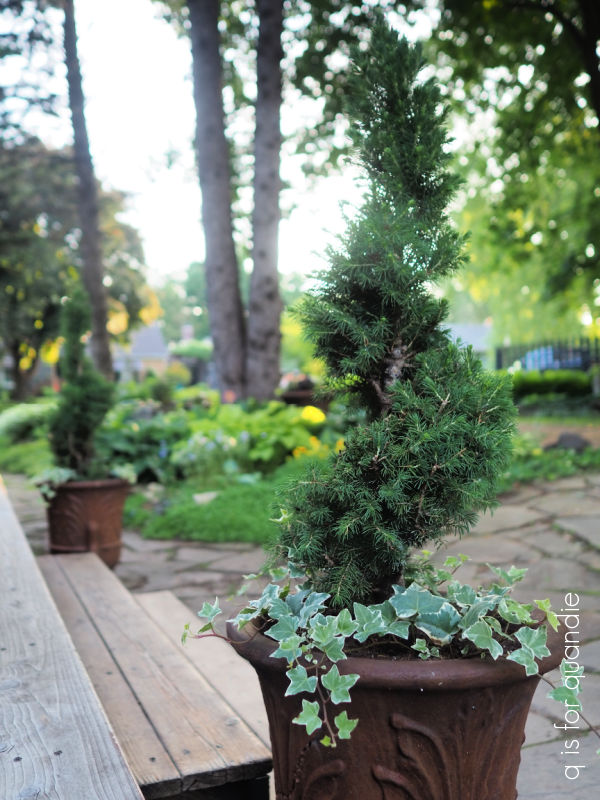
They aren’t quite boxwoods, but the added benefit to the Alberta Spruce is that they are hardy down to zone 2 (some sources say 3). In other words, it should survive the winter here, even in a pot. A plant needs to be hardy to two zones colder than your zone to survive winter in a pot. Since I’m a former zone 4b, now zone 5a, the Alberta Spruce should be OK.
I’ve also inadvertently experimented with that. I put a Dwarf Alberta Spruce in my wheelbarrow fairy garden last summer (to the right of the fairy house). It came through the winter beautifully.

I did mound leaves on the wheelbarrow, and cover it with some burlap for protection over the winter. So I may possibly do the same with the spirals, or I may just try to overwinter them in my unheated three-season front porch. That would be the easiest spot for me to be sure to keep them watered. I’d love to keep them in their pots for several years. I should be able to keep them smaller with regular pruning. We’ll just have to see how that goes.
I underplanted the spirals with some ivy.
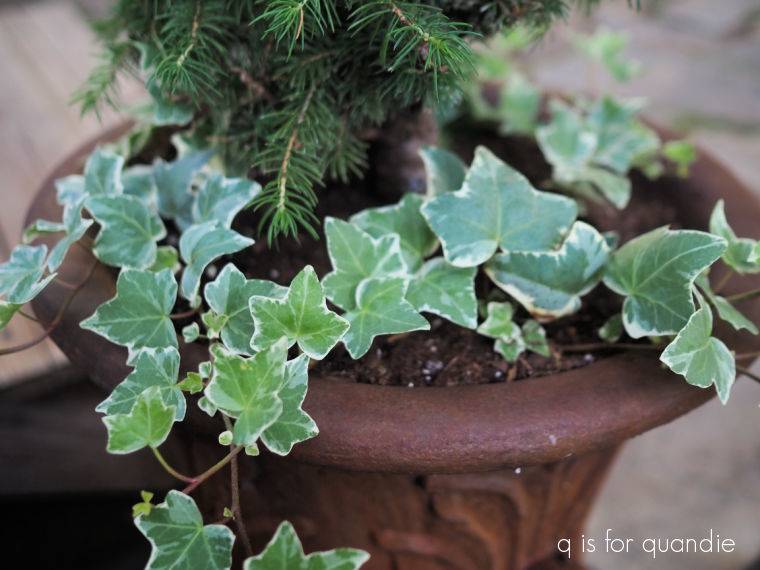
I’m looking forward to seeing that fill in a bit more.
But for now I’m quite happy with how my spirals look on either side of the steps to our deck.

I’m also quite happy with how easy it was to refresh my rusty pots!
Speaking of making stuff rusty, I rustied up a bunch of items for my upcoming sale including the St. Francis statue that I picked up at the Tangletown garage sales.
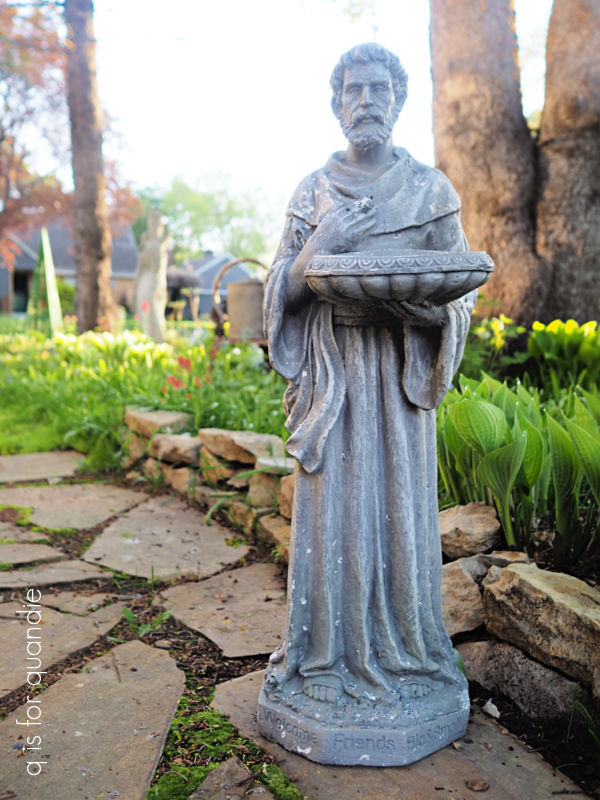
Remember him?
Now he looks like this …

I consider it a vast improvement, but I suppose the rusty treatment isn’t for everyone.
What do you think? Leave a comment and let me know.


I love the rust look too. – I’m just not sure why…. lol! maybe the details pop more w rust? so glad you talked about your topiary! I was asking myself – is it real or not? thanks for the details!
LikeLike
Yep, it’s real! Let’s hope I can keep it looking good 🙂
LikeLike
Your pots look great! An extra thank you for all your tips. My big pots turned out great, and it is super fun using these rust products. I’m OOT, or I would send you a pic how great they look. As for St. Francis, I probably wouldn’t have painted him, but I’m pretty sure that opinion comes from many years of Catholic school. LOL Happy gardening!
LikeLike
LOL, yep, due to my secular education I don’t feel a bit of guilt for painting up that saint 😉
LikeLike