

Good morning from the garden!
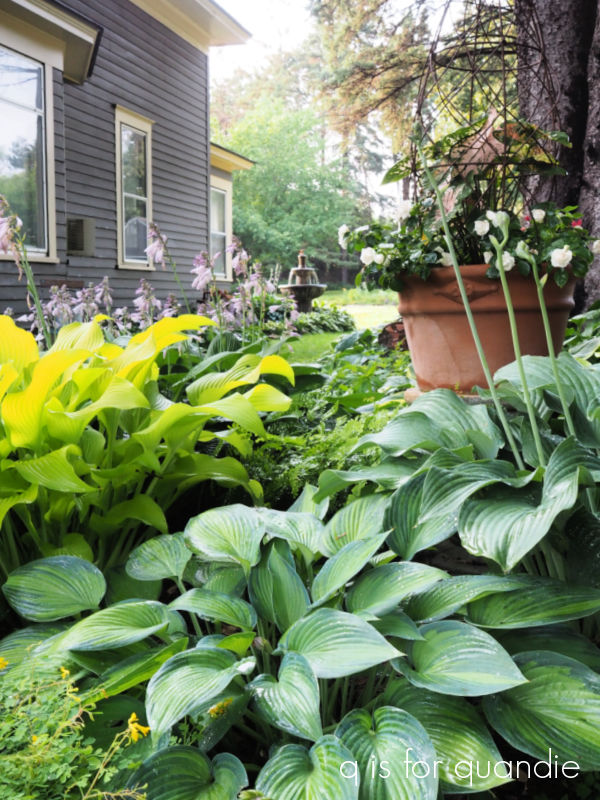
We had a bit of rain last week, and when it stopped and the sun came out in the evening, the shade garden was looking particularly lush. So I thought it would be the perfect time to get some pictures to put together a little tour of this area for you guys.
Let me explain the layout a little bit. Our gravel driveway runs along the east side of our house and goes to the carriage house which is all the way back at the southeast corner of our lot. The shade garden sits between the driveway and the house, and pretty much runs the entire length of the house.
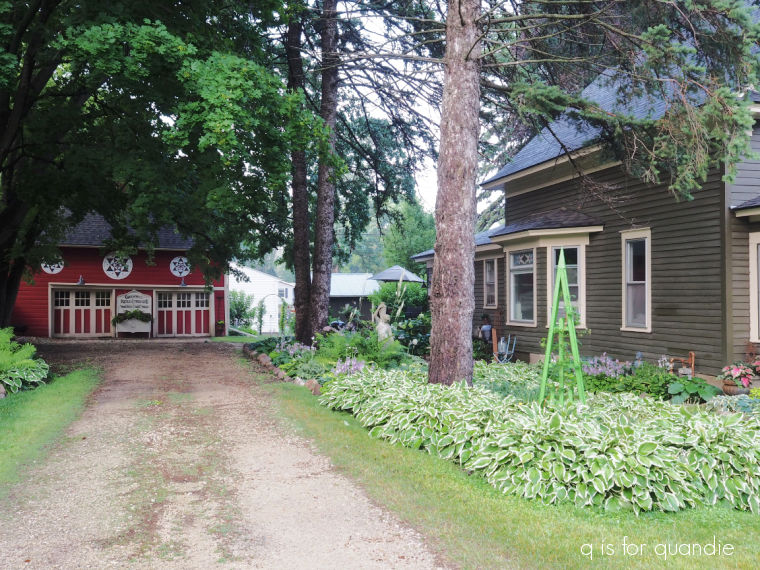
OK, now the basics. I garden in zone 4b in the Twin Cities (for those who don’t already know). This garden ranges from part shade on either end to full shade in the middle. It’s shaded by two huge maple trees on the other side of the driveway, and a couple of ancient pine trees down the middle of the garden.
This particular garden is definitely the one that gets the most attention from me. There are a couple of reasons for that. First of all, I much prefer working in the shade over working in the hot sun. It’s so much cooler. So I find myself wanting to spend more time weeding there. Second, it’s very visible from inside the house. Most of our windows look out to this side of the house including our large picture window in the piano room.
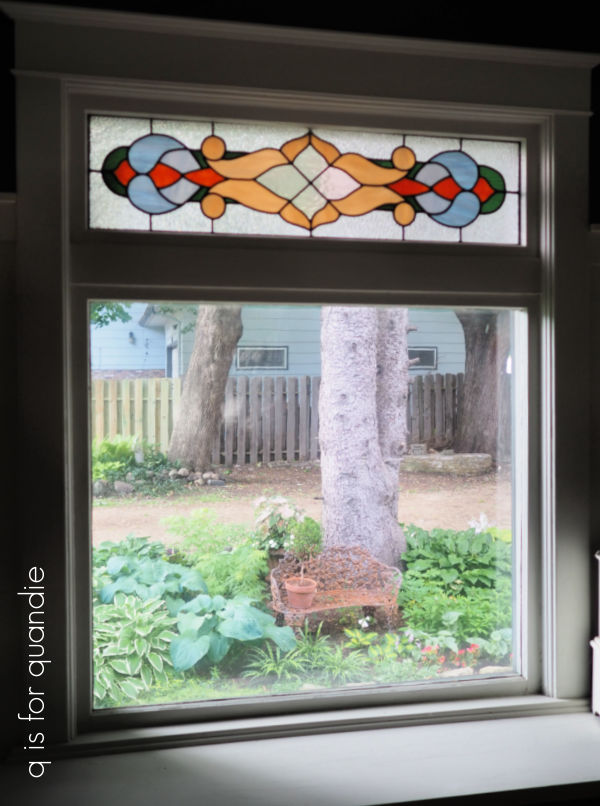
So we get to enjoy this garden from inside the house as well as outside.

We never could get grass to grow in the area between the shade garden and the house, although we tried for years. It’s a fairly high traffic area because our spigot is just next to where you see the watering can on the chair on the left. We eventually gave up on grass and put in the flagstone. Ironically, when we started digging up what grass was there, we found a layer of sand under it. So at some point in the past, this area must have been paved in some fashion. No wonder we couldn’t get any grass to grow!
I’ve always wanted to extend the flagstone all the way down, and then create a path to the front door as well, but um, yeah, that’s probably never going to happen. There are too many other things ahead of that on the wish list.
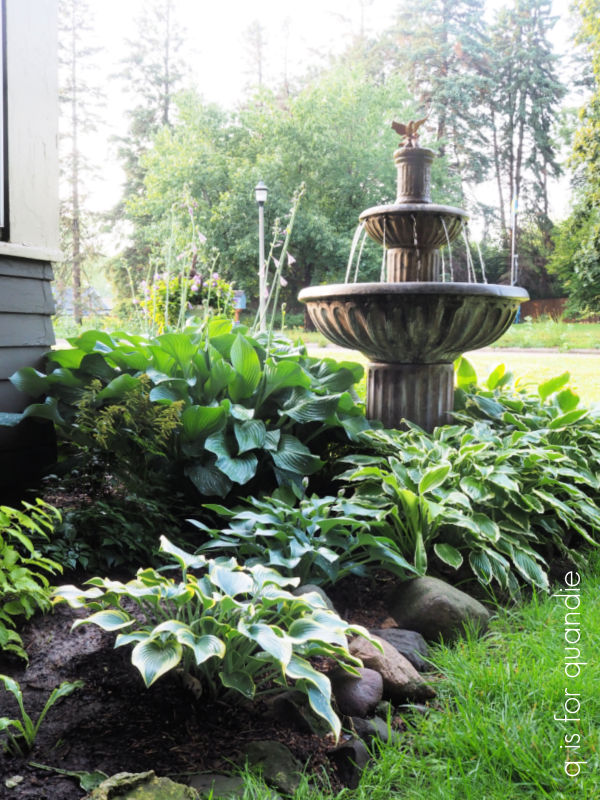
The fountain that you can see down at the end has been located in a couple of different spots since we purchased it, but I like this one the best.
My garage sale statue, Cossetta, sits in the middle of the shade garden.

She’s actually quite tall, but so are the plants surrounding her. There is a fern around her base, and some fairy candles (a.k.a. Black Cohosh, Black Snakeroot, Black Bugbane or Cimicifuga racemosa) behind her. Those fairy candle flowers are taller than me. I think the way Cossetta emerges from the foliage looks rather magical.
This garden is full of shade loving plants. Some of my favorites (other than hostas, which are a given) include tiarella, or foam flower …
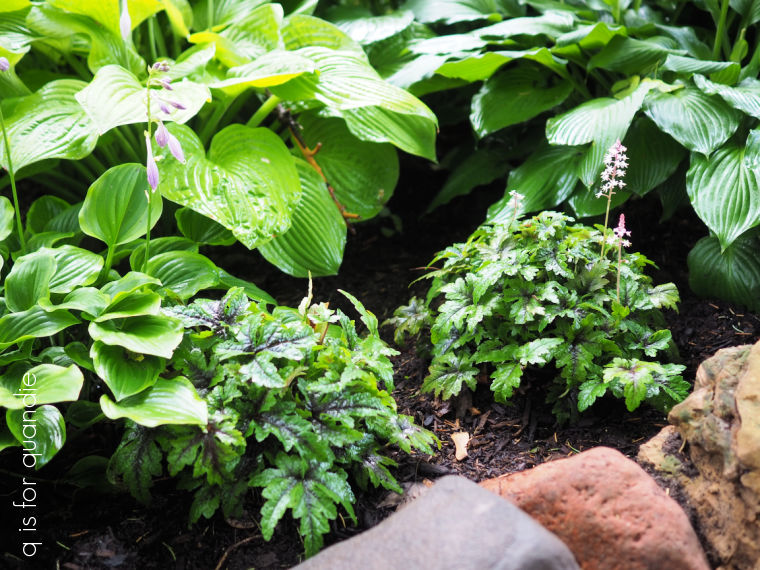
Japanese painted fern …

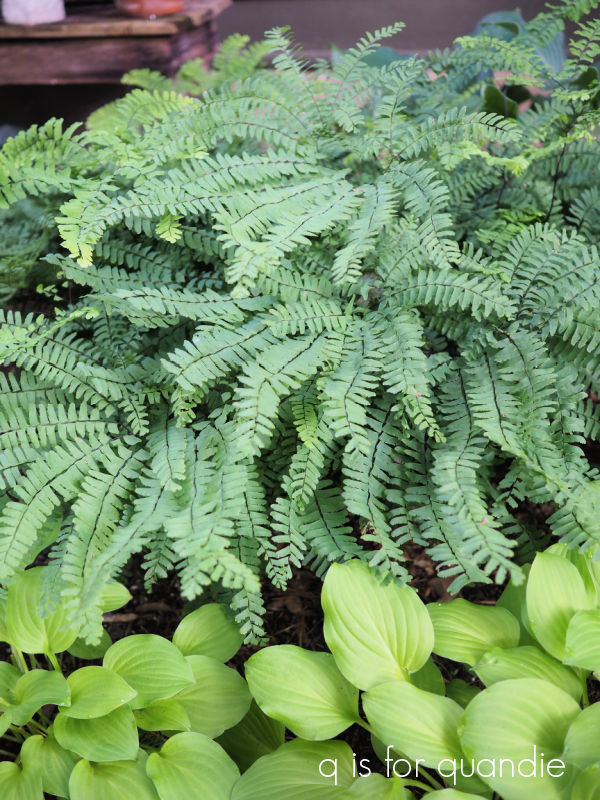
Maidenhair fern …
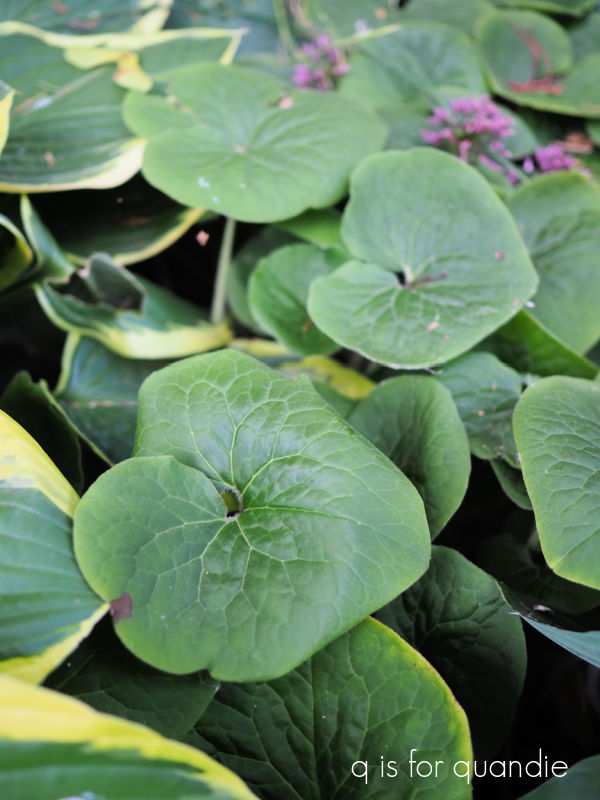
Canadian wild ginger …
and fernleaf bleeding heart (this one continues to bloom for most of the season, and doesn’t start dying back this time of year like the other bleeding hearts).
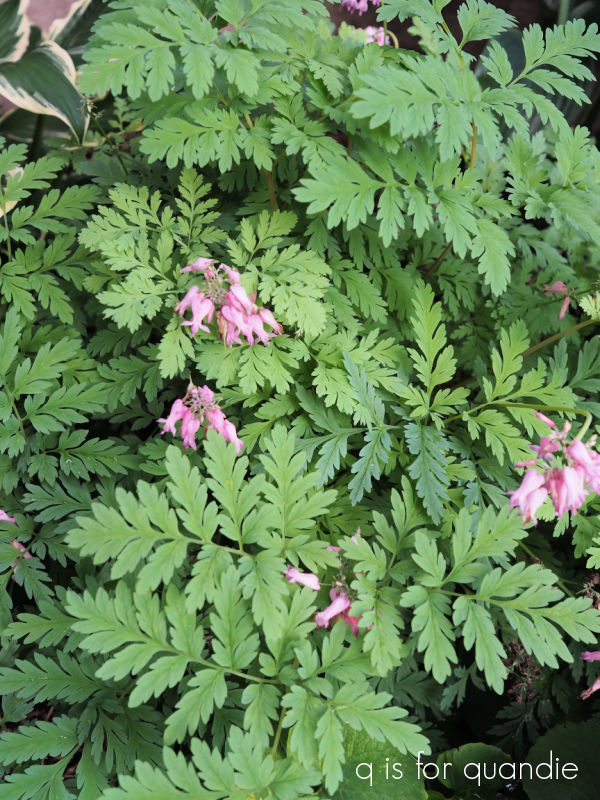
All of these make great companions for hostas.
Speaking of hostas, my neighbor nnK’s mom, Judy, gave me three Curly Fries hostas as a thank you for helping in her garden earlier this summer. I planted them in a triangle in front of the wrought iron bench that came from handyman Ken and his wife, Arlene.

Aren’t they fun? Their texture contrasts perfectly with the large blue hosta behind them.
I’m trying to follow a new rule in my garden, and that is to plant at least three, if not five, of a single type of plant. Planting in groupings of odd numbers like this feels more natural and harmonious than having lots of single specimen plants dotted around.
I have definitely not always followed this rule! I mean, let’s face it, it’s 3x more expensive to buy three of a particular plant rather than just one. But, I’ve been working on dividing existing plants into groupings, and whenever I add something new I try to add more than one.
That being said, I definitely still have some single specimen plants like these hostas.

That is a Guacamole on the left, and a Lakeside Dragonfly on the right.
The Sun Power hosta packs a big punch with it’s bright color, so I think it can stand alone as well.
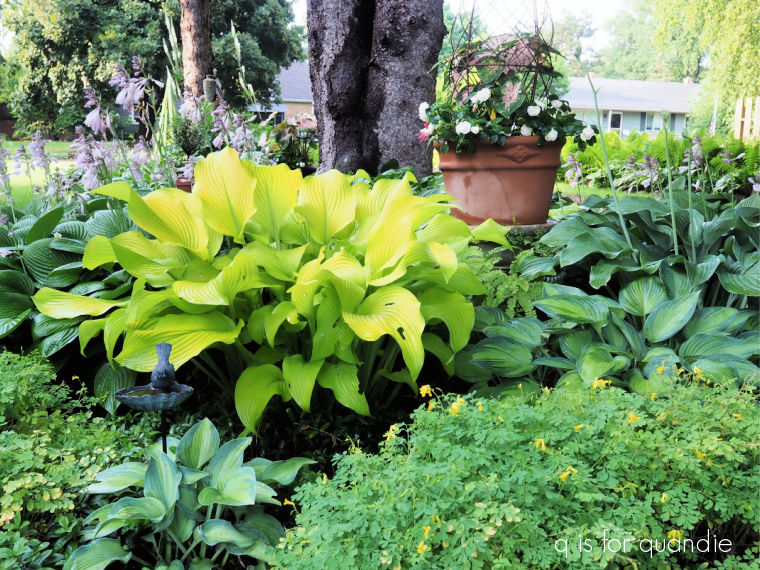
It’s flanked by two June hostas, and that yellow blooming plant in front is a freely self-seeding Corydalis lutea. It pops up all over the place, but it’s also quite easy to pull out if it shows up somewhere that you don’t want it.
Something that I’ve been experimenting with a bit more this year is interspersing some annuals in with my perennials, usually to fill in a space where a neighboring perennial won’t reach full size for a couple of years. I pulled out some bleeding heart last year and after popping in three of the budget heuchera ($5 each!) that I found in the clearance aisle at my local nursery this spring, I also added in some King coleus to fill up the space.
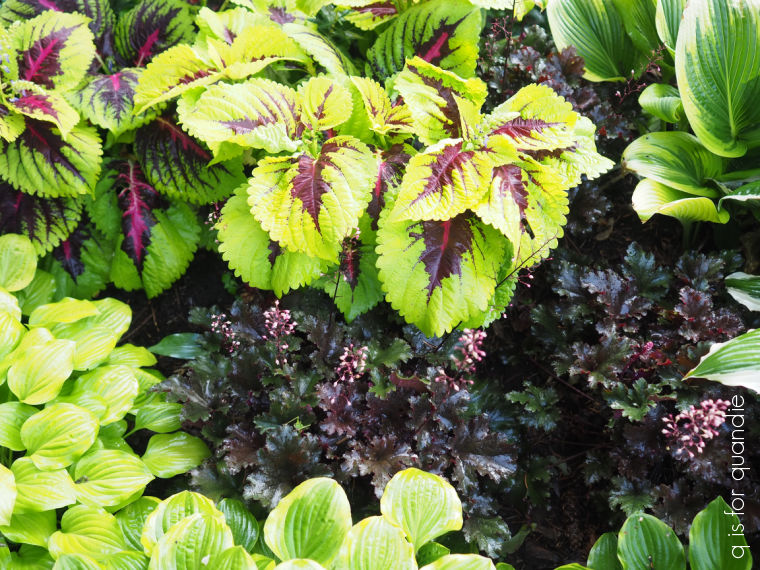
It has created a gorgeous swath of colorful foliage.
Another good way to fill up some empty space is to place pots right in the garden.

My ‘Sun King’ aralia will eventually fill in this whole corner, but in the meantime a couple of my rusty pots filled with caladium look pretty here.
By the way, have I mentioned that I prefer my gardens to be jam packed with plants? It really cuts down on weeding.

There can be some issues with plants that are crowded in like this, they are competing for water and nutrients and there is a greater risk of disease and insect pressure. But personally, I think it’s worth the risk.
I hope you enjoyed this little tour of my shade garden. If you have any questions about particular plants, be sure to leave a comment and I’ll do my best to answer them. Otherwise, I’m heading out to enjoy a cup of coffee in the shade garden!
 q is for quandie
Lovely garden. I once saw a garden in Hampshire England that was totally green and white, it is amazing how many shades of green and white there are in nature. Well done
LikeLike
So true, so many shades! Thanks Juanita!
LikeLike
It’s really lovely what you’ve done! I’m in New England- Zone 5b and we share many of the same plants–most of our yard is also shaded w/Maple and Pine trees. Hope you enjoyed your coffee this morning 🙂
LikeLike
I sure did, thanks Lee!
LikeLike
Your shade garden is gorgeous! I agree with you on feeling the weeding is cut down if you plant your gardens “full”! The plant that drew my attention most is the small one on the left side with dots on the leaves in your last picture! I enjoyed my cup of coffee while enjoying your post! Thanks!!
LikeLike
That is the Raspberry Splash pulmonaria. I love that one too!
LikeLike
Thanks!
LikeLiked by 1 person
Absolutely Beautiful ♡ Your knowledge and comments are “the best”, Love It ♡♡♡
LikeLike
Thanks so much Diane!
LikeLike
Your garden is lovely! I like to plant full and close too! Totally agree about it reducing weeds. I think it’s finding the right balance of planting in groups of 3 or 5 versus a single plant. There’s a place for each to be effective and pleasing to your eye, which your garden certainly is!! Thanks for sharing.
LikeLike
You’re so right Cheryl, it’s a balance for sure!
LikeLike
Your yard is totally outstanding! It is truly amazing. I’m surprised my drooling hasn’t short circuited my iPad 😉
Smiles, alice
LikeLike
LOL, thanks Alice 🙂
LikeLike
I live in Washington State on the Western side of the mountains. We don’t get real warm here, but I do enjoy working in my flower gardens. Unfortunately, we have issues with Snails and Slugs. Do you? If so what do you use to deter them? They LOVE my hostas and it’s very difficult to keep them at bay.
Enjoy all of your posts 😊
Janette
LikeLike
Some years my slug problem is worse than others. This year has been very dry for us and as a result I am not having a lot of slug issues, and I’m also barely getting any powdery mildew (and usually all of my peonies end up with it by now). I used to use a slug bait, but last year I discovered that my cat was eating it! To be clear, there are two different types of slug bait. One is life threatening to pets if they eat it, and one is supposedly pet-safe (so be sure to read the label if you decide to try one). Luckily I was using the pet-safe one, and she suffered no ill effects. Nonetheless, I didn’t want to keep using it because it can’t be good for her, especially since she is on a kidney support diet (who knows what’s in that stuff). So, I went to my local garden center and they suggested I try diatomaceous earth and I did have some success with that. Unfortunately, it has to be re-applied after any rain or watering. And it’s pretty unsightly (a white powder that coats everything). And it doesn’t specifically target slugs, so will kill off any insects that crawl through it including beneficial pollinators. So it’s not a perfect solution. As for all of the ‘home remedies’, I haven’t tried using dishes of beer, coffee grounds or eggshells. Some people swear by them, while others say they are baloney. If you end up trying any of those, let me know whether or not it works!
LikeLike
loved the tour! and the introduction to the curly fries hosta
LikeLike
Curly fries are a fun addition to the garden for sure!
LikeLike
I’ve been a reader for awhile, but don’t believe I have commented.
I love your gardens, and your projects.
Thank you for sharing!
Christine
New Hampshire
LikeLike
Thanks so much Christine! And thanks for taking the time to leave a comment 🙂
LikeLike