
Back in the day when I first began painting furniture I was totally uneducated about the products I was using. I started with latex paint, and then upped my game and began using milk paint and homemade chalk paint, both of which needed a topcoat of wax (or something). At the time, I assumed all furniture wax was created equal. I purchased some SC Johnson paste wax at my local hardware store and figured I was good to go. And I spent a summer using that wax out in my carriage house workshop. The wax had a nasty chemical smell sort of like paint thinner, but I figured all waxes had that smell. When I wanted to experiment with an ‘antiquing wax’ I ordered some dark walnut Briwax online and mixed that with my SC Johnson wax. It definitely did the trick and created the look I wanted, but if anything the Briwax was even stinkier than the SC Johnson. That only confirmed my misguided notion that all waxes smelled bad.
Fast forward to winter. Back then I usually took a break from painting furniture in the winter. But I had an adorable little wash stand that I really wanted to paint. I figured I could paint it indoors and then wax it on my enclosed front porch. It was warm enough out there, but even with the door shut between the house and the porch, that stink made its way inside the house and it wasn’t pleasant.
So much for winter painting!
But then I discovered Miss Mustard Seed wax. Eureka! It has a scent to it, but it’s very mild, not a harsh chemical smell. I could wax inside the house all day long and not feel like my house smelled like a workshop.

However, it definitely costs more than the cheapy stuff.
Since I’m a cheapskate, I was determined to find a cheaper choice. As a result, I’ve tried many different brands of wax and guess what? They didn’t really save me any money at all because I’d open up the can and realize I was back at stinky wax. As it turns out, you get what you pay for. Sometimes. But other times even the more expensive ‘name brand’ waxes are just as stinky.
Initially my decision to ‘splurge’ on the Miss Mustard Seed wax was really just based on the lack of smell. But recently it occurred to me that I do A LOT of painting. I should really be thinking about what kinds of chemicals I am subjecting myself (not to mention the environment) to on such a frequent basis. This really is about more than just dealing with an unpleasant odor, what about repeated exposure to unknown chemicals? Just what exactly is causing that stink?
I tried to do some online research into the ingredients in various brands of wax, and guess what? For a lot of the brands it’s really hard to find that info. Apparently back in 2009 Senator Al Franken helped introduce a bill called the 2009 Household Product Labeling Act which would have required paint manufacturers to list all ingredients on their packaging, but it did not pass. But honestly, even if the ingredients themselves were listed, would you know what they are? I know I wouldn’t.
So I went straight to my source, Homestead House Paint Co, and asked the simple question “hey, how come your wax doesn’t stink?” and I got a nice email back from Loree Pringle with lots of info about beeswax and carnauba wax, and about how they need a solvent to allow them to be spread into a thin layer. Then she put me in touch with Roger Clapham, the co-president of the company that manufactures their waxes. He gave me a bunch of really science-y info about atoms in a chain and whether or not they hold hands (or something like that) that was way over my head. But basically he explained that there are two kinds of solvents that can be used for this purpose, aromatic hydrocarbons and aliphatic hydrocarbons. The aromatic hydrocarbons have that chemical smell like paint thinner, and include Toluene or Benzene. And guess what? Aromatic hydrocarbons are considered carcinogens. Yeah, that means they have been shown to cause cancer. Both the Miss Mustard Seed waxes and the Homestead House waxes contain no aromatic hydrocarbons. Instead they use aliphatic hydrocarbons.
So I followed up with the next obvious question, why would any wax still contain aromatic hydrocarbons if they are so bad? According to Roger, the aliphatic hydrocarbons are weaker solvents than aromatic hydrocarbons. Products made with aromatic hydrocarbons require less of them to do the job and those products can be more durable and provide more shine. For example, he does not believe the Homestead House wax is durable enough to hold up to foot traffic on my stairs (although I’m going to try it anyway one of these days).
As Roger says himself, he has a healthy respect for aromatic hydrocarbons and their usefulness as long as people understand what they are working with and take precautions. If you still want to use one of those products, Roger gave me some safety tips: Buy a mask specifically designed to protect against aromatic solvents (OSHA certified) and wear it while working with them (changing the filters as directed). Toxins can be absorbed through the skin, so wear rubber gloves. Pay attention to air circulation, apply the finish outdoors or use a fan and open the window. On the plus side, the danger is gone once the solvent has evaporated. So a piece of furniture that has this type of wax on it is no longer hazardous at that point, once the smell is gone so is the hazard.
Since we can’t rely on a label to tell us what kind of solvent a wax product uses, I say rely on your nose. Give your wax the old sniff test. Does it smell like paint thinner?
If so, ask yourself if this is really something you want to be working with on a regular basis? And are you using the proper precautions?
As for me, I’m not a fan of gloves and gas masks. Working outdoors is only an option about six months out of the year here in Minnesota. So I finally tossed all of those stinky waxes and am going to stick with the non-smelly stuff!
Now for the fun part! Here is your chance to give the non-smelly stuff a try yourself. When I told the people at Homestead House that I wanted to post about this subject, they graciously provided me with a truckload of free samples to giveaway.

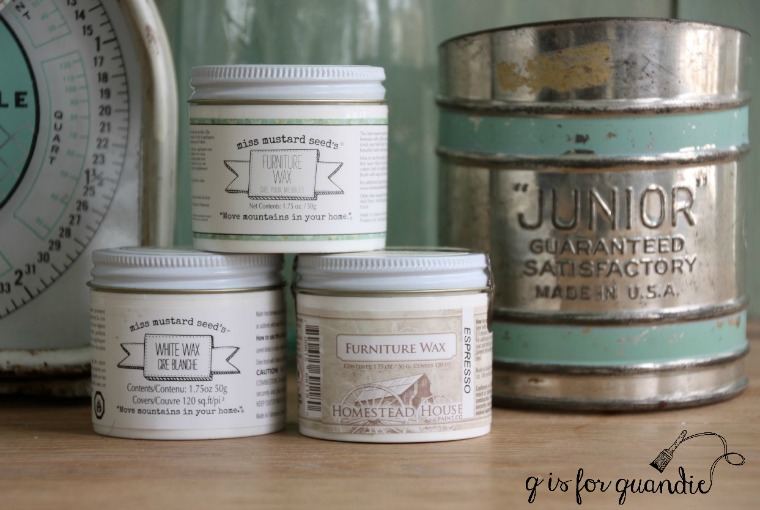
I have 8 small jars of wax and I thought I’d give them away in pairs, so 4 lucky winners will each get 2 jars of wax. I have a variety of different waxes including Miss Mustard Seed White Wax, Antiquing Wax and Furniture Wax, Homestead House Furniture Wax in clear, Espresso and Black, and a couple jars of Salad Bowl Finish. I will draw 4 names at random from the comments left on this blog post by Sunday, January 29 at midnight (central time), so all you need to do is leave a comment to get your name in the running to win. Best of luck to you!
Note: the Safety Data Sheet for SC Johnson paste wax lists Ethylbenzene and Naphthalene as ingredients (both aromatic hydrocarbons). Briwax contains Toluene, however they do offer a Toluene free version of their product, but I was not using that version.
Also please note that I have not been paid by Homestead House for this post but they have provided me with free samples of their waxes and other products including Fusion paint, Homestead House milk paint and Miss Mustard Seed products. In addition they provided me with the waxes that I am giving away with this post.
 q is for quandie
Thanks so much for the chance to win! I love seeing your makeovers and learning about your process.
LikeLike
Thanks Alison!
LikeLike
Great information! I too am “frugal” and started out with the paste wax that was out in the workshop at first, then graduated to $$$ Annie Sloan wax, which really was not a lot better in the smell department. Would love to try a healthier product…thank you for the chance!
LikeLike
I was really surprised when I purchased my first can of the Annie Sloan wax (which was fairly recently) and opened it up and discovered that it had ‘that smell’. I have been totally unable to find any info online about the ingredients in that product though.
LikeLike
Thank you for this info and a chance to win these products that I have been wanting to try!! Love your blog!
LikeLike
Thanks Joyce! I’m glad you enjoy the blog!
LikeLike
Thank you for doing this research. Some of those waxes are trully nasty.
LikeLike
Yeah, they really are. I’m kicking myself a little bit now for blindly using them for so long without really knowing what was in them.
LikeLike
Wow! Thanks for the info! Important stuff!
LikeLike
I agree. I can be really bad about using protective gear when I should, so I’m glad to know that I don’t have to worry about it with the HH and MMS waxes.
LikeLike
Great info but I’ll re-read it later today when I’m more awake. Tough sledding when my eyes are barely open yet. I’d love to try these products but like you, I have to wonder, Why So Expensive? Between the chalk paints and waxes, my jaw drops when I see the prices. I have a choice for my birthday, a selection of those products or standing rib roast. The rib roast is cheaper.
LikeLike
AND, I bet the researchers at the CDC are required to wear less protection when working with the ebola virus!
LikeLike
LOL, can you picture me working on my furniture wearing one of those fully enclosed white suits with the big hose going to my air tank?
LikeLike
Good quality ingredients always cost more. I bet you don’t want the cheap chuck roast either 😉
LikeLike
Wow, thanks for the information. I know MMS is suppose to be a natural way of painting but I didn’t realize the wax too. Good to know. Thanks for the chance at the giveaway too. I would love to win some of her waxes.
LikeLike
Same here. I have always felt good about using the paint, but hadn’t considered what was in the top coats. Now we know!
LikeLike
I hate stinky wax, too!
LikeLike
I feel like that should be on some sort of picket sign 😉
LikeLike
Your blog is such an Inspiration and educational to boot! Thanks for the chance to win this lovely prize!
LikeLike
I think I should do some more educational type posts in the future, but first I’ll have to go get educated on some more stuff 😉
LikeLike
Thanks for the information and the give-away!
LikeLike
You’re welcome Deb!
LikeLike
Thanks for the good science behind the waxes… better life through understanding chemistry! Really enjoy your blog!
LikeLike
Chemistry was always my worst subject in school. I’m fairly sure I was one of those students who said “I’ll never have to use this information ever again” as an excuse for not studying as much as I should have. Who’d have ever thought I’d end up wishing I knew more about chemistry?
LikeLike
Wow !!! And to think I have been subjecting my lungs to this smelly stuff for sooooo long. Me and my lungs thank you for the great information and the opportunity to try a new type of wax.
LikeLike
I am right there with you Vanessa. I feel a little bit like I’ve been ‘scared straight’ on the wax thing. No more stinky waxes for me!
LikeLike
Thank you for all the research! I’ve had the same concerns (money, smell, carcinogens) but so great knowing the facts! Love homestead house products!
LikeLike
You’re welcome Julie!
LikeLike
So nice of you to do all the legwork and share with us! Thanks so much! Cathy
LikeLike
You’re welcome Cathy!
LikeLike
Great write up on waxes! The products may be expensive initially but are high quality . It the Furniture Wax does last a long time. For the home painting enthusiast the 2oz or 7 oz sizes are plenty. You can also speak to your local retailer about ordering a 40 oz tub of Furniture wax. I personally offer my professional painters this option and it provides a significant cost savings. White wax goes a very long way and in 3 years I’ve only used a few 7 oz Antiquing waxes. I think Antiquing wax still is offered in a 40 oz size. This of course is a special order and your retailer may wish you to prepay . I’ve had a few special requests that were never picked up so please understand if this is required.
LikeLike
I think I might need the 40 oz tub! I do go through a lot of the regular furniture wax. But you are so right about the white wax. I have the smallest size jar and I’ve only used about half of it and I’ve done 4 or 5 projects with it. A little does go a very long way!
LikeLike
All great information! I use both Annie Sloan and MMS waxes. I do need to be better about wearing gloves though! Thanks for the reminder!!
LikeLike
I have found that you can definitely get a little more shine out of the Annie Sloan wax, but it does have that smell. I was unable to find any info online about whether or not it contains the aromatic hydrocarbons. Just please be safe and using gloves and a mask unless you know that product is safe. And if you do find any info about the ingredients in the Annie Sloan, please share them with me.
LikeLiked by 1 person
Wow! I do almost all of my painting in my living room and I usually use the ‘bad’ waxes! I had no idea they were harmful – just that they stink 🙂 I would love to try some of these ‘better for you’ waxes – especially now since it’s too cold to open windows or work outside!
LikeLike
Step away from the stinky wax Jill! Even if you don’t win the giveaway, I hope you’ll buy some HH or MMS wax and give it a try, especially if you’re working in a non-ventilated area. You can order online or find a retailer near you at the Homestead House website.
LikeLike
Thank you for the info. I know I should wear safety protection using lots of different tools in home improvements and painting but I’m not good about doing it. Will make more of an effort now with the wax. Long time reader, first time commenter. Love your work!
LikeLike
I am the same way Kathy, very bad about wearing protective gear when I should. I’m glad I’ve motivated you to be more careful.
LikeLike
I had been using browse for years, but my dilemma is it dries out too quickly, so I decided to try the mms wax, and I find it much easier to use, and yes it doesn’t smell. I haven’t tried the antiquing wax, but that is next.
LikeLike
Is that a typo Tamara? Or what is ‘browse’? Now I’m curious what you are referring to there.
LikeLike
I have never tried Miss Mustard Seed wax ! Thanks for doing all the homework Linda!!!
LikeLike
Hopefully you will be one of my lucky winners Lisa so you can give it a try. I bet you’ll like it 😉
LikeLike
What a terrific article! Thank you so much for your research. I am new to chalk painting and recently read an article on the different recipes for homemade chalk paint and thought well what about the wax? There was a link to someone that uses Howards beeswax on her painted furniture which confused me as I have only used that as a polish for stained furniture, and I find it to be oily. I plan to try it on a test piece. I have used Lowes wax for furniture on a chair but found it to leave a yellow film. Maybe I need to buff it out more? I would love to try some of the non- stinky waxes. Love your blog and all of your work!
LikeLike
I have found the Minwax to be very yellow as well, but I have never tried a Lowes wax. I’ve given up making homemade chalk paint for health reasons as well. I used to make it by adding Plaster of Paris to regular latex paint, but I read a few articles that suggested sanding and breath plaster of paris is a bad thing too.
LikeLike
Two things: Many of the safer waxes use hemp oil. They are not good over white paints because the hemp oil is dark, so it will discolor your whites. Secondly, about mixing your own chalk paint. You are absolutely correct to be worried about silicosis, a lung disease from inhaling particles of silica which are found in plaster of paris and also unsanded grout. The trouble is that silica is also in chalk and clay. After finding that out, I am always careful to wet sand. It is really too bad that we have to do all this research ourselves and only after we have exposed ourselves to things. Chalk and clay are perfectly non-toxic, but we still shouldn’t breathe them into our lungs.
LikeLike
I would love to win! I have been using MMS wax off and on (I switch up with the completely solvent-free stuff). I have a question for you. If you leave the lid off when you wax, does the solvent eventually evaporate before you even use it on the furniture? I buy it in the 40 oz. size, and have to mix it before each use, so the lid is off longer than if I were using the smaller sizes.
LikeLike
I don’t know the answer to that question, but I’m going to guess the answer is no. If the solvent evaporated before you used the wax on your piece of furniture, then the wax would not be spreadable. It would become a hard lump of wax. What is the ‘completely solvent free’ stuff? I’m curious.
LikeLike
I’ve used several brands. I think they use oil in place of solvent. CCC, APC, Van Dykes, Chalk Mountain, Wise Owl, Pixie Dust (the lavender oil gave me a horrific migraine, but it cures to a really hard finish), and probably others. I am always looking for the perfect wax that won’t give me a headache but is durable enough that I can sell the piece without worry. I love the MMS wax, but the solvent does bother me. I keep coming back to it because I trust it for my clients, but i’ll only use it in front of a cracked open window. I’m pretty sure that MMS antiquing wax has no solvent.
LikeLike
I have been following your blog for quite a while and you have inspired me to do my first project in MMS milk paint. I’m anxious to give it a whirl. Your research is great to have. I’ve always wondered why wax is stinky. 😷 Like you I don’t like wearing hazmat attire. I look forward to each post and love your makeovers!
LikeLike
It’s really hard to look attractive in those hazmat suits, right 😉 Best of luck with your first milk paint project. I always advise people to start with something small and be patient with milk paint. It’s trickier than other paints, but if you love that chippy look it’s the only way to really get it. It’s still my favorite paint to work with.
LikeLike
Oh babe, you’d be hot in HazMat! You’d so rock it!
LikeLike
Very informative post, Linda. Thank you! You were so smart to throw away your old waxes. It’s not worth compromising your health to save a couple of $$. Isn’t that why we love milk paint? It’s a natural product. 😀 Thanks again, Cynthia
LikeLike
Yes! I was initially drawn to milk paint because it could give me that chippy vintage finish, and I often forget about the fact that it’s also all natural and doesn’t contain any nasty chemical ingredients. I agree, let’s not compromise our health to save a couple of bucks.
LikeLike
Hello Ms Q. I am so inspired by your blog. I love to paint …everything…love little chippy…everything…love a little vintage scattered throughout my house. I don’t consider myself a “seasoned” furniture painter but I have painted several pieces. I am definitely hooked. I am concerned about my health too. I prefer painting outdoors but when I gotta paint…I gotta paint so I will try the suggested brands. I appreciate you doing the research for us. Keep calm and paint on!
LikeLike
I much prefer painting outdoors too, but in my climate that only works for about half of the year. The other half I’m indoors, so I like being able to use products that are safe inside a sealed up home in the middle of a Minnesota winter.
LikeLike
You had me at “not stinky” ! Great post and perfect timing with the cold winter and chilly spring months ahead for painters that have to get their painting fix. Your blog always inspires and informs and this one hit it out of the park ! THANK YOU and hoping I am one of your lucky winners ! xox
LikeLike
Thanks so much for the compliment Karen! I’ll keep my fingers crossed for you as well.
LikeLike
Excellent informative post. Sort of scares me too thinking of all those years my husband worked over winter in the closed garage never once thinking about the fact he could absorb toxins through his skin. Yikes!
LikeLike
Hindsight is always 20/20. We can’t do anything about those past exposures, but going forward we can be more careful, right?
LikeLike
This hits home Linda. When Henry was little, he had asthma. Seth built him a bed, with stain and poly. I know about off-gassing and left it in the garage for a month. The night we put it in his room, he had a huge attack. Nothing is scarier than your child not breathing. He was not sick, it was from the chemicals, even after that long. It’s stunning to me what the US allows into our food system and household products. The European Union has banned nearly all toxic chemicals. Here, though, we are left to our own devices to determine what to allow into our homes. It’s no coincidence that our health is in crisis. On a positive note, once I educated myself and removed preservatives, chemicals and dyes from our food, our children no longer had asthma. I am also very conscious of what I bring into our house, not just with cleaning products, but home items, etc. Another reason why I love to thrift because any older furniture has already gone through the stages of off-gassing. Thanks for bringing light to the issue, it really is a matter of “the more you know”. And you know I’d love to try these 😉
LikeLike
Not only does the US allow the ingredients, apparently they also don’t even want to require listing them on a label. Bizarre!
LikeLike
Thank you for the great information! I would love to try the wax on the new (old) newel I picked up recently. Inspired by one of your recent posts!
LikeLike
That’s awesome that you found a newel post too! That will be a fun project for using the wax.
LikeLike
Love this post! I’ve been experimenting with waxes as well and wow, such a difference! I love the MMS antiquing wax and would love to try the other non-stinky waxes. I hope I win 😀
LikeLike
I think you’ll like all of the waxes just as much!
LikeLike
Love all your furniture makeovers and would love to try MM wax…thank you!
LikeLike
You’re welcome Hope!
LikeLike
Thank you for taking the time to research the safety issues regarding wax. I will definitely be using the “non-stinky” type from now on. Love your site.
LikeLike
You’re welcome Laura.
LikeLike
Love me some waxes 💞 just in time for a project I need to finish and haven’t had a chance to run to my local (an hour away) retailer to get antique wax!! Thank you!!
LikeLike
I’ll throw your name in the hat Shelly!
LikeLike
I love MMS’s waxes because I find them easier to apply. It’s a bonus knowing they are safer too! Thank you for the info.
LikeLike
I find them easier to apply as well. To me they seem a bit softer than some of the other waxes.
LikeLike
Good info!!! I agree with you!!! The only wax I have used is Annie Sloan’s, yes its a bit pricey, but it does go a long way. Also learned that I could mix her dark wax with orderless mineral spirits!! Really can do many different looks!! Thanks for sharing! Have a Great Weekend!!!
LikeLike
I’ve never tried that technique. There are so many fun ways to play around with these products. Just use caution when you aren’t sure of the hazards.
LikeLike
Thank you so much for enlightening me about the waxes. I have worked with Jennylyn Pringle at Homestead and think she is really interested in helping her customers. Love their stuff!
LikeLike
I agree totally. I know that their paint products go through rigorous testing as well. Especially the Tones for Tots line which underwent additional safety testing to meet the Toy Safety Standards of North America and Europe.
LikeLike
I would love a chance to try MMS’s waxes. The ones I have used in the past were the same stinky ones you used. I didn’t know there were any that didn’t stink! Plus the bonus of being able to do it in the house in the winter in MN? Lovely!
LikeLike
Yes, waxes don’t have to stink!
LikeLike
Very informative post! Thanks for doing the research! I would love to try some new waxes!!
LikeLike
I’ll put your name in Wendy!
LikeLike
Thank you for doing the research! I stopped using stinky waxes a while ago just because, now I know I made the right choice! Sharing this post on my page, Strawberry Patch.
LikeLike
Thanks for sharing Katie! Yep, you definitely made the right choice!
LikeLike
Thanks for the information Linda! That was a lot of work and its most appreciated. Also thank you for the chance to win free wax!
LikeLike
You’re welcome Jackie!
LikeLike
Thanks so much for this info – such an important thing to consider!
LikeLike
I agree!
LikeLiked by 1 person
Thankyou for all the wax on ,wax off , information! I am particularly interested since I have to have a fragrance free household . Thanks!
LikeLike
That sounds like quite a challenge Candice, to have a fragrance free household. You definitely don’t want to be using any of those stinky waxes.
LikeLike
Thank you so much for investigating this for us all. I’ve been looking for an alternative to the ‘stinky stuff’ too, and thanks to you, I now know what to use. My brother has non-hodgkins lymphoma as a result of being a auto-body guy for many years. So, of course, I’m very cautious about what I touch, breathe in, and put out into our environment. I would love to give this product a whirl!
LikeLike
Oh, I’m so sorry to hear that about your brother. Your story is a good cautionary tale reminding all of us to be more careful about the products we use!
LikeLike
Thanks for the info! Your blog is one of my favorites! You do amazing things with old furniture. Very inspiring. Anyway, thank you for the give-away and I hope I win!
LikeLike
Thanks Cyndi! I do like to reform old furniture. It’s amazing to me to see the quality of the workmanship of old pieces of furniture compared to the cheap new stuff you can buy these days. I’d much rather have a refurbished old piece than anything new.
LikeLike
Thank you for a very informative blog post on wax. I often wondered this same question, and just used some wax in my basement last night. Here in St. Louis…winter is cold and icy. Not nearly as bad as the Great North, but still takes a bite out of my painting and waxing in Winter. I will be more careful from now on what wax I’m using.
LikeLike
Absolutely! Be more careful for both you and your family if you are waxing indoors.
LikeLike
Thank you for the info.
I am very concerned about using more natural products.
I would love to try some of the MMS wax.
LikeLike
You’re welcome Deb.
LikeLike
Great Info – I”m just beginning to dabble into the furniture wax world and would love to try this product …
LikeLike
I’ll definitely throw your name in the hat Janice!
LikeLike
It’s nice to have the scientific information… it just reinforces my love of MMSP!
LikeLike
Yep, same here. I have always loved her products. Well, that’s not entirely true. The first time I tried milk paint I wasn’t at all sure how I felt about it. It was not love at first sight for me. But then I worked with it a little bit more and became more familiar with how to make it do what I wanted it to and the love has grown from there 😉
LikeLike
Honestly, Linda…you are such a wealth of information and experience! Have you ever considered writing a book? It would be a best seller and, I know, a fun read! Thanks for the info…and an opportunity to win and try something new!
LikeLike
You are a flatterer Patty! As a blogger I often feel like something my mother used to say really applies when it comes to writing a book, ‘no one buys the cow when you can get the milk for free’. I know that’s not entirely true and there are lots of bloggers with successful books out there, but I’m already sharing all the good stuff for free here on the blog. No need for a book 😉
LikeLike
Wow thanks for doing so much research, it was very informative.I did not resort to stinky wax but started right off with Claphams in the day then moved to some others.
Thanks for a chance to try some other brands as well.
LikeLike
Good call Laura! I wish I had been as smart back when I started.
LikeLike