should I throw in the towel?

Good morning from the garden.

I just realized that the title of today’s post might come across as a little click-bait-y.

No, I’m not throwing in the towel on blogging.  What I am considering is throwing in the towel on my lilac hedge.

Yep, after 14 years of struggling to grow a proper lilac hedge I want to give up.

Let’s start with a little history on the hedge.

When we purchased our house in 1988 there was a hedge that ran all the way across the back of our property.  I have no idea what type of hedge it was.  You can sort of see it in this photo which dates back to 2009.

See it back there behind the potting shed?  It was a tangled hot mess, and it was next to impossible to prune.  However, it did a great job of providing privacy in our backyard.

I was tired of how messy it looked though, so in 2011 we pulled it out and replaced it with a row of lilacs.

I thought lilacs would be easy.  They grow like weeds, don’t they?  I see them everywhere here.  I know people who have literally cut their lilacs down to the ground and they still bounce back.

They require full sun, which I happen to have along the back property line.  So it should be the perfect spot for lilacs.

I also love the flowers, so a lilac hedge seemed like a no brainer.  A big, fairly low maintenance shrub that would provide privacy in the summer (not so much in the winter when they lose their leaves).

But aside from some lovely blooms in the spring …

I have had exceedingly poor results with mine.

I initially planted around 10 lilacs, and after 5 years, the hedge looked like this …

Really sad, right?

But I was determined.  I kept pulling out the scrawny lilacs and replacing them.  I decided that maybe the problem was the hybrid (ie. fancy) lilacs that I was choosing.  Maybe I needed a basic common lilac to get the result I wanted.

So I put in two of those, and they did quite well for a while.  Here they are last summer when I thought maybe this lilac hedge was going to work out after all.

As an experiment, I planted three clematis to grow up amongst the lilacs last summer.  Clematis take a few years to really fill out, but I did get a handful of blooms this summer on the two that made it through last winter.

Unfortunately towards the end of last summer the lilacs ended up with leaf spot fungus and once again looked awful after losing most of their leaves.

They only recovered somewhat this spring.  I had plenty of flowers.

But the leaves never really filled in well.

To try and add some bulk down low, I decided to try to underplant the lilacs with some hostas a month or so ago.

I divided these from a row of hostas that I have in another area.

Hostas always look a bit sad after being divided, and to make matters worse, something is eating them now (I suspect deer, but it could be rabbits).

But they should look much better next year if I can keep them from being eaten.  I think I’m going to have to resort to using a deer/rabbit repellant spray.

However, once again this summer we have had lots of rain and humidity, the conditions that allow leaf spot fungus to proliferate.  So once again my lilacs again look pretty pathetic.

Every year I waste on trying to baby these lilacs is another year that a different shrub could have been growing to maturity.

So now what?  Do I throw in the towel?  Pull everything out and start over?

Or do I give them one more year?  Wait and see how it looks as my clematis and hostas fill in?

What would you do?  Leave a comment and let me know.
more summer reading.

I was so pleased with the results that I got with the books that I painted a couple of weeks ago that I decided to keep the black set for myself.

And then make some more!

So I went back to the thrift store and purchased another six books and got to painting.

This time I was a little smarter about my selection and I only purchased those books that were already black.  I still had to paint them, but it only took one coat, and I didn’t have to worry about getting the inside edges of the covers.

After painting all six books in Dixie Belle’s Caviar, I pulled out the same two I.O.D. transfers that I used last time to add to them; Wilde Bloemen and Étiquettes .

I also used the Dixie Belle Gold Pen to add some horizontal lines here and there.

I finished them off with a coat of Dixie Belle clear wax.

For the 2nd set of three books, I decided to try a different floral.  This time I went with the I.O.D. Saint Germain transfer.

Isn’t that pretty over black?

Now I’m thinking that I’ll need to use this combo on a toolbox!

Although that being said, I think those florals would look pretty over Dixie Belle’s Ecru or Drop Cloth too.  On books or toolboxes.

OK, so which floral do you like better?

Wilde Bloemen on the left or Saint Germain on the right?

Leave a comment and let me know.

is it just me?

Is it just me, or do you also think garage sales gone downhill lately?

Remember the good ol’ days when I would come home with a haul like this one?

Here’s another good one that’s more recent, from 2023.

I always had some pretty good finds of the day too.

How about the time I found this awesome ‘portable’ typewriter?

Or this lovely glass tree topper to add to my non-collection?

I used to find plenty of vintage glass Christmas ornaments.

But this year I haven’t found any.

OK, to be fair, it might be slightly my fault.  I’m not getting out there nearly as much as I used to, especially this year.

Mr. Q and I took our trip to the Brandywine Valley in May, which caused me to miss a few of my favorite neighborhood sales.  And now I’ve gone and done it again since we have a trip to Canada coming up and I will miss two big neighborhood sales for this one.  I think May and September are probably the top two months for sales in my area (Twin Cities, MN).

That being said, I have found quite a few sleds this year.

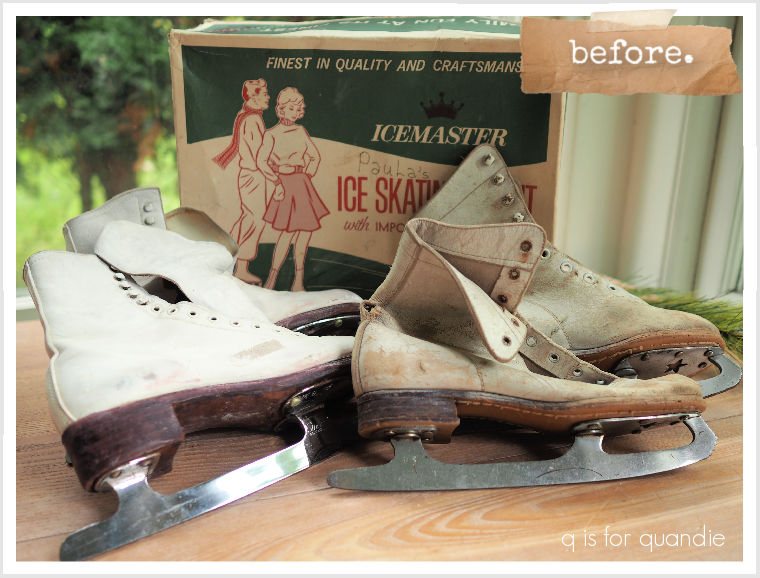
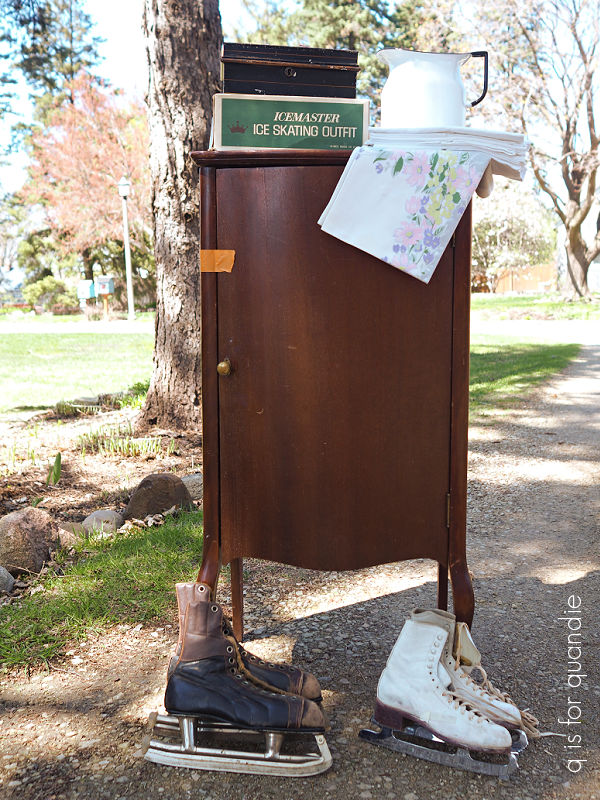
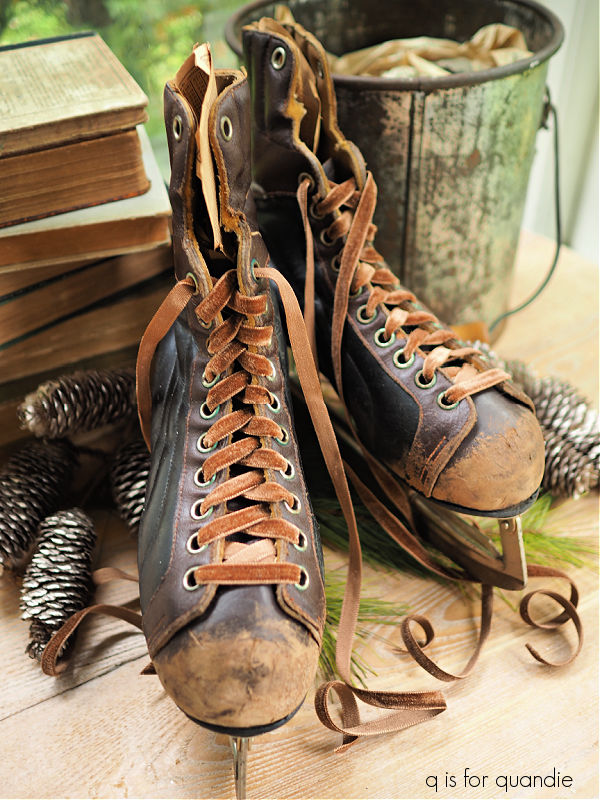
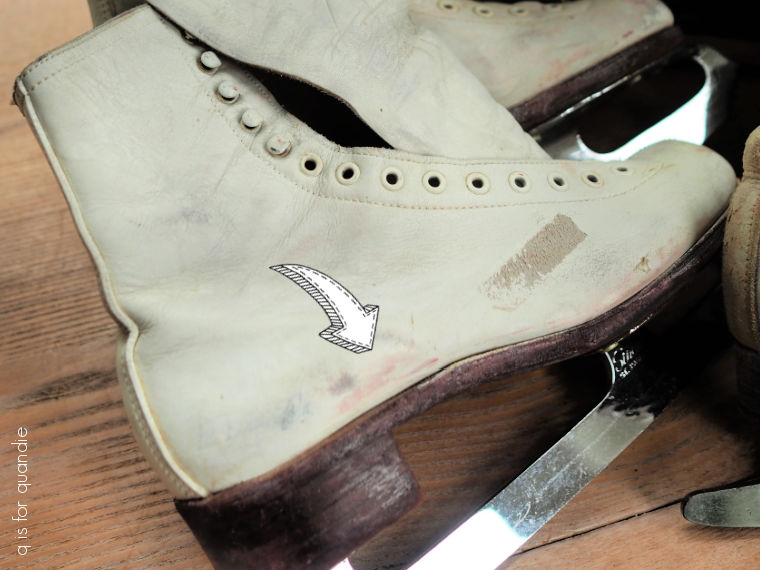
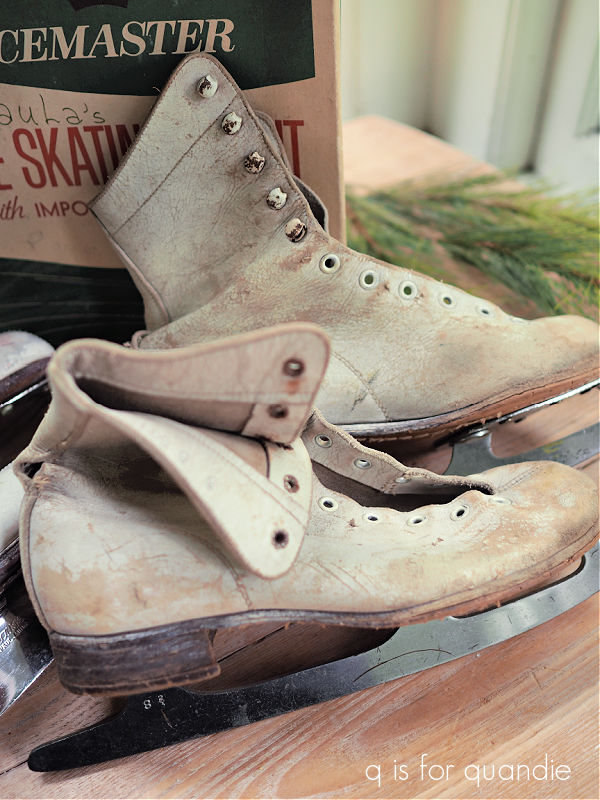
And I also have quite the stash of ice skates to work some magic on for the coming holiday season.

I’ve also definitely found plenty of toolboxes over the summer.

That brings me to my latest ‘haul’ … if you can call three items a haul.

My friend opK and I went up to Chisago (yes, that’s Chisago, not Chicago, although autocorrect begs to differ) for their city wide sales a week ago or so, and I came home with just three things.

First up, this vintage laundry basket.

It has a fantastic patina and is in great shape.  My plan is to fill it with dried hydrangeas and then put it in my fall sale (tentatively scheduled for October 4, FYI).

I also nabbed a pair of vintage pillow cases.

I love the feel of vintage linens like these.  It’s hard to describe if you don’t know what I’m talking about, but suffice to say they just don’t make ’em like this anymore.

I will soak these in some Oxyclean (although I haven’t found any stains on them), then wash them and hang them on the line for our own use.

The third item I brought home is another toolbox.

It will be added to the stash to be worked on at a future date.

And that’s it for my recent garage sale finds.  How about you?  Have you had any amazing finds lately?  Leave a comment and let me know.

all the buzz.

Good morning from the garden.

It seems like planting pollinator friendly plants is getting all the buzz these days (pardon the very bad pun).

I have to admit that I’ve never planted anything just because it’s good for pollinators.  That quality is way down on the list of things I look for in a plant.  I figure any flowering plant is better for the environment than just having a lawn, right?

I do sometimes choose things specifically to attract hummingbirds though, like Salvia guaranitica, or Black & Blue Salvia.

After all, who doesn’t enjoy seeing a pretty hummingbird in the garden?  I can verify that yes, the hummingbirds definitely love this one.

This year I’ve discovered that the Swallowtail butterflies really like my verbena bonariensis.

As do the bees.

So that’s an added bonus to growing it, but I would grow it anyway because I love the look of it.

And that brings me to my Serendipity Allium.

I planted these about three years ago, and this is the first year that they’ve really looked fantastic.  That’s about right, the first year they sleep, the 2nd year they creep, etc.  This is their year to leap!

I also had 4 or 5 seedlings sprout up around the main plant this spring, so although they aren’t especially known to re-seed freely, mine definitely is.

I have to say, these things are bee magnets!

Look closely at the photo.  Do you see how many bees are on there?!

Although the big fat bumble bees aren’t particularly aggressive, they still would prefer that I not mess with them in the garden.  I’ve never been stung by one, but they do chase me away by buzzing around my face and bumping into me which is just as effective.

So I’m pretty much avoiding weeding in this area for the time being and just letting the bees have their fill.

But to be honest, I’m just blaming my lack of weeding on the bees because they are a convenient scapegoat.  I usually get a little tired of gardening about this time of year.  It’s probably lucky that I live in zone 4b/5a because I don’t think I’d enjoy having a longer gardening season.  Even our short growing season is a bit too long for me.

One last thing, while we’re talking about bugs, over the last couple of years I have been approached by at least half a dozen door-to-door sales people trying to get me to sign up for their pest control services.

They always catch me while I’m out in the garden, and they always use the same tactics mentioning that they are only in the neighborhood because my neighbor John Doe (insert actual neighbor’s name here) uses their service.  The latest saleswoman was very charming, mentioning how amazing my gardens were and appreciating how much work they must entail.  And wouldn’t I like to get rid of those pesky spider webs?

I always say that I’m trying to encourage pollinators, not kill them.  The I’m told, ‘oh, but our product is plant based’ … um, yeah, but it still kills insects right?

Anyway, I recently did some research and found a press release from the MN Attorney General’s office warning people about door-to-door pest control scams (you can find that here).  Apparently they are running rampant in the Twin Cities.  So if you are local, or if this is also happening where you are, just be warned.  Send those door-to-door salespeople packing, no matter how charming they might seem.

I’d love to know which plants in your garden are the biggest pollinator attractors.  Leave a comment and let me know.

the oxford fog toolbox.

I’ve been patiently waiting to share today’s toolbox with you guys!

You see, Dixie Belle sent me the new colors from the Countryside Collection of their Silk paint in advance of the release.  So I immediately went and painted a toolbox in one of them, and then realized I wouldn’t be able to share it for weeks!  I should have read the fine print first 😉

In fact, I painted this one before any of the toolboxes that I shared during toolbox week!

And then I had to keep it hush hush until the new colors were revealed.  And I’ll let you in on a secret, I’m not good at keeping secrets.

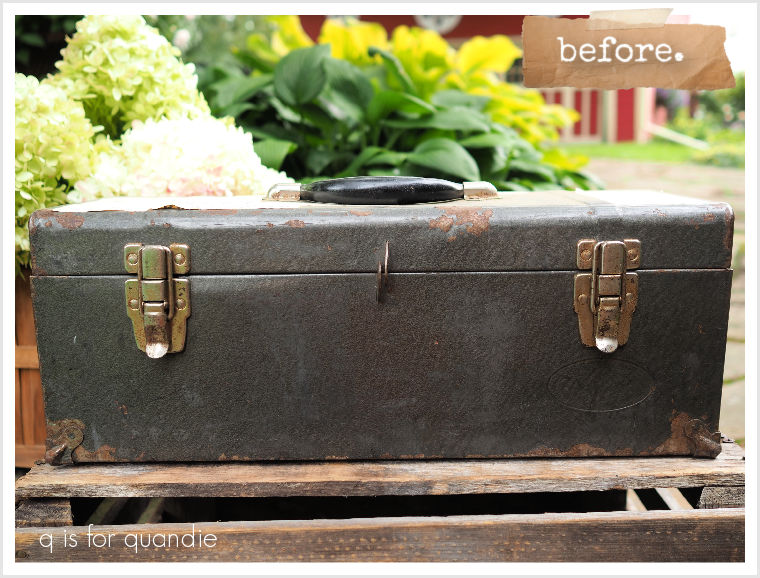
But I made it!  And now I can share, so let’s start with the ‘before’ of this toolbox.

It was pretty basic, in good shape but a very drab color.

After my usual prep of cleaning it well, lightly scuff sanding it and giving it a base coat of Dixie Belle’s Bonding Boss, I painted the interior in DB’s Blue Grass.

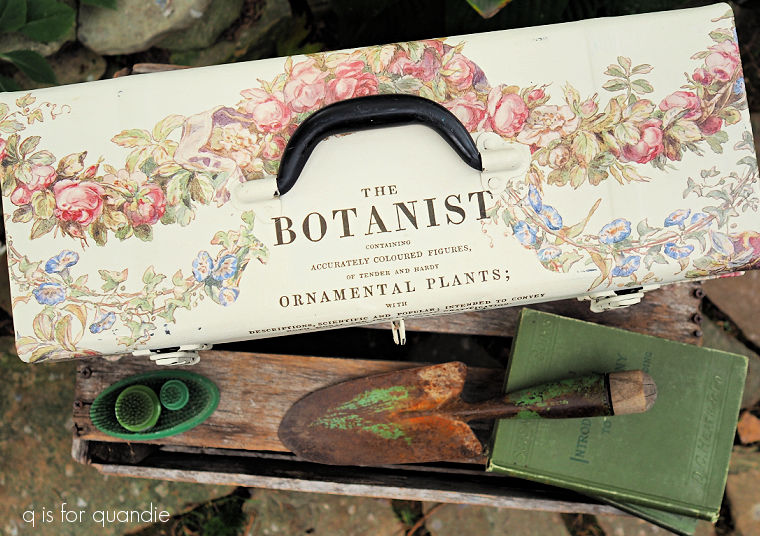
Then I painted the outside in the new Countryside Collection color called Oxford Fog.

I just knew these two colors would pair up beautifully.

They are two different styles of paint.  The Silk paint is a water based all-in-one acrylic paint with a built in primer and top coat.  On the other hand, the Blue Grass is from DB’s line of chalk style paints.  Chalk paint doesn’t always require a primer, but I like to add additional protection from bleed-thru with the Bonding Boss when painting over rusty metal with both styles of paint.  In addition, for durability the chalk paint should be top-coated with hemp oil, wax, or a clear water based sealer.  I used Dixie Belle’s flat clear coat to seal the interior of the toolbox.  Furthermore, although the Silk paint doesn’t require a topcoat, the transfer does.  So I finished off the outside of the toolbox with some of Dixie Belle’s clear wax.

While technically you could mix these two paints together since they are both water based, I’m not sure I would recommend that.   However, you certainly can use both on the same project like I’ve done with this toolbox.

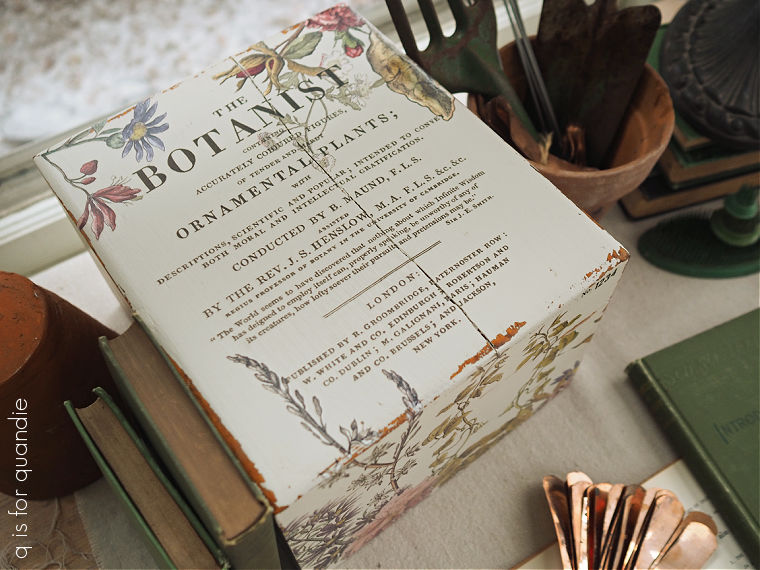
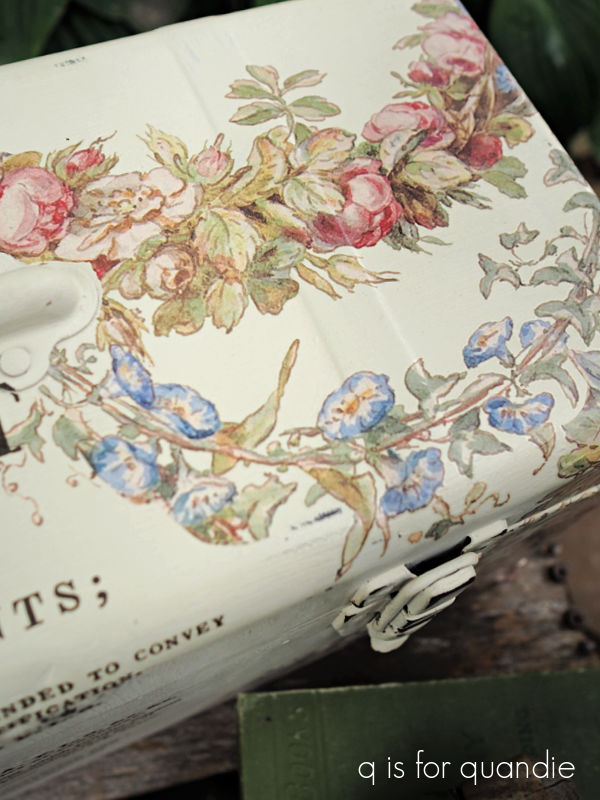
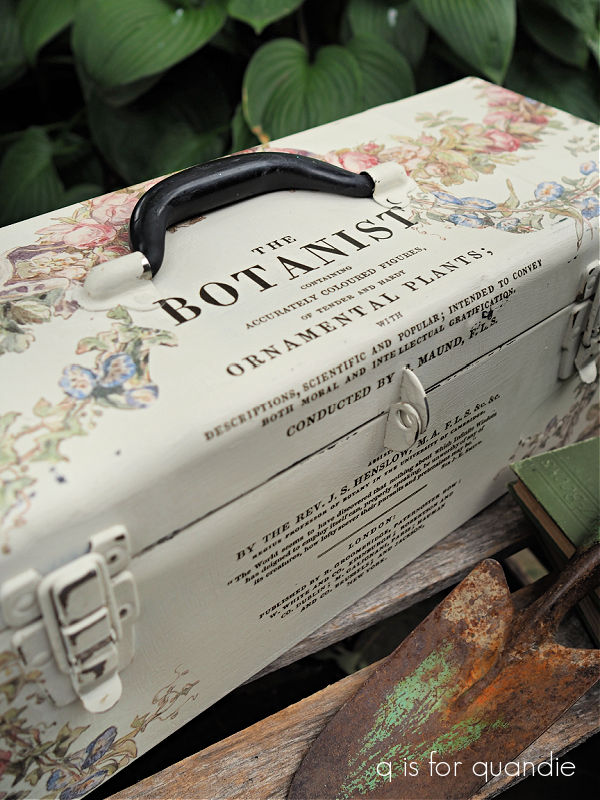
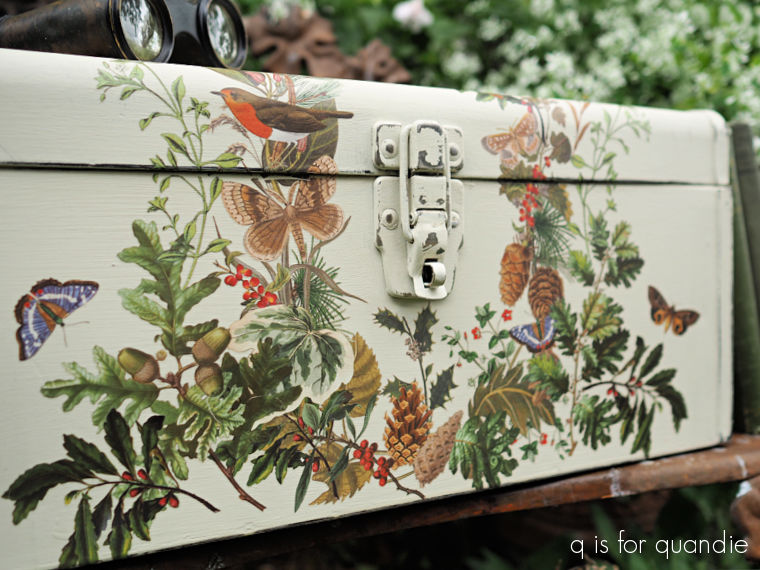
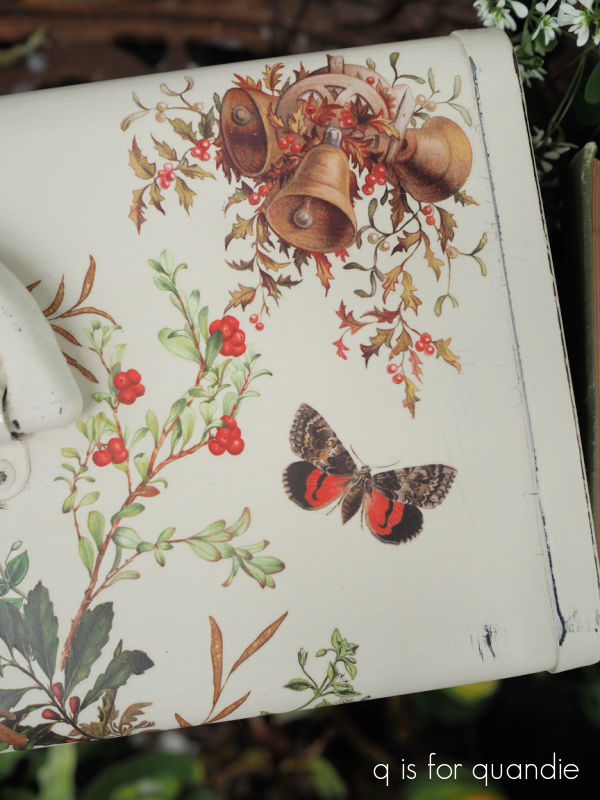
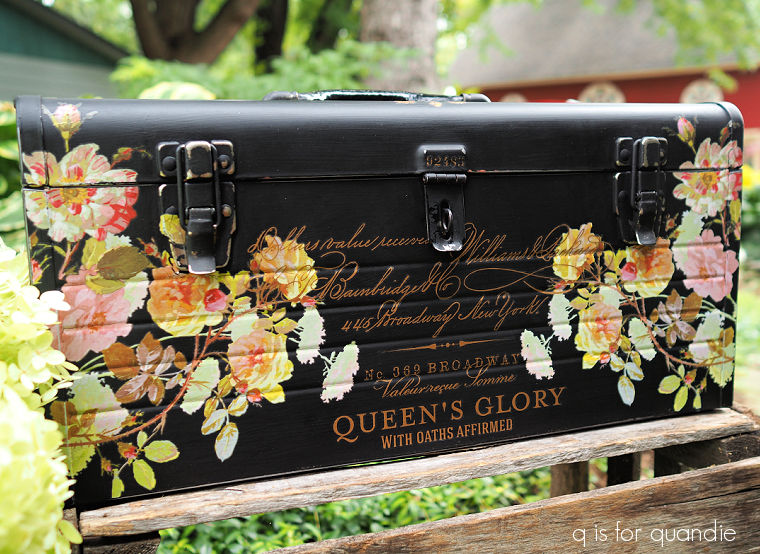
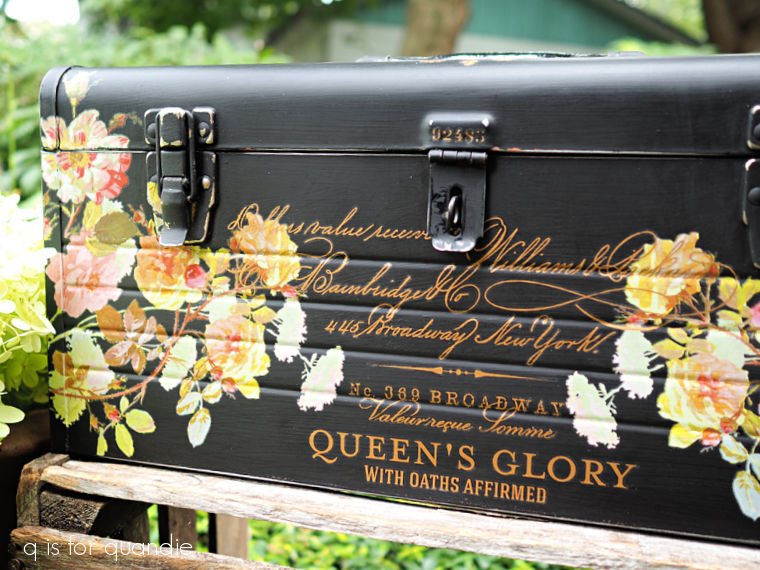
Once my paint was dry, I added some florals from the I.O.D. Saint Germain transfer.

Gosh those florals are gorgeous, aren’t they?

I wrapped them around the sides …

and up over the top.

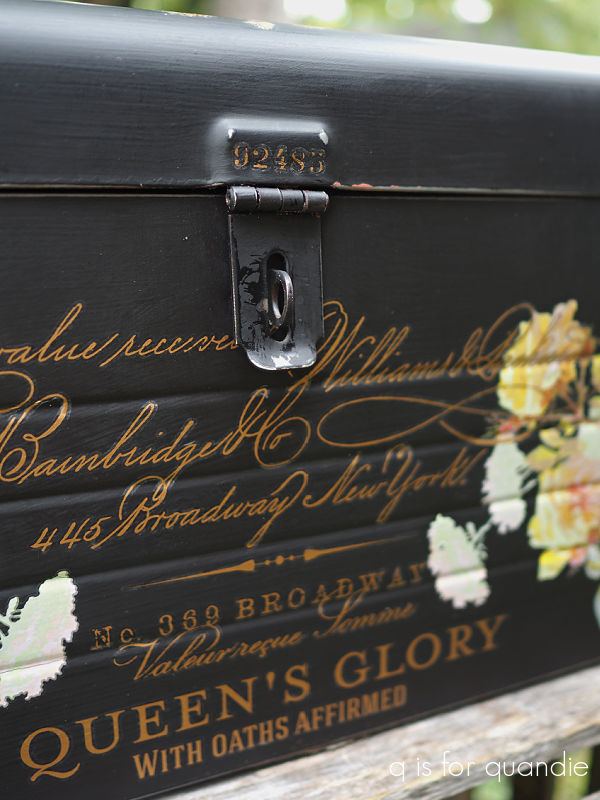
Next up I pulled out my precious stash of I.O.D. Label Ephemera transfers.  For those who aren’t familiar, I call them ‘precious’ because this transfer was retired several years ago and is very hard to find now.  I have a steadily dwindling stash of them, but unfortunately it’s not going to last forever.

Anyway, I chose some sections of text from Label Ephemera and applied them next.

I followed that up with that coat of clear wax that I mentioned earlier.

I staged my photos of the toolbox in the shade garden, but I also placed a couple of watering can flower arrangements behind it for added color.

I think the Quick Fire Fab hydrangea, hosta flowers and some verbena bonariensis made a pretty combo.

With fall just around the corner, followed closely by Christmas (I know, way too early, but they will be here before we know it), I’m wondering if I need to lay off the florals for a while.

Or do you think florals can be used year ’round?  Leave a comment and let me know.

Meanwhile, this toolbox is for sale.  Check out my ‘available for local sale‘ page for more details (sorry, I don’t ship my items).

Thank you to Dixie Belle Paint Co for providing the beautiful new Oxford Fog and Blue Grass paints used for this makeover.

the truffle bar stools.

This summer I’ve been trying to make an effort to go through things that have been stored upstairs in the carriage house for too long.

I’ll be honest, I haven’t made much headway.  Somehow there’s always something more fun to do.

However, I did manage to drag this set of three bar stools down the stairs and into my workshop a few weeks back.

I don’t remember exactly when I purchased these, except that it was before I was retired.  So … yeah … at least 4 years ago.  I seriously considered putting them at the curb with a free sign on them.  But then I thought, no, just bite the bullet and paint them.

I originally planned to paint them black, and then add a Swiss cross to the seats like the stool I painted a few weeks back.  To that end, after cleaning them up, I gave them each a coat of Rust-Oleum’s spray black primer.  I even got so far as to paint the first chair in Dixie Belle’s Midnight Sky.

But I just didn’t love how the stool looked in black.  Then a little voice in my head said ‘hey, why not try out one of the new Dixie Belle Silk All-In-One paint colors instead?’

I picked Truffle because it’s a lovely, rich neutral.

The Silk line of paint has a built in primer and top coat, so technically I didn’t need to prime these bar stools.  But it was already done, and I’m not mad about it.  These stools had that shiny factory finish look to them, so a little extra primer just made it that much easier for the Silk paint to stick.

Each chair got two coats of the Truffle.

Then, inspiration struck.  I saw a post on Iron Orchid Design’s Instagram showing a set of cutting boards that were painted by Jonathon Marc Mendes.  If you haven’t ever seen his work, you should check out his Instagram account,  I really admire his style.

You might be wondering how a trio of cutting boards could inspire a set of barstools.

But it was the way he used the I.O.D. Gregory’s Catalogue paint inlay that caught my eye.  He just used parts of it rather than using the entire design.  And I happened to have that particular paint inlay on hand, so I thought why not try this look on the barstool seats.

So that’s what I did.

FYI, the paint inlay worked perfectly with the Silk paint (which is an acrylic paint).  One tip I’ve read is to not wait too long to remove the inlay’s paper backing.  Unlike chalk paint, acrylic paint is not reactivated with water and may not release the paper backing of the paint inlay as easily if left too long.  After applying the inlay into wet paint, I let it dry for about 30 minutes before wetting the paper back down and peeling off the backing (for full paint inlay instructions, head to this post).

After spraying the seats of the chairs with Rust-Oleum matte spray sealer to keep the inlay from smearing, I then sanded the edges of the chairs to distress them.

Finally, I decided I wanted to add just a little more depth to the Truffle color with dark wax.  So I blended some of Dixie Belle’s Brown wax with some of their Big Mama’s Butta.  The addition of the Butta helps the wax go on more evenly, and makes it easier to blend.  It also mellows the look of the brown wax a bit.

Here’s a look at the difference between a stool with the wax (on left), and one without (on right).

So even though the Silk paint doesn’t require a top coat, you absolutely can add one for aesthetic reasons like I’ve done here.  That brown wax really added some depth to the Truffle paint.

I realize that the look of the partial typography on each stool is not going to be everyone’s cup of tea, but I think it’s pretty fun.

What do you think?

This trio of bar stools is for sale locally, so check out my ‘available for local sale‘ page for more info if interested.

Thank you to Dixie Belle for providing their products used in today’s makeover.

made in the shade.

Good morning from the garden.

This morning I thought I’d share a quick tour of the mid-August shade garden.

This shade garden runs between the house and the driveway.  It is just a basic rectangle without any fancy curves or anything, but I consider it my favorite of all my garden beds.

It’s also the one that is most visible from inside the house, so on rainy weekends like this one I can still enjoy the garden.

It contains some of the most well-established plants that I have, especially since the Hosta albomarginata was here when we bought our house 37 years ago.

It’s the hosta in the foreground of this photo …

I consider it one of the old standby traditional hostas that every foundation planting had 40 years ago.  It’s a basic green with white margins, and it’s probably … no … definitely my least favorite hosta in the garden.  That being said, it’s also a tremendous workhorse.  I’ve divided mine so many times over the years that I now have dozens of them, and they are huge.  So removing them and replacing them would be quite the project.

Sadly, it’s also the most susceptible to both hail damage and insect damage because the foliage is not as sturdy as some of the newer varieties.  However, so far this summer we haven’t had any hail (knock on wood), and I’ve been using Sluggo Plus to take care of the slugs and earwigs and that’s working really well.

I just discovered Sluggo Plus this year (ordered from Amazon).  I used to use the regular Sluggo which contains iron phosphate, which is effective against slugs and snails.  Sluggo Plus, contains both iron phosphate and spinosad, a natural insecticide which is effective against earwigs and pill bugs.  Last summer was pretty wet and the earwigs did lots of damage to my hostas, so I wanted to stay on top of that problem this year and it’s lucky I did because this summer continues to be fairly wet as well.

It’s nice to have hostas that still look good in mid-August.

That bright green hosta is Sun Power, and it just glows in the shade.

Another of my favorites is Lakeside Dragonfly (center front below).

It’s perfect for the front of a shady garden bed.

I’m still finding plenty of jumping worms in my garden, and I can tell that they have had an impact on the texture of my soil, especially in the shade garden.  The top couple of inches of soil look very granular, and it dries out quickly.  Fortunately we’ve had plenty of rain this summer, but I’m keeping a close eye on the garden and watering regularly if it gets too dry.  I’m also adding nutrients in the form of both bagged compost and Espoma’s Plant Tone.  There is conflicting info out there on whether or not using an organic fertilizer makes the problem worse by also feeding the worms, but I can’t find any better suggestions for keeping my plants well fed.

I would say that my well established perennials are doing just fine despite the worms, including my Japanese painted fern.

The annuals that I planted this year don’t seem to be struggling either.  Some of you may remember that I filled in some empty spots with Impatiens.

They filled in quite nicely and add a bright pop of color to my otherwise mostly green garden.  The bright pink of the Lipstick impatiens is pretty, but it isn’t really my vibe though.

Perhaps next year I will use the Apple Blossom double impatiens instead.

They are looking quite lovely in my planters and are more in line with my personal aesthetic.

In the spring I mentioned that one section of my shade garden had completely died out over the winter including my Aralia cordata ‘Sun King’.

  I replaced the aralia with one I purchased at Home Depot, and also added in a couple of new hostas, bleeding heart and astilbe.

They are all doing well, and the astilbe is blooming for a 2nd time!

This is Astilbe Younique Ruby Red and everything I’ve found online says this plant does not rebloom so I don’t know what to make of it.

The Fairy Candles (or Black Cohosh, but seriously, isn’t Fairy Candles a way better name?) that I got from my friend Jackie are doing great growing around Cossetta’s feet.

Cossetta is the statue that I purchased at a garage sale that was right behind Cossettas Italian restaurant in St. Paul.  That was such an amazing find.  I never seem to find things like this at garage sales anymore, what a bummer.

But anyway, the Fairy Candles are done blooming now, but here’s how they looked in bloom a few weeks ago.

And with that I’ll bring this tour of the shade garden to a close.

I hope you enjoyed seeing my shade garden and that it inspired you in some way.  Leave a comment and let me know what your favorite element is in this garden!

all that glitters.

A few weeks back my friend Jackie gave me some toolboxes.

Well, I’m collectively calling them toolboxes, but really there were a couple of toolboxes, a tackle box and even a lunchbox.

The outside of the lunchbox was black, and when I opened it up I found that the inside was a shiny gold.  So with that combo in mind, I decided to take some inspiration from the books that I recently painted …

After giving it a good wash, I touched up the interior color with a fresh coat of Rust-Oleum Metallic Gold spray paint.

Then I freshened up the exterior with a coat of Dixie Belle’s Caviar.  Once dry, I pulled out the I.O.D. Wilde Bloemen transfers and started adding florals to the front of the lunchbox.

Once those were all in place, I added some gold typography from the I.O.D. Étiquettes transfer.

To play up the gold a bit more, I used some of Dixie Belle’s Gilding Wax in Gold on the latches (after having painted them with Caviar along with the rest of the lunchbox).

I followed all of that up with some of DB’s Big Mama’s Butta as a top coat.  I found that the Big Mama’s started removing a bit of that Gilding Wax though.  I’m not sure if that was because I didn’t wait long enough for the Gilding Wax to harden, or if the Butta and Gilding Wax aren’t compatible.  To be on the safe side, perhaps adding Gilding Wax last would be the way to go in the future.

Either way, the problem would be easy enough to solve by adding more Gilding Wax to the latches.  But I think I kind of like the worn look that resulted so I’m leaving them this way.

They say that all that glitters is not gold, but in this case it is … well, shiny metallic gold anyway.

What do you think?  Leave a comment and let me know.
mini garden furniture.

Aside from the fairy garden, I haven’t spent any time working on miniatures this summer.

The plan was to work on the porches and the garden of my dollhouse, but I think I’ve realized that mini’s are going to be more of a winter thing for me.

That being said, I have been accumulating stuff for the dollhouse porches.

I purchased this unfinished patio set at Hobby Lobby sometime last year.

When I had my milk paint out for another project recently, I decided to go ahead and paint these up at the same time.

I began by giving all four pieces a base coat of Dixie Belle’s Coffee Bean so that I would have something to distress my final coat of milk paint back to other than raw wood.

Next I mixed up some Sweet Pickens Milk Paint in a color called Pantry Door.  I had a sample packet that I purchased from The Painted Heirloom for $7.  The little sample packets work great for painting miniatures, and it’s a fun way to try out new colors.

After applying two coats of the milk paint, I sanded the pieces with 220 grit sandpaper to distress them.  I tried to only sand back to that darker Coffee Bean layer, and I mostly succeeded.

Of course, there are also some spots where I went too far.

But that’s OK, I still love how they turned out.

I staged them out in the fairy garden.

But I didn’t put any sort of top coat over the milk paint, so they definitely wouldn’t really hold up outside.  They’ll be fine on the porch of the dollhouse though, when I get to it.

Speaking of the fairy garden, I was out there doing a little pruning the other day and was amazed at how much some of the plants have taken off.

Remember the miniature hostas that I purchased at a garage sale back in June?

Here’s the Pandora’s Box in June when I planted it …

And here is it now.

And, in fact, I even divided this one initially breaking up the one plant I purchased into two plants.  Here’s the 2nd one …

This is one of the things I love about planting divisions from someone v. a new plant from a nursery.  They usually have a very established root system and the plant will fill out much more quickly.

Sadly, now that I have jumping worms in my garden, I can no longer easily share my own plants in this way.  Granted, I could share them if I carefully washed off all of the dirt that could contain jumping worm cocoons.  But personally, I’d rather not take the chance of giving others jumping worms.

That being said, I already have jumping worms so I’m not so concerned about bringing them in on garage sale plants.  Maybe that’s a mistake, I don’t know.  Bottom line; don’t risk it in your garden.  Do as I say, not as I do.

But I digress, this post was supposed to be about miniature patio furniture.

Coming soon I’ll share the bistro set that I painted up for the porch, I can’t share it quite yet because I used a new color from the Dixie Belle Silk paint line.  I have to wait for the official reveal before I can share that with you.  But stay tuned, because this color is quickly becoming my new favorite!

early bloomers.

Good morning from the garden.

Well, we’ve had some exciting times in the garden lately.  We had severe thunderstorms blow through, two nights in a row a week or two ago.

We survived the first storm with just a few small branches strewn about, but the second one took down a sizeable limb from our neighbor Ken’s remaining tree.

If you’ve been following me for long, you’ll remember that Ken had a very large tree in his backyard cut down last year because he was worried it would come down in a storm.

They cut it into sections and then lifted it out (right over the top of our house) using a crane.

At the time he also had some deadwood cut out of his remaining smaller tree.

So in an ironic turn of events, he lost a big branch from that smaller tree in the 2nd storm.

And of course, the branch fell right onto the new hydrangea hedge that I planted last summer after Ken had that larger tree removed.

Fortunately it didn’t really do any damage.

The hydrangeas bounced right back.

These are Quick Fire Fab hydrangeas.  So far my hedge is only about 3′ tall, and according to Proven Winners they will max out at 6′ to 8′.  However, they also say that about Limelight hydrangeas and my Limelights are easily 10′ tall or more.  So I’m hoping to end up with a tall hedge here.

The Quick Fire Fab are the earliest to bloom of the panicle hydrangeas.  The flowers start out white (as you can see in the photo with the branch on them), and then slowly go from white to pale pink to bright pink to deep red by fall.

I think the color they are right now is my favorite.

In comparison, Limelight hydrangeas are the latest of the panicle hydrangeas to bloom.  The flowers on mine are only just barely starting to open up.

And they are still the pretty lime color that gives them their name.  They will gradually fade to white, and then start to turn a pretty coppery sort of pink for fall.

I absolutely love the Limelight hydrangea, but when I was deciding what hydrangea to use for my new hedge last year I thought it would be nice to have a hydrangea that blooms a few weeks earlier to extend hydrangea season.

For those of us who garden in a cold climate (I’m in a suburb of St. Paul, MN, zone 4b to 5a), a panicle hydrangea is definitely the way to go.  So far I have found them to be pretty much impervious to a cold winter.  As I’ve mentioned before, our last winter was pretty hard on plants.  We had some days with temps well below zero, but hardly any snow.  We need that snow to protect the plants that are in the ground.  I lost quite a few things in my gardens, but the new hydrangeas came through with flying colors even though I had only planted them in August.

I wish we could get those gorgeously vibrant macrophylla hydrangeas to bloom reliably here.  You know, the ones that are bright pink …

Or blue …

But I’ve never had any luck with them, including the Endless Summer varieties (I took the two photos above at Longwood Gardens in Pennsylvania).

I’ll just have to settle for the more subtle look of the panicle hydrangeas in my garden.

Earlier this week I decided to try a bit of an experiment to see how well the Quick Fire Fab hydrangeas will hold their color when dried.

So I cut a few and popped them into a bucket with about 2″ of water at the bottom.

Next I’ll put them in a cool, dark, dry location and let them dry out.

It’s possible that it’s too early to successfully dry these, I usually wait until the flowers have started drying out just a bit on their own before cutting them to dry the rest of the way.  But these Quick Fire Fabs will have turned red by then (and of course, I’ll also dry some then), so I hope I can preserve some in this pretty blush pink.

If you’re a fan of dried hydrangeas, you may want to go back and check out my post on how to make a dried hydrangea wreath.

Or for more details on drying hydrangeas, check out this post.

Are you able to grow hydrangeas where you are?  If so, which ones are your favorites?

Leave a comment and let me know.